← Take Command: A Leadership Podcast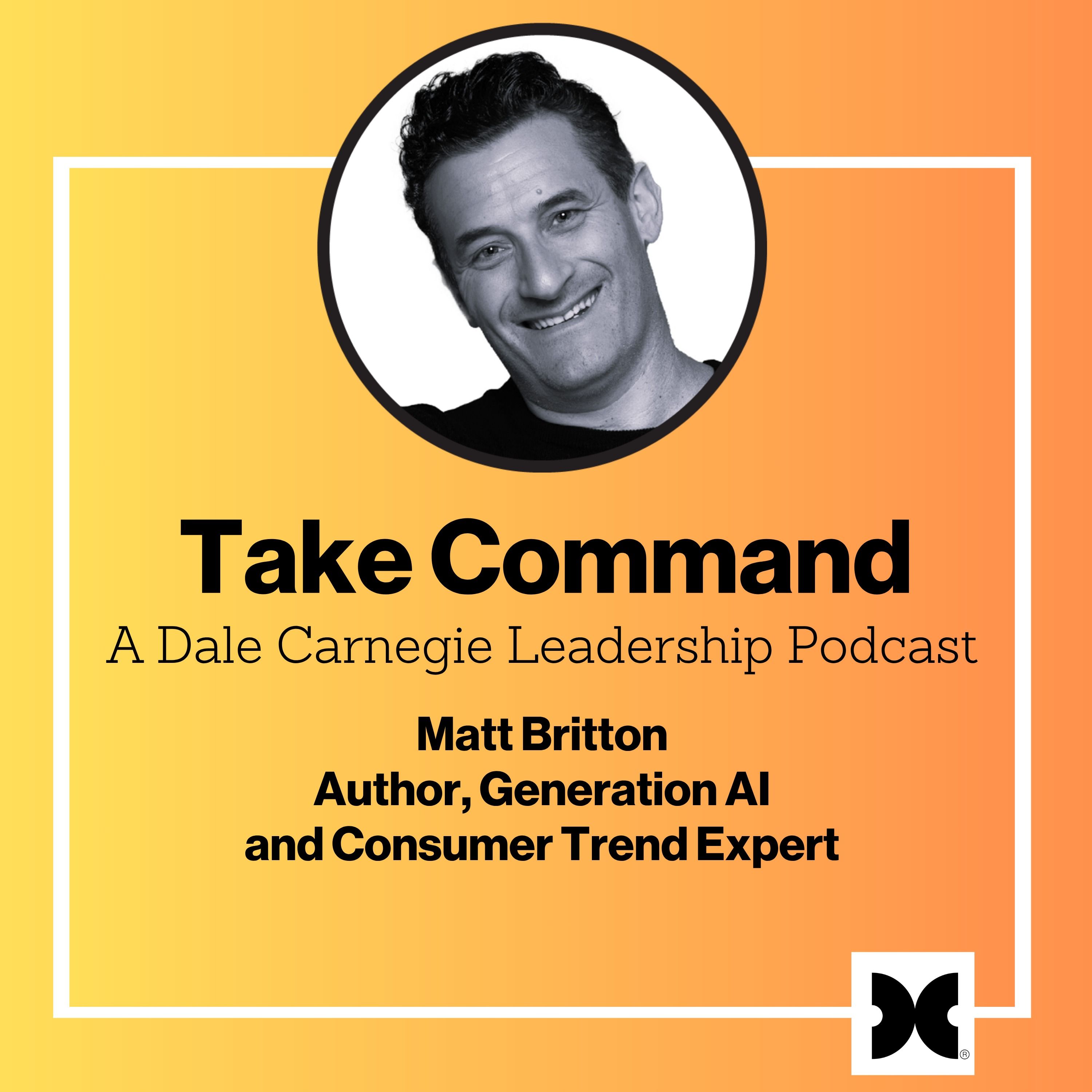
Take Command: A Leadership Podcast
Generation AI: Why People Skills Are the Ultimate Competitive Advantage
00:37:32
Matt Britton is a trailblazer who’s made a career out of understanding what’s next—especially when it comes to youth culture, digital behavior, and the future of brands. He believes, “Culture moves faster than companies can keep up. If you want to lead, you have to stop reacting and start anticipating.” In this episode, Matt breaks down what it takes to stay relevant in a world of constant disruption. He dives into generational shifts, how AI and automation are changing consumer expectations, and why Gen Z is rewriting the rules of brand loyalty. Matt encourages leaders to stop looking backward and start building for what’s coming. “It needs leaders who are willing to reinvent before they’re forced to.” He says.
Loading summary
Transcript54 lines
- [00:00]
Matt Britton
I think what Dale Carnegie has done a great job at throughout its history is really the core leadership skills on whether it's public speaking or sales acumen, et cetera. And now the workforce is in need for a whole new realm of development and skill set development. And what I hope to bring is my experience running an AI powered startup in Suzy, all the research I've done in writing my book Generation AI and all my daily countless hours of hands on experience building an AI and combine that with what Dale Carnegie has done so very well over time and create a completely new different type of education curriculum that I think is so very in need right now for all workers. And I think the risk right now is if people don't upskill, if they don't look at themselves in the mirror and ask themselves the question, does my skill set align to where the world's going? It's going to be a tough road ahead.
- [01:01]
Joe Hart
Welcome to Take Command, a Dale Carnegie podcast. I'm Joe Hart, CEO of Dale Carnegie and if you don't want to miss a moment of transformation, follow Take command now and unlock the power of leadership with every episode. Today's guest is at the forefront of understanding the modern consumer. As the founder of a leading AI powered platform, he shares how embracing technology and human adaptability can unlock new levels of competitive edge in an ever evolving business landscape. He's been a trusted advisor to more than half of the Fortune 500 and has delivered over 500 keynotes worldwide from CES to private events for Nike and Google. He's the New York Times best selling author of Youth Nation and his latest book explores how emerging technology is is reshaping consumer behavior. Please welcome author of Generation AI and consumer trend expert, Matt Britton. Matt, welcome to the Dale Carnegie Take man podcast.
- [02:08]
Matt Britton
Joe, thanks so much for having me. Big fan.
- [02:11]
Joe Hart
Well, thank you. I'm a big fan of yours as well. And it's really been fun getting to know you really over the last couple months. We met at the CNBC CEO forum in Arizona. You were one of the keynote speakers. I'm excited to talk about your book Generation AI, which I bought a bunch of these to give these to people. Great, insightful book and excited to talk about a partnership that you and Dale Carnegie that we have and a really exciting product. We'll share that a little bit. You're an expert on AI, you've written about it, you talk about it, you consult on it. We'll definitely want to get to that. And your insights on what people really need to do to be relevant and to leverage this amazing technology. Tell us about you, Matt. How did you get started in business? What are some of the key things that would be interesting to our audience?
- [02:53]
Matt Britton
So my start in business dates back to my colleges at Boston University. I didn't really know what I wanted to do or who I was, as many people are when they first go to college. And a guy I knew was handing out flyers to promote a party to people who were leaving a bar. And I was like, hey, what are you doing? He's like, well, I get paid to hand out these flyers, and if people show up with my flyer, I get, you know, a piece of the action. I was like, would you mind if I work for you? And he gave me flyers. I remember holding so many, I had to hold them together between my cheek and my shoulder. I was handing them out to people. And then when I showed up at the event, I was promoting and I saw people there. Something, like, clicked in me that, wow, like, what I'm doing can dictate where people spend their time. And that kind of became intoxicating to me. And I ended up building a little bit of an empire during college of a nightclub promotions business. I was never really a big drinker, a big party guy, but I just loved the whole notion of understanding what college kids love and trying to give them a product that meets their needs. And over time, I was running 20 to 25 events a month targeting all the college students throughout Boston. And then what started to happen is a lot of local businesses asked me, can we sponsor your party? Can we put our logo on your flyers? Can we put a banner up inside the nightclub or set up a table and start to work with a lot of local businesses? And that ended up spinning off an agency, a local marketing agency I started called the Magma Group. And at that time, it was at the beginning of the dot com boom. So this is 1999, 2000. And after I graduated, I. I made the decision, I'm going to take advantage of this time and get my piece of the Internet gold rush. So I started sending out these mailers to Amazon.com right when they started, I created a diorama with, like, leaves in it. It was probably so terrible looking if you looked at today, but just trying to get people's attention. And my offering them was the same thing I had done in Boston. Have a network of promoters, college kids to promote. I can do that for brands and build a business up to about $5 million in revenue. And then, of course, the dot com bubble burst. I didn't know, there's a thing called accounts receivable risk, and I had to sell the business, but really it was just getting someone to bail me out. But that was sort of my 101, so to speak, in business.
- [04:58]
Joe Hart
You know, it's interesting, though. A lot of times you look at starting a business took off. Maybe it didn't end the way you wanted it to.
- [05:05]
Matt Britton
Right.
- [05:05]
Joe Hart
But at the same time that learning that you had, it was almost like that was part of the education to lay the foundation for all the things that's right. Including the things you're working on today.
- [05:15]
Matt Britton
And I wrote about this whole thing in my book. I specifically remember, you know, there was a big press release that our company had gotten acquired, and friends were, like, thanking me, but, like, they basically just gave me a signing bonus to get to New York. So I was still in Boston. And I remember I used my whole signing bonus for the down payment on the apartment I was renting in Manhattan. I really didn't have any money to my name, and I had to use a bunch of change that I had in a, you know, a jar to a coin machine to get enough money to eat at McDonald's on 28th and Broadway. I remember it like it was yesterday. And I remember just. It was like I got punched in the face, but I needed it. It was the best lesson I could learn about business. But the great thing about that is I was able to fail generally in private. It was before social media. I didn't have to worry about. People were commenting on Instagram. And I think people today, younger people, are faced with a completely different reality because they see what everybody else is doing, and obviously everyone's only sharing their highlight reels of life. They're comparing them against everyone else, and it's taking away their patience, and it's making them want to get it all right now. They don't want to be punched in the face. They don't want to learn. And I think it's creating really, like, an expectation epidemic, if you will, amongst young people, where you and I both know it takes time. You need your lumps. You need to learn before you can capture success. And speaking for myself, I still don't feel like I'm successful. It's a lifelong journey, and the enjoyment really is in the journey, not the destination.
- [06:40]
Joe Hart
Well, it's interesting, too. I'd say there's a common theme for all the CEOs and great leaders I've interviewed in the show. So many of them have talked about the humility that they've had along the way. You know, everyone looks at the outside, they say, oh, you know, Matt, you're running a $100 million business. Or Matt, you know, you've got these different things going. Or, Joe, you're doing this. But the reality is it's up and down and back and forth in those private moments that sometimes no one else sees you question yourself and so forth. But it really is about our own resilience and kind of developing that inner strength to be able to have the context to keep moving forward.
- [07:11]
Matt Britton
Yeah, I think about that as a parent, too. Right. So many parents these days, they helicopter over their kids. They don't let them fail, they don't let them scrape their knees, and then by the time they go out to college, they don't know how to deal with failure. Right. And I think it's so important, you know, not to hover on them and let them go through their own journey, because you can't control what's going to happen in your life. And you have to learn how to have resilience, how to deal with things, learn from them and move on, because we're all going to have things that happen to us that are unexpected.
- [07:40]
Joe Hart
In your book, you talk about parenting. In many ways, your book, I think it's for business leaders. It's also for this younger generation and how they can thrive in what will be a really rapidly changing environment, one maybe like none of us have ever experienced before, before we get to that between kind of that experience. You're in New York, you're kind of struggling. How did you get from there to here?
- [08:01]
Matt Britton
So a company bailed us out. One lesson there is, like, always make relationships with people because you never know where things are going to lead. And I had made a relationship with somebody at a larger publicly traded company in my space that was also marketing to younger consumers. And, you know, they assumed our debt and they gave me a signing bonus. Got to New York, I worked for them for a couple of years, and there I learned how to deal with larger customers like more established companies like Procter and Gamble and Coca Cola, who were their clients. I had only sold to dot com startups and I didn't know how the real corporate business world worked. And one day I saw a bunch of people with suits walking in and I caught wind that the company I was working for was about to get acquired. And another, like, light bulb went off my head that I'll never forget, which is, like, now I'm going to work for this other company and I have no say in it, and that's not okay for me. And at that point, I knew I wanted to be an entrepreneur, and I was willing to take the risk and all the heartache and the ups and downs, which we can talk about in being an entrepreneur, to basically leave what at that point was a really good salary in New York. I was probably 23, 24 years old, and start on my own. I did my Jerry Maguire moment where I called a bunch of clients. I was like, who's coming with me? And Red Bull was one of the clients that came with me. And they gave me a $75,000 contract, and it was enough to get started. And I started a business called Mr. Youth and I started in 2004 that over time would be rebranded as MRY, which was the first ever social media marketing agency. So an ad agency that's specifically built to help companies understand how to use social media. And we created the social media practice for Microsoft and for Procter and Gamble and for Visa. I personally registered at Visa on Twitter for Visa to show you, like, how early days this was and right place, right time, great tailwinds. Ended up building the company to about 500 people. I was acquired in 2011 by a multinational holding company called the Publicist Group. And that's sort of the path and obviously lots of ups and downs in between to our point earlier. But that's kind of how I was able to capture some level of success in the business world.
- [09:56]
Joe Hart
What advice would you have, Matt? You make it sound like, hey, you know, I was. At this point, I decided I wanted to be an entrepreneur. I mean, that's still a scary decision at that point. You got costs, you think about your future and so forth. Some people in that role might have said, I got to find another job or I got to find something that's going to give me a paycheck and get a W2 exactly at the end of the year. I'm curious about how you face that decision. What advice you might have for people who are in these moments where they're afraid. What insight might you share about making a decision that might be a tough one, but a good one for them long term?
- [10:26]
Matt Britton
Well, at that point, I didn't have kids. I wasn't married. You know, I didn't have a mortgage. I think it's a lot easier when you're younger than somebody who has two kids. One's about to go to college, you have an expensive mortgage, and you're expected to go on your own. You have too many obligations. So I think it doesn't mean that you can't start something new when you're at a different place in life. But you have to have a certain level of financial security if you have obligations to do so. So I think that's 1, 2. I did hedge a little bit. Like I was able to build relationships and I had a couple of clients say, if you start something new, I'll be your first customer. And knowing I had that in the bag I think made it a little bit easier. What I didn't have at that point was like a co working space to work out of. I worked out of my bed. We didn't have all these incredible cloud based tools, let alone AI back then. So I had to be a little bit more creative in terms of how you start a company because at that point people were still having data hosted on servers in their offices. But you learn along the way. Ultimately you have to be willing to bet on yourself and you have to be willing to go through the ups and downs of being an entrepreneur. Because I face many existential moments throughout my career. Even my business, Mr. Youth, which became MRI and make it sound so great. But in 2008, during the Great financial crisis like bitcoins like Johnson Johnson were sitting on their payables to us and there came a time where we couldn't make payroll and I had to put it on my American Express card and Amex found out about it and they banned me for two years. I basically charged the American Express card with my company. So my company get revenue to essentially pay my employees. And you're not allowed to do that. You have to know that it's not going to be easy and you have to have your eye on the prize long term and know that there's going to be so many ups and downs along the way.
- [12:11]
Joe Hart
Yeah, it seems like that's the right way to look at it. Right. If we define failure as I tried to do something and it didn't work. We're always going to hold ourselves back from things. But if you know that whatever happens, I'm going to learn and you invest in yourself like you said. I mean, I think about my sort of my first company. I left a very secure job with a mortgage and two children at home under two as a sole bread winner. That was terrifying. I'm sure without the full support of my wife, it never would have worked.
- [12:36]
Matt Britton
And you also can't be worried about what people think. I think in this world, with younger people, you grow up in the world where you get validation from how many people like an Instagram post. And that causes people to hesitate to start a blog or put themselves out there and build their brand because they don't want people to talk badly about them. And you really can't care. You have to know that your real friends are going to be rooting for you no matter what. And ultimately the only people who really will fight through thick and thin for you is your family. And you just have to put yourself out there and not worry if you really want to do it. But if you're doing this to get validation from other people, it's probably not going to work. And I would even argue, even if you're doing it just to chase the money, it might not work. Because you know you're going to have times where the money's good and times when money's bad. You really have to have passion about the problem you're trying to solve. The best entrepreneurs are ones who really are fervent and passionate about the problem they're solving for the end user. And if you have that passion, it doesn't feel like work. And then all the other pain becomes a little bit easier to swallow.
- [13:37]
Joe Hart
100% passion. If you have that strong enough, why, you can get through almost anything. And probably if you don't have a strong enough why, then even a great situation becomes tenuous. So how did you go from you're an expert in AI, you're sought after all over the world. You're speaking, you're on NBC last week and you've written this book. AI as we know, has been in development for decades, but really coming to the fore in the past few years. How did you get to be an expert on AI and bring us up to speed on that?
- [14:04]
Matt Britton
Yeah, so I mean, the common thread throughout my career is I've been passionate about understanding the new consumer and helping brands try to understand what it means for their business. So the new consumers evolved over time. At first it was the millennial, that was the Internet generation. And I essential with my first business, help companies understand teens and college students and how to reach them through digital media. Then it became Gen Z and that is really the iPhone and in many ways the social media generation. And that's when I pivoted my business from Mr. Youth to MRY to help people understand Gen Z. And now we're entering a completely new phase, arguably much more prominent, and it's going to have much more staying power and seismic shift on society, which is AI and is going to be brought in by Gen Alpha, who right now is age 0 to 15 years old. So that's been the passion throughout my career. And my last book was written almost exactly 10 years prior to Generation AI, and that was called Youth Nation. And that was about the concept that for the first time ever, because of social media, because of the iPhone, youth culture was no longer counterculture. Before social media, if young people wanted a voice, they would have to almost protest. Like you see, like Woodstock or people going in town squares that have a voice. The only media that would be consumed was things that corporate America pushed out there, right? Whatever Clear Channel put on heavy rotation or whatever. They would talk about the Ed Sullivan show that dictated culture. But now with social media, young people can dictate culture. So it's a big shift, which is why I called the book Youth Nation. And it was profound and it really got me going in terms of the future possibilities of business. The same thing happened recently with AI. I run a software company called Suzy. And when I first became, to your point, accessible to the mainstream, I was kind of fascinated by it. And the deeper and deeper I dug, it dawned on me like, this is really going to impact so much more than business. It's going to impact society and culture and parenting and education. And that's what kind of became the catalyst for me to write the book. How I got to be an expert is I've always done the work. You see a lot of people out there that go on stage and use big buzzwords. I think what I like to do, believe is my differentiator is I do the work, meaning I build an AI. I know how to actually code and build an AI. When I talked about social media, I bought some of the first ever ads that ever existed on Facebook. So I've always been hands on keyboard, been fascinating, with a love for the technology, for the tools. And that way, when I go on stage or I talk to customers about these technologies, I can talk to them with a real source of authority and knowledge versus just being in an echo chamber in terms of what I read in the trades.
- [16:39]
Joe Hart
Well, one of the things I appreciate about you, Matt, and you certainly you're clear about this in your book and in your speaking, is that this technology and the ability to use it to transform our work and our lives is accessible to people. I mean, many times people who are consultants want something to say, you need me to do this. And there's a layer of complexity here. But in your book, you talk about how you built a healthbot, for example, how you created in ChatGPT your own confidential AI chatbot that you could load up your personal medical content into and basically get a breakdown on your mortality risks.
- [17:14]
Matt Britton
That's exactly.
- [17:14]
Joe Hart
I know we're going to talk about. We're at a point right now we've all got to take command. This is the Take Command podcast. Take command of our careers and as business leaders, take command of our businesses to make sure that people are equipped to be able to use this. So let's just take a step back, though, before we get into that. What are some of the ways that you see AI most shaping the world of work society? What are some of the top, most transformative areas you're anticipating?
- [17:39]
Matt Britton
So the biggest way I like to describe the AI shift when it comes to the workforce is I think the spoilers are going to go to those who understand the problems that need to be solved versus those who understand how to solve the problems. So what I mean by that is you look at the last 25 years, essentially the digital revolution, which started with America online and everyone getting access to the Internet. We had a boom of this knowledge economy, right, where if you understood how to code and you went to Stanford and you understand how to write code, the knowledge of writing code was high in demand. Or if you knew how to do someone's taxes or you knew how to write someone's contract and you were a lawyer, or arguably if you knew how to read an X ray as a radiologist. What shifted now is the knowledge economy is being commoditized because AI has way more knowledge than humans could ever command, right? And now with the advancement of these frontier large language models can be put to work to essentially perform a lot of the knowledge economy tests. Coding is a perfect example. And if you look at the open coding jobs in America, they've dropped like a stone over the last 18 months because companies are realizing that computers are much better at writing code than humans are. Right. So where does that leave us in terms of where are the opportunities? Well, somebody needs to tell AI what they're writing code for, right? Somebody needs to tell AI what the contract that's being written is trying to achieve. That's where the shift really happens. And I think the best analogy I like to give is like photography. It used to be if you were a good photographer, you would need to understand how to develop film. You need to understand how to use a DSLR camera and all the knobs and dials on it to really get the lighting right and everything. And now 99.9% of all pictures are taken on the iPhone. And really, the best photographers are the ones who know where to point the camera to. You don't need to know how to develop the film anymore. And you can make things look different from lighting and shadows now just by talking to it using like a tool like Adobe Firefly. So the best photographers are going to be the ones who have taste that understand where to actually point the camera to and when. And I think that's the best analogy for business. And I think what that means is if you are waiting to be told what to do every day when you walk into work, you're just somebody who knows how to solve problems, but you don't know what problem should be solved, your job is at risk. But if you're somebody who can come in every day and be a problem solver, and if you can be creative in the ways to solve those problems, your value is going to be greater than ever before. And I think that's the fundamental shift we're going to start seeing as a knowledge economy starts to fade.
- [20:15]
Joe Hart
Well, and some of the people skills and these skills that you're talking about, and certainly in the book you talk about creative and social, emotional intelligence, those kinds of things. Critical thinking we've also talked about, and this is part of the reason we're working together, people skills, the communication skills, ability to influence are absolutely going to be some of the most important skills that people need. Talk about why maybe you could build on that a little bit more.
- [20:35]
Matt Britton
Well, ultimately, that's at the heart of what it means to be human. Right? Greatness is in the agency of others and your ability to collaborate with other people with different worldviews, with diverse backgrounds that come up with a new problem that needs to be solved. Those are the companies that are going to be able to change the world. Ultimately, you cannot collaborate with other people if you don't have people skills. If you don't understand how to consensus build, if you're not a great leader and you can't corral people around a vision that matters more than ever before. Now at the same time, if you're just a middle manager that's going through kind of a routine, kind of mundane system, well, that's not really leadership skills. So I think the bar is going to be raised, but those who can achieve that bar are going to be in more demand than ever before.
- [21:20]
Joe Hart
It's interesting though, and you talk about this in the book, that many of the people today lack these skills at a time when the skills are more important than ever. Now we've got people who often are fearful, maybe more fearful than they were before. They lack confidence, they're insecure and so forth. These types of things would seem like right now, I mean, especially as there's uncertainty in the world and jobs and so forth, that those things are really going to be at a super premium, incredibly important.
- [21:46]
Matt Britton
You're right. I mean, for so long people were just remote. Companies are slowly starting to come back and return to office, but not all of them are. And I think especially when you look at Gen Z, who grew up during this time, they definitely have a dearth of these skills and they need to quickly build that. Because again, if you're just relying on your knowledge, that's a really risky proposition. And we're always starting to see it take place. You're seeing big tech companies lay off thousands of people because they are realizing before anyone else, like we can build agents, we can build automation that can eliminate a lot of jobs and it's scaring a lot of people. A lot of people don't know what to do. They don't know what the first step is to take. And a big passion point at this point in my career is really helping people navigate it as professionals, as educators, as parents. Because I just think we're at a time like no other in history.
- [22:37]
Joe Hart
So what are some of the first steps you'd recommend? I mean, especially for those people and they don't know where to start. What are some of the things you suggest?
- [22:43]
Matt Britton
It's having a mixture of soft skill development. So we just talked about a lot of those. In terms of you need to get comfortable with collaborating, you need to get comfortable with leading, you need to get comfortable with how to brainstorm with other people and interact with other people in a very productive environment versus a linear environment. Here, do this. Come back to me. And I think that's something I know your organization prides itself on, is the ability to grow your leadership potential. And I think the other side is you do need the hands on keyboard experience on how to put these tools to work. Because while you don't necessarily need to know how to solve the problem anymore, you need to be able to point AI in a direction so it can solve the problem. And what I've noticed is it's very hard to do in the workplace because while a lot of companies like to say we're AI first, we're going to allow our team to upscale an AI when they put their hands on keyboard. What they find is they can't use tools without getting permission through it, they can't upload data without getting permission from data security and legal. And because they are so kind of tied up, they're not actually really able to learn. So that's why I like to tell a lot of people, well, why don't you try to build things at home? Build your own version of a healthbot or a family chatbot or something that matches your personal finances. And a lot of people always have the same reaction. Well, I have no idea how to start. Like I'll tell you how to start. Go on ChatGPT and say, I want to build a custom application that can help me manage my finances. Give me step one and after I'm done, give me step two. And if you just persevere, by step 58, you're going to be in a completely different place. And I think those two things combined the soft skills we discuss and the confidence on how to put these tools to work and command their power really is a powerful concoction, so to speak, to differentiate you and future proof you in the age of AI.
- [24:30]
Joe Hart
Especially if we start, people have concerns about I don't know how to do this or whatnot. Try it in a low risk environment, which is the personal side.
- [24:37]
Matt Britton
That's exactly right.
- [24:37]
Joe Hart
I mean, I've been using this technology for a couple years, very, very actively. But a lot of it started with just even how do I use this personally? I scheduled a vacation for my family. I put information about myself and my kids, you know, what are different things that we could all do. I scheduled a trip to take my son to Denver. It gave me hotels and mountains to climb and all kinds of things. It was very effective. So that's a low risk environment. And at the same time, you know, we as business leaders, the world is changing so quickly. Companies that are here today may not be here in 10 years. So we as business leaders have to take command of our companies. So where is that balance then? What is your advice to business leaders? You could say to people, individuals, hey look, you got to take command for yourself. What about the business leaders? What should they be doing? What should we all be doing?
- [25:21]
Matt Britton
Well, I think we're going to go through a period of massive organizational design change. A lot of companies are still not even built for the digital era, let alone being AI first. And when you think about how companies are designed with departments and what the people in those departments do, I think every leader needs to take a long hard look in terms of what are the skill sets I have in my company. What is the organizational design and how can we reorient to the greatest technological transformation We've seen. And in order for them to make those decisions, they need to have hands on keyboard. Like one thing I'm saying right now, Joe, so much is these venture capitalists are making these insane investments in these companies where, knowing what I know, these companies have no technological moat, but the VCs are making it because they're not using AI themselves. So they're deploying capital really in the dark. So one of the challenges with things moving so fast is if you don't dedicate so much time to it, you're just going to be lost. So I think leaders first need to understand truly what's possible with AI, then look at their organization, design it in the right way, and hopefully design it in a way where your employees can use AI in a way that's unencumbered. A lot of it is systems based thinking. I think one way I see a lot of companies deploying AI the wrong way is they just say, sure, play around with a lot of tools, when the reality is you need to deploy the tools the right way, make sure the right security and privacy guardrails are there, but then distribute it, train on board and make sure that it's part of employees everyday workflow. And I think a lot of leaders still have no idea on actually how to do that because it all happens so very fast. As you pointed out earlier, there really.
- [26:57]
Joe Hart
Does seem like there's from a leadership standpoint, a couple different pieces. Right. So on the one hand we got to make sure people have the people skills, the confidence, the communication, all those kinds of things. And then they've also got to have the technical proficiency and the tools even. Just today we had a session at Dale Carnegie where we're taking all of our team through AI proficiency. We want every single person in the company to understand how they can use these tools, prompt engineering, a whole range of different things and also making sure we've got access to tools. But for us, we've already got that first piece, you know, which is around the skills because that's what we do. But having those two things together. We are working on a program together. This is a joint course and this is for our audience. I'm really excited about it. Man, it's been such a lot good to get to know you. Human by Design Future Proofing Yourself in an AI Driven World is the name of the course that we're going to be offering together. You want to talk about that course a little bit, Matt, and what your thoughts are?
- [27:50]
Matt Britton
Sure. I mean, as I mentioned earlier, my biggest kind of source purpose at this point in my career is really helping people arm themselves with the tools and skill sets that they need. Both soft skills and hands on keyboard skills we talked about to make sure that they're on the right side of this. And I think what Dale Carnegie has done a great job at throughout its history is really the core leadership skills on whether it's public speaking or sales acumen, et cetera. And now the workforce is in need for a whole new realm of development and skill set development. And what I hope to bring is my experience running an AI powered startup in Suzy, all the research I've done in writing my book Generation AI and all my daily countless hours of hands on experience building an AI and combine that with what Dale Carnegie has done so very well over time and create a completely new different type of education curriculum that I think is so very in need right now for all workers. And I think the risk right now is if people don't upskill, if they don't look at themselves in the mirror and ask themselves a question. Does my skill set align to where the world's going? It's going to be a tough road ahead. It really is a path in the road where if you can go the other way and if you can acquire some of these skills that we discussed today, you're going to be in such high demand. And I think that's why I'm so excited to be able to partner with Dale Carnegie on is really empowering people and changing their future course.
- [29:15]
Joe Hart
Your values are so aligned with ours, Matt. It really is for us about helping people unlock this greatness and the potential they have so that they can perform. It really is a combination of a couple things. It's that people side, but also the know how side I thought was interesting. In your book when we talk about the skills, you actually were able to start applying AI in your business to dramatically improve performance. You actually took two weeks. You can talk about the level of complexity that was involved in this, but it sounds like this is something that could be accessible to anybody to do. But you basically created a sales system where you were importing thousands of hours of customer conversations into it to create a chatbot so that your sales team could get access to consistent information, saving them hundreds of hours and being able to be more responsive to the customers. But part of it is that kind of knowledge that you talk about in your book are the kinds of things that we could teach people, people could be taught course like this one.
- [30:09]
Matt Britton
That's exactly right. And it's all about starting with the problems that you need to solve. Like when you talk about what I call the growth engine that I built. Suzy, in talking to my salespeople, and this goes back to the people skills, right. I identified a problem that they had in being as efficient as possible, which is they were spending too much time trying to find information and not enough time with customers. And I took some of the learnings I had had from building stuff in my personal life, and I applied that same framework to our business. I was able to build a tool that made them more efficient. And now our sales efficiency is up dramatically because they're spending their time on the higher value tasks. In a perfect world, that's what AI does. It didn't replace any of those people. It made all those people far more effective.
- [30:49]
Joe Hart
So how hard is it to do some of these things, Matt? I mean, we're about to teach people how to do some of these things. Again, you've got people at various places in the spectrum. Some people are very afraid of AI, Some are more advanced. But even some of the kinds of things you talk about building a health bot, building kind of the sales enablement chatbot type of thing, I mean, they sound intimidating. How hard or easy is it for people to learn these kinds of things?
- [31:11]
Matt Britton
It is so much easier than people think. Think. That is the crazy thing. And I know that, like, I'll be on stage all around the world showing things. Like, for example, I use a tool called Suno that makes songs. And what I do is when I go on stage and I give keynotes everywhere, I'll make a song about me presenting at that conference that day, and it'll be super customized based upon the area of the world I'm presenting to in the company. And I'll put a music video behind it and I'll play it, and people look at me like I'm Steve Jobs. And after I'm done playing it, I tell everyone, this took me five minutes to build. And there is such a knowledge arbitrage right now in terms of the very few people that have taken the time to understand how easy it is to build, and everyone else who just thinks that these things are impossible and closing the gap can unlock so much value, because it is just when people finally do take the time, their mind is blown as minus.
- [32:02]
Joe Hart
Yeah, I mean, the great thing is that we can build this up to be really hard. And then all of a sudden we realize maybe it's not. And we can do distinct, incredibly more productive things.
- [32:12]
Matt Britton
100%, you can do things that you never knew were possible.
- [32:14]
Joe Hart
You never knew they were possible. And then we also know that when people start to discover their own confidence, that gives confidence in others. What else can I do? Didn't even realize that.
- [32:22]
Matt Britton
And the first thing they want to do is they want to share it with their spouse, they want to share it with their best friend. They can't believe what they're now capable of. And it's a great feeling.
- [32:31]
Joe Hart
Awesome. So for our audience, this course that we're talking about is going to be something that will be available in September. We'll be promoting it through our Dale Carnegie Worldwide Network as well as through the Dale Carnegie.com website. So if people want information about it, certainly they can have that. Matt, what are you most excited about? If you look at the months and the years ahead relative to AI and.
- [32:54]
Matt Britton
Society, I just want to create an impact. You know, I've had a decent level of success in my career. And at this point in my career, I want to be more purpose based. You know, I think I've spent a lot of time in my career chasing money and as a lot of people do because we live in a capitalist society. And you know, when you have kids and you want to do things expensive and at this point I want to have more purpose in my career. And where I want to have purpose is to help people. And you know, I see people scared right now of what's going to happen in the future. And they're scared for good reason. And if I can change the course of people's trajectory, because it's not just about business, it's about family. People work so they can support their family and they can put them through school or they can take care of aging parents or whatever it is they need to do. So it's much more personal than just them having a job. Right. So if I can actually help people through the knowledge that I've gained and the passion I have, I can't think of a better way to spend my time. And that's what I'm most excited about.
- [33:51]
Joe Hart
That's a great thing to be excited about, caring about other people. The reality is that we will see disruption in the world in the months and the years ahead, particularly as it relates to the job market. And often it's not necessarily everyone on an even playing field. Right. I mean, we've got people who may use AI and those who don't use AI, those who don't use AI who are afraid of it are at much greater risk than those who are. Those who have the mindset that we talked about even earlier in this podcast, that kind of that entrepreneurial mindset that I got to invest in myself and I got to believe in myself, I got to help develop my skills. And for the companies that are doing that same type of thing, people really can be in different situations depending upon what they do or what they don't do.
- [34:31]
Matt Britton
That's right. Well put.
- [34:33]
Joe Hart
Well, it's exciting to be with you, Matt. Looking forward to continuing to get to know you and to work with you. Any closing advice for our audience?
- [34:41]
Matt Britton
Well, I would just tell everyone, like, being afraid is not a great strategy here. Neither is saying this is bad. I see a lot of people saying, oh, AI is terrible for society. It's taking away artistry and this and that and all that may be the case, but the reality is that this is here and we're not going backwards. And we've seen technological innovation demonized throughout history. You know, Socrates, when people first learned to write, said it was bad for humans because it wouldn't force them to remember anything. And when Henry T. Rolled out the model Ford, 70,000 companies that were in the horse and carriage business had to shut down. But where would we be automobiles today? And I think, yes, AI is going to bring some perils to society, but it's also going to bring a lot of potential. Could cure cancer. Right. It could unlock some new realms of science that we never knew possible. Regardless, we're not going backwards. The genie's out of the bottle and it's not being put back in. And I think we owe it to ourselves and our careers and our futures to really embrace this. And that's what I'm hoping to do with our partnership.
- [35:42]
Joe Hart
Me, too. And, you know, I think you are. And I am optimistic about the future and optimistic about really what all of this technology can mean for society and for individuals, particularly when we take command and so forth. If someone wants to buy the book or learn about you, Matt, where can they get the book?
- [35:56]
Matt Britton
So, Matt Britton, the book is anywhere books are sold. You can just go to Amazon and type in Generation AI book and you can find it. If you want to learn more about me, you can go to mattbritton.com M A T T B-I T T O N.com all right.
- [36:09]
Joe Hart
Awesome. Matt, thanks for being with me today.
- [36:10]
Matt Britton
Thanks for having me, Joe.
- [36:12]
Joe Hart
If you enjoyed this episode of Take Command, we have exciting news for you. This September, Dale Carnegie, in partnership with Matt Britton, will launch a comprehensive course designed to help you master essential leadership skills alongside AI. Proficiency. These critical capabilities will future proof your career and equip you to lead confidently in today's rapidly evolving workplace. For more information and enrollment updates, please visit dale carnegie.com stay tuned for details. Coming soon I hope you enjoyed this edition of Take Command, a Dale Carnegie Podcast. Check out our resources at www.dalecarnegie.com for more research, insight and tools that will support your success and help you take command of your leadership potential. If you enjoyed this episode, please consider rating it and following us on Apple Podcasts and Spotify. For more exclusive content, subscribe to our Dale Carnegie YouTube channel and follow us on social media. As always, thank you for listening and we're looking forward to you joining us for the next episode of Take Command, a Dale Carnegie Podcast.