← Take Command: A Leadership Podcast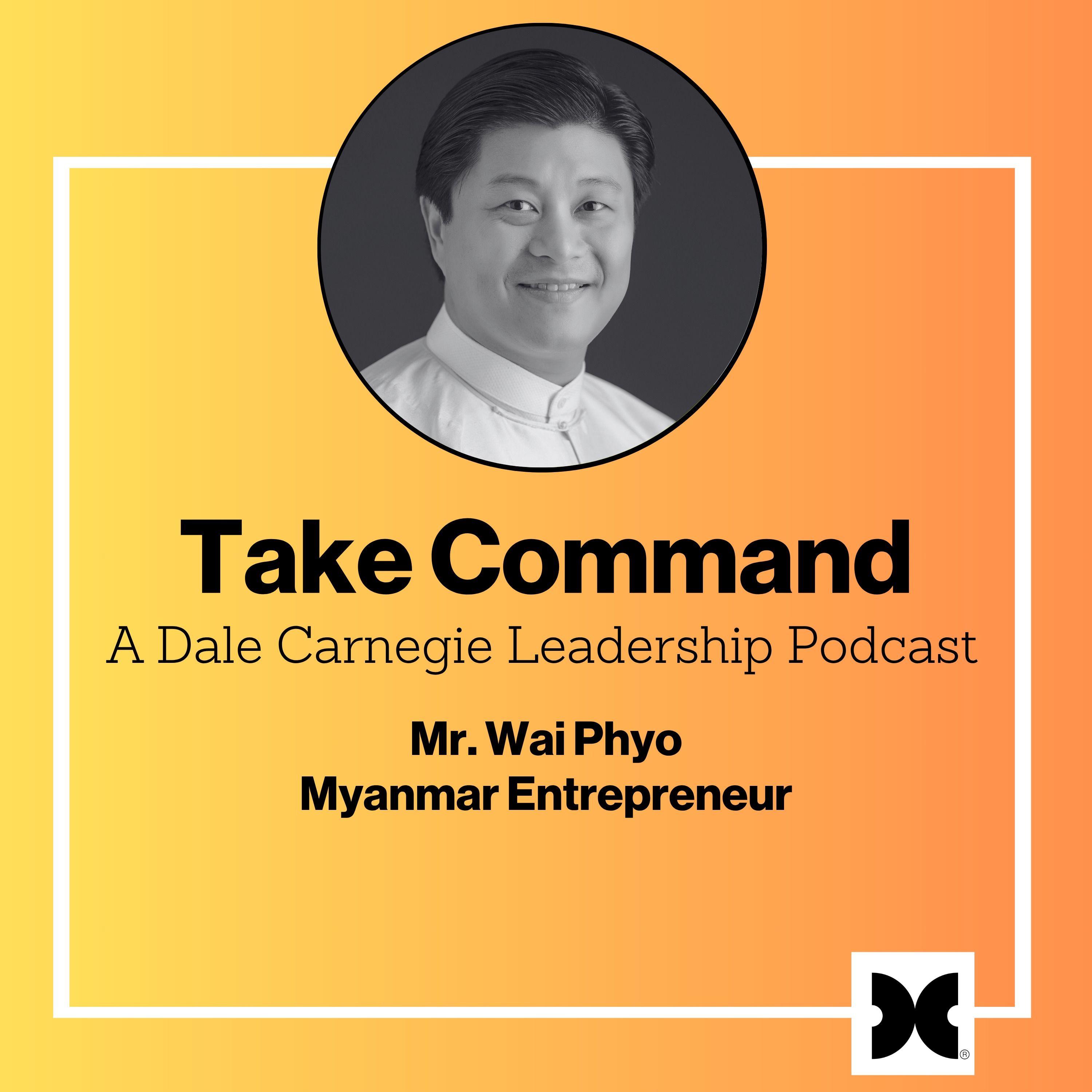
Take Command: A Leadership Podcast
Grit Is Not Optional: Leading Through Crisis with Courage and Heart
00:33:58
Mr. Wai Phyo is someone who has defined his leadership through grit, resilience, and a deep belief in people. When he took over his father’s instant noodle business at age 23 with only two years of experience, he faced a crisis that could have broken anyone. He says, “Grit is the single most important characteristic that separates the extraordinary from the ordinary… you have to acknowledge failure, embrace it, and overcome it.” Wai Phyo’s episode is filled with practical leadership insight. He shares how he moved from ego-driven expansion into unrelated businesses to focused, synergistic growth across food manufacturing, nationwide distribution, and technology. He explains why succession is “not a right, it’s a privilege,” and how building a culture of trust starts with the mindset of “this is our workplace.” He also reflects on Myanmar’s connection to How to Win Friends and Influence People, and how that philosophy shaped his people-first leadership style.
Loading summary
Transcript45 lines
- [00:00]
A
The president that was elected at that time through the democratic process got a hold of the book how to Win Friends and Influence People. He read it and he said, this is a life skill. He actually translated it into the Myanmar language and made it a required course in high school.
- [00:31]
B
Welcome to Take a Man a Dale Carnegie Podcast. I'm Joe Hart, CEO of Dale Carnegie, and if you're ready to grow your leadership skills, follow Take Command now and never miss an episode that could transform your career. Today's guest exemplifies vision and strategic leadership across multiple industries. From food manufacturing to nationwide distribution and cutting edge technology. His businesses have shaped modern enterprise in Myanmar and across the region. In addition to his entrepreneurial work, he serves as Vice President of the Union of Myanmar, Federation of Chambers of Commerce and Industry. He is the founding president of the Myanmar Young Entrepreneurs association and has held key roles in international organizations including the ACN Business Advisory Council. In 2017, he was recognized as an Eisenhower Fellow for his leadership and impact. Please welcome Myanmar entrepreneur Way Pyo Wei.
- [01:38]
C
Welcome to the Dale Carnegie Take Command podcast.
- [01:41]
A
Thank you, Joe. It's an honor to be here.
- [01:44]
C
Well, it's an honor to have you here. And it's interesting because I was reflecting on all the guests that we've had over the years on the Take Command podcast. Some just absolutely phenomenal CEOs, and I don't know that we've ever had anyone who is overseeing either leading or managing director of 12 companies. So I certainly want to talk about that and your experience with Dale Carnegie. You are a leading executive in Myanmar and certainly are doing some incredible things and building not just Myanmar, also having an impact in the ACN region. So tell us a little bit about you, Way. I mean, how did you start to get into business? What was your journey like?
- [02:24]
A
I was born in Myanmar. I'm the only son. My father was an engineer and he worked in the Ministry of Industry and my mother worked in the Ministry of Commerce. Now mind you, this was during the socialist era, so everyone basically had to work for the government. But the thing is, my father had a knack for business. He resigned from the ministry, he went to Singapore, he took all of us there. So actually I went to school in Singapore. Up to now I still consider the city state as my second home. My formative years were there. When I was nine years old, we moved back to Myanmar and went to the State School. In 1988, that was when there was a lot of civil unrest. The dictatorship was overthrown and then the government changed. The schools were closed. So I had the great fortune of attending the only international school in Myanmar, graduated from there, and I went to the US to get my Bachelor's. 1997, finished it up, got a business degree, and I immediately came back to work in my father's business that he started in 1996. I started as an assistant supervisor and then I had to work my way up to marketing manager to director because my father really, really did not believe in handing out titles. You had to earn it. That was a tough journey, but it was all worth it because 1999, my father suddenly passed away. I was 23 years old, only had two years experience, and I was struggling. But I had a great team and we managed to pull through and a lot of hard work and we became the biggest instant noodle manufacturing company in Myanmar. We diversified from there. Now we operate three verticals. Food, manufacturing, distribution and technology. That's my professional journey. The great fortune is that I am married to my middle school classmate, Yumon, and we have two wonderful children. One is a boy, Sue, 15 years old, and another is Te, 9 years old. So that's my professional journey.
- [04:23]
C
Well, thank you for sharing that. Just to go back, I mean, so your father started this company really with nothing in 1996. So congratulations. This is the 30th year in business. It's a noodle company you mentioned. It's one of the largest now in Myanmar in the Asian region. I just have to ask you, I mean, you know, this is a traumatic situation. Your father passes away, you've got two years in business, you've got a degree, and now you're taking over this company. What was that like? And what were some of the things that were going through your mind and your heart at that time? I've got to imagine there must have been some fear, some question about, can I do this? And you know, what were some of those things and how did you overcome them? Because I think a lot of people who listen to this, you know, find themselves in challenging situations. And that certainly was a challenging situation.
- [05:09]
A
Absolutely. It was as if the roof that we were sheltering under, all of us just collapsed suddenly. It was basically a fight or flight situation. I had a choice. I could say, okay, this is too much, and say, I'm going to go back to the US or some other foreign country, get a job, and then support my country as best I could, support my family as best I could. That was the easy choice. The tougher choice would be to continue with the business, see it through a lot of uncertainty, a lot of doubt. But I did that. The reason is because of three things. One is my family. I couldn't leave my widowed mother. Number two is the staff that we employed. It wasn't much. It was only 70 people, but still, I couldn't bear to let them go. And the last is, of course, my father always had a vision for me that I should benefit the people of my country and be a positive force. Those things were going through my mind, and I finally made the decision that I'm going to go see this through whatever happens. And the first part was doubt. Can I do this? Can I survive? Another thing is, will the staff accept me? Will they see me as a daddy's boy, or will they see me as a true leader? And I remember telling my staff, we had a town hall, and I told them that succession is not a right, it's a privilege. And the reason why I said that is that I'm going to prove to you that I deserve your trust. And I did that. Across the years, I've always had that in mind. And if I were to look back and point out a single most important force for success is my team, My father's staff, they accepted me, they supported me. We had our ups and downs. But having that environment of support where it's not just a transaction, it's a family culture. It's a culture where we will come together and make sure we overcome whatever happens. So I think all of that comes together and that is what led to the success.
- [07:29]
C
Well, it's interesting. I know when you and I met in Bangkok in January, one of the things that really stood out to me about you is just your people focus, your belief in people, your commitment to investing in your team and bringing out the best in other people. There's a lot of different ways that people lead, and sometimes it's more about just you lead purely by results and who cares about the people. But I can't help but wonder if a lot of the way you are now, I'm hearing just a little bit about that. Even in your early days of leadership, was that always part of just who you were? Were you raised with this mindset that you want to invest and create a better environment, or where did that come from?
- [08:04]
A
Two things, I suppose, and both originate from my father. The person that had the most influence in my life would be my father. I would gladly attribute him as the person who shaped the man I am today. One of the turning points that shaped me was when I graduated high school, was going to go to university. Of course, you know, you're happy you're going to the US to, you know, be by yourself and do this and do that. He took me aside and he said, okay, son, I need to have a conversation with you. I am sending you to the United States. I want you to get a degree, come back and make sure that you contribute to the people and the country of your birth. So that was very clear. And he made me promise that I would actually come back. And I did. I got on the first plane after I got my degree and came back and worked. Because this responsibility, this sense of responsibility to a greater cause, so to speak, has been hammered into my head since the beginning, since I was 14 years old. That's one thing. Another thing is in our factories, in our offices, we always have a slogan, this is our factory or this is our workplace. So there is always an emphasis on our. The collective people coming together and sharing this space that gives us livelihoods, gives us security, so that we are obligated to protect it because it is ours. That's where we come from.
- [09:35]
C
Well, there's a stewardship in the approach that you took. It's not just, hey, this is my company and you're going to do this. It's, hey, this is our organization. We're here for each other. And the difference that makes in culture, we see that certainly in Dale Carnegie, how we engage people. So you take over this role. You're 23 years old. You've got this team and this responsibility, and I mean, ultimately, you grow this into now this company that's hundreds of millions of dollars, billions of dollars. You're now overseeing a dozen companies. But I'm curious, like, what were a couple of the challenges that you had to overcome in those initial years? Because the future of the company was not by any means certain. It could have gone a lot of different ways. What were some of the challenges that you faced and how did you overcome those?
- [10:16]
A
Some were environmental. Some were my own making. I will admit that, and I'll share that story. So the environment was tough in Myanmar at that time. I think still it's about seniority. It's about elders. And I was 23 and I was taking over the business. And when you go and talk to people, it's like, I'm the age of their son. So meritocracy was not top of mind. It was about seniority. So you have to overcome that. And I think the only way that you can overcome it is to be there, take on the challenge, and prove yourself over and over again. It's not going to happen overnight. And you just have to be dedicated to that. Persevere and state your story. And you needed patience. I learned through the hard way that patience is a virtue. That was the culture side. Another one is, of course, the environment side. The environment in Myanmar at that time, I mean, even now, there was always the issue of the formal economy, the informal economy, and how that came together for legitimate businesses like ourselves. It was tough. So we had to be really flexible and really adaptive to what was changing the environment while trying to preserve our mission and values. It was a tough sell, that's for sure.
- [11:28]
C
How did you do that? You're 23. You've got people who are older. You're telling people we've got this political socioeconomic environment which is rapidly changing. How did you do that?
- [11:38]
A
I suppose at that time I was younger than them, so I had to show respect. I think respect is not just given to older people. You should also give it to the younger people. You should be respectful of everyone around you. But especially at that time where respect was expected, I led with that. And once they understood that I was respectful of their position and I was respectful of seniority, I can slowly make my case. And it worked. And it worked. If at that time I was going to be aggressive, assertive and take them head on, then it really wouldn't work. You need to be adaptable if you are going to lead.
- [12:23]
C
And it sounds like you were. I want to ask you also about mindset. I have this conversation with my kids all the time. It's like, you know, we can create opportunity or crisis in our minds, right? I mean, it's just how we see things. Two people in the same situation can look at the exact same thing and see two completely different things. One sees opportunity, the other see crisis. Talk about your mindset. And even now, Myanmar continues to rapid development. I don't want to say instability, but certainly there's been changes politically over the years and so forth. Today. How did you then frame your own mindset with that resilient, courageous kind of,
- [12:58]
A
we can go do this in Myanmar, it's always a situation of volatility. You know, when we talk about the Vuca environment, that is true in Myanmar. So if you look at the country's history, 1945, we got independence. From the period between 1945 to 1962, Myanmar led the Southeast Asian region. We had the best universities, the best airports, the best shopping malls, you know, the best democracy, actually, to be honest. 62, there was the Myanmar way towards socialism. There was a military coup 1988, civil unrest. After that, 2010, there was the quasi civilian government, 2015, civilian government, 2021, military coup. And now we have an election again. So all of these ups and downs, I suppose in the Myanmar psyche, the Myanmar culture, we understand that this happens. Religion also plays big deal because we talk about impermanence in the Buddhist culture. So I think all of this comes together to make resilience. And going back to what you were saying, some see opportunity and some see risk. So it's about the glass half full or the glass half empty. And I would like to always see the glass full. I believe in seeing opportunity when there's risk. I believe in investing through crisis. We did that actually because you cannot always look at the present. You have to be mindful of the present and mindful of the future as well. So it's about how do you think strategically? Resilience. Of course, you know, you only build resilience through failure in many ways. So if you have failed and you've gotten back up, you slowly start to build that muscle, resilience. And then we as a country has done that many times. So I suppose, you know, we are resilient in that aspect.
- [15:00]
C
I love what you're saying though. You build resilience through failure. You build resilience through challenge. Having the honor to lead Dale Carnegie through the COVID period, which is very difficult for us. I had to think back about even times in my own life where I was leading a small startup, you know, in the early 2000s or 9, 11, you go through the 2008, 2009 financial crisis, you get to something and going through the difficult times, we often don't see, see the value. It's just stressful. Right. But then with hindsight and perspective, we can say, gosh, you know, these things really prepared me for this moment of leadership. And there really were a blessing in many ways, if we look at it that way. Right?
- [15:37]
A
Yeah, absolutely, absolutely. You know, you're always reminded of the phrase that what doesn't kill you makes you stronger. That is true. It may be a cliche, but it is true.
- [15:46]
C
It is definitely true. So you take this company, you build it. Now, today, of course, your business is one of the most successful in Myanmar, very successful in the Asia region. You branched out so that now you are essentially controlling or overseeing 12 companies. How did you go from that one company that started with a single line and a single delivery truck in 1996 to now overseeing 12 very substantial companies?
- [16:15]
A
This dovetails into the failures and the self inflicted failures that I was talking about earlier. So what happened was, you know, the instant noodle business, it was doing very well. It was growing at a good velocity. We were making profit, we're making cash flows. And you know, when that happens, when you're young, you think you're all that. What I start to do is I invest in this, I invest in that. Unrelated businesses, no synergistic effects. So I specifically remember that I invested in a company, I put in so much money, I was taking out money from the successful businesses, investing into the unsuccessful ones. And to be honest, in hindsight, it was an ego trip. I did not want to say or admit that I was wrong. But in the end, I had to. I sold at a substantial loss. And since then, it has taught me one critical lesson. Focus. And actually, that bad decision is the foundation of how I built these companies. So sold it off, focused everything. And then I only did things that made sense and that built on one another. So the manufacturing business is the distribution business. You needed to make sure that products can reach the consumers and the customers in the most efficient manner. So that was synergistic. Then as time went on, we needed to make sure that we were productive and efficient. So we needed technology. So we invested in technologies. And then now we get to the conclusion that it cannot be just a B2B business. You need B2C exposure as well, and you need that exposure in scale. So, you know, we go from there and there and there. So it's all about creating synergy in a focused manner. So before, really messy, but now all the companies in the three verticals are very clear. Their mission and values are clear. They're financially independent, and they have independent leadership on the operational levels. So that's what shaped our businesses.
- [18:16]
C
Yeah. Now the opportunity for you is to continue to grow those companies with those independent leaders. And a part of what we talked about in Thailand when we were meeting is your desire to invest in those teams and to bring out the best in those teams. So. So that they can continue to thrive and that they can continue to expand, which is, again, I think, a pretty important philosophy. And how are you seeing that moving forward? Are you feeling pretty good about that?
- [18:40]
A
Yes. Yes. So we have concluded our succession planning, meaning that we have identified the CEO candidates. And of course, when we do that, it's not just the CEO, it's the CEO minus one, minus twos. We've identified up to the minus twos, and right now what we're doing is crafting a comprehensive training program for all these people. So it's going to be a multi year engagement and multi year program. So for example, my CEOs, we have shortlisted three executive education programs, multi months and in Singapore or Malaysia, they will have to go through that just to understand that this is what is expected from a CEO, a real one. I told them upfront that I am not interested in giving you just a title. I'm interested in giving you the skills to make sure that you are worthy of that title. So we're going to have that for that. But also we are looking, I was talking to Dale Carnegie about this. We are looking to see how we can get not just the Cs, but the C minus 1s and C minus 2s to come together so that there is understanding. Once I leave the CEO position, the next CEO needs to be seen as the leader. I have to make sure that I support him, not just in training or anything else, but I need to support him so that the people under him see him as the leader or her as the leader and not come to me. So that's the delicate balance that we have to strike. And the thing is that it cannot be done overnight. It has to be done with patience, it has to be done with intent and it has to be done with care. So that's what we're doing across the entire thing, making sure the C's, the C minus 1s and the C minus 2s have all the support that they have, skill set, emotion, culture, everything, so that we will actually do a successful transition, not just a transition to tick the box.
- [20:45]
C
Yeah, I can't help but think that what you're doing for your C level people is really what all leaders should be thinking about in terms of the people with whom they report. Someone might be not be a C level, it could be a manager. But the point is, how do I support whomever I'm working with so that they can grow and be independent and ultimately continue to thrive with even less reliance on the individual manager or CEO or leader? I know you're having conversations or working with, I think our me and Mar Dale Carnegie team. So certainly we're sort of excited to be a part of that journey with you. And thank you for trusting us with your people in this process you shared with me. I know we were talking separately about your connection with Dale Carnegie and actually something that was interesting to me, even the connection that Dale Carnegie apparently has in Myanmar that so many people are familiar with Dale Carnegie in your country. Tell us about that.
- [21:34]
A
Actually, Dale Carnegie has very long roots in Myanmar. So it started after the independence of the country. The president that was elected at that time through the democratic process got a hold of the book, how to win friends and influence people. He read it and he said, this is a life skill. She actually translated it into the Myanmar language and made it a required course in high school. So in Myanmar language, it's called Metabala Tinga. Metabala is basically the art of making friends. So that's the literal translation. So my father's generation all grew up with the Dale Carnegie book. So we have a lot of roots with that. And I was just flipping through the book as well, and I've read it many times. But as you know, you grow and you understand and you mature as a leader, you understand that. There's so many business parallels that Dale Carnegie wrote about in his book, just to highlight a few. And these are things that I still talk to my staff as well. For example, leading with empathy. And that's part of Dale Carnegie. It is basically design thinking when you think about it. You have empathy for your customers, you have empathy for your staff. How do you design a great product that addresses that? Another thing, becoming genuinely interested in people, in other people. It's the basis for know your customer. It's basic customer research. Then when you talk about, talk in terms of the person's interest is the basis for making outstanding products and service design. So if you don't know that, of course you can't design it. He speaks about that. He speaks about smiling. He speaks about addressing people in their own names and saying that your name is the best sound that the person can hear, of course, and then thanking them. Customer service and care, definitely. Every service company practices that. And of course, be a good listener and encourage people to talk about themselves. Hey, this is strategic market research. Very simple, right? And then of course, the last thing that I always tell people, respect other people's opinions. Inclusive collaboration, all of these jargons that are, you know, like, thrown around in business and business, like management books. There's a lot of prayer rules with Dale Carnegie.
- [23:55]
C
Yeah, it's funny because it's the proverbial what's old is new again. A lot of times I'll hear someone come out with a new philosophy and I'm like, Dale Carnegie said that 100 years ago or in Nano and Friends or how to stop worrying and that type of thing. But it is interesting how pervasive that philosophy that the book and the principles are, certainly how well known they are in Myanmar. But I also think, you know, people have a choice about how they want to live and how they want to see things. And certainly part of what I think attracted me to having you in this podcast is this is part of who you are. You've got this Dale Carnegie heart, and it's clearly been a success in terms of how you've dealt with people and how you've grown from one business to 12 businesses. Still have a career ahead. What are you excited about? For you, for the future, what are you most excited about?
- [24:39]
A
Many things. Many things. But maybe, you know, I'll just say three things. Succession planning. I'm excited to actually see other people lead and lead with art. So I'm really excited to see that. And I am dedicated to making sure that they have all the support, all the training that they need to do that. So I'm really interested in that succession planning. The second thing is, I'm an entrepreneur. I think I still have one or two companies left in me or one or two businesses that I want to start. So I will do that. I will do that. And when I do that in Myanmar, it's an interesting phenomenon because we are a few decades behind most countries. When you travel, you can see many things. Bring it back to Myanmar, adapt it to the Myanmar culture and the Myanmar environment, and then you can build products. It's like Back to the future, right? You can bring products back and then you can give it to the people. So you are actually making people's lives in Myanmar better. And that also is important because it will allow some aspects of our economy and society to leapfrog. For example, one of the businesses that we do are consumer platforms. And in consumer platforms, we had a mandate that whatever the consumer buys on this platform needs to be done in less than three clicks. And the thing is that we did it. It just helps a lot. So things like that. So we're really interested in bringing new ideas back and making sure that we build businesses that can help the people in the country. The last thing that I'm interested in is AI technology. AI is an existential thing. Every single company will need to have some type of exposure to it if you want to be relevant in the future. But what I'm really interested in is not just the company being relevant. I want to see how I can make my people relevant. In the age of AI, you hear a lot about how AI is disrupting people, how jobs are going to be lost. True. It will happen. It's inevitable. What we're doing right now is we have exposure to AI. We have a few AI projects that are ongoing. But we are taking that step not to fire people, but to enable people to use technology for a few things. One, I want my staff to work less, have exponential productivity and higher pay. If you look at a triangle of productivity, work and pay, sometimes you will think that you can't have all three. My current goal is to see if I can get all three. Because you don't really need to fire the people. You can be redeployed in new companies that you start or new businesses that you start. So at least they will also have that life skill, that technology skill that they can take with them. Whether they work with us or not, you know, it's okay, they can take it and then they can build a life. So that's what I'm interested in. That's what I'm excited about, how to use AI so that it benefits not just customers, but employees as well.
- [27:44]
C
What I hear a lot about and a lot of CEOs talk about is just the productivity part. You know, hey, we can be more productive. Many people say we may not need as many people. We can drive our margins and those kinds of things. And at the same time, what I love about what you're saying is this can be a win, win, win for everybody. If you equip your people, you train your people, you teach them how to use AI. Now people are more productive using it, they can benefit, they can make a good living, they can have a good work life balance, if you will, and be beneficial to the company. And certainly that's something that is an opportunity. I'm curious about you, Wei. I mean, you're overseeing companies and your father, you travel. There's all kinds of change in the world as you and I speak today it's the 13th of March, there's a war in the Middle East. I mean, there's a lot of things that are happening, tremendous instability and uncertainty and so forth. And yet I know that you are very grounded, you're very positive minded person. What are some of the things that you do to invest in yourself when you're not working? How are the ways that you stay mentally, emotionally, spiritually healthy?
- [28:53]
A
I suppose, you know, under all this instability, my religion plays a great deal. But I don't want to make it all about religion. So it's just about mindfulness. You know, Buddhism teaches about mindfulness and I appreciate that and I understand that things happen for a reason. Nothing is permanent. There will be ups, there will be downs. You just have to weather the storm when it comes and be happy when it's gone. I suppose that's how I look at it. Another thing is to be relevant. I was talking about relevance. I really like what Stephen Covey said. The seventh habit of sharpening the saw. I try to learn something every year. So I will either attend an executive education program or I will go to a conference, I will go to a trade show, whatever places that I can learn. I've done courses in Harvard Business School, mit, National University of Singapore. As long as I'm learning, I think that's a positive thing because I will bring back a lot of ideas, a lot of things and I will try and implement in my company. Some are successful, some are not. But at the end of the day you learn from failure. And for me it's always learning experience. So I think continuous learning, lifelong learning is something that all leaders really need to do to remain relevant. The last thing is how do I unwind? I don't really have a lot of hobbies, to be honest. The way I unwind is very simple. At home with the kids, watching a movie with my wife, you know, talking about life and things like that, I'm happy.
- [30:26]
C
At the end of the day, our families are the most important parts of our lives. So clearly having family time and time that can bring us joy and peace is a good thing. I know you've got, you said one teenager, two teenagers.
- [30:40]
A
One teenager, a boy.
- [30:42]
C
Ah, yeah, 15, right?
- [30:44]
A
Yep.
- [30:44]
C
I've got six children and there was a point where I trying to remember if I had three or four teenagers at once and that was tumultuous goodness. But like you said, you know, there's the storm and you get through the storm and now everyone's great. So you know, just one maybe kind of closing question because I mean clearly you've achieved so much, you've learned so much. You talk about having this learning mindset. If there's only one piece of advice you'd give to a young entrepreneur, someone who's starting out or maybe even to yourself, a 23 year old version way of you taking over this business. What are maybe one or two things that you know now that you did not know then that you wish you had?
- [31:21]
A
I would say grit, the value of grit. So grit is actually something that all of us leaders need to understand. And I think that is the single most important characteristic that separates the extraordinary from the ordinary. Grit also has a mindset component. I mean, yeah, true, you go through the tough times, you emerge as a better person, you fight through it, but it is also a mindset of acceptance. It's not a mindset of avoidance. So we have to understand that failure will knock on our door or adversity will knock on our door. I mean, that's something that I don't think anyone can escape it. It's just a matter of what you do when that happens. So for my part, I would say acknowledge it, embrace it, and overcome it. And sometimes you will win, sometimes you'll lose. And the most important thing is to get back up, learn from your mistakes, and keep on going. I think that is the message that I would give to anyone, any young entrepreneur who's starting out or myself when I was young. I think grit is something that is so important, it literally will be the foundation of your success.
- [32:45]
C
Okay, well, on that point, it's an inspirational close way. Thank you so much. I mean, grit is something that we can all have it if we embrace it. We're all going to have the storm. We're all going to have adversity. The question is, how do we go through it? And also, you talked about learning mindset. You know, you're constantly learning. So what can I learn from this? Thank you so much for being on the Dale Carnegie Take Command podcast. It's been a pleasure to have you here.
- [33:08]
A
Thank you, Joe. It's an honor and a pleasure as well. Always good to talk to you. Thanks.
- [33:12]
C
And I look forward to seeing you again soon.
- [33:14]
A
Looking forward to it.
- [33:22]
C
I hope you enjoyed this edition of Take Command, a Dale Carnegie Podcast.
- [33:26]
B
Check out our resources at www.dalecarnegie.com for more research, insight and tools that will support your success and help you take command of your leadership potential.
- [33:38]
C
If you enjoyed this episode, please consider
- [33:40]
B
rating it and following us on Apple Podcasts and Spotify for more exclusive content content, subscribe to our Dale Carnegie YouTube
- [33:48]
C
channel and follow us on social media. As always, thank you for listening and
- [33:53]
B
we're looking forward to you joining us
- [33:55]
C
for the next episode of Take Command, a Dale Carnegie Podcast.