← Take Command: A Leadership Podcast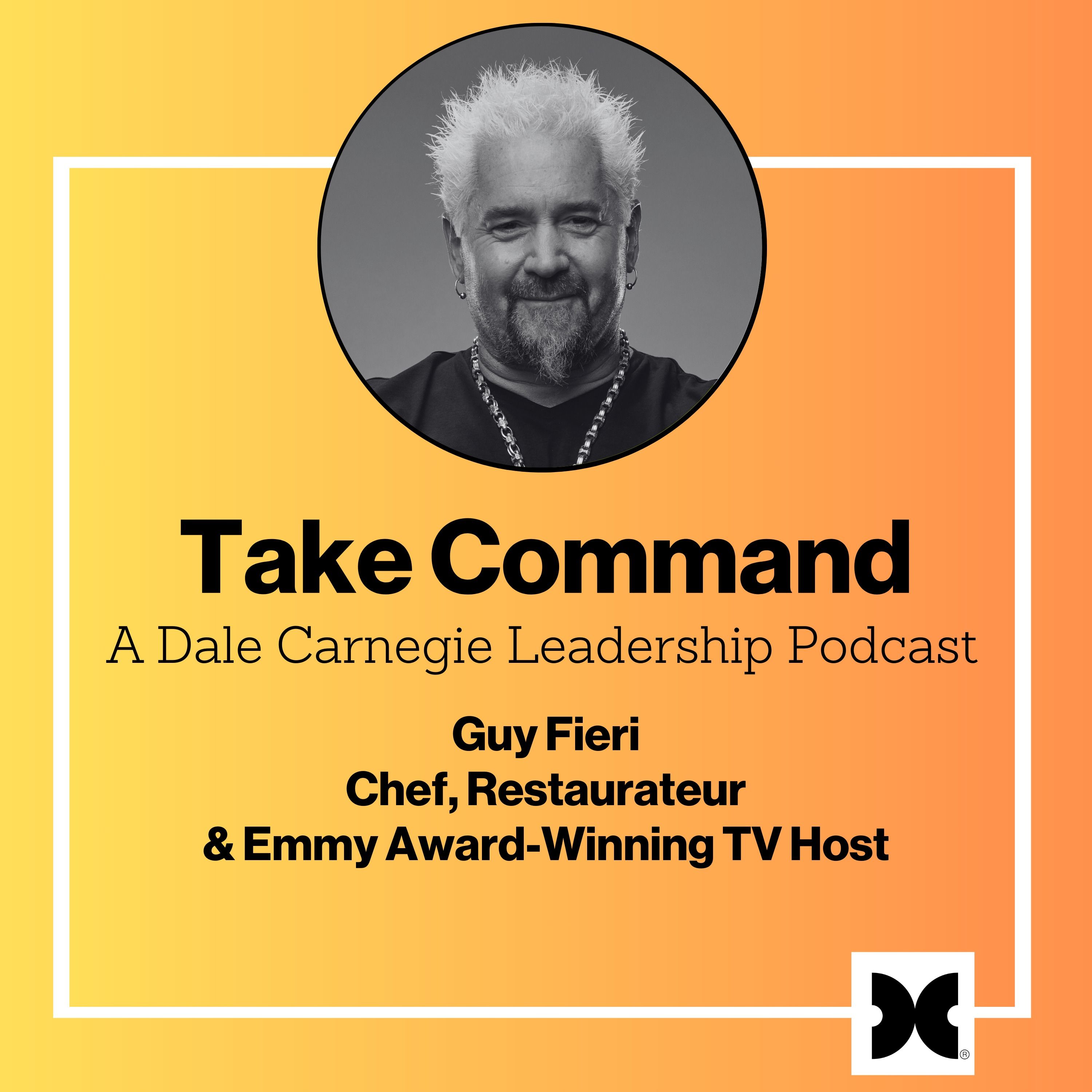
Take Command: A Leadership Podcast
Guy Fieri Returns: Recipe for Success, Part 2 — Authentic Leadership Beyond the Plate
00:40:32
Guy Fieri is back! A few months after our first conversation, he returns with even more energy, insight, and straight-talking leadership wisdom. In Part 2 of our episode, Guy dives deeper into what it truly means to stay authentic in a world that often pulls you away from your roots. From building rescue trailers for disaster zones to staying grounded despite massive success, Guy lives by principles that are both timeless and timely. As he reminds us, “If you don’t take the shot, you’re guaranteed to miss.”
Loading summary
Transcript48 lines
- [00:00]
Guy Fieri
How to Win Friends, Influence People should be a curriculum for a semester in every single school. At that formidable age of eighth grade, maybe freshman, maybe sophomore, junior, I don't know. You guys have better intel and analytics of that, but this is the stuff we're supposed to be living by and teaching. It's not a right or a wrong. It's a perspective and an awareness and an adaptation and a consideration and a mindfulness. Where the hell did you get it from?
- [00:39]
Joe Hart
Welcome to Take Command, a Dale Carnegie podcast. I'm Joe Hart, CEO of Dale Carnegie and if you don't want to miss a moment of transformation, follow. Take command now and unlock the power of leadership with every episode today, we're joined once again by a guest whose impact extends far beyond the culinary world. Returning for part two of our conversation, he shares deeper reflections on leadership, service, and the importance of staying grounded amidst success. He first rose to national prominence after winning the next Food Network star in 2006, and quickly became the face of hit shows like Diners Drive Ins and Dives. Since then, he's built a food empire that includes over 80 restaurants worldwide, multiple best selling cookbooks, and a signature line of sauces and spices. He's also one of only three chefs to earn a star on the Hollywood Walk of Fame. Please welcome back chef, restaurateur, New York Times best selling author and Emmy award winning television host, Guy Fieri. So, Guy, welcome back to the Dale Carnegie Take Command podcast. Great to see you today.
- [02:01]
Guy Fieri
Well, I'm impressed that I get invited back. That means I passed like the first course, right? Like I read the book and I paid attention. I get to come back for the sophomore class. It was a great conversation and a lot of my friends, a lot of people listen to it. Even people that I didn't know understood, you know, the Dale Carnegie movement. It was really cool. So thank you and I've been a fan. When I was in eighth grade, I was in a contest. I wasn't a very good student, not because I wasn't smart, but because I didn't like school that much and didn't apply myself. I was more interested in business. But anyhow, this teacher encouraged me to participate in the National History Day and I did the National History Day. I won the National History Day for my area, which then for some reason I represented California, maybe with my age group or whatever. And then I went there and I did the history of the pretzel and the history of the push cart, and I had a pretzel cart business. Did I tell you this last Time we talked about the pretzel cart. So you did.
- [02:55]
Joe Hart
But it's a great story.
- [02:56]
Guy Fieri
I had a pretzel cart. I loved eating pretzels. I was from California, not from the East Coast. Never seen a soft pretzel in my life, except for we went skiing and I spent all my lunch money eating these pretzels. And my dad says, if you love the pretzels so much, I was in fourth grade, he says, you should open your own pretzel business. My dad. Dad was always really encouraging me to seek out my things that I enjoyed. And both my parents really encouraging me to do whatever I wanted to do, but just do it really well and work your butt off. So, yeah, I went National History Day, blah, blah, blah, blah. So the folks from National History Day had reached out to me and we were trying to collaborate something, talk about. Because I think National History Day is again, one of those things. And I got to tell my publicist to reach back out to them because we're missing history all the time. These kids are not getting the background. We're talking about so many different things. You're so distracted with all these contemporary issues or foreseeing the future. They got to know where they came from and how they got there. So that was what my inspiration was. Because it reminded me how important the Dale Carnegie book was. And I think I told you this in our last talk. I bet you I've given 250, 300 of the paperbacks to people. As a matter of fact, I have old editions that I found in bookstores. I went to bookstores all the time. Like, do you have Dale Carnegie, how to Win Friends, Influence People? So I have some hardbound books, great publication dates. And most of the people look at me a little sideways, like, this is what's going to help me. Like, just do it, but promise you're going to read it. Anybody that works on my team has to read it and has to give me a report. So that's how this all came about. It was Natural History Day. Reminded me of my past, of what was so important to me, got me there. And then I thought, I don't see the book as much anymore, maybe because I don't go to bookstores. But I said I got to reach out to these people. And that's what Joe led me to, you and this conversation. And I was really honored that you asked me to come and speak to you. And so the fact that I'm back means that I passed the first chapter.
- [04:51]
Joe Hart
First book you passed. You crushed it. Having you in that podcast was such a pleasure. It's an honor to have you back and our audience. Absolutely, as I mentioned to you, loved hearing, hearing from you. And I mean, I think so much of you guy is that authentic, inspirational. You told your story, you didn't pull any punches. And I think that's something that we can all relate to. And frankly, part of where you started with that and maybe where we even can start this conversation now is these are my words. But you kind of had talked about a life before you read how to Win Friends and then a life afterward, Right? So before you're managing a restaurant, you really were struggling with your interactions with other people. You didn't know how to tell them to do this, do this and so forth. And you leave that job, you have a two week break, you buy all these things, but the one book you read is how to Win Friends. And then you go into your new job and all of a sudden people are like, who is this and how is he so effective? You go from managing one restaurant to six restaurants. You are truly someone who has demonstrated what it means to live the Dale Carnegie principles. Part of why I'd want to even start with this conversation Guy, is where are you using those principles today as you have grown and become so much more successful than you were, you know, back in the day? What are the principles that our audience would benefit from knowing that you're applying either principles or the stories, things that resonate, the ideas that resonate with you from Dale Carnegie.
- [06:09]
Guy Fieri
The first thing is you're never too old to learn. I say, as soon as you're not learning, you're dying. You know, I tell it to young chefs all the time. There's no way you are ever going to know it all. Matter of fact, my dad used to tell me, the older I get, the more I realize, I don't know, he has a different word, but I'll just say stuff. The older I get, the more I realize I don't know anything. And I think that so often, especially at that age that I was at, 22, 23 years old, come on. I had it figured out. I went to college. Somebody I really respected told me that this was the book. And I looked at it and I was kind of like, yeah, it was. If this is the book that's going to help me, it's only that thick. This is my kind of book. Little did I know, I had to read it 85 times, you know, cover to cover. But the principles are so straightforward. And Dale Carnegie was such a Great storyteller. I trip out all the time, like, where did he get it? But he goes back to that thing that we learned. What is that thing? They say everything you need to know in life you learn in kindergarten.
- [07:12]
Joe Hart
Right? Yeah.
- [07:13]
Guy Fieri
Think before you speak. My favorite was Abe Lincoln writing the letter. And he's gonna send the letter off and he decides to table the letter and put it in his drawer. Oh, boy, we love to get an email. Fire one, back off and let them have it. Pump the brakes a little bit, folks. I think that's one of my favorites. Before you go. And ready, shoot, aim, make yourself a deal. Take 24 hours, absorb it. What we want to do is we want to shake it off of us. We don't like what somebody just threw at us. We don't like how that makes makes us feel. So the best way to recover from that feeling is to strike. No, no, no. Sometimes that patience can give you better perspective, can let you calm down, can let you read it again. I mean, how many times have we read something the wrong way? You know, we've had too much coffee, we didn't sleep well last night, We've maybe already been to martini hour, you know, whatever the case may be, pump the brakes. That to me is one of my all time favorites. That when I think about how to not trip over yourself. We try so hard, we work so hard, we do so much. And if we could keep from sticking our own foot in our mouth, I think that we would be right off the bat. Because once you do that, then you have to employ so many other techniques about being humble and about apologizing, that those things go on and on and on. So I think that's probably one of them that I take the most appreciation for. And it's one that I talk to my team about all the time. Because they come in and something's happened and we're gonna hold on. And I say it all the time. It's one of my favorite. It's from Smokey and the Bandit when Jackie Gleason gets out of the car, Sally Fields has just left, and the guys are there pulling up in the van and they're stealing the tires. And he jumps out of the car and he says, hold up on the car wash there, boys, you know, which they're not doing a car wash, they're ripping off the tires. One of my favorite finds in the world. So I'll say it to my team all the time. Hold up on the car wash. You know, so anyway, that's one of them.
- [09:20]
Joe Hart
It's such an important idea though. I mean, especially because, you know, we think about our relationships, right? The people that we work with, the people that we live with, the people that we're around. And there's such a temptation, we can easily get defensive. I don't know about you. I've learned that I should never send an email after 9:00 clock at night. I just felt like as the day goes on, it's. I'm much more likely to say something I'm gonna regret. So this idea, this idea of just like you said, it's like, hold on there, boys, you know, give it a second.
- [09:46]
Guy Fieri
Car wash, boys.
- [09:47]
Joe Hart
That's right. How do you do it in practice? I'm just curious, are you tempted? I mean, you're in an environment, right? Especially in your show. By the way, there's a lot of other celebrity chefs shows or whatever where people come in and it's just like, it's a completely different mindset. But part of what I'm seeing in you is this is who you are. You're someone who is trying to build people up. You're not trying to raise yourself up, put anyone down, that type of thing. But in your environment, how do you recommend that people do that in a high stress environment?
- [10:17]
Guy Fieri
Well, I'll use in a different example, as opposed to looking at it as a confrontational perspective, I'll use it in a deal making perspective. In the way my dad always taught me was if two people walk away from a deal and they don't feel that they got a deal, then somebody took somebody. And that never sets you up for success in the future of ever doing a deal. You don't have to win right now. Same way as I always said to my team members, our motto in our restaurants is to create and keep guests. Create and keep doesn't mean I'm always right, doesn't mean that the guest is always right. But the reality of it is is you want to be right or do you want to be happy? And I think just those simple little statements. Another motto we use inside of our restaurants is what you say is what you hear, what you hear is what you think and what you think is eventually what you believe. You know, I say these to high school students all the time. You have any friends that are stupid, Isn't it coincidental that they're stupid and they tell themselves they're stupid or they're unlucky or they're never going to make the team or nobody likes me. Self fulfilling prophecy. So the way I look at all of these things is in the context of you got to frame your own situation, you got to design how you want this to go, you got to be willing to take the back seat, you got to be willing to apologize, you got to be willing to be wrong. And I think that all of these traits aren't necessarily what we teach. And I think that people get really steadfast on their position and not backing down. And I tell my sons, my nephew, my nephew just graduated with law degree. My son Hunter is graduating with his MBA writers, freshman in college. And I said, before you go and blame somebody else, I want you to evaluate your participation in the situation. So before we're going to lay it off on that person, let's take it and evaluate you in this deal. Because it's impossible that everything is about this person, this other person, or this other situation. So a lot of times when I help people diffuse themselves and take responsibility for their position, it's not as out of control as it was when they first walked in. You know, I do all. My whole meeting is here in my kitchen. I have an office. It's great, but I never sit in the office. I always sit in the kitchen. But so when the team walks in and we have meetings here, I first will just say, okay, hold on a second. Tell me your involvement. I don't know that that answers your question, Joe. I think I gave you about eight different facets, but I think that it's a bar fight. There's two to fight, so there's one fighting, you know, so think about your involvement in it first. And I think that once you do that, you. You really take what is 100% problem, and now you take out 35, 40%, 20%, whatever. Now the problem isn't as large because your participation's removed. So now let's evaluate the person. They're 60% a jerk. Well, it's a little bit easier to deal with.
- [13:33]
Joe Hart
But I like what you're saying too, which is we've got to look at ourselves, right? We say in Dale Carnegie, if you're wrong, admit it quickly and emphatically and speak about your own mistakes first and those kinds of things. But so much of what you're talking about really is mindset. And that's one of the things that separates all of us. Some people have a victim mindset, some people have a abundance mindset. And part of what you're talking about is that mindset of trying to see things from the other person's point of view. And the different things that we do talk about in Dale Carnegie. I'm curious, though. You come across so many people, Guy. You're interacting with so many people, and there's all kinds of different people. How do you deal with people who are maybe of a different mindset? Your sons are receptive to the kinds of things you're saying. Right? And it's great if people are receptive. Hey, dad, that's great. What about the people that aren't? I'm curious how you and your career, your life, have you come across people who've said, I disagree or they're just difficult. They're not going to change.
- [14:23]
Guy Fieri
I have hate. I have people that hate me. People that don't like bleach, blonde hair and tattoos and, you know, whatever I do, they don't like. That's okay. I'm not going to change their opinion. I mean, I'll try to be a positive example. I'll try to be receptive to criticism, but somebody that just wants to send a message and, you know, you're an idiot, I don't have any time for it. I mean, honestly. I mean, Joe, if you called me and said, hey, Guy, and I don't know you. I mean, I know you from our meeting on the phone and our podcast that we had, but I respect you enough to know where you're from and know you're educated and had a chance to meet you and talk to you. And if you called me and said, hey, you know, I think that the way you did that restaurant and the way you portrayed that, I'd listen to you. I might not agree with you, but I'd listen to you. And a lot of times that can diffuse a situation, and a lot of times it can educate you. I love to hear what other perspectives are, because it can't all be in the world of Guy Fieri. I don't know everything, you know. You understand the term Namaste? Sure.
- [15:26]
Joe Hart
Yes.
- [15:27]
Guy Fieri
So it's one of my favorite words, and I never understood it until my little sister was passing away. And matter of fact, I have it tattooed on my arm. Namaste. The power in me recognizes the power in you. The God in me sees the God in you. The universe in me sees the universe in you. And so I think so much what happens is everybody looks at the world. I say this to people all the time. The world is from your perspective, is it not?
- [15:52]
Joe Hart
It is.
- [15:53]
Guy Fieri
I go because everybody else is in your world. It's your world. They're just all people in it. Okay, you agree to me, right? They say I agree. I said, okay. Now let's take a different perspective. Pretend for a fact, just idea. I see the world as my world. Okay? So you're in control of the world. I'm in control of the world. That's where our fights start. That's where the countries don't get along. How about you acknowledge that I see the world from my perspective, and you see the world from your perspective. And when we start to give a little bit on that, we start to relax a little bit on that, and we start to what it really is. Not to get too weird, but when we do a paradigm change, when you take a moment and look at the situation from somebody else's perspective, it's the same situation. Just look at it from their side for a second. Get done being pissed. Get done being right. Maybe just play a game with yourself and say, I want to find out why Joe thinks that that is blue. Oh, no kidding. If you stand over here and you look at it through that window, that is blue. Joe's not crazy. So that, to me, is a lot of what it is. And that Namaste thing was taught me by my little sister before she passed. And it really is probably one of the most important words. I use it with people all the time. That in paradigm shift. Try before you cement yourself in an idea, before you run your mouth and tell everybody somebody's wrong, before you make a conviction on the situation, just take a second and look at it. But that was, again, one of those principles. Look before you leap.
- [17:41]
Joe Hart
The underlying idea just to go back to Namaste and what you're saying about the God of Mises, the God in you and so forth goes to something, I think that underlies every Dale Carnegie principle idea, which is that every single person has inherent greatness, right? What can I learn from the person? And he quotes, as you know, on how to win friends, Ralph Waldo Emerson. Every person I meet is my superior in some way, right? In that way, I learn from him or her. So part of what you're hitting on, which I think is so valuable for me to be reinforced and also for I think our audience, is just the importance of questions. I had a situation, guy, this morning. I'm talking to someone who had a point of view, and I was like, I just don't see it, but help me see it. And by the time we were done, I was like, this is actually a pretty good point of view, but we wouldn't know unless we took the time to ask. So much of it just comes down to fundamental respect of the person.
- [18:26]
Guy Fieri
Right. When you say fundamental respect of the person, what we should be saying is fundamental respect of the person being yourself. If you really have self respect, then you will release yourself of having to be right and release yourself of having to be in control and, and release yourself to the opportunities that can be absorbed and understood. You got to be confident with who you are and where you are. And you could be standing in a group of a bunch of screaming people that are telling you you don't know anything about anything about whatever the topic may be. And if you're confident with yourself, you may sit there and you may actually learn something. You may actually learn what the opposition is by just keeping your mouth shut, not forming an opinion, and just absorbing some of what's going on and around you. And it's kind of like a practice in the art of can you do it every day? It's kind of like meditation. Some days I can do it, some days I can't. So, yes. Do I fail at it? You know, I try to tell my sons all the time everything I tell you, I don't want you to believe I do not fail at. It's okay to make mistakes. It's okay to fail, but it's great to continue to strive to not fail. But when you do, don't throw the skates away. Your career's not over. Just pick yourself up and get back after it. You're going to make mistakes. I don't want anybody listening to me. Thinks a guy, Fieri, thinks he's got it all figured out. No, no, no. Oh no, no, no. I fly off the handle, get pissed, miss the subject, don't listen. You'll have to come back to it two hours, 10 hours, two days later and pick it back up. And I can just listen to myself saying this to my team or saying it to my kids and going, huh? But again, nine o' clock at night, too many cups of coffee, didn't get good sleep, whatever the case may be. So now go back to the very first thing I said. Table it until you're ready to really metabolize it. And then you're probably going to have a better platform from which to come from again. That's one of my first and foremost. When I get to that fork in the road, I just got to look at it and say, do I got this all figured out? Am I ready to answer this right now?
- [20:40]
Joe Hart
What you're saying is great advice for all of us. None of us are perfect. I make the same mistakes that you are. I had One of my kids say to me, you know, you're the worst CEO of Dale Carnegie ever, because you're always complaining. I'm like, just pick up your room. Pick the place up. I've asked like 10 times. We do the best we can, right? We're not perfect. We're going to make mistakes. But I want to switch gears for a second because one of the questions I heard from a lot of people you are around your career is being around food constantly. I can't imagine how you can do that and not be, you know, three or four times heavier or whatnot, right than you are. You've lost 30 pounds. You have gone on the record to talk about this health change that you've had that I think is pretty intriguing. You want to share with our audience how you balance what you do with a healthy lifestyle.
- [21:30]
Guy Fieri
Well, a long time ago, when I first got on the Food Network, I had a guy named Jack levar, who. I've got Jack's tattoo on one of my arms. Jack passed away. We had gone to the Middle east and cooked for the troops during the Gulf War. And Jack was a great mentor, great friend. He was an advertising sales guy that had retired. He was 65 years old. And Jack would say to me all the time, we're not going to burn up through the tunnel. I want your finances to be right. I want your relationship to be right. I want your health to be right, not to burn up through the tunnel. It was great. I would go and see the Elvis movie and about the Colonel, and I look at all the things that Colonel did to Elvis and all the things Jack did to me. And my Jack was the greatest. And one of the things was, I'm 57 now. I was probably about 50 years old, 52. I looked at myself and I'm like, I could be better. I don't want to burn up through the tunnel. I don't want to do all this work. The exponent now of my opportunity, my earnings, my everything is a thousand to one of what it was when I was 30 years old and I was in better health. Actually, I think I'm in better health now, honestly, than I was when I was 30. But I just started talking to people and I was, you know, again, being honest with yourself. Don't play games and just say, what do I want to be? See, if you can't say it, you can't hear it. If you can't hear it, you can't think. If you can't think, you can't come it. I just Looked at myself, I said, I don't need to be 235. I can carry it. You know, I'm stocky guy. I don't know why the voice changed, but I looked at myself and I'm like, I want to be healthier than that. I don't want heart disease. I don't want to go through these things. So do I get to eat everything I want? No. Am I having salad for lunch? Yes. Did I not want to get up this morning and exercise? Huh? But the reality of it is there's a lot of things I don't want to do. But the great thing is, is the things I don't want to do make the things I do want to do better. So let's just take it back to when we were a kid. Gotta eat your vegetables, but you get to have ice cream. And so that discipline is part of what I live by, in that discipline makes me better. Every morning I get up, I do different exercises, different days, but I always hot sauna and cold plunge. So I sit in the sauna for 25 minutes at 185 degrees, and then I cold plunge for anywhere from five to 10 minutes, let myself come back to normal body temperature. Usually shivering pretty bad, which my wife just looks at me standing out on the patio and shakes her head and goes, why? What are you doing? Joe Rogan talks about it. A lot of people talk about it is like, if you can get up in the morning and face cold plunge, you can accomplish anything in your day. We all have these hurdles in life. Just pick which ones they are. But once you get that momentum, once you've done the two toughest things in your day, what's the rest of it gonna be like? That's one of my philosophy. So I hots on a cold plunge. I exercise four days a week, more if I'm not on the road. But the biggest thing I do is I intermittent fast. So I don't eat till noon and I usually stop eating at 6. And that wasn't the easiest thing to do. I always drank my coffee for how many years? Always drank my coffee with a little half and half. But that's not the way intermittent fasting works. You can drink black coffee, tea or water, nothing in it. That was a little bit of a struggle. But once you get your body tuned into how it needs to utilize its resources, worked out fine. But there's all kinds of stuff, exercise to me. Like I have to exercise before I film. I run so fast and so hot and I've talked. I got a million things going on. If I don't exercise before it, I find that I'm a little bit sharper. Not sharper. Good sharper. Like, you know.
- [25:26]
Joe Hart
Yeah. I think this whole conversation is really an important part of leadership and even the things that we were talking about before, because if I want to bring my best self to work or to the people around me, it's just something is off. It can be little things that cause us to be edgy or whatnot. But I've been doing intermittent fasting, by the way, and really enjoying it. I'm finding a level of energy, mental clarity and energy that I'm like, oh, my gosh, I don't even need caffeine for the vast majority of the day. All of this is about how we present, how we connect, how we interact with people. So prioritizing our health. Someone was asking about, how do you find time? You're running a business, doing all these different things. Have a family, like you said, you prioritize it. You make it the first thing you do. It's that important.
- [26:10]
Guy Fieri
I love how I babble. And then you condense it down into a chicken bullion cube. I give you five gallons of chicken stock, and you made it into a bullion cube that people can take away. That's just perfect.
- [26:22]
Joe Hart
I'm just following your lead.
- [26:24]
Guy Fieri
We make a great team, Joe. No, you know what it is? I look forward to doing things throughout my day till noon to when I get to eat. I look forward to it. I make very conscious decisions about what I eat. I don't like to eat crap. I don't eat a lot of fast food. But what's the most important thing about driving your car? You can say all. The seat belt, the windshield. How about gas? How about the fuel you put in your car? Pretty damn important. Doesn't matter what the tires are and the windshield clean and the stereo. None of that matters if you don't have the right fuel in it.
- [26:59]
Joe Hart
100%. Yeah. So let me ask you just to switch a little bit to your career. If you look back over 25, 30 years now you're at this point of very prominent success. You're one of three celebrity chefs, if I could say that, who has a star on the Hollywood Walk of Fame? What excites you about the future? What scares you about the future? What really is driving you kind of right now as you look at your years ahead?
- [27:27]
Guy Fieri
There's different sides of it. There's the family side of it. There's the business side of It. There's the career side of it and there's the philanthropy side of it. So in the family side of it, you know, to see my sons doing so well, and my nephew, who's like one of our sons, my nephew Jules. Jules worked full time in the music industry as an agent in EDM and. And went four nights a week for two years to go to Loyola for law and just is graduating. Okay. What kid is doing that anymore? I mean, who's going to night school? And I told him, stop and just go to school. And he's like, no, no, no. I want this degree. I want this career in this business. And it takes time to build this. So Hunter getting his master's in business and Ryder going to San Diego State, work at the basketball team. Lori, super healthy, doing great. My mom is 81, living a great life. You know, losing my dad, but spending time traveling. So family. Great. Just want to see that trajectory continue on business. We just continue to thrive in this knuckle sandwich. And Flavortown, you know, is the big brand name and what's going on with that and the partners that we have with all of the sauces and dressings and dry rubs and tequila and wine and pots and pans, you know, all these components are really firing on all cylinders. The career side of things is really going well. I've got this great relationship with the Food Network, getting ready to launch a YouTube channel. That's really going to be exciting. I believe that, you know, everybody is getting into this space. We'll be one of the first. From the culinary side of it to the level that we're talking about, so really doing well. So I'm just really happy how all these ships have set sail and the direction in which we're going, and they've got really good momentum and a lot of really awesome captains in those ships. And each one of them had to be launched at a different time and needs different trajectory and needs different propulsion. But I'm so happy with the way they're going. And the thing that really is not the last thing to set sail, because it is going, it is underway, is the philanthropy and seeing the potential that we have. And I'm wearing the shirt today. No coincidence is really one of the things that makes me so excited. We live in the greatest country in the world. How did we get there? Well, there's all different facets and reasons, but one is the first responders, the active military and the veterans. And I don't think that everybody walks down the street seeing somebody in uniform and Thinks I should probably say thank you because maybe you did something or I imagine you do something that makes my country better, makes me safe, keeps people from speeding down my street or keeps that building from catching on fire or, you know, thwarted the bad guys over to another country. I just don't think people get that as much as they should. Maybe we did back in the day. Like me talking about National History Day. How do we have Veterans Day, Memorial Day? And it's more about the vacation than it is about the remembrance of the sacrifice. And it's not just the person that's doing it or did it. It's the family that was put through it. So once I got a perspective on this, I was at the forest fires that we have in Northern California, and I was watching the fire victims stand in line and get food from restaurants and people feeding them. And I'm watching the first responders stand over there by their cars and their trucks, and they're eating granola bars and MREs. I said, come over here and eat. Like, no, no, that's for the fire victims. I said, you're a fire victim. And that was, boom, timeout. I said, I got it.
- [31:08]
Joe Hart
And there was your paradigm shift, right? I mean, that's when you said, yeah, you got it.
- [31:13]
Guy Fieri
Same situation. Wasn't anybody who was right or was wrong. It was just. I looked at it from a different perspective. I said, okay, so now when we have a disaster, when LA caught on fire, horrible situation, we went down and fed 25, 000 meals in 10 days. There's a lot of organizations down there feeding people. World Central Kitchen. One of my favorite things, Jose Andreas. Everybody pick where they want to deal with it. Not everybody plays first base, not every place outfield. Not everybody's the pitcher, so not everybody has to do the same thing. My interest is first responders, active military veterans. My dad was a veteran. That resonates with me and it resonates with a lot of people. So that's what we focus on as opposed to being so spread out and trying to do everything for everybody. So preaching that message, reminding people of what these veterans do, what these first responders do. We were just in Palm beach county and there was no disaster, but there's a bunch of people that make a lot of efforts that are also supported Florida during the disaster they had. We just said, hey, we're going to be in town. We have a rescue trailer that's 50ft long. Can you please call your troopers, your fire department, your SWAT team, your patrol officers, people that work in the office at 91 1. Call them all. We're going to pull into your parking lot next Friday. Going to just feed you lunch and say thank you.
- [32:36]
Joe Hart
That's awesome. Guy, I'm curious, if people want to support your foundation, how can they do that? Because it's such a worthy foundation. People want to write a check or contribute in some way, what should they do?
- [32:46]
Guy Fieri
We love it all. And if you can't write a check, write a nice message or come volunteer. And we have two programs going. One on the west coast, one on the East Coast. These rescue trailers that we built, trucks and trailers, the whole thing. We always need volunteers. And then hopefully we'll have one in the south and then we'll also have one in the north. I want to have at least four in the country that we're able to go. At any time that there's a disaster, we can go help. And then if there's not a disaster, we can go and support and just say thank you. And if they go toGuy Fieri foundation.org that's the easiest way to connect with us. We'd love any support. If you can't do either one of those, just send the message around and let people know what we're doing. Because so often, as we know from the institute, knowledge is power, especially once.
- [33:30]
Joe Hart
We apply it right, we know it and then we do something with it. 100%. I want to come back full circle as we start to kind of wrap up our discussion. Maybe we'll have a part three at some point.
- [33:39]
Guy Fieri
Anytime, Joe.
- [33:40]
Joe Hart
Anytime you feel like a kindred spirit. Guy, I got to tell you, it's very easy to have the conversation. Really enjoying talking with you. We go a lot of different directions. You talked about history, so history is something that's important. You talked about Dale Carnegie principles and even having some first edition Dale Carnegie hardcover book. So I just want to pose this situation with you. If you were talking with Dale Carnegie today, Dale Carnegie, poof, appears, and he's standing there talking to you, what's one question or one thing you would say or ask to Dale Carnegie?
- [34:16]
Guy Fieri
When did the aliens come down from outer space and give you this incredible vast knowledge at such a young age, in a different era of thinking? And how were you able to absorb it, transcribe it, and manifest it into a scripture that was so easy for people to understand and adapt to? I mean, when I first read it, there was no such thing as the Internet. You couldn't look up where did it come from. And I just remember when I did get to the Internet. You know, I go back, I start reading about Dale Carnegie. I'm like, what? Where did this come from? And that would be where it is. Like, when did it hit you? Were you just raised with it? I mean, my dad was raised without a dad. When he was 15, his dad died. My dad's the most worldly man I ever knew. And so many of the principles that I read in Dale Carnegie, my dad taught me. And so that was great to see, you know, that I was mirrored with this from both ends of my life. Where did this come from? And I'm so scared, Joe. This is what I started with. I'm so scared of seeing the younger generation lose track of what got them here. Like, will they remember where it all started from? And, I mean, I told you this in the last thing. I've said this a million times. How to Win Friends, Influence People should be a curriculum for a semester in every single school at that formidable age of eighth grade, maybe freshman, maybe sophomore, junior. I don't know. You guys have better intel and analytics of that. But this is the stuff we're supposed to be living by and teaching the. It's not a right or a wrong. It's a perspective and an awareness and an adaptation and a consideration and a mindfulness. Where the hell did you get it from?
- [36:10]
Joe Hart
It'd be fascinating to hear how he would explain that he was born into a very poor family and had a very, very humble upbringing. But I would guess he would say that it was so much of what he just learned throughout his life. I mean, he actually set out to research historically all of the great leaders, all the great thinkers, People have great relationships. And to put it all down. But, I mean, I don't know. It's a great question. Guy. Let me ask any final words of advice or wisdom for our audience today.
- [36:39]
Guy Fieri
Yeah. Don't be afraid to fail. Don't be afraid to fail. I tell young chefs this all the time. Don't be so scared to cook something you don't know how to cook. Put yourself out there. So don't go through life wearing boxing gloves, because you're never going to be able to pick anything up. You're going to have these big mittens on your hands, and you're going to protect yourself all the time. And that's just no way to succeed. You can't pick up the tools of life when you got big padded mittens on. The difficulty is, though, Joe and you and I grew up in a different era is the only bad criticism that we Got was, you know, written in the bathroom wall or passed around as a gossip in school. Nowadays with social media, you know what? Quit Googling yourself. Quit reading messages from people you don't know. Close your circle a little bit of the people that you allow to influence you that don't really matter to you because the reality of it is if you don't know them, then why would you take their perspective and their attitude and their position on you with such regard? So in one way, open yourself up and relax and be willing to make mistakes. And another way, slow yourself down and incubate yourself a little bit from all the crap because it's painful and it's dangerous and it's negative. And it doesn't need to be. Because the people that love you and the people that respect you and the people that are there for you are the ones that will give you the straight answer and will help you out. And you need to make sure that you put yourself in the most fertile soil you can be to grow to the best opportunity that you can have. I think that that's just some rules to live by. It's what I've been doing and it's how I've lived my life. I think it's proven to work out pretty well.
- [38:28]
Joe Hart
Dale Carnegie was talked about. Listen to people who've earned the right and you've certainly earned the right and you've certainly been subject criticism of different kinds of things. But you know, you can't let that stop you, right? Thank you for the words of wisdom. Thank you Guy for being here again. It's fabulous. And look forward to continuing our conversation.
- [38:45]
Guy Fieri
Well, Joe, I'm honored again to be in such company because I really take what you all do and how insightful you are. I mean, you really study people and study the opportunities for people and when I tell people about a matter of fact, I was telling one of my managers that runs my ranch, I was saying, I think this program would be so amazing for you. I think you could learn. I don't think people even understand how worldwide you are. You guys have been awesome for me. I am going to make it to one of the conferences. This is going to go farther in my career. Don't be surprised when I'm hitting you up for the seminar or the event that I need to be at.
- [39:16]
Joe Hart
I'm going to hold you to that. We almost got you to be a keynote speaker for Dale Carnegie International Convention.
- [39:24]
Guy Fieri
I know what happened.
- [39:25]
Joe Hart
But you tried. You did try.
- [39:26]
Guy Fieri
My calendar is a little bit more out there than you might imagine but I really do respect the program and I really would love to help and participate. Got to continue to get these messages out there and help people grow.
- [39:37]
Joe Hart
Thank you guy. Well thank you for all that you do. Thank you for the positivity that you put out into the world. Thank you for sharing this message by Dale Carnegie and how it has impacted your life.
- [39:47]
Guy Fieri
You're awesome buddy. Keep up the good work.
- [39:49]
Joe Hart
Thanks. I hope you enjoyed this edition of Take a Dale Carnegie Podcast. Check out our resources at www.dalecarnegie.com for more research, insight and tools that will support your success and help you take command of your leadership potential. If you enjoyed this episode, please consider rating it and following us on Apple Podcasts and Spotify. For more exclusive content, subscribe to our Dale Carnegie YouTube channel and follow us on social media. As always, thank you for listening and we're looking forward to you joining us for the next episode of Take a Dale Carnegie Podcast.