← Take Command: A Leadership Podcast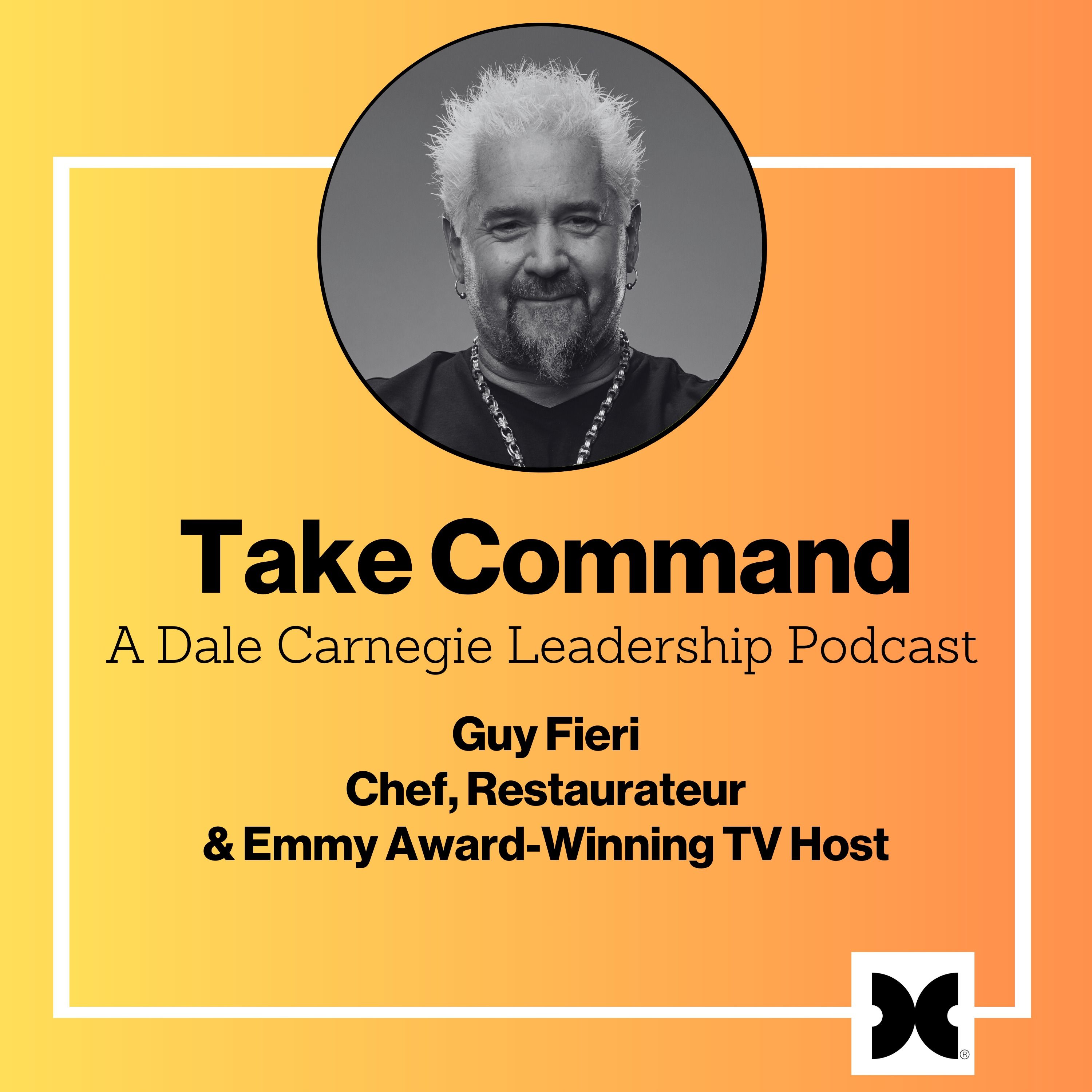
Take Command: A Leadership Podcast
Guy Fieri’s Recipe for Success: Spicing Up Leadership
00:43:37
Guy Fieri is arguably one of the most recognizable and well-known chefs in the culinary TV and restaurant world, and he owes it all to How to Win Friends and Influence People. Guy brings his whole self to everything he does, not worrying about anything standing in his way. Of his doubters, he says, “There may have been people deterring [me], but I don't really listen to that stuff. I pay attention to the things that are positive.” Guy has plenty of stories on this episode, as well as invaluable advice for anyone wanting to get along with others (which, let’s face it, is everyone in the workplace). From his early experience with Dale Carnegie’s teachings to his time on reality TV, Guy has built a brand of empathy, understanding, and genuine curiosity for others’ stories. He tackles life head-on, saying, “Empower yourself to engage in the situation, and at least be standing up taking the punches versus hiding in the corner laying down.” Learn plenty more from Guy when you tune in t...
Loading summary
Transcript58 lines
- [00:00]
Guy Fieri
Oh, I take the fight. Right, wrong and different. Don't lay down. Stand up for yourself. Be respectful. Do I say that it doesn't have any merit? No, the difference is empower yourself to engage in the situation and at least be standing up, taking the punches versus hiding in the corner, laying down. And I think that that's what people kind of miss sometimes is that, yes, it sucks. Life is tough. It's not a participation trophy. You know, you gotta be in it to win it.
- [00:42]
Joe Hart
Welcome to Take Command, a Dale Carnegie podcast. I'm Joe Hart, CEO of Dale Carnegie, and if you're ready to grow your leadership skills, follow Take command now. And never miss an episode that could transform your career. In today's episode, our guest reveals how he went from a small town chef to an iconic culinary figure known for his authenticity and resilience. He explains how he built a successful brand by embracing empathy, curiosity and positivity, even in the face of doubt. He rose to fame as the winner of the next Food network star in 2006, and has since become the face of hit shows like Diners Drive Ins and Dives. Beyond television, he's built a food empire with over 80 restaurants worldwide, best selling cookbooks, and his own line of sauces and spices. He's also earned the distinction of being the third chef to receive a star on the Hollywood Walk of Fame. Please welcome chef, restaurateur, New York Times best selling author and Emmy award winning television host, Guy Fieri. Guy, welcome to the Dale Carnegie Take a Man podcast.
- [01:57]
Guy Fieri
Thanks for having me.
- [01:58]
Joe Hart
It's certainly a treat to have you here today. You're someone who's extraordinarily famous, certainly I've watched your shows over many years. You really started with a love of food in your youth and you've really taken this to the world. And so I want to talk about that. You also, I know Dale Carnegie has had a huge impact on your life, how to win funds and influence people in particular. So we want to talk about that first. For people who may not know your full background, you started really with a love of food. At 10. Tell a little bit about the story about how you got started and how you cultivated this lifelong love.
- [02:33]
Guy Fieri
Well, in my family, whoever cooked got to make the decision of what we were having for dinner. And my parents, you know, this is mid-70s. My parents are very adventurous people in food. We lived in a small town in Northern California and we did everything from macrobiotic to vegetarian to vegan to, you name it. So we had a pretty good run of food. I Just, you know, was going to my friend's house and they were having meatloaf. Like, what is a meatloaf? You know, I'd never been around this. We were eating spinach pasta, you know, and peanut butter from the co op. So I figured out I could do this. We had to cook. In our family, you had to participate. You either cooked dinner or you did the dishes. And I hated doing the dishes. So anyhow, at a very young age, I realized that I loved to cook. And I loved food. And I always thought about it. I'd ask my mom in the morning, what's for dinner tonight? And became a rule. I. I was not allowed to ask what was for dinner until we had at least had lunch. It drove my mom crazy that I would be hounding her, because I was thinking, like always, what was for dinner. She was making eggplant parmesan one day, and I said, why couldn't we just have chicken parmesan like the normal people? And that was it. She said, if you don't like the way I cook, then you cook. I was confident. I was about 8, maybe 9 years old. Our town, you could charge at the grocery store. And I went to the butcher, John Maselli, and I said, I want to eat meat. What do I get? And he says, he sold me a couple rib eyes. I think, what do you cook with this, John? He says, probably spaghetti. So I went and got spaghetti. I didn't know that you didn't cook the sauce and the pasta together. So my parents came home from work at a small western clothing store. Made saddles and all that. They came home and I'm there cooking a steak in a pan. Butter and soy sauce is all I knew. My dad's like, what are you doing? And I said, mom said I could. And she's like, I didn't think you take me seriously. So they sat down and I had the table all set. It all was a steak and pasta and some tomato sauce. You know, my dad took a bite of that steak, and he looked at me and he said, that might be the best steak I've ever had in my life. And I'm like, that's it. I was done. That started it. And then I found the book, the Joy of Cooking. I'm like, wait a second. They give you all the answers. I mean, it's all right here. Why doesn't everybody cook all this? And I would fake being sick to stay home to cook.
- [04:55]
Joe Hart
So you have this passion. And then you even started to turn into a business at a young Age, right? I mean, you're 10 years old, you have this love of soft pretzels. And ultimately I think you use that as a way to fund your education in France, if I'm not mistaken.
- [05:09]
Guy Fieri
Yeah, I was always a business guy. I always had a some kind of hustle going. I was always making money one way or another. The town that I lived in, you ever seen the movie Outbreak with Dustin Hoffman? It filmed in a town called Ferndale. We still have a family home there and a bunch of businesses and so forth. Really angelic little Victorian village. And so I would take my toys and put price tags on them and sit out in front of my parents store. I'd sell them. People would buy my dump truck and walk in and go, hey, little kid out there sold dump truck for 50 cents. Can we give the dump truck back to you? So I had all these little business, but pretzels? Yeah, I was eating soft pretzels up in Tahoe. We were skiing and my dad gave me five bucks. We'd leave the car and I'd ski all day by myself or with my sister and you know, we'd meet up at the end of the day. My dad says, hey, what'd you have for lunch? I said, I had a couple of those pretzels. He goes, I gave you five bucks. What else do you eat? I go, pretzels, because you eat 10 pretzels. So I love these things. And he said, well, you should start a little business with that. You know, my parents are always super encouraging and supportive and you know, if I showed interest in something, they both got behind it, you know, 100%. So I had the pretzel business, the awesome pretzel. And I did that for quite a few years, five, six years. And I saved all my money. And ironically enough, while I was doing that, my parents, we had exchange students. I'm seeing these people come from different countries. Norway and Sweden were the two first we had. And I'm like, wait a second, the world is way bigger than I'm getting. And my parents are also very worldly, very mindful. They travel to Europe a lot. So they were big minded people. And I wanted to be an exchange student really bad. So I'd saved the money. But I didn't speak the language because my school didn't have French. And you couldn't really take a language until you were a junior and senior. And you couldn't get into an exchange program unless you had been in at least two years of the language. So nothing was going my way. And I worked a deal out with a friend to get me to a high school outside of Paris. My dad said I could go. I had saved my own 10,000 bucks and all I had to do was pass conversational French at the junior College as a 15 year old. Well, I pulled all of it off and I went to France when I was 16 years old.
- [07:13]
Joe Hart
Incredible determination. I mean, you hear about people who've got kind of a love for something, you truly followed it. And by the way, I can't help but think too, for all of us, sometimes there are people in our lives that support our dreams and really kind of are a wind at our back. Sometimes there are voices that say, hey guy, you're crazy. Restaurant business is a hard business. I mean, did you have some of those voices that were kind of trying to deter you or was everyone kind of around you supporting your dream?
- [07:40]
Guy Fieri
There may have been people that were deterring it, but I don't really listen real well. I pay attention to the things that are positive. Of course the restaurant industry is tough. I used to have people walk in and go, man, I bet you hope your boys never get in this business. I'd look right at them, I'd say, you know what? I hope my boys do whatever makes them happy. If they want to work in the restaurant business, then awesome. Nothing worse. For as much time as we spend in life working, why would you do a job you don't love? Why paint yourself into a corner? It's like sleeping on a bad bed or walking around in bad shoes. The drum was so loud from my mom and dad about how life can be and what you need to do to be successful, that it's very interesting because when I read how to Win Friends Influence People, which is an amazing story about how I got to the book, it was the same mantra my mom and dad had always taught me. Now I'm reading a book like, wait a second, did you read the book? And my dad was very self made. His dad died when he was young, when he was 15. So my dad had made himself. So it's just crazy, these affirmations I was getting having read the book, but never slowed down, look back. I mean, yes, second guess, yes, doubt, yes, question, yes, be fearful, any one of them. One of my favorite speakers is a guy named Zig Ziegler. Very Dale Carnegie.
- [08:57]
Joe Hart
Yeah.
- [08:58]
Guy Fieri
And I waited in line two hours to meet Zig over the lunch break of his thing. But I didn't wait for an autograph. I just waited to ask him a question and he just laughed he goes, you waited this whole time for a question? I said, yeah. I said, is there ever going to be a time, Zig, when I get on stage that I'm not nervous to speak? And he goes, well, I hope not, because that's when you're not going to do your best because, you know, he's got that really great Southern accent. He says, you know, it's when you get up there and you're nervous and you got a little fear in your belly and you got a little question. He says, that's when you're going to push harder. Gives me goosebumps to this day even talking about it, but that was the kind of stuff that I wanted to know, you know, like, is it okay by public speak all the time? And there was one time that I had an experience when I got up and I was just a little bit too confident and. And it really was the worst presentation I ever did.
- [09:49]
Joe Hart
It's great advice, really. It's like, I think people have an idea. It's like you public speak a lot. You don't get nervous or whatnot. But if you really care, if you care about your audience, you really want to give the best of yourself. Zig Ziglar was a Dale Carnegie guy. Started out in Dale Carnegie.
- [10:02]
Guy Fieri
Oh, did he really? Yeah. I can't believe I didn't know that. I should have known that. That makes all the sense in the world now.
- [10:09]
Joe Hart
How did the Dale Carnegie had on friends book come into your life?
- [10:13]
Guy Fieri
Oh, man, this is it. So I reached out just for everybody listening. This is what a fan I am of Dale Carnegie. This is how much it affected my life. I've told people this story. It has been such a part of my life. I went to my publicist, to my team, and said, someone reach out to Dale Carnegie because I want to make sure they know this story and not that it's not what everybody else has already told you. I think you've probably got CEOs and presidents and big leaders that have all kind of given their same story, but here's mine. So I was a restaurant manager. I graduated college at UNLV and went into the restaurant business. I'd been cooking. I wanted to get all the aspects of restaurant business because I wanted to open my own restaurant. That was my whole goal, my whole life was just to be my own owner. Well, the thing was, my dad said you had to work all the different positions, make sure you're done everything and go work for a big corporation. Go see what it's like. See how they manage their people, P L statements, and you just get that corporate structure. Awesome. Well, I went there and I was very passionate about the industry. I live and breathe the restaurant business. So I wasn't the greatest leader at a young age. At 22 years old, I was very smart about what I knew. I was very expectant of people, and I just couldn't understand why people wouldn't work their ass off and be great. I always had worked my ass off. Any job I ever had, I just gave 150%. So now I'm working with, you know, 150 team members that don't all give 150%. And I don't know how to really manage it. So I just do it with aggression, you know, I do it with making people stay late doing exercise work. So anyhow, it doesn't really go well. And I finally get my act together and I get recruited out of that restaurant. I think one of the managers actually went and got me recruited out of my own restaurant to go work for this small startup. And I'm getting ready to go work for this company. I take two weeks off and I really do some self evaluation. So I go to the bookstore and I buy all these books about self development, okay? Some with a cassette tape, some, you know, packaged. I think there was a Tony Robbins maybe bought all this stuff, 500 worth of stuff. And as I'm checking out is this little paperback, how to Win Friends and Influence People. Light orange, light blue, that thick, whatever, grab it, ring up the 500 worth of stuff, go back to my house, and I call my mentor, the guy that had been the first restaurant GM that I worked with, this guy named Tom Karen. And I called him, I said, hey, listen, taking the next two weeks, I'm getting myself really focused for this new job. I'm going to be a GM of this new restaurant. And I really want to find, like, where to pivot because I can't do what I've been doing. He says, well, just hang on a second before you go spend a bunch of money. This is just one book you need. And I go, let me guess how to Win Friends and Influence people. And he goes, exactly. You've heard of it. You got to be kidding me. The paperback. I went and returned all that stuff. So I take it, and I'm sitting there, my girlfriend, who's my wife now, she's watching me read this book. She goes, how long does it take you to read this book? I go, this is the dumbest thing I've ever heard. I Got to read chapter one, and then I got to read chapter two. Then I read one, chapter one, chapter two again, then chapter three, then chapter one, chapter two, chapter three. And I'm highlighting and I'm taking notes because. Are you studying for a test? I'm just reading the book. Life Changing slowed me down to take that chance to really be aware of what we're getting into and to really participate in the awareness of not what you say, but what people hear, just all these things. I mean, it was my dad coming through the book. It was mind blowing. And that was it. It changed my whole paradigm.
- [14:15]
Joe Hart
So you have this before and after kind of experience, Right? So you're managing by aggression, which, by the way, that's not uncommon.
- [14:22]
Guy Fieri
Right.
- [14:22]
Joe Hart
I mean, a lot of people start out, they don't know how to manage people. We think we can because we interact with people all the time. And so sometimes people think, you know, hey, a leader is the person who's going to tell you what to do and yell louder or whatever it is. Now you read how to Win Friends and influence People. What does the post how to Win Friends guy look like? How are you leading differently, and how does it affect your life?
- [14:45]
Guy Fieri
Again, I use the word paradigm shift, and it's something I talk about a lot. I have this tattoo on my arm. It says Namaste. My little sister was her favorite saying. I lost her to cancer, but that's her tattoo about her. And she would always say Namaste. And I never understood what it meant, but it has a very similar feeling to me about the how to win friends influence people. And Namaste is a definition for anybody, but it's basically the good in me or the God in me. She's the God in you. Like, I recognize your power. I try to teach this to my young managers and young chefs. Anybody that works on our team, the world as you know it evolves around you. You are the center of your own universe. So look at Joe over there. He is the center of his universe. As long as you can understand that Joe believes he's the center of the universe, you're going to have a better chance of understanding how to work with Joe. So when I started to pull back and look at people and say, okay, wait a second, I'm not going to get this guy to clean his kitchen or to make this dish properly by laying the heat on him. I got to find out what motivates this guy. Why is he here? Maybe it's because he's just got to have a job to Pay for his family. Maybe it's because he really wants to aspire to become a young chef, who knows? But let's find out what the energy is. Let's find out what the perspective is. And then when I think I got it all figured out, take 24 hours, come back and revisit it from another perspective before you go and step in it. It went into a Zen state. You know what so funny is when I watch the movie the Matrix and all of a sudden he's in the hallway and the bullets are zooming. Everything goes in slow mo. When I stopped putting all the pressure on it to fix the situation immediately and I started to address things in a more global perspective. You know, it's the run down the hill and meet one of the cows or walk down the hill and meet all the cows. That was it. And so I went to that restaurant as the general manager, tiny little pasta restaurant. And within three months, I had such inertia, such momentum, such success in the restaurant, that the company came to me and said, what's going on here? This team's never responded this way. We have another restaurant that we need some help with in Beverly Hills. So here I am, 23, 24 years old. I became a GM. Now I've got two restaurants that I'm the leader of. Finally they pull me out and say, we're going to give you six restaurants. I'm 25 years old now. I'm the district for six restaurants. Crazy. And I made every manager that worked with me not for me, and nobody works for me. Every manager that I got a chance to work with all had to read the book.
- [17:31]
Joe Hart
Is it still something you do today?
- [17:34]
Guy Fieri
My nephew or my second cousin, we call him a wrangler. He travels with me because we do, you know, shooting shows and visiting restaurants and so forth. And so he's kind of my right hand guy that does the admin on the road. And he started with me about three months ago, or the first responsibility he had is to read the book. And we went through it. I said, you explain it to me. Yeah, I made him write a paper about it. He's like, I'm not in college anymore. Said, you got to get it, you got to understand what it is. I think it's one of these things, you know, everybody complains about what kids learn at school these days, and all the craziness goes on. Oh, if we could just get people to sit down and read the book, I think it would handle so many misunderstandings and difficulties that go on. One of My friends called it the Hocus Pocus book. Is that really a real thing? How to win friends? Manipulate. No, no. It's not about manipulation. It's about consideration. It's about recognition. It's about awareness. It's about empowerment. You know, it's all these really cool, amazing pieces. And how this guy came to understand that in, what, the 1920s, 1930s.
- [18:39]
Joe Hart
He started his program in 1912 and then wrote the book in 1936. Like, he would say, this is my laboratory of life. This is what I've seen about, really, how to build better relationships, how to respect other people. I mean, because it is exactly as you said, guy, where every person is the center of his or her own universe. And as soon as we recognize that and people have a desire to be appreciated and valued and listened and respected. And that's really what Dale Carnegie was talking about. And it's also what you were doing at your restaurant.
- [19:11]
Guy Fieri
Yeah, it carries through. You know, I do a show on the Food Network called Diners Drive Ins and Diets. And everybody asked, like, what is it? I said, just please remember, it's not me. The people exist. The restaurants are in these small towns. They're available. We drive by them. Because it's not the big shiny neon sign. Why does it work? I think it works based really on the same principles that I live my life, same principles of how I raise my kids, do my businesses. I'm walking into this restaurant. This is not a gourmet restaurant. This is not a train chef. Who cares what it is? Coming in and respecting their castle, taking the time to ask them questions about them. Taking time to recognize who they are and what they're making and what this is about. And it's amazing how people will open up. You know, Just as we're having this conversation today, you told me this is not going to be an interview where you can ask me questions. This could be a conversation. When you make it a conversation, then it's fluid, and it can move up and down and swirl around as opposed to being chopped up. That's when people get quiet. So when I first did the show, the first episode, the guy walks me in, he says, okay, here's the question I want you to go ask this cook. So I'm standing in this little diner. They're turning hash browns, pancakes, people sitting at a counter, they need coffee. Got a truck driver over here that doesn't understand why there's a TV camera in the back of this little diner, and the guy wants coffee. And I'm from the Industry, man. This is what I do. So I'm pouring the coffee, asking the question. Pancake starting to burn. I flipped the pancake. You know, we're just kind of two buddies on the line cooking. About 20 minutes into it, and all of a sudden, the producer at the end of the thing yells, get over here. Get outside. I go, what? He goes, what the hell was that? I said, what? And he goes, I told you to ask these questions. I said, I did ask the questions. I said, listen, man, I'm from the restaurant business. I'm not going to come into some guy's kitchen and start hammering them on 20, 20 questions. I got the information, didn't I? He goes, you can do that again. That's what we do. He goes, yeah. Throws his clipboard on the ground. We've got a hit. How it started?
- [21:17]
Joe Hart
Yeah. I mean, he was expecting one thing, he got it in a different way. I'm curious. You really came into fame, if you will. You were in the Food Network's competition, where you won in the second season. And part of that, I think, was just you being you. A lot of times we can think we need to be somebody else, or we think to be successful, I've got to look a certain way or dress a certain way or act a certain way. You are uniquely you, and it's been kind of a part of your brand. Talk a little bit about that. Was there ever any pressure on you to try to be somebody that you're not? And how did Dale Carnegie perhaps influence you in this process?
- [21:52]
Guy Fieri
Well, when I went there, people kind of tripped out. I think I was the first guy that actually had, like, visible tattoos or big gold earrings. Not trying to be sensational. I mean, I was just being me. And I really had no business being there if I hadn't had my friends kind of pushing me to go. And matter of fact, I dodged the bullet a lot of times. And I wasn't going to send in my demo tape, like, what do I want to do? Go to New York, be on tv, get my butt kicked by a bunch of people that are, you know, TV people. So finally, what it was, I'll tell you, back to some Dale Carnegie isms. I'd always been the guy that was always telling everybody to go, go for it. Ask her out, start the business, get the loan, buy the truck. I'm always the guy that's pushing everybody to go live their best self. But I'm sitting there looking at myself. My wife and I are pregnant with our second son. Hunter's not 8 years old, and I'm like, wait a second. I'm not living my own mantra. I'm not following the deal. I'm being chicken about this. I need to go do this New York thing. So I made the tape and I sent it in. It was pretty sensational. It's pretty whacked out. You got to see it sometime. You ever have a chance, go check it out.
- [23:02]
Joe Hart
Is it on YouTube? Can we find it out there?
- [23:05]
Guy Fieri
But it's me talking smack, having fun with it. And Food Network just. They either thought they were going to get a crazy person or maybe somebody that can actually win. But anyhow, I go and do that competition, and I had to be me. I was 35 years old at three restaurants at the time. Beautiful wife, great son, baby coming parents, live next door. Life is awesome. I was a big fish in a little pond. I mean, it was just all cool. But I went there, and there was a lot of times they tried to break me. Not break me like Marine break you, but, you know, just, like, move me off my position. My position was always my position. It wasn't an act. You got to believe in yourself. You got to be who you are. Authenticity. You just said it a moment ago, Joe. That's one of the biggest keys. Know yourself. Take some time to meet yourself. Take some time to dig down and understand what your real position is. And there was a situation in the competition, and I don't even know some of the team knows this. One of the people competing had made a mistake, and I let it. Fought to give her a chance to get her mistake fixed. Now, in most people's situation, she screwed up. Let it be the failure of hers. You know, maybe that takes her out of the competition and she goes away. Not into that. I don't want to win off anybody's failure, okay? You just run that race as fast and as hard as you can. Don't look over your shoulder. Be the best you can be. Perform the best you can perform and win. Don't do it based off of somebody else's failure. You got to base it off of your success. And I think that that's so often where people get lost is they spend a lot of time looking over their shoulder, comparing. Just be the best you can be. And then if you win, you know you did it right. And if you don't, then you can look back at it and say, what do I need to do better? But you're not going to become better because of somebody else's failure.
- [25:00]
Joe Hart
To go back to this idea you learn this goes to mindset, too, because some people are so paralyzed by like, oh, my gosh, what if I do this? And if it doesn't work out, going to be a failure, especially in the restaurant business. One of the things I really wanted to ask you, because you had some criticism, and certainly all of us can face unjust criticism. You opened a restaurant, I think it was your first restaurant in New York City, and really received just some vicious criticism from the New York Times. Clearly, it was unfair because your restaurant was extraordinarily successful. For the next four years, you're in the top 100 restaurants. I mean, so notwithstanding the fact that you had a great restaurant, someone is criticizing that. How do you deal with unjust criticism? Because I think that's something probably our listeners would be curious about. From your experience, how did you handle that, and what advice would you have for people?
- [25:47]
Guy Fieri
You know, we want to jump onto the bandwagon of unjust, but that's always somebody's opinion. Everybody's got an opinion. My position more is about who are you taking the advice from? Who are you taking the opinion from? Your buddy that doesn't have a medical degree that wants to tell you what's wrong with you physically and mentally, or do you want to go talk to a real doctor now? You maybe have a buddy that blows a bunch of smoke at you and tells you that you're fine and everything's great and it's okay. The reality is you got to go to the credibility of the source. Do I like criticism? No. I don't think anybody likes being told this show sucks or the restaurant's terrible or you're not a good basketball player, whatever it may be. I tell my sons this. Just go to the source. Who is saying this to you? Is it some random person that's typing into a chat site, commenting on an article that was written about you and chiming in this or that or, you know, if you give that time and energy, then you're really kind of just chasing your tail. You know, you're going down a rabbit hole. If I come to you and say, hey, listen, I don't think you played out on that court today. I don't think you gave it your all. I would take that with a little bit more credibility. We want to go and discount what was said about who was. But you also have to take a fair amount of responsibility in it and say, hey, you know what? That was a young restaurant. We were only five weeks old. Were we screwing up some things? Absolutely, we were. That's what happens in the restaurant business when you're trying to open a restaurant that's doing $30 million a year? So with some of it, the wrong timing and the wrong stuff. Yes. Was some of it true? Yes. Was it as bad as it was? No. But the reality of it is you don't sit there and dwell on it. You don't sit there and cave from it. You know, we went right from that, the New York restaurant, and went and opened our next biggest flagship in Las Vegas. And people like, how did you do it? Like, how do you get up in the morning and shake that off? You said you don't shake it off. You face it. You embrace it. You take what's in it and make energy out of it. You don't become scared from it and hide from it and act like it didn't happen. Now you're being foolish. Now you're creating a mountain out of a mole's hill. Talking about it is always a great thing. You know what happened to us when we were kids? We'd sit in our room, it's dark, and that monster in the corner, the blanket folded up on the chair, got bigger and bigger and bigger to the point where we were just completely consumed by this monster and finally yell for our mom or dad, or we get up, we turn the light on, and it's not a monster. It's a blanket that looks like a monster. We've made it into be a monster. We made it to make a bigger monster than ever could have been. And I think that that's what people do. And I don't know if this is Dale Carnegie stuff. I mean, I have lost myself into the book and into the mantra and into the attitude and into the energy. So much so that I don't know if it's a Zig Ziegler or my dad or Dale Carnegie or what happens. But this mindfulness, this is what I'm teaching people all the time now. We just lost my dad to cancer in January.
- [28:56]
Joe Hart
I'm sorry.
- [28:57]
Guy Fieri
Oh, thank you. He's my best friend in the world, my hero, my mentor, my greatest coach. And I put on his gravestone, dad, husband, father, brother, nephew. And the last one I put at the very bottom was mentor. And I try to walk people through this stuff all the time about facing their trepidations and getting over themselves because they're their worst critic. You want to really talk about this? You want to figure out really why you're not happy about this. You're playing this broken record in your head, but you Know what? Maybe you're having a good time having this pity party. Because if you come to me and you ask me really how you're doing in your job, I'll tell you. Or you could just continue to play the record that you suck. You know, it's just so crazy.
- [29:44]
Joe Hart
You're absolutely right. I mean, so much of this is how we frame things for ourselves. One of the other books that Dale Carnegie wrote, I'm not sure if you read this or if it's, you know, one of the ones that maybe this kind of is absorbed into the larger kind of space, but how to Stop Worrying and Start Living is all about Dale Carnegie saying, you know what? We create stress for ourselves, anxiety for ourselves. We see this blanket on the chair, we turned it into a monster. We think if we do this, all these, you know, parade of horribles are going to happen. Going back to the example we gave of criticism, you could have been paralyzed by it, you could have been frustrated by it, angry about it, whatever. But I think the thing for our listeners is you didn't let it stop you. You had a vision for where you wanted to go, and you kept on going.
- [30:24]
Guy Fieri
Let me touch on that one second.
- [30:26]
Joe Hart
Sure.
- [30:27]
Guy Fieri
So I flew home. I had been in New York. I hosted a fundraising Sandy. The hurricane had just hit New Jersey, New York. I was in New York doing a fundraiser for Sandy victims at my restaurant with the New York Times. That night. That night I flew home to Northern California from New York. When I landed, the article had come out. I went home, told my son I would take him to school, saw Ryder, gave him a kiss, saw my wife, gave her a kiss, drove back to the city, got on a plane, flew back to New York, and then we had the morning show. Come to the restaurant and try all the food that had just been lit up. Oh, I've taken the fight. Right, wrong and different. Don't lay down. Stand up for yourself. Be respectful. Do I say that it doesn't have any merit? No, the difference is empower yourself to engage in the situation and at least be standing up, taking the punches versus hiding in the corner, laying down. And I think that that's what people kind of miss sometimes, is that, yes, it sucks. Life is tough. It's not a participation trophy. You know, you gotta be in it to win it. My youngest son, Ryder, said to me the other day, we were talking about basketball, and he's a big basketball player. He just started San Diego State as a freshman, and we're talking about the game. This was last year. I Don't know where it came from. But he said, you know, dad, the only shot I'm not gonna make is the one I don't take. Where did you hear that? That's the best line I've heard.
- [32:05]
Joe Hart
You're saying, this is my son, he gets it.
- [32:08]
Guy Fieri
Exactly.
- [32:09]
Joe Hart
One of the things Guy, that is interesting is, you know when you talked about how to win friends, you talked about, you start to live these principles, it changes you. I mean, this is really true is often people can see changes in us. We may not see them ourselves. You have a story of a Dale Carnegie person who saw you, didn't know who you were, didn't know anything about you, but said, this person is clearly a Dale Carnegie person. Would you share that story?
- [32:35]
Guy Fieri
All right. Now you're going to have to validate this for me, Joe, because I told Joe about this before we started recording. So come to Northern California from la. My wife and I are pregnant with our son Hunter. I have no money. We have a car with 400,000 miles on it, my pickup truck from college, two Rottweilers and an eight month old pregnant wife. Have no money to open my restaurant. I'm trying to get an SBA loan, finally find a restaurant opportunity. That's awesome. Call my dad, said, dad, I don't know what to do. I got to get some money. This deal is only going to be on the table for the next couple days. And he covers the phone and yells to my mom, benny, guy found a restaurant. He thinks this is the one, needs $50,000 because. All right, sounds good. I'm gonna go down to the bank right now, I'll put a second on the house, I'll send you the 50 grand. My business partner had 50 grand. The landlord loaned us 50 grand and I got my 50 grand and we bought out the current restaurant and we opened our restaurant. Paid my parents off, by the way, in six months and never look back. I was seven days a week, 17, 18 hours a day. We had no money. We just had a baby. We're living hand to mouth. We got to survive. So I'm working the floor, I'm doing everything. So table nine, little two top table, the side of the restaurant. And this lady's watching me tell when someone's watching you. At the end of her meal, I said, how was everything? She goes, it was really great. She was, how long have you worked here? And I wouldn't tell people I was the owner. I said, I've been here since the beginning. She goes, amazing. She goes, the way you Are with people, the way you talk to people, the way you listen. This is really impressive. She said, I work for a company, and we do motivation and education, and so you would be great with us. I don't know if I was getting offered a job. I think there was a job implication of that. And I said, oh, thank you. I go, what's the name of the company? And she gives me her business card. Dale Carnegie Institute. You gotta be kidding me. I said, do you know what a fan I am? I said, who are you? And I believe now again, I can get names mixed up. Dorothy, Donna, I think it was. Donna gives me this card. She says, I'm the granddaughter of Dale Carnegie. I said, this is like the greatest day ever. Are you serious? I could be completely wrong on this.
- [34:51]
Joe Hart
I'm going to ask her. I will check with her.
- [34:53]
Guy Fieri
Listen, man, you got to get back to me and tell me if she remembers coming to Santa Rosa, California. California. So we have this conversation. And I said, no, this changed my life. I knew it was a Dale Carnegie person now, whether or not it was Donna and whether or not I was getting offered a job. I said I thought it all figured out. I said, I did have the restaurant side figured out. I knew how to make great food. I knew how to run a restaurant. I knew all this stuff I said just wasn't getting that conveyed to my army, to my team. And I'm a very. What you say is what you hear, what you hear is what you think. What you think is what you believe. And what you believe is who you become. I mean, that's always been my mantra, but you have to practice what you preach. So this went on, and I told her about it, and I said, by the way, I make all my managers read the book. I said, I have five copies of it in hardback, printed in 1936, 37. I said, I have hardbacks of that. She's like, wow, you're pretty excited about this, aren't you?
- [35:45]
Joe Hart
She had no idea how serious you were, but she could tell just by the way you were acting and interacting with people and so forth. So, Guy, you know, one thing I've started to do with the podcast is I go to ChatGPT before the podcast. I say, hey, I'm gonna have this interview with the guy, and if you can ask guy any one question, what would you ask? And so the question I'm going to give you is the question I got from ChatGPT right before this interview. You ready for this? Probably the best question I've asked All day.
- [36:12]
Guy Fieri
Oh, boy.
- [36:13]
Joe Hart
Okay. Throughout your diverse career, from chef to TV personality to entrepreneur, you've stayed true to your unique personality and brand. What has been the most important lesson you've learned about staying authentic? And how can others apply that lesson to their own lives and careers?
- [36:31]
Guy Fieri
Buddy of mine went skiing. What was the orator that used to do the radio show? The rest of the story.
- [36:41]
Joe Hart
Oh, I know exactly who you're talking about. It's gonna hit me.
- [36:45]
Guy Fieri
It'll come to me anyhow. But I loved how I always got the message. I used to look forward to it all the time. Matter of fact, you can still find it on. I have an app where they play one and I can go and listen to him because he always had the greatest way of teaching you the lesson through the story.
- [36:59]
Joe Hart
Paul Harvey.
- [37:00]
Guy Fieri
That's Paul Harvey with the rest of the story. So to answer your question, I'm going to do it in a Paul Harvey style. Buddy of mine says to me, I went skiing this weekend. I said, really? Where'd you go? He said, I went to Tahoe. I said, all right. He said, I skied three days. I never fell once. I said, wow, you are either an Olympian in the making or you were on the bunny slopes the whole goddamn day. And what I mean by that statement and what I'm referring to, and to answer you is you gotta be willing to play if you want to make the pay, you know, or some other goofy rhyme. You got to be willing to take the chances. I walked into that room the night that I got there, my dad's birthday, November 19, into the apartment building in New York City. I just got out of the cab in flip flops, shorts, and a yellow leather jacket, and I walk into a room full of cameras and all these chefs are going to compete, all standing there in their chef coats. And I'm in a cut off T shirt, big gold chain, and a leather jacket and sunglasses. And I'm looking around like, we're not in Kansas anymore. This is going to be bad. And I'm looking at myself going, what are you doing here? Who knows? Just give it a shot. Have I fallen hard? Have I got back up? Absolutely. Just as Ryder said, the only shot you're not going to make is the one that you don't take. So for me, when I watch people, one of my favorite jokes is the guy that wants to win the lottery, and he tells God that he's going to win the lottery and he's going to take all the money from the lottery, and he's going to do all God's work. And after years of praying that he's going to win the lottery, he doesn't win and finally goes to the top of his cliff and he's going to jump. And he says, God, I promise you, I would do all your work. I would take the money, I would give it to orphans. I'd do the work. You didn't help me. Cloud's part, and he hears a booming voice and says, could you at least just buy a lottery ticket? You gotta get in it to win it. And so often people are sitting back and there's a lot of trepidations and a lot of scares and a lot of potential failures and you think you're gonna look stupid and all these things are going to happen. If you're going to let those demons get you, if you're going to let that negativity attach itself to you, then, yeah, you're never going to jump out of the plane. I am so scared of heights, Joe. I'm the most petrified guy of heights. And I made myself jump out of an airplane. Anytime I come across something that feels like I can't do it, like it's going to be better than me, I have to go conquer it. And sometimes I don't. Like, I didn't ever jump out of the airplane again. That sucked. But I did it.
- [39:49]
Joe Hart
You did it. Once you faced the fear, you proved you could do it. My moment, like that was doing stand up comedy. That was terrifying. It is so much about taking the shot. Guy, thank you so much for being with me on the show today. Really just excited to have had you. And truly, you're an inspiration.
- [40:06]
Guy Fieri
Well, you guys didn't reach out to me. I don't even think you knew about me and my relationship with Dale Carnegie. But Erica, who's my PR machine, I text her and I said, I want to make a contact with these people. I want to say thank you. Whose ears it falls on, who gets the message? I don't know. Didn't know if there was a podcast or anything. Didn't know if it was just going to be, hey, Guy Fieri, want to let you know he's a fan and thank you. I have so much more to talk about on this topic and what it is and how it's changed my life and where it's taking me and so forth. But I just had to say thank you. And hopefully, maybe through this podcast or maybe just through affiliation or whatever, it inspires one person. As Zig Ziglar said, as long as you walk out of here with one idea, as long as it's made a difference to one person out of the 5,000 people that are here today, then my job is done, that I've been successful. And so as long as somebody hears this today and looks at it and says, man, really, it made a difference, okay, I'm going to make my kid read that book, or I'm going to read that book, or I'm going to have everybody in my company read that book, or I'm going to go to this institute. Maybe you don't want to read books anymore. And I'm going to go do the training. It was my way of saying thank you because it changed my life.
- [41:21]
Joe Hart
Well, thank you and thank you for sharing that. And these kinds of testimonials are what fuel us. We are really mission driven to help as many people as possible get access to these amazing principles because they change lives. They can create richer, better relationships, better careers, and like you said, make us better fathers, husbands, everything.
- [41:41]
Guy Fieri
And we need to do this because as you watch the fabric of our society taking so many different hits, no one's ever anticipating AI. No one's anticipating social media. Nobody's anticipating fentanyl. We've been getting hit from all these different angles. We sure the hell need to work on the fabric of community and the fabric of camaraderie and teamwork and mental, physical, emotional support and respect. We can do it ourselves and we can do it. We just have to make the commitment. And this is the kind of stuff I want to see us teach. So you guys are heroes of mine. I think it's awesome what you're doing and, you know, hopefully our paths will cross again. And you let me know if there's any way that I can ever help or give back. But it's an honor. It really is. All I want to do is just tell you guys thank you and then you guys invite me on the podcast. But this is great. I'll be listening, I'll be tuning in, and hopefully we'll get a chance to, you know, do something else in the future.
- [42:34]
Joe Hart
I look forward to that. Maybe we can do a part two to the podcast.
- [42:37]
Guy Fieri
Well, please go verify that Donna has been to Santa Rosa, California, because I sure have been selling that story.
- [42:46]
Joe Hart
That's awesome. Well, I'm going to tell her and we'll see what she says, but thank you, guy.
- [42:50]
Guy Fieri
All right, bud. Thanks a lot, Joe. Appreciate it. Brennan, you're awesome. You're extraordinary.
- [43:00]
Joe Hart
I hope you enjoyed this edition of Take Command. A Dale Carnegie podcast. Check out our resources at www.dalecarnegie.com for more research, insight and tools that will support your success and help you take command of your leadership potential. If you enjoyed this episode, please consider rating it and following us on Apple Podcasts and Spotify. For more exclusive content, subscribe to our Dale Carnegie YouTube channel and follow us on social media. As always, thank you for listening and we're looking forward to you joining us for the next episode of Take Command, a Dale Carnegie Podcast.