← Take Command: A Leadership Podcast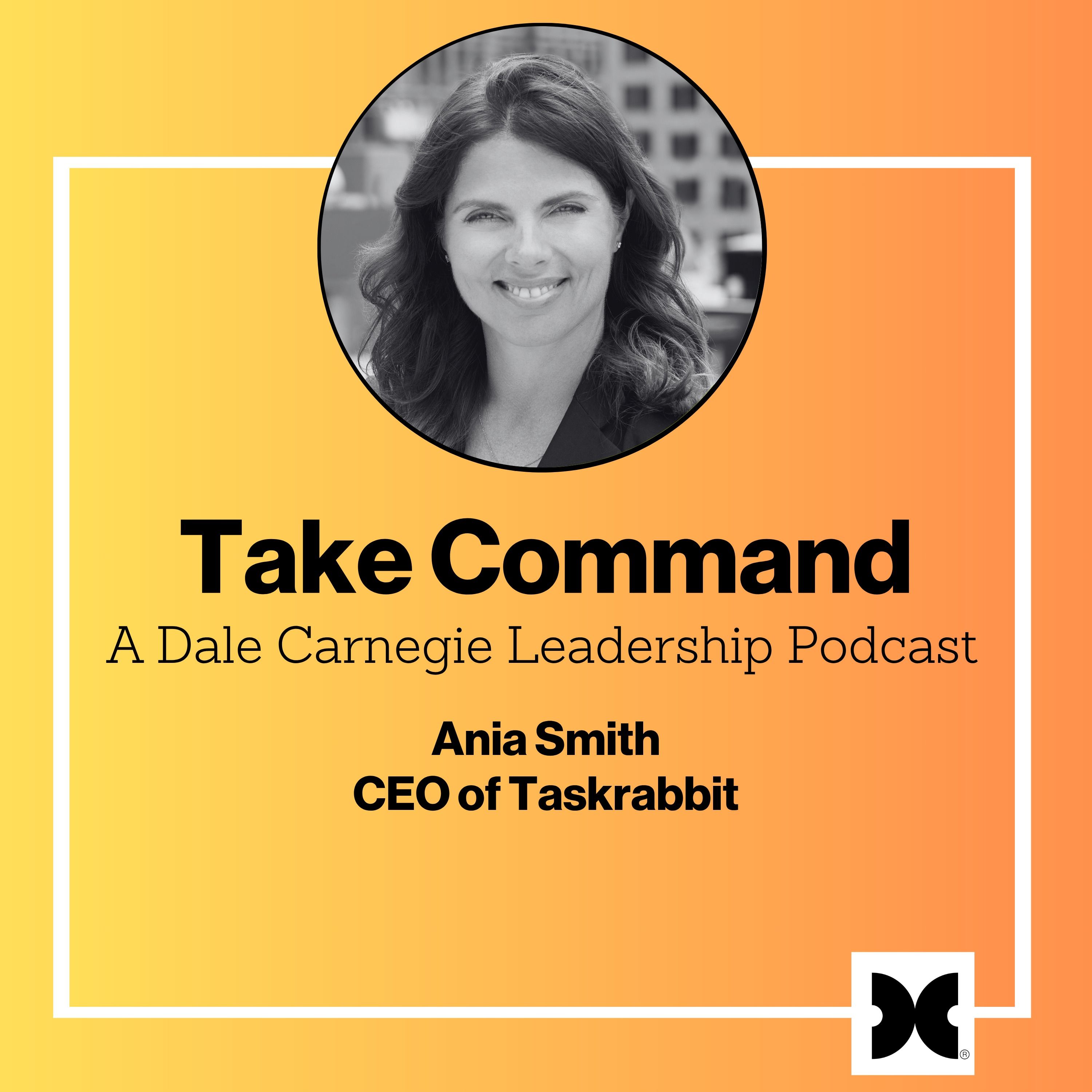
Take Command: A Leadership Podcast
Hire People Smarter Than You: Humble Leadership in the Age of AI
00:36:17
Ania Smith is someone who has built a remarkable career on resilience, curiosity, and a deep belief in people. She arrived in the U.S. from Poland at 12, not speaking English, and went on to lead at Airbnb, Walmart, and Expedia before becoming CEO of TaskRabbit in the thick of the 2020 pandemic. She says, "It is not about the fall. It really is about the ability of being able to get up the moment after the fall — and use that experience to get that much stronger." Ania's episode is full of grounded leadership wisdom. She shares why careers look more like Google Maps than a straight highway, why she hires people smarter than herself, and why listening is the core skill of leadership. She reflects on raising resilient kids in a low-stakes world, keeping relationships alive "when you don't need anything," and why — even in the age of AI — "the most exquisite thoughts really still live within us humans." Tune in for these and other shining nuggets of Ania's wisdom.
Loading summary
Transcript48 lines
- [00:00]
A
I certainly don't have all the answers. I want to make sure that every single person on my team that I hire smarter than me, you know, they better be because I want to be building the company for the long term. And so that means bring in the best talent that I can bring.
- [00:27]
B
Welcome to Take Command, a Dale Carnegie podcast. I'm Joe Hart, CEO of Dale Carnegie, and before we dive in, don't forget to follow Take Command, where every episode gives you the tools to lead with confidence. Today our guest shares what she's learned, leading and scaling some of the world's best known marketplaces through rapid growth, building mission driven operations, and expanding a brand across new markets. She brings more than 20 years of experience in global business operations and strategic planning with leadership roles at Uber, Airbnb and Walmart E Commerce. In her current role, she helped lead the company to a record breaking year of growth. She is a member of the Forbes Business Council and was named one of the San Francisco Business Times most influential women in Bay Area business. Please welcome the CEO of TaskRabbit, Anya Smith. Anya, welcome to the Dale Carnegie Take Command podcast.
- [01:34]
A
Thank you so much for having me. I'm really excited to be here, excited
- [01:38]
B
to have you, and I think you really are going to offer a different point of view to our audience. You've worked with some pretty incredible companies over the years. Airbnb, Uber, Walmart, Expedia. Today you are the CEO of TaskRabbit, which is a global marketplace, certainly connecting people who can help other people accomplish tasks around their homes or their businesses and so forth. It's one of the fastest growing platforms as I understand it. So congratulations on the success. And you've been with the company. You started just after 2020, right?
- [02:07]
A
It was right in 2020, at the end of August. So in the midst of the pandemic.
- [02:13]
B
What an incredible time to start. And so I definitely would love to ask you a little bit about the insights you had before. We do just give our audience a little bit of a sense of who you are. You came to the United States at 12. You were born in Poland. You, you didn't speak English. You really learned the language and ultimately had an education journey and a career journey. Tell us a little bit about you.
- [02:34]
A
So you're right, I moved here when I was 12 and it has become this part of who I am in a way that of course, when you're in it, you don't think about. But like any other or many, many immigrant stories, my family and I moved here when just sort of before I became a teenager, and I was trying to really figure out how to assimilate myself in a small town called Sioux Falls, South Dakota, which was an interesting experience, primarily because there weren't that many immigrants. And so, you know, I was sort of a novelty to many people, and the situation's very different today. And that was both helpful and, in some instances, not as helpful. But I felt just almost like any teenager does, this really strong sense of needing to belong. And so that led to me trying very quickly to, first and foremost, learn a language and figure out how I can really survive and thrive in a new country where everything was different, you know, from how the stores looked and the food that we ate, the friends that we had, and then, of course, the school day and what that was like. And I was very excited to be here and very excited to learn. And there were some incredible teachers and people that came along the way that really supported my brother and I and helped us to get acquainted with the culture, and then really gave us a lot of wisdom and time, especially in those early years. You know. In fact, a few years back, my brother and I were back in Sioux Falls together, and we saw one of those teachers who, literally, that first summer that we were here, she met us at school every day during the summer when there was no school, so that we can spend two hours reading. And that's just an incredible amount of just sacrifice and generosity that many people gave us. And I am very, very grateful for that.
- [04:46]
B
It's pretty incredible, isn't it? When we look back over our lives, the people who maybe acted out of kindness, they did something we weren't expecting, but they played such an important role in our lives. Certainly there's an opportunity for us to be that with other people as well. So did you have a vision for yourself at that time you came to the United States, you're learning the language. Are you trying to belong? Today you're a CEO. I mean, like, what was your vision for yourself as you were going through those teenage years?
- [05:11]
A
Honestly, the vision was simply to not be poor. And, you know, when you start with a fairly low floor, I often talk about that because it sort of drives you. And I just wanted to make sure that I had the ability to have a good job, have a family, and that was going to be very sufficient. And, you know, as I went away to college and I started getting out and about a little bit more, and I spent some time in New York, but I also spent my summers in Washington, D.C. i got very excited about working internationally and having Some sort of an impact in the world that was bigger than the town of Sioux Falls. And I was really driven to study hard and to learn and to meet as many people as I could and really be curious. I was very curious about the world. I remember, you know, spending days and days negotiating and debating NAFTA when we were in college. This is what was happening in the world. And I really loved these conversations, and I loved spending my summers on the East Coast. And I was fairly certain that I wanted to do some work internationally. And that was definitely the dream, and I didn't dream past that.
- [06:37]
B
It's interesting, I think I saw in your background that you were in Model United nations in college.
- [06:42]
A
Yeah.
- [06:43]
B
Which is something I remember doing in high school. When you're talking about debating nafta, and that's exactly what you do in this environment. You're standing up in front of a room full of people. You represent a country, you're arguing on a position, but it really does force you to be on your feet and to take a position.
- [06:58]
A
And so much of this really comes back to people. You know, I had a wonderful professor on college, Dr. Tom Loeb, and I'm still in touch with him, who ran Model United nations and really exposed and introduced me to the world that is bigger and broader. And it's, as you said, that, you know, certain people have such an outside impact on who you become and who you are. It's incredibly powerful to know that as a human, you can have such a profound impact on someone else's life.
- [07:33]
B
It's true. I'm kind of curious about how some of these relationships affected your mindset. Right. Because you came here, you talk about courage, boldness, agility. Certainly that's something that you're known for talking about. You know, you're meeting different people who are supporting you or guiding you or whatnot. Where does that mindset or where did it come from from you, that desire to get out and to take chances and to push yourself?
- [07:59]
A
Well, I think along the way, you know, we were growing up quite poor. I had to get a first job fairly soon after we landed in Sioux Falls. I started with a paper route because I just needed money to buy clothes for myself. Whether I knew it then or not, it certainly provided a level of motivation to make sure that I remain curious and I study and I work hard in order to be able to do better. And I think having the support the network around is really useful. And so I feel extremely fortunate and really a great sense of gratitude for, you know, people that Come along the way and really help and support you on your journey. And my goals then were not to become a CEO. I wouldn't have even known what a CEO is. I remember at some point a friend of mine mentioned the word Harvard. His sister got into Harvard. And once you go into Harvard, your life is made. I had never heard of Harvard. I'd never heard of really good universities. In college, I did an exchange. I actually went back to Poland and studied and at a very good university. And there people said, you know, Wharton is the best business school because I was studying business. And so that's what everyone says. So we're just following what Wharton does. And I didn't even know what Wharton was. And so it took me a while to actually realize that there was just a much more expansive world. But I think that that's okay. You know, I think kids now, they grow up so quickly. And especially being a mom, I can see this happening. It is definitely a different life than the one I was leading as a teenager.
- [09:45]
B
It sure is. Right? I mean, people are exposed to so much more. They've got the world at their fingertips. You can see and learn so much just by our phones or whatnot. It's also. It strikes me as a harder time in many ways for younger people. Right. I know you've got three kids, I've got six kids. And I've seen firsthand just some of the challenges that they've had. And certainly we see young people coming into the job market. Sometimes they're not prepared for the corporate world. They don't have the skills, they don't have the confidence and so forth. So. So are you seeing that in your world as well? What's your perspective?
- [10:16]
A
I mean, yes, I think one of the biggest skills that is lacking often is resilience and really being able to get up every time that you get kicked down. And life is rough and can be very rough. I feel as parents, we want to protect our children from almost anything that can potentially hurt them. But what happens is, if there's so much of this protection, once they go out into the real world, they tend to flounder a little bit. Right. And they're learning these resilience lessons probably a little bit later in life than they could have. But the stakes are very low in elementary, middle, and high school, and we make it feel like they are very high. You know, I see parents just screaming on the side of soccer fields and doing these things, getting right.
- [11:08]
B
It's like it's the World cup or something like that. On the 10 year old soccer field?
- [11:13]
A
Yes. I have a hard time understanding why, because these kids just need to be kids and they need to learn to lose and they need to learn to lose a tournament and lose a championship and have a bad game and do all these things because these things are so low stakes. They become higher and higher as you get older. So this is the time to learn. I feel that we spend too much time protecting our kids so that then those lessons become that much harder when
- [11:44]
B
they're older, for sure. I want to ask you a little bit about resilience because we're just talking right now about you've gotten through Wharton and now you can start to go into the corporate world, work for major technology companies. You're leading a technology company today. What are some of the key things that you've learned about resilience? What advice would you give to people who are struggling with kind of this level of confidence? And, you know, you get knocked down and it's hard to get up sometimes. What have you learned, Anya, and what advice would you give?
- [12:13]
A
It can be hard and it's so hard in the moment. You know, when you have a horrible day or something really goes bad. You lost a deal that you thought you were going to get, you lost your job, you, you know, are having a difficult time with your spouse or whatever it may be. Every day is a new day and a new opportunity. And so understanding that really that's what makes us tick. That's what life is about, is learning from whatever experience and then doing that much better next time. It's really hard in the moment. And you know, I sort of always allow myself to grieve for a little bit. Whatever the emotions are, you have to feel the emotions. But then you got to get up. You know, I remember the very first time I took, I think it's called the gmat, to get into MBA program and I didn't do that well. I thought I would do much better. And I was so upset and literally in my head what that meant is I'm not going to get into a really good business school. Once I don't get into a good business school, I will not get a good job. Once I don't get a good job, I will then get a really bad job and then I probably will lose that job. And then I probably. And I could just in my head go all the way down this path and I let myself mope for, I don't know, a day or two. And I remember my boyfriend at the time looked at me and Said, just get up, stop being a victim. These were wise words. It is not about the fall. It really is about the ability of being able to get up the moment after the fall, or the day after, or the week after, the month after, and use that experience to get that much stronger.
- [13:54]
B
It's so true. And I can't help but think that a lot of this depends on how we frame it. So you were thinking to yourself, oh, my world's over. We can tend to catastrophize something, right? And I think, going back to your point about low stakes for kids, in many cases, I think it's low stakes for us, but we make it into big stakes. So we make something into a much bigger thing than it truly is. It's like, it's not the end of the world. Tell us a little bit of your career journey. You advanced in some very large companies. Tell us a little bit about that background and some of the things you learned along the way.
- [14:26]
A
I think right after college, I got very fortunate and I took this job in international development, which was fabulous. And that was the first time I sort of went into this environment and I was surrounded by only people who went into Ivy League schools. Literally, I was the only one. And somehow I managed myself to get in there. But fairly quickly I realized, wow, people are super, super smart and I need to go back to school. And I had really great support network again and again. I'm friends with my very first boss. I am still very close with her, and I think it's really important to continue to build relationships. After business school, I decided that one place where you can really advance is investment banking. I had no idea what that meant, but I knew it made a lot of money. And I am definitely motivated by money. And I think some of that comes from growing up without any. And so people are often shy to talk about it, and it seems shallow, but I don't think it is. Especially for women, it is okay that one of your motivating factors can be money or can be to provide for your family, which is what it is for me. And so I started my career off in investment banking and fairly quickly realized that this doesn't quite suit me. My skills, but more importantly doesn't align with what I want to do in life. It felt a little bit for me like it was moving money from one place to another, but not really creating value. And I really wanted to get better at building something. So I went back into consulting, and that actually was really incredible training. And I still use some of the skills that I learned at lek. To this day, after a few years of being there and being promoted to a manager and really feeling like I'm learning and growing, I wanted to go into a company and then start really building what felt like adding value. And I've been really fortunate to work for some of these biggest brands like Expedia and Walmart, and then got into Airbnb, which, you know, was just an incredible, incredible experience. One that I knew then every day that was incredible. And I knew I probably will not get to relive it again. And maybe I will. I don't know. You know, I feel very fortunate living here in a Bay Area and having that experience.
- [16:53]
B
What made it so incredible?
- [16:54]
A
I'm just curious, you know, it was just such a rocket ship. We were just moving so quickly and it seemed like no matter what we did, the company was just going to grow. And being in that growth environment is so valuable because the speed and the urgency with which you make decisions, with which things go really well or really bad, it's just a great, great learning experience. And then more than anything, I was surrounded by some just absolutely amazing people again, many of whom I'm still very close to. And so I highly recommend running towards growth, running towards what seems like the impossible, because it gives you this chance to really be uncomfortable. You just don't know. There wasn't a market like that and we just had to invent and be creative in so many ways. And it really can set you up, especially at a different speed. But you know, you asked me about just the career trajectory and I've talked about this before. I often think about careers a little bit like Google Maps, where you're not always on this high speed highway. You very often can take the wrong turn and sometimes you end up in a ditch, sometimes you end up in a dirt road and you really have to slow down and sometimes you kind of have to go around something before you can get back on. And I really think it's hard for people to recognize that careers are not just these linear trajectories. Having to get off the highway and having to really find a new way to get somewhere and going lateral and learning a new skill really helps to set you up. You know, I heard Jamie Dimon talk about this when you start your career and you get really good at one skill and figure out what that is, and you kind of do that really well, you know, as you move up. Now, this one area that you oversaw, now you're overseeing two other areas and you don't know much about these two other areas, and somehow you still have to lead these two other areas. And then, of course, as you go up, you add other areas, and you, by definition, can't be an expert in all of these. And so. So how do you adjust to that, to knowing less and having the confidence to lead? And I think one of the things is having resilience, and the other one is having curiosity and being open to learning and asking for help and getting people to help you. And I think that's been really important in my career.
- [19:23]
B
It's true, many times people are reluctant to ask for help that either don't want to ask for help or they think that there's something bad about asking for help. But I mean, it's really true. Most people, in fact, many CEOs who've been on the show have talked about key mentors in their careers and simply just asking and reaching out. And usually people are often very willing to help. They want to help. Certainly you probably help others. I've helped others and help others. So it's something that many people are just receptive to if they're asked, I think.
- [19:51]
A
Absolutely. When I became a CEO of TaskRabbit, it was my first SEO job. It would be crazy to assume that I would know how to be a CEO. I mean, by definition, I had only led operations or some form of operations before. So, yes, I've worked a lot with the legal team, and yes, of course I've had finance partners, and yes, I understand what product and engineering functions do, but I never oversaw those functions. And so I very quickly reached out to several CEOs, people who had been my partners or my mentors or bosses previously who are now leading organizations. I don't think anyone said no. And I structured calls and would come in very prepared, asking specific questions like, this is a problem that I'm facing. This is how I think I should solve it. What do you think? You need some sort of sounding board. And so I asked a lot of questions, and not just of this team that I assembled, but also of my team here at TaskRabbit. I went on a listening tour almost immediately when I started, and I met with every single person in the company, one on one, to better understand, well, what is working, what isn't working, what do you think are our biggest challenges? And it really helped me to try to figure out how to set the strategy and the vision for the company going forward.
- [21:15]
B
You engaged people. I'm curious. You've talked about relationship throughout this interview. You've talked about people you've stayed in touch with, past bosses, mentors, and so forth. Do you have a couple of. I don't want to say secrets, but things that maybe you have found to be effective in building strong relationships?
- [21:34]
A
I think one thing is keeping in touch when you don't need anything. So not always coming to get something, but also offering to give and being helpful as much as possible. Right. So these people now, for example, also have needs and have questions, and it's really nice to understand that it becomes a reciprocal relationship. I also learn a lot from being a mentor to younger generation. I learn from them way more, I think, than they learn from me. It's really helpful to understand how they frame problems, how they think about solutions, how creative they are. And I think it's important to be able to give and take along the way. And I think always being curious, I think it's really important to care deeply about what everyone else is going through and why this specific topic is important to them. I almost always say yes. Sometimes it takes a long time to get on the calendar, but that's okay. I certainly take the time to be as helpful as I possibly can because I know how impactful that has been in my life.
- [22:48]
B
Well, that's right. And it's paying it forward. It's interesting that there's a quality I'm hearing from you which has come out from a lot of CEOs and others I've had on this show, which really is about humility. You know, there's this perception often that the leader, the CEO, needs to have all the answers. Or, you know, if I'm a VP or whatever it is, I need to have the answers. I need to project that knowledge. The reality is we don't always have the answers. We can always learn from somebody else. Dale Carnegie famously quoted, I think it was Ralph Waldo Emerson in How to Win Friends and Influence People as saying, every person I meet is my superior in some way in that I learn from him or her. Right. So what you're saying here is I'm talking to someone who might be much younger than I am, but, you know, what can I learn from them? But there's a humility, I think, in leadership that says, look, I don't have all the answers.
- [23:33]
A
I certainly don't have all the answers. I want to make sure that every single person on my team that I hire is smarter than me. You know, they better be, because I want to be building the company for the long term. And so that means bring in the best talent that I can bring, and we each have a specific role to play. But I certainly cannot understand everything that our engineering leader does and how he chooses to lead his team. And from a technical point of view, certainly I can only pick up what is needed at a high level. I try to get to the point where I can ask some dangerous questions, and that's basically what I can do. And then there are some special skills or special things or interests that I have where I will go in a lot deeper. But generally speaking, the team that I'm building is the team that is leading the company day in, day out, and then hopefully their teams are doing the same.
- [24:33]
B
So, Anya, on this point, how would you define leadership? What does leadership mean to you? What does good leadership look like versus not good leadership?
- [24:43]
A
For me, leadership really, at the end of the day, comes down to people and being very human. And so there are many things, whether it's having empathy or being a good listener or having the right courage or confidence. But at the end of the day, I think when I see people on my team and their teams grow and come up with much better stuff than I could have ever come up with, or just much more innovative and creative ways to solve solutions, that's where I feel the best. That's where, you know, I see someone on my team getting through and getting promoted. That's what makes me most happy. At the end of the day, TaskRabbit is a wonderful place. It's an amazing organization, and really, I'm grateful to Leah, who founded the company, and Stacy, who then took it on for setting such amazing foundation and culture. But at the end of the day, TaskRabbit will be here after I leave as well. But the relationships that I'm building here and in my previous opportunities, like those things matter forever. I've been fortunate where I've brought in some folks with whom I've worked with before to TaskRabbit, and one of them is my general counsel. He's going to be celebrating five years at TaskRabbit here this week or next week. And it's so exciting because it creates a level of trust and a level of understanding for each other that I think at the end allows us to move faster and grow faster and do all the things that I want to do. You know, I can be very direct as an example, but hopefully I've built enough trust that when I am direct, it's because I'm trying to help someone. It's better to do that than to sort of hold back and then not see them grow. As a result. So it's been a great journey, but I'm still learning every day. And how to be a better leader. Still a long way to go.
- [26:43]
B
What is something that if you look back to when you were young, you've learned that you'd say, I wish I had known this when I was 22, 25. Something about people, something about leadership.
- [26:55]
A
I think more than anything, I wish I had learned to be a better listener when I was younger, earlier. And I'm still learning. It's something that I have to be very intentional about, but I think it's really the core of leadership. I think without being a good listener, it's really hard to be a good leader. That's my personal opinion, and I wished I would have known that sooner. I joke with my daughter, who is, as she's being told by many others, many me, that at least I can point out all my flaws to her now, and she can start learning how to address them way sooner than I did. And she rolls her eyes appropriately, obviously.
- [27:38]
B
Yeah, I was gonna say, if she listens, right? I mean, I will talk to my own kids. And I'm like, you know, your dad knows a couple things here that I could be helpful, but, you know, people have to be receptive. How old are your kids?
- [27:50]
A
So I have three kids. They are 14, 16, and 18. The oldest one is just getting ready to leave soon, and that's very bittersweet
- [27:58]
B
and sad, exciting time. My youngest is 19. Oldest is 27. And I have found that when they get a little bit older, they usually come back and say, I've got one who I used to really butt heads with. And she'll say, you know, dad, I need some advice, because most of the time, you're right. And that wouldn't have happened when she was 18. What are you most excited about? Anya, as you think about your future, the years ahead here, you still have, you know, Runway that you're focused on what really excites you for the future.
- [28:29]
A
You know, I'm excited that we're living in some crazy times, and so I like the uncertainty of it. And I tend to be a glass half full person. And so, you know, whether it is our politics in the world at large or, you know, the dawn of AI and what that means, I tend to find or look for the positives and all of that. I am particularly excited about what we can do with AI especially thinking about it in a human centric way. At TaskRabbit, we're very much so about people. We talked about Taskers I think we're a long way away from a robot show up at your house and mount a TV and then leave your house. And so we're really leaning into the human connection that we continue building on and then within the company as a whole, I think that's really. I think these skills of how do you connect with people, how do you listen to people, how do you build the relationships that are so needed, is really important today particularly, I think that AI has a place, but it will never replace a human, even when it comes to things like creativity. I was just reading this morning and, you know, because I have an oldest daughter and she just went through the college application process, and so there's been a lot of talk about writing and how do you write well, and this idea that AI can help you generate some ideas and then you can write, and then it can help you kind of finish it off. I don't quite agree with that. I really think that the best ideas are definitely still within us as humans. It's just AI to me, it's like generating to the mean, right? Is just taking the average. And sometimes that's okay. Like, averages can be really, really amazing. But I think the most exquisite thoughts really still live within us humans, and it takes us to try to figure out what they are. And I think that it's exciting to have these tools to help us, but really see the beauty that humans can bring. And so for me, this is an exciting time to be alive.
- [30:51]
B
It's interesting because some of the things that you talked about, I mean, AI is a tool and people can use that tool. I don't know about you. I mean, I get emails and communications from people, and it's very clear to me that it was just written by AI and I immediately draw judgments like, oh, was it not important enough for you to take a moment to kind of customize this, contextualize this? I think what's going to happen in the months and the years ahead is the things you're talking about, the ability for someone to be creative, the ability for someone to develop relationship, connection, trust. I mean, again, these are tools that people are using, that people are still using them. And at the end of the day, it goes back to this theme I think we've had about relationship and the importance about relationship. You know, someone I think about a salesperson could use AI and do research and hopefully be more effective in the sales process. But it's still that person asking questions. It's that person listening. If they don't have the skills, AI is not going to help them. And you know, really this is an opportunity, I think, for younger people, older people, to really differentiate themselves by those kinds of deep human skills that can help them be far more effective if they're leveraging the tools well. But if they're just like you said, abandoning their creative self and just kind of relying on it, it's going to be very obvious to people. And I don't think that's going to be helpful to them in their careers or their relationships.
- [32:10]
A
I agree. I mean, at least the tools that we're seeing today, and I don't know, obviously they are evolving. But I think about six months ago, the New York Times ran a story where they gave AI a prompt, a writing prompt, and then an actual author who writes books and is an exceptional writer, the same prompt. And they each had one month to write this story. And when you read what they wrote, it is beyond clear who the human is and what AI wrote. I couldn't really even finish the AI story because it was so cliched and boring, really. I think it will be really hard for AI to actually eclipse that.
- [32:54]
B
I agree. We will see what the world holds. You work in a very high pace environment. You're in the San Francisco Bay area, you're growing a technology company. You're owned, I believe, or partly owned by ikea. There's a lot of pressure certainly in your life, balancing family. What are some strategies you've developed, Anya, for yourself to be grounded, to deal with stress and worry and that type of thing.
- [33:20]
A
I think it's different for everyone. For me, I long time ago stopped sort of thinking about this concept of having a balance. I think a lot more about how to actually integrate my worlds. And so I don't mind when I'm on holiday to take 20 minutes to check in. It relieves my anxiety and allows me to enjoy my day. I don't do that every time I'm on holiday, but I certainly try to just because it helps me to do better. I think really for me, having the autonomy over my schedule, even though I'm super busy. I'm also trying to carve out time that's specific to my kids, to my family, my husband, my friends. I have to give up things like hobbies, generally speaking, for now, I have these three teenagers who are in my house and I feel like that time is fleeting and I need to be spending majority of my time with them. And then I'll do some of the other stuff later. Maybe that's not the right strategy. But for me that feels right today. And look, TaskRabbit is an incredible place. It is very fast paced. It's about finding the right team and then really believing in what we're building, which today means we're really trying to ensure that taskers are able to build a meaningful income for themselves and that we're solving these big problems for clients. And that's motivating. And so I think that's another way and that I don't dislike my job. I love when I come to the office and I love when I'm working. And I feel unfortunate, but I'm trying every day to make sure that everyone else who's here also feels like they're doing their best work. And that's very motivating.
- [35:04]
B
Well, when you're connected to something that's meaningful, that you feel is a purpose. Right. And I know I've heard someone recently reminding me that the CEO's role is often as the Chief Inspiration Officer, really trying to give people hope and encouragement. And, you know, we're driving hard to results and at the same time, we want to have fun in the process. So, Anya, thank you so much for being with me today on the Dale Carnegie Take Command podcast. It's really been a pleasure to meet you and to talk to you.
- [35:28]
A
Well, thank you so much for having me, Joe. This has been fun.
- [35:32]
B
All right, look forward to seeing you again soon.
- [35:33]
A
Thank you.
- [35:40]
B
I hope you enjoyed this edition of Take Command, a Dale Carnegie Podcast. Check out our resources at www.dalecarnegie.com for more research, insight and tools that will support your success and help you take command of your leadership potential. If you enjoyed this episode episode, please consider rating it and following us on Apple Podcasts and Spotify. For more exclusive content, subscribe to our Dale Carnegie YouTube channel and follow us on social media. As always, thank you for listening and we're looking forward to you joining us for the next episode of Take Command, a Dale Carnegie Podcast.