← Take Command: A Leadership Podcast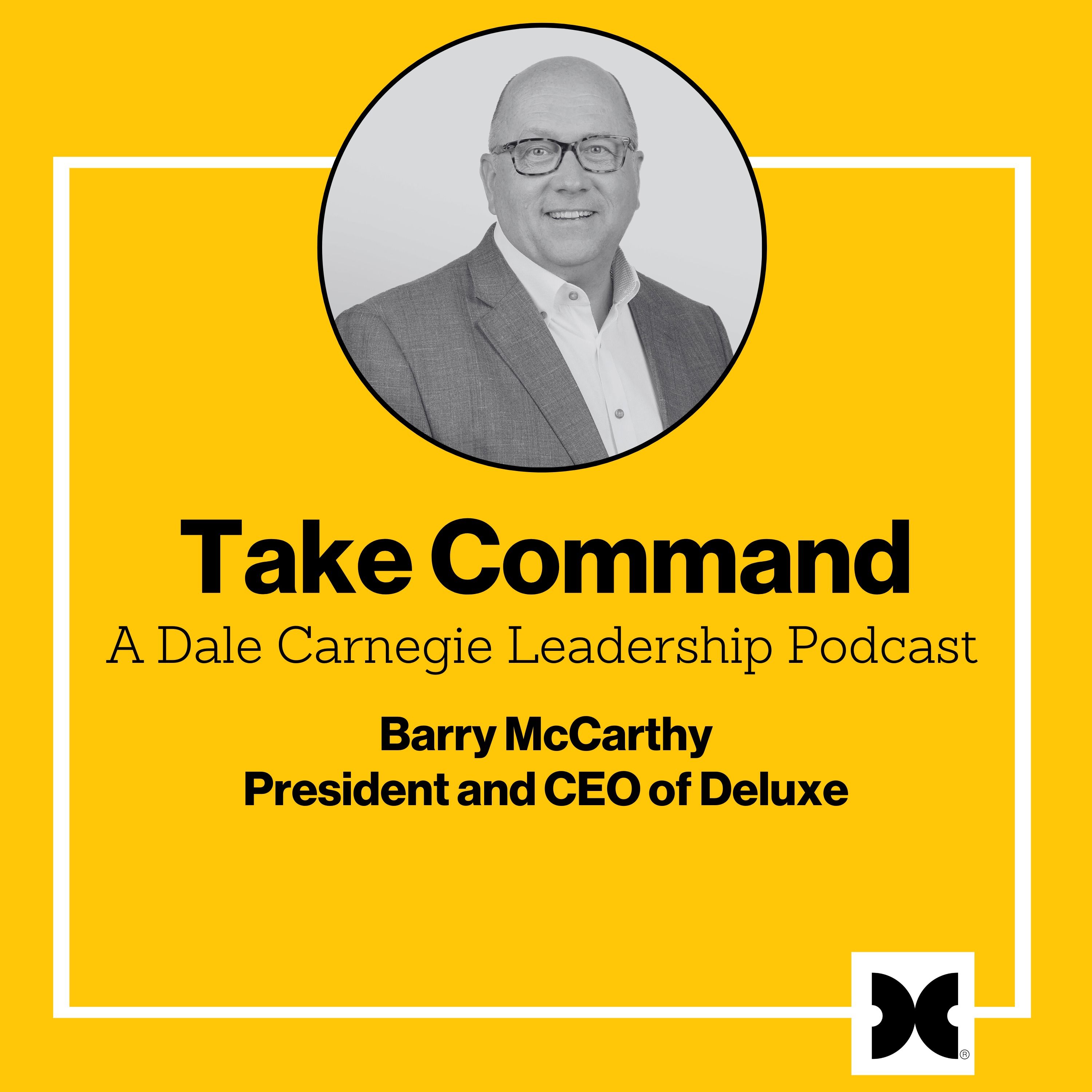
Take Command: A Leadership Podcast
Integrity First: Where Kindness, Respect, and Innovation Meet
00:33:27
Barry McCarthy—CEO of Deluxe Corporation, a trusted payments and data company—visits the Dale Carnegie Take Command Podcast to share his wisdom. But don’t expect tautologies on the art of appeasing consumers. Barry is concerned with something deeper: “If we lose a customer, we can find another customer. If we lose our reputation, there's no way to get another reputation back, which means that integrity is incredibly important.” Integrity is what engages employees in the company mission and ultimately delivers for customers. Tune in to hear Barry’s thoughts on how to build (and destroy) passion, how to show you’re ready to be a leader, and why communication supports all your other goals.
Loading summary
Transcript49 lines
- [00:00]
Joe Hart
Ready to elevate your leadership. Follow Take Command a Dale Carnegie Podcast. Now transform inspirations into actions. Hit, follow and lead with impact. Welcome to Take Command, a Dale Carnegie Podcast, the show where we seek to uncover what leadership means in today's world. I'm Joe Hart, CEO of Dale Carnegie and we will be talking to diverse leaders with stories to tell across various industries to help unlock your potential for success. We will be sharing real life insights into leadership which in turn can help spark the next level of your growth as a leader. Our guest today is a distinguished leader known for transforming financial services companies and driving innovation. He has spearheaded his company's evolution into a cutting edge provider of payment solutions with an impressive career that includes key positions at Procter and Gamble, First Data and Wells Fargo. He has pioneered advancements in Internet, cloud and mobile payments. He is the CEO of a $2 billion Fortune 1000 company and his book Small Business Revolution and his role as executive producer of the Emmy nominated Small Business Revolution series highlights his and his company's dedication to supporting small businesses. Please welcome President and CEO of Deluxe, Barry McCarthy. Barry, welcome to the Dale Carnegie Take Command podcast.
- [01:39]
Barry McCarthy
Well, great to be here. Thanks for the opportunity.
- [01:41]
Joe Hart
Well, thank you. It's great to see you again. It's been a little while since we've seen each other. It's been fascinating for me watching your career at Deluxe. You're the President CEO of Deluxe. You became that. You took that rollover. We met right after that. This of course being a 100 plus year old company. We talked a little bit about what it's like to transform and move a company of the size that you have publicly traded company. I think you have about 6,500 employees and you started as a printer of paper checks. And part of what you had said is we really want to reinvent the business and reinvent the brand and so forth. And I really enjoyed watching the success that you've achieved. You've had four years of consecutive organic growth and you're continuing to hit numbers. So congratulations on that success and just really looking forward to talking to you and learning from you in terms of you and the business.
- [02:31]
Barry McCarthy
Thank you for that. Very proud of the progress we've made at Deluxe and think the future is bright for us.
- [02:37]
Joe Hart
Well, tell us a little bit about you, Barry. What are some of the things about you or your leadership that are important for our listeners to know? I mean, you undertook this role. You didn't have to. You were very successful prior to coming to Deluxe. What are some things about you that you'd want to share with our audience.
- [02:53]
Barry McCarthy
You know, I'll start sort of really broadly and then get more specific. I think at the broadest level. Joe, every role that I've ever had in my career, I've sought opportunities where a business was at an inflection point of some kind. Need to accelerate profitability, need to reinvent a product. This is the biggest one I've ever been a part of. The scale of the inflection that was required of this company. But I've always sought those opportunities. I really think of myself as something of a fixer, of a reinventer, of an innovator. And opportunities to do that type of work were things that always appealed to me. But I think there's a couple things that I think were really consistent. In addition to seeking business opportunities, career opportunities that are inflection points always chose companies that had great reputation or the opportunity to build a great reputation. A reputation, whether it's your personal reputation or the organization's reputation, there really is nothing else. I talk to our teams all the time that we never want to lose a customer, but if we lose a customer, we can find another customer. If we lose our reputation, there's no way to get another reputation back. Which means that integrity in everything you do and the small things are incredibly important because that's how you build a reputation over a long period of time. And so I'm very, very disciplined about making sure the organization, I'm part of, the organization I lead, leads with integrity to build on reputation. One of the things that appealed to me about Deluxe, by the way, one 9 year old company, incredible Trust, Newsweek came out with a report that said we're one of the most trusted financial services brands in the country. So the notion of reputation really important. Second thing though, is always leading with people first, meaning that any organization as a leader can only be as good as its people. And the organization can only deliver for customers based on how deeply engaged people are in the company's mission, how on fire they are to deliver for a customer. We spend a lot of time really thinking about our people, our people strategy, how we have the right people and right jobs, give people the right opportunity, compensate and reward them fairly in a way that recognizes their contribution, but in addition to all that really cares about them as individuals and about their career progress and their career development. So we've always, in all my roles, have tried to do things that really help reinforce that for our employees, to make them feel valued and special because they are, because they are what the company is most important asset the company has. And every one of my earnings calls, I have a whole paragraph on it every time, 100% of the time where I talk about the contribution of my fellow deluxers to help the company succeed. The third is not just inspiration, it's about passion. If the top person and the leadership team isn't passionate about what they're doing, they need to go on to do something where they can be passionate. Because not going to be anybody more passionate or excited about the company than the senior most leader. Because at every level through the organization, some of that is going to get diluted. And so there's got to be a lot of passion and energy at the top. Otherwise by the time it gets through all the layers of the organization by that dilution, you could end up at the lower levels without people believing in the mission or having passion about what the company can achieve. I think it's important that the top person is almost annoying in their passion and the commitment for what they're getting done. And I think that work ethic at the top, along with absolute belief in what the mission is and that it can be accomplished, I think it's all three of those things together that is what helps people be successful as leaders.
- [06:47]
Joe Hart
You came to the company and you're a new person to an established company. Would love to have you talk about how you went about developing or cultivating that people first culture. What are some of the things that you did that were really important, one of the things that you learned along the way?
- [07:03]
Barry McCarthy
So when we first started, the company had acquired over 50 different businesses in the previous seven to 10 years and none of them were performing well. And the company had felt maybe a little bit deflated or maybe slightly defeated. So we needed to get people to believe in themselves and believe in the possibility that they could do difficult things. And we really set the top leadership of the company, probably the top 50 people or so. And we had a series of two week sprints to do small tasks to prove and build momentum. And the series of small tasks would build up to a bigger end result. And people got really energized by those series of sprints and that they had to report out, you know, weekly intermediate reports on every Friday. And then of course a real report for the report on how that sprint had gone every other week. And that helped, I think, build a sense of esprit de corps, but also a sense that we can eat an elephant one bite at a time. And then we did things around compensation and philosophy, around making sure that everyone Was a shareholder in the company. So early in the game, we made every single employee, all the way down to the guy that sweeping the floor on the plant, a shareholder in Deluxe. So we made it clear that they were part of something bigger than themselves, that this wasn't just a job, that they were building a company for the future. Just like the people 100 years before us had built a company we were running. Now is our turn to help drive the company forward. Spent a lot of time traveling and seeing and meeting with people and being really clear that we have an open door policy. We want to be available and accessible, communicate to the point of perhaps being a little bit annoying to make sure that people understand what's going on and why we're doing it. But I think it's that combination of building momentum, helping people believe in themselves. It gets the company moving, but then continuing to deposit in our people to give them opportunities to grow. So we have LinkedIn learning available. All the entire catalog of coursework for people we've added. Really, we think novel and unique benefits. Like we offer people volunteer time off so that we help people take up to five days off paid to go volunteer in the community. We do matching programs on our foundation and we recognize people for the great successes that they're having. So it's not one thing, it's many things over a sustained period of time that we focus on people, their success incentivizing, rewarding them and helping them build momentum. So they build esprit de cora among.
- [09:43]
Joe Hart
The team and talk about communication. Because ultimately the culture starts with the CEO, right? So you're articulating the values and the vision that's got to permeate through your leadership and really middle management all the way throughout the organization. How do you inspire people? How do you communicate the culture that you're trying to create? The values of the organization?
- [10:06]
Barry McCarthy
I think it is incumbent on the leader to be really clear about the company's mission and the company's values. And I don't think you can ever talk about it enough. And I'm not going to say that we're great at it, but I can tell you we work pretty hard at it and we use that communication and that repeating what the company's mission is, to make it clear that the work that people do really connects to a greater purpose. And so our company's mission is really simple, a few number of words, which is we help businesses succeed so communities can thrive. We fundamentally believe that when a business succeeds, it hires more people who have demands for additional Services, Maybe it's a pizza on Friday, a dry cleaner to get the car fixed, which then creates more jobs, which creates more demand for more services, which creates demand for more jobs, which then creates great things for the community. It brings in people with time, talent, and treasure to give back to the community. It creates the means to invest in things like parks and roads and schools. But without a strong business, which is what our company does, help businesses succeed, helping them with payments and data solutions, that flywheel of success cannot happen. So we talk about that a fair bit here, about the notion of we help businesses succeed so communities can thrive. And then we add to that the notion of volunteer time off and foundation matching. So we're saying we actually believe what we say, that we're actually doing what we say. We're not just talking, we're actually doing. And I think that gets our team pretty motivated and inspired to do more.
- [11:46]
Joe Hart
Well, it's important that you have demonstrated that. You know, I had Richard Edelman on the show recently, and he is the CEO of Edelman. They've started the trust barometer, which you may be familiar with.
- [11:56]
Barry McCarthy
Yes.
- [11:56]
Joe Hart
And when you talk about a breakdown in trust, it really often starts with people saying one thing and then, of course, doing the other. But when, especially as the CEO, people look to see, hey, what's the follow through? That's really where you started this whole conversation, really, about that high integrity kind of leadership.
- [12:13]
Barry McCarthy
I think that's right. And I think the whole notion of trust gets shaken through Covid and through all sorts of other reasons why trust has been shaken, which is why we spent a lot of time talking about that internally with our people, but also why we're so gratified to have been recognized as such a trustworthy company. And that's helping us grow the business.
- [12:34]
Joe Hart
Talk a little bit about your definition of leadership. What does leadership mean to you? If you were to put it into a sentence or two, what would that be?
- [12:42]
Barry McCarthy
A leader. Someone who can set a vision that inspires people to achieve more than they thought they could.
- [12:52]
Joe Hart
I mean, that sounds like a great definition to me. The three things that you just talked about apply to every single person at every level of the organization as they think about their leadership. Right. I mean, in terms of inspiring and being high integrity and helping people achieve, inspiring people to achieve more. You and I know from an engagement standpoint, people really connect to their manager. So how do we really get people to do that? It seems like that definition that you just outlined is a recipe really for anyone.
- [13:21]
Barry McCarthy
I agree with that. I think that leadership at all levels is about inspiring people and then helping them achieve. I should have said something about helping people to achieve, supporting them in achieving. It's not just about inspiring them, it's also about supporting and helping them achieve. Which is great coaching, great leadership development opportunities, great candid feedback. That all goes in a good definition of leadership. But that's the same whether you're a first line manager, all the way to the CEO. Obviously the responsibility and scope changes, but those elements are the same and it's important at every level.
- [13:59]
Joe Hart
Where does humility fit into this equation? And having known you for about six years, seeing you to be a humble leader. So many CEOs and other leaders have had in the show have talked about humility is an important ingredient to leadership. Where does that fit in the mix of things for you?
- [14:14]
Barry McCarthy
I love the question and 100% agree. And I think that goes with the notion of sort of open door. I am only the 9th CEO in this company's 109 year history. I feel the weight and the responsibility every day of fulfilling the promise that was started by W.R. hotchkiss that it went to his father in law because needed a job and he needed a $300 loan so he could start a company and he created the checkbook and that's become this Fortune 1000 company 109 years later. And we work very hard to make sure the company is going to go for another 109 years. So you start with a deep sense of humbleness that you are carrying on a legacy that is so significant for so long. But I also don't believe that anybody wants to follow a flashy hey, look at me, it's only about me kind of a leader. I just don't believe people want to follow that kind of a leader. It's about people that genuinely care about not just the success of the company, but the success of the people within the company. Back to the second point about being people first, that if you don't genuinely believe that people know and they can see right through it, being accessible and available is huge. You know, in our company we don't officially have any offices. We have small conference rooms that people can squat in if they need to have a sort of privacy. I hang out a fair bit of my time in this particular conference room. But if I'm not here, people have the opportunity to use the space because we don't believe in this notion that there's sort of levels, that levels shouldn't matter, levels should matter only in the process of making sure we're doing the right things and that we're being responsible and respectful. But having people engage and talk to each other is of utmost importance. And if somebody has a great idea, everybody's able to hear. It doesn't have to be filtered 50 times over and sanitized to the place where it doesn't mean anything anymore.
- [16:16]
Joe Hart
It's true. And one of the things that we teach in Dale Carnegie and that we know is that people want to feel valued and appreciated and respected. There's a great quote also, I love this quote, which is, people don't care what you know till they know that you care. I mean, so ultimately our leadership is about connection and people are assessing. Does Joe care about me? Does Barry care about me? How do I fit? Am I listen to, am I respected? And those types of things. And you know, to have a belief that people have greatness and people have talent, if we want to get that out, we need to do exactly what you just said, Barry. Right. Which is to start with that level of humility and respect. And as you talked about being people.
- [16:53]
Barry McCarthy
First, I'm going to steal that quote. Whoever said that was great, that if they don't believe you, they're not going to follow you. I think that's brilliant. And there's lots of ways to do that though, right? It's also easy just to stand up and say, yes, we believe in people, but it's something different to actually do something about it and actually spend money and time and resource against those things. And I think that's where this notion of honestly, integrity, humility, being good for what you said you're going to do all comes together to paint a picture of somebody as a leader that people want to follow.
- [17:28]
Joe Hart
So Beer, let me ask, because we're talking about being people first. And one of the things that Dale Carnegie talked about is that, remember, people aren't necessarily creatures of logic, they're creatures of emotion.
- [17:37]
Barry McCarthy
Right?
- [17:37]
Joe Hart
So people have fears and things that they're excited about, insecurities and a whole range of other things. They face challenges, they face worries. What do you do to inspire people to have greater self confidence or, you know, when people are in that point of fear, you know, you led the business during COVID there's a lot of challenges. I mean, what were some of the things that you did or that you do to help people develop that confidence, to take action, to be risk takers?
- [18:05]
Barry McCarthy
I don't think I have a silver bullet, but I will tell you some of the things that I Think that came out of the COVID crisis. You know, our company lost 40% of our volume in a week. And you have to adjust pretty rapidly to that, obviously. And the first thing was just being completely transparent and having all hands calls and just telling people, here's the truth. Here's what I know, here's the information I'm gathering from CDC and all the other groups that I was able to listen in and listen to experts. Here's what it means for our business. This is what we're going to do to buy us time to learn more. And then when we realize this is going to be longer, these are the actions we're going to take to ensure the stability and survival of the company. And we asked people to do some really, really hard things. But we didn't start with the hard things. We started with here's the reality. Let me just tell you the truth. Business. We lost 40% of our business. We got to do something about that. What are we going to do about it? How are we going to do it in a way that doesn't damage our ability to recover when this gets over? How do we do it in a way that's respectful for our people and respects all of the issues people are working with? But then it gets really personal. We started the transformation just a little bit before COVID We had announced the final new leader on the leadership team in January. We had the company's first ever investor day in February and we were all home in our basements within a week. So the leadership team doesn't even really hardly know each other at this point. We are starting down that path and did very simple things. We had a daily standup meeting with the elt, then the leadership team. Each of them had a daily stand up with their teams. I kept an Excel worksheet where I made sure that I talked to every single ELT member at least once a day. So I kept track of that. I talked to every one of them every day. And then to keep the next set of folks engaged and motivated, I was on a pretty significant handwritten note campaign where everyone at the next level would get every so often a note from me handwritten, that was mailed to them at home to be a note of encouragement to encourage them on. Here's the great stuff that's going on. I know it's hard, but here's all the things that are happening and then having skip level conversations even though we're not in the office, reaching out to people. And so I think all of that works together to Help us get across that divide. And it was about extra effort to make sure that you were engaged with every person every day in a way that you might have been able to do in the hallway, but you couldn't do in the hallway anymore, so you had to have another way to do it.
- [20:45]
Joe Hart
Yeah, these things were important then in terms of transparency and connection and availability and helping people work through their concerns.
- [20:54]
Barry McCarthy
Connection and personal connection.
- [20:57]
Joe Hart
What's the value even of small things like handwritten note? You say handwritten note to somebody, it's like, oh, gosh, you know, Barry is thinking about me or whatnot. People really do appreciate those kinds of things. What advice do you have? I know a lot of people who listen to the show. You know, they think about their career, the next stage of their career. What are some of the skills that you encourage people to have as they're moving up within an organization? What are some of the things that you value the most? If there's one piece of advice you'd give to people that would be valuable, it's like, hey, to go from where you are to the next step, here's something you should be thinking about.
- [21:29]
Barry McCarthy
I tell people all the time to invest in relationships. It's the number one thing that I tell people to do to prepare themselves for more responsibility. If you genuinely get to know other people and you learn from them, they're going to be invested in your success. And you'll have people that you can go to to learn from in a time of need or just a time in general. And by building relationships, you are going to build your own skill. You're going to understand and learn from other people how they lead. And in doing so, you're going to prepare yourself to build relationships as a leader as well. So in the preparation for more leadership, building more relationships with more people, prepare you build relationships with a larger group of people that you have to influence to drive an organization ahead. I tell people all the time that you have every opportunity every day to engage with somebody new or someone deep in a relationship with somebody. And in doing so, you're building your own skill. You're giving back to somebody, and they're going to help you as well. And that foundational level skill of building relationships will be very helpful to you as a leader going forward. Really focus on building relationships. It will make you more human and help you get prepared for the next job.
- [22:43]
Joe Hart
If I think about my career, Barry, and maybe yours too, relationships have been an absolutely critical part of every major step. Either someone I knew who said, hey, you Ought to look at this or someone made a recommendation or someone I went to for advice or whatnot. And all those people were people who I had just gotten to know previously. In some cases, like intentionally, you know, just getting to know someone and learning about them. In other cases, just as you said, developing relationships. But so much of the quality of our lives depends on the quality of the connections we make with people. Do we listen to people going back to this point, are we trying to help other people? You said people don't want to follow that person who's just kind of glamorous and self seeking and that type of thing. I mean, what kind of people are we? So when we put ourselves out, when we are humble, when we try to learn and listen and value other people and build relationship, that always comes back in a positive way.
- [23:35]
Barry McCarthy
Totally agree. And I think specifically in relationships, I coach my kids on this, honestly, which is, as you're building those relationships, focus not on what that person can do for you, focus on what you can do to help that person succeed. So if you are focused on and you end every conversation with how can I help you? You are creating a really powerful effect which is that you're really building real relationships which are about a two way relationship. Not just what you can do for me, it's what can I do for you? Maybe there's nothing I can do for you today, but if there is, let me know. And I want to be helpful, to be in a real relationship with somebody.
- [24:12]
Joe Hart
Yeah. And then to follow through. Right. I mean to say, oh, well, of course, yeah, of course. How can I help? How can I help you? And then, you know, sometimes that might be guidance, it might be an introduction. Yeah, you raised this issue also that gets me thinking about mentorship. Is that something that you do actively mentor people? Do you encourage people to seek mentors? And what is your perspective on that?
- [24:31]
Barry McCarthy
I'm a firm believer in mentorship everywhere, at every level of the organization. But I think what happens often on mentorships is they don't get set up appropriately at the very beginning. So sometimes mentees think, well, I'm going to get to know this person and they're going to get me promoted. No, that's not what mentorship is about. Mentorship is about a relationship to help you improve yourself and improve your own prospects to do more and to learn more and to someone that can share the lessons and guidance. And I think there's really no substitute for that. And whether it's formal or informal, all of us got to where we are because not one person but many people took interest and made commitment to help us succeed. And it's our job as leaders to do the same for the next generation. Someone did that for us. It's our job to pass that on. I had a meeting yesterday with two different summer interns and they just wanted to understand what it was like and it was really powerful. Great for me to hear was on their mind. I hope I was helpful for them. But it was a powerful opportunity to engage it's relationships. And a mentor is a very targeted relationship with someone to offer and to help you with.
- [25:44]
Joe Hart
Miri, what are some things you do to sharpen your skills? When we think about mentorship, we're always in a constant state of learning and growing. Growing hopefully.
- [25:52]
Barry McCarthy
Right?
- [25:52]
Joe Hart
Pushing ourselves out of our comfort zones and Certainly being the CEO of a publicly traded company, Fortune 1000 Company, you've got a lot of stress, you've got a lot on your mind constantly. What are some things that you do to develop yourself? What are some things you do to relax, stay healthy? What are things you do to kind of be centered yourself?
- [26:12]
Barry McCarthy
A few things. I'm a very voracious reader, so I love reading books on leadership, business success, etc. Like this book this guy now wrote called Take Command. Nice book. It's a really good book.
- [26:27]
Joe Hart
Thank you for the plug. Appreciate it.
- [26:29]
Barry McCarthy
Absolutely. It's a good book. You should buy it. But also reading periodicals, I'm really, really understanding what's happening in the marketplace, broadly. Second, I really like to attend. I don't have much time to do it as much as I would like, but there are groups of people that gather to talk about topics, whether they're CEO, CEO forums, or they're a forum on what's happening in the economy. And you have a speaker like a Janet Yellen, but getting exposed to other senior leaders, hearing and talking about super relevant issues. And I attend seminars, occasional seminars to sharpen the saw. I think personally it's really important to have things that you do outside. For me, I've got an incredible family and we like to do things together. Water sports, terrible golfing, ride bikes. We'd like to snow ski together and really, really use those times. They're not extended times, maybe like a long weekend to go ski, but those things are recharging. They're really important to keep the primary and most important relationships healthy, but also give you just a little bit of a break to clear your head a bit and come back refreshed.
- [27:38]
Joe Hart
My philosophy at work has changed. It sounds like It's a little bit like yours. Early in my career, I was working so hard, I was getting myself sick. I remember thinking to my gosh, if I could get less sleep, then I could get more done. I was getting up early and going to bed late and literally getting run down. And now I just feel like exercise has to be a part of every single day, even if it's a walk or something. We need all of us to center ourselves in some way. All those different things you said, I think are source of inspiration for me and for our audience. I got to tell you, Perry, something I've started on the show recently. I went to ChatGPT prior to this interview, and I said, chatgpt, I'm going to be interviewing Barry McCarthy, CEO of Deluxe Corporation. You know, what are some questions you'd ask? And I got a list of questions. And then I said, look, if you could only ask Barry one question, what would that be? And I'm going to give you that question right now.
- [28:30]
Barry McCarthy
Oh, my gosh.
- [28:30]
Joe Hart
Now I'm probably the best question yet. It actually is a pretty good question. Can you share a pivotal moment in your career where you faced significant adversity or challenge, and how did that experience shape your approach to leadership?
- [28:48]
Barry McCarthy
So in the role prior to coming to Deluxe, I was at a company called First Data. Ultimately it merged with another big payments company called Fiserv. But I was there in the chapter when the company had gone private with KKR and the company was 10 times, almost 11 times levered. So the company was in pretty desperate financial straits. And I had the great fortune to work for a couple of really outstanding CEOs, that I learned the importance of courage and expressing courage in difficult times as a leader. And that in those moments when there's pretty grave doubt was how important it was for the leader not to be energetic and enthusiastic, but just have courage of conviction that we could get through this and lead with courage. That came into big play when I came here and Covid happened just as we had launched a mega transformation initiative, made mega promises to the street and had to follow through. And that meant making some really difficult choices, but then not hesitating on the choice and moving and having the courage to act. And I think that the courage to act, it just can't underestimate how important that is. We don't talk about that in leadership necessarily all the time. We talked about some of the softer things there, but courage to act expeditiously and purposefully, incredibly important. And I think I learned that, you know, in A very tough environment that has helped, I think, here very much.
- [30:26]
Joe Hart
That's fabulous, Barry. Thank you for sharing that. You know, it's easy to, in a situation like that, just be frozen, that courage to act. And for all of us, you know, sometimes the indecision can just be paralyzing. It's the courage to act that really makes a difference. Well, Barry, anything else that you'd like to share? Any insights or thoughts with our audience as we close?
- [30:48]
Barry McCarthy
You know, I think often there's additional skill or philosophy that gets overlooked, and it's the notion of kindness, decency, and respect. I think often people in business feel like they just have to bulldoze their way to a result. Obviously, there are times of great peril where you have to move at that kind of speed. But I think moving with kindness, decency and respect is rewarded because the organization follows that style and tries to do the right thing. Kindness, decency, and respect. You don't have to be a jerk to get things done. You have to be tough and firm and strong. But it doesn't mean you can't be kind, decent, and respectful. And by doing those things regularly, I think you make yourself a much better leader and that you are showing much greater care for the people around you than if you're just a bulldozer getting your way or the highway. You still got to get the job done. You still got to get from point A to point B. But there is a way to do it that builds trust and confidence and loyalty and passion. And there's ways that destroy it.
- [31:59]
Joe Hart
Yeah, it's unfortunate that some people believe that to be successful, you've got to be difficult or just grinding or rude or whatever it is. And sometimes people will point to certain CEOs will look at this CEO or look at this CEO. But some of the greatest CEOs that I know embody what you just talked about. Al Mulally, who turned around Ford and Boeing. His mantra is humility, love and service. And, you know, if you can achieve the kind of results with that kind of a mindset, the mindset that you're talking about right now, why wouldn't people do that? Why would people want to ruin the lives around them? Be a tornado of negativity and so forth. Barry, fabulous being with you today. Thank you so much for being on the show.
- [32:41]
Barry McCarthy
Appreciate it. Great to be with you, too.
- [32:43]
Joe Hart
Thank you. I hope you enjoyed this edition of Take Command, a Dale Carnegie podcast. Check out our resources at www.dalecarnegie.com for more research, insight, and tools that will support your success and help you take command of your leadership potential. If you enjoyed this episode, please consider rating it and following us on Apple Podcasts and Spotify. For more exclusive content, subscribe to our Dale Carnegie YouTube channel and follow us on social media. As always, thank you for listening and we're looking forward to you joining us for the next episode of Take Command, a Dale Carnegie Podcast.