← Take Command: A Leadership Podcast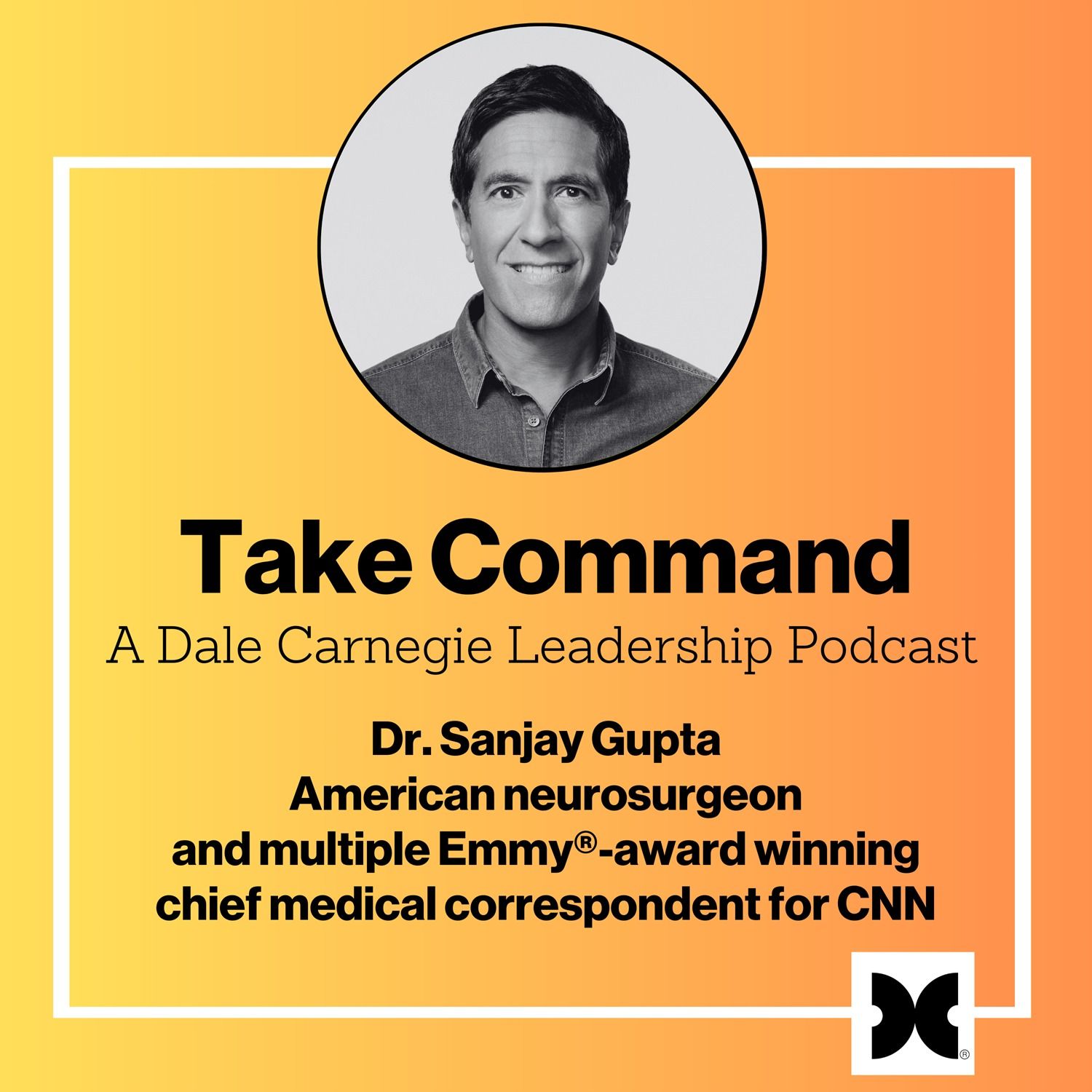
Take Command: A Leadership Podcast
Keep Sharp in Chaos: A Surgeon's Mindset Hack
00:44:06
Sanjay Gupta is someone who has balanced a high-stakes career as a practicing neurosurgeon and CNN Chief Medical Correspondent through curiosity, humility, and lifelong learning. He says, “Everyone's a teacher, if you allow them to be, and you should be a good student, a good and willing student, and then also teach at the same time when you can.” Sanjay’s episode is packed with amazing advice. He talks about Dale Carnegie's transformative impact on public speaking and relationships, the power of admitting "I don't know" to build collaboration, and brain health hacks like brisk walks over intense runs. Sanjay wants others to thrive, saying, “What Dale Carnegie really taught me: It's not that hard to do, it's just that most people don't—spend the extra minute building someone up.” Tune in for this and other shining nuggets of Sanjay’s wisdom.
Loading summary
Transcript68 lines
- [00:00]
A
I think that what Dale Carnegie really taught me was it's not that hard to do. It's just that most people don't do it. How do we do that in our daily lives with the people on our teams, in our lives and our families? We may think it, but how do you put that into action in some way? I try and do that and it takes a minute.
- [00:29]
B
Welcome to Take Command, a Dale Carnegie Carnegie podcast. I'm Joe Hart, CEO of Dale Carnegie and if you're ready to grow your leadership skills, follow. Take command now and never miss an episode that could transform your career. Today's guest reflects on a life shaped by unexpected turns. He has moved from the operating room into public storytelling and his life shows how embracing uncertainty and leading with humility and can unlock deeper impact and connection. A New York Times best selling author, he turns complex medical challenges into clear life saving insights for millions of Americans. Elected to the National Academy of Medicine, he serves as an associate professor at Emory University, co founded the Life Itself conference and is an executive producer for the HBO documentary unit. Named one of the 10 most influential celebrities by Forbes, he guides people toward healthier, more informed lives. Please welcome American neurosurgeon and multiple Emmy award winning chief medical correspondent for CNN, Dr. Sanjay Gupta. Sanjay, welcome to the Dale Carnegie Take a Man podcast.
- [01:46]
A
Thanks so much for having me, Joe. I've been really looking forward to this ever since you were kind enough to ask. So thank you for having me.
- [01:52]
B
Well, I'm excited to have you. I mean, you are a tremendously successful TV journalist, practicing neurosurgeon, successful author, speaker. I know there's many other things we could add to that list. One of the things I'm most excited about is you're also a Dale Carnegie graduate. So I'm looking forward to talking with you about that a little bit. Sanjay, tell us a little bit about you, your background and some of the things that maybe led you to who you are today.
- [02:17]
A
Yeah. Thank you again for having me. I'm a dad, a dad of three teenage daughters. One just turned 20, so we're moving along in years here. A husband. I'm a doctor. I'm a son of two people who were automotive engineers and one who was a Dale Carnegie graduate herself, my mom. I'm somebody who decided to become very interested in neuroscience from a pretty young age. Spent a lot of my, I think formative years sort of grinding away in that world of the brain and the central nervous system. And then I became very interested in journalism as well and more so from the Standpoint of taking medical concepts and topics and trying to really explain them. I think more than anything for the masses, sort of an explanatory journalism sort of role. I've been sort of balancing this life now for some 25 years. I'm a happy guy, I'm an optimistic guy. And I'm someone who, you know, is very engaged with society, trying to just always do things. And like you, Joe, probably trying to make the world a better place every day that I can.
- [03:21]
B
Yeah, I think it's clear that you are, and certainly I am as well. And one of the characteristics that I think comes forth from you, Sanjay, is your authenticity. Probably one of the reasons why, I think even as successful as you've been in media, because people crave authenticity. Right.
- [03:35]
A
How did you make that leap from.
- [03:36]
B
The medical profession to media?
- [03:38]
A
It's really interesting. It was a bit serendipitous versus strategic. And some of this does go back to Dale Carnegie, which I hope we get to talk about, because I'm a big fan of the program. But I was very interested in what was happening to our healthcare system. And this is going back to the early mid-90s. We had a healthcare system that people were trying to reform at that point. And I was a resident and medical student around that time and was very interested in sort of what was happening and how that might affect medicine overall. Eventually I started writing about that quite a bit for various magazines and also worked at the White House for a while as a White House fellow, mainly writing speeches for the President and the first lady about healthcare policy, about other topics as well. But that was sort of the common denominator. And I think that was something that, for the first time in my life, at least, got me interested in communicating in ways beyond just standard scientific journals and writing papers and things like that, writing speeches and seeing the public policy implications of that and what could come out of putting words on paper and having, in this case, the president say them, what would that lead to? I thought was very, very interesting. I moved to Atlanta back in 2001 to take a job at the Emory Clinic as a neurosurgeon. This also happened to be the headquarters of cnn. And so I had met people at CNN when I worked at the White House, and they asked me if I would do some of the same sort of thinking about issues for broadcast as I had done at the White House, thinking about healthcare policy, what was going to happen to our health care system over time and to mainly, you know, do this for Sunday morning talk. Long story short, is that I started in August of 2001. Three and a half weeks later, 911 happened. And as you know, Joe, the world changed. Everybody's world changed. And I remember them coming to me and saying, hey, look, we're probably not going to be talking about healthcare policy for a while, considering all that is happening in the world. But now you're a doctor working at an international news network in the midst of what is unfolding in the world. Would you be interested in reporting on that, talking about that? And I was, it was obviously the attacks on 9 11, but you may remember anthrax attacks, the fall of that year, then obviously the wars in Afghanistan and Iraq. All of a sudden I went from being somebody who was going to be sort of a wonk on television talking about healthcare policy, specific issues, to covering conflicts, covering natural disasters, covering outbreaks, and really over the last quarter century now have covered just about every war and natural disaster and outbreak anywhere in the world. It was not part of the plan, but it just sort of evolved into that.
- [06:21]
B
It's interesting too, I know that on multiple occasions when you were reporting, you actually get called into duty really to help in some very tenuous medical situations. I know in Haiti, I think in 2010 you were instrumental in saving the life of a young girl. The same thing happened, I believe, in Iraq as well. So it was interesting kind of how that you were the right place at the right time to really make that kind of a difference.
- [06:44]
A
It was really interesting for me and I think for a lot of people who sort of bifurcate their lives or take on something else sort of mid career as I did, I had never done anything in the world of journalism. I certainly hadn't covered conflicts or anything. I've been a doctor. And so all of a sudden I'm in the middle of a war zone in Iraq. This is the first time it happened. And. And you know, I was embedded. And you know, when you're an embedded journalist, you really get to know the people with whom you're embedded. And they obviously knew I was a neurosurgeon. And on several occasions they basically said, hey, look, we don't have a neurosurgeon in this part of the conflict zone. And yet we have people who have had gunshot wounds to the head, significant injuries. Would you be willing to take off your journalist cap and put on a surgeon's cap? And of course I would. And I did. And so it was a very unusual role. I think I was certainly first, if not the first person to have done something like that. Obviously, I think it was the right thing to do to take care of patients in the middle of conflict zones. Although it's interesting, you know, within the world of journalism, there was all this discussion about how close do journalists get to the stories that they are covering, which I think is a very fair discussion to have. But for me as a doctor, you know, I was a doctor first, so putting on the surgeon's cap was a no brainer, if you will.
- [08:02]
B
Yeah, it seemed like probably that was the right thing to do. You really made the difference in that moment. I'm kind of curious going back though. You've had this transition from being a doctor to then basically talking about policy and so forth. Now you're in the field and so forth. What insights do you have for people? I think about just even other people at different stages of their careers. You know, often, you know, we have a very linear view of what we should be doing. And it just strikes me that you were very open to the different changes and the opportunities that happen in your career along the way. Has it always been kind of a mindset of yours to say yes or to be. Be curious about different kinds of things or what led you to do some of those things?
- [08:38]
A
I think that the mindset of openness was there. I will say that the fairway, if you will, the playing field was much narrower, you know, early in life. So saying yes to something else when I was so focused on neuroscience might mean, hey, I'm going to take a different path of looking at this neuroscience question versus just looking at it this way. So it was sort of still within the same field. But I was willing to say, hey, look, I don't think that this is bearing fruit in this area. Let's try something else. You know, in terms of research focus, when I started thinking about health care policy, the connective tissue was that there were significant things happening in our health care system. Again, this is the mid-90s, remember, health care reform was a big topic of discussion for the first Clinton presidency, for example. And yet very few doctors and clinicians were part of those discussions. So that was, I think, what sort of inspired me to get involved, saying, hey, look, I don't know that I can have a lot to offer here. I'm a guy in my mid-20s at the time, but I'm really interested in this. And I think, you know, physicians should be interested in this. We should have a voice in this. So that got me writing, and I just figured I'd write about it from my own experience and that Took me to a job at the White House as well. The journalism thing was very. It was very different in a way. And I think one of the great insights for me, Joe, is that when you get to work with people, especially if you're doing something that's new and you're working with people at a high level, I think you have to recognize that they are going to have skill sets that you don't yet have. And, you know, I think it's very easy to say, hey, look, I'm a well trained guy, I'm a smart guy. I went to college, I went to medical school, school, I trained. And yet, you know, there's producers who are out in the field who taught me so much. It's just what they do. As much as you think you sort of have things figured out, there are counterintuitive things in life, and you have to be able to lean into that. You have to be able to be comfortable with that. So in the beginning days, it's uncertainty. And I think you have to be comfortable with uncertainty more than anything else to increase your chances of success in some areas. And just basically being a perpetual student, I think that was the big draw for me was that when I started doing work, especially in a conflict zone, I mean, you know, I was working at the company for a few months, and all of a sudden I'm wearing a Kevlar vest in the middle of a war zone. You better have good relationships with the people that you're working with. Your life could depend on it. And you're learning so much. I learned how they behave, how they interacted with other people, how they scheduled things, you know, how they conducted them, little lessons in life that you gather. So everyone's a teacher if you allow them to be. And you should be a good student, a good and willing student, and then also teach at the same time when you can.
- [11:33]
B
It's interesting, you know, if I think about this podcast and over the years, so many leaders I've interviewed, a couple of things that have come up, and I think you just touched on two of them, which is the importance of curiosity and the importance of humility. Often the perception of a leader, or any of us, is, you know, I need to have the answers, I need to know, I need to be the one to make the decisions and so forth. But often it's the people around us, they may know more than we do, right? It's like, how foolish would we be not to seek other insights or to listen to them or whatnot? And I hear that from you. You know, here you are, you're in this environment, and you're not approaching it with a, hey, I know better than everybody else. Your approach is, I need to partner with people. I need to learn from people. I need to listen. I need to see what I can glean to be successful.
- [12:16]
A
I absolutely agree with that. That really crosses over my entire life as a professional, both within the world of journalism and medicine, but also as a father. I think that in medicine, for example, there is this notion that if a physician says, I don't know, I know the answer to that, that somehow that's going to be minimizing to them, that it's going to create a lack of trust between the patient and the physician. What I have found, and again, I say this with humility, to your point, is that almost the opposite is true when you say you don't know. But look, we're going to collaborate, we're going to work on this together, and we're going to arrive at a better place through that collective effort. It not only is more likely to be successful, but I think galvanizes people in a way that's sometimes hard to do. You bring people into the process, and sometimes that starts with that humility, that honest humility. You're not just paying homage to the humility. I don't know how we're exactly going to solve this problem. So here's how I'm thinking about it. How are you thinking about it? You know, sort of thing. But the other thing, and I think this is a bit of a nuanced point, is that if you're lucky enough to work with people who are really good at what they do, don't constantly be questioning their decisions. Get comfortable with the mindset that they evolved into how they think through lots of trial and error, they've made the mistakes, probably so that you don't have to, and they've gone through that and they've learned the lessons, and now they are kind enough and generous enough to share those lessons with you. So instead of questioning it and saying, wait, that doesn't make any sense. It's not saying, don't be an honest skeptic, but it is saying, hey, look, these people are good at what they do. I'm good at what I do, let's trust each other here so we can collectively get to a better place.
- [13:56]
B
It's interesting. Sanjay, I'm listening to you, and I'm thinking about Dale Carnegie principles. Try honestly to see things from another person's point of view. Become genuinely interested in other people. I mean, all these things that really are about focused on the other and validating the other person and respecting, but also learning and benefiting in the process. You had shared that you are a Dale Carnegie graduate. I would love to hear about how did you learn about Dale Carnegie? How did you end up in a Dale Carnegie course and what was your experience like?
- [14:23]
A
First of all, I just want to say Dale Carnegie was really instrumental in my life. I think people, you know, they go through various things in their lives, they take courses, things like that. But for me, at the stage of my life, especially when I took that course, I think it had a really lasting impact on me. It came about through my mom. I'll just brag for a second if I can, Joe, but you may, Please do.
- [14:44]
B
Yeah.
- [14:45]
A
My mom was the first woman ever hired as an engineer at the Ford Motor Company. Remarkable person, but even more so because she was a refugee until the age of 12. She came from the other side of the world, was part of the partition of the subcontinent of India, had to flee her home at age 5. And, you know, someone handed her a biography of Henry Ford when she was in a refugee camp. Who dares to dream like that? And she says, I will work there one day. And then Jawaharal Nehru, who was the prime minister of India, you know, they were trying to build India post partition into a technological sort of capital of the world. And he would go to various schools and small towns and say, look, we need engineers. And by the way, I'm not just talking to the boys out there, I'm talking to the girls as well. And my mom felt like he was talking right to her. She dreamt big. And she eventually was able to leave not just the refugee camp, but all male universities in Baroda, India. She eventually went to Germany, she came to the United States, went to Oklahoma, and then cold called the Ford Motor Company and they didn't even know what job she was applying for. Wait, you're a woman applying for an engineering job? She was, and she did, and she got that job. And this was late 60s, mid-60s, 65, 66 time. Funny story, my mom's name is Dementi. And they said, hey, look, you're great. We're going to hire you, but we don't think we're going to be able to say your name. Can you give us a nickname of some sort? And she kind of thought about it for a while and she said, yeah, call me Rani. R A N I, which in Hindi means queen. So she's basically saying look, if you're going to make me change my name, you can call me queen for the rest of my career. So she was the one who took the Dale Carnegie course first. It was offered to her through her workbook Place, and English is not a first language. She was very uncomfortable speaking in front of groups of people. And so she leaned into that as opposed to shying away from it, and it really changed her. I see the book behind you, how to Win Friends and Influence People. That was a Bible in our house, and we still have copies of it. My brother has it, I have it. My parents have it. It's in all of our bookshelves. And she would quote it to people first. We're like, mom, come on, Dale Carnegie, who is this guy? And then I took the course myself, and I understood how transformative it was for me as well. I think my mom and I shared some things in common. Both of us were fearful of speaking in front of groups of people. I was not the most social person growing up. I think if you choose to be a neuroscientist, you're choosing an insular life to some extent, especially neurosurgery. Your most formative years are spent in dark operating rooms and under microscopes and things like that. So it had a huge impact on me, Joe.
- [17:30]
B
And how old were you, Sanjay, when you took it? It was in your teens, you said, right?
- [17:34]
A
Yeah, I think I was 17 years old. Yeah.
- [17:36]
B
And if you were to think about. I'm just curious, I mean, the impact that the program has had on you since that time. What are a couple of things that stand out to you?
- [17:43]
A
I couldn't speak in front of a group, Joe, before that. And now I speak on television, you know, to hundreds of thousands, millions of people. I give talks. To be fair, I still get nervous, but the butterflies are flying in formation. Carnegie writes about as opposed to fl around scattered. There are a lot of lessons that in some ways are such a part of me now that I don't even think of them as lessons as much as they become a part of my personality. Something as simple as using people's names in conversation. I've said your name three times now. You know, you've said my name a couple times. A name is the most important word to that person's ears. That is not just a euphemism that fundamentally changes the nature of your relationship with somebody. It's a hack almost, you know, in terms of building those relationships. So there's a lot of things I think objectively had an impact on Me, but I also think subjectively, just being in that environment of other people who are, you know, grinding away, trying to figure out, like, can I actually get up in front of this room of people I don't know and try and tell a story? And I will share with you that Carl Allison was our instructor. He got up there day one. To this day, Joe, I don't know if the story is even true. Maybe it's just part of the Dale Carnegie training. But he told this tragic story of a girl who had been burned badly and she was in the hospital. I get a little choked up still thinking about this story. But the girl was badly injured and the parents were so helpless, they didn't know what to do. You know, I mean, obviously they were getting her care and stuff. But in terms of their relationship as parents with this girl, like, you're so helpless, what do you do? And he said that basically they would go to her window because they had to stand outside this window. There was infection protocols and stuff. And they would say, you are strong, you are beautiful and you are smart. And then one day when she kind of woke up, they didn't even know if she could hear her. She just looked at them. She couldn't really talk. She repeated the gestures back to them. This little girl, back to her parents. That was powerful. You know, you think about like, why is that so powerful? Why is it still so powerful? Me today as a storyteller and a journalist, like, why does that stick, stick with me? And I think there's a lot of reasons why. And it was such a short story, but now I have three girls of my own and you know, I think luckily they haven't been in a medical condition like that. But to just every day tell them they are smart, they are strong and they are beautiful. I mean, to tell them that every day, which I do, that came about from Dale Carnegie. Did I ever think that Dale Carnegie, when I was a 17 year old kid, was going to teach me parenting skills? Not really. But here we are.
- [20:21]
B
It's amazing that you remember that. I mean, it just touched you so deeply and affected you in that way. And you know, I can't help but think that there's a love in that story, right? Clearly the love for the daughter and also the opportunity that we all have to build up those people around us, whether it's our children, the people we work with, the people we come into contact with. Because at the end of the day, Bill Carnegie talked about the people crave, the need to feel important or valued or Worthy. And so that's a powerful story. And it's also an invitation, I think, for all of us to be able to think about how we interact with the people around us and the influence that we want to have and the impact that we want to have. Right. Because, I mean, ultimately, this is the life that we're living. And what impact do we want to have? Do we want to try to bring the best out in other people? I think that's ultimately what leadership's about. Right. It's about trying to bring out the best in other people.
- [21:17]
A
I think that what Dale Carnegie really taught me was it's not that hard to do. It's just that most people don't do it. I mean, to spend the extra minute. In that case, it was the story of these parents telling their daughter at a time when they didn't know how else they could help to just remind her that she was smart, she was strong, and she was beautiful. How do we do that in our daily lives with the people on our teams, in our lives and our families? We may think it's. But how do you put that into action in some way? I try and do that, and it takes a minute. You know, a lot of times now when I'm on planes. And again, this came from Dale Carney. If I'm on a plane and I'm thinking about somebody or somebody's popped into my mind, I might just send them a note, and the note comes out of nowhere. I'm not asking them for anything. There's no recent, you know, connection. I've just said, hey, Joe, thank you. That was a brilliant conversation. You're so good at what you do. Thank you for doing that. Thank you for spending the time. You know, it's like hack. It's like it has such an outsized impact on that person's psyche. And frankly, just took you a couple of minutes to do. And it's not to suggest that you're being Machiavellian about this or you're being overly strategic about this. You're sincere and authentic about it. It's just that most people never do it. So if I ever get a note like that from somebody out of the blue, I cherish it. And then I wonder, did that guy take a Dale Carnegie course or something? So it really is about winning friends and influencing people. It makes a huge difference in people's lives.
- [22:46]
B
It does. And Dale Carnegie himself said, it's not about manipulating. It's not about trying to get something from somebody. It is about just genuinely being a Good person. What's wrong with wanting to do that, to extend that? My son and I were at There's a local state park bias, and just the other day, we went out to sit and watch the sunrise over the lake. And we're sitting there on this bench, and there's a guy at the table, just maybe he's 20ft over. He's got an acoustic guitar and he's playing a little bit and singing. And it just made such a big difference to just our experience sitting there watching the sun go down by the lake. And I went up and I said something to him afterwards. He said, oh, I'm not really very good. I said, I think you're great. The difference, you know, our experience was tremendous. And I could just see what that meant to him. I don't know him. I'll probably never see him again. There's a great quote. I can't remember the exact wording. Maybe it's Ben Franklin, you know, I shall not walk this way again. Therefore, any kindness that I can give, let me do it now. So, again, I think that defines who we are as people. And it also is an opportunity for us, the people with whom we work, the people that we see. As you said, Sanjay, it's honest and sincere. No motive, but it is just about demonstrating that caring leadership.
- [23:55]
A
There's no other motive. I think that that's it. It comes unconditional. It comes without any strings attached. The one thing I will say which I find interesting, sort of from neuroscience perspective, just to draw on that part of my life for a second, is that my guess is that after you told that guy, the musician, while you're watching the sunset, after you told him that, you probably felt pretty good, too. And I think it's this concept of something known as reciprocal altruism. You know, it feels good to do good. That doesn't necessarily biologically make sense. Like, if you think about, like, you know, what Darwin sort of talked about, you know, this concept of survival of the fittest, I'm going to get me mine. You know, it's. Why would I ever sacrifice on behalf of somebody else, whatever it might be? And yet, when you're charitable towards other people, it feels good. How did that become a human trait? What purpose does it serve to the individual? And what you realize is that it serves a purpose to communities and to society. Reciprocal altruism makes societies more likely to thrive and survive, you know, as opposed to survival of the fittest. It was never about rugged individualism. I think it was about reciprocal altruism And I think Dale Carnegie, probably, in his own way, you know, knew that. It just intuitively made sense to him. So you're absolutely right. There's no strings attached except the betterment of mankind and all of us.
- [25:17]
B
But like you said, we feel good, too. So you brought up neuroscience, and you are a neurosurgeon. You've written about brain health. So let me ask you about this, because part of what I want to shift to is just how do we, as leaders do things that will help support our overall brain health? You had written a book. Actually, you've written, I think, four books. But you said that brain health rests on five pillars. Brain health rests on moving, challenging, your mind, resting, nourishing and connecting. I'm curious about how you, as a leader, you're so incredibly busy as it is. You talked about your family, your work, all the other things you're involved in. What are the things that you do to help ensure that you are fortifying yourself so that you could be your best self in all that you do?
- [26:02]
A
Well, I think about this all the time. I think that there are some interesting nuances when it comes to brain health versus even just overall health, body health, cardiac health. I'll give you an example. I've always enjoyed exercise and movement and playing sports. You know, I've been sort of a athlete. I do triathlons. I've been doing those for 15 years now. Started around age 40, so it wasn't something that I did earlier in life, but I always ran. But I started doing triathlons later. But what I found interesting when I really started to think about these and explore these concepts for the book was this idea that out of all the things that we do in our lives, the best way to grow new neurons, new brain cells, is through movement. That has the most evidence behind it. For a long time, we didn't believe you could grow new neurons. We thought you got what you got, and that was that. And you drained the cash. Over your life, certain things would drain the cash more quickly. Alcohol, things like that. But that was that. And, you know, over the last decade or so, we've proven that that's not the case, that there are certain parts of the brain that can continue to grow new neurons. Then of course, the question became, how do I do that? And the thing that had the most evidence behind it was movement. But here's the nuance. Cardiac health. If you're trying to improve cardiac health, you're probably doing more intense movement, more aerobic activity, things like that. That will certainly be helpful in terms of growing new brain cells. But when you intensely exercise, you, in addition to creating these factors that'll grow new brain cells, you also make a lot of cortisol, which is a stress hormone, and that can actually inhibit new neuronal growth. So for me, what does that translate to in addition to maybe doing intense exercise for a period of time every day, a bike, swim or run or something like that, I will now do brisk walks with my wife and my dogs. It was something that I just saw as a luxury in the past. Oh, yeah, we'll take a walk. But now I realize that if you're trying to improve brain health, a brisk walk like that probably does more for you than a intense run. So I've incorporated that into my life, diet wise. I think everybody knows that we eat too much sugar and sugar can be toxic. And that's not new news. But what I think was an insight for me in terms of really changed how I think about sugar, is that when you're eating a lot of sugar, you're consuming a lot of energy in the form of these calories, and your body will absorb that and store it as fat. If you have a lot of sugar glucose circulating in your brain, your brain's blood vessels, your brain doesn't respond the same way. When the sugar levels get too high, the receptors typically just turn off. So instead of like, oh, yeah, absorb, absorb, absorb more energy, they just turn off. So in essence, you could be stuffing your body and starving your brain at the same time. So sugar will deplete me in an hour from now. You know, people talk about this in kids, like, you know, the sort of sugar high and then the crash. But there's a reason for that and it happens to adults as well. So on days that I'm got a lot going on, I'm going to do a podcast with Joe or do whatever. I'm really, really careful about my diet. So I biked this morning. I did a walk a little later on in the morning, and I've eaten a very low sugar diet. And, you know, preparation of a day.
- [29:21]
B
Like today, now, is there a time where you're doing that in preparation for something like this? Is that your daily lifestyle or other times you splurge or.
- [29:30]
A
I do, I do, yeah. I mean, I do splurge from time to time still, you know, but I think once you have a visual of how things work in your body, like if I tell you that this sort of brisk movement, the substance known as bdnf, brain derived neurotrophic, factor. And it's almost like this miracle growth of your brain. So when I go for a walk, I'm not just, you know, going for a walk. I'm thinking, wow, I'm creating all this miracle growth in my brain and new neurons are sprouting. And if I eat too much sugar, I'm thinking, ah, man, I am about to starve my brain. I'm about to do something bad to my brain. I'm, you know, starving it. Why did I do that? If you understand the why of something, you're much more likely to follow through on what you should do from an explanation standpoint. My explanatory journalism sort of mode, I really wanted to understand what was happening in my body and be able to translate that for other people with the belief that if they understood that, they would be more likely to carry through. This is a typical sort of life for me. Although, you know, I got kids, we live normal lives, and that does involve splurging every now and then.
- [30:31]
B
Is there a threshold around sugar when you talk about restricting your sugar? Is there a level where you'd say, I don't want to get more than 24 grams or something like that? And you got refined sugar, natural sugar. I'm just curious for anyone who's listening to this, who's now thinking to themselves, because we have a why that. We have a clear why that you've outlined. Any other guidance around that that would make sense.
- [30:50]
A
Here's what I would say is just don't eat sugar. Because there is so many sneaky ways that sugar gets into your food already. If your bread that you're eating, for example, is particularly moist, it's probably because of sugar. Because sugar, in addition to acting as a sweetener, can act as what's called a humectant. It actually can draw fluids and retain that fluid, and that's what makes certain foods stay, you know, softer. My point being that you're getting a lot of sugar in your diet already, so just no added sugar. Just don't add any sugar to anything. And, you know, try and read labels as much as possible. You are getting plenty of sugar in the standard sort of eating that you do from basic foods. So I'm pretty hardcore about it. We just don't have any sugar. We have no sweets, no added sugars. My coffee is black in the morning, so again, I splurge from time to time. But on the days when I'm pretty good about it, I feel great later on in the day.
- [31:44]
B
Yeah, I do, too. I've tried to reduce sugar for a long time. The challenge I have, and I don't know if you feel this way, Sanjay, is you talk about the sugar dragon, so to speak, you can try to tame it by not having it, but then you have a little sugar and you want more. Right? I mean, it's that addicting kind of substance. So I've had the horrible sweet tooth. It's either all in or all out. Tough middle ground.
- [32:03]
A
Don't keep stuff in the house that is going to tease that sweet tooth. You know, ice cream was one of those things for me. And when I really started thinking about this, I said, we're just not going to keep ice cream in the house anymore. And first the girls complained. I have three girls. They complained. But after a while, we sort of just got used to that. You know, we'd always, I think having some sort of sweet after a meal or after dinner in particular, for a while, that was sort of the norm. And I think after a while, it just wasn't the norm. You don't need to have a sweet, you don't need to have a dessert. And if it's not in the house and you add these barriers to getting it, you know, again, when the kids were little, it was harder. Now that they're older, everyone has sort of gotten on board with that and I think been appreciative of it.
- [32:41]
B
So which of your books? I know you've written several books. Is there one of your books that really talks about this? If any of our listeners want to. To go out and dig in deeper into some of the work that you've done, which book would you recommend?
- [32:52]
A
The one that's really focused on brain health is called Keep Sharp. This came out a couple years ago. Now, that book was sort of a revelatory experience for me. I'm a neurosurgeon. I've studied neuroscience my whole life. But the idea of taking these neuroscientific principles that I was hearing about and reading about at big scientific meetings and being able to again, translate and explain them for the readers, that was the real goal. It came about from this idea that this concept of neurogenesis, growing new neurons, which you can do at any age, that was now shown to be true, that was a big deal in our world. We didn't think that was the case, but then it was all about, okay, now that we know that's true, how do we do that? What is the objective data, the evidence behind this? So, you know, I wanted to write it in a way that I would Be able to incorporate the lessons into my own life and into my wife's life and my kids life, my parents lives. If I could do that, then I felt like I had a book to write and it took about three years to do it, but that's the one that really focuses on that.
- [33:54]
B
I'm looking forward to digging into that book a little bit deeper. I know you do triathlon training. I like to run. But downloading a book like yours onto audible and listening to it while running I guess is a multi factored way to get the benefit of good brain health. Right?
- [34:08]
A
Yeah. Or a brisk walk.
- [34:10]
B
Or a brisk walk.
- [34:10]
A
Anytime you can be moving while doing something that's better versus sitting or just being still. You know, in fact, I say that I think one of the biggest benefits of walking is the fact that you're not sitting. You can't be sitting and walking at the same time. So sitting may be a bigger culprit negative than walking is a benefit. But we know that you cannot be sitting while you're walking. So just move is the key.
- [34:33]
B
Would that be true even for like a walking desk treadmill?
- [34:36]
A
Yeah. You know, interestingly, your listeners may know there was a study that came out recently that showed that walking desks, for whatever reason in terms of overall weight loss, did not seem to have a much bigger benefit over sitting desks. But when you read that study, I was a little concerned that maybe, you know, it was all self reported and a lot of people have desks that you can move up and down. So they may have still been sitting a fair amount even if they had a walking desk. So having a walking desk in and of itself is not going to do anything unless you're being diligent about using it for sure.
- [35:05]
B
So one other area I just want to ask you about before we wrap up is stress. So much stress in the workplace in particular, I mean, in families and I think also for leaders and people who are struggling with so many different areas. And clearly this is a brain health related issue. Right. I mean, what advice do you have for people, for leaders, about managing stress?
- [35:26]
A
I worked in this documentary a few years ago for hbo. It's called One Nation under Stress. It was pretty stark to understand just how much stress we're under and what the ramifications of that are. If you looked in the United States, for example, what really I think got a lot of people's attention was that, and this goes back before the pandemic that life expectancy in the United States was dropping. So despite the fact that we had made all these remarkable advances in technology that there was still a significant thing that was happening that was overall decreasing life expectancy. And there were certain demographics that were affected more than others. There was stress that seemed to be a common denominator and it seemed to be much more so in the United States compared to even similar countries. Canada, the uk, other countries in Europe. How you sort of manage stress, I think is a very individualized thing. Stress in and of itself is not probably the enemy. We're very binary sometimes in terms of how we approach things. Inflammation, bad, let's get rid of inflammation. Actually, no. Inflammation can be really helpful if used in the right way. Stress, bad. Let's get rid of stress. I want to live a stress free life. There's books about this and we know that stress is actually necessary. Get you out of bed in the morning, makes you study for a test, whatever it might be. So the problem really seems to be, and where we arrived with this documentary was it's not stress that's the enemy. It's the relentless nature of it. And I remember interviewing this guy named Robert Sapolsky, who's an evolutionary biologist, and he wrote this book called why Zebras don't get Ulcers, which I highly recommend. It's a great book. The title sort of says it all. Zebras don't get ulcers. Zebras could be chased by a predator. And when they're being chased, they are highly stressed. Cortisol levels through the roof. And then as soon as they're not being chased, they're happily grazing. The ability to find things in your life that can take you from the high level of stress, which may not only not be a bad thing, but actually be a necessary thing, a good thing, to getting objective breaks from it. How do you find a break from your stress?
- [37:41]
B
So, Sanjay, do you mind us? What do you do? Do you have something that helps you in that area?
- [37:46]
A
There's a couple things that I do. One is I do exercise. It's been a big part of my life. And I find that in addition to being beneficial for my just physical health, it's kind of my time. And just having that time is really helpful in terms of alleviating stress. It's almost like, hey, look, if I got time to go for a run or bike ride or swim, whatever, I must be okay. I mean, my world's not falling apart. I could find time to do this. Another thing I started doing with the help of Herbert Benson a few years ago. And then Deepak Chopra was I meditate I meditate every day and I practice different types of meditation. I've recently got into something known as the More protocol which is mindfulness oriented recovery enhancement. You can certainly google and read about this, but I'm not didactic about this Joe, because I think people can find relief from stress in different ways. Just taking a walk outside, being in nature, just sitting outside for a period of time, going and talking about your problems with somebody who you trust and admire, whatever it might be. But again, just within your day, make it as important as anything else to just like have the true release from stress. Allow yourself to pop back up again like, okay, now I gotta grind for a bit. Don't strive for a stress free life. Find things that just gives you a break from it throughout the day.
- [39:02]
B
Awesome, Sanjay, thank you so much. Just the one thing I want to ask you and I've kind of gotten to this to be a standard part of the podcast a little bit. In many cases I've gone to ChatGPT to ask for a question to ask you. I'm not going to do that right now. What I am going to ask how are you using AI today?
- [39:18]
A
Every aspect of my life I am a huge early adopter of AI. We use it within our medical practice. One of the most remarkable things I think in neurosurgery is that, you know, if you're trying to make a simple decision about a patient who comes in, for example, with back pain and leg pain, a common problem, you know, someone may have a herniated disc or something in their spine, whether to operate or not operate. But I want to know, not just operate or not operate, I want to know for a 50 year old guy who's a runner, who's otherwise healthy, who's had three and a half weeks of pain, is not taking any pain medications yet for this pain and stratify all this. What AI and large machine learning models allow us to do is to look at lots and lots of data very, very quickly, stratify a bunch of other patients who are just like my patient that I'm looking at now and give me some clinical insights based on that data. It would take 10 years before to gather those sorts of insights, conduct a prospective study. This can look at retrospective data, large sets. Just about every image in our hospital is probably read by an AI platform before it is read by a human. I have my AI platforms generating letters, creating reminders. For me there's different platforms. Obviously I'd like Perplexity, but I use Perplexity more than I use Any kind of standard search engine. I will have headphones in and I will be interacting with my AI platform and ask questions. I'm curious, curious person. Then there's questions that pop into my mind and I will have conversations with my AI platform. So I'm a big believer. I sit on the National Academy of Medicine and I sit on a subcommittee that is specifically dedicated to the interplay between AI and healthcare. And we're thinking about all the big questions here about how AI is going to affect our society. Long run comes with caveats, as I'm sure most of your listeners will know. But I'm fascinated by it. By the way I wrote in my first Waymo the other day, I don't.
- [41:09]
B
Know if you know what you think.
- [41:11]
A
I was blown away. And Waymo is essentially an AI platform on wheels.
- [41:15]
B
Where did you do that? Where were you?
- [41:17]
A
I was in Austin, Texas, dropping my daughter off at college. She goes to UT Austin. I am not fearful of it. I think this is here to stay. It's a new technology. I think we're going to have to continue to always have a different kind of AI, which is authentic intelligence and common sense. I think AI has affected just about every aspect of my life. I'll tell you, Joe, on a personal note, when I'm having parenting questions, even teenage daughters are mysterious creatures. I'm like dealing with something I have asked an AI platform. Here's the deal. This is happening, this is happening, this is happening. And I'm a little bit at a loss. What would you advise? And sometimes I've gotten some really good insights.
- [41:56]
B
Quality of the advice has been good.
- [41:58]
A
Not bad, not bad. You know, you got to take some of it with a grain of salt and inject some of your own life experience into it. But if you use it enough as well, these platforms get to know you, they can start to incorporate your own life experience. You know, you read this book a few years ago call why Zebras Don't Get Ulcers. It would be a good time for you to remember one of the core learnings of that book as you deal with the situation with your daughter. You know, find her some breaks from stress. Don't get mad at her about being stressed all the time or being anxious. Find her like, really objective breaks in that stress. I'm making that up, but I'm just saying that I think that can be really helpful.
- [42:31]
B
It's going to get more and more powerful, right? It's going to get to know us better. I mean, pretty soon it'll be my AI agent interviewing your AI Agent. We don't know what the future holds. But, Sanjay, it's been just tremendous spending time with you. Thank you so much for being with me on the show.
- [42:47]
A
Oh, thanks. This has been great. You're so good at what you do. I really appreciate it.
- [42:51]
B
Well, thank you. You made my job easy and look forward to continuing to watch mtv.
- [42:56]
A
All right, And I've got to ask before I leave, who did a better job, me or my brother?
- [42:59]
B
Oh, geez. I mean, you can't put me on a spot. I think both of you guys are outstanding. I know there's a real sibling rivalry there, right?
- [43:06]
A
I'm 10 years older than he is, so, you know, I was like a third parent to him, so he pretty much just does whatever I tell him. Yes. There's always some rivalry there.
- [43:14]
B
Yeah, Sunil's awesome.
- [43:15]
A
Sibling revelry, as we call it.
- [43:18]
B
Revelry.
- [43:18]
A
Revelry.
- [43:19]
B
Love it. Thanks, N.J. you got it, Joe.
- [43:22]
A
Thanks for having me.
- [43:29]
B
I hope you enjoyed this edition of Take Command, a Dale Carnegie Podcast. Check out our resources at www.dalecarnegie.com for more research, insight, and tools that will support your success and help you take command of your leadership potential. If you enjoyed this episode, please consider rating it and following us on Apple Podcasts and Spotify. For more exclusive content, subscribe to our Dale Carnegie YouTube channel and follow us on social media. As always, thank you for listening and we're looking forward to you joining us for the next episode of Take Command, a Dale Carnegie Podcast.