← Take Command: A Leadership Podcast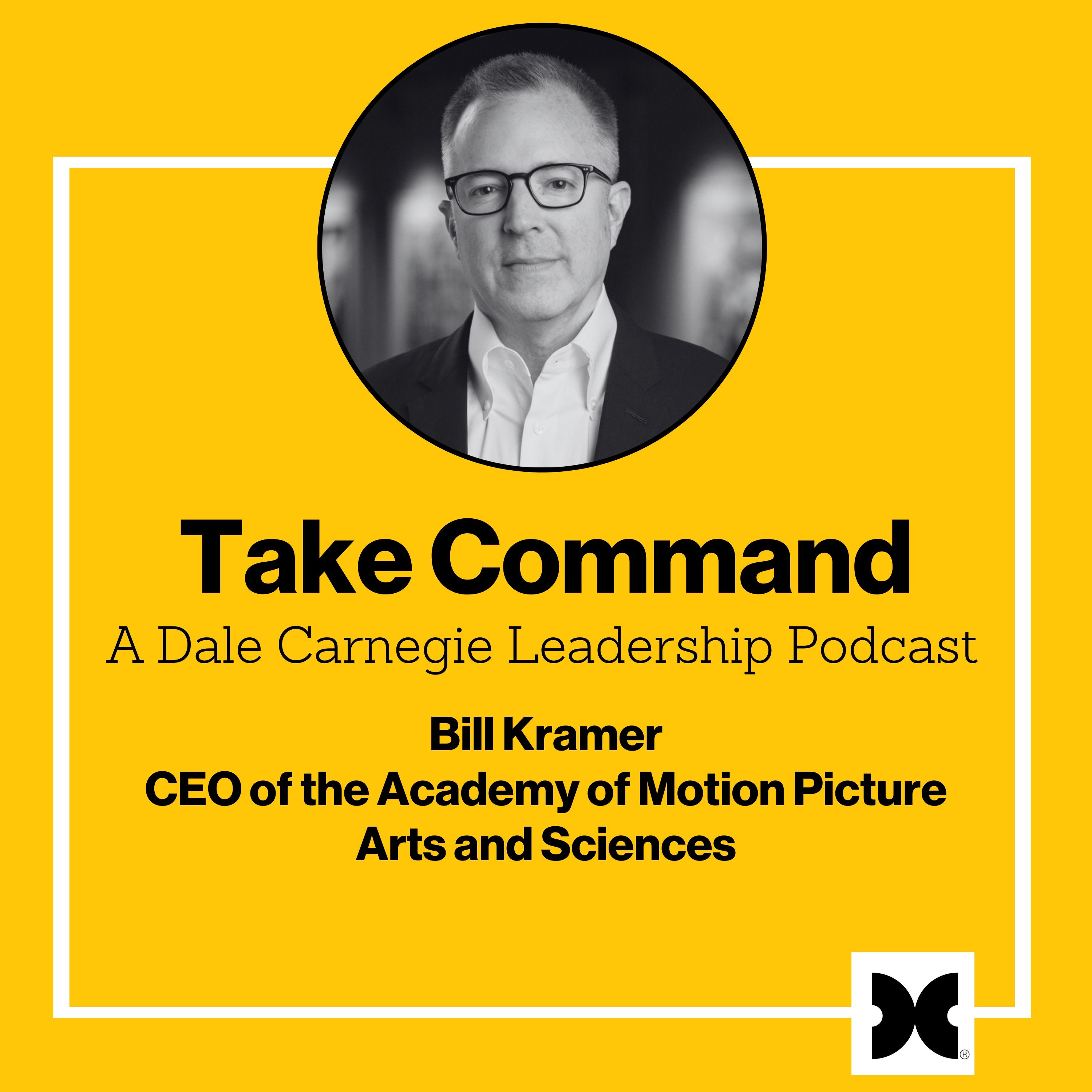
Take Command: A Leadership Podcast
Leadership in Motion: Strategies for Building Purpose-Driven Teams
00:39:38
Bill Kramer’s entire aim as CEO of the Academy of Motion Picture Arts and Sciences is to support creatives by leading his team into the future while preserving and honoring the past. It takes a lot of leadership prowess to do what Bill has achieved. Bill says that starts with finding joy in your work.: “We’re going to have good days; we’re going to have bad days. But if we’re not enjoying the work, if we're not sharing in working towards the mission of the organization, if we don't feel that it's important, then it’s hard to find the joy.” Tune in to hear why a CEO is only as good as their team, how to find opportunities in disruption and change, and what to do to move out of your comfort zone. Bill’s advice will have you stepping up to better leadership in no time.
Loading summary
Transcript38 lines
- [00:00]
Bill Kramer
Foreign.
- [00:09]
Joe Hart
Welcome to Take Command, a Dale Carnegie Podcast. The show where we seek to uncover what leadership means in today's world. I'm Joe Hart, CEO of Dale Carnegie and we will be talking to diverse leaders with stories to tell across various industries to help unlock your potential for success. We will be sharing real life insights into leadership which in turn can help spark the next level of your growth as a leader. Today's guest is a visionary leader in the world of cinema, overseeing one of the most prestigious organizations in Entertainment. He manages $180 million budget and leads a team of over 700 across Los Angeles, New York City and London. He directs global operations including the Academy Awards, the Academy Museum of Motion Pictures and services for the Academy's 10,000 members, advancing film education and preservation. With a career spanning top institutions like the Brooklyn Academy of Music, CalArts and the Sundance Institute, his leadership in fundraising and external relations is unparalleled. Please welcome the CEO of the Academy of Motion Picture Arts and Sciences, Bill Kramer. Bill, welcome to the Dale Carnegie Take Man Podcast.
- [01:28]
Bill Kramer
Hi Joe, great to be here. Thanks so much for inviting me today. I'm looking forward to our discussion.
- [01:35]
Joe Hart
Me too. You and I had a chance to get to know each other a little bit a few months ago and in that conversation I thought what a terrific guest you'd be for the podcast. And you're leading the Academy right now really through a very dynamic time time of changes in the industry with streaming and AI and a whole range of other things. You've done a terrific job. You've been in the role for a couple of years so far. In fact, I just saw congratulations. You've been renewed until 2028 a year early. Good sign. So, really want to talk to you a little bit about what you're seeing, what your experiences are and your strategies around leadership, relationships, that type of thing. What led you to the Academy? Take us back. Bill, you had a business background, originally urban planning background. How did you end up at the Academy of Motion Picture Arts and Sciences?
- [02:21]
Bill Kramer
A long and winding road. I'll give you a little bit of my cv. I went to the University of Texas at Austin. I was an Actuarial science major. I have a BBA in Actuarial science. I was a bit of a numbers guy. Still am. Love probability and statistics. Didn't really know what I wanted to do when I grew up, but I knew that I liked that kind of pedagogy and study I did, by the way, as a young person growing up in Maryland, where I grew up, I was a huge Music and movie lover, pop culture lover. So I was always very interested in the world of the arts, visual arts, cinema, but didn't really know that you could work in that world. It didn't seem like a path for me. I just didn't know one could do that. I grew up in a small town north of Baltimore, Timonium, Maryland, and no one in my world was doing that. It's interesting. My mother was an artist and had a gallery in Fells Point with some friends, but it didn't seem like a career to me. So anyway, so I went to the University of Texas. You had a great experience there. Graduated with a bba, immediately moved to New York and attended nyu. I received my master's in urban planning and public policy, which is really sort of a public administration degree that was really about applying my BBA in a way that would help with city building, demography. That's where my head was moving. I love cities and was always really interested in populations and the building of cities and architecture. I was sort of swirling around that. But I immediately started working for the MTA as a budget and policy analyst as part of the subway station renovation program in my early to mid-20s. And really what I learned there with my first big job, I. I'm not a creative, but I love facilitating the work of creative. So I was doing a lot of long range planning. How many subway stations could we renovate each year? And I was writing a lot of grants to bring in federal funding to do that work. But I was working with architects and designers and also with community groups. I was working with a lot of stakeholder groups. So I thought, oh, this is really interesting. This is what a planner does. I really like facilitating the work of creatives. I like building and I like working with stakeholder groups to create a project or an initiative that pleases a lot of different groups of people. How do I drive to that end goal with a lot of interested parties.
- [04:53]
Joe Hart
In that process, you're working with all kinds of different people and everyone's got an opinion about a project, Right?
- [04:58]
Bill Kramer
I mean, that's right.
- [04:59]
Joe Hart
You're managing a wide range of different kinds of groups. What did you learn in that time about just even relationships and how to build strong relationships and how navigate what could be pitfalls?
- [05:10]
Bill Kramer
Yeah, that was one of the big takeaways from that job. You have to balance a lot of competing needs and desires. You learn to listen, you learn to, as they say, an improv. Yes. And lead people to a place where they feel heard and good, even though you really can't say yes to what they're asking for. A lot of it is bringing compassion to the table and meeting people where they are. With the subway station renovation, you're going into neighborhoods, and every neighborhood is unique and distinct and has different needs. You're also dealing with boards, the MTA board, the Transit Authority board, the City of New York, the State of New York. So you learn how to listen. And again, you're taking a lot of competing needs and saying, okay, not everybody's going to get 100% of what they want. But how do we create a project that really works for the most people possible, possible, and do it in a way where everybody feels heard? I really learned that. I don't know if I realized I was learning that, but just sort of organically, I was sort of learning that process in that role, you know, and after doing that for several years, I realized I wanted to take those skills and really apply it to the nonprofit art sector. You know, that's my love, and that's what I do in my downtime. I go to museums, I go to movies, go to the opera, you know, so how can I take those skills, the fundraising skills, the budgeting skills, the planning skills, and apply it to that sector? So I moved from there to Columbia University. I was associate dean of finance administration for the School of the Arts for their performing arts theater, Miller Theater. I then moved to LA in the late 90s and took my first fundraising job, straight fundraising job with the Sundance Institute, the Sundance Film Festival. The relationship brought me out here. I met some people who worked in that world. You know, LA is a place where people are open to saying, you know what? You seem like you'd be good at this. I'll open this door for you. And I walked through that door and never looked back. So, you know, I had a couple of positions that prepared me for the straight arts fundraising world, and I started doing that at Sundance and really never looked back after that point. I came back to Columbia University, actually, for a Director of development position at the School of the Arts, and then came back to LA, closed out a capital campaign for CalArts, and then moved over to the Academy to start as the, I think, third employee of a new museum project. I was the head fundraiser, and I needed to raise, at the time, $250 million. It grew, and that started my career at the Academy. And then I moved through, you know, progressively, positions that increased in responsibility at the Academy. What was interesting is, after I was hired to do all of the fundraising for the capital campaign to build the Academy Museum of Motion Pictures. My urban planning background came into play, and the board said, look, we need someone to work with Renzo Piano to design the project and take it through public approvals. Is that interesting to you? I said, you know, you had me at Renzo. Absolutely. I'm a huge architecture buff. Everything sort of came together for me with that position. And then I ultimately became Director of the Museum and now CEO of the Academy, and the Museum is part of the Academy. So, sorry, this is my way of telling you my winding road story, but really, it's a lot about skill building and leaning into your strengths along the way and walking through those doors that open where maybe you know 60 to 70% of the job and you have a lot to learn, but you go in with humility and you ask and you build a team that really supports you. And that's what I've been able to do. And the Academy's been an amazing experience.
- [08:55]
Joe Hart
I can't help but think, in listening to your experience, how your openness really was a key part of the different opportunities that came up. You started with one point of view in terms of urban planning and so forth, and working for mta. I know sometimes in our careers we can look back and see how the dots connect, but we can't at the time. And at the time, all we have is that openness to see, where does this door go? A lot of people, I'm curious, have fear. We can all have fears and hesitations. We often think of our careers as being linear. You start here and you go straight to here. Did you have any of that? Were there points at which you were doubting the decisions you were making, or did it just kind of naturally flow from one thing to the next? And what advice would you have for people who might be in similar situations in their lives and careers?
- [09:41]
Bill Kramer
I love the way you framed this because I think you and I are of the same generation. When we're starting our careers, people didn't really move around a lot. At least that was my experience. So I would say for me, some of my nervousness about some of the moves was that I was not staying put for long, long stretches of time. I felt like I was skill building along the way and contributing and moving into positions that were teaching me new things. While I was bringing skills with me, I never really had a moment where I worried that I'd made a wrong decision. I really enjoyed the journey, and I'm so thrilled to be where I am today. I do think for younger generations in the workforce there is more of a, what's called sort of a portfolio career where you can take different positions that teach you things. And your CV may look a little more filled with positions, but I don't think people look at that as a bad thing. I think loyalty is important, but I also think taking care of yourself is important and you do it in a way where you leave the employer whole and you leave yourself whole. But I did think of my path as a lot of skill building. And you're right, though. In the moment, you don't necessarily see the linear progression. But I was always thinking about, okay, so it's science. I was learning how to fundraise with individuals at the mta. I was writing big grants. I wanted to learn corporate fundraising. There's sort of many legs of fundraising. I didn't know a lot about corporate sponsorship. So when I went back to Columbia University, that was in my portfolio. And then when I moved to CalArts, I was actually running a fundraising campaign, a multi year campaign. So I just kept thinking, they're building blocks in fundraising. And I was adding blocks to what I was building long term. And it served me well. I was very lucky to have a lot of people open doors for me along the way.
- [11:40]
Joe Hart
Let me ask you about that, because sometimes mentorship is something that doesn't really get the attention that deserves. I know in my own life there have always been people along the way who have helped me, who I could go to and would help really guide me or encourage me. And I've done that for many other people as well. Who are some of the people along the way who've helped you and what advice do you have for people about seeking mentorship opportunities?
- [12:03]
Bill Kramer
I think that's so key. And you know, we met because we're part of the CEO connection. And what was great about that for me is I'm the CEO of a nonprofit organization. We're a 501C6 and a 501C3, a membership and arts and culture organization. But I wouldn't necessarily meet CEOs from the for profit sector. And what I've liked about this experience is that, you know, our conversation taught me a lot. We may be dealing with different end products, but we're dealing with similar issues and concerns and we can share our experiences. So throughout your career, I think being open to meeting colleagues and peers where you can share best practices, concerns, ideas, that's really key. I'm very lucky to be a part of this group now. And along the way I've had mentors I think Stephen Levine, who was the longtime president of CalArts, was a great mentor for me. I don't even think he quite understands that, but I learned so much under his management and guidance. And he's someone I turned to a lot when I was at CalArts. And after that point, a gentleman named Ken Brecher, who's no longer with us, unfortunately, he's the former executive director of the Sundance Institute. I think about who I work with now in my role as CEO at the Academy, but even earlier on with other positions I've had at the Academy, Bob Iger was the chair of our capital campaign, working with him to raise the funds to build the museum. Through just those experiences, I learned a lot about decision making and being decisive and planning. And I think one must always be open to peers and colleagues in their world, being really open to those conversations, because you're going to learn something along the way. And the last thing I'll say is I have an incredible team of senior leaders at the Academy who teach me so much every day. We had our bi weekly senior team meeting earlier today, our leadership meeting. Sometimes I'll just listen to what my colleagues and peers are saying, and inevitably, I'm learning something along the way. It's about mentorship, it's about peers, it's about going outside of your comfort zone and talking to executives who are in perhaps roles that may not seem exactly aligned to your role, but who can teach you something. I think it's just being open to those conversations.
- [14:29]
Joe Hart
Yeah, I couldn't agree with you more. And it is an intentional action. This is the Take Command podcast. Right. So it really is about being intentional, living an intentional life. And some of these things, I think a lot of times, any of us, I look at your job, you're in the midst of a $500 million capital campaign, you're leading the Academy, dealing with the Oscars, all kinds of things. And yet you make time to prioritize relationship networking, if you will, and so do I. And one thing that also underlies it, and you use the word hum earlier, and you talked about your people and for all of us to recognize, we don't have all the answers. So by being in community or being in connection with other people, this is something that can help us grow and succeed as well.
- [15:09]
Bill Kramer
Could not agree more. It's something I've really learned in this role, leading with humility, spending time with your team and learning from your team, not being afraid to say, I'm unclear here and I need to learn something here. I think that shows humanity and openness to learning. And I think that's a great culture that you want to set for any organization. And I think it really opens you up to conversations you may not have at your disposal. If you don't enter with intention. I love that word. And humility, because you'll learn something if that's your approach.
- [15:46]
Joe Hart
So how do you deal with conflict, Bill? For example, in your role, you've got people with very strong opinions, and you're dealing with all kinds of different people in Hollywood and around the world, and business people, people in your organization. People aren't always going to agree, and they might not agree in a very strong way depending upon people of emotions. And one of the things that Dale Carnegie talked about is we're dealing with creatures of emotion, not necessarily always logic. Right. So what are some strategies that you've learned over the years that you use either in dealing with difficult situations, dealing with difficult people, conflicts? What are some things you've learned?
- [16:21]
Bill Kramer
I think the emotion part of it is a really important point to remember. I think bringing compassion to those conversations is key. And empathy, because if someone's unhappy, there's a lot of emotion coming at you. All the logic in the world doesn't negate the feelings of the person who may not be happy on the other side of the conversation. So I think understanding that that energy will be there. And how do you diffuse that in a way that makes the other person feel heard, but also brings clarity to the conversation? I think being clear and direct is key, but also compassionate. Finding that middle ground is key. And obviously never engaging in harsh words or countering emotion with a lot of emotion. I find that that doesn't really help. But I think understanding that sometimes people just need to be heard is really key any job. It's all about relationships. You may not think you want to keep this relationship alive, but you ultimately always want to keep your relationships healthy and open to future growth. And I think you should constantly be thinking about that in moments of tough meetings. And I think balancing a lot of competing needs is always the order of the day. And again, I think bringing compassion to those conversations and understanding someone's going to be hearing a no, and how are they going to take that? And how can you get them to a place where even if they're not thrilled with the no, they understand why you needed to make that decision. I think that level of transparency, where possible, is really helpful.
- [18:00]
Joe Hart
Well, and for people to feel that they've been heard, one of the principles we teach is to try honestly to see things from another person's point of view and is probably one of the most important points of leadership. And it goes to the word you're using, which is compassion. We can't have compassion unless we understand. Can we see things from another person's point of view? You do that in an excellent way. You really, I guess, in many ways have to. You've got such a visible role in the world. Let me switch a little bit to say, the Oscars you took over in 2022 different points of view about the Oscars. I think what's unequivocal is that the last two Oscars have been very positive. You know, people have talked about energy, that you have brought leadership and vision to this. You're also working in a time of great dynamism, if you will, in the industry, between technology and streaming and a whole range of other things. What can you share about the complexity of that kind of leadership, of managing a dynamic situation? You can't control all the different variables. You're doing the best you can. How have you found it to be successful to lead in those kinds of situations?
- [19:05]
Bill Kramer
I appreciate that you're bringing up the complexity of the environment in which we are working today. And I'll start with that and then I'll directly answer your question. You know, the Academy sits in two worlds. Again. We're a non profit. We sit in the film world. Right. Our members are members of the film industry. We celebrate cinema, we award excellence in cinema, we engage our members. We have a film museum. We serve the public. We're in the film industry, and we're in the nonprofit arts and culture world. Both are going through radical business model shifts right now, like many of our industries are. It's not just us, but these are two sectors that are seeing big shifts in revenue streams and how audiences are engaging with our content, whether it's visiting a museum, engaging with our content, on social, watching the Oscars, going to the movies. So there's a lot of opportunity when things are shifting like this. And I think part of leading during a time of great. I'll use the word disruption, is that there are opportunities, but you have to get in front of those opportunities. So to be a leader in this moment, I think means acknowledging that a lot of things are changing, bringing optimism to the situation and bringing a sense of this means things will change, but there are great opportunities in change and being really open to those conversations with your staff, with your academy members, with your museum members, really being open to those conversations and not pretending that this isn't happening and really planning for the future. I think seeing that these changes will impact us in a year, two years, five years, really requires us to start adapting and evolving today. So getting in front of how those changes will impact our finances, the ways in which we engage with our members in the film industry, the way we curate our exhibitions in our museum and host our daily screenings, all of this is impacted by the shifting sands, and we have to get in front of that. I think the last part of your question, you were focusing on the Oscars, and that's a lot of responsibility. We have a lot of eyes on that show and it defines our brand. Even though we do many things other than the Oscars, it is a brand defining component of our work. And for me, what is so important is that I hold myself accountable for that show fully. We have an amazing group of producers and writers. We have an incredible production team, we have incredible partners in Disney, abc. But I hold myself accountable for the show. And, you know, that doesn't mean that I have 100% control over everything that's happening at all times. There are a lot of moving parts, but I think as CEO, it's so important to play that role of being accountable because decisions have to be made quickly and swiftly, sometimes in the middle of the show. And people need to know who's ultimately making that decision. And sometimes it's me, sometimes it's a group of us. But I don't let my eye off the prize throughout the night and in the lead up to the night. I think that's really important. And I think you can apply that to any key project or initiative of an organization.
- [22:39]
Joe Hart
It's just fascinating. You've got an event that is such a marquee event, global, iconic, it's the super bowl of what you do. It can go really well, or it could have issues. And either way, like you said, you're accountable. I think it's the role that all of us need to embrace as leaders, you know, whether we're managers, whether we're leading a company, whatever it is. But you talked about your team, I think in empowering your team. And I would love to hear just a little bit about that as well, because from my standpoint, leadership really is about developing and bringing out the best in other people and helping them achieve great results together. What are some ways, one or two strategies that our listeners could take away, if they're leading right now, something that they might do that you said, you know, I find this to be really an effective way. The Buck stops with me and I need to build great leaders. Here are a couple of things I do.
- [23:29]
Bill Kramer
Yeah, that's right. I mean, there's CEO accountability, but you're only as good as your team. I think step one in building a team that also holds themselves accountable, a team that feels fulfilled and engaged. That's also key is goal setting and really moving into every fiscal year, every long range plan with a sense of shared goals that you can then take to your teams and have them ladder up more specific goals tied to their areas into the bigger organizational goals. But we spend a lot of time talking about that. The Academy, we do so many things. We have the world's biggest film related collection, 52 million items. We produce the Oscars, we run the biggest film museum in the world. We're a membership organization. Sometimes it can be hard to create the thread that ties it all together when you're in the middle of a project that's specific to one or more of those areas. So I really think it's important to create a sense of vision and values and goals that we all agree to hold ourselves accountable to and share in the creation of. And I think that's really key and I think touch points. I have monthly meetings with either the entire 700 person plus staff or components of my staff, people who are managers, people who are members of our employee resource groups. And we bring different topics into those meetings and try to create feedback loops. So I'm hearing from members of the teams, we're talking about goal setting, we're talking about responses to goal setting. So I think creating that sense of vision and clarity, but also creating feedback loops. And I've learned that through this job. I didn't start with that process. And after, you know, a year, I realized we're missing this here at the Academy and it's created a much greater sense of camaraderie. And I'll use the word clarity again. I think clarity is key. It's so easy to have static around you. There's so many things we can do and add to our plates on any given day. But how do you make sure that people are really focusing on the key projects and initiatives at hand? And I think team members appreciate that because life can become overwhelming otherwise. There should be joy in the job as well.
- [25:54]
Joe Hart
Speak a little bit more about that joy in the job. I couldn't agree with you more, but what's an example of joy in the job?
- [26:00]
Bill Kramer
Well, I'll use the Oscars as an example. Last year was an incredibly successful show. I want Everybody feeling great about that. So easy to think about, oh, that light bulb over there was not working. And I was focused on that throughout the entire show. Savor the success. We're doing something important for the film industry, for film lovers, for young storytellers. We're inspiring new filmmakers find the joy in that. So I do think that's also part of a CEO's job to kind of elevate the conversation and help our team members find the joy. Because we're gonna have good days, we're gonna have bad days. But if we're not enjoying the work, if we're not sharing in working towards the mission of the organization, if we don't feel that it's important, it is hard to find the joy. It doesn't mean that you're not working incredibly hard. It doesn't mean that you don't have of really tough days. Doesn't mean that you're not tackling challenging issues. But I think finding the joy is key. And you know, we both work for organizations that I think inherently bring some joy and a sense of collaboration and camaraderie to the table. So, you know, we're lucky. I think it's sort of inherent in our work that we want to be with people with shared interests and goals. Any CEO should be thinking about that. I think that's key.
- [27:16]
Joe Hart
You're right. It may be easier for you or for me because, you know, Dale Carnegie is such a purpose driven organization. The Academy is a purpose driven organization. You're committed to a culture and to a cinematic arts and so forth. So we have kind of a natural built in thing that people can easily gravitate to. And I remember one time, Bill, I talked to a man who made, he was a CEO of a company, they made plastic pallets, the kinds of things you'd put underneath packages like at Costco, but they were recycled plastic. He was so excited about the plastic pallets and the impact that they were having on the environment. I think probably for all of us as leaders to be able to inspire in other people a passion or a purpose or a mission in whatever it is we're doing, that it's good that it's valuable, it's making a contribution, such an important form of leadership.
- [28:03]
Bill Kramer
I could not agree more. In those plastic pallets are part of an ecosystem that we would all be lost without. And everyone has to find the why? Why am I doing what I'm doing? Why is this company or organization doing what it's doing? We're all linked in some way and you don't want to be hokey about it, but you want to find that sense of purpose. Everyone's role should feel purpose driven and connected to a greater vision. And then I think beyond the company or organization, connected to the world in a meaningful way, or your community or everything in between. You know, sometimes in one's day today, you can lose sight of that. And I think a strong leader helps teams see the why, the joy, the purpose on a consistent basis.
- [28:53]
Joe Hart
Absolutely right. Speaking of which, you know, you're a very high profile leader and part of what you're trying to do and I'm trying to do is inspire joy in other people and to find that purpose. What about you? From a personal growth standpoint, you're constantly on the go, you're raising a lot of money all over the world, you've got members all over the world and you're in a very visible role. How do you find peace, joy, purpose, rest for yourself? How do you invest in yourself so that you can do the very difficult job that you have to do that's.
- [29:25]
Bill Kramer
So important for all of us, regardless of your role? But I take that part of my life very seriously. You know, I'm lucky I'm married. My husband's amazing, brilliant person, a compassionate person, teaches me how to be a better person every day. I'm grounded in my marriage and my relationship in a way that's very meaningful. Same with my friends and family. I really prioritize time with my family, my friends and my husband. You know, it's not always easy to do. You have to carve out time for that and you have to do it with intention and be present. But you realize you're a better leader if you're nourished outside of the office. We all work hard. We're all defined by our jobs to a certain extent. But you have to cultivate a life outside of your work and in doing so, you become a better leader. You become a more holistic and compassionate leader. I think exercise is important. I run, I do Pilates several times a week. I eat well. That's really key. So, you know, sound body, sound mind, you know, get an annual checkup. I think that's also really important. You really want to make sure that the stress of the job is not impacting you in difficult ways. I read a lot. Again, we're big arts consumers. We see a lot of movies, we go to a lot of museums. We were just in Maine and Cape Cod and we have a house in the Berkshires. We get away. I always keep an eye on work while I'm doing that. But I think striking that healthy balance is really key.
- [30:56]
Joe Hart
Right. And no one's going to do that for you, necessarily. Right. Or for me. I mean, I have to be intentional for myself. Or you have to be intentional for yourself. To say what's important to me and ultimately make time to do it, I will tell you, I find time to exercise. I do something every day. If it's running or working out, lifting weights or something, I feel like, especially as we get older, it's even more important. But just that physical outlet. But whatever it is that we need to do to make that happen. Going back to the Academy for a second, I mean, so you think about the years ahead. You're in this time of really dynamic change. What do you see as the future for the Academy? And it's a very big question. But you could say the future for the Oscars, the future for the Academy. If it's five years, 10 years from now, what are some of the things that you see? How does it look?
- [31:41]
Bill Kramer
Things are looking great. You mentioned earlier our $500 million fundraising and global outreach campaign. We launched that publicly a few months ago in Rome with our partners at Rolex and Chinichita. That was about sort of future proofing the Academy and really getting in front of some of the changes we were talking about earlier. The. The shifts in audience behavior and revenue streams for nonprofits. So I see the Academy, and it's a lot of the work we're doing now, becoming a much more global organization. Our brand has never been stronger. We're leaning into a lot of components of the Academy's work that we really haven't before. We opened up a film museum two and a half years ago. We've already had over 2 million people visit the museum. Hugely successful. We're the center of the preservation and the curation of our film history for the world. We really want that to become a much more central part of the work we're bringing to the world. In addition to our awards, our honorary Oscars, our Oscars, our SciTech awards, and then the work with our members, we have close to 11,000 global members of the Academy. These are films professionals and artists. These are our film leaders. So there's no other organization like the Academy. We are at the center of the global film industry in a way that no one else can really match. So we're starting from a position of strength. Our campaign most likely will be completed by our 100th Oscars in 2028. That will create an Endowment, general portfolio that will provide us with an incredible revenue buffer for the future as we chart our PAT beyond our 100th Oscars. But we're in a really strong position right now. The last thing I'll say is we're looking at the future of the Oscars with Disney, abc. We're so lucky to have a great partnership with them. But it's going to be interesting to think about how this show evolves as people consume award shows differently. But I will say this. Everybody wants an Oscar, and our brand worldwide has never been stronger. So we're in a very fortunate position as an organization. I feel very lucky and honored to run the academy.
- [33:59]
Joe Hart
One of the things I appreciate about you, Bill, and again, I got to see this when you and I were speaking previously, is your outlook, your mindset. Our mindset governs just the way we see everything. You mentioned earlier about do people see fear? Do they see opportunity? You see opportunity. There's so much change right now. You said, hey, we need to really have this capital campaign. You might not have gone down that path, but a high percentage of your revenue coming from the Oscar event itself. You're still a nonprofit. You've got all these people, you've got all these other responsibilities. So how do you ensure that longevity? You came up with the idea of a $500 million capital campaign and you already raised over $100 million so far. So after a great start, that role of vision and looking for opportunity amidst change I think is just a critical takeaway that I hope all of our audience will receive. Because all of us in our day to day lives run into things that can be our first reaction is, this is bad or this is a challenge or I'm cooked or whatever it is. And yet when we're innovative, we've got the right mindset, really. We can make incredible things happen.
- [35:02]
Bill Kramer
A strong leader really sees into the future and brings that sense of opportunity and optimism to the teams that will lead us into the future. And you don't want to be unrealistic, right? You need to do it in a way that seems achievable, but you also need to create a vision that people can align with. And sort of meeting that vision with a realistic strategic plan is key, but it's always about finding the opportunity. And as things change more and more rapidly in all of our worlds, we're going to be confronted with these moments of uncertainty more and more, I think. How can you pivot? How can you see three to five years ahead to make sure that you don't fall off a cliff or you don't need to lay off a huge group of people, or if you need to make staffing changes, how do you do it in a thoughtful way? Sometimes that's part of evolution. Sometimes it's budget driven, and sometimes it's programmatically driven. With all of that, you have to do it in a way that's compassionate and optimistic. I stand by that.
- [36:10]
Joe Hart
Absolutely. We want to treat people the way that we would want to be treated ourselves. And you talked about transparency earlier as well, I think, which is something people respect and appreciate. Bill, one practice I've gotten into in the podcast is I've gone to ChatGPT prior to the interview, which I did today, and I said, hey, ChatGPT, I'm interviewing Bill Kramer, CEO of the Academy of Motion Picture Arts and Sciences. And what questions would you ask? Bill? And ChatGPT politely gave me some questions and I said, well, what's one question you would ask? If you could only ask one, what would it be be? And this is the question. You ready?
- [36:46]
Bill Kramer
I'm a little nervous, but go for it.
- [36:48]
Joe Hart
Well, it may be the best question yet. Okay. In your role as CEO of the Academy of Motion Pictures Arts and Sciences, how do you ensure the Academy not only honors the past, but also actively shapes the future of the film industry, particularly in a way that remains inclusive and relevant to the next generation of filmmakers and audiences?
- [37:10]
Bill Kramer
That is the work we're doing. So with our film museum and our 52 million item academy collection, we're preserving our global film history with our talent development and education programs. We're training and inspiring the next generation of diverse and inclusive storytellers with our Academy membership. And we've really done a great job of creating a more global and diverse membership. We're inviting more international members in and members from traditionally marginalized communities in the film industry. So we're working to create a more diverse film industry and a more diverse pipeline into the film industry. So we're doing all of that. And then with our award shows and our incredibly robust social media presence, we're connecting film lovers around the world through the Oscars, through our Instagram page. We're a source of connection and education and preservation and curation and. And we do it in a way that no one else can do, with the expertise of our members, with our state of the art collection that we have, with our film museum, which is the largest film museum in the world. We have all of the tools to do everything you just mentioned in that AI generated question that really hit all of the components of the Academy, so they went into our mission statement and sent it back to us. But that's the work we're doing and I think we're doing a beautiful well.
- [38:36]
Joe Hart
We certainly wish you the very best. Any final thoughts for audience before we close?
- [38:40]
Bill Kramer
No. Thank you so much for having me today. I'm a big fan of you and your work, and I think the tenor of this podcast and the topics you're covering are so important and I'm just grateful for the opportunity to speak with you. So thanks, Joe.
- [38:54]
Joe Hart
Awesome. Bill, thank you so much for being with me today. I hope you enjoyed this edition of Take Command, a Dale Carnegie Podcast. Check out our resources at www.dalecarnegie.com for more research, insight and tools that will support your success and help you take command of your leadership potential. If you enjoyed this episode, please consider rating it and following us on Apple Podcasts and Spotify. For more exclusive content, subscribe to our Dale Carnegie YouTube channel and follow us on social media. As always, thank you for listening and we're looking forward to you joining us for the next episode of Take Command, a Dale Carnegie Podcast.