← Take Command: A Leadership Podcast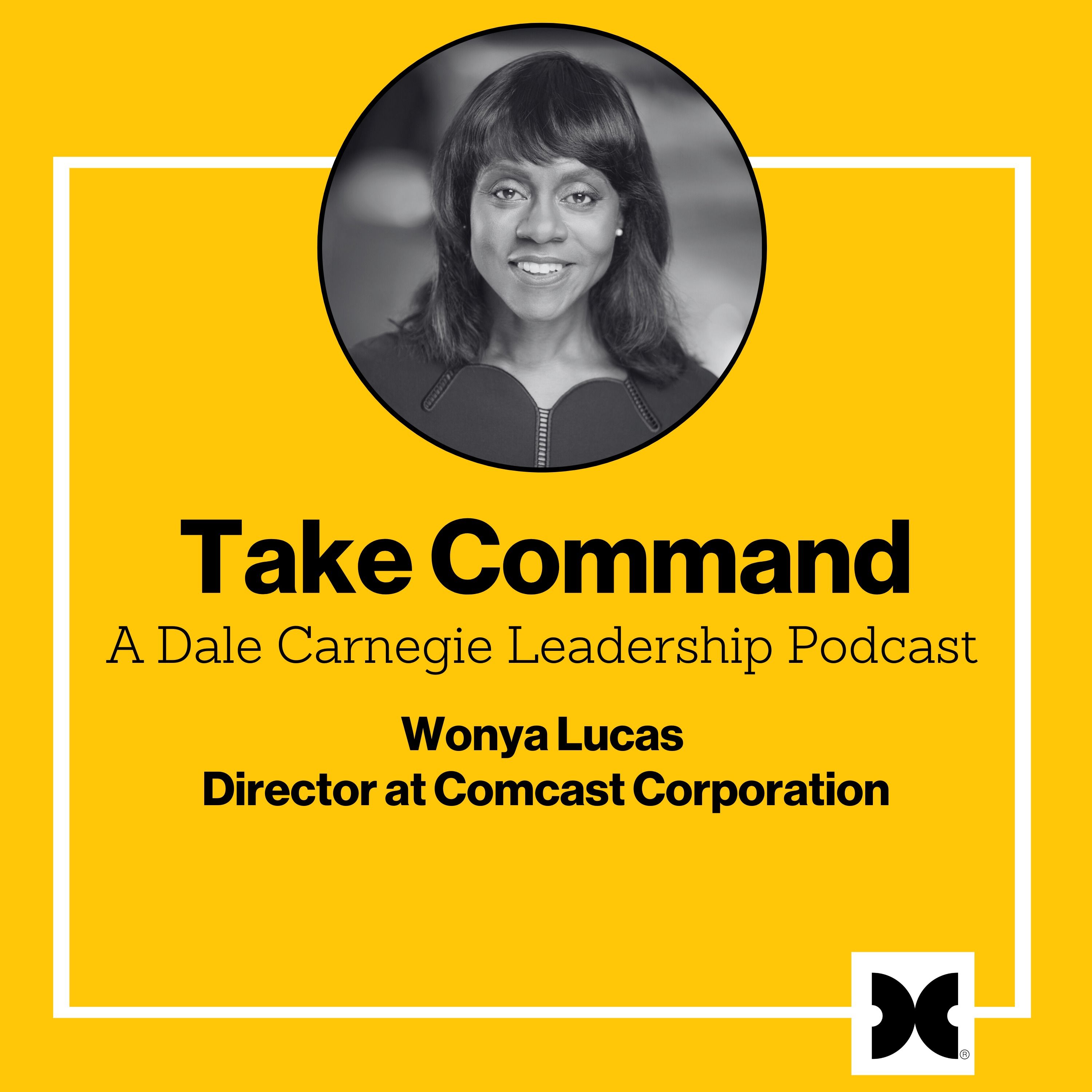
Take Command: A Leadership Podcast
Leading with Love: A Hallmark of Excellence
00:33:40
Wonya Lucas embodies all the best qualities of a leader, and, just like mom’s cookies, she does it all with a sprinkle of love. “Love is a commonality that we all have,” she says. “It is very much at the core of each person and the essence of people.” During her marketing and advising work, Wonya has kept her focus on those whom she is leading. “I want people to know that, as a leader, I'm here not just to help the company but to really help with their careers.” Tune in to hear more about how getting to know people feeds their success, why creating a safe space for vulnerability is critical, and why everything is about connecting with people to build relationships.
Loading summary
Transcript51 lines
- [00:00]
Joe Hart
Ready to elevate your leadership. Follow Take Command, a Dale Carnegie Podcast. Now transform inspirations into actions. Hit, follow and lead with impact. Welcome to Take Command, a Dale Carnegie Podcast, the show where we seek to uncover what leadership means in today's world. Hi, I'm Joe Hart, CEO of Dale Carnegie. And we will be talking to diverse leaders with stories to tell across various industries to help unlock your potential for success. We will be sharing real life insights into leadership, which in turn can help spark the next level of your growth as a leader. Our guest today is an accomplished media executive renowned for her leadership as CEO of prominent organizations such as Hallmark Media. With a wealth of board experience, including serving on the board of Jurors for the Peabody Awards and the Board of Trustees for Children's Healthcare of Atlanta, she brings expertise in management, marketing and strategic planning. A passionate advocate for the power of storytelling, she was inducted into the Broadcasting and Cable hall of fame in 2023, an honor recognizing television's most influential pioneers and innovators. Please welcome director of Comcast Corporation, Wanya Lucas. Wanya. Welcome to the Dale Carnegie Take Me in podcast.
- [01:35]
Wanya Lucas
Thank you. I'm excited to be here.
- [01:38]
Joe Hart
Well, I'm excited to have you here and I know you've got so much really wonderful background and insight to share with our audience from your experience. You are on the board of Comcast, the board of the Atlanta Braves. You were the CEO of Hallmark Media, had a really fantastic career. I'm curious because you didn't start out in media. You started out with an engineering degree from Georgia Tech. Your first job was working in a Westinghouse plant in St. Louis. How did you go from that to leading one of the biggest media companies in the world?
- [02:11]
Wanya Lucas
Well, I will start by saying that I've always had a duality. I've been left and right brain. And so when I was in high school, I did science fairs and I was a mathlete, but I was also in a school of performing arts. Now, I was not one of the stars, but I was in the School of Performing Arts. Even when I went to Georgia Tech, I was in the chorus and I did plays. So I've always leveraged both sides of my brain and both interests, quite frankly, that I've had. The reason I chose industrial and systems engineering is because it had a strong business base. I knew it was going to be in a plant for all of my life, but I had no idea what I would do. So I after I did engineering for about five years and I truly loved Westinghouse. They cared about people they gave me an opportunity to be a spokesperson, trying to encourage others to be an engineer. And so that helped the public speaking. But I knew it wasn't my destiny. And I had a lot of friends around me who were in law school and business school. So I decided to go to business school, majored in finance and marketing at Wharton. So that duality always stays with me.
- [03:16]
Joe Hart
Yeah, yeah. So from now engineering to finance and.
- [03:18]
Wanya Lucas
Marketing, you know, I was one of those people that, you know, I'd go see a presentation from a company, and it's like, I'm going to be an investment banker. I'm going to be xyz. And all my friends are like, what are you going to be this week? W But when I saw marketing and brand management, I could clearly see there was an opportunity to leverage both sides of my brain and both of my strengths. And starting at Clorox, which was really deeply rooted in the P and G way, was probably the best move I've ever made. Because I really understood not just how do you do commercials and how do you create products, but who is the audience, not just who they are, but who's the opportunity audience in addition to the current audience, and not just the demographics, but the psychographics and really understanding what drives people in life, but ultimately to purchase. And that's something that I've used consistently in every one of my jobs. So that engineering background and then the ability at tech, believe it or not, didn't have problems getting a role there. There weren't a lot of people like me, but to really express myself creatively. Actually, a lot of people like that really did help me along the way in the road post grad school.
- [04:29]
Joe Hart
So what is it about? Because a lot of times people can go about what we're doing and not think about other people. Certainly one of the things we talk about in Dale Carnegie really, is to try to think about the other person, to listen intently, to care, and to value the other person. But what was it that kind of. Was that trigger point for you? Because I know that was an important part of your career. Afterward, thinking about the audience and thinking about how do you really deliver value to the customer?
- [04:53]
Wanya Lucas
You know, having a respect for the audience is what I learned, regardless of who they are. Right. I used to give out a T shirt that it would say, you are not the target audience. The place I love the most that I gave that T shirt out actually was the first time was cnn.
- [05:07]
Joe Hart
You gave it out at cnn.
- [05:09]
Wanya Lucas
I gave it out at cnn. I was part of the senior team. And we would meet at a round table, this big room every morning, and it would be the head of CNN and all the top journalists, people who were running the different networks. And I ran all of marketing. And we were getting ready to go through a brand study and really do a deep dive on the audience, but also look at the competitive situation, too, and understand the Fox audience because they were an emerging, I would say threat. At the time, we were still number one, but they were an emerging threat. And so I gave out this T shirt and I loved seeing Tom Johnson put on his you are not the target audience T shirt. But it really did help the mindset so that these incredibly brilliant people, just a wealth of experience, could understand that sometimes you have to step out of your shoes and step into someone else's shoes. And those shoes are really important shoes.
- [05:58]
Joe Hart
Was there a time that you did that that had a really meaningful impact either on you or the people around you, where you had kind of this defining experience?
- [06:08]
Wanya Lucas
What a great question. I think Weather Channel was probably the most defining because when I got there, we were basically the man in the map and doing really well. We kind of owned weather.weather.com it launched. It was doing incredibly. But one of the things that we learned through consumer insight research is that we covered weather. And really, let's just talk about storms and the devastation that can happen, right? So we covered the storm as it was pending, but we basically gave the rest of the story, the human part of the story, to news outlets. We left after the storm. So we created shows like Storm Stories, told those stories about people post storm. We created a show called It Could Happen Tomorrow. And our pilot episode was, what if a Category 5 hurricane hits? New Orleans, direct hit. This is before Katrina. This was like a year before Katrina. Everything that happened, for the most part, it wasn't a direct hit. So some of the things were a little different. But people said, we're not going to leave. They've been talking about this forever. It was really just incredible foresight as to what could happen. And we saw it happening in real time. We moved our reporters, but we were there to cover the aftermath, which is something that I think was really important. They still continue to do a great job.
- [07:30]
Joe Hart
It's interesting though, because I think about perspective, right? So people are doing something a certain way. The Weather Channel is successful. But then again, when you talk about the audience and you have that insight, it's like, what does someone really want to hear or understand? How do I connect with them? And you're right. It's the stories. It's not just the weather. Yes, I'm interested in the weather, but you know, how does this affect me? How does it connect with the humanity? So there's really a lot of value in really trying to think deeply about the people that we're connected to, the people we work with, the people that we serve and our teams and our customer.
- [08:03]
Wanya Lucas
Of course, our tagline was bringing weather to life and we incorporated that insight into our upfront presentation. We created winter, spring and fall. We had snow machine for the winter and then we brought in advertisers and it was our first big upfront. And I remember there was a reporter, I won't say his name in the Wall Street Journal. He's quite famous. And he said, I just came to make fun of you guys. What's the Weather Channel doing having an upfront? But I will also tell you the power of that brand. There was an up and cominging band and our producer of the show said, hey, wanya, I've got this band. They've been living out of their car, but now they have a song, they have an album and their song is shooting a number one. And they love the Weather Channel. A couple of them are from Oklahoma. And we heard who it was. And I'll tell you the punchline. By the time we had our upfront, Maroon 5 was the number one artist in the country. They love the Weather Channel and they played our little show. You know, that insight became so big and so important to our business model, quite frankly. That was a lot of fun.
- [09:09]
Joe Hart
It sounds like fun. I want to continue to explore your journey and your leadership journey in particular because again, you were going from one level originally working in a plant. Now you're in media, you're working. You're part of a leadership team at cnn, the Weather Channel. You ultimately lead all of Hallmark media. Talk about that journey. Some of the things you learned along the way about how to lead effectively, how to inspire other people.
- [09:33]
Wanya Lucas
I would say that I learned a lot about leadership from my family and how do you lead teams. I grew up in a baseball family. It was all about the team. And it was also about having great positional players. So for me, most of what I learned in leadership and I took leadership courses at Wharton. I was in one that our dean taught. It was very prestigious to be in that class. But at the end of the day, how you play together, how you win and how you lose, I don't care what you do. That's important, right? In anything that you do, anything that you Pursue. So taking those leadership lessons around team, having strong individual players, understanding the goal, learning from mistakes, like those types of things I took with me as I became a manager. I also think it's about giving people time, knowing who they are, knowing what drives them, what are their hopes, dreams and aspirations. And those are questions I would ask. Not just my direct reports, but I tried to get to know everyone in my departments. I would create special times everywhere I worked where people could sign in and come see me. I don't care who you were. And we could just talk, get to know you, or we could solve a problem together. And I think being accessible and being willing to listen and not always talk was really a helpful skill that I developed over time.
- [11:00]
Joe Hart
Well, it seems like that accessible leadership is something that people really are craving today. I know I've experienced it. Kind of like you the Ask Wanya. I've had the Joe World Tour, which is I create a QR code and anyone on the team can schedule a time and anytime for 25 minutes for a one on one conversation. And I've really actively tried to do that. And personally I find that to be one of the most fulfilling parts of my role is being able to get to know the people on our team. It's fun. It's a reminder about the people as leaders that we serve and how fortunate we are to be in a position of working with such great human beings.
- [11:37]
Wanya Lucas
And also, you know, it's a reminder that we were them.
- [11:41]
Joe Hart
It's true. That's true.
- [11:43]
Wanya Lucas
We were them. And all I wanted was to tell my big ideas to someone and sometimes they'd listen and sometimes they wouldn't. But I remember I will never forget being them. And I think that's helped keep me grounded and accessible. But also it's been a secret to my success because I always say sometimes the perceived tiniest voice in the room can have the best idea, just can't.
- [12:04]
Joe Hart
Yeah, that's right. We never know someone's going to see something or maybe have an insight that we're not going to have. Going back to influences, I know that your father, your parents and your father maybe in a special way had a huge influence on you and your leadership. He was the first black general manager in Major League Baseball, I believe, right. At the Atlanta Braves. And you saw him and work closely with him. How did he inspire you? What did you see and how did that affect your leadership?
- [12:31]
Wanya Lucas
So one of the things I loved about my father and my father and my mother both came from really humble beginnings. First, you know Families to graduate from college. But what I loved about him is he just had this big personality, but he didn't overtake the room. He was always cognizant of others. And so at a party with my father, you would know he was there because he had this great voice and he had a beautiful smile, and he had this wonderful way about him. But most importantly, he listened to people. He listened to us. Like he said, drive me to school, and, you know, he'd ask me all these questions, and I knew he was listening intently. So I think my father, as a leader, was a listener. I also think that he studied the game really well, having played it, and not been as successful as the people he was managing or putting on the team. He understood the struggle, but he also understood what it took to become successful. And I think getting to number one, knowing who you are, number two is, I would say, understanding who others are and trying to figure out really, like, what are their strengths and what are their weaknesses and how can I help them with both. And I remember he would have players come to our house, and I listened to some of the conversations, not knowing that I would use some of the lessons. But he would spend a lot of time trying to understand. Today, we would say, what's your. Why? He wouldn't say those words, but that's what he was doing. What motivates you, what drives you, and then trying to transfer that into basic baseball, you know, so just taking time with people was another thing. And seeing people. And then I would also say that just being self aware, I learned this skill from him. He would always admit when he was wrong. I model that because I want to create a safe space as a leader where people can say, I was wrong or I shouldn't have done this one. Yeah, I should have done that. When people know that, okay, so what would you do differently? That's what's important. And those are the kinds of things that I learned from my father, I think from my mother. My mother is just bold. My father died. Ted Turner. I was 18. He said, I will always take care of you. He put me through college, was a senior in high school, two weeks from my graduation, and he said to my mom, I will always take care of you. When she retired from teaching for over 30 years, she went to work at Turner Broadcasting. And eventually he put my mother and my Uncle Hank on his board of directors. And my mother, being a teacher, asked a question, and in the boardroom with her, Jerry Levin, John Malone, ryan Roberts, Terry McGurk, like all of these big People. And she asked the question, what about content for kids? And one guy, none of the ones I'd mentioned, said, we don't care about kids, Ruby. Ted doesn't care about kids. And Ted said, yes, I do. And eventually he commissioned Betty Cohen to come up with this idea, and that became Cartoon Network. So from my mother, I learned, if you have an idea, no matter who's.
- [15:42]
Joe Hart
In the room, speak up, speak up and listen. Right. I think about your mom, and your mom must have had a lot of courage. She's on this board of directors, all these other people, but she wasn't afraid to speak up. And often that's the most important thing that all of us can do. You've talked about being true to yourself and that type of thing. And, you know, Ted Turner, to listen, to listen to the idea.
- [16:05]
Wanya Lucas
Yeah, I mean, it is a great lesson. And if I can impart anything on people, I think that's the lesson, to have the courage to speak up. And I hope they have leaders who will listen.
- [16:17]
Joe Hart
Has it ever been hard for you to be in that environment to speak up? And if so, how have you overcome that? Because I think a lot of people could be in a room and might be afraid. You and I were introduced by Lisa Shallet, former CMO of Goldman Sachs. And, you know, she talked about the importance of taking a seat at the table. But a lot of times people are afraid to do that. So have you had a time in your life where you were afraid to speak up? And if so, you know, how did you overcome that? Or what advice would you have for people to, hey, speak up when you got something to say?
- [16:45]
Wanya Lucas
It has happened more often than I probably care to admit. You know, sometimes it is about. For me, I am almost always the only person of color or certainly black woman in the room, sometimes the only woman. And so I pick and choose what I speak up about. I want to make sure that it is moving the conversation forward and productive. So I screen myself, which I think most people do. But a time that I can remember when I was at tnt, I was the VP of marketing at tnt and the company had no strategy. And I was in a meeting, happened to be in a meeting where a senior, the person who ran the network was in this meeting, as well as my boss, but also the COO of the company. And he's like, what do you guys stand for? What do you mean? And he started asking all these questions that I knew how to answer, so I knew what to do to answer them. And so I decided, I talked to My boss and the head of the network. And I wrote the strategy for all of tnt. Now what I was also doing is I was learning what everybody did because I knew I wanted to be a gm. So I worked with the development people. I wrote their strategy. It was like a Q and A. And I would say, is this what you mean? But I would put it in, let's call it more business language. And I did that with every department. It did two things. A, I understood the business better, but B, they knew who I was and they valued me in a different way. So that was the time when I was afraid to speak up. But I did and I followed through. And it was the pivotal point in my career.
- [18:13]
Joe Hart
That's a powerful story and a powerful learning point, I think. Right. For all of us. Because I think we've all faced times where, you know, we're afraid to say something. We're afraid of looking bad or what if I say something stupid or whatnot? And yet this is the life that we have, right? And we need to be true to ourselves and to contribute what we can. And usually it seems like nine times out of ten, the things that we're afraid of just really are nothing.
- [18:37]
Wanya Lucas
So true. What I've done my whole career is create a safe space for people to talk. And I always did ask Wanya, you know, everywhere I've gone and anybody can come and ask me anything, and it's relatively small, but creating a safe space. And honestly, when I was at the NPR station in Atlanta, I was doing an Ask Wanya, and there was a young lady, she was reluctant to talk. And they said, tell Wanya what you do. On the weekend, she investigated civil rights cold cases with her professor at Emory, who was a Pulitzer Prize winning journalist. And that became our first podcast. Now, I naively said, we're going to put a mic in front of him and we've got a podcast. That's not how it works, but my team created a podcast. It won a Peabody Award and it won an RFK Social justice award. So I always say sometimes, again, that perceived tiniest voice in the room has the best idea.
- [19:34]
Joe Hart
Absolutely. And sometimes we're the one who's got that voice. So again, to your point earlier, we need to not be afraid to share it. Otherwise it may not see the light of day. You took over Hallmark Media, and now that you're kind of at this pinnacle point, if you will, you're the CEO of this media brand, what was your vision as you led that? How did you inspire others around that? And what Were some of the key experiences that you had during your point of leadership?
- [20:00]
Wanya Lucas
Sure. Well, I will start by saying that I loved the brand. I watched Hallmark hall of Fame as a child. We never left the south, but I could see places I'd never been and see people I'd never seen and stories, and it just stuck with me. They had stories with black people in it. And back then, you didn't have that a lot on television. And so for me, music like opera, which I did in high school, it was just life changing for me. And so to get the opportunity to lead Hallmark Media was just the pinnacle of my career in many ways. What I love about the brand is that it is a brand that is deeply centered in one concept that everybody values, and that is love. Everybody wants love, you know, different kinds of love, but everybody wants love. So we broke down love. There's family love, you know, there's romantic love, there's love of self, there's bro love and sisterhood go on and on. But at the end of the day, we encounter love in so many different ways. And so to have the opportunity to expand the aperture of what we stood for was really a joy. Hallmark Media was successful when I got there. People love the stories, relatively old demographic, so we needed to really try to develop a younger demographic. But it was beloved. And so the people, my predecessors who led, they did a great job. It was just widely known and criticized and true that the stories were all the same stories over and over and over again. And so as I described all the different types of love, that was the opportunity. We did a lot of consumer research. We saw we had permission to expand the brand, but also not just the types of love, but different types of people who have love. Right. It was important to show stories with people of color. It was important to share stories with people that might not have the best of circumstances, just all types of love, to lean into the universal power of love. And that's what we did. And it was, I would say, welcome by the community. Probably not all. Some people like that sameness. They do. And so the key is trying to find that balance. But telling different stories, different types of love, that was what people seem to really want when we did our research, and that's what we delivered.
- [22:25]
Joe Hart
So with fan in mind, you had this vision and you really wanted to connect with people again, thinking about that audience and really resonating in an important way. What do you hope your legacy will be from your time at Hallmark?
- [22:38]
Wanya Lucas
I think my legacy will be the diversification of content and by that I mean just showing different types of love. You know, I'm so proud of the team and all the things that they're doing because I think the one thing that they're continuing to do is to really still understand that love is a commonality that we all have. And it is very much at the core of each person and the essence of people. And how do you bring that out in a way that connects with people whether they look like you or not? That is what I'm really proud of.
- [23:11]
Joe Hart
That's great. And as you think ahead, what are some things that excite you about the future?
- [23:16]
Wanya Lucas
So there are a lot of things that excite me. I would start by saying I had two goals. One was to become a GM like my dad and to be a corporate board member. And so I've really enjoyed the board work that I'm doing with Comcast, with Inspire Brands, with the Braves. I almost cried when the Braves called me because of what it means to me. But also I'm really proud of the community work. That's the other piece that I learned from my family. They were very involved in the community. And so I'm on a number of boards. Community foundation, our Children's hospital, our Children's Museum. I'm on a lot of nonprofit boards, but continuing the Carter center, but to continue to give to my community, but also to stay connected from a business perspective with my community. And the other thing I'm looking at potentially is like doing advising advisor roles. I think that would be fun. Or executive coaching. So I'm trying to decide like what will be the more sort of professional work thing. But I definitely don't see myself doing like a full time network kind of job again. Well, I can't because I'm on the board of Comcast.
- [24:23]
Joe Hart
That's right. You might be conflicted, but with all of these things, I mean, you're very, very busy. You've got a very full plate. How do you invest in yourself? How do you make sure that you are not burning yourself out, you're recharging, that you're giving yourself the time and the space. What are some things you do to keep healthy?
- [24:42]
Wanya Lucas
So I walk or work out every day and I have this little trail, it's called the Silver Comet Trail. And I committed to doing five to six miles a day, which I have not done today, admittedly not yet, Just not yet. But I will. I love it for a whole lot of reasons. I meditate while I'm walking. I see people, different constructs of families or Just people, nature. It gives me peace. So that's what I do for myself. I think the nonprofit work that I do, I'm doing for myself as well, because I care about this community. And so to be able to give back to this community for the betterment of the community is something that I find quite rewarding. And then I just, you know, spending time with my family, which I've not done as much as I wanted to over the last few years, I have found my own Hallmark movie love story. So that's.
- [25:32]
Joe Hart
Oh, okay.
- [25:34]
Wanya Lucas
So, you know, that's what I'm doing. It's really about self care, community and family.
- [25:40]
Joe Hart
And we really need to prioritize those things. Right. It's so easy, particularly when we look at our lives or our careers, and we really want to continue to grow in that respect for things to be lopsided. But it is the Take a Man podcast, being intentional, making sure we're taking care of our health and our relationships and the parts of our community, our mental health.
- [26:00]
Wanya Lucas
I mean, the other thing I would say that I'm doing, I talked about my tiny little footprint in the South. I'm traveling, I have been to this year, Bali, Australia, Martha's Vineyard, Italy, and Paris Olympics. Yeah, I'm just experiencing the world, which I have not had a chance to really do either. I learned so much by being in a different environment with different types of people. So that's been great.
- [26:28]
Joe Hart
So when we think about relationships, and certainly this is a Dale Carnegie point of view, that so much in life is about the connection that we have with other people. We work with people, we're in community and so forth, what are some of the strategies or the ways that you found effective, especially in your career, in developing strong and effective relationships with other people?
- [26:49]
Wanya Lucas
Yeah, I think one of the ways that I've developed strong relationships with other people is to listen. And a lot of it is because I'm intellectually curious about people. But when I listen to who they are and I think it's what their why is, then it's easy for me to ask about, from a business perspective, what do you want to achieve and how can I be of service? How can I help you? I want people to know that I, as a leader, I'm here to. Not just to help the company and not to make money, but to really help with their careers. Another way I develop relationships is just to be present. And one of the things I try to do is I've learned now that I'm older, I can't be everywhere But I do like to go as many places as I can go and meet as many people as I can, because I found it sometimes it's those people who are seemingly the quietest people that are more interesting than others. And one of the things I've always done since I was little and somebody pointed this out to me, my kids pointed out all the time, is always look for a connection with people. I can almost find a connection with anybody. My daughter says you could find a connection with a rock, which probably true, but developing relationships is about connection, right? And so the only way for me to make connections is to listen and to ask and to pro, but also to make people feel comfortable. Now I also, you know, try to develop relationships by just being present, just being. Just being in all the different places I can be. This is probably because I'm Southern, but even when I'm walking on my path, I'm saying hi to people. Now nobody else is saying hi, but now I've developed some friends by just saying hi, you know, just acquaintances and just smiling at people. And it's not a real relationship, but it does make people feel good, including myself. And that's a skill I think that I've always used my whole life. So I think I could summarize by saying I really think it's important to try to understand and know who people are, what really motivates and drives them, and then how do you connect with them? Really trying to figure out a point of connection as you're doing that. I think it is also about repetition. It's something I continually do in my life, day to day, not in a big way, in little ways, in larger ways. But I try to connect with people to build relationships.
- [29:06]
Joe Hart
That's great. And the fact that you practice it, like you said, big ways, small ways. But one of the most powerful things that we can do for anyone is to be present and to listen. And frankly, it's not always easy, right, because there's so many distractions and we get little pings or whatnot at Snapchat or whatever, instant messaging. But to give someone that attention, really, that says you're important and to really listen intently validates and creates connection. And it's something that all of us, us can work at and do and probably get better at, but it's such an important part of relationships.
- [29:42]
Wanya Lucas
The final thing I would say, I think this is really important because it's consistent with my uncle, my father, my.
- [29:49]
Joe Hart
Family, by the way, your uncle. We need to make sure the audience knows who your uncle is. The great Hank Aaron, right?
- [29:55]
Wanya Lucas
Great Hank Aaron, wonderful human being. I miss him dearly. But one of the things that I try to do consistently is to not just look people in the eye, but also try to make sure that people feel safe to say anything to me. And creating that sense of familiarity for me to be semi vulnerable, but also just be present, I think is so important. So creating a safe space that people can be themselves and be welcome to share whatever they want to share.
- [30:27]
Joe Hart
That's awesome. Well, I'll tell you, Wanya, one of the things I've added to this podcast not long ago was to go to ChatGPT, which I did before this episode, before we got on here, I went to ChatGPT and I said, I'm interviewing Wanya Lucas today and if you could ask Wanya only one question, what would that one question be? So I'm going to give you the question as it is written from ChatGPT. How do you balance the pursuit of career success with personal happiness and well being? What advice would you give to those struggling to find that balance?
- [31:00]
Wanya Lucas
We did talk about it a little bit. I think the first thing I would say is self care, and I mean mentally and physically. I think if you don't have the right mindset and you're not in great physical condition, however you define that, it's hard to actually prioritize other things. So I think care of self is first, I think care of family would be second. And loved ones really spending time to develop those relationships and enjoy those relationships. Because I think about my older family members, I don't know how much longer they're going to be here and the younger family members, they need a lot of help. There's so much you could do. So I think care of family and the last thing I would say is care of community, which I touched on as well, because to me, really making sure that the community is as strong as it could possibly be. It is definitely carryover from my family. You know, my mother and father both really involved in the community. And so, you know, again, to whom much is given, much is required. I feel so fulfilled when I do that. The last thing I would say is just the joy of love and all types of love. Love of family, love of friends I get to see and hang out with my friends, love of self, romantic love, puppy love, and they've got puppies. So I think that those are the things to focus on the most for me.
- [32:22]
Joe Hart
Well, it's a good reminder also, you started by talking about the audience and thinking about other people and what's important to them. And ultimately love is a critical part of who we are and what life is about and really having that connection to other people and really trying to value and respect and spend time with them and all those types of things. So Wanya, thank you so much for being on the Take Command podcast.
- [32:45]
Wanya Lucas
Well, thank you so much and thank you for everything you do. Really. I think it's just so powerful. So thank you.
- [32:50]
Joe Hart
Oh, thanks. Well, I look forward to keeping in touch and thank you again for today and we'll be back in touch soon. I hope you enjoyed this edition of Take Command, a Dale Carnegie Podcast. Check out out our resources at www.dalecarnegie.com for more research, insight and tools that will support your success and help you take command of your leadership potential. If you enjoyed this episode, please consider rating it and following us on Apple Podcasts and Spotify. For more exclusive content, subscribe to our Dale Carnegie YouTube channel and follow us on social media. As always, thank you for listening listening and we're looking forward to you joining us for the next episode of Take Command, a Dale Carnegie Podcast.