← Take Command: A Leadership Podcast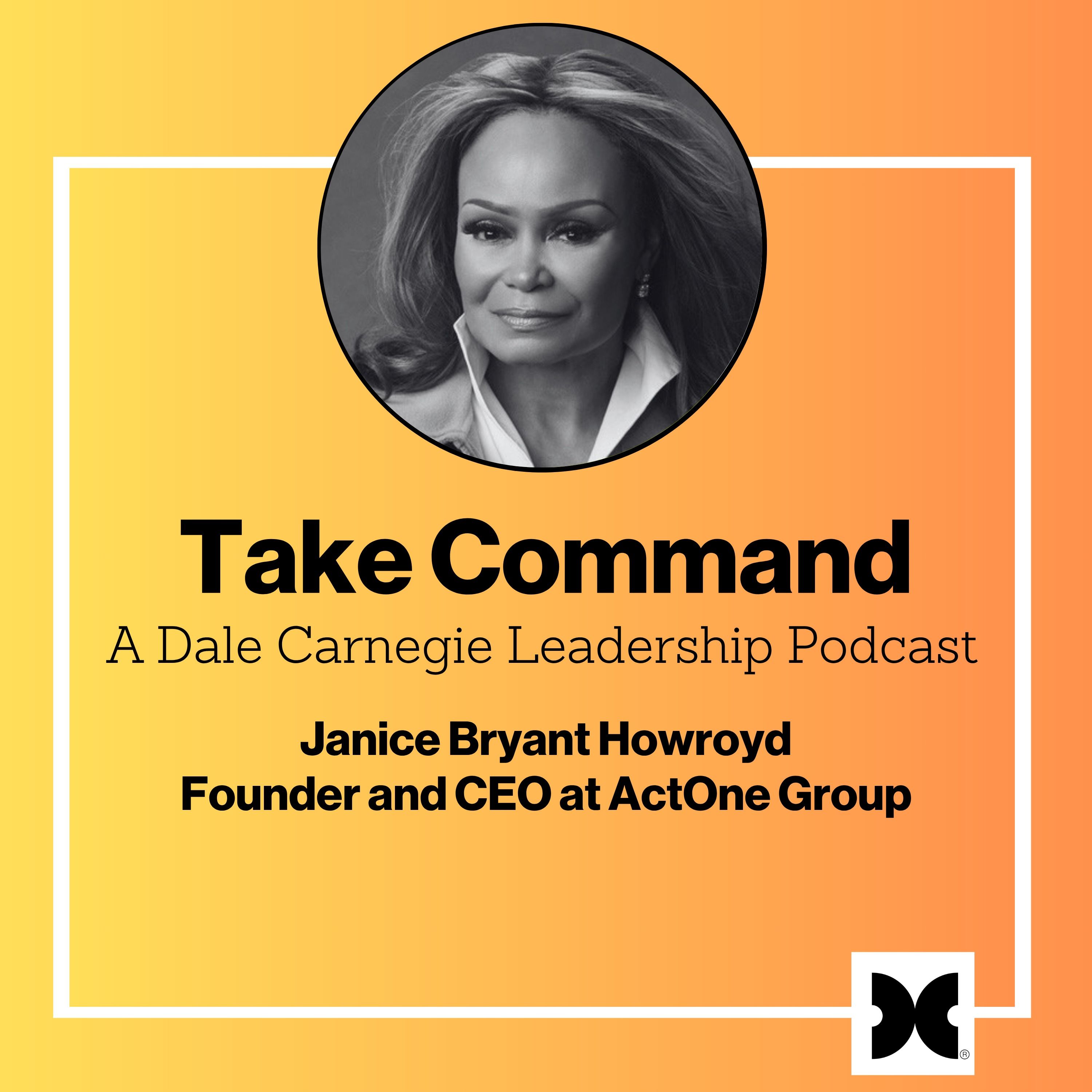
Take Command: A Leadership Podcast
No Shortcuts, No Excuses: Building What Lasts
00:47:05
Today’s guest made history as the first African American woman to found and build a multi-billion-dollar company, now a global organization operating in more than 30 countries and connecting talent with opportunity at scale. She is a best-selling author, award-winning entrepreneur, and global speaker on leadership, business, and opportunity in a changing world. Janice Bryant Howroyd built her success on a simple belief: “No shortcuts, no excuses.” In this conversation, she reflects on growing up in a large family in a segregated Southern community and how those early experiences shaped her mindset around discipline, resilience, and opportunity. She shares powerful leadership lessons, including “Ask the right questions, then listen, listen, listen,” and the reminder that “No circumstance deserves to overwhelm your goals… nobody has the right to steal your joy.” Her perspective on leadership is rooted in clarity, consistency, and keeping people at the center. Janice also explores how...
Loading summary
Transcript44 lines
- [00:00]
Janice Bryant Halroyd
I'm not here to say oh, this happened and I sailed through it this happened and I sailed through it There were bends and curves There were humiliations and pains but nobody has the right to steal your joy and no circumstance deserves to overwhelm your goals.
- [00:30]
Joe Hart
Welcome to Take Command Adele Carnegie, Carnegie podcast. I'm Joe Hart, CEO of Dale Carnegie. And before we dive in, don't forget to follow Take A Man where every episode gives you the tools to lead with confidence. Today's guest made history as the first African American woman to found and build a multi billion dollar company, now a worldwide organization connecting talent and opportunity across more than 30 countries. She has received numerous honors including national entrepreneurship awards and advisory appointments at the highest levels of government and education. She's also a best selling author and a sought after speaker on business and opportunity in a changing global economy. Please welcome founder and CEO at Act One Group, Janice Bryant Halroyd. Janice, welcome to the Dale Carnegie Take a Man podcast.
- [01:28]
Janice Bryant Halroyd
Oh, Joe, it feels so good to be here. It actually feels like a homecoming. I mean, not only did you, Jen and I have a chance to hello ourselves before we begin this conversation, you guys are pretty interesting. So thank you. I feel quite at home.
- [01:43]
Joe Hart
Well, thank you so much. Appreciate the kind words and I mean it's exciting to have you here. Especially this is the Take Command podcast and I think about people who've taken command in their lives. You are just a great example of just entrepreneurial grit and contribution to society. Have been very philanthropic and successful. You built a business from nothing into a multi billion dollar business starting in 1978 with $1,500. Certainly looking forward to hearing your story about how you did that. It's an incredible story. Tell us a little bit about you, a little bit about your background, even what led you to starting your business.
- [02:21]
Janice Bryant Halroyd
Well, Joe, I gotta say this first. You know, when you talk about Take Command, certainly that's interesting and it's exciting in this time of business globally, where people can open a business overnight, be global. Right? But Take Command, I never identified myself that way. You know, I tend to think of myself more as offering opportunities. So it's kind of neat to hear that and I'm going to try to wear that a little bit during this conversation. You want to know about me though? And that's one of the subjects that I least enjoy talking about. So why would I come onto your podcast anticipating that you really would ask me to talk about me?
- [03:00]
Joe Hart
Yeah, we want to hear about you. And I know too. I mean, you started with Humble beginnings. And you're one of 11 kids and you grew up in North Carolina and you found your way to California. That whole story is pretty interesting and would love to hear a little bit about it.
- [03:12]
Janice Bryant Halroyd
Well, you know, it's such a blessing to be able to talk about it from a place of grace, goodness, and a place of, I would say, success. You know you're familiar with Earl Nightingale, right?
- [03:23]
Joe Hart
Yes, I am.
- [03:24]
Janice Bryant Halroyd
And Earl Nightingale, for those who know him, was famous for saying, success is the progressive realization of a worthy ideal. I like to think that's what my life is. I don't think of it in terms of a noun so much as an experience. And growing up one of 11 kids in Talbot, North Carolina, at the time I did, I was paradoxical in ways. While I was growing up, it was heaven. I had a healthy childhood and I mean that literally and figuratively. Mom and dad were very aligned in how they raised us kids. So they had the same platform when it came to goals and morals, etc, although they were very different in temperament. I shared recently with my kids that I can't remember a day in our house that my mom wasn't single singing. And she used to sing It's a Light of Mine, I'm Gonna Let It Shine, or songs of that nature. Songs that now I realized were likely aimed at us as kids as much as they were at herself, to keep her spirits up. But mom sang her way through her day. And I think that as kids we kind of expected music to be a side of how we lived. And it's funny because much later, someone brought that to me who knew the history of my mom singing in the house was when I said, you know, you got to play the music that takes you where you want to go. And sometimes the blues are good. Sometimes you really want jazz. Sometimes it's good old fashioned gospel. You know, you play the music that takes you where you want to go. I think that is how I framed my life. And whether that music is by other artists or whether it's by the lessons and the thoughts that I repeat to myself growing up in Talbo, North Carolina, during the season I did, Joe was pre civil rights. And so I grew up in a segregated community. It didn't occur to me that there were some things very wrong about our community until just before my 11th grade year back. During that time, the federal government was requiring integration of schools and the separate but equal clause was being shot down at the federal judicial court level with Brown versus Board of Education. As a matter of fact, they used my school District as part of the data and study for that case. Years later, I met a gentleman who had provided some service to that case as a young lawyer. It was interesting because I had a physical reaction for the first time in my life to meeting a person who had distantly impacted my life. But I grew up in a community where everybody knew everybody. And all the adults along the streets that we walked were guiding and lesson giving people to us. And some of them occasionally might even smack you on the bottom. And we know that that's a crime today. But that was the kind of community, if you ever watched Andy Griffith's show and their hometown, it wasn't that far from my hometown and it wasn't that far in miles. Nor inexperienced. That's pretty much what Tarboro was like now. Panola street divided Talbora white community from black community. There was a cooperation in etiquette that folks had then, though. So while some of the realities were harsh economically, socially, we were very polite to each other. And I like to say that when I go back to that hometown now, it has retained some of that even with the devastating natural events like hurricanes and Covid that impact affected the economy of the community. It was then one of the poorest parts of the nation and it remains one of the poorest parts of the nation. However, you will not find any people with richer culture and enjoyment of each other. So, yeah, I paint a paradoxical picture because, let's be candid, that's where life lends us oftentimes. And in some of the harder times, that's where we go for as well.
- [07:36]
Joe Hart
So it's interesting. I can't help but think, I mean, amidst the environment that you're in, your outlook, your mindset is a positive one. You were finding the goodness you're listening to your mother sing. Notwithstanding injustice in the area in which you grew up, you found some positive things around that. Just going back to your mom, I can't help but think about the times that sometimes people do things or we have an influence on people around us that we don't even realize. Right. I mean, she's so singing, and that singing is lifting your spirits and.
- [08:06]
Janice Bryant Halroyd
And what you're singing, as a matter of fact, We Are the World is a lesson in business. And if you Google We Are the World for the business lessons of it, you see that Quincy Jones, along with Lionel Richie and Michael Jackson, were able to bring some of the most diverse talent from across the globe into a common setting within a finite amount of time. Identify a goal. Quincy Jones had the Eloquence and the skill to be able to anticipate where each voice and each message would be in that song before the artists themselves entered. And hours later they left with a high paying product that most people of that genre knew the words to that song. Kind of like tie a yellow ribbon around the old oak tree as we message for servicemen coming home home from war. So music has long been an instrument for not just cooperation, but for planned outcomes. I mean, you don't go onto a stage to see put your lip in front of a mic without anticipating the outcome you want people to have. You know, if you want them to laugh, cry, get up and dance, or sit reverently in a synagogue or a
- [09:24]
Joe Hart
church, that's a great point. It is about being, I guess, intentional. I mean, before you get to a mic, you want to think about the impact that you want to have. And your mom had that, probably intentionality too. One of the things that impressed me about your family, because I've done a lot of research, as much as I can, is that you had 11 children, but it was an extremely organized, you know, you had mentors. Each child had a mentor in the house, someone to make sure that you were doing homework and kind of being organized and so forth.
- [09:53]
Janice Bryant Halroyd
And the older kid got allowances, got permission, and got disciplined based on how well the younger one did, who they disciplined. One thing about the music dojo, I think the message from our conversation around music is multifaceted because it's also about the need to make sure that we are embracing song in how we live right now. And whether that is instrumental or whether that is with vocals. I think that it's important for us to remember that we can sing today and that it has value and that it joins us together. Think about what people do with just seven notes, and we continue to generate new and wonderful music with it. So if we can do that with seven notes, then us who call ourselves business folks certainly can do better. At most denominations, we get 10, right? A penny to a dollar.
- [10:49]
Joe Hart
So you leave, you go to college, you move to California, and you have the idea of starting a business. You literally start with nothing. It didn't exist before you started it. You started with $1500, a fax machine, 1978. Where did you get that entrepreneurial spirit, Janice? Is that something that came from your family? Was that you? I mean, what was it that kind of drove you to think about, hey, I want to start my own business as opposed to just going to work and having a job.
- [11:16]
Janice Bryant Halroyd
The spirit of making something from nothing was alive and well, not just in my household, but in my community. We were a very poor community. We did not live in poverty. And so mom had summer, winter, spring gardens. So we ate very well, very healthy, and it costs a fortune to eat today the way we ate. Saving money back then. But the entrepreneurial spirit was alive not only in people who officially ran businesses, but people who ran lives, who ran households. You were constantly having to budget. You were thinking on how to make more from less. You were thinking of how to keep people cooperative in the process of that, and at best, joyful in that process as well. That's the type of community I grew up in. We were a very church centered community. So there was a lot of sharing and caring and very little swearing as well going on. And as kids, we were not simply invited to do things at the right age. We were encouraged and sometimes required to work in a garden. In my own household in particular, we had chores assigned to us. So the discipline side of it and the ability to orchestrate work was very alive and present. And it was how I grew up. Mom said there were just too many people in our house not to be organized. And she could not only tell you where the needles were, she could tell you on which side of the box the certain size needle was. And folk have laughed at me because I have that same discipline in my home today in terms of the entrepreneurship, worship in the pureness of that word. I thought back on my life much later to determine that folk were entrepreneurs in my family now. My aunt Sarah raised my dad because his parents both died when he was very young. His mom died at childbirth and his dad followed soon after. So Aunt Sarah raised him. That's how dad got up out of Warren county and came into Tarboro, Edgecombe county, to be raised there and met mom. She was a school teacher. She also owned properties. As kids, we would run around to collect rent from folk to take it back to aunt Sarah. And sometimes folk would say, ask her if she'll take these eggs, or ask her if she'll take these veggies or these chickens. So we may leave home with a bag to put money in and come back with arms filled with, you know, whatever folk had in lieu of money to pay Aunt Sarah for rent that week. And on my mom's side, her family actually operated a restaurant. It was a barbecue shack. And so her dining room was always dressed and beautiful. To this day, I keep a dressed and beautiful dining room. I think it is not simply an homage to my grandma Dora. I think it was because as a kid it always enamored me that we couldn't go in there unless we were helping to clean it. That dining room was reserved for the white folk in town who would cross Manola street and come over and have their lunches at her home. And then the black folk would pick up their food out back. Kind of what you might call a takeaway today, right? Or drive through. And of course, most folks walk to wherever they were going. But she was running a business. She was serving two different communities with the same needs in the way they wanted to be served. Fast forward years later, I'm talking with a mentor of mine, Jack Shoemaker, who at the time of his death owned the second largest amount of Walmart stock of anyone whose last name wasn't Walton. Right? And he had helped Sam Walton in the early days of Walmart. He taught me that when Walmart went to Australia, they went there thinking we would have a very similar marketplace and so we could do some of the same service and nothing could have been wronger. And after they learned that lesson, kind of with a hit to Walmart in Australia, they came back home with my Walmart. So once they learned they had to apply it to the Australians, they figured, well, we can apply it to communities. And after one of the largest hurricanes to hit this nation, Walmart became one of the fastest and most vast suppliers of content. Because Walmart knows that in east harbor, people like orange Kool Aid and in West Tabor, they like red Kool Aid. So they don't just sing Kool Aid. You know, those lessons happen around us, I think, in ways that we can learn. And some of the best ones come from nature, but a lot of mine came from nurture as well.
- [16:08]
Joe Hart
It is interesting. There are lessons all around us and are we open to those lessons? Do we see those lessons and you built the company. Today, the Act 1 group is a multi billion dollar company. I want to go back though, to when you started it, because a lot of times people will see a successful business, a successful person like you, an entrepreneur, someone who's been recognized for so many different positive things. What was it like to get started? What was it like to build that business? Was it just a straight line success? Did you have ups and downs? What did you have to overcome to go from nothing to a multi billion dollar business?
- [16:42]
Janice Bryant Halroyd
Well, let's correct it because it didn't come from nothing. I came from a lot. Part of that was never money. Okay? Nor Joe did I have the dream of starting a business when I was A little girl growing up in Talbot, North Carolina, I did not envision starting a workforce solutions company. I don't think anybody in Charbo, North Carolina could have given you the definition of workforce solutions. Most of the folk on my side of town were light industrial workers, you know, and day workers. So the idea wasn't there fomenting and waiting to become a business. My brother in law, Tommy Noonan, was a successful executive in the music industry. He and my sister went to Italy for a Nimit conference, that's a music industry conference. And he left me to take care of his office because he took his assistant with him as well, Sophie. And while he was gone, I did what I do. I did what Mama and Daddy had taught us to do. I organized things, clean things, got people into places and, you know, some of the folks who were there looking for a chance to become music industry stars, but were filling roles in clerical and office positions with no skills there. You know, I encouraged them to leave and brought folks in who were really looking for work and no music industry dreams. And when he came back, he thought it was genius and I thought it was common sense. Somewhere around our discussion of that, he invited me to go help two friends over at A. M. Alpert and Moss to do some work over there. And he said, can you do for them what you did for me? I did it that weekend. He asked me how much they paid me and I had not asked for pay. And he had a long conversation about getting paid, you know, not only for your work, but what your work is worth. And that was when the idea came up from him that I should start a business. They used to have games on weekends. Motown Records, Me and my sister helped move Motown Records to Los Angeles. And I was sitting there and have you ever heard of a guy called Marvin Gaye?
- [18:55]
Joe Hart
Of course, yeah.
- [18:56]
Janice Bryant Halroyd
So I'm sitting there and he comes over and he sits beside me and he basically tells me that I should not go back to North Carolina without giving a shot at what Tommy had been saying. Evidently, Tom had told him that Sandy has a really smart sister and she doesn't know her worth and we need to keep her out here and let her prove it. Now remember, I grew up in Tawboro, N.C. has segued into Washington, D.C. worked at the National Academy of Sciences for a bit. Came on a vacation to California shortly after my dad had passed away. And that was kind of my life. A lot of fun and a lot of teaching things in between, but not a lot of experience in any real world. Varied ways. And so they thought I had a lot more than I had seen in me. And from that experience of not charging for my work, Tommy suggested I should. Should. I made a deal with a rug shop to have a really good address on Wilshire Boulevard in Beverly Hills. And in return I took calls for rugs. Now these are thousands and million dollar rugs back then, okay, I wasn't getting those from Walmart. So I had a lot of time and a beautiful environment to place people in full time jobs. And that's how I started. And the lessons I learned around making guarantees that people would stay for six months or you didn't get paid taught me a lot about how to do business. A lot of lessons can get learned in the process of having to deliver before you get paid.
- [20:46]
Joe Hart
Well, that's right. Because you know, you also have the approach of working with. I think you put the candidates at the center of all that you do. And your view is if I can and help them prepare the center of the universe.
- [20:58]
Janice Bryant Halroyd
Yeah, and still is today. And it was interesting to see people as late as post Covid actually catch on to that. And now they're having to defend that as we are aggressively in this world of AI. Joe, people are treating AI inside the corporate boardrooms as well as inside, outside in the hallways as though it's something new. It's been around since pre mid century. What's new is our understanding and reckoning with it in an everyday way. And so we're still finding that people have to learn and relearn the lesson of the human worker being the center of the universe. My company has an agentic offering and it's called aria and we help companies actually orchestrate the various technologies and especially the I ness of how they are entering their next generation of work and get it together from that platform. And that was an innovation from my son who, you know, Brett. But AI has phenomenally enhanced how we work in our company as well. So keeping humans at the center of the universe is going to be an exercise that I pray will not be futile for companies, but will certainly be enriching for those who embrace embrace it, understand it and continue to innovate their products and their solutions around human beings.
- [22:29]
Joe Hart
So it's interesting you bring this up and I wasn't going to go in this direction at this point, but I will because you're talking about keeping humans at the center of the universe and clearly there's no little worry about what AI could mean to the workforce. And you're in a staffing Business, of course. I mean, so what is your sense about the impact that AI has in the workplace and advice you would give to people, people you know about how to be as valuable as possible in the years ahead?
- [22:53]
Janice Bryant Halroyd
And it's going to be a cooperation. You heard me use the term orchestration. And in that sense I was talking about how we orchestrate the various technologies so that they work and they play well together, whether it's lms, whether it is your back office systems, you know, wherever, how those work. When we talk about human beings, there's a story that my son and I would tell for years in the company and it is one that my husband shared with me. My husband was British born and he as a little boy told the story of how the iceman. My husband was considerably older than I am, so he had relationships to the world of technology and innovation that predated the phone, the everyday use of the phone. And he shared that the iceman would drive through the little roads in those villages in England and. And the horse knew his way around and knew where to stop and when to start walking again. He pretty much as an animal, was well tuned to the needs of his humans. And the iceman could go on about the chatter and the chat and throw a couple of nice ice cubes to kids in the summertime, but that was basically how people refrigerated. That iceman didn't know people were looking for refrigeration. They thought people were looking for ice. And so on a next Monday, when he drove down a path and nobody needed anything, and consistently people didn't need anything, he realized that refrigeration had come, he was selling ice. And I think that is where I see human beings today. You know, when we look at the eight I ness of things, people aren't necessarily looking to get rid of typists, people aren't necessarily looking to get rid of researchers. People are looking for information and processing in a faster way. And when we identify our ability to participate and at best lead in this innovation of technology, I think that will be all right as people. I think that some folk will lose some jobs, some folk will gain some jobs, and other people will become far more entrepreneurial in the way they work. The orchestration of it all does not burden simply the worker, though. It also is an opportunity for the goodness of the employer. And it is about the rhythm and the support that our governing systems offer us, whether those be political, whether they be organizational. However we look at that, we may change what a work week looks like. You, Jen and I were laughing before we began recording this conversation when I asked if she'd ever watched Downton Abbey, and had she seen the dowager turn to the person seated next to her and ask, what, my dear, is a weekend? This dowager did not relate to a weekend because she didn't have a work work week. But you can flip that question for those of us who have a work week. And that work week is all seven days. On either side of that coin, we're asking the question, what is a weekend? And the solution and the joy for people today as we integrate AI more and more into how we live and how we play will be how we identify the we week. That work week may reduce itself to three days. It already has changed itself into hybrid work. Some people work from home, some people got to go into the office because proximity to the next person is important to their creation and to their stimulation. And others may do a little bit of both. And I think AI is going to continue to evolve. How we work with it will be important. I don't want to have a conversation about what the political, social, or moral implications of AI are in this moment. What I do want to make sure of is that people are aware that they just don't need to let it happen to them. They can let it happen for them as well.
- [27:14]
Joe Hart
What a great message. Because, I mean, so much of this depends on our own perspective, our perspective of the week, our perspective, what AI means. You've got people who can live in fear of something. Two people can be the exact same situation. One person sees opportunity, the other person sees fear. But we have the ability individually and certainly our perspective is Dale Carnegie. We've done global research on this, and we believe that the types of skills that will be really important are the people kinds of skills, the ability to communicate, to be creative, to leverage these tools in a way that makes us more productive. But it all starts with us and the way we see things, which I think is what you've really framed very, very well, right?
- [27:53]
Janice Bryant Halroyd
I mean, growing up, 11 kids, one mom, one dad, and whatever we happen to have. I remember when my dad was excited that his pay went from 70 to $90 a week. We never had government assistance in our home. That's not a statement of my perspective of government assistance that simply, we didn't do it. Our solution was to grow food. So we grew food. Now we were blessed to have enough yard around our house to have a garden. It's so funny, too, because I live in one of the most expensive per capita income communities in the Nation. When I'm in California, where I'm sitting right now talking to you from. And I came home from a trip, a business trip, and my husband had rooted up all around the house and planted yellow roses. Now, calla lilies are my favorite, but he could only find roses that could grow all year because of the cost of roses in our house from a florist. So he said, I'll grow you flowers. You'll have them all year. And the spirit hit him. And right outside my bedroom, Joe, not that many feet from where I'm sitting are kumquats in full bloom. I was disgusted that he was planting food outside my bedroom window. I get some of the most pleasant natural fragrance coming through my bedroom. As a result of that, we get actually luscious kumquats that now my grandson enjoys. And I teared up the first time I gave him one. He's just a year old. And I said, this is from Grandpa. Grandpa planted these years ago. So, yeah, whether it was my mom growing food because she had to, or my husband growing food, we've got orchards of grapefruit, oranges. You know, he grew vegetables. He did it because he respected the land and he enjoyed the work of it. My mom did it because she had 11 kids and a husband to feed. You know, I want us to get to that place. I want us to be in a place as human humanity and as individuals where we're not so overcome by where our personal fears are that we lose the ability for those fears to be innovative for us, whether we are a small business owner and we're so afraid of the impact of tariffs or whatever may be happening in our sense of governing our businesses that we forget we have the ability to be highly transformative in the solutions that we can bring about. And I'm not being pollyanna here.
- [30:33]
Joe Hart
No 100% right. Dale Carnegie's first principle was don't criticize, condemn, complain. I think the reason for that is because that kind of energy doesn't help us in anything. You can curse the situation or you can look for a solution. And what I'm hearing you say is, in your background, with your parents, and in all that you've done, you've been looking for opportunities. I've got to ask you, though, because I know people listening to this.
- [30:55]
Janice Bryant Halroyd
This.
- [30:55]
Joe Hart
My kids will often say this. Oh, dad, you make this sound so simple. But it's not always simple, right?
- [31:00]
Janice Bryant Halroyd
I mean, someone's facing it doesn't always mean easy. It is. We don't have to apologize for being Simple. The principles of climbing a mountain are simple. How many people do it? They don't because it's hard. Know the difference between simple and hard. Sometimes simple is very hard.
- [31:21]
Joe Hart
I'm with you 100%. I'm curious though, just going back to you because I can imagine people who are listening to this and they're facing tough situations, they're facing tough decisions in their work or their entrepreneurs or their business leaders or whatnot. Have you had a time where you've had to overcome your own fear? Where you've had to dig deep into that confidence in order to move forward in a constructive way? And what advice would you have for people in that situation?
- [31:47]
Janice Bryant Halroyd
First of all, one of the earliest lessons I teach anybody in my organization, and I've done this in a much more classroom and elevated way for organizations and for private groups, is the ABCs. Okay? Ask the right questions, then listen, listen, listen for the right answers. Been teaching these ABCs for years. We get so overwhelmed by the questions or the problems or the challenges that we forget to pay attention to the ones that really matter in this circumstance and the ones that I can really impact in this circumstance and the ones that I can impact now or that are going to take a longer term solution for them. We overwhelm and oftentimes we fall underneath not doing anything because we can't figure everything out. And so asking the right questions and then listening, listening, listening for the right answers, stop repeating the question and set it there and let it extend itself alongside that. I mean my daily prayer and constant throughout any exercise or any process I'm engaged in, Joe is now, I happen to be faith based, so it begins with Lord. Lord, let me honor you in all I think, in all I say, and in all I do. When you live that prayer, whether you preface it with a creator or whether you preface it with just your own energy, however you approach your life, that formula works for you. That process is in all I think, in all I say, and in all I do. We think in secret and it comes to pass. Environment is but our looking glass. So when we think it before we say it, which doesn't simply mean editing your conversation, it means doing the research of your conversation so that you are really rich when you start to communicate it out to coworkers, employees, clients or family members that you have thought about it. Spontaneity is beautiful. It also can be reckless if you're not thoughtful when you're in a leadership position, when you're in a guiding position. And once you do that, you will find that you engender the thought and the innovation of others who then help you in the doing of it. So this is not a promise that, oh, baby girl, everything's going to be all right. And it is a valid process and tool to use towards solutioning that everything will be all right. And the B in the ABCs is about being where you say you'll be, when you say you'll be there, how you say you'll be there. You know, and important in that is how, because most of us have devices, we're talking about AI right now. You can build a business from AI. I talked with a young lady earlier today and she set up business in a box. We originally thought we use the tech around that. AI has that business set up in minutes. Not only just organizationally, but, you know, the marketing of it all those first 90 days of that business are solutions within minutes via AI. Once you plug in the information there. I mean, if you've got a phone, right, your phone can tell you when you're going to show up. It can tell you which streets to take to get their phone fastest. But it can't tell you how to smile walking through the door. It can't tell you how to treat the information you got from AI about the people you will be meeting with. It can't teach you to be human. It can't bring that human aspect to that solution or to that engagement that you're entering into. And then the C is about communication collective. Complete communication collective is about collaborating with others as well as gathering. And the complete is assuring that everybody who needs to know knows. Most times in an organization, you're failing because of communication, not because of finance. It's because of how you communicate. Whether you irked somebody, whether you fail to educate somebody, or whether you simply forgot yourself. So I think the ABCs can work for people. And again, that goes back to you and me talking about things sounding simple. Each step of the ABCs I've shared with you are some of the most difficult things that people face, not only in building businesses, but in building lives.
- [36:31]
Joe Hart
Well, it's interesting you say that. I mean, even we think about our Dale Carnegie principles, we'll often say this is common knowledge, but not common practice. People can do it, but you've got to stick with it. And the ABCs that you've just outlined are the exact same way. Asking the right questions, learning how to ask good questions, listening, improving our communication, all those things. It's like we can do those things. That's the good News is we can do those. We can get better at those things. We just have to decide to do that. I want to ask you about a quote that you've had. No shortcuts, no excuses, right?
- [37:03]
Janice Bryant Halroyd
Right.
- [37:03]
Joe Hart
Where did that come from? And where do you see that as a key mindset for people now?
- [37:10]
Janice Bryant Halroyd
That came from my dad, and I'm all about paying homage to the authors of Lessons in Our Lives. When I talk about no shortcuts, I think of it this way. My dad used to say, if you ever needed a surgery, you wouldn't want the surgeon to take a shortcut in the process of your operation. I look at it most often in my business as I revisit years of growth, especially those that were transformative in some way in a finite time period. The failures, the risks occurred around taking shortcuts. My mom would say, and she was one of the best cooks I knew. I'd elevate her to chef, except she didn't use those tools. Right. She would not let you shortcut the cooking of something. You know, it just had to be at this temperature for this length of time. Don't turn the oven up to 500 degrees and think it's going to cook faster. It'll burn and be messy inside. And that's what people do in their work life and sometimes in their social lives as well. They think if they can just turn it up faster, that it'll turn out better. And that doesn't always mean better. So I think it also, though Joe allows us to enjoy the process, aiming toward the result is great, and the result is always the truth. The process is what most people enjoy, what most people smile or cry or sharing stories from a sofa. When youngsters come around about their lives, you tell them, oh, you were able to discover this, or you invented this, or you got honored for this. They don't tell you about going on stage to get the award. They tell you about going through the stages of life to earn the award. And so I think we have to remember the process matters, not just toward getting the right result, but also enjoying yourself while doing it.
- [39:17]
Joe Hart
They talk about enjoying the journey. I think that's a really big part of it. And what do we learn along the way? I think a lot of times we can get caught up in the result. Sometimes we don't even get the result that we want. But what do we learn from that?
- [39:30]
Janice Bryant Halroyd
I'll tell you something. Growing up, so 11th grade year, integrating schools in Talboro, North Carolina, I was a kid picked to go over to the White School. Right. We decided that from the black school, we tend, you know, kids who were smart and who would assure that white people didn't feel that their schools were going to be torn apart by having to integrate with black kids. And I had a girl throw feces on my face. Oh, my gosh, 11th grade year. So I don't know what you were doing in your 11th grade year, but I was dealing with that. And because of how my parents had raised me and because of the importance of how I demeaned myself, I knew I was not going to take that long walk home from school, crossing Panola street to change up. So I wiped it off and I stayed in school. Now, the things that I remember from that are the lessons that I could still find, focus, learn, and make friends in the face of that. You see what I'm saying? And so I'm not here to say, oh, this happened and I sailed through it. This happened and I sailed through it. There were bends and curves, There were humiliations and pains. But nobody has the right to steal your joy and no circumstance deserves to overwhelm your goals. That's what we're talking about. Joe. Look, it has not been an easy journey to sit here in my library with thousands, literally thousands of books. A guy from Forbes came to interview me once in my home, and he was shocked at the numbers of books in my house. Right. I happen to love books, and I believe that buying paperback pays homage to the author more than it destroys the forest. So I continue to buy paperback. You know, I put it on Kindle for travel, but it's on paperback if I really loved it. And, Joe, that's the spirit I'm speaking from. Every coin has four sides. Most of us just pay attention to the two we see. And I think that we can enjoy the process of building businesses, we can enjoy the process of building each other up, as long as we remember the process of building character. Build your character up. None of us ever reach a hundred percent of the best our character can deliver. And so that's always a journey, that's always a goal, and that's always a process that we can enjoy the doing of love. When we reached fourth grade, later, sixth grade. I don't know if siblings got dumber as they got more of them or not, but dad used to make us learn the poem by Ruya Kipling. If you can keep your head when all about you are losing theirs and blaming it on you. If you can trust yourself when all people doubt you but make allowances with their doubting Too. If you can wait and not be tired by waiting or being lied about, don't deal in lies and being hated, don't give way to hating, and yet don't always have to look too good or talk too wise. And the poem goes on and on. You're nodding. So I gather you know it.
- [42:59]
Joe Hart
It's incredible because my father gave me that poem as a young teenager. And it's the most important poem I've ever read. I've memorized it. I know the words as you're going through them, and it says. It's an emotional reaction for me to hear you say those words. It's a powerful, powerful poem. When my father gave me that poem as a gift, I didn't appreciate it at the time. I'd wanted a different gift. It was for a graduation from eighth grade. I didn't react very well at that time. In fact, I didn't accept that gift as appreciation. But when I reflected on that poem afterward, I went and I apologized to my dad for the way I had reacted. And then I memorized it. And there's no poem that I've read that's been more important than. Than that one. Anyone who's listening or watching this. I mean, if you haven't read if by Rudyard Kipling, it's an incredible poem that I think can inspire all of us to. So much of what you're sharing, Janice, and you've shared so much of who you are, and just some of the just unspeakable things that you had to endure in your life, you've overcome with just an incredible energy and positivity and perspective about things. Things. So you've inspired me in this interview greatly, and I know you've inspired our audience. I would just give you the invitation as we close. Is there any final piece of advice or something you'd like to share with our audience as we wrap up?
- [44:22]
Janice Bryant Halroyd
Well, if you know it, say it along with me. Let's give them the last verse of Ruya Kipling's poem. It is. If you can talk with crowds and keep your virtue, if you can walk with kings or queens, the common touch, the common touch. If neither foes nor loving friends can hurt you and all people with you, but none too much. If you can fill the unforgiving minute
- [44:46]
Joe Hart
with 60 seconds worth of distance, run
- [44:50]
Janice Bryant Halroyd
then yours earth and everything in it. And I paraphrase it too. And what's more, in life you will have one. I think that's so important for us to remember today. Daddy, he made me go back to that poem when I came home with still the smell of feces around my neck and face. And he reminded me that one full line of that poem is if you can fulfill the unforgiving minute with 60 seconds worth of distance, run, you know, go in there and use that time that you would dwell on returning hate or feeling let down or disappointment or weakness, any of that. If you can instead fill those minutes with learning, guiding and helping, it can change the whole dynamic of your life. That's what's important right now for people to remember. And it's a joyful message. Message. No circumstance can overwhelm your joy when you live from that kind of truth. And so being a faith based person, I'd also say no matter who you call God, call God every day and then be quiet and listen.
- [46:12]
Joe Hart
It's awesome. Janice, thank you so much for being with me today. Appreciate you so much and I know our audience is going to love hearing this interview.
- [46:21]
Janice Bryant Halroyd
Thank you Jeff.
- [46:28]
Joe Hart
I hope you enjoyed this edition of Take Command, a Dale Carnegie Podcast. Check out our resources at www.dalecarnegie.com for more research, insight and tools that will support your success and help you take command of your leadership potential. If you enjoy this episode, please consider rating it and following us on Apple Podcasts and Spotify. For more exclusive content, subscribe to our Dale Carnegie YouTube channel and follow us on social media. As always, thank you for listening and we're looking forward to you joining us for the next episode of Take Command, a Dale Carnegie Podcast.