← Take Command: A Leadership Podcast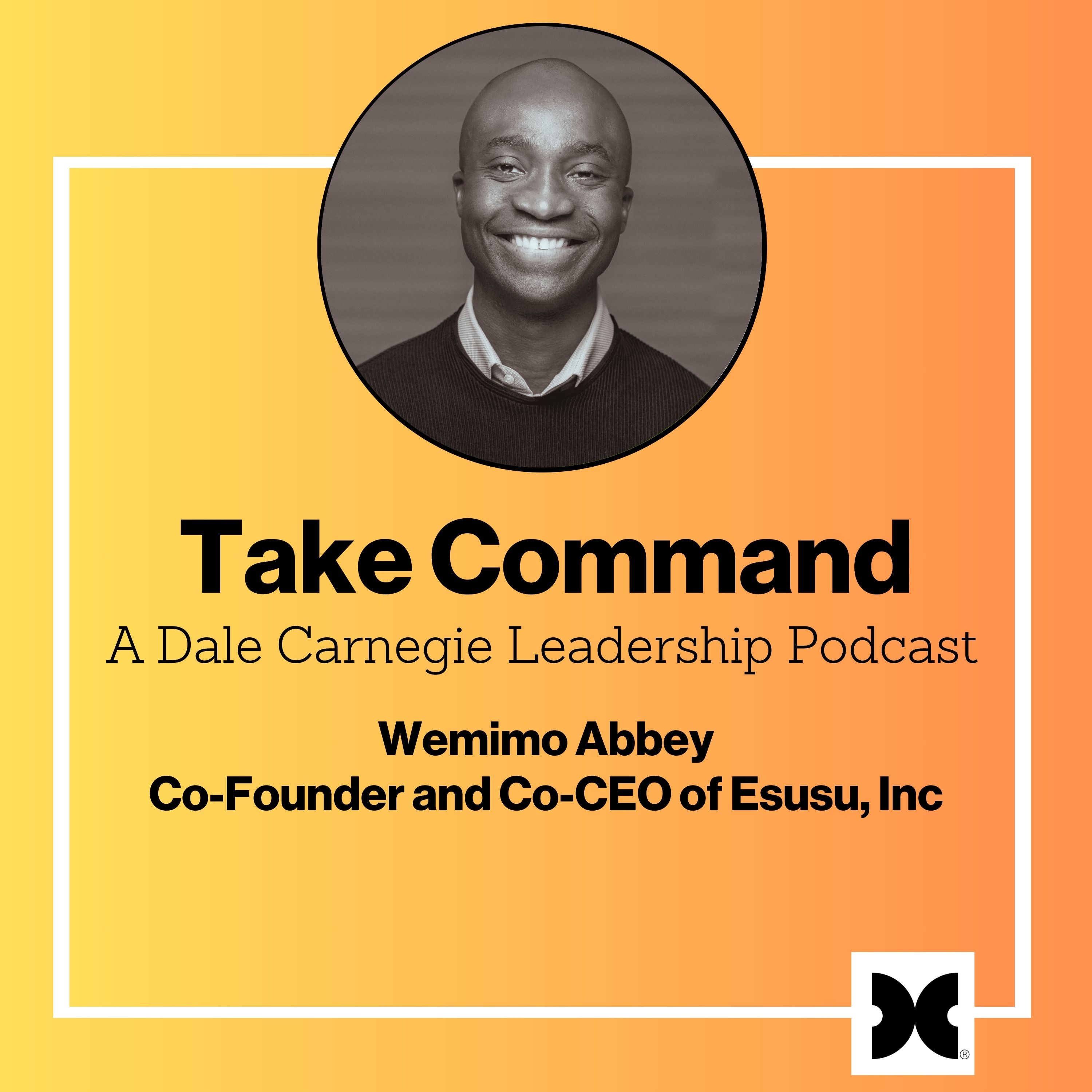
Take Command: A Leadership Podcast
Nothing to Lose, Everything to Build
00:38:43
Wemimo Abbey is a purpose-driven entrepreneur transforming financial inclusion in the U.S. through Esusu, a fintech that helps renters build credit and access flexible payments. His leadership philosophy is deeply rooted in resilience, faith, and the principle of “falling forward” from failure. Abbey believes that meaningful impact comes from combining bold ambition with humility, saying, "If you want to go fast, go alone. If you want to go far, go together." He shares vivid stories from his journey—from growing up in the slums of Lagos, Nigeria, to navigating predatory loans in the U.S., to building a billion-dollar company alongside his co-founder, Samir Goel. Abbey reveals how embracing failure, learning from each setback, and maintaining an unwavering focus on purpose can turn adversity into opportunity. Tune in for an episode packed with actionable insights on leadership, resilience, and building organizations that uplift communities.
Loading summary
Transcript36 lines
- [00:00]
A
You know, I read the book how to Win Friends at a very, very early stage in my life and one of the things I actually enjoyed the most was I think there was a quote in the book that talked about talk to someone about themselves. They'll listen for hours. And for me, I sort of live my life as an anthropologist, so I like talking to people about themselves and just learning especially about their families and their kids. Foreign.
- [00:35]
B
Welcome to Take Command a Dale Carnegie Podcast. I'm Joe Hart, CEO of Dale Carnegie and if you're ready to grow your leadership skills, follow Take command now and never miss an episode that could transform your career. Today's guest reflects on a journey shaped by resilience and a deep commitment to expanding opportunity. From growing up in Lagos, Nigeria to building one of the most influential fintech companies in the United States, his story shows how conviction and character can turn adversity into lasting impact. He has helped redefine how renters build credit and achieve long term financial stability. Today he his company is valued at over $1 billion and has been named to the Forbes FinTech50 for three consecutive years. Individually, he's been recognized by forbes as a 30 under 30 honoree and awarded EY Entrepreneur of the Year honors that reflect both achievement and a deep commitment to inclusive, equitable growth. Please welcome co founder and co CEO of Isusu Wamimo, Abbey Wamimo. Welcome to the Dale Carnegie Take Command Podcast.
- [01:51]
A
Thanks a lot for having me. Really excited to be here Joe.
- [01:54]
B
Well, I'm excited to have you here especially we're recording this right after the holidays. Early in January you disclosed on a major round of funding for your business. You just have reached what you were probably before at unicorn status, a billion two valuation. And interestingly, I know you've shared that you started in very, very humble circumstances. You've said, you know, you lived in the slums of Lagos, Nigeria and came to the United States with nothing. Really. What you've created today has been the product of resilience and vision and just innovation. So looking forward to having a conversation with you. Tell us a little bit about your early start with Mimo and where were you before you came here and what led you to come to the United States?
- [02:35]
A
Yeah, thanks again Joe for having me. My story started in the slums of Lagos, Nigeria. I grew up there. I grew up in a humble home. I lost my father at the age of two and I was raised by my mother and two very spirited sisters. My eldest sister was 14 years older than I am and my middle sister is 10 years older than I am. So I was sort of the baby of the house, but also had to be a lot of responsibility because I had to respect my elders a lot. And during that experience, one of the things my mother fundamentally believed in was the power of education. My mother barely graduated high school, but she always believed education was one of the most important investments any child could have in his or her life. So she afforded my school fees, having worked at the post office for over 21 years herself. It's one of the finest high schools in Nigeria. And that school opened my eyes because I had to live and learn from kids from different walks of life. We went to Europe for the holidays of the United States. And one thing education does is it's the great equalizer, because I found that a lot of these kids, we were equally bright and I could do what they were doing. And the destitution of my social position did not necessarily need to limit my imagination or what I could do in life. So having the opportunity to go to that institution for high school changed my life. And when all the kids were following the final year of high school, thinking about their next steps, they were applying to colleges in Europe and the United States. And I followed suit. And I had to self study for the SATs because we have a different system in Nigeria and West Africa in General. Passed the SATs and applied to the University of Minnesota, Crookston, which was a small university in the northwestern corner of Minnesota. I remember going to the embassy and the person at the embassy said, are you sure you want to go to Minnesota? And I said, well, how hard can it be? And I immigrated from 80 degree weather in Lagos to negative 22 degrees. And it was a character building experience. And Minnesota taught me a lot about myself and I'm immensely grateful for that journey.
- [05:07]
B
Well, I mean, it's not an easy thing, right, to go from one country to another and especially those kind of changes and so forth. But what would you say kind of inspired you in the next stage of this? Because you're at Minnesota, jumping ahead, you're extraordinarily successful entrepreneur. Did you have an entrepreneurial spirit? Did you study business in Minnesota? What were some of the things that happened along the way that kind of inspired you ultimately to the path that you're on right now?
- [05:31]
A
Yeah, I have always had an entrepreneurial spirit in me. And I think one of the interesting things and when it dawned on me was actually going back during my time in Nigeria, my mom, like I said earlier, worked at the post office and she made a Certain amount. And we struggled to pay school fees periodically. And one of the innovations that I came up with when I was in high school is I was one of the biggest traders of game boy cartridges, PlayStation CDs and in some cases imported chocolates like KitKat and M&MS, because some of my colleagues were in boarding school and they couldn't leave the premises. So I understood the concepts of demand and supply very earlier on in my life. And what opened my eyes about entrepreneurship was just this learning earlier on, even if I didn't have the language for it back then, was labor can now outpace capital. And let me explain what I meant. I knew my mother was working at this job. We could barely make ends meet. Like putting food on the table, paying for all the obligations as a single mother was tough. But at some point I accidentally saw a payslip and I saw how much she made. I'm like, that's very interesting. Meanwhile, in my business as a 13 or 14 year old, I discovered by trading Pokemon, PlayStation CDs and selling big bags of candy and distributing it and charging a 300% premium, I was actually making more in doing my side business and going to school more than my mother made in a month working a full time job that required two and a half hours of commute each way and she couldn't keep up. So ever since then, I've always found entrepreneurship interesting. I've always found this idea of demand and supply really exciting and the joy when you actually deliver value for people. It's just this rush that I cannot explain. So when I came to the United States, you know, first off, we had a rude awakening like we didn't have a credit score, which is one of the most important financial identifying markers in this country. We walked into one of the biggest banks, borrow money so I could go to college. Because as international students, you don't get financial aid. We were turned away because we didn't have a credit score and had to go borrow money from a predatory lender at over 400% interest rate.
- [08:04]
B
Wow.
- [08:04]
A
My mother sold my dad's ring, we borrowed money from church members, and that's how we got started in the United States. You know, we cobbled money together, paid for the first year of college. Fortuitously during my first semester, you know, I had an opportunity to join a club called Students in Free Enterprise. And that's where I started my first business in the United States. Really bringing students together to build water infrastructure in developing countries so people can get access to clean water and build strategically in schools. Because school has always been that convenient point for me. So I think entrepreneurship was born out of necessity when I saw what the struggles my mother was going through. And then I learned that, wow, this is something I loved and just delivering value. And I've always thought about the idea of doing well and doing good and that not being mutually exclusive has guided my entrepreneurial journey for, you know, going to close to 20 years now.
- [09:05]
B
Well, certainly it's a foundation for your idea with Isusu, your current company. And I definitely want to ask you about that. But I can't help but wonder, I think about all the different things that hold people back from their dreams. We can often have fears and insecurities and even our own inner voice will say, you can't do this. This is never going to work. I just can't help but think, were those things going through your mind as you went from this poverty in Nigeria to the United States? Now you're in college, you're taking a full 400% interest rate loan out, your mother really bet on you, you really bet on you. I mean, what were some of the things that were going through your mind at that time? And was there a point that you felt like, I've got to figure out how to overcome this fear, or was that just not even a factor?
- [09:45]
A
I grew up in an environment whereby I had nothing to lose, right? I grew up in the slums. The first time I saw constant watching of television in my house was when I was seven years old. You know, my mother and I and my sister moved into an uncompleted building and we didn't have running toilets. So for a kid like me in Nigeria, no one thought anything of me, right? So I've always lived my life like I don't have anything to lose and I always keep that mindset and don't get distracted by the materialistic things in life. But what I'm maniacally focused on is whatever I have been afforded, how can I give back more? And then how can I contribute my own humble quarter to make the world a more perfect place? So we have less and less of my story and actually have more and more of folks that can live their full life story. So for me, that has always been the driving factor and it gives me this ability to not be scared and take bold moves, right?
- [10:43]
B
Well, it's true that when we have a strong purpose or a strong why, that can overcome a lot of different things. I just would encourage, as I think about just even our listeners or people maybe like thinking about something right now or struggling right now. But this mindset that you're talking about, like in your particular case, you might have said, I really don't have anything to lose. But in most cases for us, we don't have anything to lose either. We kind of create in our minds that if I try this and it doesn't work, what's going to happen? What are people going to think about me? And so forth. But in many ways we've got nothing to lose as well.
- [11:13]
A
Yeah. I think I would answer that question with actually a quote from Dale Carnegie. Right. I think, you know, one of the ones that stuck with me is like, you have to develop success from failures and discouragements. And failures are two of the surest stepping stones to success. Right. So when you live your life in a way where you don't have anything to lose, all you're going to do is not think about what you can fall back on. You just want to fall forward. Right. So that's the way I've lived my life. I never want to ask myself, what if that's the scariest thing. I want to put it all out there on my debt bed when my lease expires on this thing called life. I don't want to be on my debt bed or telling my children or my grandchildren or my niece or nephew or anyone that's around me at that point and say, what if I did this? So I'll give it my all. Failure is like the guarantee, but there are ripples, effects of success that would rise from the plethora of failure that will make hopefully the world a more perfect place. And that's what I focus on, not the things that could go wrong.
- [12:21]
B
That's great. I love that. Just looking forward. And it's really true. I mean, I remember even just starting when I started my first company, I remember being afraid and my wife really kind of prompted me. She's like, well, if you don't do this, are you going to regret it? What's going to happen 10, 20 years from me, you can always wonder what would have happened. And, and that's the same thing I hear from you saying right now. And I think it's probably something that can fuel all of us. You mentioned Dale Carnegie. I know that you're a devotee of Dale Carnegie. I believe you've read how to Win Friends and you were sharing with me a little bit about how Dale Carnegie's affected your life. I'd love to hear you share that with our audience.
- [12:52]
A
Yeah. You know, I read the book how to Win friends at a very, very early stage in my life. And one of the things I actually enjoyed the most was, I think there was a quotes in the book that talked about, talk to someone about themselves, they'll listen for hours. And for me, I sort of live my life as an anthropologist, so I like talking to people about themselves and just learning, especially about their families and their kids. And one of the other things for me is like, what is your why and what is your intention in life? Because it's a great filter for me to say, hey, okay, are we aligned? Are we not aligned? Do we care about the same things? If you care about materialistic things, like, I'm probably not the best person to hang out with because I'm going to bore you about all the impossible things in the world that we should be thinking about addressing or be caught trying till we die, right? Just talking to someone about themselves, understand what makes them tick, understanding their intention, for me, gives me a lot of joy. And just learn the basic psychology of why people do what they do. You know, One of the other things that keeps me grounded is when there are disappointments because there are many failures that we don't talk about. Another one that sticks with me is, remember, today is tomorrow. You were worried about yesterday. That's sort of like the trick for me. But I think I have used a lot of principles of Dale Carnegie to bring people together to talk about what is possible and not to lose myself in all the worries of today. Because the things I was worried about yesterday and are the things I'm doing today. And that's just a perpetual journey. So life is this interesting continuum you have to enjoy. You have to lean into the failure and feel it and don't run away from it because that's what makes us human. If everything just goes up to the right, you don't learn. But it has also gotten me to this point whereby I'm maniacally focused on studying failure successes is a derivative of many failures that compound over time. And you learn. But the real failures are the things that I pay attention to, I spend a lot of time on. And I want to talk to my team about. Because if we learn, we're not going to make the same mistakes again. You know, I think Mark Twain once said, history doesn't necessarily repeat itself. It rhymes. And I think if we learn from what has happened in the past, we will seldom make failures and repeat the same failure. So I'm really excited about it. The book has had a transformative impact in my life, but one of the things I took out for, for my personal experience is just learn more about people, understand their why, figure out their intentions. It's a filter for me as a human being. It also just makes life more interesting because you get to learn new things about folks rather than talking about yourself because that's what you already know. So it's just a wonderful way to live life.
- [15:50]
B
That's great. I can see you've really kind of embraced this philosophy of Dale Carnegie. It sparked a quote in my mind from how to Win Friends quoting Ralph Waldo Emerson where Dale is quoting him saying every person I meet is my superior in some way in that I learned from him. So we can always learn from other people. Every conversation we can learn something if we've got that right open mindset. I'm curious because you're talking about failure. And again, you know, we all have our own definitions of failure. Sometimes we limit ourselves because we think failure is when I don't achieve something I've set out to do. And it's a very limiting, you know, versus what I hear you saying is it's hey, if I can learn from this. But you talked about learning from failure. What is a failure that you've experienced that maybe even it was a significant one that taught you a real lesson that guide you.
- [16:33]
A
Even now there's so many failures. The biggest one that I still remember was actually when we started Isusu. We had this concept of trying as much as possible to get people to save as a collective. And it was one of the oldest forms of banking. We created the infrastructure, we got the licenses and we had this hypothesis that for low to median income people, if we can get them to save as a collective and buy big ticket items, that would move the frontiers of their lives forward faster. That hypothesis, albeit noble, was not what people wanted. What working Americans wanted and we believe still wants is cheap and affordable access to debt. That isn't predatory. But we rolled out this initiative and pushed it out there. We did everything we can to deploy this solution and what we were seeing is we just didn't have this virality and there were so many dependencies of it being a huge venture backed company. So we learned from many investors that said no to us and used that as inspiration to understand why and things we could improve on. And my co founder and I said okay, what is the biggest way to have the greatest impact? And we shouldn't just be married to our own ideas, we should have an expansive view. So we learned from that failure and we shut down our direct consumer business because we didn't have the reach we needed at that point. So we then switched to saying, hey, what if we move to a business to business idea where we work with the stakeholders that we actually care about to have a material impact in life? And you know, we implemented that. And fast forward, ISISU is what it is today. But I think the ability to pivot when something fails, the ability to change, and above all the ability to shut something down, is really, really hard because you have to essentially kill your baby and then start over again. It's a public acknowledgment of failure.
- [18:48]
B
Right.
- [18:49]
A
And that's something we had to deal with. And the lessons learned from that has guided us to the path we are on. And we fail every day. There's a lot of things we experiment on, but there's this unapologetic feeling to say, hey, failure is just the baseline, but we will rise from the ashes of failure and create something beautiful. So a lot of the things you see about ISUSU today are essentially the compounding effect on learnings from a plethora of failures. And what you see celebrated are probably 1% of many failures and lessons learned from many experiments. That's the derivative of some of the success you see. So if every success you see, there's probably like 100 or 200 experiments that we've thought through, the team has challenged my ideas, we've had deductive debates and create something special. So if you're not ashamed of the first products you put out there in the world, you're not trying hard enough or you're not moving fast enough, and failure should be embraced because that's the way you truly learn, iterate and hopefully make something better. If you come to me and say you've not failed, you haven't lived and you have to spend more time failing.
- [20:06]
B
That's right. It's ironic because sometimes we are afraid of that failure, but that failure can actually be the very thing that fuels us to, to move forward. So Woemimo, you know, in talking about failure, it's just interesting because again, people will see what you've done. Right? So you just closed a Series C round of funding, $50 million, $200 million total, raised $1.2 billion valuation in less than eight years. Right. So people see that, they don't see all those failures. One of the most interesting posts I saw from you, which is on your LinkedIn, which anyone can go to look at, is about 2018, you're sitting at a Denny's with your co founder, you're $100,000 in debt. You don't even have enough money for a hotel room. You get kicked out of Denny's, you get to fly out the next morning to San Francisco to meet with investors. Now you can look back at that and you can say, ah, it's all worked out and so forth. But when you're in the moment of that kind of an experience, what gives you the strength and the focus to keep moving forward?
- [21:06]
A
It's a really good question. And just to provide additional context on that story. So when we started Susu, we added friends and family round and got into an accelerator and raised our first $400,000 and we were generating six figures in revenue at that point. And during this process of trying to figure out what we call product market fits in the startup environment, we had to raise our seed round of financing. 326 investors said no to us and some of them had valued reasons.
- [21:37]
B
I said 326 said no.
- [21:39]
A
326. And I keep scores. And I think it's important. It serves as an inspiration actually to just get at it. And it keeps you humble when you keep scores because you don't get ahead of yourself. So after so many no's, my co founder and I, when we decide to quit our corporate jobs, my co founder was at LinkedIn, I was at Pricewater House, Coopers Incorporated America. During mergers and acquisition, the commitments we had to ourselves was baseline. Starting a company was going to be incredibly hard. That's it. But we had this sort of analogy of we've been traveling around the world in a wooden ship, we're going to park in an island, bond the ship and, and try to build a steam ship and sail around the world. And it's going to be painful because we're on an island. We have to get merchants from different places to help us build that ship that can help us sail around the world and hopefully we can spread the gospel and do things that others can imagine. So that was the concept. So we came into this journey knowing it was going to be incredibly hard. So those nos where many failures we endured and I don't care who you are, I don't care what you do, when someone looks at you in the face and tell you they're not going to back your idea and they have reasons, and in some cases they have reasons at that early stage is an indictment as on you as a human being. I know so many people will tell you, oh, it's the idea. No, it's personal. It is personal and it hurts. But you got to get up the next day. You have to have a go at it. You have to bring the same enthusiasm to talk to the next investor. What happened on that story was my alma mater, the University of Minnesota, gave us one of our first largest contracts. In hindsight was $20,000. We appreciated it so much. But the way it worked is there was a difference on when you execute, on the work and when you get paid. But myself and my co founder Simeir were $100,000 plus in credit card debt. Our credit cards were maxed out. We couldn't get a room. So we had a genius idea after delivering this product and service to go to one of our favorite restaurants, which is still one of our favorite restaurants today, Denny's, to camp there, get the grand slam, eat and walk all night. Because it's open 24 7. Unfortunately, because we took the train for six hours the night before and did not sleep. Usually we pull all nighters. It's easy for us because we were young, but it was probably 48 hours of no sleep. So it was weighing on us. And we started dozing off on the dentist, and rightfully so. The gentleman came and said, many people employ this tactic. Unfortunately, gents, I have to kick you out, else I'm going to lose my job. It was very respectful. So we got kicked out of a dentist in the early hours of the morning. And I have a photo, I'm looking at that photo in my office today. And it keeps me humble, gives me a sense that everything can be taken away from you. And everything that you have means nothing until you can give as much as you can to the world. So that moment was a defining moment for us that keeps us grounded, humble and remind our team that never get complacent. This is where we came from and we should never forget it. And that's the way I try to lead my life and that's the way I try to show up, is a level of humility, but confidence and humility that regardless of what life throws at you or throws at us, we will overcome. But there will be many failures along the way and that should be expected. But we will learn from the failures and emerge stronger.
- [25:31]
B
What a great mindset. You got to imagine, if that's the mindset we have, if we continue to endure whatever the situation is we're going through at the time, no matter how bad it may seem, if we keep moving forward, we're going to have that success over time. It's a character trait. It's a habit. It's the virtue we have within ourselves to just have that kind of perseverance. We haven't really talked about what Isuzu is and I guess maybe in a sense, sentence or two. Like how would you explain to someone who's not familiar with the company what the company is?
- [26:02]
A
It's very simple. What we do is when you pay rent, we make sure it shows up on your credit score. And then we have a payment business that when you need to split your rent into multiple installments, we help you do that. So if you're a working family, you work on a ride share application and your income is sporadic, we can help provide flexible payments to pay your largest monthly obligation, which is rent. So you're not evicted, you get credit for paying rent and hopefully make the world a more financially viable place for folks that are working hard to make this country what it could be.
- [26:39]
B
Yeah, I mean, you think about people who are paying rent and not getting credit for it and their credit reports suffer. I know one of the statistics I've seen on your website is that you help people increase their credit score 35, 45 points just as a result of giving them credit for what they're doing. Anyway.
- [26:54]
A
If we take a step back and just understand the landscape right, A third of Americans, over 110 million people rent. They send roughly $1.4 trillion to their landlords every year. Before we got in this business, less than 10% of that data showed up on their credit score. So think about it. Your largest monthly expense doesn't show up as a marker on your credit report. It doesn't show that you're credit worthy for your largest monthly expense. And for low to median income people, it could be 50% of their monthly expense. So we wanted to make sure people's financial portrait is accurate, reflective of their largest monthly expense. And that's what we're able to do. And today SUSU is owners and operators, over 65% of the largest owners and operators of real estate in the country. 5 million doors, 13 million people live in our clients properties and they collectively have over $100 billion in rent volume. It's something we're incredibly proud of. But the most important thing is not those numbers. The most important thing is actually the impact we have and the intention. The intention is simple. How can we help people live their financial best in the wealthiest country in the world? And how do we create a win, win, win outcome? Right. We focus on you pay your rent, it shows up on your credit score. And if life happens you, for some reasons, you can't pay your rent. We can help you split your rent into multiple installments. It's flexible. And what I'm most excited about, what gets me out of bed, is ISUSU has now established credit scores for over 200,000 people in this country. Remember when my mother and I came to this country, we didn't have a credit score. I had to go borrow money at 400% interest rate. That's 200,000 or maybe now over a quarter million people in America that will not have to go through that. Number two, we've been able to unlock over $50 billion in economic activity, $30 billion of which is mortgages. It's the quintessential way of people building wealth in this country and able to unlock that. It's not rhetoric. The record is there. People have also gotten other affordable finance that they will otherwise not get access to. And I think it's perfect. Because I'm a kid that grew up in the slums of Lagos, Nigeria. America gave me an opportunity. So many people poured into me and to wake up every day trying to make this country more perfect, trying to give a fighting chance to working Americans because people don't want to end out, they just want to end up is what gets me out of bed daily. What a privilege and what a joy, you know, to fulfill the founding father's assignments for this country, which is to make it more perfect. And I think what I'm doing, what all my colleagues at ISUSU are doing and the investors that backed us and the stakeholders that have supported us, is something we ought to be proud of. And one day, if our lease expires on this thing called Earth, we will look back and say, wow, we've unlocked tens and hopefully hundreds of billions and trillions in capital for people that otherwise have been left behind, overlooked or neglected, and help them participate in actually being part of this American dream. So there's a lot of things broken in society, but what you find me doing is I will be caught trying to make this country more perfect. It is a perpetual journey. I will be caught trying, regardless of the trials and tribulation, regardless of the challenges, because that's my intention. That is my life purpose. That is what gets me excited. The materialistic things are secondary, but being able to look at someone that says, that company helped me avoid an eviction, that company improved my credit score, and now I can buy a home. That company helped me get a auto loan so I can drive my kids to school, there's no greater Joy. There's no greater satisfaction. And that, in and of itself is what money can buy.
- [30:50]
B
Well, you're talking about impact. And going back to this whole topic of even just resilience and perseverance, I mean, the fact that your passion, your caring, your commitment all come through, I can hear it in your voice. I think our audience can as well. But this thing you're talking about, which is impact each one of us, irrespective of the job that we're in or the lives that we're in, we all have an opportunity to create impact. It may be different. Your impact is through helping renters make sure you're getting the credit for the rent that they're paying and helping improve their credit report. But what can each of us do? This is something in Dale Carnegie I'm proud about, the impact that we have, the number of people who tell us all the time, you know, Dale Carnegie changed my life, helped me accelerate my career as the secret to our business success. All these different things, but all of us can have impact. Anyone listening to this, you know, what are you doing? And you know, where is the opportunity you have for impact? And I go even back to the simple things you were talking about from Dale Carnegie about listening and helping people kind of feel that value. I have to ask Wumimo. I know the last time you and I talked right before the holidays, we were going to record this podcast. I kind of saw you and you were clearly exhausted. We both agreed, hey, let's just do this after the holidays. I mean, you just closed this round of funding. You're traveling all over the country, all over the world. You've got a very, very full plate. How do you restore or focus on your physical health, your mental health, your emotional health? What are the ways that you invest in yourself so that you can bring your best to the people with whom you work, to your investors, to your family?
- [32:20]
A
It's a really thoughtful question. The way I invest in my physical, mental and emotional health is number one. I am a person of faith. I believe in God. I believe in Jesus Christ. And I think when you think about the odds of being where I am today, I wasn't born with a silver spoon. I grew up with a single parent in a very challenged country. I grew up in the slums. My mother worked at the post office. At some point, as a middle school and high school student, I was making more than my mother. The odds were stacked against us. When you look at the probability of being where I am today, if you don't believe there's a God. Hopefully. My story tells you there's something in the universe. My faith has guided me. My belief in God has been what keeps me going day in, day out. And that has just been my foundation number two, really leaning into people that want me to be successful. It takes a village to get to where I am today. There are people that point to me emotionally. There are people that just want me to be successful against all odds. And then you have my investors and community and the SUSU team that have poured into me as a human being and I'm immensely grateful for that. And then more physically, I cannot function if I don't get an exercise in. So I try to wake up early, meditate when I am able. And then I am a regular, either doing CrossFit or at Barry's boot camp, doing very, very intense exercise because it helps me clear my mind and gives me this euphoric feeling with all the endorphins firing. So these are my rituals. I think faith is above everything, believing in God and prayers. I don't ask for anything in my prayers. I just ask to live the life I've been created to live. I think each and every one of us has a purpose in this life and we're on this journey of finding it. And that's what I pray for, to make sure whatever I'm doing is aligned with my purpose, you know, for my mental health. Meditate, read a lot. And then above all, exercise is non negotiable. If I don't exercise, I'm not a good functioning human being. Those are the rituals for me. And in my spare time, I love to watch the real football, otherwise known as soccer in America. That's, you know, one of my first loves. And yeah, that's how I spend my time. And those are some of the things that keep me grounded.
- [35:01]
B
Well, thank you for sharing that. I mean, I think this is such an important thing because we can all get worn out with different things. And you know, you talk about taking care of your body, taking care of your spirit, taking care of your mind, really, the whole thing. My family can tell when I haven't worked out. So certainly working out is a critical part of that. I've been doing something called F45, which is maybe. Oh, you've done that before.
- [35:23]
A
I know F45. I've seen the studios around. I haven't had the courage to go in yet because I'm a creature of habits. I would try it out at some point.
- [35:31]
B
It's probably a CrossFit Lite. It's maybe a blend of CrossFit and Orange theory or something like that, but I've enjoyed it and to balance that with some cardio. So for the final question, I've been going to ChatGPT. I said to ChatGPT, I'm interviewing Wumimo Abe and what is one question that you'd ask Wumimo if you had the opportunity? So this question comes from ChatGPT. As I look at it, I think you've answered some elements of this already, so it may be a tad of an overlap. But wo Mimo, what is the one belief or principle that has guided you from Lagos to becoming a FinTech CEO, the belief you hope every listener carries into their own life and leadership?
- [36:11]
A
Failure is a stepping stone to success. Never think on the things you can fall back on. You need to fall forward. The other thing I would say is nothing worth doing is what doing alone. And it's what we are about at isisu. If you want to go fast, you can go alone. But if you want to go far, you fundamentally need to go together and set good intentions and understand your why. What have you been uniquely placed here to do in life? And that's what I focus on. I think I've been uniquely put on this earth to have impact in people's lives and anything that is not aligned with that is a distraction for me. And I try as much as possible to stay maniacally focused on that. So those will be my guiding words. And when things get tough and when you fail and when you fall, which you will if you try hard enough or don't play it safe. Be caught trying. Be caught trying to make this world a more perfect place. Be caught trying because pessimism never builds anything. Be caught trying because giving up is not an option. Be caught trying because each and every one of us have the perpetual assignment of making this world more perfect and leaving it better than we found it.
- [37:36]
B
Awesome. Well, thank you Wumimo. An inspiring way to end our podcast. Certainly I and our audience will be cheering you and Isuzu on. We know that really the best is yet to come. You really just in so many ways getting started with Isuzu. And certainly we know that you've got a lot, God willing, lot to give. So thank you for being on the Dale Carnegie Take Command podcast.
- [37:57]
A
Thank you so much for having me, Joe. I'm really grateful to be here.
- [38:01]
B
Foreign. I hope you enjoyed this edition of Take Command, a Dale Carnegie Podcast. Check out our resources at www.dalecarnegie.com for more research, insight and tools that will support your success and help you take command of your leadership potential. If you enjoyed this episode, please consider rating it and following us on Apple Podcasts and Spotify. For more exclusive content, subscribe to our Dale Carnegie YouTube channel and follow us on social media. As always, thank you for listening and we're looking forward to you joining us for the next episode of Take a Dale Carnegie Podcast.