← Take Command: A Leadership Podcast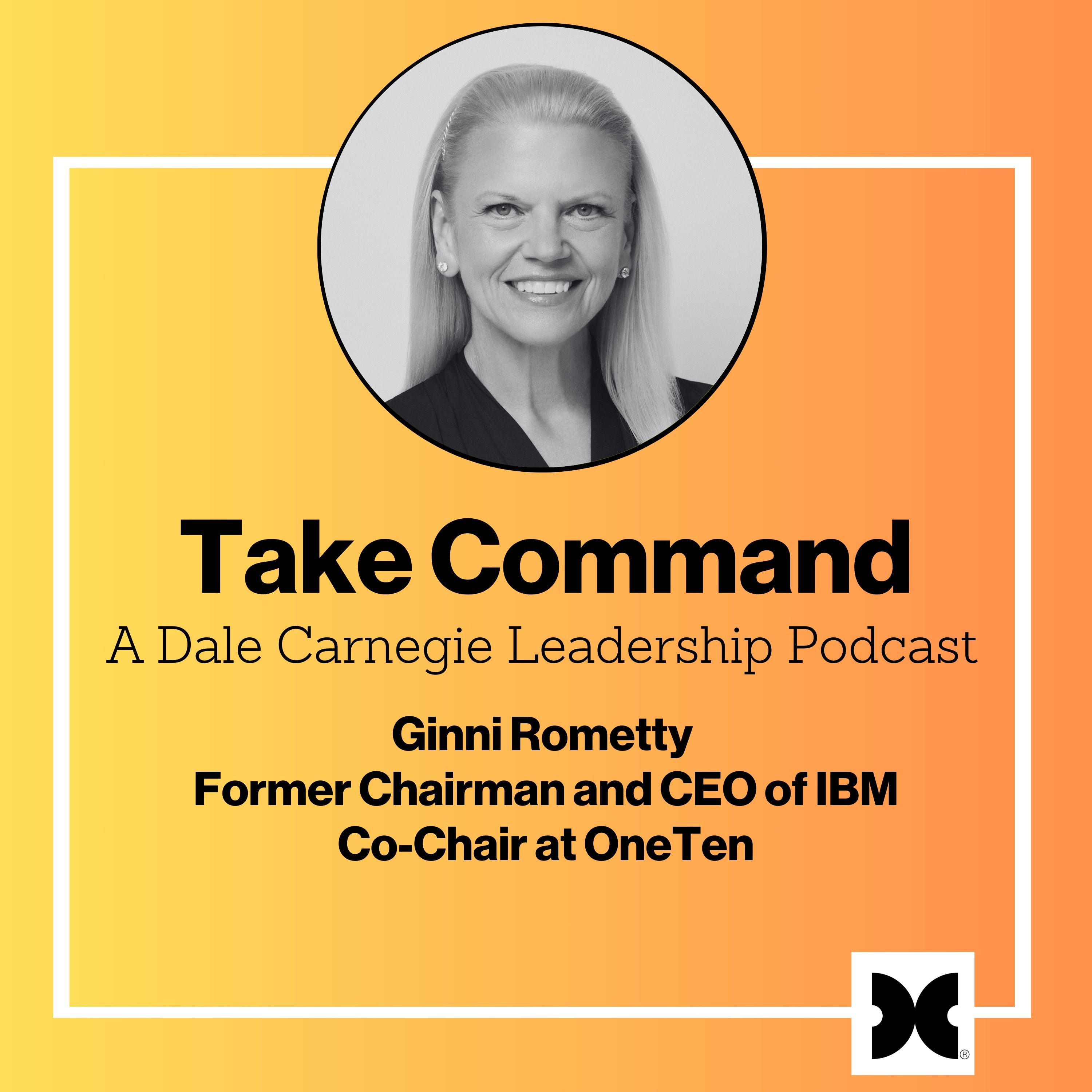
Take Command: A Leadership Podcast
Olympic Learning Meets Leadership: Insights on Grit and Good Power
00:46:14
Ginni Rometty is someone who has defined herself and her career through intentional action backed by hard work and determination. She says, “It's your attitude, and you control it. You can spend ninety percent of your time reliving the problem and ten percent on the way out of it. Or you can spend ten percent dwelling on the problem and ninety percent about what to do going forward.” Ginni’s episode is packed with amazing advice. She talks about how intentional practice can produce brilliance, why it’s selfish when leaders aren’t role models, and what it means to become an “Olympic learner.” Ginni wants to see others succeed, saying, “Don't worry about not having every step planned out . . . I didn't. My view was [to] do a great job and the next thing will open itself up.” Tune in for this and other shining nuggets of Ginni’s wisdom.
Loading summary
Transcript60 lines
- [00:00]
Ginny Rometty
I end up talking a lot about resilience because to me, that it gets to the heart of it. It's your attitude and you control it. And when I think back in life for all of us, you can spend 90% of your time reliving the problem and 10% on the way out of it, or you can spend 10% dwelling on the problem and 90% about what to do going forward. And I always flip to that 10, 90, right? It's such a waste of energy, which is debilitating to focus over and over. And trust me, I have relatives and friends that over and over I'm like, okay, this is just upsetting you more, right? Versus what are you going to do to go forward? Right? It's so much more optimistic for the people around you, etc. So that's, to me, the big thing I learned.
- [00:47]
Joe Hart
Welcome to Take Command, a Dale Carnegie Podcast. I'm Joe Hart, CEO of Dale Carnegie and if you don't want to miss a moment of transformation, follow Take command now and unlock the power of leadership. With every episode today, our guest shares how intentional action, hard work and a forward focused mindset have defined her career. She offers valuable insights on continuous learning and embracing opportunities without planning out every step in advance. She led a 100-year-old global technology powerhouse through a major transformation, reinventing half of its portfolio and building a $25 billion hybrid cloud business. She's been recognized as Fortune's number one most powerful woman for three consecutive years. And her best selling book, Good Power, continues to inspire and influence the business landscape. Please welcome former Chairwoman, President and CEO of IBM and Co Chair at 110, Ginny Remedi. Ginny, welcome to the Dale Carnegie Take man podcast.
- [01:56]
Ginny Rometty
Thank you. I'm very happy to be here. Joe, great to see you and great to be here.
- [02:00]
Joe Hart
Thank you. It's such an honor to have you, Ginny. I mean, you are the former chairman, president, CEO of IBM. You've achieved so many incredible things in your life. You were named by Fortune magazine the number one most powerful woman in the world for three years in a row. You've written a tremendous book, Good Power, which I had the pleasure not only reading your book, but listening to the audible version, which is really a treat. Really excited to talk to you today.
- [02:26]
Ginny Rometty
It's great to be here with you. And I can't believe you also listened to the audio version, Joe.
- [02:30]
Joe Hart
Oh, the audio version was fun. It was great. It was actually me. It was you. You did the entire thing. And I'd go on long Runs and listen to it and come back, would take notes and go back to the book. So it's a lot of fun to be able to do that. So, Jenny, let me ask. I mean, you know, when people look at you and the level of success you've had, incredible success. A lot of times people might not know all that you went through to get there, Particularly even in your upbringing, some of the challenges you had. Talk a little bit about the early part of your life and some of the things that happened that really helped you become as resilient as you are.
- [03:05]
Ginny Rometty
You know, it's an interesting question. From this perspective, I think people listening, it's worth thinking hard about your early life because it actually does inform so much of what you become. And I hadn't thought about it that hard until I wrote a book. And then as I reflected, all of this started to crystallize. And in fact, even when people read the book who know me, they'll be like, oh, now I see why you are like, you are. My upbringing. Look, while difficult, there are others who've had a much more difficult and others who probably did not have as difficult. In my case though, it was three really strong women that really raised me, but all had horrific tragedies in their lives. My great grandma was the last person alive in Belarus. Time of the World war. Came here speaking no English. She would never speak English, really. She cleaned bathrooms in the Wrigley building in Chicago her whole life at third shift. Saved every dime. Every Christmas I got a tin of Wrigley gum. But she would be the reason that one day we would have a house. Actually, my grandma then would be widowed twice by her early age and had to take care of herself. And she had a lamp store, taught me to sew, made lamp shades. She'd be the reason we'd have a car. And then my mom and I know, you know my story, but my mom, at age 32, four kids, my father abandoned us. And so here was my mom having never gone to college, never worked outside the home a day in her life, and she finds herself with, you know, four kids, no money, no home, no way to live. And we would go on financial aid and she would get a little education, get a little better job, etc, and to finally get us off of, you know, financial aid and public assistance. And as I thought back on it, I mean, I don't necessarily think of those as the hardest of times because perhaps I learned so much from watching all three of them. Clearly my great grandma and grandma taught me, hey, look, don't ever complain. Hard work is a way to get ahead. And they both, you know, did really hard things. And they also were like, hey, doesn't matter how bad it is, there's always a way forward. Right? You know, running a company, those things in your mind will come to be very important one day, that there is always a way forward, to not dwell on the past or you're never a victim. And in my mom, to me, the biggest thing it taught me, because when my father had left us and I happened to witness the event, he didn't know I was there. My mom was so determined to never let him define her. And that probably is my biggest lesson from my mom, was, hey, no one was going to define her as a loser. She was going to write the end of this story, not my father. You know, like I said, she got a little education, eventually got us out of trouble, and raised four great kids. And that idea of only you define who you are, I think it applies to people. But I would learn it would apply to a company, my own company, and I would learn it would apply to countries, too. I mean, you define who you are, or if you don't, someone else will.
- [06:01]
Joe Hart
Well, it's really incredible, too, because you think about the position your mom was in and you were in at that point, you're 16 years old and your entire family was at a point where you could have taken a victim approach. You could have said, woe is us. What are we going to do? Or you could really look forward. That's what your mother did. I know she went and really kind of educated herself and did whatever she had to do to protect her family. You also supported your siblings. I think you had three other siblings. You were the oldest of four and did that and. And then went on to college. To be the first person in your family to go to college, you did all of that with this mindset, which is kind of in a positive, constructive way. And I'm curious, because sometimes we could all be tempted to be discouraged. We could all be tempted to say, woe is me. What advice do you have for people who might be in that situation? As you look back and you look forward from your life, I would think.
- [06:50]
Ginny Rometty
Of two things on this topic. For me, what happened, it set the bar for what bad was. Anything else that happened after that was never really bad in my mind. And I think many people have had things like this happen to them. So I'm not unique. I hear this from so many people, and so it gave me perspective, is what I learned. And So I learned to not let a lot of things bother me so much because I'm like, wow, I've seen bad. Trust me, no matter how bad this is, it's not as bad as that was. And so you get perspective and that there is always a way forward, and that's all you really focus on. But the other part, I think for people, no matter where you are in your career, and it's a lot of how I ended up structuring the book, is that you personally have more agency for yourself than you think you do. And as I wrote the book in Good Power, I kept having this, like, image in my brain of when a pebble drops in water and there's a first ring and then a second ring and a third, you know, depending where you are in life. And as you mature in your jobs and family and this and that, the book is separated me, we and us, right? And it does grow over time. And I think that comfort that it does grow and that you have power for yourself, then you have power to pack people right around you. And then lo and behold, you actually can impact society more than you think. Like, so don't get frustrated with government or anything else, because you have that agency. So that's what it taught me, as I look back and I hope to give, like, people confidence that, hey, you have a lot more power than you. You think, right? And many people say that in different ways. So hopefully, like my story, which is a very normal person, is a way to say, hey, you could be that too, right? You have more power than you think.
- [08:30]
Joe Hart
I mean, it's really true. You've titled this book Good Power. And I certainly want to have you explain what Good Power meant to you. Of all the things you could have titled this book, you named a Good Power. The point you're making is such an important one, probably for all of us because there is that tendency that we can have in a difficult situation, as you correctly said. I agree with this. You know, especially when you're leading a company or in any kind of a position of leadership, we have to be thinking, there's got to be another way. When you hit a block or something, we can say, wow, what am I going to do? But we say in Dale Carnegie, in what ways can I? Right? Or in what ways can we versus can we? Can we not in what ways can we?
- [09:05]
Ginny Rometty
I end up talking a lot about resilience because to me that it gets to the heart of it. It's your attitude and you control it. And when I think back in Life for all of us. You can spend 90% of your time reliving the problem and 10% on the way out of it, or you can spend 10% dwelling on the problem and 90% about what to do going forward. And I always flip to that 1090, right? It's such a waste of energy, which is debilitating to focus over and over. And trust me, I have relatives and friends that over and over I'm like, okay, this is just upsetting you more, right? Versus what are you going to do to go forward? Right? It's so much more optimistic for the people around you, et cetera. So that's, to me, the big thing I learned.
- [09:44]
Joe Hart
Well, 100%. And this is the Take Command podcast. Taking command is about being intentional. And what you're saying, true, is that we can intentionally ask, where do we want to spend that focus? I mean, we can spend 90% just kind of dwelling on something that's not right or make that the 90% on the solution. So you were the first person in your family to go to college and you went into the engineering space, which was a male dominated space. And this is particularly at the time that you did that. Did you always have the desire to go into engineering or what led you in that direction? Direction. And what led you ultimately to IBM?
- [10:18]
Ginny Rometty
When I answering your questions, I want to keep thinking of ways to answer them in a way that people listening will have a, like, take something away from it. I went into engineering because I liked math early on. Subconscious lesson is you're way more passionate when you do things you like. Right? And so I liked math. The reason I'm a proponent for engineering the sciences for so many people, not that you have to. To me, what it taught me was how to think and how to solve problems. For a short while I was electrical and computer science, but I wasn't a hardcore engineer for that many years. Right. I went on into other things, but I always felt what I learned was how to think out of that. Because some people think, oh, if I'm an engineer, this means I'm, you know, really doing hardcore engineering all the time. I'm like, oh, no, but if it teaches you to problem solve. Every job has problem solving in it, right? And that was to me, the great benefit of why I want to see more schools teach the math, the sciences. Because I actually think that's what it's teaching you is how to do that logical, go forward problem solving. And I did like I was the first, I think I was maybe their first year of computer Science. So this is the late 70s when I would graduate. I was probably the only woman in many of those classes back then. And some people would say, was that a problem? And I say, well, yes and no. On one hand, when you are the only, and there are many people listening who are the only of something. Right now, what I always thought of was, oh, they're going to remember every word I say. And therefore what it made me do, fair or not, was study more. That in the end ended up helping me. Right? Because I always thought, oh, I raised my hand, you know, they know it now, they're going to hear me. If I'm wrong, everybody knows it. So I studied more and more. Well, in the end that ended up being quite helpful. So I'm a big proponent, like I say, of the engineerings for problem solving. And it's back to that, you know, just hard work at the end of the day for some of this.
- [12:01]
Joe Hart
Well, one of the great themes I think in your book is about continuous learning. You talk about this at the early stages of your career at IBM. You are teaching yourself. You're saying, hey, no necessarily going to help me with this. By the way, one of those things was communication. Dale Carnegie could have helped you at that time. You did that yourself. You said, I really need to be able to communicate effectively. I really want to develop new skills. And you did that. So that continuous learning theme seems like it's really been an important part of who you are.
- [12:27]
Ginny Rometty
Yeah, I was thinking about this. If people remembered one thing that you and I talked about, right, it would be this. Become an Olympic learner if you can. And so much of that is to kind of learn the how about things, don't memorize the what you know. And that to me is a secret to so many people's careers in so many different ways. So an example, if you're an Olympic learner, let me connect it to the topic of networking and mentoring or sponsors. People often say, oh, to succeed you got to have a great mentor or a great sponsor. I'm like, no, you need to be a great listener. Because if you are a listener in learning, I'm telling you, the people you're listening to, they will become your sponsor. In that you ask questions and you listen, they become invested in you. I'm not a proponent of having one mentor, one sponsor or anything like that. It's got to do with this. Genuine, genuine. Because people can tell when you are not genuine about this topic. Right. And I always say, like often when I go to a party, people will Come back and they will like not even have known what I did or who I was. I will have spent more time asking questions. Right. My friends always laugh if they want to find something out about their kids. They ask me to talk to their kids. It is genuine. I'm genuinely interested. I would prefer to talk about you than me. Oh, here I am talking about me, this whole podcast. But I would prefer not to normally. And so that idea of Olympic learning a impacts your mentoring and your sponsorship. I think it is also you're referring to something I write about in the book. It builds this lifelong network because I once had someone tell me, when someone asks you for help, you give it to them. You're capable, you give it to them. And that would to me, over a lifetime accumulated of that. It builds so much support in the world at large for when you need it one day. Because you know how they say trust is built by the drop, but it's withdrawn in buckets. And it's that idea over time and they show up at just those right moments when you actually need the help and support. And so that Olympic learner part, both from a professional development perspective and then now in this day and age with AI, the amount of how fast things are changing, it made me quit hiring people for what they knew in the moment. Because I'm like, okay, three to five years, you're obsolete. So I actually want people who are willing to learn things. And it would lead me to have IBM test for your propensity to learn not what you knew in the moment. Always being curious. And I guess those are such kind of common words, but you can act them in so many different ways, like I was just illustrating. In fact, I'm going to do some help with another company right now. You know, they're talking about how do I get people to want to be account owners for clients. And I said, you know, sometimes I think about this idea of a T shaped professional. You need to be really deep in some things and that gives you credibility. But then really curious and like a broad horizontal T. Right. And all that's related to this Olympic learning piece. I've done CEO searches for companies now. In the old days, you'd write down all these things. Now I think like the number one thing we've picked in so many of it is, oh, they better be a good learner, you know. Very interesting.
- [15:42]
Joe Hart
Yeah. So how do you assess that? How do you assess whether someone is a Olympic learner?
- [15:47]
Ginny Rometty
Well, some of what we've done is by. You've probably done a Lot of this or coached on it. And hiring is giving them problem solving or give them things to do. Right. That they have to learn and do on site. So you witness some of it, asking them to tell you the stories about when they've done it. But I think you can also tell just by the questions they ask in the interview. Right. And what they've done to prepare for the interview. And then there is some actual testing you can do. Right. So there's academically proven tests you can do. So those are the ways at a very high level, if you're interviewing, you can tell. But, you know, just, do you prepare? I mean, to me, preparation is the highest form of compliment you can give someone. Right?
- [16:27]
Joe Hart
Yeah.
- [16:28]
Ginny Rometty
Prepared for today. Trying to think about the points I want to make and for your audience, different than other audiences. And I got to a point in my life with clients, they'd be like, what else is on your list that you thought about? You know, because they became so accustomed to that idea that you'd done homework for them. And I. I learned that working for one of the greatest CEOs of all time, Lou Gerstner, who had run RJR, Nabisco, American Express, saved IBM from bankruptcy. And I would go with him to clients. I was a wee pup mid career and called me a day before and he's like, studying about these clients. And I'm thinking, this guy runs one of the biggest, arguably companies in the world, and he is doing homework to prepare. I'm like, no one is beneath homework. Right. And it would just have such an imprint on my mind about what learning would mean no matter who you were and where you were in your career.
- [17:17]
Joe Hart
It's interesting. I mean, some of these things, they're basic in a sense.
- [17:20]
Ginny Rometty
I know, I know, I know. Basic.
- [17:23]
Joe Hart
Well, no, I don't mean it in that way. We talk at Dale Carnegie, but like our principles, it's common knowledge, but not common practice. And what often differentiates the greatest leaders and most successful people is the fact that they put in the work. I mean, they put in that preparation. And certainly what you're saying resonates a lot with me. I had, even early in my career, would say, no one's going to outwork me. I'm going to work really hard in terms of just trying to be prepared and that type of thing. And I think that's a good lesson for all of us. I want to go back. You were talking about Olympic learning. And I can't help but think there's also a component of this that Was like Olympic relationship building. And you may not have been even intentional about it. You were just genuinely interested in people as a result. And you were talking about mentors. I mean, you had so many people who really helped you get to that next level, your career, because they saw you, they cared about you. And the reason that that happened is also because you took the time really to get to know them and observe them, share a little bit about that, is what I'm saying. Correct. Do you see it that way, too?
- [18:25]
Ginny Rometty
I do see it that way. And another, I think, really interesting lesson, again, as I reflect back. So this is all revisionist history that hopefully others can gain from, right? Because it's not like in the moment, you're like, oh, I'm so smart. I'm doing these. I would have learned from watching so many people, right? But I really try to impress upon people the importance of relationships because many people think relationships are a waste of time or it's like a thing you do, and they don't think through the purpose of them. As an example, have you ever been to a party and someone's talking to you and you can tell they're actually looking over your shoulder for who more interesting might be coming along? Right.
- [19:03]
Joe Hart
Horrible.
- [19:04]
Ginny Rometty
Doesn't happen to you.
- [19:05]
Joe Hart
But no, it happens to me, too. And I know exactly, I would say something.
- [19:09]
Ginny Rometty
They wouldn't even know what I'm saying right now, actually. And there is a very big difference. So now why do I think they've become so important as you go on in your career? I think what they end up doing is giving you perspective. So that's one of their roles. I can't tell you how many times I had big problems that maybe I was dwelling on. And someone would say to me, oh, you have this all wrong. Or that's insignificant. Look here. And it's because those relationships came from so many different various walks of life, okay? So they weren't all of the same. It could have been clients, entertainment, politicians. I mean, it didn't matter, right? To me, in fact, the more varied, the actual better for you. And it is offering you a perspective when you can't see it yourself. And so that is one, to me, like, incredibly important professional reason to have relationships. The other one is, to me, they offer a great source of resilience. And so that resilience, because, okay, what gives you energy in the long run? Because, you know, you. I. These are all very tough jobs at a certain point. And so they give you that ability to go on a little bit of that old what was the name of the Chicken Soup for the Soul book or something? I can't remember. A long time ago, right? I don't even know if it's still out there or still relevant, that resilience piece, Right. To make time for them. For that reason, it's not a lot of time. Which is the other important part about these relationships. It is the quality, not the quantity. And that's another mistake I think people make. Like, I don't have time. I'm like, well, no, it's about being present in the moment. When you're with even your family, by the way. You know, I mean, I would learn that with my husband. I always remember this one story. I would go to the bathroom, and I'd be gone 20 minutes, you know, and he's like, well, clearly you were on your phone, you know, like, you're not in there 20 minutes. I know that you're at a restaurant. And I'm like, yeah, you know, you're not in the moment. I think it's very true. In today's age, with so many devices we have about, can you focus and be in the moment? Right. And not multiplex. God, I multiplex like everybody. But I really try at times. I'm like, no, focus, focus. We must all notice that, you know. So anyways, it's for both that perspective and to give you resilience that I think that they're so important.
- [21:25]
Joe Hart
It is. And, you know, again, it's so important to give people. What does it say to people when we give them our undivided attention? We really are listening with the kind of this active, caring, genuine interest. It really says you're important. And just going back to your example, the events where someone's looking over, you know, who else is more important to talk to? That says something, too. I don't know about you, Jeanne. I have found myself lately, I will sometimes leave my phone in the car. If I'm going to lunch or dinner with someone I didn't want on the table, I want it away. I mean, there's even science about how just having the phone on the table can change our thought process in the conversation.
- [22:01]
Ginny Rometty
I think it's a really good point. You know, you remind me of a few things, like, always say you can tell if I'm listening with an intent to learn, right? Not just listening, if I'm actually listening with intent to learn. And that makes such a big difference to someone on the other side. So, anyways, like, I loved your comment. Common knowledge, not common practice. And that's A real secret. I've never positioned it that way, but I do think that's a secret of a lot of successful people. It's not brilliance, it's just that they practice these things very consciously. Right. So it's really excellent point you make.
- [22:32]
Joe Hart
No, well, thank you. You know, I want to ask you one of my favorite stories that you tell in the book. And again, you were advancing throughout IBM, and part of it is you're succeeding. You are impressing people around you. You talk about having really this defining promotion opportunity, and I believe the opportunity was to lead IBM's global insurance unit. One other part of the book, you're saying, you know, that many women will look at you as someone, as an inspiration and you kind of. I'd say, why would I be an inspiration? Beyond that, you make a point in this section of the book to say that your husband encouraged you. You were thinking about the things you lacked. I've got eight out of ten of these things. I don't know these two things. Maybe I'll do these things and I'll come back. And he had said, how would a man look at this? Just you wanted to share a little bit about that story.
- [23:18]
Ginny Rometty
It's funny, that story. Everyone focuses on that story. It was the alternate title for the book, by the way.
- [23:25]
Joe Hart
Oh, wow.
- [23:26]
Ginny Rometty
There's lots of science for what I'm going to say now in retrospect, but I think maybe the story is more powerful because I think it applies no matter what country you're listening to us in, in men or women. Actually, this was mid career, just as you described. I was offered a big job. In fact, my boss said, hey, he says, I'm getting promoted, so you should take my job. Go to the interview. And my reaction was, new. Two more years, I'll be ready. I'm not ready for a job that big yet. I could do about a third of it. Not yet. The whole thing. And he looked at me oddly. He says, go to the interview. I go to the interview. The gentleman offers me the job. I answer, I want to go home and talk to my husband. He looks at me a little bit oddly and says, okay. I go home. My husband, who I've now been married to 45 years, you know, I'm blah, blah, blah. And he's just listening. And he says to me, do you think a man would have responded that way to that offer? I said, no. And he said, I'm not on a gender thing really, but I've watched this movie now over and over with you because I'm already now 10, 15 years in. And he said, every new position you go through this, every reason you can't do it, you're so nervous you don't want it. And then six months into it, you're ready for the next thing again, he's like, you got to stop it. You got to reframe risk. And that's, to me, the key point, the saying that I kind of formed in my mind, which was the alternate title, was that growth and comfort will never coexist. This idea that if you're going to grow, you are going to be at risk or uncomfortable. And I think when people logically think of this and they say, like, hey, when did you learn the most in your life at something? People always tell you some risky story of what they went through. They do. So back to common knowledge, not common practice. This reframing of risk to be a good thing. Because then I started to view it as, hey, if I am nervous about something, this is excellent. Because this means I'm learning. If I'm not nervous, I'm like, whoa, I'm getting stale, right? I better go do something else. Like I said, over the years, this would, like, really grow. I mean, I would start to take on many big risks that maybe even sometimes I too big because of this feeling that I associated it with growth. Or I would volunteer for the things nobody else wanted to do. You know, after the tsunami in Japan, no one wanted to go. Well, the data all said you were safe. We left our people there. They were safe. So I guess I could go. And to this day, my Japanese colleagues do not forget I was the only American that went there. I mean, the country doesn't. The companies, the clients. So that idea to reframe risk, I kind of press it upon it. Be my number. Another number one other than Olympic learning, I leap with people that risk growth and comfort will never coexist. So next time you feel that way, it's actually really good for you. And I do see it more with women. Okay, so back to the gender point. On one hand, I say it definitely applies to men and women. But I do tend to see, and there are studies of this, women will say, let me tell you the eight things I can't do. And a gentleman might say, let me tell you the eight things I can do of the same question. You know, just two ways to look at a question. So for whatever reason, it was to me, a defining moment, as you might call them. Joe. Probably one of the biggest ones was that my husband takes credit of everything Thereafter.
- [26:31]
Joe Hart
Well, that's right, of course. So it's all because of him, right?
- [26:34]
Ginny Rometty
Yes, yes.
- [26:35]
Joe Hart
It's an inspiring story in. You know, I have four daughters and two sons. And so on the one hand, I'd want all my daughters to know your story and to hear that, I think it's a great lesson and my sons, too. I think whether you're male or female, the bottom line is we all can lack confidence. We can all frame risk in a way that maybe it's just a much bigger thing than it really is. We can all hold ourselves back. We can be uncomfortable, as you said, and then not have that growth. So I think, you know, your story is inspirational, really, to everybody.
- [27:06]
Ginny Rometty
Yeah. And I think, even if I may, to those starting in a career, I was with someone earlier this morning who was saying to me, she had a son in college and he's like, oh, geez, maybe I should not exactly go into neuro. Whatever he was talking about. And. And someone saying to him, hey, hey, hey, you got a whole rest of your life to explore these things. And I think there is such great pressure on young people today about charting a path, knowing exactly what it is. Don't worry about not having every step planned out, Joe. You might have in your career. I didn't. My view was, do a great job in the next thing will open itself up. Don't be naive. You work a bit at steering. But basically it was, okay, how much can I learn from this? And then what doors does that open? Right. Versus okay, I'm going to take these next eight steps. And some people, that may work, but I wish some people today would just let life unfold and not put that unnecessary pressure on themselves.
- [27:59]
Joe Hart
It's a great point. Especially younger people. I know when I was young, I was very much the way you were describing and trying to be very methodical until I realized it just didn't work. Started as a lawyer and realized I didn't want to do that and went into areas that were completely different.
- [28:11]
Ginny Rometty
And then you're a great example. Right. You were a lawyer.
- [28:14]
Joe Hart
A lawyer and a recovering one, as we were talking about beforehand. But I think your point is a really important one for anyone, wherever they are in their career. It's like just having that mindset, that openness, and doing the best that we can along the way and building the relationships that we did. I have to ask you, Ginny, because you led one of the largest companies in the world. So first of all, there is the reality that you were open and you promoted all the Way to the top. That's an absolutely incredible achievement in and of itself. If there were one or two lessons for our listeners, I mean people who aspire to a higher leadership beyond what you've said, is there anything else that you might add to that that was important to you and your journey?
- [28:57]
Ginny Rometty
Let me answer it maybe two ways because I would take over IBM at arguably its most difficult inflection point, had done fabulously well. It's the oldest technology company that there is. You, Joe, run a company that's been around how many years now for Dale County? 112 exactly. We're about the same age almost, give or take two, three years. And with that is a great blessing and a great burden. And so again, most tumultuous time of change. So I would have to change almost everything. So I would learn much about that. And in fact, that's kind of what led to the book about some of the principles I observed and learned from others about how to drive big change. One point you say the habit made it really is to get people not to be afraid of big change and that there is a good way to do change. Because I think there's some very negative role models out there today and that you can do change respectfully. You can love tension, not let it be divisive. And if you just celebrate progress, not perfection, you'll be surprised what can get done. And so I do think there's this idea of good power. I want to impress upon people that I am really trying to espouse a way of leadership that I think in this moment is very important. That's at a macro point I would make. As I look back and I say I wish I did anything different on my leadership. The one thing I would recommend to people is I wish I had been more vulnerable earlier. What I mean by that is maybe vulnerability and authenticity go together in a lot of ways about being yourself. Because it's not about copying other people. It's learning from other people what you want to be right and you create your own mosaic. But the vulnerability part, especially having been a woman in a very male dominated industry, you know, I spent a lifetime trying to not be a woman. I mean, trying to never put focus on that topic. Never, never, never. Just look at me for my accomplishments. Don't ever bring this up. I didn't participate in women's things forever, blah blah, blah. But as time went on and I was obviously as you described, my career went on and more and more confident and successful, I would then begin to talk about these things. And I learned a few things from it. One, first off, there are a lot of people out there who need role models to believe it's even possible. It's very selfish to not want to talk about it is what I started to conclude because it was actually a responsibility for this next generation that they could look at me and go, hey, if she could do this, I could do this, right? So more I was vulnerable to talk about those things, the more good I actually did. But probably the bigger thing I learned about the vulnerability, whether it's admitting things are wrong, whether it's being honest about things, whether it's about telling your story, whether it's about speaking from your head and heart, is the more vulnerable I was. It was quite an instrument for followership. You know, at a time I would have half a million people. When you have to reach big groups, followership is your biggest lever for change. Actually, the more vulnerable you are, as hard as it is to be vulnerable, actually, the more people will follow you because they look at that and they see themselves too and they see your flaws, their flaw. It is a common thing that combines you. I wish I had been more vulnerable earlier. I learned that in the end the last decade of my career. But I probably could have done a lot more good of my 40 year career in the first two decades too having learning that. But you're much more protective in those years, right? And so it's just something, it's not an on off switch. You learn it over time. And I put it forward and it applies to men and women. This is not a woman or man thing. It's a really important leadership instrument is how I view it.
- [32:37]
Joe Hart
Well, thank you for sharing that, Ginny. And I think too when you were leading and you talked about getting us in the last 10 years of your career, I mean the world is different now too. I think people expect more vulnerability, authenticity from their leaders. There's more transparency. So certainly it's something that we can relate to more readily today. And at the same time, I mean, you know, you clearly demonstrate that in this interview and in so many other examples. So thank you for sharing that. I would say too, we could keep on talking. The Good Power book is fantastic and we are just scraping the surface of so many of the real insights and experiences that you share in this book. So I encourage anyone who's listening to pick up the book and listen to it like I did or read it or both. But let me ask the title, Good Power. This is ultimately what you went with. Just tell us a little Bit about good power and what would that mean to our listeners?
- [33:28]
Ginny Rometty
Well, I really wanted to impress upon people that how they did what they did can be as important or more important as what you do. And I believe that could be lost right now. The how does matter, hence the good power idea. And it was that there were these kind of tenants that I briefly mentioned that the way good power is executed is you have a choice. You can be respectful in how you talk about issues and differences or not you have a choice that you can love tension. And most people hate it and they hate conflict. I think in this day and age, you have to learn to love it. But there's a but to me, it isn't just love that there's a difference. You have to look for a third way to solve it. A third way. And I learned that over time that there was always a third way that wasn't polarizing. And if I found that third way, it led to the third tenet, which is then I could actually make progress. And as long as I wasn't ideological and out for perfection over time, that progress added up to a lot of things. I wish I could convince people that that's a good way to lead and that they could learn from when I did it right and when I did it wrong. It's a memoir with purpose, Good power. So it's like, trust me, I don't have to take you through every boring part of my life. I tried to pick out the stories that somebody could learn a lesson from and that add up to that idea. Because if you do it actually there's big problems in the world to solve and the bigger they are. I think that approach can solve the biggest of problems. And I witnessed it with what I did with creating a movement around skills first. You know, hiring people for skills, not just degrees. By the way, any country I went into, whatever your political parties are called, jobs for people is a common language and a common currency that is a positive. If you can help that situation, better jobs for more people, you can get a lot of things done. And to way to approach it is in the way I just described. So anyways, that's to me what good power was. So love tension, look for the third way, do it respectfully and just celebrate progress, not perfection, and you will be surprised.
- [35:33]
Joe Hart
Love it. Love it. And especially the way you led with good Power. You were talking about the skills first kind of approach that you had in the P Tech kind of movement that you had within IBM, which really was about trying to help people they might not have college degrees. And a lot of times, right. This is something that it's an exclusion. If it's a prerequisite, you won't even consider someone. But you found ways in your environment to find people who have the skills to bring them in to help them be employed. And I know you're very active with the program right now called oneten. Do you want to just talk a little bit about what that is?
- [36:03]
Ginny Rometty
Maybe in a nutshell again, why I encourage people to look back on their lives, think about what they've learned. You know, we started with the story of my mom and one of the other things I learned from that was access and aptitude are not equal. My mom was smart. She had no access, no access to education, these jobs, nothing. Well, I would learn over time. You know, 65% of Americans don't have a college degree. Oh, by the way, that's true in every developed country. And then that took me down a journey which you mentioned these schools called P. Tech. It won't go into how we got into it. It was a corporate social responsibility, a high school. And we gave kids internships and hired them. And lo and behold, they could do the jobs. And we're like, okay, hire more. Oh, 100% of our jobs require a college degree. Yes, but they could do this work. Why do we make that the starting requisite? So that would teach me. Where someone starts should not determine where they end. Just like my mom. Access and aptitude. It took me down this path that has now become my passion. Wait a second. How many of us over credential our jobs? And I'm going to generalize, but of all of us probably listening, I would bet 50% of your jobs are over credentialed. You require a college degree to start when they don't require one to start. And I'm not against college. I am a vice chair at a university. I have to always preface, this is not a have and have not world, but there's just a fact in reality. And if you love living in a country that's peaceful and has an optimistic future, it will only be because people think they can have a better future. And we're on a borderline on that places. And so to me, that's why I say it's essential to the future as well to have that view, that anyone can get a good job, family of four, be able to live upward mobility, and you don't have to start in that spot. So skills first. I learned, Hey, I actually taught them the skills and hired them. Even if they didn't have the degree. And especially with technology changing. Oh my goodness. And so many first generation people that maybe I was first generation. Like you said, they went to college. You can't afford it. And gosh knows the cost of what colleges today in places it just proved and how I got proven right over time. Because this now, I've studied this and worked on it 15 years, 30 countries. I mean, this now has grown. And now we're working on making it a movement. 110. It started to take a million black employees into upwardly mobile jobs without college degrees, but now it's all people without college degrees. Hire them for their skill first, not just their degree, and then give them the opportunities. Whether you are a pilot at Delta Airlines, whether you're a nursing assistant at Cleveland Clinic. I mean, we got millions of success stories of this now. Now, as I would say, God spreads aptitude evenly, just not access. That's all. And great people are everywhere. And I would study it. They'd be more retentive, they'd be more loyal, they took more education than my college educated crowd. They're hungrier. In the end, I just celebrated. We have our second PhD that came out of the crowd. So this wasn't an issue of their rights. This was an issue of access. And sometimes then when you're around it, what you learn. So anyways, I'm a big proponent. Anybody listening? If you're hiring, this is a journey, a cultural journey. By the way, we could do a whole episode on that, give it some real thought about how many hidden talent pools are out there that you don't tap because you have these false requirements. And particularly if you believe in a diverse, more inclusive workforce that is the majority of those pools. And you will be so delighted with the people you hire out of them, in the end, you have a better business.
- [39:35]
Joe Hart
So, Ginny, many people who listen to this podcast may be CEOs, business leaders who want to take this next step. What would you advise that they do? Is it to go to oneten.com or how can people learn more about this movement?
- [39:47]
Ginny Rometty
You can go to 110. Org, the biggest thing we help companies with. And we have a hundred of the biggest companies in the country now having joined and changing their policies will help you with how to embrace skills first. And what does it mean? Because it's not just, oh, let me remove this from the job wreck. It's then how you hire, it's how you onboard, it's how you promote. By the way, there's a lot of bias in the system because it's developed for many reasons. Right. That this is out there. And so we help you with that whole journey to do it. But it just starts with look for a job in your company. You know, it's over credentialed. And all I ask is don't try to hire one or two people into there. That's an experiment. You gotta hire a critical mass so that they change you. You don't change them. I always say, like put 20 people in that spot. Try 20 and you are going to be be so surprised at the kind of people you will find. You can go there. We'll help you with skills first. Doesn't matter what type of person you're looking for, but we can help you with that skills first journey. Think of it as a talent strategy and culture, not just about, oh, I'm doing some social good. Oh, no, I need good people. Right. And I want a bigger talent pool that you're not fishing in. That's how I viewed it.
- [41:00]
Joe Hart
It's a win really, for everybody. It's a win for the person, it's a win for the business. It's also an exercise, as you'd say, of good power because we, the authority, the ability to have this impact and we can be the catalyst for making that happen. I've had a habit in the most recent podcast, Ginny, of ending the interview by going to ChatGPT. And I said, oh, I'm going to be interviewing Ginny Rometti, former president CEO of IBM, and what question would you ask? And this is a question that I got from ChatGPT that I'm going to ask you. As AI continues to evolve and integrate into our data daily lives, how are you currently using AI in your everyday routine to enhance your personal productivity and decision making?
- [41:40]
Ginny Rometty
Did it really tell you to ask me that?
- [41:42]
Joe Hart
Yeah.
- [41:43]
Ginny Rometty
As one of the foremost authorities on AI, I was AI before AI was cool. All right? So I always say I had great ideas. My timing was not always right on these. So my experience goes way back to the early 2010s and before, which, by the way, in my view, AI is all about people change, not technology changes change. Okay, this has never been really a technology issue. Technology has always been better than how it was used. But now in my current life, how I use it, let's see, my husband is sick, I haven't checked every test result. I get in the detailed MRIs, and I'm like, give me this in layman's terms. All right? So honestly, it does a pretty Good job. Then I run it by the surgeon or the doctor, and they're like, yeah, that's pretty accurate. Okay. Not always correct. So I'm very careful, but I use it a lot to kind of get my handle on complex medical issues. Some others may identify with this topic if you're taking care of someone out there. I did my wedding, you know, redid our vows because my husband almost died. He succeeded, and so we had a big party. So I had Chat take a ride and do their vows for me. Now I had to change it. All right. But great starting point. And it leads to this point, which I think for many people, be careful of what it can do and what it can't do. Right. I actually think very good at summarization, at interpreting, even ideation, like the wedding vows. Okay. Not good at judgment. Okay? So be careful. And this is what humans do. Better judgment. Don't ask about which is your best business strategy. You can also say, but tell me the 10 business strategies out there. It's about using it properly. And I would suggest everyone, it's getting better and better, and I'm hoping for a lot of things. It'll level a playing field, you know, and how people can do their jobs. Think of how many times you call a call center. I feel empathy for these people. Really complex questions they can't answer and know everything. But with them getting assistance, I have this view that it could be a great equalizer, have people do jobs even better than they could by themselves. That assistant idea that everyone talks about. But for my real life, I use it for medical advice, helping me get started on a difficult task. And I think it's great at getting started on a difficult task.
- [43:53]
Joe Hart
It's a powerful tool. It's just unfortunately inaccurate. Many times.
- [43:57]
Ginny Rometty
Yeah, well, you know, when it first came out, I said, so who's Mark Remedi? That's my husband. And it told me all about how he ran IBM. His view was, oh, finally someone's giving me credit. You know, I was like, okay, well, this is wrong. I even still read things. It's got stories in there about me. I just can't get it corrected that are wrong. I went to Northwestern University. I did not go to General Motors Institute. I just can't seem to get it out of it there that. No, I really went to Northwestern. But you're right. So this is where you have to. Good input, but use your judgment. Right?
- [44:25]
Joe Hart
Well, it goes back to what you're saying about the people, too. I mean, ultimately, this is a tool that we're using and we need to be able to assess it and challenge it and research and do the things that we do. But I also think, Jeannie, about kind of what you're saying about preparation in the beginning. I mean, this is an opportunity for really extreme preparation, if you will. I mean, you can use a tool like this very quickly to get a good sense of what something is. Maybe you have to challenge some of the accuracy of it at some points.
- [44:50]
Ginny Rometty
But generally get the general right for sure accurate. I agree with you on this. And you know, if you're implementing it in your business, two points. I'd say people's tolerance for errors goes down. The more critical problem they're asking it about, okay, like medicine is very critical. You'll be careful. So therefore think of that when you apply it in your business and think, okay, if it gives the wrong answer, I am going to be financially responsible. If you know that, I guarantee you'll implement it the proper way.
- [45:19]
Joe Hart
All right, Great advice. Jeanne, thank you so much for being with me today. A really inspiring interview. I know that it's giving so much to our audience.
- [45:26]
Ginny Rometty
My pleasure. Joe, you're a great interviewer.
- [45:29]
Joe Hart
Well, thank you very much.
- [45:30]
Ginny Rometty
Thanks for hosting me.
- [45:37]
Joe Hart
I hope you enjoyed this edition of Take Command. Adele Carnegie Carnegie Podcast. Check out our resources at www.dalecarnegie.com for more research, insight and tools that will support your success and help you take command of your leadership potential. If you enjoyed this episode, please consider rating it and following us on Apple Podcasts and Spotify. For more exclusive content, subscribe to our Dale Carnegie YouTube channel and follow us on social media. As always, thank you for listening and we're looking forward to you joining us for the next episode of Take Command, a Dale Carnegie Podcast.