← Take Command: A Leadership Podcast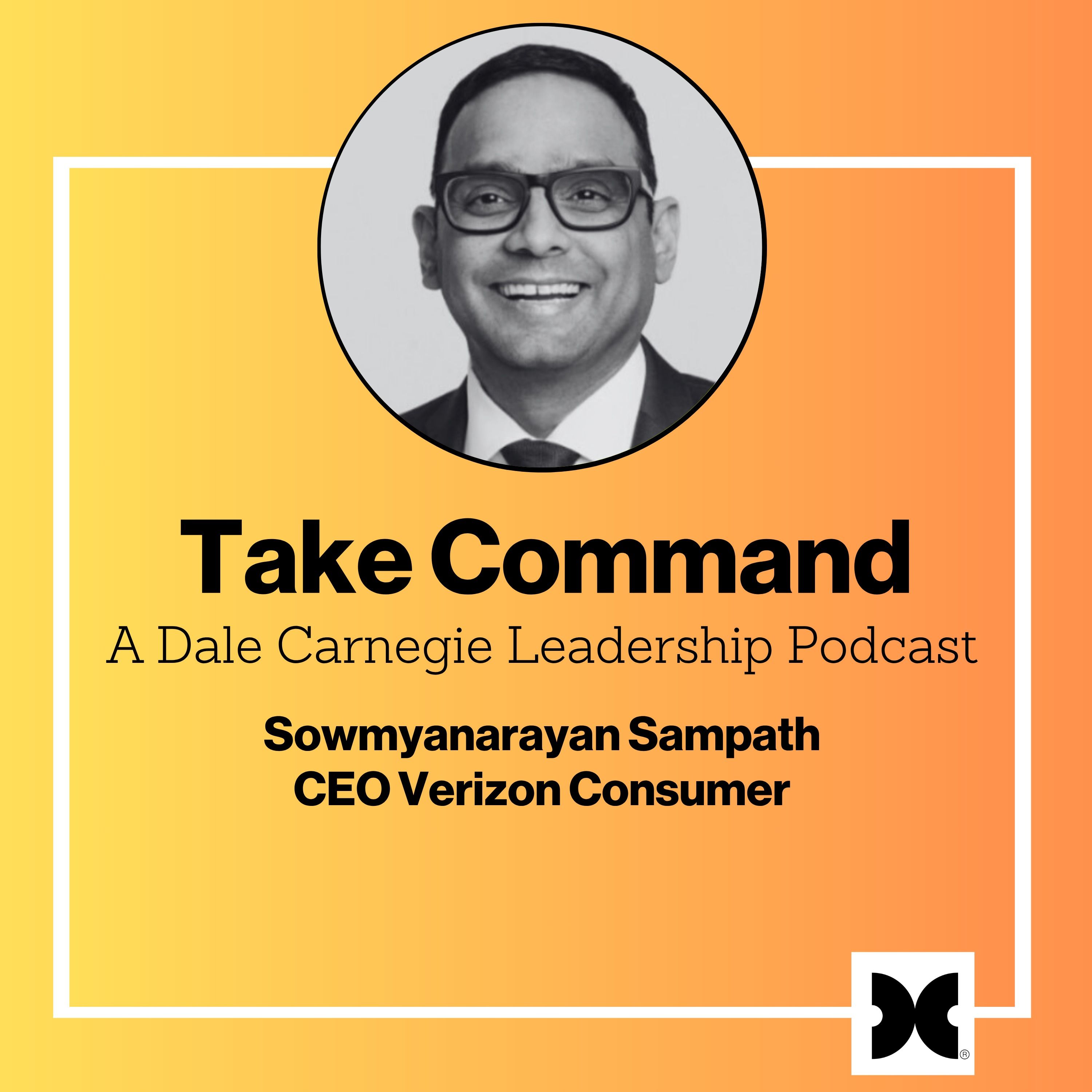
Take Command: A Leadership Podcast
Refocus and Rise: Thrive in the Era of AI
00:41:35
What happens when a Fortune 20 executive blends sharp strategic thinking with a lifelong learner’s mindset? You get Sowmyanarayan Sampath, Chief Executive of Verizon Consumer. In this wide-ranging conversation, Sampath pulls back the curtain on how he leads one of the world’s largest tech-driven organizations—with clarity, calm, and a deep belief in people. From reshaping careers through AI to building lasting trust in teams, Sampath shares what it means to lead intentionally in a time of rapid change. He opens up about his personal philosophies, including why he thinks in three-year chapters, how karma influences his choices, and why self-discipline and communication are the new power skills. And his take on AI? It’s not something to fear—it’s “borrowing another brain.” He explains how it’s already transforming productivity, reshaping job roles, and giving professionals a chance to grow in entirely new ways.
Loading summary
Transcript46 lines
- [00:00]
Aryan Sampath
When you live an arc of time, you find out that when the going is good, it's not that great. And then when things get rough, it's always not that rough. And there's this attitude that you have to start reverting to the mean in emotions and expectations is how you start reverting to the mean. And that helps a lot. And a lot of that comes from the Indian philosophy of karma. You know, karma says you got to do good. That's your job. There's a balance sheet for you. The more good you do, the more longer term it'll pay off for you. But you cannot expect any results. So when you're in that type of mindset, you are able to manage the ups and downs very effectively.
- [00:48]
Joe Hart
Welcome to Take Command a Dale Carnegie Podcast. I'm Joe Hart, CEO of Dale Carnegie and if you don't want to miss a moment of transformation, follow. Take command now and unlock the power of leadership with every episode. Today's guest shares how a customer obsessed people first approach drives transformation at scale. He discusses empowering frontline teams and practicing humility, all while creating lasting value in a fast changing world. He oversees one of the largest consumer facing businesses in the U.S. managing more than $100 billion in annual revenue and serving over 100 million customers. Prior to his current role, he served as CEO of Verizon Business and partnered with 99% of the Fortune 500 to help drive their digital evolution. Please welcome CEO of Verizon Consumer group, Somine and Aryan Sampath. Sampath, welcome to the Dale Carnegie Take Command podcast.
- [01:56]
Aryan Sampath
Hey. So good to be here.
- [01:57]
Joe Hart
It's great to have you here and I'm so excited to talk to you. And first of all, you lead one of the largest consumer facing companies on the planet. Over $100 billion in revenue, over 100 million customers. You touch millions of lives every single day. So I mean, just your experience leading that business and talking about leadership is fascinating, but your philosophy about leadership, I want to talk about, you know, kindness, which is an underlying pillar of kind of how you lead and you still are driving incredible results. Many people wonder how do you be kind and drive those kind of results? Do you do that? Want to talk to you about AI as well. Before we do anything, tell us a little bit about your journey. You were born in Kolkata, India. I know you had originally wanted to go into engineering. That was your life dream and it really didn't work out that way. What happened?
- [02:47]
Aryan Sampath
Well, I wasn't a good engineer. I was very keen in high school to become an Engineer. I did all my AP Physics, equivalent of AP Physics, AK Chemistry. I didn't do biology, AP Math, AP Calculus. And I thought I was ready for engineering school. I wasn't. I didn't get into any decent engineering school. I mean, to be more precise, I didn't get into any engineering school. It was a interesting moment because I always thought I was good at what I did till the day I wasn't good at something and I had to make a pivot. It was a defining moment for me, one I still remember, one I still go back to. And my parents were like, you have a good business sense, I think you'll become a great accountant. It was a hard pivot to say it, but it turned out very well. They were right. Worked out well. But growing up in India, you talk to any Indian who's in corporate America, you hear the same story. What I call mcv, Middle class values. You know, there are three things growing up in India. The first is education. Education matters the most. It's our path to excellence. It's our path to get out. Or whatever we were doing is education. Even till today in our house, it's the most important thing for us. The second is respect for elders and respect for the order of things. I think it helps with a harmonious way of getting things done. And in large companies it's very effective in that style of working. And the third one is humility. You were put on earth to do good, you were not put on earth to do anything else. And you have a place in life, you have a place on earth and you have to be humble. The day you're not humble, bad things happen. So these three fundamental, what I call Indian middle class values is what's helped me throughout. And I try to put them in my kids. Some luck, some maybe not. But every Indian will have pretty common stories about these three themes.
- [04:33]
Joe Hart
But it's interesting, I mean, the fact that you had those values and you had them maybe from your parents and maybe from the culture as well, and you've tried to instill them. It's not easy always living those values, right? Especially the humility part. And I'm just curious, you know, because a lot of times people look at you or look at CEOs and they see the success, but they don't see the ups and downs and the bumps. And I know you had that real struggle probably at that time. I mean, I would love to hear just a little bit more about how you kind of of got through that because again, you had a dream and that Dream, you had to pivot, as you said. And probably people who are listening to the podcast or watching the podcast, people are struggling with different things that aren't working out the way that they had wanted. How would you encourage them to embrace that pivot?
- [05:15]
Aryan Sampath
When you live an arc of time, you find out that when the going is good, it's not that great. And then when things get rough, it's always not that rough. And there's this arc attitude that you have to start reverting to. The mean in emotions and expectations is how you start reverting to the mean. And that helps a lot. And a lot of that comes from the Indian philosophy of karma. You know, karma says you got to do good. That's your job. There's a balance sheet for you. The more good you do, the more longer term it'll pay off for you. But you cannot expect any results. So when you're in that type of mindset, you are able to manage the ups and downs very effectively. When things go great, you don't celebrate too much. When things go rough, the world doesn't collapse on you. And you have this grounding entity, a grounding thought process that is, you're here to do good work. And I keep going back to that every time I get in the jam. And that's how you maintain a good posture with your colleagues and teams. Because if you're too excited, your energy is too high, they actually don't know what to do with it. And then if you are a sarpas and then you're just grumpy all day, you know, it's very difficult for them to get energized and actually do something. So I manage that by this philosophy of karma, and it's pretty helpful. And it also helps with very difficult situations because there's nobody on earth who gets a free run and a free pass every single time. You're going to have to hit challenges. And it's actually good to get some challenges sometimes along the way. In the moment, it doesn't feel that way, but when you come out of it, you're like, I'm glad I went through that. So that kind of helps me navigate through the day to day of running a large company.
- [06:54]
Joe Hart
Yeah, I mean, it's interesting because, you know, at the time we go through something, things can be very difficult. I mean, we all went through Covid. You were leading a large business through Covid, and at that time, things just were not great. And at the same time, we can look back with perspective and how we've learned and how we've grown and so forth. It strikes me that for you to teach that philosophy around karma to people, even as part of a leadership philosophy, is a valuable part of how you drive culture at Verizon.
- [07:21]
Aryan Sampath
Yeah. And also I think people spend too much time in the moment sometimes and they think whatever we are up against, either good or bad, defines their whole life, defines their career. We all live in an arc of time. We all have history before, after us. And if you see things that are in a larger context, you'll realize that we found ways to work through everything. I mean, think about it. You know, in America, we had the great financial crisis, we had Covid, and now we are going through some uncertainty on tariffs. I think these are skirmishes that will come and go. But longer term, America is a great place. I think the next 20 years of America, the greatest 20 years of America will ever have in terms of technology progress, health care benefits, like that. But you have to look at it in a context of time. The minute you narrow your timescape to a day, a quarter, a month, a year, you just get into a very different mindset. And I think having a slightly larger perspective of time helps you to make better quality decisions, but also manage your emotions more accordingly.
- [08:22]
Joe Hart
So how do you balance that with the reality that you've got a publicly traded company, you've got to get quarterly results, you're under the scrutiny of analysts and so forth. And what you're sharing, which I agree with 100% by the way, I think it's a wise approach and kind of is incongruent to some degree with the pressures that might be on you on a day to day basis or on the company. How do you reconcile those two things?
- [08:43]
Aryan Sampath
When you run a large company, you have to telescope a lot. You know, there are some parts of your day when you're in the moment, you're trying to hit the quarter, and then there are some parts of your day you're planning for five years and some parts of the day you're planning for 10 years. And leadership is the ability to telescope in and out very quickly on those type of conversations. If I spend more than 30% of my time in the quarter, I'm not doing great. So I think how you spend time is going to be super important and you have to be intentional about it. You can't just let time work its way through the machine and then take a rack up at the end of the quarter. For example, I color code every hour I spend. Red for me is time with Kids and family. And then I have time with my teams. I have time on strategy, I have time on short term and then I balance that equation. I know exactly how much time I want to spend and, and there are some weeks I don't do well. I go back and course correct over the weekend. So next week I come out spending time in the way I want. So how you spend your time will also reflect how your team spends time as well. I think that's an important metric. The second is you cannot make long term progress if you don't make short term progress. Everything can't happen on the back nine holes. You know, the first nine holes also have to be great taking a golf analogy. So you could take a little bit risk in the short term, but you have to make short term progress to make long term progress. I don't think both those have cognitive dissonance. They both kind of align with each other. I don't see a situation where short term you go backwards and longer term you do great things. It just doesn't work that way because you lose momentum in large organizations.
- [10:13]
Joe Hart
I agree with that. I'm just kind of curious. You were talking about color coding and I'm fascinated a little bit. And when you see you color code everything, so could you just unpack that a little bit? What do you do and what's your approach?
- [10:25]
Aryan Sampath
So every time I run everything through my calendar, we use Google, but it could be any calendar. And then everything gets blocked off in chunks. And instead of going and actually allocating how many hours, you color code everything and you set up your own color code. For me, as I said, family is important. I put that in red. That is all stuff I spend on family, kids. Yesterday my kids had a jazz concert. Great concert by the way. High school jazz. Highly recommend that. So that gets put in red for me. And I see how much time I spend during a Monday, Friday environment with kids and family. And then I have things marked as longer term strategy. It's how I'm working with AI, what we're doing with long term technology, the longer term product roadmap, just classic strategy, planning, capital allocation. I color code that a different color. And then I have day to day stuff, which is how do I meet the quarter, what are sales, what's going on? And then I have another color for people development. Am I spending time on talent? I'm spending time on people. Am I working the funnel? Well, I'm working the succession. That's it. Those are the four things I spend time on end of the week. I look, I print the whole thing out and I see other colors matched. If there's too much of yellow, which is what happens in a day to day quarter, it's not a good week, then I have to course correct next week. I try in a month to balance it out where I spend not more than 30% of my time in the quarter, the rest 70s for other activities. And the other thing I do is talking to customers. I make it a point to connect with 10 customers every single week directly. And I track it. It gets done sometimes on Friday I'll talk to five customers because Monday to Thursday I didn't do well. So these are some things I've just put in the system, in the operating system of my office so that I don't have to spend time thinking about it. The system takes care of it and I'm able to do that. And talking to customers is a pretty unique thing. And I always pick up messy escalations where we've screwed up, where we've let the customer down. And I call the customer, A, they're happy to receive you, B, they let you know how they feel, which is not great. And three, you understand there's something fundamentally broken that you go and fix. So that's how I manage my time, using systems and process so that every single day I'm not micromanaging how I spend my time.
- [12:36]
Joe Hart
Well, it's interesting just to hear you talk about this because this is the Dale Carnegie Take Command podcast. And Taking Command really is about being intentional. I mean, so often if we're not intentional about our time, we could just get completely lost in the things that would pull on us or the demands and so forth. So the intentionality that you demonstrate certainly is something I think it's a great lesson for me and for all of us. But the other thing you talked about relative to the customer goes back to what you know, this philosophy of humility, because I can imagine that some people might not take the time to talk to customers. But you want to hear it? And I'm sure like you said, sometimes you made a mistake. But you know, one of our Dale Carnegie principles is if you made a mistake, admit it quickly and emphatically. And sounds like that's a leadership approach that's kind of core to who you are.
- [13:16]
Aryan Sampath
At the end of the day, I'm in business only because of the customer. I'm not the boss. My boss is not the boss. The customer is the boss, full stop. There is no other way to think about it. And the further you move Away from that. Bad things happen in companies. So I think it's really important to stay grounded. And it's not always great to talk to the happiest customers. You got to talk to a few of them so, you know, life gets more balanced. But you got to talk to the unhappiest customers, customers who you left down, customers who couldn't get something done. The other day I spoke to a lady, a very old lady, and she called me and her husband passed away. She said, sampath, I need a voicemail. And I say, ma' am, why do you need a voicemail? And she goes, my husband left me a long voicemail and every day I listened to that voicemail once a day and something happened in the system and you guys deleted that voicemail. And I miss my husband. And it goes back what we do, we connect people. We connect things every single day. So you pick up things like that. It also gives you a purpose of why you are in this company. My purpose at running Verizon Consumer is to connect people and connect things. That's the business I'm in. Of course, there are outcomes of that, which is to drive service revenue, EBITDA and free cash flow. But that's an outcome. The main purpose is to serve customers and help them connect things. And no better way to be reminded of that than talk to customers every day. And on the time thing, you also have to let time to do nothing. There are chunks of time on my calendar, it's called a block, it's an orange where I do nothing, I'll walk the office, I'll walk the floor, I'll read reports randomly, call colleagues, I'll call analysts. So you also have to let time to do nothing. You have to be intentional. But even doing nothing, I think we have to be intentional about.
- [15:06]
Joe Hart
It's interesting just to hear that. Just out of curiosity, how much time are you allot to doing nothing and what percentage of your calendar is that?
- [15:14]
Aryan Sampath
15%.
- [15:15]
Joe Hart
15%. Got it. And everything else is pretty much balanced between the other categories.
- [15:20]
Aryan Sampath
Yeah. So it's an hour and a half a day, roughly, where I do nothing. It's unstructured time. It could be anything. I could spend time on a particular topic or reading customer verbatims, but it's completely unstructured. And what I find is if I don't have that time, I always get pressed in other engagements where I'm not in the present because my mind is in all different places. So I use that time to get out. The mind wanders a bit. Get it out of the system. So that when I'm there, I'm present and in the moment. I think everyone should do that. I think in America we are all a little over scheduled and because of that we are never in the present. And we are checking phones and we are checking three other things and there's a cricket game going on. In my case, this is my trick to being present is give yourself time to do nothing.
- [16:05]
Joe Hart
And again, you're intentional about it. Because I would imagine that that's not going to happen in the days and the lives that we live. It doesn't happen unless we're intentional about it. I do the exact same thing. I start every single day with 30 to 45 minutes of just quiet time to focus in the day and to think and to meditate, to pray, do all those kinds of things. But also during the day to take those blocks that you're talking about. Sampath sometimes are the most productive. They're the most unintentionally productive periods of time because we're able to get that free thought or to connect with other people just in an unstructured way. It's usually very, very valuable time.
- [16:43]
Aryan Sampath
Also it's your time because most of the other slots that I have on my calendar, someone else is directing your time. Then you know, it's either a review or it's a meeting or you're out in the field. So someone else is controlling by design, your time and how you spend in it. This is the only time where I control how I spend in it. Sometimes I do absolutely nothing. I enjoy doing that. And sometimes I'm super intense. I'm working up things. Look, I have a lot of intellectual curiosity and I use this time to satisfy that and go down rabbit holes. I think one of the things I enjoy doing more is going down rabbit holes. I love going down rabbit holes because there's so many connections, interconnections to make. And I think it also makes me a better thinker as well.
- [17:26]
Joe Hart
What's a rabbit hole that you've gone through lately or a topic of interest that challenges you?
- [17:32]
Aryan Sampath
So just in the last 24 hours, I'm in the rabbit hole of how shipping containers move around the world. It has almost nothing to do with my business. Of course we do import a lot, but you know, it's not something I get involved in. But how shipping containers get moved, how prices change of shipping containers. Who owns these shipping containers, how long are they in service? I think for 10 years. And how it has impacted trade in a way that would not have been possible 50 years ago before shipping containers came. That's just what I did in the last 24 hours. It's a great rabbit hole, by the way.
- [18:05]
Joe Hart
All right. So encouragement for me and for our listeners to check that out. It is kind of fun to see where some of these things go. It's the intellectual curiosity that can keep us sharp. When you took over as the CEO of Verizon, I know in many ways it was positioned a little bit as a turnaround. I mean, Verizon has been such a successful company for decades, so many years, and at the same time, you took it over with a mandate, so to speak. Part of what I've seen is that you're succeeding in this and getting really tremendous results. I think your fourth quarter of 2024 was the best that you'd had, if I recall correctly. I don't want to put words in your mouth, but you also have a leadership framework, so you're taking on this challenge, and you believe so deeply in things like kindness. You know, you align so much with Dale Carnegie and a lot of what we teach. How does kindness. Why is that part of your philosophy? And could you give a sense to our audience about why they might want to embrace this as well?
- [19:01]
Aryan Sampath
I run on the philosophy of don't be an ass. I think people don't like working with people who are not kind. People don't like giving it their best to people who are not nice. I wouldn't make a friend who's not nice. Why would I come and work for him or her? So I think kindness is super important now. I don't want to confuse kindness with accountability and expecting results. I think they're two very unrelated things. I can be very kind, but I can expect very high results from you, very high standards from you, and I can hold you accountable to promises you've made me. But I can do it in a way that's kind. I do not need to use other methods. And what I find is people always give it their best because by nature, human beings have a bias to kindness. Human beings have a caience to positivity, and human beings have a attitude to problem solving. By nature, that's all we want to do. People don't get up saying, I do not want to solve problems. So how do you create the right petri dish in your group where people do these three things? That's all you want them to do. You want them to solve problems, you want them to work well with each other, and you want them to move the business forward. So why add extraneous things in it that come against doing that? And introducing kindness takes out the ability to add other things. And it's also a little contagious. You know, if six people in a room are kind, the seventh and eighth person cannot not be kind. And then it gets contagious and they're like, oh, shit, I have to be kind. And they actually are kind. And it leads to a better environment. So I think that's. One second is business by nature is friction. When you run a large company, organizations are friction, products are friction, system of friction. So the other philosophy I have is any extra time I have, I want to take friction out of the process. Friction between colleagues, friction between systems, friction between orgs. And I think it's the best ROI of my time is taking friction out. The minute I take friction out, things work way better than self. So be kind, hold people accountable, but help them by taking friction out. Because it's easier for you as a manager to take friction out than ask your teammates to work something out. So I have a rule, you know, in 24 hours, if teams can't align on something and they've tried their best, they have to tell me and I'll help them work through it. And it's a great use of my time. I have unlimited time to take friction out of systems and processes.
- [21:22]
Joe Hart
And so what does that look like? What does it mean to take friction out? Does it mean that you make the decision that there's indecision and you force a decision? What does that mean to take friction out?
- [21:29]
Aryan Sampath
I think there are two types of friction. One friction is people friction, and the other friction is the decision friction. So people friction is when two people are not able to agree on something. I would say half of it is that when two people are not able to agree on something, it's because they either have different fact patterns coming in to a particular situation where they think they have different facts, or they're incentivized to do different things. One may be incentive to drive revenue. One may be incentivized to take cost. So by definition, they're not going to do great because they're working against each other. So I think that I get involved in saying, hey, do we have the right fact pattern? If not, let's argue. Let's keep arguing till we all agree that the baseline facts are right. Once you get the baseline facts, then we go to the next thing. Okay, what are you incentivized? What are you. Are those incentives right? Is there a place where one of you have to compromise to get the other done, knowing that in life it could be the other way. And I do this again and again and again and again. And over a period of time, things start aligning. People start having common baselines. The concept of shared success, you have common baselines, then you can work on common objectives. So I think that's people friction. Then there's a little bit about people's personal ambition and other things you're going to work through. Then there's decision friction, which is who takes decisions? In large companies, it's never clear. Everyone thinks they have a pocket veto. I think decision friction can completely kill companies. So it's very clear on this concept of dri Directly responsible individual who is on the line, who needs to make the decision. And whenever you get in a situation, the first thing I do is appoint a DRI DRI Directly responsible individual. It's her job to make the decision. The minute I appoint a DRI to any situation, 70% of the problem just vanishes because all people want is who should I look to make a decision on this particular thing? So taking friction out of people, taking friction out of decision making is hugely valuable to a manager. And if I had five hours extra, I would spend all my five hours extra on taking friction out.
- [23:33]
Joe Hart
Well, it's interesting because that is such an important role that only you can play to some degree. But how to make it cultural, because there's only one you. So how do you scale this throughout an organization like Verizon? So that I would expect you want your senior leaders, your managers, to play similar roles for people who report to them. So that scales kind of, that influence, but even your view on things like karma or on positivity or on kindness with results and so forth. I mean, what are the strategies you've used to help scale those philosophies to drive the culture you want to drive at Verizon?
- [24:08]
Aryan Sampath
You know, people think culture is what's written on a wall, what's written in a credo, what's written on a notebook, you know, what's tattooed to the back of your eyeballs. I don't think so. I think culture is the sum total of every single interaction in a company. And the worst of that interaction is what defines the culture of a company. So you interact with. I'm going to make up 100 people a day. Pick the worst interaction you had. That is the culture of the company. It's the lowest common denominator. My kids are learning fractions right now, so it's big for Me, that's what drives culture. Two things. One is, I'm very clear on what expectations I expect from people. We have some cultural pillars, things like kindness and integrity, a bias to action, shared success. So we have some very clear cultural pillars that we expect. Two, we reward it when people do well. We don't reward people for hitting their sales number. We do, but we reward people for kindness. We reward people for bias to action. We reward people for shared success. So you have a reward system that works. The third one is if you tolerate anything that's not aligned with your cultural system, then people will assume that it's okay to do it. And your cultural thing is bs. So part is, you can't tolerate bad behavior. If you see bad behavior somewhere, you got to call it out. Irrespective. The person could be the best salesperson on earth. The person could be the best marketing executive on earth. But if you tolerate bad behavior because they're producing something, you are basically telling people something triumphs culture every single day. You got to track it. And if you see bad behavior, you got to pull them out. You got to have a chat. And if someone doesn't align over a period of time, as we say, you've got to promote them to being a customer. So I do think reinforcing it and not tolerating bad behavior is super important. It's the lowest common denominator. So every interaction matters.
- [25:58]
Joe Hart
I love that every interaction matters. What a great way to think about that. We can often look at the things that are going well and and think that that's the pervasive thing. But the reality is sometimes it's that lowest common denominator that does create the culture. This reminds me before we started, we were talking a little bit about Dale Carnegie and How to Win Friends. We are kindred spirits here in terms of just the philosophy that you have. And you've read how to Win Friends and you mentioned that's also had a positive impact on your thinking.
- [26:23]
Aryan Sampath
You know, I've read the book twice at two different points in my life. I heard there's a new edition out, so I'll probably read it a third time. I think every time you read books like this, a lot of it's dependent on where you are in life. So the second time I read it, it felt like a completely new book. And then I realized, I've read this. I've read this really well. I actually did a course on this in college as well, but it feels like a completely different book. And then you realize there are some Things that are timeless. You know, a large portion of content we consume was created in the last 24 hours. I think the vast, vast majority, almost 90 to 95% of all content that human beings consume today was probably created in the last three months. It was either new Netflix show or something you saw on X or something on Instagram or some podcast. We don't realize that people have been creating high quality content with insight, with wisdom for the last 10,000 years. And we forget all of that and we are worried about what was created in the last three months. And I think there's a big recency bias on how content gets consumed. So I try very hard to keep my recent content down to 30, 40% and try and look at slightly older content, which is why I read a lot of history, but I also read books that are slightly dated by design so that I can see things in a different light. But recency bias and content consumption is not a good thing.
- [27:45]
Joe Hart
The amount of information that we consume, like you, I'm constantly reading and looking at a book or more a week if I can. Most of those books are written some years ago and some are recent. But there's enduring and then there's also things that's new, but we're all factoring it into the mix in terms of who we are. But I was excited to hear when you were talking about the book how to Win Friends and how that had a positive influence. And like I said, I'll send you a copy of the updated version. The first time it was updated since the 80s. So in fact it was done under the care of Dale Carnegie's daughter, Donna Carnegie. So that'll be interesting. You know, we're talking about people, we're talking about the human touch, we're talking about human skills, really the kinds of things that you're discussing right now, but people skills. Where does AI factor into all this in your mind? I know that the world is changing so quickly. We see it, we're experiencing it. AI is a big part of what we're doing at Dale Carnegie. And at the same time, our view is that the people side of this, that's not going to go away. In fact, the skills that we have, the creative, the social, emotional intelligence is going to be probably more important. What is your view as you think about AI, both from a product standpoint, but also in terms of a leadership standpoint and a management philosophy that you might have as you lead Verizon?
- [28:56]
Aryan Sampath
Put a stretch goal out there that I want Verizon to be the world's best AI applied company. The operative word is applied AI. So I'm not as excited to create all these cool models, but I want to use them. I want to embed them deep into my system processes and how we operate a company. So we are pretty far along. I would say probably of the Fortune 100 companies, we are probably the furthest along on how we use AI in our core operations. The first role for me has been using AI to take cognitive workload off my frontline. You know, we have very large frontline groups, call center associates, people who go and do truck rolls, people who are out there selling and there's this lot going on in their head. You know, they have to remember a lot. Our rates, our plans, our systems, our process technology. So step one is how do you take cognitive workload off? The second is task workload. You know, how do I start taking some task offload from them? So it's kind of a two step journey. @ some point down the line, look, there's going to be jobs that are going to vanish, but they're going to be new jobs that are going to be created. I think AI is the most transformative thing for the next 30 years in America. And it's not unlike digital. In mid-90s, when digital was first working its way through, you saw it had huge impacts on companies. There were winners, there were losers, companies took advantage of it. AI is similar. I don't think there's like a hyper urgency to do AI tomorrow morning. It's going to be there for the next 20, 30 years. There's time for companies to figure it out. And every company is going to have to take it differently on how it does. But it's the only deflationary tool available for the country for the next 30 years. Everything else the country is doing is inflationary demilitarization going to add more military resources. That's going to be inflationary. Aging healthcare, aging population is going to be inflationary. The energy transition is going to be inflationary. Outsourcing, offshoring has kind of run its course. So you're not seeing the labor productivity that we saw in the early 2000s. In fact, last three, four years we went pretty flat labor productivity. So I think the country really needs AI and I think it's very early in the cycle. I think we're top of the first innings. So I don't think people should get too excited that they're going to be left behind. There's a lot of time to learn, but I think it can reshape industries it can shape people. Now, how I find AI impacting people is I think AI is like another brain. You can borrow someone else's brain for $14.99 with Verizon for $10 you can get Gemini. So I think it's just borrowing another brain. We should do it. It's a great way to stay up to speed on things. Scratches your curiosity. You write better, you communicate better. And I think people who don't want to use that are like, you know, the people who still use paper to read all the time. I do both things, so I think you got to move with the times. And it's a great self improvement tool.
- [31:50]
Joe Hart
It's incredible how much it can help us be more productive if we use it the right way. I had this conversation with someone the other day about, well, is it going to make people lazier or is it going to make people more productive? And I think it really depends on the people you know, I mean, it depends on how we use it. It's an agnostic tool in itself. But if we use it to be more productive, I use it all the time for all kinds of things and it has created hours of time in my day that otherwise might be spent on something else. So to your point, it can be very, very productive. How are you using in your personal life? Even Sampath? Do you have some approaches or some tips that you might have for our audience?
- [32:28]
Aryan Sampath
I think this lazy versus productive is a good way to look at it. Back in the day, before the calculator happened, people had to manually add numbers. And when the calculator came in, oh, you're being lazy. You're using the calculator to add numbers. No, I'm not. I'm taking work that is simple and offloading it to a computer so I can use the headspace and the time space to do more exciting things that I want to. AI is exactly like that. The way I use it personally is one is to do research. I do a lot of research. As I said, I go down these rabbit holes. I use Gemini from Google and I find it a great way to go down rabbit holes. I can say I'm an expert, I'm a learner, I'm a beginner. I go down that. It keeps my curiosity going. The second thing is communication. One of the things I practice a lot is very deliberate communications with my team. I have very few messages. My messages are aligned, I'm consistent. The tone of communication, the content, a structure, the framework. And we are all not born great writers. Carnegie was a great Writer. I'm not a great writer, but I use AI to become a half decent writer. And if you can communicate better, you have more impact quicker and faster. So use AI. Use it. For example, I take my talk points, I put it in, I get a draft, and then I tweak the draft to put my tone and my personality and some of my bad dad jokes into it, which I will refuse to do. I think it makes me a significantly better communicator. So I use it to go down rabbit holes. I use it to communicate much better personally. But a huge portion of my communications in some form goes through an AI filter. Right now.
- [34:03]
Joe Hart
It's interesting. I was at the CNBC CEO Summit about two weeks ago. This is the CNBC Council. And there was an AI expert talking about how he's using AI. He's basically created an AI healthbot. All of his health information goes into basically says, you know, what are the things that. Based on everything you understand about me, my numbers, et cetera, what are my five biggest risks for early mortality? Those types of things. I thought that was a fascinating approach. You really could have an expert medical doctor, so to speak. There are cautions to these, right? We've got to check for accuracy and so forth. But to your point, there's so many great ways that we can use this. And so you clearly are very bullish on this. It sounds like you're implementing it throughout Verizon with incredible speed and impact.
- [34:51]
Aryan Sampath
I think it's also going to have impact on the workforce. Some job categories are going to change. I think that's inevitable with any new technology that comes out. I think as a society, we are going to have to be ready for it, but it's going to create new job categories as well. So there's a reskilling that happens. Most people will find ways to reskill. They'll enjoy it. It's part of life, it's part of growing up. I think AI is no different. So I think instead of fighting it, looking for where there are opportunities to reskill people, I think that's super important for the workforce more broadly. I tell my colleagues, I tell my teams, you know, you got to reskill constantly. Things that used to spend time early in your career, you don't spend time right now. So why do you expect that to be the same over the next 20 years as well? So reskilling is super important. And I think people are going to have to invest in their personal leadership and their personal learning to get there.
- [35:40]
Joe Hart
What are some of the skills that you think are going to be the most important ones in the years ahead.
- [35:46]
Aryan Sampath
There are some things that are evergreen. I look at it the other way. What are things that are not going to change? Because things that are going to change, I'll be good at it, but it's going to change anyway. So why care? But look at things that are not going to change. The ability to connect with people. How do you build enduring relationships with people? For example, I don't network. I don't go to conventions, I don't go to industry gatherings. I don't network. I find it not a great use of my time because I feel you need 10 hours to know a person, to call him or her an acquaintance and a hundred hours of time with them to call them a friend that you can lean on. If I'm just going and randomly meeting people, I'll never hit my rule of 10 or 100. So it's a waste of my time. But how do you build good, enduring long term relationships, Few quality relationships, because you're the sum total of the five relationships around you. So you might as well pick smart people or good people and you'll be better. It's like literally a free pass in life. So that's never going to change. So spend time on that. The second is analytical ability. And I'm not talking about data and analysis. I'm sure systems can do that better. But how do you problem solve? Ever since the pyramids came up and you know, the Mohenjo Daro in India, people have always solved problems. But there's a method to solving problems. There are different approaches. So you keep getting good at solving problems. The third is self discipline. It's even more easier to get distracted now than two years ago, easier than five years ago, easier than 10 years ago. So self discipline is one. So those are three or four things I would double down on. The rest is going to change. So you got to flow with the times. But three or four things that I spoke about are pretty evergreen and any field you are in, any skill you have, you'll be good if you have some of these fundamentals.
- [37:26]
Joe Hart
Great advice. Certainly the reality is people are people. We need to have the ability to develop strong relationships, to communicate effectively, to influence, to share our ideas and so forth. And those things are going to become more and more important clearly in the years ahead. I'm curious though. As you said, some jobs will go away, new jobs will be created and that can create fear for a lot of people. You know, you mentioned call centers. One of the things I Heard recently was a call center that was going to be able to go. 70% of their first interactions would be with AI, and then the remaining 30% would be with the human for the more complex kinds of things. So if you're in that call center, what advice would you give for people both about confronting fear and I think you've given some good advice about career. But what might you add to that?
- [38:10]
Aryan Sampath
So let's take a call center. You know, we work with some of the finest call center people on earth at Verizon. We're very lucky to work with them. The role of their job is changing. Historically, they've spent a lot of time on problem solving, on serving customers as AI takes care of a lot of that work. Probably 50, 60% of our calls get sorted out by AI. The other 50 reaches an employee. What's reaching an employee is twofold. One is they're getting the more difficult of the calls because a lot of the easy calls are being taken care of AI. So you got to upskill to take the more difficult calls, the complicated cases that we have, the ones that cut across multifunctions or have different issues. So you've got to upskill to take care of the more complex situations. So I think that's a clear thing. It's going to take a very, very long time to solve the long tail of problems. So be specialist at something. So I think that's one. The second is a lot of them have used their extra time. They've had to start selling because they were in service mode, but now they've started selling because easy stuff gets taken care of. So two very clear upside opportunities for call center. One is get involved in long tail complex escalations. It's AI proof, at least for a while. And the second is if you're in service, move to sales. If you're in sales, find ways to serve. So I think there are two very clear parts for them to do to keep and reinvigorating their career longer term.
- [39:29]
Joe Hart
I would also think that two things you talked about earlier really would be guiding principles here. Number one is your intentionality. We need to be intentional about our careers and our lives and the skills that we're taking, that type of thing. But the other thing is that mindset you really talked about as being important, which is to have that philosophy around karma and things are going to work and so forth. We need to take the lead though ourselves to grow and to become as effective as we can and to have the lives that we want to have and the careers that we want to have. Sampath, it's been fantastic talking with you. Any final advice for our audience?
- [40:02]
Aryan Sampath
I think people think of their career in increments of three months. It's very difficult to plot your 30 year career three months at a time. It's a lot of plotting to begin with. So one of the things I tell people is think of career in chunks of three or five years, because anything less than three, you're not lapping your results, you're just flying between places, between things. Three is a very good number where every three years you say, in three years I'm going to get this done. And then once you get it done or you don't get it done, you move on to the next thing. So life is a series of three year sprints. It keeps you focused. At the same time, you're not running like a hamster every day. But as you said, you've got to be intentional about your career, but be intentional in 3 year increments.
- [40:44]
Joe Hart
Awesome final advice and really appreciate you being with me on the Dale Carnegie Take man podcast.
- [40:49]
Aryan Sampath
Hey, thanks so much. I'll see you soon.
- [40:51]
Joe Hart
Sounds good. Thank you. I hope you enjoyed this edition of Tech Take Command, a Dale Carnegie Podcast. Check out our resources at www.dalecarnegie.com for more research, insight and tools that will support your success and help you take command of your leadership potential. If you enjoyed this episode, please consider rating it and following us on Apple Podcasts and Spotify. For more exclusive content, subscribe to our Dale Carnegie YouTube channel and follow us us on social media. As always, thank you for listening and we're looking forward to you joining us for the next episode of Take Command, a Dale Carnegie Podcast.