← Take Command: A Leadership Podcast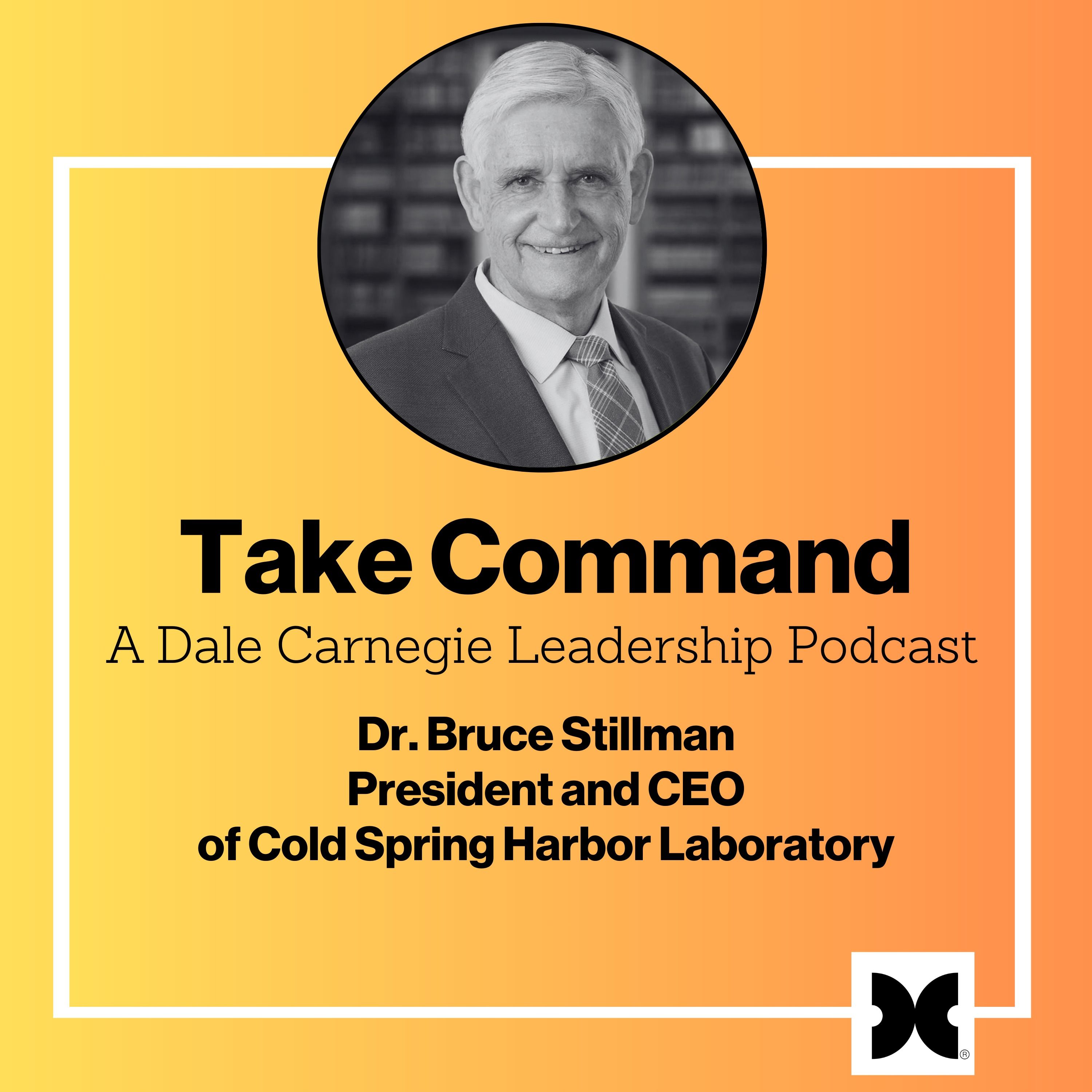
Take Command: A Leadership Podcast
Risk and Reward: AI, Leadership, and Organizational Growth
00:31:12
Scientific and medical research are critical aspects of our lives and even the economy. And no one knows this better than Dr. Bruce Stillman. Bruce is president and CEO of Cold Spring Harbor Laboratory. He’s led this distinguished organization by wholeheartedly expressing his belief in what the company stands for. He says, “I think if you believe in the mission we have, which I do, then it's easy to pitch the mission, and if you pitch the mission right, then people can buy into it.” Bruce knows a thing or two about leading people to greatness. Listen out in this episode for his advice concerning the benefits of a flat organization, the paradox of the freedom and restrictions of science, the potential of AI in business and medical systems, and why mentoring is critical to an invested workforce. Bruce says, “We can afford to take a lot of risk, and we can hire people who are risk-takers. And that is the secret, I think.” Discover more of Bruce’s secrets in this eye-opening episode.
Loading summary
Transcript42 lines
- [00:00]
Dr. Bruce Stillman
I think if you believe in the mission that we have, and which I do, then it's easy to pitch the mission. And if you pitch the mission right, then people can buy into it. I've often found that when people come here and they see the nature of this place and how it works and they understand, you know, not having tenure, the flat organization, the innovation that we seek to achieve, then people buy into it big time. You know, we're not publicly very well known, but when people get to know us, they really get to know us well.
- [00:44]
Joe Hart
Welcome to Take Command, a Dale Carnegie podcast. I'm Joe Hart, CEO of Dale Carnegie and if you're ready to grow your leadership skills, follow Take command now and never miss an episode that could transform your career. Today our guest highlights his belief in mission driven work and the balance between freedom and structure in science. He also shares insights in the value of mentoring and why embracing risk is key to innovation. He is a globally recognized biochemist and cancer researcher, leading one of the world's most prestigious scientific institutions in the world. With a career dedicated to advancing DNA replication research. He's been elected to the Royal Society, the National Academy of Sciences and the Australian Academy of Sciences. His groundbreaking work has earned top honors including the Alfred P. Sloan and Louisa Gross Horwitz prizes. Please welcome the president and CEO of Cold Spring Harbor Laboratory, Dr. Bruce Stillman. Well, Bruce, welcome to the Dale Carnegie Take a Man podcast.
- [01:54]
Dr. Bruce Stillman
Thank you very much for the invitation. It's a pleasure to be here.
- [01:57]
Joe Hart
Well, it's a pleasure to have you here and to see you again. Really enjoyed getting to know you a little bit just prior to the holidays and really excited to feature you on this show. I mean, you are the president and CEO of the Cold Spring Harbor Laboratory. For our listeners, this is one of the most distinguished scientific and research facilities on the planet, formed in 1890. Incredible breakthroughs in DNA, including around the double helix, cancer research. You've made such an incredible contribution organizationally to the world. And Bruce, you've led this incredible organization for 31 years this year, right? 31 years.
- [02:35]
Dr. Bruce Stillman
Yes, that's right. Hard to believe, but it is.
- [02:38]
Joe Hart
Part of what I will look forward to talking to you about is the innovation that comes from the lab and the kind of culture that you encourage. As the president and CEO, tell us a little bit about how you got to Cold Spring Harbor Laboratory. You're from Australia and did you always know you wanted to go into scientific research or how did you get where you are?
- [02:57]
Dr. Bruce Stillman
Well, yes, I did grow up in Australia, first in Melbourne and then Sydney. And from the age of 11, I wanted to do medicine. I got involved in a cadet program for essentially emergency medicine when I was 11. And then when I was 15, I became a member of this organization, which is volunteer. It's essentially like a voluntary ambulance organization. So I was working in hospitals, and I did emergency medicine. When I was a teenager working in hospitals, I saw a lot of routine medicine being done. And by the time I got to university, I decided that I really wanted to do medical research rather than practice medicine. And so I pursued that career. And when I graduated with my doctorate from the medical school at the Australian National University, I was looking around for places to come, and I knew about Cold Spring harbor, and I knew it was such a great place. And I came here for two years from Australia to do research, research under Jim Watson, who was my predecessor. And two years has now transitioned into 46. I never anticipated living in the United States for all that time, but that's been a lot of fun.
- [04:06]
Joe Hart
Well, you know, one other thing I should have mentioned, too, is right in Long Island, New York, I mean, so we've got this incredible institution. I used to live two miles from you and drove by, and it's a pride of Long island, end of New York. You mentioned, just kind of in passing, Dr. James Watson, Nobel laureate, incredible breakthrough around DNA. What was it like learning from him, and what are some things you learned working with him?
- [04:30]
Dr. Bruce Stillman
When I came to Cold spring Harbor in 1979, there was probably only about 20 faculty here. Three of them had Nobel prizes. Jim Watson, Barbara McClintock and Al Hershey. Jim was unbelievably interesting person. He was very visionary. He was very blunt. And he threw out ideas, lots and lots of ideas, and some of them stuck and some of them didn't. He was a very good motivator of people. And I came here, I wrote to him, and I said, I want to come here and do a particular project. And I eventually came here, as I said, for two years, intending to go back to Australia. But it was an amazing experience working with him and the colleagues that were here. And I learned a lot. And when Jim decided to step down as director and then president, they formed a search committee to look for people. And everybody said they wouldn't come here unless Jim was not here. And he said, what do they want me dead? So I was here, and I got plucked out of the faculty here to become assistant director and ultimately director. And it was a big surprise to me and almost everybody on the planet because I had no experience in running anything. But I knew the culture of the lab, and Jim knew that. I think that was the most important thing that I've carried forward.
- [05:57]
Joe Hart
What was it like? I mean, when you're a researcher, that's a certain discipline that you see in terms of just. Even the interaction you have with people is different than you might have in other professions and so forth. You're kind of, as you said, plucked out to become the assistant director. What's going through your mind when this is happening, and how did you feel and react to that opportunity?
- [06:15]
Dr. Bruce Stillman
Well, I got a reputation of being a pretty visible scientist during the first 12 years that I worked in the laboratory myself. What happens in academia is that faculty run their own individual laboratory. You have to write grants to fund it. So I worked in the laboratory with. I had 14 people in my group at that time. And I got offered a position at Berkeley as director of a kind of semi institute at Berkeley. And I think that's what triggered Jim to want to keep me here. And I found out very quickly what it was like to go from being a faculty member to being a leader. I also tend to be fairly blunt. And then I realized when I was head of the laboratory that things I said probably actually mattered to people, whereas previously they didn't. So I had to be a little bit more diplomatic than I was before. But I think it's the only thing that changed. I still run a laboratory here, which is the reason why I went into science in the first place. And I have a lot of administrative support to be able to do that.
- [07:17]
Joe Hart
So, Bruce, you learned maybe some of the interpersonal skills, or maybe a different approach to interpersonal skills, it sounds like, than maybe you'd had before. Because now you've gone from being an individual. I mean, you were leading a lab, but now you're leading a much larger entity. What would you say was really important for you as you grew? How did you learn to do were the people around you, and what advice would you have for people? Because this is something we see a lot, right? And we see it in Dale Carnegie, where, you know, people are great individual contributors leading smaller groups, and all of a sudden they are moved into management. And these are different skills. This whole experience of administering and working and leading and inspiring and communicating, that's a different animal. And many people aren't successful at it. So what are some things that you learned and some advice you might have for people who are at that stage, who are wanting to get better at that themselves?
- [08:10]
Dr. Bruce Stillman
Well, I think it started actually when I was a child because my father was a director of industrial relations for a very big corporation in Australia. And at the dinner table all I heard about is union disputes and law cases. And that taught me a lot about how to deal with conflicts and negotiations. And as Dale Carnegie does, you bring in expertise. I've learned to listen to a lot of people. I watched Jim Watson, how he ran the laboratory, I talked to him a lot about it and I think that's one of the reasons why he selected me, is to follow him. And I've also had collective discussions, being on either advisory boards or talking to other academic leaders and you get a sense of how to run things. But I think the most important thing is to understand the culture of the organisation and make sure that you transmit that to everybody at the institution. And that is very, very important to maintain the quality and standards that we've had for a long time.
- [09:18]
Joe Hart
And how did you do that or how do you do that today? How do you communicate those standards and the values?
- [09:24]
Dr. Bruce Stillman
Well, partly by example, you know, even though I'm president, I don't mind getting involved in things that probably the President shouldn't get involved with if it needs some help. It's a lot of just talking to people and saying that, you know, we all are pitching in to fulfill the mission of the laboratory, which is to do cutting edge research in cancer and neuroscience and plant biology and computer science. And also we're fairly large educational institution, from high school all the way up to training scientists. It's a matter of getting people on board with the mission. And once they get the mission, then we find that they work very, very hard to achieve that mission. And I can tell within a few months when we hire people, whether they're going to get it or not. And the ones that get it, I just leave to do what they hired to do. And the other ones, we have to keep educating them until they get it and then they eventually do. People take a little bit longer than others, so I spent a lot of time doing that. I'm very, very keen and almost insistent on a flat organization. So there's very little hierarchy here. As I often tell prospective graduate students, the difference between a graduate student and the president is about three inches. And that sends a message that everybody can have a say or be heard. And, you know, we're rather small, we have 1100 employees, so I know a lot of people, that helps.
- [10:50]
Joe Hart
But you really are making an effort, and I know that about you, to know people throughout the organization. I mean, it's a lot of people. But to know people by name and to know something about them and their families and that type of thing, I mean, at the end of the day, we're still people and having connections with each other. We all want to feel valued and important.
- [11:06]
Dr. Bruce Stillman
Well, a lot of people who work here talk about us as a family. In fact, on the campus here, which is a really beautiful campus on the west shore of Cold Spring harbor on Long island, we still have houses where some of the faculty live with their families. In fact, I live on the campus in the president's house and brought my kids up on this campus. And so it is more like a community and a family than what you would find in a normal corporation where people commute in and out. And so that provides a measure of culture as well. And it's an easier way to get to know people.
- [11:43]
Joe Hart
So Bruce, what you've talked about so far, you know, especially when you're talking about the mission, you know, some people get it right away, other people eventually get it. That doesn't always happen, right? I mean, I think a lot of times there are challenges where people aren't getting together or they're not motivated. You know, certainly I've said many times before that, you know, as leaders, if people just did what they were supposed to do, then our job is pretty easy. But that's really not the job of leadership, right? It really is a job to try to bring out people, to inspire them and so forth. But have there been times that you've found that to be particularly difficult over your 30 plus years in leadership? And how did you handle those difficult or challenging situations?
- [12:21]
Dr. Bruce Stillman
On both sides of the coin in academia, there are the faculty who are professors here and then there's the administrative people. And the administrative people, if somebody doesn't work out within one to two years, we really search for somebody else and turn them over. On the faculty level, we're unusual for academic institution. We don't have tenure and that helps a lot. You know, scientists peak at a particular time in their career. Some become non productive. To get to be a professor at Cold Spring Harbour is a fairly prestigious position. And so if they're not performing at the highest level, I go and talk to them and they get the message. And a lot of those people have gone to become department chairs at universities, which are very difficult positions to be in. But these are prestigious scientists. And we've had a few of those who I've had a lunch with and chatted with and they get the message.
- [13:13]
Joe Hart
But you know, it's important Though I think you've highlighted something that many people struggle with, which is having the difficult conversation or being candid with people. I think even early in my career, I admit it was uncomfortable, Comfortable sometimes having a difficult conversation with someone. I wasn't sure how someone would react to it. I could be defensive. How's this going to affect the way we work together? I've learned as I've grown in my career that it's really my responsibility to have candid, direct conversations. I'm not helping the people that I work with if I'm not being honest with them and coaching them and trying to help them understand here are the opportunities and here are the expectations. We've got to deliver results together. So particularly people earlier in their career, it can be very challenging. But what you're highlighting, the need to do that is certainly critical.
- [13:54]
Dr. Bruce Stillman
Well, what I found, which is really important is initially to put myself in their situation and their position, not only from the work point of view, but to find out what's really behind how they're behaving. And sometimes it's personal, sometimes it's family situations. Most of the time it's just literally they don't fit in in this working environment. But if you put yourself in their position and try to understand where they're coming from and talk to them about that, you either get that there's a reason behind why they need some help or it's their personality or whatever that's not going to change. That, I think, is the best way to deal with things. Talking about personality changes, I had a discussion with one of the scientists that's been here almost as long as I have, and I actually suggested something that they do. And he said, I'm not going to do that. And I said, well, you have to. He told me, well, that's not the way you should behave. And I told him that I'm old enough now that I'm not going to change my behavior. And he said, that was a very good answer. I'll listen to you. And that's how to have a rapport with people, is you know how to talk to them, and you talk to different people in different ways.
- [15:04]
Joe Hart
One of the things we teach in Dale Carnegie, you could say almost anything to someone if you say it in a way that respects the person tries to see things from their point of view, that type of thing. Bruce Cold Spring Harbor Laboratory is known around the world. It has for decades and certainly under your leadership, as being just incredibly innovative. You've had incredible breakthroughs in cancer in Genes and so forth. So I'm curious about how you foster innovation. What are some of the reasons that you'd say Cold Spring Harbor Laboratory has been so innovative, and what are the things that you do as the president and CEO to foster and encourage that spirit of innovation?
- [15:41]
Dr. Bruce Stillman
Well, in the science area and research area, I think one of the things, as I mentioned, we don't have tenure, and we almost entirely recruit people straight out of graduate school onto our faculty or straight out of a postdoctoral period, which is a period of a couple of years or a few years of research after graduate school, their early career. And we mentor them and give them an enormous amount of financial support, which is a challenge because we have to keep raising money for that. And then these people apply for federal research grants, which they get. We really try to induce them to become the leaders in their field. And many, many of them do, and they become, you know, famous within their areas. And then they get recruited all over the place to universities, because universities are very conservative in who they hire, because they're hiring people with tenure. And so we can afford to take a lot of risk and taking a lot of risk. We can hire people who are risk takers. And that is the secret, I think. And people really have come here, as did I, and really take a risk on what you want to achieve in research. And it's a very unique situation. The other thing is we have a very large conference center on this campus, and about 8,000 scientists from around the world come here each year to attend meetings and courses at the laboratory. And it creates an intellectual environment that is second to none. It's like Grand Central Station for intellectual exchange in the life and medical sciences. And that creates a lot of opportunities for collaboration and interaction, which you need to be on the front edge of science.
- [17:28]
Joe Hart
There's some things that are very unique that you offer people in terms of being there, things that they're not going to get anywhere else. In addition to the prestigious nature of the institution, that intellectual rigor and exchange and environment and so forth, that must be part of what you have done to continue to build on that and invest in that and so forth. It also strikes me, Bruce, that the nature of what you and the researchers do can be very frustrating. It involves failure and setback time and time again. You work on something for years, potentially. How do you encourage resilience? How do you encourage people to stay positive? Because now they've achieved this level, they're at this great institution. There's going to be incredible pressure, I would expect, on performance There is a.
- [18:11]
Dr. Bruce Stillman
Lot of pressure here. I think people feel it. However, it's a pressure that we nurture in the sense that when people are struggling or they need some advice on that, I think senior people mentoring the junior people can get them through those. It can be a frustrating career, but then you only need one really major discovery, and it just changes the landscape, and people do that. I mean, you can work for a number of years and then have a major. We've had faculty do that. In fact, one of the people I recruited straight out of graduate school from Berkeley was here for three years. And then based on the work that she did, she won the Nobel Prize in medicine in 2009. And that was very pleasing, but it was something that we really supported that person to achieve. She was very good. Obviously, at that level, we can nurture that type of research. Mentoring, I think, is most of what it's all about.
- [19:09]
Joe Hart
Leadership matters. The fact that woman won the Nobel Prize probably wasn't coincidental to the fact that she was there. I mean, certainly she brought a lot to the table herself, and yet she was in an environment that was cultivating and nurturing that. So what advice do you have around mentorship? What could we learn about bringing that kind of mentorship approach to our own lives and businesses and organizations?
- [19:31]
Dr. Bruce Stillman
Well, I think it's challenging people to think big about the questions they're asking and not try to do incremental science. I mean, the way science is funded is a lot of us write grants to the National Institutes of Health, for instance, and we get these grants. But you have to write a grant and tell the reviewers what you're going to do in the next three years. So basically, it's obvious. Breakthroughs don't come from obvious incremental science. We raise a lot of money each year to support the breakthrough science. It's that money, the philanthropic money, that really allows scientists like Carol, who won the Nobel Prize, to go and do things that would be very difficult to do. In fact, the amusing thing about her was the day she was told that she won the Nobel Prize was also the same day that her grant was turned down by the nih. It was a very weird situation. I've heard that from many other prominent scientists. They're so far ahead of where everybody else is that the reviewers say, that's not possible to do. And it's happened to me as well.
- [20:38]
Joe Hart
What an incredible dichotomy to get that kind of news about winning a Nobel Prize the same day that you're rejected from a colleague. It Also highlights, again, I just think, the need that we all have to continue to in ourselves and not to be deterred. What a great analogy. You know, the NIH grant being turned down. We all face situations like that.
- [20:59]
Dr. Bruce Stillman
Yes. And that actually comes back to the mentoring and the institutional culture and environment. Here we encourage risk taking. Here we encourage inventiveness, and we support people to do that. And it costs a lot of money, as I pointed out. And most of this money comes from fundraising that I do. And it allows people the freedom and I think freedom in science nationally. This is a big debate right at the moment as well. I mean, we're going into a new administration and there's been a lot of discussion about they're going to change the NIH and they're going to do this and do that. And at the same time, the paradox is where they're talking about not funding science in the United States, which is one of the biggest economic drivers that's available in this country. Funded research, discovery research, and yet we're competing with China, which is putting huge amounts of money in research. And so that paradox is very obvious. And I'll wait and see what the administration does about it. But I'm rather nervous about the fact that they're going to dump on China, but at the same time, they're going to cut back on innovative science. And that includes recruiting people from outside the United States, very talented, not just in academia, but into tech companies and other areas like that.
- [22:24]
Joe Hart
It's one of the things that highlights probably what is challenging about the role that you have. We talked about this a little bit as well, which is that administrating this organization, inspiring the organization, and also for you personally, trying to fund for the organization, make sure that you've got the funding that you need for your people to be able to do the things that they do. That's a whole other talent and dynamic that you bring to the table. And clearly you have, I believe, tripled the size of Cold Spring Harbor Laboratory since you took over. That must be a very effective role that you've been playing there.
- [22:56]
Dr. Bruce Stillman
Well, fundraising is not something you get trained on, something that is somewhat uncomfortable at times. But one of the things I like about working in the United States is that going back to Rockefeller and Andrew Carnegie, the philanthropic support of research and science is really truly uni in the United States. We're very fortunate to have great supporters and we need a lot more. But that drives an institution like this to really be one of the outstanding research institutions in the world. It's difficult to do that if you're only funded by incremental federal funding, which is important because it keeps the lights on and, you know, the trains running. But the real innovation comes from philanthropy. So I've learned to do that and I meet fantastic people. I mean, amazing people.
- [23:46]
Joe Hart
Well, at the end of the day, you are selling, so to speak, right? We talk about so much really in life is sales, whether we call it sales or not. But ultimately you are presenting and selling the opportunity for people to fund. I mean, that can be uncomfortable for a lot of people too, and particularly people who aren't necessarily raised in that profession, so to speak.
- [24:05]
Dr. Bruce Stillman
I think if you believe in the mission that we have, and which I do, then it's easy to pitch the mission. And if you pitch the mission right, then people can buy into it. I've often found that when people come here and they see the nature of this place and how it works and they understand not having tenure, the flat organization, the innovation that we seek to achieve, then people buy into it big time. We're not publicly very well known, but when people get to know us, they really get to know us well.
- [24:40]
Joe Hart
So, Bruce, you're in your 31st year of leading the organization. I know we've talked about, we had transition at some point. I think you've signed up for another couple years or whatnot. But as you look back on your years of leadership, if you were to talk to a younger version of yourself or someone who's newer in their career, what advice would you have given yourself? All that you've learned? Is there one or two things that you'd say, I wish I had known this when I had started.
- [25:06]
Dr. Bruce Stillman
Well, there's the research side and there's also the leadership side on the research side. I think ultimately you need to choose a problem, a big question to answer, but be flexible on how you approach that from a research point of view. Don't stick with one technique or one idea and just keep doing it day in and day out. That's not how research is done on leadership. I've learned from watching other people. I do also volunteer on a number of academic boards and institution boards and things like that. And I've seen how institutions can do the right thing and do the wrong thing. And I think you have to have a way of operating that avoids conflicts of interest, for instance. And that's been a big issue at other institutions I've had to be advisor to. And we try very hard to do that here. Whether there's something I would do Differently. I don't know. It's just been a lot of fun learning being thrust suddenly into this position and learning it. But I think the other advantage I had was I was already here for 12 years and I'd gone through from being a early career scientist to being a full professor here, and very rapidly, but nonetheless gone through those different levels. And so I knew what it was like to be at those different levels again, getting back to placing myself in somebody else's shoes. I know what assistant professors feel like. They feel the pressure that you mentioned before about achieving. And so we help them do that. And I have lunch with them and talk to them and make them feel good about what they're doing. I was fortunate to have lunch in a fairly large group with Jamie Dimon last year. He was touring, as he does around the place. I was impressed that he comes in and gets to talk to bank tellers and people in the back office and things like that. It inspires them to feel like they've got a connection to the leader. He does that extremely well. And I think he's probably one of the most effective leaders of any organization I've known. That's how I watch people, how they do things. And I was very impressed with that.
- [27:14]
Joe Hart
Bruce One thing that is clearly proliferated over the last particularly couple years, certainly publicly, is AI and large language models and ChatGPT. And this is something I've started to ask in this podcast of these phenomenal leaders that I've been interviewing. How do you use ChatGPT or some similar AI kind of product in your daily life or your decision making?
- [27:37]
Dr. Bruce Stillman
Well, we have a large research program in AI. It's called Neuro AI because we have a large number of people who are trained in machine learning, which is artificial intelligence, who are trying to understand how our brain does computation and then write computer programs that will do it as efficiently as the brain. Our brain can run rings around AI. So the large language models like CHAT GPT are based on huge amounts of data. In fact, they're data limited now because they've sucked all of the words on the Internet dry and they need a lot more. Our brain can learn from a much, much lower data set. And how that computation does is something we work on a lot here. How we use AI in the day to day. I don't tend to use ChatGPT a lot. I know some people here are on it all the time. They probably Talk more to ChatGPT than they do their family. I don't do that. I will sometimes ask ChatGPT for a specific question, but I always ask for references because it can make up stuff very easily. But where it's made a big impact in science, in the life sciences, is in the prediction of protein structure, which was the people who did that at DeepMind in London. And now a Google company won the Nobel Prize in Chemistry last year for this work and the Nobel Prize in Physics. Two scientists who pioneered the whole concept of artificial intelligence. It is transforming the way we work. We are incorporating AI into a lot of the business systems, and that is something I think will be really impactful. It's not yet, but I think it'll be very, very impactful in the future and make things a lot simpler than they are now. So we're very aware of that. We're actually at the moment completely transforming our ERP system and we're trying to integrate a lot of AI into that system as well.
- [29:43]
Joe Hart
Well, it'll be interesting to see what the future holds. You know, I was at Consumer Electronics Show a couple weeks ago in Las Vegas. AI is everywhere. It's in pillows, it's in everything. And they were talking a lot about AI agents and really how this technology, even this year, next year, is really going to become much more iterative and interactive. I think the world has got some incredible things ahead of it, really, in the not too distant future. Bruce, it's been fantastic talking with you. Thank you so much for being on the Dale Carnegie take, man, podc.
- [30:13]
Dr. Bruce Stillman
This has been wonderful and I really admire Dale Carnegie and what you guys do to make corporations and people better. And we try to do that in science and I think it's fantastic. So thank you very much. It's been a great pleasure.
- [30:26]
Joe Hart
Awesome. Thank you, Bruce.
- [30:28]
Dr. Bruce Stillman
All right, thank you.
- [30:35]
Joe Hart
I hope you enjoyed this edition of Take Command. Adele Carnegie Podcast. Check out our resources at www.dalecarnegie.com for more research, insight and tools that will support your success and help you take command of your leadership potential. If you enjoyed this episode, please consider rating it and following us on Apple Podcasts and Spotify. For more exclusive content, subscribe to our Dale Carnegie YouTube channel and follow us on social media. As always, thank you for listening and we're looking forward to you joining us for the next episode of Take Command, a Dale Carnegie Podcast.