← Take Command: A Leadership Podcast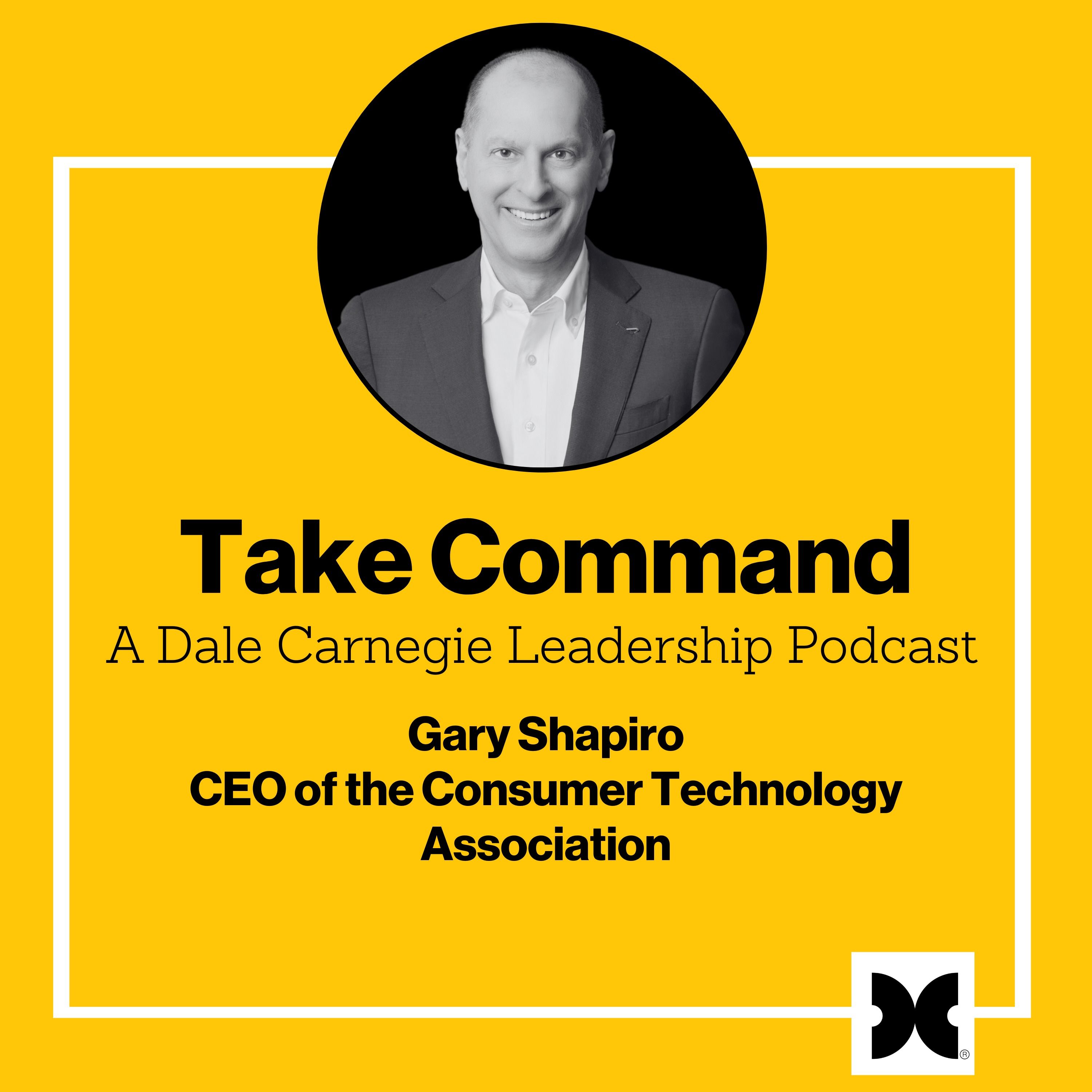
Take Command: A Leadership Podcast
Tech Tides: Key Lessons from Pivot or Die
00:36:01
As CEO of the Consumer Technology Association—which puts on the largest electronic show on the planet—Gary Shapiro has some serious clout. But Gary says that the way he came into his current position was “kind of amazing, in a way. It's almost like how many of us meet our spouses. It's just almost so random that it doesn't seem you could be so lucky.” Gary hasn’t relied on luck, however, to become a great leader. He’s put in the work, and he’s learned some incredible things that he shares with Dale Carnegie CEO Joe Hart on this episode of the Take Command podcast. Tune in to hear about why the risk-averse never succeed, the importance of meeting people where they are, and how the United Nations General Assembly came to name the “right to access technology” as a fundamental human security.
Loading summary
Transcript43 lines
- [00:00]
Joe Hart
Ready to elevate your leadership. Follow Take Command a Dale Carnegie Podcast. Now transform inspirations into actions. Hit follow and lead with impact. Welcome to Take Command, a Dale Carnegie Podcast, the show where we seek to uncover what leadership means in today's world. I'm Joe Hart, CEO of Dale Carnegie, and we will be talking to diverse leaders with stories to tell across various industries to help unlock your potential for success. We will be sharing real life insights into leadership, which in turn can help spark the next level of your growth as a leader. Today's guest is a pioneering force in the $400 billion US consumer technology industry with over 35 years of transformative leadership. As the head of an association representing over 1300 North American tech companies, he leads CES, the premier global stage for technology and innovation. He has been recognized as one of the most influential people in tech and policy by Washingtonian, a top lobbyist by the Hill and Executive of the Year by Association Trends. A New York Times best selling author, he's launching his latest book, Pivot or Die. How Leaders Thrive when everything changes. Today, October 8th, please welcome President and CEO of the Consumer Technology Association, Gary Shapiro. Gary, welcome to the Dale Carnegie Take a Man podcast.
- [01:41]
Gary Shapiro
Thank you for having me. I really appreciate being on here. I'm honored, actually.
- [01:45]
Joe Hart
Well, we're honored to have you and it certainly has been good to get to know you. We're both part of the CEO Forum Group. Our friend Robert Reese introduced us and you are the CEO of the Consumer Technology Association. You put on the largest electronic show on The Planet, the CES show. 130,000 people in Las Vegas, 4,000 exhibitors. It is the place for consumer electronics. You lead this organization, so looking forward to talking to you about that. You've got a new book coming out, Pivot or Die. So this is, I think, your fourth book. You've had three bestselling books. We'll dive into that. The first thing I got to ask you, though, Gary, and you may not know this, but you and I both share this in common, that we're both lawyers by background. How did you go from the law and practicing law to leading the largest electronic show on the planet?
- [02:34]
Gary Shapiro
Well, it's kind of amazing in a way. It's like how many of us meet our spouses. It's just almost so random that it doesn't almost seem that you could be so lucky. I was in law school in Washington and I needed a job just to pay for macaroni and cheese. And I got one immediately on Capitol Hill working for a congressman and that turned into a job at a law firm. One of their clients was this trade association. And although I joined as a lawyer and was an associate for a couple years, I ended up working full time for this one client. I attended their CES in Las Vegas, and I was just astounded. It was the essence of competition in the marketplace. Companies side by side showing the latest, coolest technology, and it showed innovation. Innovation that not only made our lives better, it makes the world better in all sorts of categories, way beyond entertainment. I was fortunate enough to get the offer to come in, be a lawyer inside and a lobbyist. And by nineteen 1991, I was running the place. So it's been a great almost 40 years, actually, of being in charge. It's been wonderful because not only has the technology blossomed beyond the VCR and the CD and the home computer to, you know, agricultural technology and healthcare technology and so many other categories of technology, it's a business event for the most part. A lot of consumer technology products are shown, but it's anything having to do with innovation and improving people's lives. It was just an opportunity I grabbed and I was fortunate.
- [03:57]
Joe Hart
Well, it's interesting though, too, because sometimes we have a mindset about what we can and can't do. And certainly maybe having gone to law school, you thought was, I'll practice law, and then you're able to do something completely different, as I have as well.
- [04:09]
Gary Shapiro
I always wanted to go to law school. I was never sure about being a lawyer. My friends in law school made fun of me because I really loved law school. I just thought it was so interesting, and I would be engaged in the classes and they were bored. And it was a means to the end for most people, frankly. But even at my wedding, my law school best friend stood up and made a toast to the fact that we all wanted to talk about why we went to law school. Some of it was for justice, some of it was for money. Gary wanted to represent the consumer technology industry. That was the beginning of my career. And now, as I head towards the sunset of being with this organization even, it's amazing it's lasted this long of pure excitement and joy.
- [04:46]
Joe Hart
Well, you've sure had an impact. Your imprint on this organization and so much of leadership. We'll talk about leadership today is having a vision for something. What was your vision for CTA and for the CES show in particular, because it's changed so much. How did you have that impact on the vision and inspire other people around it?
- [05:05]
Gary Shapiro
Well, the vision for CES has Clearly evolved. I mean, first it was just to make the best event you can make and do it in a way which is transparent, honest. We're one of the few events still today that independently audit, for example, our numbers, because we are the largest in the world of any business event, not just in technology. We want to continue to redefine what consumer technology is. And that's why we're able to get into mobility with cars now. You know, major car companies are there showing off technology because that's what sells them today. And certainly healthcare technology has grown quickly, but in robotics, in quantum computing, artificial intelligence, we kept on saying agricultural technologies out there. We even cut a deal with the United nations the last few years ago that just continues to expand about promoting fundamental human securities, the right to health care, the right to food, the right to clean air and clean water, and community. And they actually even recognized a year ago at the opening of the General assembly that technology is also a fundamental human security. Access to technology because it really is important in connecting our lives and making the world better. And that's something which is an inspiring message actually that drives me and I think drives a lot of people who work at CTA and on ces, that we're actually getting people together in a really fundamental way and making the world better through those very important relationships, through serendipity and discovery. If Covid taught us anything at the CEO level, it's that we need that human to human contact. Even though I am the paid cheerleader for the technology industry and talk about.
- [06:32]
Joe Hart
That human to human contact, to be able to do the things you've done requires extraordinary interpersonal skills, leadership skills. What are some of the things you've learned in terms of interacting with so many different types of people, so many different agendas? I mean, part of what you do is governmental, Part of what you do is public policy. Part of what you do is focusing on industry and technology and innovation. How do you manage relationships with so many different people with so many different kinds of interests?
- [06:58]
Gary Shapiro
That's a great question. What I learned is I'm really not that good at some of this stuff. I didn't even know how bad I was. But I used to focus on people based on only on a performance. And I learned to focus on them as people. And every person is an individual and every individual has different wants and needs. For the people that report directly to me, for example, some of them are best meeting with me on a regular basis. Others will send me emails or memos or a text. Others it's just Periodically check in. I try to meet people where they are. And that took years to learn because I just used to say, you're good by your results. And that's the only thing that's important. It doesn't mean people aren't accountable. I mean, the way we actually succeed as an organization is we define our accountability as a full group. Every employee is on incentive compensation based on individual goals which tie into bigger goals for the group. And we hold each other accountable in a sense, and we all get paid more. Because we are a nonprofit, we could still allow incentive compensation. We don't have equity or ownership, but we do run like a for profit in a sense of where there's very specific measurements. But I've learned, for example, I really wasn't good with empathy. I'm still not the best. I work at it. One of the things I learned is you surround yourselves with people that fill in for your weaknesses. Now, obviously, Del Carney helps people overcome some of those weaknesses. And you could try, but you'll never be an all star, I think at a weakness that you had or you could try. Maybe it does happen. I shouldn't talk about stuff I don't know. But I've learned I'm good at some things, I'm not good at other things. And I've been really big on. On diversity going way back. In fact, diversity is one of the things we've had for over 20 years as one of the criteria for our board members. We really want to engage women. We want to engage underrepresented groups. We do actually things that help with groups like that, including investments at the startup level, because it's just the right thing to do. We do it with the disability community as well because we think technology is an answer there. But in terms of as a leader, I think a leader's job is to present a vision that inspires and also though, to make tough decisions and explain them and hold yourself accountable to your employees and to your board members as well as other constituencies. And I think we've succeeded in part talking to my wife about how we've been managed to stay together for 20 years. Part of it is just sheer luck to be where we are, and part of it is you have to work at it as well. And you have to continue to ask yourselves questions about how you could do things better. So everything that goes wrong is a learning opportunity. That's the positive side. One thing I'm good at is looking at the positive side of the worst situations. And I try to instill that with our team that didn't work out. Right. We're honest about it, we're candid about it. What did we learn? And that's the important thing.
- [09:26]
Joe Hart
You've talked about failure really being an opportunity, which is a point of view, right? I mean some people are afraid to fail, afraid to take risk, because we can define failure as, you know, I tried to do something and it didn't work out. But you've been very vocal. You talk about it in your book and you just spoke about it now. But failure is an opportunity. Where did that philosophy come from and how does that guide you now?
- [09:47]
Gary Shapiro
Well, I think that's a culture we have in the United States, especially in Silicon Valley and technology and other areas is that if you've tried to create a company and you haven't succeeded, you've gotten an amazing education and that's something that other countries cultures aren't as strong as. And as I go around the world and talk to different groups of entrepreneurs and innovators and big companies and governments around the world, they say what can we do to be like the United States? Part of my answer is we're diverse. We have a culture where failure is actually an education. It's very valuable. That's when we hire people we looked up, they've been involved in the startup. That's a real plus. So what if they failed? I was also extremely fortunate. I had an early on boss slash mentor who said, Gary, you're doing a great job, but you're going to fail and I'll be there for you when you do. So that allowed me to have the confidence because one of the things a leader also has to do is take risks. If you are risk adverse, then you're not going to be able to succeed. You're not going to be able to get ahead of the package and make a difference with your organization. You have to be out there and be willing to fail. And sometimes as leaders we do it very visibly and our employees jobs may be at stake. And that's one thing that I think almost united CEOs around the world during COVID is like we were feeling the same thing. It was tough to do business, it was tough to deal with employees without seeing them face to face in real life. And getting all the, you couldn't share a meal. There were more pivots going on during COVID There was more risk taking. I even saw our own company, our own industries. Companies used to like copy each other, but then they started during COVID They went in different directions and they committed to a strategy. Those that took the risks, I think, are doing well now.
- [11:19]
Joe Hart
Well, it's interesting because your Covid pivot story, I think, is really an extraordinary one. And for people to understand the scope of the annual CES conference, the fact that people are planning to go to this event months a year in advance. People go every year. You have 130,000 people coming to Las Vegas, the scope of 4,000 exhibitors. And you found yourself in January of 2020 and certainly 2021, when you had to do it virtually in the midst of a major pivot. Share with our listeners what that was like and how you led through that and what you learned from it.
- [11:55]
Gary Shapiro
Again, Locke played a great role. Our shows every January. Covid first started hitting and being talked about in late January, so we missed that one. But by March, literally at our first week of March board meeting, even though Covid had not really been anywhere in the US in significance, we were already planning to have a digital event as one of two alternatives. And that was something we started early on. And we made a decision seven months ahead of time. We'd cancel the physical event, which saved our industry literally hundreds of millions of dollars of investment. Wasn't greeted well by some people who put on events. They said, you're too soon. You'll lose all your money for the act of God clauses. But we made a decision early, and it was the right decision. And part of that was based on the fact that we have three doctors on our big board. My wife's a doctor. And they were all in agreement that this is an extraordinary event that will not be finished in less than a year before a vaccine. And then, you know, we thought we were doing well. Then in a year later, Nevis and Omicron hit in December, big time. We were having a million cases a day. And we had major companies at the CEO level, Fortune 500 companies, announcing they wouldn't be in our event, and they were just running from it. And that was difficult. But I also had the benefit of advice from a number of CEOs, like the head of Abbott, Robert Ford, or the head of Qualcomm, who said, gary, stick with it, because we got to get back to normal. We'll survive it. Let's go forward. This is something that we just have to suck it up and do it and get back to normal. And it was the right decision. And, you know, making a big decision like that, where, you know, you're talking about health of people, it's a tough one to make. You just can't go with what's popular, you have to make the right decision. And in retrospect, we were very lucky with both those decisions. It saved us millions of dollars. Attitude of gratitude by those that participated was huge. A lot of companies base their annual business on our event because people come from all around the world to meet each other and to do business. It's just not people coming for the US market. This is where we have, you know, 45,000 people that come from outside the US and it's all about business and 5,000 media that comes. Definitely fewer people. It made a difference. Now we're back as strong as ever, if not stronger. We're doing some amazing things in January and we have new categories. And it's an inspirational event. Not just about marketing and sales. It's about all the different things that innovation could do. Because what we've been saying for years is that every company is a technology company, and that is something where they have to do business with each other.
- [14:16]
Joe Hart
So first, let me ask Gary, you've got amazing things planned for January. Would you give us a little bit of a sneak peek?
- [14:22]
Gary Shapiro
Absolutely. Generative AI is fundamentally changing the world in a big way. So everyone has something to do with that and talk about where they're going, who they need to partner with, what they're doing. The different solutions are there. But Covid raised the issue of healthcare, and there's a worldwide shortage of healthcare professionals, just not in the US and technology is able to fill in increasingly. So people could do things at home, whether it's they can have telemedicine or they can have remote monitoring to get out of a hospital. There's a whole range of solutions out there. And a lot of this changes in technology stems from the smartphone. Every smartphone contains over two dozen sensing devices. They're available for pennies a piece, and smart people figure out how to use them. They figure out how to layer apps on part of them. The phone companies figure out how to do more and more with less and less, whether it's cameras or sensing or blood pressure, you name it, and it's out there and it's improving the lives for disabled people, which is another big part of the show. We have a huge part of the disabled community. Come and see solutions for them in agriculture commun coming. Obviously, this is all overlaid with the environment. How we use energy more efficiently, how we keep the air cleaner, what we do, how we grow locally. Even in your home, you could have gardens. I mean, there's so much out there involving technology that's making A difference. So it is something where there's a lot of planning that goes into it. Companies think about it carefully. People who come walk out inspired with new ideas for the year. What a great way to kick off each year. And it's something which has its own energy and passion of people to go. That's why it is the number one show in the world.
- [15:50]
Joe Hart
It sounds like I've unfortunately never been to one. Maybe this is the time I need to.
- [15:53]
Gary Shapiro
You're invited.
- [15:55]
Joe Hart
Thank you. All right. Well, I don't think I could pass down that invitation. Especially, you know, one of the things you said is that every company's a tech company, you know, and I think about our company. I felt that way even for dale Carnegie. We're 112 years old this year. Historically, we've been a training person. Prior to Covid, almost all of our. What we were doing was in person. And, you know, Covid for us was a catalyst really to advance in so many ways and to advance our digital transformation. And it really has helped us become far more competitive as a company. When you say every company is a tech company, how do you encourage leaders to think about that? What should that mean? Both for the senior leaders who are looking at their own companies and maybe they're thinking we're not historically a tech company. What's your advice for people who work with leaders or managers at any level in those organizations? To think my company is a tech company.
- [16:43]
Gary Shapiro
My view of tech companies is it just simply to survive as a tech company, you have to have certain traits. You have to be able to pivot on a dime. You have to act quickly and move to a different area. If you see the marketplaces working against you, you have to be willing to partner with others. Because the thing about technology today is no one owns all the intellectual property. You have to cross license. You have to go out there, you have to partner with other brand names. So it's just not your brand name. You get a halo effect from someone else's that may be trying to reach your people. And it's mutual to do that. It's just not a tech company. I think this is just relationships, is you have to create win win situations for your partners, whether in business with big business, with tech or regular business, or even in your personal life, you have to create situations where both win. So you look at all these things and the other thing to do is a lot of company planners make mistakes and they look at the picture of today and they figure out that no one else is looking at that Same picture. And they'll chart a strategy or a path which is dependent upon them getting ahead and taking market share as opposed to them leaping ahead and figuring out that everyone else is looking at the same picture. So you end up with a lot of companies that are doing the same thing. Margins go down, the profitability goes down. You have to distinguish yourself. And some of it is on your technology, but some it's on your brand. And the other thing is you got to listen to your customers, which I know is trite in the, you know, standard business advice, but you really do. We tell people, especially startups, because we get over a thousand startups at ces don't come with your perfect prototype or your product or your business idea or software. Come with your solution. And listen to the people that come by, whether it's the head of Walmart or Mark Cuban at Shark Tank, small investors, big investors or big company people, listen to what they're saying. And I guarantee after four days of being at your booth or stand, you will have a different idea of what your business should and can be. Writing a long, big strategic plan down to the second into detail. Waste of time in my view. Coming up with a two page document that here are my goals, this is what I want to do, and then testing it and redoing it and testing and redoing and getting to market quick. And you know, most entrepreneurs, I have a secret and everyone else is going to steal it. That very rarely happens. Your idea, you're probably more passionate about it. You should get it out there quickly but be open. The big companies come there. You know, there's a lot of controversy whether big companies should buy small companies. I think they can. That's how you get funding as a small company. But the reality is big companies want a partner. They want to be your first customer, they want to help you, they want to mentor, they want to have relationships. Innovation in big companies is difficult. There's so many levels of people who could say no that they look to these smaller companies and startups. So you have to recognize it, whether it's a big company or small company. It's symbiotic relationships that you have to create. So as I say, think like a tech company. It's not about the technology you use, it's just about the rapid movement, solving problems using technology that other people, real people, customers will have.
- [19:27]
Joe Hart
Well, and even to go back, I know you said it's a little trite to say listen to your customers. It seems to me that that's one of the Biggest challenges businesses can have. I think even about my own little startup that 20 years ago, we had an idea of what we thought the customers wanted, and we were right about some things and wrong about others. And fortunately we were able to pivot, as your books is called, and ultimately to be able to meet some of those customer demands. I think also I've seen the opposite happen, which is where people can be so set in their own ideas of this is what the market is without really listening to the customer, really looking what the market is. And unfortunately, they don't make it.
- [20:00]
Gary Shapiro
And that's true, unless you're Steve Jobs. Like, he didn't go out to customers. He said, they don't even know they want this and I'm going to create it. And they did. But most people, they have an idea that customers may not want it or want it that way or tweak it, but that's the advantage of a live interactive event. You get more done in those four days, whether it's our show or other events around the world, by really talking to people. I'm always reluctant to say be like the tech industry, because the tech industry has a lot of geeks, and they may not have the human relations or social skills that allow them to listen and react and respond. But there's sometimes those same things where you don't listen to people are what set you apart, allow you to do things. And you could think of people like Elon Musk or others that are kind of geeky and they may lack certain social skills or filters that the rest of us have, but yet they succeed because they're different. And there's a lot of tech company CEOs like that. I'm not saying you have to be like that, but there's a certain advantage to having a vision in pursuing it as well, because you may be right and everyone else may be wrong.
- [20:58]
Joe Hart
That's true. And there's definitely a balance. And there are certainly many examples of people like Elon Musk or Steve Jobs. To go back to just that fundamental principle, I think, of human relations is something we teach in Dale Carnegie, which is to try honestly to see things from another person's point of view. You were talking about empathy earlier, and ultimately we have found that doing that is a recipe for success. Certainly in human relationships, you build trust through empathy, trying to understand where the other person may not agree. But we could certainly at least try to listen, try to value, and so forth.
- [21:30]
Gary Shapiro
Absolutely. And I struggle with that even to this day, to be honest. Like, if I'm in an emotional situation with someone and they do something I perceive as bad, I can't feel it. I'd struggle, but I do. One of the best pieces of advice I've gotten is to assume good intentions. Most people don't think I'm a bad person. They think they're a good person and they're doing something right. You just don't understand. It could have been something bad that happened that day to them. They could have other things going in their life, or they could just have facts that you're unaware of. They perceive the world differently than you do. That's a tough one. And that's something that we could all work on, I assume.
- [22:02]
Joe Hart
Well, I think so. I mean, we don't know when we run into someone or talk to someone or work with someone, really what they're carrying around. Or in many cases, sometimes it's. The very best ideas can come from someone who's not speaking. How do we get them to be more comfortable? You talked about taking risk. You know, how do we create an environment of psychological safety where someone's willing to take a risk? But ultimately it is to see and to understand what someone else thinks and at least to consider that.
- [22:28]
Gary Shapiro
We have a lot of volunteers from industry and organization. We have hundreds of committees, and we train our chairs and our leaders by saying that your job is not to have an opinion. Your job is to make sure everyone is opinion is expressed so everyone feels consulted. So if someone hasn't said anything in a meeting of a smaller size, it's your job to bring them out and ask them. And my view is none of us is as smart as all of us. And that's part of our staff culture. Good ideas come from anywhere. And if you're willing to listen to those ideas, you'll get a lot of good ideas. And they do come up every day here. Gary's not the smart guy. Gary's the guy who's willing to listen to other people and take their ideas and say thank you. And the other side of it. Sometimes you just have to be candid and say, I don't think that will work, and here's why. But you don't want to discourage people from coming forward with those ideas and their views.
- [23:15]
Joe Hart
You've used the word luck a couple times just right now. You've basically said, I don't have all the right answers and so forth. Where does humility tie into leadership? It strikes me that often when someone says, hey, it's luck, this is is different than how some people see leadership Many of the people who've been on Take Command on the show have been great CEOs. They've talked about the importance of humility. Where does that factor into things from your standpoint?
- [23:37]
Gary Shapiro
I had this discussion last night at dinner with a hugely successful colleague of mine. And she said, I always tell people, they said like, wow, you've gotten this amazing position. You're an African American woman. And she said, I always tell them. And I grew up with a single mother in the slums. I just wasn't always like this. And I was thinking about that. And I think what I tell people when they say, wow, how'd you get to this? I said, you know what? I still take out the garbage. I'm like you. You know, my wife gives me a honey to do list and I do it. We're all humans fundamentally. And that's really the story. This is the American success story. And I know you have a global audience in America. Really the dream is that anyone can succeed with some luck and extremely hard work. And then we have to keep American open that way. And that was my first book is about, is about the American dream and how people can achieve it and how other countries should if they want a model. Here's some of the things. And it goes to divers, it goes to openness, it goes to the accessibility of various things. And we're not there yet, we'll never be there. But we try to get better all the time. That's the thing, is that we all had tough beginnings and the most successful people are immigrants and the children of immigrants because they really sacrificed to get here. And if you saw the dedication of my book, it's really to my in laws who escaped communist Poland with her young daughter just to give her a better life. And they came to this country and you know, anyone who comes here and learns another language, it's a struggle. But you hope your kids are better. The problem is as the generations go on, you know, will their kids have that same intensity? And sadly not usually. I mean, it does happen, but it's rare that you have a company that survives several generations or a family wealth that's even survived several generations.
- [25:10]
Joe Hart
No, that's true. And sometimes people forget and forget all that went into that. And there's a proverbial comment about the person who is born on third and thinks he's hit a home run and that type of thing and we forget you've written a book, your brand new book, Pivot or Die, which is a great book that everyone should read. What inspired you to write Pivot or Die and talk about what you mean by a pivot.
- [25:33]
Gary Shapiro
I think in a way, Covid inspired me to write Pivot Die because Covid was something we in the world shared as humans, but businesses shared it because so many of them had to change what they were doing so quickly. It gave a certain self awareness, not only for CEOs, as I mentioned, about the importance of relationships, but how important it is to try something different and move quickly. And so I think there's a mindset globally now that pivoting makes sense. It's something that's to change in your life. And the book is intended not only as a business guide, but as a personal guide. How do you make decisions in your life? In counseling younger people and they're stressed out about what college they go to or what their first job is, it's really not that important. What's important is if you make a huge mistake, and there's only four, one is committing a felony, doing something fundamentally unsafe, and injuring yourself for life. And I wouldn't call the last two mistakes, but they're kind of life changing. Another is marriage and having children. Those are the big decisions. The other decisions, like even your first job, there's some randomness involved there. You should get to know yourself, but you don't really get to know yourself into your 20s or 30s. And you should experiment a lot of different things and figure out who you are, what turns you on, wake up in the morning, what do you look forward to each day and what gives you energy. Our jobs are most of our waking lives. And you should have a job that you enjoy. I would hate to be a CEO of an organization where people didn't like their job. It would just drive me crazy. I mean, that's not what life should be. We have a lot of laughter in our hallways. We always have interesting things going on. And I'm lucky enough to be in a position where we could treat our employees really well. And I recognize that's unusual, but in terms of why I wrote the book, it's for people trying to get ahead in business. It's for people also, though, in their own lives. I mean, my wife and I have moved forward in a sense of making major decisions by saying, look, this isn't a lifetime commitment to buy this house. It's a five year commitment. And just that little knowledge of this is not the biggest deal in life. So what's the worst that'll happen? We'll sell the house and we'll move. And that has allowed Us to get off the dime and marry for 20 years and we still have a committing relationship between two cities. And I'm not recommending that, but somehow it's been re up four times.
- [27:34]
Joe Hart
It's funny you say that, because someone asked me the other day what piece of advice I might give my younger self, my 22 year old self. I think particularly as a young person, every decision seemed like a big decision. I was worried about, gosh, I don't want to make a mistake, and so forth. And the advice I'd give myself is, don't worry so much, it's got to be okay. Fundamentally, that's what I'm hearing you saying. Even if we don't have a mindset that is naturally inclined toward risk or quick decision making, I really like what you just said about putting things in context. There are four really bad things that can happen. Other than those kinds of things, most other decisions aren't permanently consequential, right?
- [28:14]
Gary Shapiro
And for the consequential decisions, I remember even doing this when I was 18 years old. I would create a list of the pluses and the minuses and I'd put them on paper and I'd try to even score them and weigh them. Of course, then I'd do what I wanted because you have to listen to your gut, what is your heart or your stomach saying, what's the right thing to do? There are major decisions everyone makes in their lives. But you're right, the stress thing that was unnecessary, that we focused on, it'll all work out. I mean, you'll learn a lot. And the important thing is, and my mother in greatness, because I used to listen to radio and it was like, why are you listening to this talk radio? Like this is a long time ago. And she said, because if I learn one thing an hour, she said, gary, you have to be learning for the rest of your life. So to the extent that we view ourselves as creatures which are still forming for the rest of our lives and learning, and I love learning every day, even when we screw up here. Like the first question always ask is, what did we learn from that? And we learn stuff all the time. I mean, every year I've learned a lot of things because I make a lot of mistakes. And that's just part of life. You can't kill yourself for your mistakes. You can only go forward and try to avoid that type of mistake in the future.
- [29:17]
Joe Hart
Again, that's a mindset that, you know. Unfortunately, a lot of people are afraid. They're afraid because they feel like Making a mistake makes me look stupid. Maybe it's bad, or whatever it might be you were talking about culturally in the beginning of this. I remember having a conversation with the CEO of a large company in Japan. So I've got some of the most brilliant engineers here, but many people are afraid to speak up. My question for you, I guess, would be you might have this innately or you've cultivated. How have you encouraged people on your team or people in your life who you've seen didn't have that mindset. They are afraid. How have you coached them to overcome that?
- [29:54]
Gary Shapiro
You will not get ahead unless you take risks. And you have to be willing to take that risk. Asking questions is actually is one of the best things that you could do in any conversation with almost anybody because firstly, you'll learn something and should not ask yes or no questions. That's something I've noticed in a lot of places I go, even in Washington, D.C. with an incredible number of smart people, is that people are afraid to look stupid. I'm the guy who always asks the question. I think the smartest people ask questions because they don't care if they look stupid. They know they're going to learn something from the answer. And I've learned in my experience that if I don't know what's going on, I don't understand because people are always throwing acronyms at me. I always ask, you know, what does that mean? What are you talking about? I just do that naturally. Even in high school, in my yearbook, my thing was, if you ask a question, you're a fool for a second. If you don't ask, you're a fool for a lifetime. So asking questions. And by the way, that shows potential leadership. Like, I just literally came from a meeting before this. We had some political experts talking about the upcoming American elections. And the last question asked, which I thought was the coolest question, was to each of the six experts on the panel was, where are you going to be and what are you going to be doing election night now? It was the coolest question because all of a sudden we're getting insights to these experts as actual people and what they do. And they were talking about themselves as people. And those kind of questions, which may not seem like earth shattering, are ones that just. You learn a lot about somebody from those.
- [31:13]
Joe Hart
So, Gary, how do you invest in yourself? You are traveling all over the world, such a high pressure job. You're putting on one of the biggest, maybe the biggest event on the planet. How do you keep centered? How do you take Care of yourself. How do you invest in yourself, your health?
- [31:28]
Gary Shapiro
You know, I don't feel it's a high pressure job. I feel that I'm just lucky to have this job because I'm making a difference in the world and making it better. Because our whole thing is focusing on moving the world forward with innovation. I think it's more of a challenge to make sure we don't do anything that screws it up. Like laws aren't passed that stop a branch of innovation which could fundamentally change humanity. But what I do is I believe in a balanced lifestyle. I think you have to balance your physical self. I ran 8 1/2 miles this morning knowing I'd be on the show. Could say that somehow I also balance the food I eat, the nutritional value, everything else, and spirituality, as well as learning and reading and being with my family and friends. It's impossible as you get older and more responsibility. Part of it is like I wish I could erase guilt because I can't meet all my relationship obligations ever. It's just difficult. I'm not great with names, with trade shows, everyone has to wear a badge. I know my weaknesses. I'm pretty clear on them. I probably have others that other people around me could tell me about. I also realize I'm not perfect. And there's a lot of other very smart people around me who really help keep me guided. And my wife is very helpful in all these areas, frankly.
- [32:36]
Joe Hart
Awesome. Well, Gary, one of the things I've been doing in the show, you might appreciate this, especially being in technology, is I've been going to ChatGPT. And in fact, today I went to ChatGPT and said, I'm going to be interviewing Gary Shapiro from cta and if you could ask Gary only one question, what would that question be? I'm going to give you that question right now. This is from ChatGPT. I can't even take credit for it. Given your extensive experience in leading the CTA and your focus on innovation, what is the single most important lesson you've learned about maintaining resilience and adaptability in the face of rapid industry changes? And how can young professionals apply this lesson to their own careers?
- [33:17]
Gary Shapiro
Wow. And that's the scary thing about artificial intelligence, I guess, comes up with a great question like that. But you know, anytime somebody says the single most thing, which is a very good journalist question, I always get a little hesitant because I'm not a single answer person. I think it's a combination of things. And to me, what you have to do is you have to be flexible, you have to reexamine why you're making any decision in what you're doing. You have to understand how you're dealing with people. You have to be decisive. You have to be transparent, honest, open, fair and consistent. So you have some level of predictability. But you have to take risks as well. Especially if you want to get into that CEO office. This, which is some of the people who are listening here. You have to stand out, be willing to work as a team. You have to understand what other people need and be responsive and help other people. You can't burn bridges, and you have to be very careful. I happen to be one of the most controversial association executives in Washington because I'm willing to take stands on issues I view as important or we view as important. But some of them are personal. It's hard to separate sometimes. So I've been very fortunate in my career. It's taken diverse paths because I was willing to do things that other people aren't willing to do. And then you think of the worst case problem, like what's the worst thing that'll happen to me? Well, I'll lose my job, but at least I've tried to make a difference. And if you could get that mindset of being willing to take those risks, you'll have a greater chance of moving forward.
- [34:41]
Joe Hart
It's awesome, Gary. You know, it's funny, Dale Carnegie had said that inaction breeds doubt and fear, action breeds confidence and courage. So what I hear you saying is you gotta be willing to take risks.
- [34:53]
Gary Shapiro
Totally agree. And I remember that from when I read the Dale Carnegie book. It was fascinating the concepts to me of a positive view of the world. And it definitely shaped me in its own way. I mean, I may not even realize how fully it shaped my view of the world.
- [35:07]
Joe Hart
Well, certainly you embody our principles. Certainly we appreciate your leadership. And thank you for being on the Dale Carnegie Take a Man podcast show.
- [35:14]
Gary Shapiro
Well, thank you so much. Great discussion.
- [35:16]
Joe Hart
Thank you. I hope you enjoyed this edition of Take Command, a Dale Carnegie Podcast. Check out our resources at www.dalecarnegie.com for more research, insight and tools that will support your success and help you take command of your leadership potential. If you enjoyed this episode, please consider rating it and following us on Apple Podcasts and Spotify for more exclusive content. Subscribe to our Dale Carnegie YouTube channel and follow us on social media. As always, thank you for listening and we're looking forward to you joining us for the next episode of Take Command, a Dale Carnegie Podcast.