← Take Command: A Leadership Podcast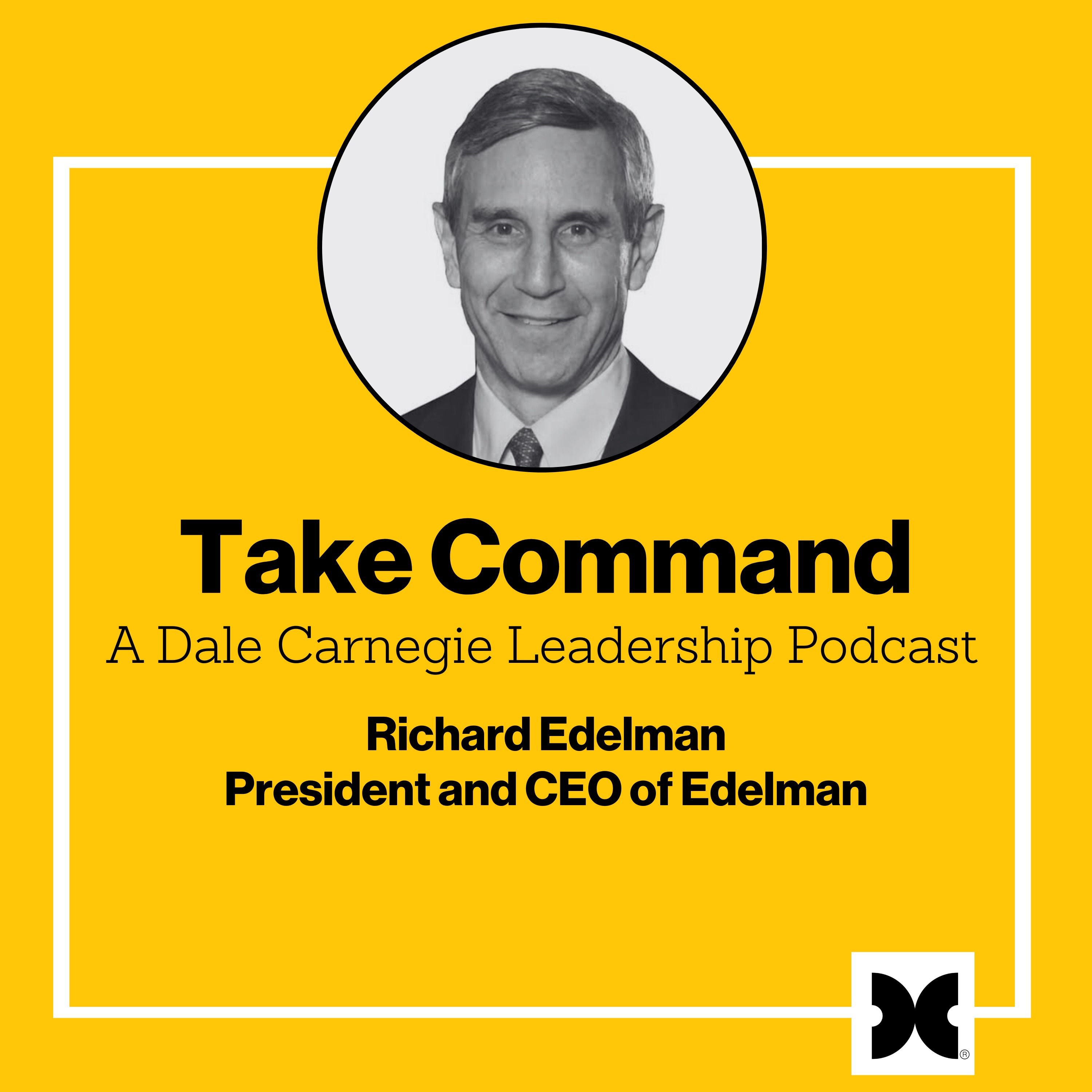
Take Command: A Leadership Podcast
The Art of Networking: A Blueprint to Humble Leadership
00:27:58
On today’s Take Command podcast, Joe Hart digs into the expertise and stories of Richard Edelman, president and CEO of Edelman Communications. Richard believes that leadership is simple: “We have to make others believe that they can be the next us and give them the chance over time to do that.” After earning his company the title “PR Agency of the Decade” from both Advertising Age and The Holmes Report, Richard knows a thing or two about leading others to greatness. “I want everyone to aspire to do something, to change the world,” he says. Tune in to hear about humble leadership, failing forward, and the origins of the Butterball “Turkey Talk” hotline.
Loading summary
Transcript65 lines
- [00:00]
Joe Hart
Ready to elevate your leadership. Follow Take Command, a Dale Carnegie Podcast. Now transform inspirations into actions. Hit, follow and lead with impact. Welcome to Take Command, a Dale Carnegie Podcast, the show where we seek to uncover what leadership means in today's world. I'm Joe Hart, CEO of Dale Carnegie, and we will be talking to diverse leaders with stories to tell across various industries to help unlock your potential for success. We will be sharing real life insights into leadership, which in turn can help spark the next level of your growth as a leader. Today's guest is the head of the largest communications firm in the world with over 6,000 employees in 66 offices across 28 countries and with $1 billion in annual revenue. He has advised senior executives through major disruptions at companies like Samsung, Starbucks and United Airlines. As the creator of the annual Edelman Trust Barometer, he's a leading authority on trust across sectors with insights cited in major publications. And as a top executive and thought leader, he has received numerous industry accolades, including inductions into the American Advertising and PR Week's hall of Fame. Please welcome the President and CEO of Edelman, Richard Edelman. Richard, welcome to the Dale Carnegie Take Command podcast. Great to see you today.
- [01:41]
Richard Edelman
Good to see another good Midwestern boy.
- [01:44]
Joe Hart
That's right, a fellow Midwesterner from Chicago. And now, of course, you live in New York City. Excited to have you here. You are known for so many things, Richard, one of which is, of course, taking over a family business, Edelman, in 1990. $85 million. You've grown this business to over a billion dollars. So incredibly successful under your tenure. Also an expert, clearly in trust, which I know is so important in every aspect of our lives and relationships and career and leadership. And you've got the 24 years of the Edelman Trust Barometer. So a lot for us to talk about today. Let's start with a little bit about yourself. You grew up in the Midwest, you live in New York. Now. Tell us about the path that led you to leading Edelman.
- [02:26]
Richard Edelman
Well, I was pretty classic kid from the Midwest. I love sports, I love American history. I was one of three kids. I was the eldest, went to school in Chicago, Latin school. And because I was so bad in my bar mitzvah, I got sent away to prep school. I memorized my Torah portion in two parts and I was so nervous, I did the second part first. And my Orthodox grandfather was freaking out on the stage. My mother elbowed my father apparently during my speech, and she goes prep school. So then I went away to Phillips Exeter and then I got into Harvard and Harvard B school, and then I went straight to work for the family business in 1978.
- [03:04]
Joe Hart
Was it your hope at that time that ultimately you'd run it? And did you have any thoughts about doing something other than the family business before you went into it?
- [03:11]
Richard Edelman
Yeah, I was all set to go to work at Playtex as an assistant product manager. My dad called me in April, like a month before I was going to graduate and said, look, I have an offer to be acquired by an ad agency. I don't want to sell. You're a good excuse not to sell. So come to work for the company for a year and if you like it, you can stay. So here I am, literally 46 years later and I haven't just loved it, I've thrived in it.
- [03:35]
Joe Hart
So Edelman, of course, is the largest public relations communications firm in the world. For our listening audience. Would you like to share a little bit about what you do for people who may not be familiar with that industry?
- [03:46]
Richard Edelman
So Edelman is a communications firm. We do brand marketing for brands such as ebay and Microsoft, Xbox and HP computers and pharma companies. And we also do reputation management for everyone from PayPal to Samsung. And sometimes it's crisis management also. And we're in 28 countries, 60 offices, and it's still a family owned business, which I'm very proud of.
- [04:17]
Joe Hart
It's a tremendous achievement. It's also a hyper competitive industry, right? I mean, low barrier to entry, a lot of companies coming into it. What would you say your secret has been to growing this firm to be the number one in the world?
- [04:30]
Richard Edelman
I think you've got to be relentless and you've got to be hustle and you got to always think about what the next thing is. So as early as 1996, 97, I saw digital as a great opportunity. One of the things we're sort of famous for is the Butterball turkey talk line to teach people how to make turkeys for Thanksgiving. And we put that into a digital format and had people on computers answering questions about turkeys as opposed to just on the phone. So that was one. And then we started to develop our own creative capabilities and not just take the ideas of the ad agency and do PR around them. So that started 10 years ago. So we've been pretty, again, clever about seeing trends before they're happening.
- [05:11]
Joe Hart
Certainly that's important and the creative part of that is important. What else would you say? Because there's a lot of people who are creative and a lot of people who really are able to see things, but they can't execute, they can't build a culture, they can't lead. I mean, what are some of the things that you've done to create such an effective team?
- [05:27]
Richard Edelman
I believe deeply in leading from the front. I believe you don't ask your people to do anything you don't do yourself. And I still run clients and I still lead pitches, and I still hire people, and I still do personnel reviews, and I travel pretty relentlessly to see my teams all over the world. And I see clients and add value every day and have ideas for clients. You should never go to a meeting without an idea. You shouldn't just go and say, oh, here's the work we've done. You should say, what if we tried this? I'll give you an example. I met the head of Unilever in North America, and I never met him. And I said, you know, this may sound crazy to you, but an idea is maybe one day we do a day of service and give away all the products that we make to the community because, you know, there are a lot of poor people. And Covid happens. And about three months in, I called him back and I said, you know, we should do it now. And I said, we should stick someone into one of your factories and show the packaging going on to poor people. And we pulled it off in 30 days and we got retail partners and all this. So dream big, but be relentless with having new ideas.
- [06:38]
Joe Hart
What advice do you give around preparation? I mean, is it extreme preparation? How do you prepare for something that is an important meeting?
- [06:46]
Richard Edelman
You know, we had a pitch today, and even up to five minutes before the pitch, I was looking at interviews with the CEO on TV a couple weeks ago, and I was looking at competitors coverage. And you have to be super prepared, as if you're going into your final exams, they're not going to ask you every question. You're not going to be perfect in knowing which questions they're going to ask you, but you better be ready for pretty well anything. Do the work. Because if you go and do a pitch without having practiced, it's just not going to work. And if you go into a meeting without being briefed and wing it, you deserve to lose the client over prepare. My father was funny. He would not only take notes during lectures, but he would take notes on his notes to prepare for exams.
- [07:33]
Joe Hart
Your father was hugely influential on you, clearly. What are some of the values or lessons you learned from your dad that inspire you even today?
- [07:41]
Richard Edelman
The first is there's a winner and A loser. He said, you know, when I was in grade school in upper Manhattan, I had to share a seat with another kid. I only got half a cheek on the seat. And he said, I don't want that anymore. I want to have a full seat. So you're going to win or lose. The second is really be very involved in your community. He was on a bunch of boards like the Lyric Opera, which he loved. He was very involved in the details of the business. He knew all the senior executives on a personal basis. And I have learned that, and I have emulated that. I mean, here's an example. So one of our guys got sick, and he was losing weight, so I sent him 100 bagels. And then two weeks later, I sent him 100 more. And the wife is like, I'm running out of room in the freezer. Will you stop it? I said, no, I want him to eat them all. But that's the kind of stuff that you do because you have to extend yourself for your people.
- [08:35]
Joe Hart
Yeah, I've noticed that about you. You have a humility and also, really, a desire to help other people. How do you bring out the best in other people? Is that something you've always had? Is it something you've developed over time? Or how would you say that trait has guided you?
- [08:50]
Richard Edelman
I think I've actually developed that even more over time, and some part of it is mission driven. So, for instance, I am determined to get people to stop smoking. So at every office I go to, I ask for a show of hands, who's a smoker. And then I say, okay, you come over here, cross this line, shake my hand, and I will give you $2,000. And I will ask you to promise me that you'll stop smoking. And if you don't, I want you to send me the money back. And I have 125 people who quit smoking. And I don't go back and check on them like a narc or something. But I'm very proud of that. I stopped my father from smoking because I saw the ad. Maybe you remember this. They did a takeoff of the Marlboro man going into a bar, and then he starts coughing and passes out. And so I was convinced my father would die. So I found his cigarettes and threw them in the toilet. And then I broke the toilet. And then the plumber came, and he said, look, either you get rid of the sun or you stop smoking. So he stopped smoking. He lived till 92.
- [09:46]
Joe Hart
Sometimes it might take something like that just to encourage people, but it also shows the Caring. Right. I mean, there's a great quote, especially in leadership. People don't care what you know until they know that you care. I mean, so for you to do that for someone, there's nothing in it for you per se, other than really wanting to help someone else be their best.
- [10:01]
Richard Edelman
Totally. Yeah. And sometimes I pay for people's gym memberships or whatever else I want them to be here, perform well, and not be workaholics. I don't believe in that.
- [10:10]
Joe Hart
So I'm curious, as you took over the business in 1996 and clearly where it is today, I mean, was it a straight line of success, or what were some of the challenges that you encountered along the way?
- [10:21]
Richard Edelman
Yeah, I pretty well screwed it up. When I took it over. I hired a cfo, and she put in a new financial system, and then it didn't work, and we couldn't send out bills for three months, and our credit line ballooned from zero to $25 million. And then we got the bills out, and I got a new cfo, and my father said, son, don't do that again. You know, he could have fired me. He could have, like, had me crucified or something, but I kind of blew it in the beginning. And I also made some blunders and acquisitions and things. We went into Russia, for instance, that was a complete Armageddon. But by and large, if you don't try and fail forward, you'll never get ahead. And so I just pick my ass up and keep going.
- [11:02]
Joe Hart
What's your advice about that, though? A lot of people fear failure. They're afraid that if they take a shot that something may not work, it may impact them. And I'll tell you, I've talked to many people. I was in Japan, and right before the pandemic, when I was talking to the CEO of a very large company, said, you know, a lot of my people, I've got some of the most brilliant engineers in Japan, but they're afraid to take a risk, and many people are afraid to take a risk. What advice do you have for people who are, say, nervous about something not working out the way that they think it will?
- [11:30]
Richard Edelman
I've always wanted to take the last shot in the game or whatever it is, and I think I'm going to make it. But I think you also have to make it clear that the culture of the company encourages risk taking. So if somebody F's up and there's a loss as a result, you have to say, okay, keep going. You know, you threw the interception. Get back out There. The minute you start second guessing people and all this, you're done. Then you'll change the culture to be risk averse. And that's the opposite of what I wanted. I want people. Okay, I'm a buccaneer. Let's go.
- [12:04]
Joe Hart
So how do you, as a leader, encourage people? Is it a value of element? Is it something you talk about all the time, or is it something you incentivize? What are some of the ways that you've encouraged risk taking?
- [12:14]
Richard Edelman
Yeah, so you can also have it be where you've got diametrically imposed incentives. So you can say to someone, hey, I want you to grow. And you know, take these experiments. On the other hand, you got to make a margin of X. Well, you should be able to walk and chew gum. But if it's a question of the two, I'd pick the buccaneer. Maybe subsidize the hiring of a couple people or things like this to lessen the risk for the person.
- [12:38]
Joe Hart
Yeah, I mean, ultimately, you know, we can encourage something. As leaders. We can say, hey, this is a value we espouse. We want you to take risk. But then if someone tries something and it doesn't work, that's when really we're tested. Right? I mean, if we encourage someone to take a risk and it doesn't work, and then we come down on them, what have they learned? Maybe that we were not entirely serious about that. Take safe risks or something else.
- [13:01]
Richard Edelman
Well, again, I believe in fast failure. And if it doesn't work, then next, let's go. Because you have to be true to your values. And if your value is hustle, then make them able to hustle for sure.
- [13:16]
Joe Hart
Speaking of values, you started the edelman Trust Barometer 24 years ago. You didn't have to do that. I mean, no one told you to do that. You did that because you felt inspired to do that. What led you to that? Why the trust barometer?
- [13:31]
Richard Edelman
The small reason was the battle in Seattle, which is the idea that the NGOs had that globalization was going to cause a huge backlash and be deeply unfair to poor people. And some of that's played out. You know, the mass class divide has increased. But the broader question was, how much does trust impact our everyday relationships? And I think it's the currency of life. And it enables transactions and enables relationships, it enables progress. And so we wanted to test business versus government versus media versus NGOs. We also wanted to test CEOs versus government, leaders versus journalists versus educators. And we wanted to test types of media we Wanted to give people a playbook on how to achieve trust. And we've been proven correct because there have been so many violations of trust over the last 25 years, whether it's the war in Iraq, the Great Recession, the rise of populism, COVID 19, all of these have had a massive impact on trust.
- [14:37]
Joe Hart
I mean, could you elaborate a little more on that? I mean, clearly you and I've talked about the crisis of trust and the leadership that has led to that.
- [14:43]
Richard Edelman
Yeah, there's sort of four or five things that have happened in this period. One is that businesses emerged as the most trusted institution, ahead of NGOs, which was the most important change, but also ahead of government, which for 2020, because of COVID was the one. Also the battle for truth. People don't know what to believe anymore. They go to left or they go to right kind of media, and they just basically read without which they agree with. The third is developing versus developed countries. Developing markets have much higher trust levels in their institutions because of economic performance. The last is the mass class divide, which is a huge development in the last 10 years. Used to be UK, France and the US. Now it's Thailand and Saudi Arabia and China. The big difference between the top 25 and bottom 25% of people and trusted institutions.
- [15:33]
Joe Hart
By the way, your report is available for free on your website, so anyone who's interested in that can go to edelman.com and download it for free. And it's in depth and fascinating. And I'm curious, Richard, you know, what do you believe are the most important factors in building trust, whether it's in the workplace or individually, interpersonal relationships.
- [15:53]
Richard Edelman
So I believe fundamentally in the proposition that trust drives growth, but action earns trust. There's one thing to say something, it's another thing to do something. And the action part is where I'm trying to push companies to lead. You know, change their supply chain or change how they pay people, or be affirmative about diversity and inclusion, or things like this that are tangibles measured and reported out. And trust, it turns out, is after price and quality. The third thing in purchase is trust. How you treat your employees or how you source your products or what you do in your community.
- [16:40]
Joe Hart
Well, that's right. And especially we want to work with people with whom we trust. And I keep thinking, though, about even just the individual level, like two people you and I are talking, and how do you believe two people? And this is something we teach a lot in Dale Carnegie. So I'm interested in your perspective about this. But at Its fundamental level, how do two people establish trust? Or how would you say two people violate trust?
- [17:02]
Richard Edelman
I think you achieve trust by honesty, by doing things for each other, living up to what you promise. Our measure is very simple. Trust to do the right thing. But it breaks down into four parts. Ability, dependability, integrity and purpose. And it used to be that ability was 75% of total trust measurement. Now it's only 25. People assume that Dale Carnegie knows how to motivate people, but the rest of it, we need to know.
- [17:35]
Joe Hart
So ability, dependability, integrity and purpose are the four.
- [17:40]
Richard Edelman
That's right.
- [17:40]
Joe Hart
So it used to be abilities. How do the other three play into that now?
- [17:44]
Richard Edelman
Well, now dependability, massive. But people also want to know, do you have a soul and do you have a North Star that matters. I mean, 2/3 of people say, if my CEO doesn't stand up and speak up about the issues of the day, I don't want to work there. We have mission driven workers now. And the same thing with consumers. They'll only buy a product from a company that's a good company. If they know that you are bad about wages or other things, it's a reason for them not to buy.
- [18:16]
Joe Hart
We have a much more informed population both in an organization. I mean there's a lot more visibility and it's really been a transformation of transparency. Right. If we look even 20 years ago, organizations had a tighter control over communication and what people may know. And everything is transparent. There's social media, there's all kinds of other things that are out there. Especially being in the public relations business, you, how do you advise people around all these different disparate forms of communication and building trust, leveraging them.
- [18:47]
Richard Edelman
So again, it used to be an easier business because there were a relatively limited number of media that you needed to contact and now it's an infinite number. You can blow up your reputation by a ridiculous social post or by hiring the running influencer. Any of these things can be formative. The broader point is continuous communication. If you make a mistake, correct it, apologize, fix it. It's not just about the boss, it's about the entire company having enough knowledge so that they can put out quality information. Because what's happened is trust, which started to be in the Moses model, top down, he had the tablets, we didn't. And then it went to horizontal peer to peer. With the rise of social media 15 years ago and the last couple of years because of COVID it's gone local, it's come close to me. So I trust you because you And I had lunch and met. I wouldn't trust you just based on your reputation. I need to know you and I need to have a relationship, which is why Dale Carnegie matters. You teach this forging of close personal ties. That matters more than ever.
- [20:01]
Joe Hart
Yeah. I mean, thank you for saying that. We're seeing that as well. I mean, at the end of the day, we talk about technology and AI and all of these different things, it's still people. It still comes down to you and I. It's two people having a relationship, whether it's a supervisor and a team member or a CEO with customers or organization. You talked about how you prepare for your meetings with customers. That's trust, right? I mean, coming in prepared with an idea demonstrates a level of trust and credibility. I'm curious a little bit about other qualities that you think define leaders, Richard. I mean, how would you define leadership?
- [20:36]
Richard Edelman
I think leadership requires you to be constantly evaluating your competitive position. Being humble, being self confident. I love Teddy Roosevelt's line about the best decision is the right decision, the next best is the wrong decision. And the worst is making no decision and then being collaborative, encouraging others to give you input, but then decide and stand with it and move and also be enthusiastic and give other people the sense of hope and the sense of confidence that they can do it.
- [21:16]
Joe Hart
That's right. To inspire other people to greatness. Right. Everyone's got this greatness inside. And, you know, how do we encourage people to have the confidence to try? If you think about yourself, you look back at your career. Certainly you've learned a lot over the years. If you were to speak to Richard Edelman coming out of college, you're getting your mba. What piece of advice might you give a younger version of yourself?
- [21:40]
Richard Edelman
Learn foreign languages. Be part of cultures outside of your home country. Make sure that you cultivate a set of friends and business connections on a continuing basis. Constantly meet people. Make sure that your network grows instead of shrinks as you age. And have enthusiasm. That word is the most underrated part of it. Do you have a sunny disposition? Can you handle reverses and not freak out?
- [22:09]
Joe Hart
Yeah. It's especially important for a leader. Right. I mean, if I walk in and I'm enthusiastic, that's contagious. If I were to walk in as a leader and be down or negative, that's also contagious. I mean, Dale Carnegie talked about enthusiasm being the engine to success. And it's just critical, especially for us who are or aspire to leadership.
- [22:28]
Richard Edelman
Totally. We have to make others believe that they can be the Next us and give them the chance over time to do that, give them their show.
- [22:38]
Joe Hart
So I have to ask you about your first piece of advice on foreign languages. What is it about learning foreign languages that would have that be the first thing you said?
- [22:47]
Richard Edelman
So I'm married to a woman who speaks six languages and she's as comfortable in speaking Portuguese in Brazil as she is in speaking German in Germany. She's cross cultural. That's a huge advantage. Listen, I was head of Edelman Europe and I spent three years running around the continent, so I have a pretty good familiarity. I'm very interested in their politics. I always ask questions, but hers is a function of deep literacy. Reads books in those languages. So what an advantage. We shouldn't be just Americans, for instance, and homers in a way, I noticed.
- [23:23]
Joe Hart
Especially as I've traveled around the world, so many people just naturally know multiple languages, just culturally they're learning two or three languages.
- [23:31]
Richard Edelman
And Joe, also, you can't be part of the digital divide. We have to put our arms around AI. I have to accept that when I write my blog posts, I should be using ChatGPT. I just should. It's going to improve my work as opposed to somehow competing with the machine. It's such a joke. I'm not going to ask it to write my blog, but I am going to ask for ideas.
- [23:51]
Joe Hart
It's funny you say that because I'm going to ask you a question in a minute. I've gotten in the habit in these interviews of going to ChatGPT. In fact, I went to ChatGPT prior to this interview and I said I'm interviewing Richard Edelman. What are some questions you might ask? And if you could ask only one question, what's that one question? I'm going to tell you what that one question is in a moment. Before I get to that question, I just have to ask you about you and you're constantly learning. I know you were about continuous improvement. What are the things that you do on a day to day basis or an ongoing basis to sharpen your saw, to continue to grow?
- [24:26]
Richard Edelman
I read relentlessly. I read the FT, Wall Street Journal, New York Times, Bloomberg, Axios, Politico, Fortune every day. On top of that, I read books. Now I'm reading. I'm partway through a book called Masters of the air about the 8th Air Force in World War II B17 guys and just finished a book on the 1968 revolution in Mexico where the students were protesting. Anyway, I try to have a very broad lens.
- [24:54]
Joe Hart
It's interesting in reading, we realize how little we know. It's humbling and it's enriching at the same time. So the ChatGPT question. What single piece of advice would you offer to young professionals who aspire to make a lasting impact in their careers and communities based on your own experiences and insights gained throughout your leadership journey?
- [25:15]
Richard Edelman
Do important work. Do things that change the direction of society. I'm so proud of our agency having worked on COP28. We had 100 people in Dubai for weeks leading up to the historic agreement to basically try to reduce carbon emissions significantly by 2050. And that was across the world work. We took that assignment, and that's a legendary kind of piece of work. The team that's part of it. We're going to have a reunion of everybody at some point over the summer. I want everyone to aspire to do something to change the world, something to.
- [25:55]
Joe Hart
Have a lasting impact. Right? Leave a legacy. And most people aspire to doing something important. So when we can touch on that, we really help them reach their fulfillment.
- [26:07]
Richard Edelman
But I'll tell you one other which is in as much as you can afford it, as and when you can afford it, be charitable. I feel so proud of having provided scholarship money at three schools that either I went to or my daughters went to for kids who otherwise wouldn't go to college or to private school or, you know, whatever it is, it is.
- [26:31]
Joe Hart
Very important to give back. Are there other things that you like to give to as well or other charities that you get behind?
- [26:36]
Richard Edelman
Yeah, I mean, you know, I give to my synagogue. I give to a great little charity in Chicago called Project Hood that is situated at the intersection of four gangs in Chicago. And the pastor, Corey Brooks is building a community center. And he's already raised 30 of the $35 million. And I'm determined he's going to get those last five. And I just feel good every time I see him that he's making change.
- [27:00]
Joe Hart
That's fabulous. As a Chicago person. Cubs or White Sox? Cubs, no question.
- [27:06]
Richard Edelman
No question.
- [27:08]
Joe Hart
All right, thank you. Well, thanks for being with me today, Richard. You're terrific. Really appreciate you.
- [27:13]
Richard Edelman
I've loved this. Thank you so much.
- [27:20]
Joe Hart
I hope you enjoyed this edition of Take Command, a Dale Carnegie podcast. Check out our resources@www.dalecarnegie.com for more resources, research, insight, and tools that will support your success and help you take command of your leadership potential. If you enjoyed this episode, please consider rating it and following us on Apple Podcasts and Spotify. For more exclusive content, subscribe to our Dale Carnegie YouTube channel. And follow us on social media. As always, thank you for listening, and we're looking forward to you joining us for the next episode of Take Command, a Dale Carnegie podcast.