← Take Command: A Leadership Podcast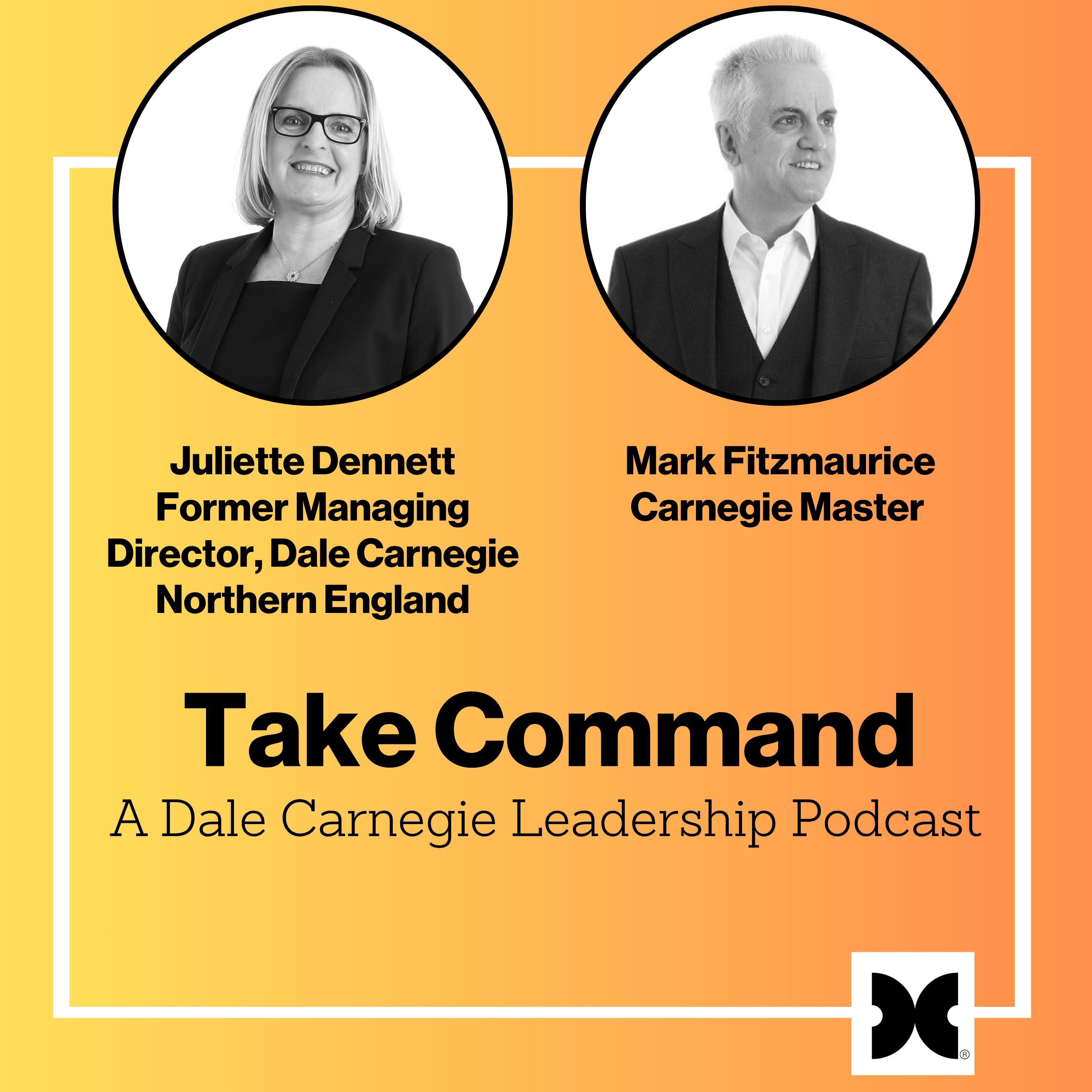
Take Command: A Leadership Podcast
When the World Stopped, They Kept Moving: A Journey from Fear to Freedom
00:41:23
Mark Fitzmaurice and Juliette Dennett’s journey is a testament to resilience, partnership, and the power of living your values. From humble beginnings in the UK to leading one of Dale Carnegie’s most successful franchises worldwide, their story is about turning passion into purpose—and navigating life’s toughest challenges with grace. Mark got into Dale Carnegie after a breakfast seminar in 1986. A young baker at the time, full of insecurity and imposter syndrome, he enrolled in a leadership program that changed everything. “I saw myself differently,” he recalls. Promotions followed, confidence grew, and by 1990, Mark joined Dale Carnegie full-time—a decision that shaped the next four decades of his life. Juliette entered the business in the mid-90s, drawn by the culture and mission. Together, they built a thriving franchise in Northern England, weathering storms like the 2008 financial crisis and the global pandemic. “When you’ve got skin in the game, you have no choice but to mov...
Loading summary
Transcript78 lines
- [00:00]
Juliet Dennett
I'm going to go simply with give honest, sincere appreciation, especially the honest and sincere part of that. And I just think in a world where today there isn't always enough of that, people are very quick to criticise that. I think staying on that track of looking for the honest, sincere opportunities to give appreciation to people also goes a long way. Foreign.
- [00:37]
Joe Hart
Welcome to Take Command a Dale Carnegie podcast. I'm Joe Hart, CEO of Dale Carnegie and before we dive in, don't forget to follow Take Command where every episode gives you the tools to lead with confidence. Today we're joined by two extraordinary leaders with a combined 60 plus years of business experience shaping how individuals, teams and organizations adapt, lead and thrive. Our first guest brings over 35 years of experience leading global initiatives focused on building agile, resilient teams, developing world class trainers and driving business improvement through emotional intelligence and executive development. Joining him is a 25 year passionate advocate for high performing teams. Renowned for her expertise in senior team facilitation, she champions collaboration to help leadership teams build trust, alignment and sustainable success. Please welcome Dale Carnegie's partnerships director for EMEA and APAC and Carnegie Master trainer Mark Fitzmaurice and former Managing director of Dale Carnegie Northern England, Juliet Dennett. Mark and Juliet, welcome to the Dale Carnegie Take Me in podcast.
- [01:57]
Mark Fitzmaurice
Thank you. It's great to be here, Joe.
- [01:59]
Juliet Dennett
Thank you, Joe. It's good to see you and it's a real pleasure to join you on the podcast.
- [02:03]
Joe Hart
Well, thank you. It's great to see you too. I mean, especially since I've had the pleasure, the honor of knowing both of you for really a couple of decades now, for quite a bit of time, you have been extraordinarily successful people in the Dale Carnegie business. Countless thousands, tens of thousands of lives you've impacted both through your ownership of the Dale Carnegie franchise in the north of England as well as through your role. Mark, you've been one of our Carnegie Masters, one of the very top trainers around the world. You've certified so many people to be trainers. And Juliet, you were the president of the International Dale Carnegie Franchise association. So you supported our network and really had a true one Carnegie mindset. So it's really just fabulous to be with you.
- [02:45]
Mark Fitzmaurice
Thank you. Yeah, thanks Joe.
- [02:47]
Joe Hart
Let me just start by saying I know you were franchise owners for many years. You're past franchise owners. Now. What was it that drew you originally into the Dale Carnegie business and what was it that led you to turn your passion really into a business?
- [03:04]
Juliet Dennett
I have to come clean on this because I didn't come into Dale Carnegie because I was familiar with it beforehand. I'd had a career in various management roles including with IBM, with Revlon. And yeah, I knew of somebody who'd got into the training business and I thought, you know what, I think that could be a business where I could make good use of my past experience. So I actually stumbled across Dale Carnegie. But once I'd had the interview and connected with the passion of the people involved, I knew that was really what I wanted to do and I never looked back. I can't say that I was drawn in by the organization. I found that once I got here.
- [03:44]
Joe Hart
How about you, Mark? How did you come to Dale Carnegie? What drew you into the business?
- [03:48]
Mark Fitzmaurice
I went to a breakfast seminar in 1986 as a result of that breakfast seminar. I was really impressed. I'd never seen anything like this before. I enrolled onto a leadership program in August 1986 and that was my very first experience being in a Dale Carnegie environment. I was a young baker at the time. I was 26. I was a young supervisor full of insecurity, very nervous, full of imposter syndrome. I took leadership training for managers first in 86 and then in January 87. I took the 14 week Dale Carnegie course. And that completely changed the direction of the rest of my life.
- [04:35]
Joe Hart
How did it do that, Mark? What was it about that you took that 14 week Dale Carnegie course? I mean, you could have stayed in the business that you were in. I mean, we know ultimately where it left. What was it about that experience that led you to say, I need to get into this myself?
- [04:48]
Mark Fitzmaurice
I think it caused me to see myself differently. I actually got promoted at work twice on the back of the two programs that I did. And I was in a family business and couldn't really get promoted anymore because the next level was family. So by the time I was 29, I'm starting to think what's next for me? I'd already been a trainer for a year from 88 to 89. And I thought, I've got to do this. I'm getting more fun, more enjoyment, more fulfillment to being in Dale Carnegie than my other job. So I joined Dale Carnegie full time on the 1st of February 1990. So I've been involved in Del Carnegie one way or another for almost 40 years now.
- [05:33]
Joe Hart
That's absolutely incredible. And Juliet, when did you actually come into the business?
- [05:37]
Juliet Dennett
It was the mid-90s when I came in to the business. Yeah. So not quite as long as Mark, but I've been around quite a while as well.
- [05:46]
Joe Hart
Well, and Just also, full transparency for our audience. You are married and have been married for how many years?
- [05:53]
Juliet Dennett
26 and a bit years.
- [05:56]
Joe Hart
And that also came about, I guess, through your interaction meeting at Dale Carnegie?
- [06:00]
Mark Fitzmaurice
Yeah, we got married, by the way, just after the Dallas convention in 1998. We stayed on for a few days after convention and got marri the city of Dallas 26 years ago.
- [06:12]
Joe Hart
Wow. So Dallas and the Dale Carnegie convention have a special significance for both of you. So take us through. You joined at different points in time. What led to you becoming franchise owners? I think also about our audience. You know, people face different decisions, and a lot of times we fear things. Right. I mean, things might seem daunting, and certainly owning and running a business is something that can be very daunting. How did you come into the process of becoming franchise owners, and what was that decision like? And was there anything you had to overcome in doing that?
- [06:42]
Juliet Dennett
Yeah, I think we did that slightly different times. So we each worked within two different franchises in the UK and those franchises merged. But there was other leadership as well. So when we first became owners, we were part of a leadership team of five owners of a bigger franchise. And then as things moved on and people moved out of the business, we then took on the north of England business. But yeah, for sure, that was a big decision, a real head and heart decision, because for the heart, there was never any question. It was always something that I hoped we would do. The head, of course, has to go into all the serious stuff and make these decisions in a measured way. But yeah, wow. So glad that we did.
- [07:31]
Mark Fitzmaurice
It was the year, Joe, before the global credit crunch. So that happened in 2008. So we invested everything we had, put our home at risk to be in the business. And then the credit crunch happened in 2008. But luckily we had some good people and some good customers that kind of kept us going through that. And similarly, with the pandemic in 2020, without the team that we built and the customer base that we had, we just wouldn't have survived. So we've been very fortunate to be surrounded by amazing people in our business right from the very beginning.
- [08:09]
Joe Hart
That raises a question too, because that doesn't happen by accident, right? We attract the kind of people into the business and we're successful in recruiting the people that see a culture or see something. So I guess two questions come to mind. You know, one is to hear a little bit about the strategy that you have and the kind of culture you're trying to create in the organizations that you've Run. I also can't help but wonder what it was like for you in 2008. You put everything into the business. You, you're looking ahead, you've gotta be optimistic, and then all of a sudden you have this calamity. So what was the mindset that you embraced to get through that? What was that like?
- [08:44]
Juliet Dennett
For sure, the worry principles came into their own at that time. And I think probably Mark and I had a different approach to that. So for me, it was very much about living in daytight compartments and doing the best that you can do every single day. So just moving forward, focusing on the moment, on the current issue, whatever that was, moving forward and taking everybody with us as best we can.
- [09:08]
Mark Fitzmaurice
You know, Joe, when you've got skin in the game and you've got a lot at stake, you actually have no choice other than moving forward. And we realized that we'd made big decisions, big investments. We had no choice other than be positive, keep going, focus on the things that we can do and not get too distracted by the things that we can't do. And we had some amazing customers who were really flexible and helped us out and signed long term contracts with us that provided cash for our business. So we just got creative, you know, when the world stopped to say we have no choice, in what ways are we going to make this happen?
- [09:49]
Joe Hart
Yeah, it's interesting hearing this and especially probably looking backwards, because at the time you're going through it, we don't know what's going to happen. You look back, you can see context, but I've got to imagine that that was a challenging time, but you had the right mindset. You had to think to yourself, we're going to get through it. How did you encourage your team? We should tell the audience that you led one of our top performing franchises in the world for many, many years. In that moment, in 2008, how did you build your teams? What was it that you did to inspire people both through good times and challenging times?
- [10:20]
Juliet Dennett
I think I realized very early on that when people come together, enjoy what they're doing at work, and can really own the vision or mission that we stand for, that makes everything a whole lot easier. And I think as leaders, our job was always just to create an environment where people can and want to flourish in serving goals and a purpose that's bigger than themselves. So that was always pretty important, really. I remember a time when this sounds like a kind of negative aspect of this, but I remember very early on there was somebody in our team who was an outstanding performer. This was, as we were taking over, really, but an outstanding performer, but seriously undermined the values of the organization. And in his conversations was almost having a toxic impact on the culture. So that was a real sort of leadership lesson early on, was having had several conversations to discover that this situation wasn't going to change. Unfortunately, we had to part company with somebody who was a real good performer. And, you know, people outside our organization thought we were crazy to let somebody so good go. And you know what? Immediately other people started to flourish in the business and the culture bounced back to what it should have been. You know, I'm reminded that sometimes when the biggest tree in the forest falls, then a lot of the newer saplings get to grow and flourish. And that's exactly what happened in our business.
- [12:03]
Mark Fitzmaurice
I've always been a great believer, Joe, that everything in our business is really simple. And when we get people to truly understand what we're about and feel passionate about it, you don't really have to get people to buy into that. We have a culture where people want to be part of it, want to be successful. And we've always been team first and created an environment where people support each other. They're not out for it themselves. They always lift each other and support each other. So when the chips have been down and we've been in crisis, it's just natural for people to say, what do we need to do? How can we help? How can we help each other? How can we help you? And that's always been in our DNA as a team, right from day one.
- [12:53]
Joe Hart
That's awesome to hear. I'd like to push you both a little further, though, as I think about people who are listening to this, who may be leaders, they may be, see, big teams or little teams. What is one specific piece of advice you'd give to other leaders about things that they can do to build the culture that you're talking about?
- [13:11]
Juliet Dennett
I've always found my personal style of leadership has always been strongest one to one. So I think those individual conversations, regular individual conversations with people, understanding what people's commitments are so that you can also commit to what they're committed to in the world and kind of make it easy for them to remain committed and so on. And I just think that the depth of that relationship for me personally, is the way I've always gone about it, that kind of one to one connection.
- [13:44]
Mark Fitzmaurice
Yeah. I think in Dale Carnegie, Joe, it's actually very clear how we want people to behave. We've got our core values, our human relations, principles and for any leader. You know, I borrow the mantra, if people can't see it, they can't be it. And I think it's always been our job to role model what we want other people to be like. Because if we're not role models, then they can't see it, they can't be it. So using the guidance that our core values give us and our behavior standards is just to always role model that and show people this is what excellence looks like in this area and try and be the best that we can be being Dale Carnegie people.
- [14:30]
Joe Hart
I'll just say, having worked with you both, something that I've observed is when you talk about modeling, I think both of you have been authentic leaders and transparent leaders. In other words, you never had to guess which mark or which Juliet is going to show up today. It was always the same mark, always the same Juliet, always transparent. And Juliet, I remember when you were leading the international Dale Carnegie Franchise association, the idcfa. That could be a difficult job. You're representing all kinds of different franchise owners. Small ones, big ones, middle sized ones from all over the world. But what I saw in your leadership, you know, you attended all four of the regional events around the world. You sought to really listen to people, to understand what was important to them. And at the same time you were always consistent in terms of the positions that you took and so forth, which is not saying one thing to one person. Another. For me as a leader, it's something I think about a lot is how do we make sure that I'm showing up in a way that is truthful and consistent and just authentic. You never have to worry when we do that. Right. I mean, when we just are ourselves and we're consistent, then it's easy in a sense.
- [15:34]
Juliet Dennett
Yeah. That was a great learning time for me as well. It's a very different kind of leadership experience. Probably one that gave me a bit of insight into what it is to be a kind of political leader as well. So, yeah, great fun.
- [15:48]
Mark Fitzmaurice
Scrap that. Juliet took that role just on the verge of the coronavirus pandemic. We seem to just have a natural touch to do something just before a global crisis.
- [15:59]
Joe Hart
Yeah. So please don't do anything big in the Dale Carnegie business anytime immediately. Soon I make money, of course. So especially for audience, I mean, this is more of a Dale Carnegie conversation in the sense that we all share this in common. And at the same time, I think there's lessons that we want to impart to really everyone in any business or any walk of life who's listening to this podcast. So we talk about the principles, we know the principles, and so forth. Many people aren't as familiar with them as, say, the three of us are. But what principles specifically have you leaned upon to develop your leadership and to really inspire your teams to great performance?
- [16:37]
Mark Fitzmaurice
Sorry, for me, Joe, it's principle number 28, give the other person a fine reputation to live up to. Now, the way that I interpret that is see their potential and lift others. So again, back to if people can't see it, they can't be it. So I'm a great believer in showing people what's possible, A, through my leadership and B, through my coaching and getting them to be the best version of themselves that they can be. And that, for me, is what that principle is all about. Give them a reputation through my own behavior and give them a reputation through seeing their potential and coaching them to get there. So whether I've done that when training other trainers or coaching my own team to improve their sales performance, I think that principle really stands me in good stead and sits really well with my own core values. Thank you.
- [17:34]
Joe Hart
Mark and I want to go to Juliet, but just to go back before we do, we're people that talk about stories and examples. What would be an example of how you applied that principle with your team where it really made a positive impact?
- [17:46]
Mark Fitzmaurice
I think we've had a number of people. We've generated three master trainers in our team, two Carnegie Masters in our team, and we've done that because when we see their potential, even when they don't see it, we've always been encouraging them about what's possible. What's the next step for you? What's your development with the people that I'm thinking about? When we first had the conversation about what's possible and their growth, I don't think they saw that possibility, but we did. And then as we coach them, we fill them with confidence and we get them to see this is what you're capable of, they begin to see it as well. And then that becomes possible, what the next step is, and they grow into something much bigger than we ever anticipated. And there are a few examples of that in our team. People who've gone on to do amazing things much better than we could do.
- [18:47]
Joe Hart
Well, I'll just share my experience with you. Using that principle is just even the people who took over your business, because I remember visiting you in the UK in 2016 and you were very methodically grooming some people to take over the business. You knew it would be years ahead, but really giving them a fine reputation to live up to and supporting them and so forth. And I think a lot of people looked at them and said, wow, you're stepping in the shoes of some, some great leaders in the business and they've done a terrific job. I mean, that's something that I saw, Mark, that you and Juliet did very intentionally. Juliet, how about yourself? What Dale Carnegie principle and the trainer in me is going to ask you for a time and a place where you give your example or story.
- [19:27]
Juliet Dennett
To be perfectly honest, I shouldn't have let him go first. I think I'd have picked that principle too. I'm going to go simply with give honest, sincere appreciation, especially the honest and sincere part of that. And I just think in a world where today there isn't always enough of that, people are very quick to criticize that. I think staying on that track of looking for the honest, sincere opportunities to give appreciation to people also goes a long way. And I can think of times when people have maybe been doubting themselves having a tough time in terms of how they're performing at work. And while you do have to have the challenging conversations, I think it goes a long way when you stay focused on looking for the positive that can turn into somebody really turning around their performance or their own attitude and so on. So, yeah, that's one that I always continue to do my best to live by.
- [20:30]
Mark Fitzmaurice
It's interesting, Joe. We always talk about how to Win Friends and influence people, and rightly so. It's a very amazing book. I personally feel I've got more value from how to Stop Worrying and Start Living. I think how to Win Friends and Influence People, it's a toolkit for managing relationships with other people. I think how to Stop Worrying and Start Living is a toolkit for managing your relationship with yourself. And I've definitely got more value out of that with emotional control, keeping things in perspective, and having some practical things to do in difficult times that really keep me grounded. The thing about the Golden Book is you get both. There's no problem either for me or with other people that that won't fix. So I've got a value from both how to Win Friends and How to Stop Worrying.
- [21:22]
Joe Hart
Yeah, it's funny because that book is maybe the lesser known of Dale Carnegie's two best known books. And at the same time, you know, if we want to lead other people, we first have to be able to lead ourselves, right? So if we're showing up and we're stressed and worried or anxious, so we have a Our emotional control just is not strong. How do we inspire other people? How do we bring out the best in other people? How do we help other people have confidence? And just to your point, Mark, that book really is about how we manage ourselves so that we're then in a better position to manage and to lead and inspire others.
- [21:57]
Mark Fitzmaurice
Yeah, it's like everything else. The title, it's so much bigger than the title. You know, how to Stop Worrying and Start Living sounds like it's just about worrying when it's about so much more than that. It's about my relationship with me and I found that the most useful in my journey in this business.
- [22:16]
Joe Hart
Any particular thing that jumps out from that book that you want to share with our audience?
- [22:20]
Mark Fitzmaurice
As Juliet mentioned earlier, living daytime compartments. And I think when you're in difficult times, it's easy to be frightened and have fear about the past. Try and live for today. And the next principle is what's the worst that can happen? And being ready to face up to that and understanding what can we do about it. So just those first two principles for me have always been my go to to say, so I don't let my emotions run away with the situation. Let's look at these two things one day at a time, one event at a time, one class at a time, and take it from there.
- [22:59]
Joe Hart
And it all starts with us in our mindset and having that intentionality to do that. Right. To be that emotionally resilient, strong person. You have worked with some incredibly, incredibly successful people throughout England and the world. What are some of the traits that you see in great leaders and what are some of the strategies you've encouraged other people to apply to develop those traits?
- [23:25]
Juliet Dennett
Yes, I can think of a CEO that I worked with over a long period of time. He was very much a big fan of Dale Carnegie, but also first and foremost, he was all over the detail of the data. He was very strong on that area. I think for me it was seeing the balance of somebody who was working really hard on the soft side of being a leader, on the emotional intelligence and the connection he had with his people. At the same time, he was just simply brilliant as well at understanding what was going on in his business and being able to make decisions from that. So I really, truly admired him for that. So, yeah, I think leadership has many different facets and Dale Carnegie teaches the most important aspect of it, but that was certainly who I admired.
- [24:16]
Mark Fitzmaurice
Do you know, for me, Joe, like you said, I've had the opportunity over my nearly 40 years to work Pretty much all over the world. And even in cultures that are very different to the one I'm from here in the uk. I think when you scratch the veneer of culture, what you realize is all human beings want the same things. They want to feel happy, they want to feel valued. They want to feel safe for their families. You know, they've got ambition for their life and their career. And it's amazing how, you know, we're not that different, whichever country we're in, whichever culture we're from. Actually, underneath, most people are the same. They want the same things. And I think that's why what we do is so transient across different cultures, generations, because underneath it, human beings are all the same. I find that very inspiring to learn that and realize that actually we're not that different in different countries.
- [25:15]
Joe Hart
Yeah, it's really enlightening to see that, isn't it? I mean, I tell you the same thing that having traveled all over the world, and that's one of the reasons why is Dale Carnegie a global organization? Why has this been successful for over 100 years? Why are we in over 80 countries? It's because these enduring principles that Dale Carnegie really defined do apply because they go to kind of the heart of who we are as humans.
- [25:38]
Mark Fitzmaurice
Exactly right.
- [25:39]
Joe Hart
Let me ask this, because you and Juliet, Marc, you and Juliet were business partners in the franchise for many, many years. Certainly any partnership can have challenges. What are some of the strategies that you had to be able to work together? What can they learn from you and the way that you've so successfully managed your partnership over many years?
- [25:58]
Mark Fitzmaurice
I think my starting point, always with any relationship, Joe, is respect, respecting what the other person brings to the table. And, you know, I know that Juliet is very, very different to me in a really good way. That lifts me. So she sees things that I don't see. She's got different levels of empathy that I probably don't have. So she brings the things that I don't have and respecting that and utilizing each other's qualities and strengths, I think that's really enabled us to do a lot of things that on our own, we definitely wouldn't have done. And that's been our strategy, is just to respect each other and utilize each other's different talents.
- [26:45]
Juliet Dennett
Yeah, I think that's very true. I think it's really worked well that we are very different in the way we think and the way we approach people in the world. So, yeah, I think that's really worked. And then at the same time, I think in terms of our Functions within the business as well. We've tended to stay in our own lanes. So the beauty of coming home and being married at the end of the day to business partner means we understand perfectly what each other has been dealing with and doing on that daily basis, which has always been a really positive thing. So, yeah, over the years we managed to find a way of complementing one another and bringing together our combined strengths to hopefully something that worked.
- [27:29]
Mark Fitzmaurice
Yeah. And luckily, of course, as you know yourself, Joel, this is not a job that you do. It's a way of life. And for us, it's been a way of life. You know, we met through the Dale Carnegie business, so it's been a way of life for us, for all of our relationship together. So luckily we didn't have to transition from work to life. And they were very different environments. Being in Dale Carnegie, running a franchise, building a team has been a way of life for us for all the time that we've been together.
- [28:01]
Joe Hart
I think sometimes people have this mindset, well, I've got a way I show up in business or a way I show up in my personal life. It's all should be the same. Right. We're one person and when we kind of live by a common set of values or principles, then you know, we're going to be consistent in everything that we do. Yeah.
- [28:16]
Mark Fitzmaurice
And I think that's our connection at that level is our core values are absolutely aligned.
- [28:22]
Joe Hart
So let me ask if you look back over your journey together in the Dale Carnegie business and certainly building one of the most successful operations that we've had in Dale Carnegie and leaving a legacy, what are you most proud of? If you think back, but all those years, what stands out as something that I'm really proud of this, for me.
- [28:41]
Juliet Dennett
It would be the team that we built. I was always very proud of the individuals in our team and the whole team. I was proud for them to represent us with customers. I was proud for them to represent us on any Dale Carnegie platform as well. And of course, you know, it didn't always go perfectly. So to build the team that we did, we, as I always say, kissed a few frogs in order to find the princes and princesses that we ultimately found and leaving behind that team and a leadership team that was just already ready to go. I think that's probably my proudest this moment. Yeah.
- [29:21]
Mark Fitzmaurice
Can I have two, Joe?
- [29:23]
Joe Hart
Of course. Please. Mark.
- [29:24]
Mark Fitzmaurice
I remember speaking at convention for the first time in San Diego in 1994. So I've been in the business for about three years, full time. It was only my second convention. Mrs. Dorothy Carnegie was sitting on the front row. Tom Coletta was the emcee and he said my name and I just got this overwhelming feeling of fear. And I walked out onto the stage and did a 20 minute presentation on stage. And Mrs. Carnegie wrote me a note at the end and pushed it under my hotel room door. And I still got that note from her and how special that was. And the second One was in 2014, we were working on defining Dale Carnegie's DNA. What is it to be in this business? What are the behaviors and the standards? At that time, I don't think we were as consistent in developing our trainers as we are today day. Each instructor trainer had their own way and their own methods and we were just trying to find some consistency. I was on a bike ride on Thursday morning in October 2014 and just thinking about while I'm pedaling around the countryside, how can we create more consistency? So I came home and got my computer and started writing down all of the structures that we use. And out of that I created the simple structures. And now when I see them all over the world and see them in everything that we do, I can look back on that and say that's my legacy for this business, is just give those simple structures where people can follow and have some simple guidelines on what do you do as a Del Carnegie trainer.
- [31:12]
Joe Hart
Yeah, and probably you can't overstate how important that's been in the business being someone who's gone through the process to become a Dale Carnegie trainer. So for anyone who's listening to this, this is not an easy process. Some other companies in the training space, people could become trainers over a weekend. It can take a very, very long time to become a Dale Carnegie trainer. And it's rigorous. And that's part of the reason we're able to have such high quality around the world and consistent experience. But Mark, what you put together with a simple structures made the ability to learn how to have that experience so much easier. I mean, that's all I knew going through the trainer DNA, so to speak. But having talked to so many other trainers who've gone through the other, you know, without that, it was a lot less consistent. And today we have as a global organization the highest net promoter score, voice of customer scores that we've ever had. And that goes to the amazing trainers that we have, the commitment that our franchisees have, and it goes to the simple structures and the DNA process that.
- [32:10]
Mark Fitzmaurice
We have for training that team that we put together in 2014 was probably the most empowered I've ever felt anywhere to get things done in the way that we did. That was a very, very special time in the business. And, you know, that's over 10 years ago. And the legacy of what we created collectively as a group still defines our organization today.
- [32:35]
Joe Hart
It absolutely does, and it will continue to. So when you think about the years ahead now, you're both doing different things right now, but you're still both involved in varying degrees in the business. I guess, you know, it's one of those things where you're quote, unquote retired and yet still engaged. Both which we are appreciative of. We don't want to lose either one of you. Tell us just briefly what you're doing now and what are you most excited about as you look and think about the future?
- [32:59]
Juliet Dennett
Well, I'm currently in a very small way, I'm supporting another franchise in the uk. I enjoy being able to champion the individuals in that business and support them in their performance. So, yeah, I'm excited to continue that for as long as they'll have me and as long as I can still be relevant. I'm already starting to feel quite old in this business and for how long we've been around, but as long as I can contribute something, then that's what I'd like to do.
- [33:32]
Mark Fitzmaurice
You know, Joe, speaking of our DNA behaviors, one of them is lifelong learning. Somebody asked me the other day, how do you stay relevant after nearly 40 years as a Dale Carnegie trainer? And that was a really good question. That made me think and the way I stay relevant and what excites me about the future is I learn from our customers every single day. I don't think I've had a single original idea of my own in my whole life. Life. I've always learned from great customers, great colleagues. And I think as the world changes, if you're a trainer or if you're in sales in this business, you are right at the sharp end. You're with customers who are innovative, agile, using new technology. We get to work with them every single day. So being right on the front line of innovative organizations, creative people, amazing leaders, I find that that keeps me sharp, keeps me fresh, and that's very exciting.
- [34:32]
Joe Hart
And now you've piqued my curiosity because I have to ask you, what are one or two things that you've learned recently, something that you didn't know that you have learned, and maybe even that surprised you? But what would a couple of those things be?
- [34:44]
Mark Fitzmaurice
I think especially how leadership has changed Especially since the pandemic. So when you look at the last five years or so, I couldn't figure out on my own what the changes have been. But by talking to customers and talking to leaders, what I'm starting to understand is, you know, with the different generations coming through, they have very, very different expectations. Now I've not learned that from myself. I've learned that through talking to customers, being involved in classes, engaging with leaders. And they are telling me this is what's different in leadership. This is the challenge for me personally, how I need to pivot, be more agile, be more innovative. I'm learning all of that not through my own insights, but through customers insights. And I'm sure as we move into a space where AI is more prevalent, it'll be the same again. How are organizations using that? What's the impact on leaders? I'm going to learn that from my customers. Joe?
- [35:49]
Joe Hart
Well, one thing that's really clear is that things are moving so quickly and the world is so dynamic and so fluid with AI and just all the other just changes in the workplace and leadership and so forth. It seems like the only thing that any of us can do is really do the best we can to learn and to invest and to try to grow ourselves and to develop our own skills even further. Julian, how about yourself?
- [36:12]
Juliet Dennett
Yeah, I think I'd sort of reiterate the same is that when I was still a trainer, but also having conversations with business leaders, it's very easy for them to see different aspects of their business. Whether it's technology or operating systems, whatever it might be. Everything moves at such a fast rate as you just suggested. Not everybody realizes that leadership has shifted and changed very much so as well. Not everybody has been prepared to invest in their own leadership skills and upgrading their leadership skills in the same way that they might upgrade their tech systems and so on. So I've always found that really interesting to explore with people, especially people who feel that they've ticked that box, they've done the leadership training or they did the management course and that's as much as they needed to do. I think it's realizing that with the way people approach work today means that leadership has to be adjusted to meet those needs and to get the very best from people.
- [37:13]
Joe Hart
If we're going to be leaders, we've got to be able to effectively guide people through the changes of the world and grow ourselves. I am finding that AI is making me so much more effective. I use it every day. Research on something, preparation for something, analysis not to replace my own thoughts or preparation. But to supplement it, I think this is going to get just far more effective over the months ahead. Just to kind of a closing question, because I often will ask an AI based question, what's one way that you're using or would recommend that people use AI if you have kind of a tip or suggestion for people.
- [37:49]
Mark Fitzmaurice
For me in a sales environment, Joe, I can now just go on to something like ChatGPT and just ask the question, tell me about the challenges that Dale Carnegie are facing and it will just produce for me kind of the top 10. And that saves me hours of looking through a company report, reading the chief executive statement. So when I've been doing classes for an organization and I've done my research on ChatGPT or Copilot, I can then go into that situation armed with that information that took me three minutes to find on the web. And it's amazing when you talk about these things, the client just pricks up because they know that you know. Right. And that builds our credibility. So I will continue to do that, use AI to build my credibility both as a trainer and in sales.
- [38:44]
Juliet Dennett
Yeah, I think very similar and as you said, Jo, particularly with research as well, and use programs like Perplexity and others that will do a great job of summarizing a topic and also using AI to draft reports and be able to put text together in just such a streamlined way. Probably the basics for where we are in our careers at the moment. But it's just still so important.
- [39:09]
Joe Hart
It seems like it's just so critical. I can't imagine. I mean, there's going to be, I think, a growing disparity between people who are using AI effectively, they're effectively prompting it and getting great feedback, and those who. Who aren't. There's no reason, using your example, Mark, for a salesperson to go in a meeting unprepared. You should be super prepared, more prepared than ever, in fact. That creates, I would think, an expectation on the customer's behalf. So someone who's not prepared doesn't stand a chance. I recently was flying to a country for meetings and was just really interacting on the plane with ChatGPT about tell me about the country. What are the issues that are happening? What are the most important things? Really learning in a way that might have been so much more difficult that enabled me to show up in an even more respectful and effective way. I would say for anyone who's listening to this, if you're not really leveraging AI, start soon.
- [39:58]
Juliet Dennett
Right.
- [39:59]
Joe Hart
Well, thank you, Mark. And Juliet for being here. It's really just tremendous. And thank you again. You've been just such awesome contributors and role models for people, not just in the Dale Carnegie business, but I know having been with you in the north of the uk, meeting with your clients and knowing the impact that you've had on just so many people, both the clients as well as on your team members, it really is a great representation of what happens when people live the Dale Carnegie principles and model them for others. So thank you so much for all that you have done and continue to do. And thanks for being on the Dale Carnegie Take man podcast.
- [40:32]
Juliet Dennett
Thank you Joe, thank you. We've enjoyed the conversation.
- [40:35]
Mark Fitzmaurice
It's been a pleasure. Joe, thank you.
- [40:36]
Joe Hart
Thank you. Me too. Take care of I hope you enjoyed this edition of Take Command, a Dale Carnegie Podcast. Check out our resources at www.dalecarnegie.com for more research, insight and tools that will support your success and help you take command of your leadership potential. If you enjoyed this episode, please consider rating it and following us on Apple Podcasts and Spotify. For more exclusive content, subscribe to our Dale Carnegie YouTube channel and follow us on social media. As always, thank you for listening and we're looking forward to you joining us for the next episode of Take a Dale Carnegie Podcast.