← Take Command: A Leadership Podcast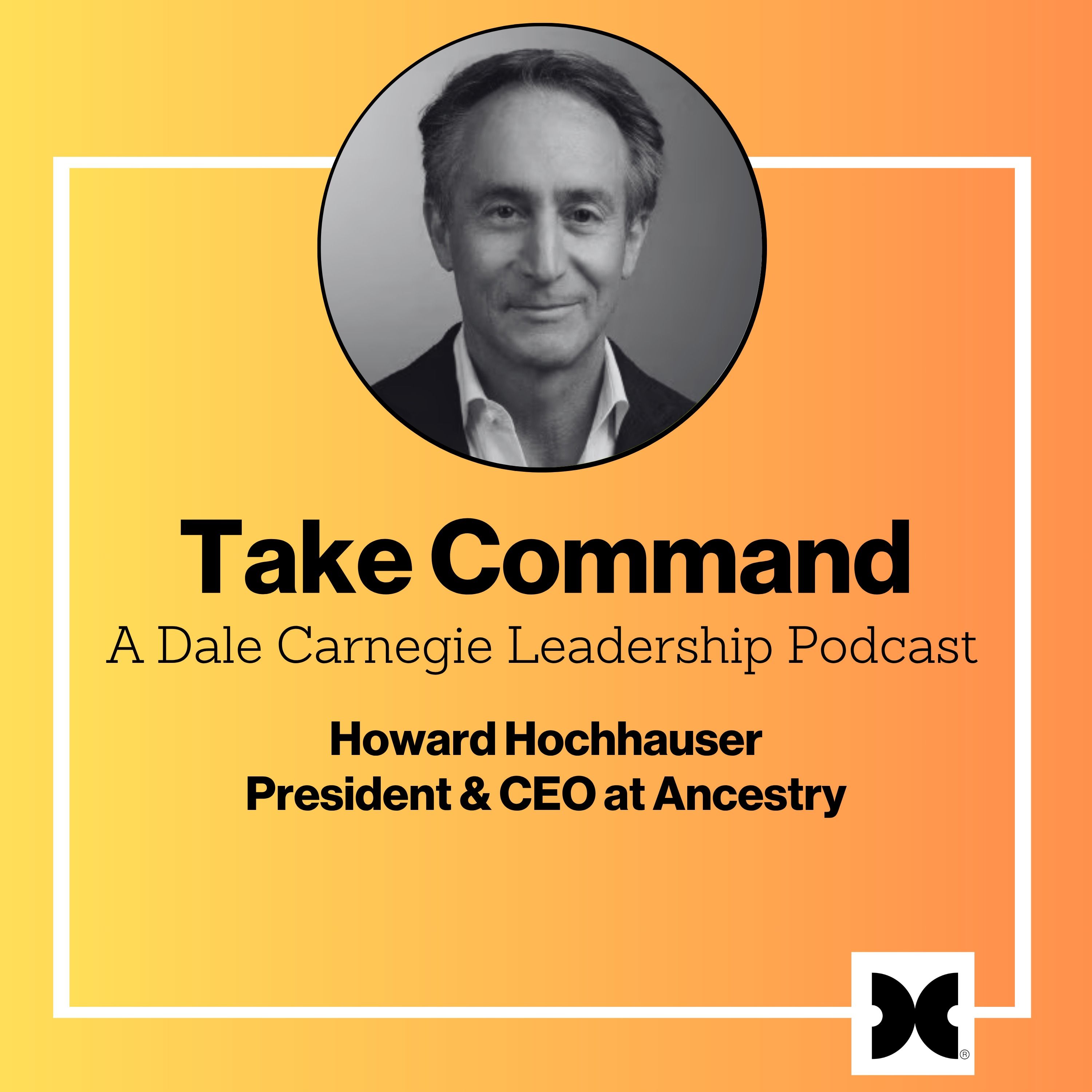
Take Command: A Leadership Podcast
Your Story is Your Superpower: Leading with Curiosity
00:33:51
Howard Hochhauser believes the most powerful technology doesn't replace human connection, it strengthens it. As CEO of Ancestry, he has led the company through a remarkable turnaround by refocusing on its purpose: helping people discover, preserve, and share their family stories. Along the way, he has reshaped the company's culture around humility, curiosity, and honest feedback, while embracing AI to bring millions of untold stories to life. In this conversation, Howard shares how curiosity led him to Ancestry, why feedback is one of the greatest gifts a leader can receive, and how humility creates stronger teams and better decisions. He also discusses balancing innovation with humanity, building trust across an organization, and why great leaders focus on doing today's job exceptionally well instead of worrying about tomorrow.
Loading summary
Transcript48 lines
- [00:00]
A
And I think it's just undervalued, just asking basic questions. Sometimes people are so embarrassed, like, oh, I can't ask this question. It's so obvious. This likely, not likely. Somebody else likely has that same question. And so, yeah, just being curious, I find to be so important.
- [00:23]
B
Welcome to Take Command, a Dale Carnegie podcast. I'm Joe Hart, CEO of Dale Carnegie. And before we dive in, don't forget to follow Take Command, where every episode gives you the tools to lead with confidence. Today's guest oversees the global leader in family history and consumer genomics with a mission to help everyone connect with their past and share their unique family stories. Over his tenure, he's helped guide the company through its public offering and multiple acquisitions, growing revenue from roughly $200 million to more than 1 point billion. His leadership has been recognized with honors, including Best CEO of 2018 by the Utah Technology Council and CFO of the Year in 2021 by Silicon Slopes. Please welcome President and CEO of Ancestry, Howard Hochhauser. Howard, welcome to the Dale Carnegie Take man podcast.
- [01:22]
A
Great to be here. Thank you, Joe.
- [01:25]
B
I'm excited to have you here. And clearly we're going to talk about Ancestry. I've been an Ancestry customer for many years. You and I got to connect at the CNBC CEO Summit recently. Maybe we can talk a little bit about what you shared at that. It was pretty cool, and it was a very special moment for me. Your leadership has been absolutely critical in developing this company from $200 million to over a billion in revenue. You've been with the company for 17 years, CEO, year and a half. Tell us a little bit about you, Howard, about your journey and what led you to Ancestry.
- [01:55]
A
Yeah, I love telling the story because what led me to Ancestry is really the product that we do. So I, at the time, I was living in New York. I was working for Martha Stewart, living in New York City, two kids, wife, you know, in a small apartment, gets kind of tight, living downtown right by the Brooklyn Bridge. Someone told me about Ancestry. You got to check out this company. They're looking for a cfo. So did a little homework, and I found my great grandfather's old man's draft card. So the end of World War II, they started drafting people that were 30s and 40s. Okay, so I found old man's draft card. And as it turned out, he was living on Pitt street in Lower Manhattan on the Lower east side. I was living down by the Brooklyn Bridge. So this gentleman who had grown up, known the family, had no idea that when he was My age, he was living right by me, living, you know, walking past the same buildings, having probably a similar experience. And so that, you know, put the bug inside my head that this product is pretty neat. The product at that time was kind of hard to use, but really powerful. Powerful enough that that initial piece of content, that initial story got me to move from New York City to Park City, Utah, a big switch.
- [03:09]
B
And I know you're very mission driven in terms of who you are, and certainly you've recentered the company around dynamic mission that's already started to drive growth. So you go to Ancestry and just for people who may not be familiar with ancestry, just talk a little bit about what the company is and what it does and how it serves.
- [03:25]
A
Yeah. So a 40 year old company, we have been collecting records for decades. And when I say records, think of the 1940 U.S. census, which list the name, the occupation, where your parents lived. So we have records from the 1940 census, we have 17th century birth records from France, we have the employment records from the Guinness beer company to find out if maybe your grandfather worked for Guinness in the 1800s. So we have collected records from around the world, spent nearly $500 million doing that. We've digitized those records that you go online and make a discovery and find out a bit about your family that you likely never knew.
- [04:05]
B
So you decide to join Ancestry, you move across the country in 2008, and you become the CFO and ultimately the COO. But is you're at the company, what do you find there from a team standpoint? I mean, part of this is you're building a culture, building a team. What do you see and what do you do?
- [04:24]
A
When I first moved to Utah, a smaller company, $200 million as you referenced, a much smaller company, local team, all based in Utah. Most of the people there were really passionate about the product, passionate about the records, passionate about what they do. And some folks had just limited experience outside of Utah, limited experience with a growth company. But the fire and the belly to make the company bigger, make the company better, outweighed any sort of limited experience that you had. And so we really built a team organically, promoted from within. And we did make some outside hires. We opened an office in San Francisco ultimately, but really grew organically in Utah, which by the way, now is a wonderful, wonderful place to both live, vacation and to build a business.
- [05:11]
B
So Howard, as you scaled that company from $200 million to $1.3 billion, what are some of the lessons you learned about leadership? Was it purely a Straight line or what were the challenges that you had to overcome to be able to achieve that kind of growth?
- [05:24]
A
Listen, nothing is ever a straight line. Or in my experience, I'll say nothing is ever a straight line and nothing's certainly easy. I remember when we went public in 09. While we're public, we had this TV show called who do youo Think youk Are? Tremendous success, great ratings, driving lots of growth. And without our knowledge oppressively came out saying that this show is being canceled, Right? As soon as that happens, you could watch your stock go down, you could watch employee morale go down, you could watch revenue get negatively impacted. And we had a few moments like that over time. And listen, ultimately it's about sort of regrouping and dusting yourself off and standing up and motivating people in that instance where our stock did get hit. As an example, when that show got canceled, myself and the CEO at the time, Tim Sullivan, loved the business, saw that it was a subscription business. Customers were passionate about the business. So high renewal rates, high margin. Our point of view is that, gosh, we still love what we're doing. We should use this as an opportunity. If the public markets don't like it, let's go private. And that's what we did. So definitely a case of making lemonade out of lemons. So stock went down, we took this as an opportunity to go private and we spent a year finding the right partner and we did went private. And that allowed us, frankly, to make investments in the business. We invested in a DNA product and other products to re. Accelerate growth over time.
- [06:48]
B
Talk about innovation a little bit, because, I mean, your product has changed so much over the years. And I know I'm going to want to talk about AI and what you're doing right now, which is so creative and incredible. How did you innovate over that period of time and what was that process like?
- [07:02]
A
One of the reasons I joined the company, I found this draft card, but the site was just so hard to use. It was for someone who really wanted to do a lot of work to find that draft card. And so the opportunity that myself and the CEO at the time saw was make the product easier. You know, more of a storytelling instead of delivering you an Excel spreadsheet of a census record. Turn that into a story about your grandfather. That, wow, he owned a radio. He was the only person on that block to own a radio. Maybe he was, you know, wealthy. Maybe he started his own business. So to turn that product into a bit of a story about your family and to do that. Yeah, it was all around innovation, getting the right people, getting the right people into the right roles. I mentioned opening an office in San Francisco. We did that. We couldn't find marketing people that we wanted in Utah. We couldn't find some product designers in Utah. So we did have to open an office outside of Utah, which was great. I got to tell you, the. I don't say the competition, but having both offices proved to be a real benefit over, you know, five, ten and longer years.
- [08:04]
B
It's interesting in hearing you too, just thinking about you opened a physical office because you needed to at that time. And of course, now it's a whole different ball game. I would assume you've got a lot of virtual people all over the country of the world.
- [08:15]
A
A lot of people in San Francisco no longer have a physical presence. We have a great office in Utah. That is something we struggle with. People love getting together, love that serendipitous interaction you get when you're running to own the hallway. At the same time, right now, I'm not in the office trying to strike the right balance, the right cadence of getting people into the office at the right time to have those interactions while also recruiting talent, where talent lives and giving people the opportunity to live in Montana and then if they want to, you know, fly into Utah, they can not perfect. But we definitely have a good. Hoping to make it better. That's a journey.
- [08:52]
B
It is a journey. And I'm curious a little bit about what your personal strategy is for connecting and building relationships. I mean, I certainly would deal. Carnegie is all about relationships. And I can't help but even think your product is about helping people get connected to their past and those relationships. But how have you done that as the company has changed?
- [09:10]
A
Yeah, those connections in our mission, like we're trying to connect people with their ancestors. Discover, reserve, share your family stories. And as a small aside, my dad, who passed away a year ago, who I greatly admire, built this phenomenal business in Long island, was a big fan of Dale Carnegie and took his courses and again spoke very highly. So it is about storytelling, it is about personal interaction. It is about getting people together. And so we do try and put as much candy in the hallway as we can. Virtual candy to bring people in together. So all of our leadership events are in person. They're not over zoom. We don't even have a zoom. We just had leadership all in Utah. No zoom. Invite, fly in, spend two days, have some social interaction. And we do that periodically where there's not a zoom. Option. You sort of have to be in the Utah office to participate. And you know people, because it's not every day. People really admire that and want to participate and want to come in at the same time. My own personal behaviors had to change. I had this mindset that I just had to be in the office. It's every Monday, I would drive to the office, I'd get there, and no one's there. And it's an hour drive in, hour drive home. I had to, like, unprogram myself to go in. Tuesdays and Wednesdays, that's when people are in. I have lunch downstairs in the cafeteria. I'm hanging out with people. I have coffee in the hallway, and I make sure to keep my calendar open. And I am interacting a lot with people from around the organization.
- [10:37]
B
One thing I've observed about you, Howard, is we've gotten to know each other a little bit so far. You're very approachable, very authentic. I've seen that in your interviews. I've seen that in the articles and things I've read about you. So I've got to mention that's a really important part of your leadership style, is just being present with people and just getting to know them.
- [10:53]
A
I love that you use the word approachable. One of the things I don't, like, hate about being CEO, and you probably see this is people. You're like, almost in this bubble of information. Everyone sort of curates what you see, and you work really hard to get the real sense of what are employees, what are customers saying, what are employees feeling and saying. And so trying to be as approachable as possible is key. And, you know, hanging out in the cafeteria for an hour, you'd be surprised. After people let their guard down, you find out some real consumer insights. Insights about employees, insights about customers. And so, yeah, I love that you use the word approachable. I think that's important for all of us.
- [11:30]
B
It seems like it's a part of who you are. It's one of the characteristics I've seen with so many great CEOs is there is a humility that says, like, I don't have all the answers. And people can sense that, and they can sense that authenticity. And it seems to me like in our leadership research, it's one of the qualities that is one of the most important, especially as we've got multiple generations in the workforce and as younger generations are looking for that authentic kind of
- [11:53]
A
connection, humility is everything. We just got a new puppy flying from JFK to Salt Lake City, walking this dog through jfk, right in front of Starbucks. The dog decides to sit down and do its business at JFK Airport. So if you want humility, there I was picking up the poop at JFK Airport in front of Starbucks. There's something to being humble. Like, none of us have all the answers. None of us the smartest people in the room. That's not the objective. It's about getting the right people together to have an open, honest conversation about whatever the topic is you're talking about. And I remind everybody of that. I'm definitely not the smartest person. I just want to hold myself accountable to the decisions I make. But I don't have all the right answers to those decisions.
- [12:36]
B
It's true. And frankly, we always need to surround ourselves with people who are smarter than we are. One of the things going back to humility, I wanted to ask you about, because a lot of times people are very ambitious in their career. You know, you were a CFO before you came to Ancestry. At Martha Stewart, you were a cfo. You came in as a cfo. You picked up a Chief Operating Officer title along the way. You're an interim CEO at Ancestry. So it was a journey before you ultimately became the CEO of Ancestry. What was that like? Was your hope always to be the CEO? Was it just kind of serendipitous, or what was your view from a career standpoint and a career track?
- [13:11]
A
It's pretty interesting. I mean, I was very happy in the second chair, Loved being in the second chair, just doing it for over a decade and enjoyed that, and did not have this mission to be CEO. And then, frankly, the business was underperforming after 20 great years, the past three to four years, prior to me taking over, revenue was flat to declining. The last year, profits were flat. Customer satisfaction had declined for three consecutive years. And I just found it in me. I said to Blackstone, I guess we need to make a change. I have a strong point of view on what's going to work. I'm really passionate about what we're doing. I'm really passionate about the customers. I think this is what we should do. And I told him we should refocus back on the core business and give me the job. And so something inside of me just stirred, and I got really passionate that I had for this company at this point in time, the right tools, the right skills to turn around. And I did. And now, you know, what is it? Seven quarters of consecutive growth in revenue and in nps. So we turned revenue around and customer satisfaction around and so never fully aspired to it. But right person, right time, right job with the right meaning to me. And frankly, I found another gear and it's re. Motivated me to stay at this company for another, I don't know, five, 10 years. It's been great. It's great.
- [14:37]
B
Howard. You know, all the things you could have done when you became the CEOs, a range of things. The first thing you did was to change the mission statement.
- [14:44]
A
Why personally important to me, our mission previously really didn't mean anything. It was we empower journeys or personal discovery that's meaningful, but that could be on the door of a yoga studio, of a healthcare company, of a family history company. But it wasn't obvious what we stood for or what we did. And by the way, that was done by, you know, prior CEO spending a million dollars. I'm not joking. To hire a San Francisco agency to develop that. All the wrong ways to do something like that. We did it ourselves in a month by listening to customers and employees. And now it's we help everyone truly want to serve everyone, discover, preserve and share their family stories. And I want everybody to know what we do. Like read that mission, you know, what we do. We are about family storytelling for you and for everybody. And our employees immediately felt like that was our mission forever. People just realized, think that must be what it's always been. And so it's personally passionate to me. The next thing we did was change our culture statement, which put customers at the center of everything we do. Curiosity. Another important point to it. Ask lots of questions. So don't be a jerk. But gosh, just ask a lot of questions. Be really curious. The why behind why is business good? Why is business bad? Why are products taking off? Be candid with one another. So we're really promoting feedback this year, elevating the talent bar and the way we're doing that. You've got to give feedback to people. Feedback is a gift. You got to ask for feedback. And gosh dar, you're really. You're just obligated to give feedback up and down across the organization.
- [16:19]
B
Yeah, it's funny because people often don't want to receive feedback and often don't know how or aren't willing to give direct feedback. I don't know about you, but even early in my career, I think I fell into both of those camps, was kind of defensive about getting feedback and also didn't necessarily want to give people feedback. It's going to hurt their feelings or how's it going? I've really come to believe. And certainly this is something we teach as well, that feedback is a gift. Both receiving good quality feedback and giving that feedback. It's almost like you have the answers to a test or something like that. People around you can say, hey, this is a blind spot. We recognize it. Then we can really unlock great performance.
- [16:57]
A
I think feedback's the whole ball game. Like, everybody has a coach. I live in Park City, ton of Olympic athletes. They all have coaches that give them feedback every day on how they could get better. Earlier this year, did a 360 on myself. So I had the board, I had my peers, I had people underneath me all funneling feedback. I got it. Pages of content about me that I could really action. And then I also wanted to be transparent. I gave that feedback to my team. Like, hey, guys, this is what people are saying about me. I want to be really transparent. That's a way to build trust with the team. And this way, you know what I'm working on. And I think it was very helpful, again, in building trust, which is like the foundation of everything, especially among a senior team. It's helped us have some difficult but honest conversations.
- [17:45]
B
The vulnerability is critical. Right? And that's another thing that I think people are looking for in a leader. It's like if you ask for feedback and then you respond defensively, you're not going to get feedback. And people won't be willing to engage in that process themselves. So, Howard, talk a little bit more about what the transition was like from the prior CEO and you were part of that leadership team. You are now the CEO. What were a couple of the things that you did that really made the difference in terms of the business and the culture?
- [18:12]
A
It's so interesting. We went from a period where the business was really underperforming. Revenue was flat to declining over three years. Profits flat to declining. Customer satisfaction also flat to declining. And importantly, employee satisfaction also not doing well. We had three rounds of layoffs, employee satisfaction down. So I had a strong point of view that we should refocus back on our core customer. And we did that. And one of the first things we did was redo the mission statement and recenter around our core customer, recenter about what we do help everyone discover, preserve and share their family stories. And refocusing on that, a few things happen. We turned the business around. So now 7/4 of growth, NPS. Likewise, customers are loving what we're doing. Better search, better hands, better content, better business. So revenue, customers, and importantly, employee satisfaction has also turned around. It's amazing. And I love seeing that. I love seeing the employee piece. We redid our culture statement on the heels of redoing our mission statement. And so employee satisfaction now at record highs. And something else is so funny. You know, when you invited me on this podcast, my reaction was, gosh, like, why am I being invited onto a leadership podcast? I'm just a guy who's living in Utah running this business, not realizing that you're the CEO of a 1300 poster company that's, you know, turn things around and doing fun things, people having a good time, customers, employees alike. And so just remind everybody, like, humility is just a really valuable trait to have and is a great way to lead a team, lead organization, lead anything.
- [19:47]
B
It's interesting too. I've got to imagine our listeners, sometimes we can all feel the same way, which is, you want to hear from me. My opinion is an important opinion and the answer is yes, absolutely. Each one of us has something to contribute, and often it really is about the courage to speak up and the willingness to share that. So certainly I'm grateful that you accepted my invitation to be on the show. Just to switch back to the company for a minute. You and I had an experience in Washington D.C. about a month ago. You were presenting on stage. And I'm an ancestry customer for almost 10 years and really been inspired to engaged. But it was just fascinating to me. And I was going to ask you about. You're now leveraging AI and some other relationships that you have to get access to information that you otherwise couldn't. And you had a couple of discoveries for me. Do you want to just talk about what you did and what you found?
- [20:36]
A
Yeah. This is the magic of AI So think of a. I'll give an example, a, you know, 17th century baptism record from France. You can visualize that as written in script. Hard to read people. You know, probably you may not be able to read French. And so historically, that record would have been too expensive to bring to our site. Just impossible. Today, AI can visually read that, translate it and transcribe it. So it's now in English, fully legible and in searchable. So we're taking documents like that to surface. And in your case, we found a newspaper story right about your. I think it was your grandmother, an aunt or an uncle with a photograph. That's magic. You could find a picture of an ancestor and then it was their day at the beach in Michigan. Ultimately, we wanted everybody to have an emotional touch point. We call it the magic moment. And a story like that helps do it. And that's only discoverable through technology and through AI allows that to come to life. And now with AI, we could create an audio story. I had a great uncle who I always knew was wounded in World War II, didn't know the story. So I found his application for a Purple Heart long form script document. Now uploaded to the site to Ancestry, it is transcribed and turned into a 90 second podcast. And in that it talks about him getting, you know, ambushed, shot out, someone was killed in action, someone's wounded in action, he survived the ambush, made it back to base and this really highly emotional story. So it went from something that never discoverable, can't even see the light of day, to actually now it's spread across my family like a ping pong ball as an audio podcast. And that's the benefit of technology. That gets to your earlier question around innovation. So really excited around getting people more motivated or continue to be motivated around innovating and growing our customer base.
- [22:31]
B
Well, it's interesting to me because one of the things Dale Carnegie believed is that every person has inherent greatness. He quotes Ralph Waldo Emerson in How to Win Friends is saying, every person I meet is my superior in some way and that I learn from him or her. So this idea of learning from others, of recognizing that and when we're able to go back into our own families and to learn things, and now when you combine it with AI and you get a story out of it, it's powerful. The other thing I was thinking about, you and I were talking about before we started here, just, I mean, our business, Dale Carnegie, is about helping people have stronger connections and telling their stories. And I just can't help but say, see kind of overlap in what you're trying to do with your customers. So as you look at the years ahead, you're in this role and now you're the CEO, you've already done some great things. What are you most excited about? As you think about Ancestry, it is
- [23:19]
A
a little bit about what we just talked about as it relates to technology. So we have millions of people, almost 4 million paying subscribers, this great brand, millions and millions of records a day. But that example I gave of that record about my great uncle being wounded
- [23:35]
B
in World War II.
- [23:36]
A
So historically that would just sit on the shelf and never be discovered. Where we're going is now we have an audio story over time that could be a video story, his entire life story, highly personalized to Joe or to everybody, and make that fully shareable. So today we'll digitize content for you who have Old slides or videos. We'll scan all that for you, put it to the site and the fullness of time using technology again, create Maybe it's a 30 second or 30 minute, highly curated, highly personalized video or some other form of streaming content that's about your family. And that's only going to happen, you know. Right. If you hire great people that have this fire in the belly to innovate and deliver great things for our customers and back to your world. Like tell stories about their family that are personally meaningful, that they want to share with others.
- [24:31]
B
Yeah, it's interesting. I've had this conversation with my mother, who's also used ancestry and has taken, I guess her side of the family from Italy back, you know, hundreds of years. And I had mentioned to her that I was interested in kind of going deeper and to be able to preserve the family record and be able to tell those stories and pass that on to our kids, I think is really important. Speaking of kids, you've got kids who are college age. I'm curious, as you think about your own journey, if you're talking to your kids or anyone, what are some things that you'd say you would do differently or that you've learned something you didn't know when you were starting out but that you know now? What's a piece of advice that you might give our audience?
- [25:09]
A
Yeah, my daughter is now, she graduated college last year and has her first job. Try to remind her, like, do today really well. Tomorrow's going to come, you're worried about tomorrow. But just focus on doing today's job exceedingly well and that will lead to good things down the road. People recognize that that will lead to expansion of scope, responsibility, that will lead to promotions. I'm not saying don't look down the road. I'm saying just prioritize today. So you're doing today's job exceedingly well and that will get recognized and you'll figure out what you love doing, what you like doing, who you want to do it with, what type of people you want to work with. So that's something I sort of suggest to her.
- [25:49]
B
Is that something that has been an epiphany for you over time and when you were kind of at that stage of your career, were you anxious in some way or did you need to kind of remind yourself now that you look back and say, you know, just focus on the day?
- [26:01]
A
No, I didn't. And to build on that, you know, I also tell her, like, be herself, like they hired her for who she is. And her qualifications and her skills. So just be who she is and again, focus on doing today well. And so I did make a mistake in my mind. I was thinking, like, I want to be like so and so. And so I would try and model their behaviors, how they would run a business or how they would do things instead of, you know, being myself. And I was focused on that future state instead of focusing on Howard's today state. And so I didn't always do it. And it wasn't, frankly, you know, now, when I became CEO a year and a half ago, a helpful executive that I was very close to, the former CEO of a large technology company, now he's chairman of a large tech company, said, hey, Howard, you could take elements of other people and stitch it into yourself, but you have to be yourself and stitch whatever those pieces are. You could stitch it into your own pattern, but be you. That's why you got this job. And that was just a helpful reminder because I was. Sometimes, you know, you see other CEOs who do great things and are high profile and, and that's great for them. That's wonderful. And they do that well. But that is not who you are.
- [27:13]
B
What about stress and anxiety and the different things? I mean, people have fears, so sometimes it might be easy for you or I to say that, right? I mean, and my kids always say to me, I'll give them a piece of advice and they'll say, oh, dad, that sounds so easy when you say it. But in the reality, and I think even about younger generations that are dealing with things that maybe you and I didn't have to deal with in social media and some of the stresses and you don't know how things are going to work out when you're in your 20s or whatnot. How did you handle or how would you advise handling stress, anxiety, fear?
- [27:41]
A
How do you do that? Well, first, we all have that, right. If you don't walk into a board meeting where you're making a recommendation around doing a big sort of M and a deal, you don't find that stressful. You're not taking the job serious. So we all still have that or a big presentation. It's stressful. And my on stage trick, I don't know if you're asking about this, and I got this from a former federal prosecutor who was coaching me in something, and he said, just no one can see you do this. Inhale through your nose for two seconds. Exhale through your mouth for four seconds. That will lower your heart rate and calm you down. And I do that all the time. And people think, oh, wow, I get on stage, you're so calm. Like, no, I'm not calm. I have tools to calm me down, help center me so that I could focus on doing a really great job. I don't just go there and wing it without practicing. I tell my kids that all the time.
- [28:37]
B
This issue of dealing with emotion, it's a real one. The brain physiologically reacts in a certain way, and we can't think logically when we start to get emotional. But breathing is something I've started to focus on. Even breath, work, sleeping better as a result of just being able to breathe and calm my nervous system and that type of thing. So I can see how that would help you in a speaking environment. One other question I want to ask you, how is, how do you invest in yourself? How do you focus on your health, your mindset? How do you do that?
- [29:04]
A
Make sure you prioritize yourself, and that includes your mental health and your physical health. So I do, as an example, make sure I get a good sleep. I do make sure. Every morning when I wake up, I like to just go outside and get fresh air and say, I'll take a walk outside, I'll prep, I'll take a walk on the beach, I'll do something. So I get outside so my mind is in the right headspace. And then I do this. Other things. I have this notepad. It's not going through in the background, but I just write down every day, like my list for the day with a pen and a box next to it. And that helps to, like, do my agenda for the day. I have my calendar, but this is like my agenda for the day. And then I get great satisfaction to crossing things off at the end of the day and rebuilding it for tomorrow. But more to your question, I do prioritize my mental health and physical health. I go to the gym all the time. I'm getting outside, I'm breathing, I am sleeping. And that is important to doing your job well. You can't let yourself get run down and think you're going to execute at peak performance.
- [30:03]
B
It's true. And your job, or my job, or probably the jobs of any one of us listening to this podcast, anybody, they would take all of our time if we allowed them. So we do have to be very intentional, as this is the Take Command podcast about investing in ourselves and making sure that we can bring our best. Tell the people. You know, I have had a habit of going to ChatGPT and asking if you could ask Only one question. And I went to ChatGPT prior to our interview, and I said, if you could ask Howard Hockhouser only one question, what would that question be? I'm looking at it, and I'm thinking you've kind of answered this a little bit, but I'm going to challenge you a little bit. But the question from ChatGPT to you is every day your company helps millions understand where they came from. What have you discovered about your own story that has most shaped the leader you've become?
- [30:51]
A
Let me just tell you a customer story for a second to help answer this question. So we have these records. We also have a DNA test. And the DNA test could tell you a bit about where you're from, if you're from the Dingle Peninsula in Ireland as an example. So we had a customer who thought they were from the descendant of a Greek rabbi. The husband said, gosh, never heard of such a thing. That's pretty unusual. Greek rabbi and very skeptical. And this story, like lots of family stories, continues on generation after generation with little evidence or proof. Time tends to grow over time. Well, finally, the skeptical husband bought a DNA kit, an ancestry DNA kit for that person, and they found out they were in fact Mediterranean and they were Sephardic. And there's some credibility here that, oh, gosh, maybe in fact, that person is. And so the skeptical husband, who happens to be me, was proven 100% wrong. And I did some family history research, and I found the immigration record on ancestry of this person who came over to the US Actually. And so it took me using the site. Right. It's like dog food. So use your own product. And, you know, this curiosity and skepticism is a thing. Like, asking questions and pushing for answers is a thing. And so I should have just asked for that question sooner and not just been skeptical, like, it was answerable with a simple DNA test. And so in business and leadership, like, things are answerable. You just gotta, like, find the time, push people. Like, ask the hard questions, push for an answer. And you may be surprised, but you. I was very surprised, but it just reminded me of the value of being curious. And I think that's just undervalued just asking basic questions. Sometimes people are so embarrassed, like, oh, I can't ask this question. It's so obvious. Likely not. Like somebody else likely has that same question. And so, yeah, just being curious, I find to be so important.
- [32:42]
B
It's especially important in the innovation process. Right. Tying it back to what you said with your customer. It's like, what does the customer really value and how can we add this value? What can we do? I mean, that whole curiosity is a critical driver to the success that you certainly are having and the growth that you're having as a company. So Howard, thank you so much for being with me today. Really enjoyed talking with you and certainly I'm looking forward to getting to know you more through our CNBC connection.
- [33:05]
A
My pleasure. Great to meet you, Joe.
- [33:07]
B
Thanks. I hope you enjoyed this edition of Take Command, a Dale Carnegie Podcast. Check out our resources at www.dalecarnegie.com for more research, insight and tools that will support your success and help you take command of your leadership potential. If you enjoyed this episode, please consider rating it and following us on Apple Podcasts and Spotify. For more exclusive content, subscribe to our Dale Carnegie YouTube channel and follow us on social media. As always, thank you for listening and we're looking forward to you joining us for the next episode of Take Command, a Dale Carnegie Podcast.