Loading summary
Transcript58 lines
- [00:00]
A
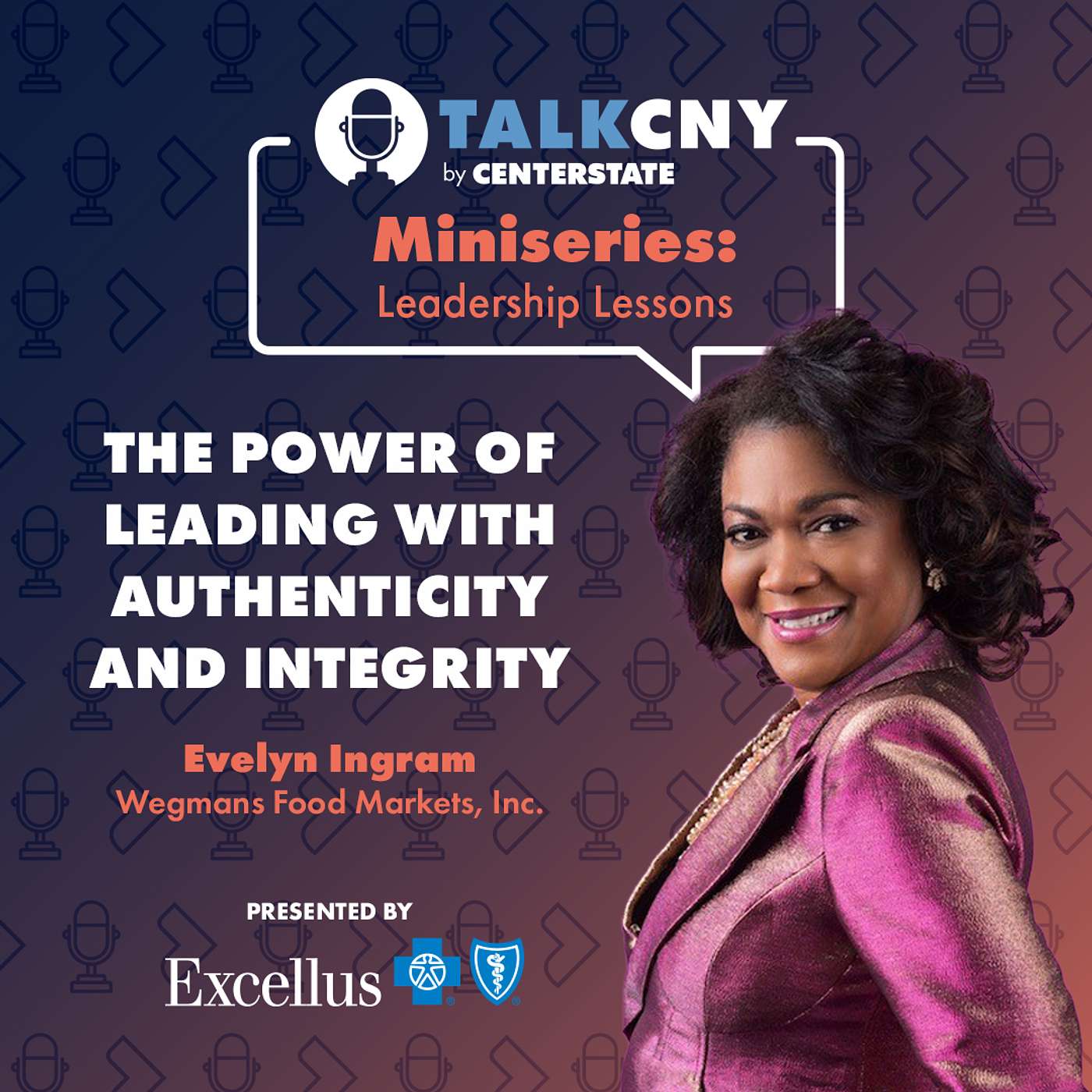
Welcome to the TALKCNY mini series Leadership Lessons presented by Axcelis Blue Cross Blue Shield. Today's guest is someone who is an example of purpose driven leadership in action. Evelyn Ingram began her career with Wegmans in 2007 as a corporate human resources manager and today serves as the Director of Community engagement where she works to connect one of the most trusted companies in the region to the people and the community it serves. For nearly two decades she has served building strong community partnerships and guiding community investment. And beyond her corporate role, she is co leading the transformation of a historic south side church into the castle. A project that is designed to create opportunity, connection and neighborhood revitalization. Joining us on this episode is Evelyn Ingram. Welcome Evelyn. Thank you for joining us today.
- [01:01]
B
Brittany. I'm excited to be here.
- [01:03]
A
Oh, thank you.
- [01:04]
B
Converse with you.
- [01:05]
A
Yes, I'm very excited. Well, you started at Wegmans in 2007 as a human resources manager. Now you are the director of Community engagement. How has your leadership style evolved over the years?
- [01:18]
B
So it's funny that you say 2007, that seemed like so long ago. And I will share that. I never ever thought that I would be with Wegmans this long. I mean it's been a great journey. But I guess I'll say the evolution probably was unanticipated because when I joined obviously I joined in an HR capacity. I really thought that that was going to be my path. But then I was approached for this position here which actually combines community relations and media relations because of my education and interests. And I was like, oh great, I think I'm going to do that. And so I literally look at it as a job that doesn't feel like work, which I love being in that space because I feel like it ties to my skills and my passion. So I love it. So I guess the evolution really unanticipated and it just has become to be something that I feel I've been able to kind of make my mark on and build a legacy from.
- [02:12]
A
Oh well, you really are building a beautiful legacy.
- [02:14]
B
Thank you. Thank you.
- [02:15]
A
So when you work with people across all different sectors, how do you build trust amongst business and community partners?
- [02:22]
B
So I think the great thing about Syracuse is that we're a city, but we're not a huge city, We're a close knit city. And I say that because when we have different challenges that are facing our community, everybody wants to get involved, everybody wants to help. All industries really want to get involved, to come together to help. So it really hasn't been difficult because we all have the same mission of helping. And I guess I always say, you know, I lead. I lead the way I would want to be led from the perspective of treating people a certain way, building that trust, you know, being honest, being transparent. I feel like I can always be in a safe space if I just operate as Evelyn. And so that's me. So, again, I feel like being able to do that in those different environments has enabled me to just really build trust. I think people see me and they see the way I operate with the level of trust, and it enables them to be trustworthy as well.
- [03:15]
A
I love that, you know, your authenticity, that is one of your, I think, hallmarks.
- [03:19]
B
Okay.
- [03:20]
A
It is something that you talk about throughout your leadership journey. That is, it was like there was like a turning point for you when you said, okay, I'm just going to move forward, forward and operate in authenticity. Can you share for us perhaps, like, what that turning point was?
- [03:31]
B
Okay, so it's funny that you asked that, because when I first started out of my career, I was at a very, I'll say, traditional corporate environment. And it was, you know, we had to wear our business suits every day. And, you know, it was just that very strict what people think of when they think of corporate America. I value that now because it really gave me a sense of business acumen and how to operate in a corporate environment, dealing with people, you know, being able to set yourself in a way that people respect you. And so I kind of always had that piece of it. But I'll say the authenticity piece happened actually during that time, but evolved later more was that I actually was involved in a gospel choir up at Syracuse University. I was a director when I was there for undergraduate, and I kind of stayed afterwards. And we were actually having a diversity day at my first company. And they knew I sang in the choir, and they asked me to bring my choir, and my choir came and sang in the auditorium at that company. And I'll never forget it. I realized that that's who I am. That's a part of me. And I was able to share that, you know, at that in that role. Years later, once I really began to be more confident in my skills, it made me able to feel more comfortable being authentically Evelyn. So it was like, you know, I'm like, you know what? I know I bring a lot value to the workplace. I know I'm an honest person. I know I work, walk in integrity. I know I'm going to always give 100% and more. And I'm confident about that. And I want to work for a company that values that. So because of that, it enabled me to just be, you know what, Evelyn. You should be Evelyn, because Evelyn is not a bad person. You know, Evelyn is going to add value. So that kind of that confidence level really helped me to evolve into that. And that's what I share with you young women when I'm talking to them, that it gets to a point where, you know what? You have to be confident in who you are.
- [05:24]
A
Well, we feel the warmth and the confidence. It's beautiful.
- [05:26]
B
Thank you. Thank you.
- [05:27]
A
So as you are working across so many different sectors, you're making different partnerships, initiatives, many deals. So as you're working with key stakeholders, how do you get everyone aligned on the same shared goals or missions, especially when you're navigating challenges?
- [05:42]
B
You know, what has happened is that in my role, I'm able to hear from many different organizations, and they know Wegmans has a very, I'll say, community engagement program that does provide resources to a lot of different entities. So with that, a lot of the companies reach out to me. And with that, I've been able to build relationships with them. But what it also enables me to do is to recognize that, okay, I'm hearing this organization saying they're doing this. I'm hearing this organization saying they're doing the same thing, but they don't know what each other are doing. So I'll bring those resources together, enable them to really have an even larger impact. So, again, everybody's doing good things, but sometimes we just need someone to kind of be that bridge to build to bring these two organizations together to help them achieve their mission. And again, I think, honestly, I think the Wegmans brand helps a lot because people love Wegmans. I mean, they love shopping at Wegmans. They love the quality products that we offer. And so I think that they intuitively just reach out to me just because. Because they love Wegmans. It's like, well, of course we're gonna love what they're doing because we love Wegmans. So I think. And because we have that rapport with so many different entities, it does enable me to bring people together.
- [06:47]
A
That's so beautiful. Well, you mentioned to me before, you didn't necessarily grow up in Syracuse, but now that you've been here for a number of decades, what inspires you to keep showing up for the people of this community?
- [06:57]
B
Coming here from Long island, undergraduate at Syracuse University, coming for my degree, to get my degree and leave. That was my intention. I wanted to go to some major cities and, you know, just, you know, I have my degree now I'm gonna go and be in New York City or LA or just, you know, just major cities. And that really wasn't what the plan was for me. So I think that, you know, now Syracuse has become home. And I love it because it really has everything, but people don't always recognize it. And I feel like everything, like, you know, we do have, you know, outdoor. We have beautiful parks and, you know, have some of the best wineries in the country. And cost of living is, you know, very low and comparable to major cities. You know, school system is great. Be able to raise your children and be. Feel that they're in a safe environment. I think sometimes people may take it for granted and always like, oh, it's nothing to do. It's. You know, it may not. It may not. It may not be exactly what you thought, but there are things to do. And even with that, I've kind of opened myself up to things that I may not historically have been to or go to, but now I'm like, you know what? I enjoy this. I enjoy being able to just interact with the people that I know and see here. So it really has become home. And now, when I think about it, I think I've been in Syracuse not. I think I have been in Syracuse longer than I was in Long island because I left when I was 18 to come here. And now here I am. I'm not gonna say how many years, but many years later.
- [08:22]
C
I love it.
- [08:23]
B
So Syracuse literally has become my son, you know, raising my son here, and, you know, he sees the opportunity and what's happening here. So I'm excited to be, and I plan to stay and continue to grow.
- [08:33]
A
It's a beautiful, warm region. I love that.
- [08:35]
B
It is. It is. I agree. I agree. Warm temperature when we get those great months, but warm from a people perspective.
- [08:41]
A
Yes, it really is warm from a people perspective. So when you look back over your career, what would you like for your legacy to be?
- [08:49]
B
Legacy? I would like for my legacy to be that Evelyn was someone who cared. And not just because she had to. Not just because her job, part of her job, is caring for community partners, but just because I knew that people know that. Take all of that away. Evelyn is still going to care. And for me, leaving a legacy of caring and compassion, which is what I try to instill in my son as well, I think is important because you can have all the. The materialistic things, you know, you can have. You Know all those kind of things that really are intangible, tangible, that kind of will go away. But no one can take away your care. No one can take away your compassion. So just want to continue to be that person. That's what I would want people to think about when they think about me.
- [09:40]
A
All right, well, now we're going to go into our rapid fire session. Okay, so this is a fun part of the series where I'm going to ask you a series of questions. Our goal is for you to answer them within 30 seconds or less, and then.
- [09:50]
B
And then we'll move on to the next one. Okay? Okay.
- [09:51]
A
All right, so the first question is, what accomplishment are you most proud of and why?
- [09:55]
B
Oh, gee. Okay. Confident. I'm most proud of is so many, of course, my son. I always say that I'm proud of him and the man he's becoming. But I will say, the transition that I made when I was with Go Redford women chair for American Heart association, that was one of those authentically Evelyn kind of situations where I said, I'll be the chair, but I have to be me and I'll share. Long story short, in the midst of everything, when we had our first luncheon under my leadership, it's a room of 800, mostly women. We ended the luncheon, which was, you know, weekday midday, ended the luncheon, doing the electric Slide. That's authentic.
- [10:33]
A
I love it.
- [10:34]
B
I love it.
- [10:36]
A
All right. What strengths do you rely on as a leader?
- [10:40]
B
So strengths I rely on as a leader would be integrity. I mean, I feel like that's important to me and to work for a company that walks, integrity and modeling integrity. So that's important for me, that's key because I feel like if I can align to your mission and it aligns to my values, and I'll be that even more productive.
- [11:01]
A
What habits or routines help you maintain resilience and focus?
- [11:05]
B
You know, it's funny, people always say, Evelyn, you know, you do so much. You're always here, you're always there. You know, do you ever take time for yourself? Yes, I do. I'm very tedious about my self care, and I make sure that I take care of Evelyn because I feel like I can't really help you if I can't help myself. So I take those times. It's simple. It could be simple. You know, I love manicures, pedicures, massages. I love that sometimes I just want to take time honestly and sit on my couch and binge on a Netflix series. And that for me is very rewarding. For me, relaxing. So I always make sure that I take time for myself. And I feel like I know when it's at a point where I definitely have to like, okay, what, Evelyn? You're at a point where you got to just take some time. And I make sure I do that. And that's very important to me. And if I. Even if I have to schedule it, I make sure that that happens.
- [11:52]
A
That's beautiful. Self care is important. How do you approach problem solving when faced with challenging situations?
- [11:59]
B
I hate operating in an environment where it's just not. And maybe this is just, I know, being idealistic of me, but where there's tension or, you know, where things are not going well, I just. That just doesn't feel good to me. So I always try to resolve it if I can. But actually, one of the people who I normally reach out to sometimes to help me is my husband. Chino is very great at just giving guidance and kind of looking at situations in a way to provide a solution. And that's one of the things I really admire about him. And I didn't really, really know how good he was until I kind of been using some of his advice. I'm like, okay, it's really, it's really working. So I really just tried to, you know, obviously I reach out to him, as I shared, but really also just being transparent and like, because again, I hate feeling like, you know, you can't say this. You can say this. You got it? So I just lay it on the table. You know, you and I have a situation. Let's just sit down, let's talk, let's work it through. Let me understand what your perspective is. I'll share my perspective. Perspective is, and let's come to an agreed resolution. And most times that works. I mean, I think sometimes people feel like it has to be this, you know, model, a formula of problem solving, but sometimes just sitting down, talking and listening, and that really resolves the challenge.
- [13:12]
A
Great approach.
- [13:13]
B
That's simple.
- [13:14]
A
All right, our last one in this section. How do you set and achieve ambitious goals while maintaining balance?
- [13:22]
B
I feel like you should never stop growing. And I mean, even though, you know, I've been at Wegmans and for, you know, now what, 19 years, geez, I still want to grow. I still work to grow. Even if it's taking on new projects, you know, doing. Taking initiative with things that may not necessarily be part of my job responsibility, but will be beneficial to the company. So I just, I think it's important to grow. And I don't think you could ever. You should ever stop growing. I mean, I don't think there's ever somewhere that you've achieved and, like, there's no growth left. I mean, I think everybody can grow. And so I try to make sure that I keep myself at a point where I'm growing, because when I'm growing, that makes me feel more confident, you know, more passionate about what I'm doing and more knowledgeable. And that also obviously reflects in the work that I do. So just kind of staying current and staying knowledgeable for me is important.
- [14:08]
A
I love it. Well, Evelyn, it has truly been a pleasure as we prepare to close. My last question for you. If someone is watching at home, they say to themselves, well, I want to make a difference both in the business and community sectors. What would you say to them? What would be your advice?
- [14:23]
B
So my advice would be three eyes. I guess I'll say three I's. And the first I is intelligence. You know, make sure that you are knowledgeable about, you know, what your craft is or what. What your arena is. And knowledgeable doesn't always have to relax, rely, or rest just on you solely. But it's being able to use your resources and knowing who you can call to get help, who you can reach out to that may be an expert in certain areas, I think. So. Use of intelligence, I guess I'll say. So I. That's the first I. The second I. I would say is initiative. You know, being able to take initiative. And to me, sometimes taking initiative means taking risk, but standing by what you're passionate about and feel as if this is the right thing to do it. And so sometimes. And sometimes initiative may not work, but I think taking the initiative, you can grow from it. But I feel like they always say doing things is better than doing nothing. So I always say take the initiative out. That's the second I. And the third I would be what I said earlier, which is integrity. I feel it's important to always walk in integrity because that's what gains. That's how people respect you and they trust you. And I feel like working for a company whose values exemplify your own values is important. I've been in a situation where a company transitioned their value system and it wasn't aligned with me, so I knew it was time for me to make other decisions. So I think being able to be integrity, walk with integrity so people can respect you, trust, you know, your work, and then hopefully a company that you're working for aligns with it as well. But always standing and that, to me, also works. Talk speaks to standing true to yourself, being authentically yourself. And so, again, I would say, intelligence, initiative, and integrity.
- [16:08]
A
That was wonderful.
- [16:09]
B
Thank you.
- [16:09]
A
Thank you for sharing that. Thank you. Oh, my goodness.
- [16:12]
B
It's funny saying these things out loud sometimes. It's things that we think about, but I don't always share them publicly. So thanks for the opportunity to be able to do that and hopefully it helps somebody.
- [16:20]
A
It will. It will. Well, I have definitely been inspired and educated today. Thank you so much.
- [16:25]
B
Thanks for having me.
- [16:26]
A
I.
- [16:26]
B
It appreciate.
- [16:26]
A
Appreciate it. Definitely. Well, the Talk CNY miniseries Leadership Lessons, presented by Axcelis Blue Cross Blue Shield, is available across all podcast platforms and CenterStateCEO.com have a great day, everyone.
- [16:41]
C
It's why I love my job. It's literally the best benefit that Axcelis has to offer where you can actually sit and talk to someone face to face.
- [16:49]
B
I've been studying this for two weeks now. I solved my problem in 10 minutes.
- [16:53]
C
I try to make it as simple as possible. I look at each member as if they were my family and I would want someone to take the necessary steps to reassure them and not take up too much of their time.
- [17:05]
A
Come see us if you have a
- [17:06]
B
problem and we will help you. And if we don't have the answer, we'll find the answer together.