
Podcast
Talking Billions with Bogumil Baranowski
Hosted by Bogumil Baranowski · EN
EVERY MONDAY A NEW EPISODE.
I READ ALL MY EMAILS - contact form on my website - www.bogumilbaranowski.com. TELL ME YOUR STORY.
I’m Bogumil Baranowski, an author, a TEDx speaker, an investor, and an investment advisor to families and individuals.
Intimate conversations about money, wealth, and living a rich and fulfilling life.
We talk about big ideas, big inspirations, big topics. We take on the hardest subject of all – money: how to make it, save it, keep it, but our conversations lead us to an even bigger question — what it means to live a rich life beyond money. NOT INVESTMENT ADVICE.
40episodes
Episodes
Newest firstAll episodes
On Consistency, Ownership, and Unconditional Giving: Unfiltered Coffee Q&A, July 2026
3d ago00:56:05Tap to summarizeThis month on Unfiltered Coffee, I share more about the machinery behind both the podcast and the investing practice — the 200-some episodes, the 2 decades of client relationships, the daily habits, and the things that simply take time and can't be rebuilt in a day, even if you wanted to. I share the idea of decision and choice fatigue: how templating the small stuff (the shoes, the shirt, the quarterly letter format) frees up mental capacity for the decisions that actually matter, and how consistency is the quiet, unglamorous compounding force behind almost everything worth building. I also talk about cultivating an ownership mindset with clients — wanting them to see their portfolio not as a list of tickers, but as part ownership in a handful of businesses worth understanding and holding.I also revisit a few books with fresh eyes: Scott Stillman's I Don't Want to Grow Up on the nonlinear relationship between money and lifestyle, David Schwartz's Thinking Big on belief as the foundation of getting help from the world, and John Kay's Obliquity on why profit, happiness, and most worthwhile goals are only ever reached indirectly. A paper from Steve Shaw and Gideon Nave on AI and "cognitive surrender" gets me thinking about the difference between reciting knowledge and actually understanding it — a distinction I trace back to a classmate from high school who could quote a textbook verbatim but didn't understand it. On the market side, I push back gently on the all-time-high headlines — you'll see why.I close with a personal story about an early client, and a round-up of recent conversations worth revisiting: Paul Johnson on Roger Murray and fundamental investing, Marion Fogli on the triple taboo of money, Robert Miles on 25 years of Berkshire CEO character studies, and a rebroadcast recommendation of the Jay Hughes episode on courage over knowledge. I end on an open question I'm still sitting with: can a gift ever really be unconditional? Listen, why the answer matters.Tune in to hear more.Podcast Program – Disclosure StatementBlue Infinitas Capital, LLC is a registered investment adviser and the opinions expressed by the Firm’s employees and podcast guests on this show are their own and do not reflect the opinions of Blue Infinitas Capital, LLC. All statements and opinions expressed are based upon information considered reliable although it should not be relied upon as such. Any statements or opinions are subject to change without notice.Information presented is for educational purposes only and does not intend to make an offer or solicitation for the sale or purchase of any specific securities, investments, or investment strategies. Investments involve risk and unless otherwise stated, are not guaranteed.
Transcribe →
James E. Hughes, Jr.: Great Advisors Offer Courage, Not Just Knowledge, The Five Capitals, 100-Year Thinking, and What It Takes to Help a Family Flourish
1w ago00:56:10Tap to summarizeFind me on Substack, search for my name.This is a summer classic — a re-release of an enhanced, longer audio episode that originally aired in late 2022, with my added intro and commentary. It’s among my most cherished Talking Billions episodes of all time. If you missed it, this is your moment. If you’ve heard it before, welcome back.It’s a heart-to-heart conversation with a dear friend, a mentor, who has shaped me and my career in so many wonderful ways.James E. “Jay” Hughes, Jr. is a widely respected voice in family wealth, governance, and legacy planning, known for helping families think beyond financial assets to the human and relational side of multigenerational success. He is the author and co-author of several influential books, including Family Wealth: Keeping It in the Family and Family: The Compact Among Generations, and his work has shaped how family offices and advisors approach long-term stewardship.Jay traces his own path to this work back to childhood: overhearing his parents argue about money, and learning that his mother’s family had lost everything overnight when her grandfather’s bank failed. That experience is the root of the proverb he’s spent his career trying to help families escape — “shirt sleeves to shirt sleeves in three generations.”Jay lays out the five capitals of family wealth — human, intellectual, social, spiritual, and financial — and argues the profession’s obsession with the last one, in isolation, is precisely what causes families to fall apart. He illustrates this with a simple hand gesture: thumb up alone is, in his words, “the death of a family.” Turn the hand over, and purpose, joint decision-making, lifelong learning, and thriving people all emerge, with financial capital finally in service of something.He explains why 70 to 85 percent of wealthy families lose their cohesion by the third generation — not usually from conflict, but from inertia, from never building a working system for making decisions together. That system, he says, is what separates families that endure from those that quietly disperse.Jay also unpacks what elders actually do in successful, long-lived tribes: they think in 100-year increments and mediate rather than decide, citing the Haudenosaunee’s tradition of honoring seven generations back and seven generations forward. He connects this to a piece of advice from his own father — that clients don’t come to an advisor seeking knowledge, since knowledge is fungible, but seeking courage to do something difficult.The conversation closes on money and parenting, with Jay offering a simple reframe for any parent standing in a toy store: never say “we can’t afford it” — say “we’re choosing not to have that today.” It’s a fitting note for an episode built around Jay’s foundation’s larger mission — helping families flourish so they can, in turn, build a flourishing society.Find out more about James E. Hughes here: The Foundation, Jay’s website.Podcast Program – Disclosure StatementBlue Infinitas Capital, LLC is a registered investment adviser and the opinions expressed by the Firm’s employees and podcast guests on this show are their own and do not reflect the opinions of Blue Infinitas Capital, LLC. All statements and opinions expressed are based upon information considered reliable although it should not be relied upon as such. Any statements or opinions are subject to change without notice.Information presented is for educational purposes only and does not intend to make an offer or solicitation for the sale or purchase of any specific securities, investments, or investment strategies. Investments involve risk and, unless otherwise stated, are not guaranteed.
Transcribe →
Robert P. Miles: What 20 Berkshire CEOs Taught Him About Character, Inside the Temperament, the Moat, and the Culture that Keep Compounding
2w ago01:19:25Tap to summarizeFind me on Substack, search for my name.Robert P. Miles is an author, educator, and the world's foremost authority on Berkshire Hathaway's management culture. Robert has written three bestselling books on Warren Buffett, created the only graduate MBA course dedicated to Buffett's philosophies, and founded the Value Investor Conference in Omaha. His journey from an entrepreneur to a globally recognized Buffett scholar began with a single Berkshire annual meeting in 1996 — and Warren Buffett himself has been paying attention ever since.Episode Sponsor: Fiscal AI is a modern data terminal that gives investors instant access to twenty years of financials, earnings transcripts, and extensive segment and KPI data—use my link for a two-week free trial plus 15% off: https://fiscal.ai/talkingbillions/Notes:3:00 – Bob Miles is introduced as the world's foremost Berkshire Hathaway culture scholar, author of three (now four) bestselling Buffett books and creator of the only graduate MBA course on Buffett's philosophies.5:30 – His path began with Napoleon Hill's Think and Grow Rich and a failed high school "movie day" venture. The lesson that stuck: "you got to understand what business you're in."7:23 – His first 1996 annual meeting: Buffett tells a small shareholder, "between you and I we own half the company," and calls Wall Street "the legal pickpocket of the average investor."14:24 – The Dairy Queen story: a self-published "101 Reasons to Own Berkshire Hathaway," a line around the block, and Buffett walking through the door — leading to a two-book deal with Wiley.31:18 – On concentration: Buffett put 65% of his $20,000 net worth into Geico at 19, tied to his "star player" basketball analogy for conviction investing.36:41 – The three unchanging lessons of The Intelligent Investor — stocks are businesses, your partner is a manic-depressive Mr. Market, and margin of safety — because "principles are principles because they don't change."42:59 – A contrarian aside: private equity "has done more harm than good," with the Berkshire system as its inversion.53:43 – On Berkshire's real edge: "I see the moat as cash," the roughly $400 billion war chest that lets Ajit Jain write insurance the day after disasters strike.1:08:58 – On character over credentials: concentrating on admirable traits "there's no cost," regardless of background.1:10:34 – Miles' definition of success: stay humble enough to be taught, and "go to bed a little bit smarter" every day.Podcast Program – Disclosure StatementBlue Infinitas Capital, LLC is a registered investment adviser and the opinions expressed by the Firm’s employees and podcast guests on this show are their own and do not reflect the opinions of Blue Infinitas Capital, LLC. All statements and opinions expressed are based upon information considered reliable although it should not be relied upon as such. Any statements or opinions are subject to change without notice.Information presented is for educational purposes only and does not intend to make an offer or solicitation for the sale or purchase of any specific securities, investments, or investment strategies. Investments involve risk and, unless otherwise stated, are not guaranteed.
Transcribe →
Marion Fogli, Finance Made Human: Money a Triple Taboo, Three Money Questions, and Talking Early About Inheritance
3w ago00:54:42Tap to summarizeFind me on Substack, search for Bogumil Baranowski.Marion Fogli, a Swiss digital banking pioneer who co-founded Switzerland’s first digital private bank, now teaches what she calls Finance Made Human, translating money into a language that real people can actually understand, use, and feel at peace with.Episode Sponsor: Fiscal AI is a modern data terminal that gives investors instant access to twenty years of financials, earnings transcripts, and extensive segment and KPI data—use my link for a two-week free trial plus 15% off: https://fiscal.ai/talkingbillions/3:02 – Growing up “rich in love, not money” — Marion’s father’s story shapes her definition of wealth.5:29 – Building Switzerland’s first digital private bank taught her: “The math is visible, but the behavior is where everything actually happens.”8:07 – The human touch problem: digital banks see anxiety in login patterns hours before a client ever picks up the phone.13:03 – On AI and investing: technology can hand you 30 stock picks, but not the conviction to hold them.15:18 – Money scripts, explained: childhood beliefs about money live in the body, not the words — “a shallow breath, tight shoulders, a nervous laugh.”17:21 – Three questions to surface your own money script: your body’s reaction, the sentence you heard most as a child, and the gap between what you say and what you do about money.20:38 – The surgeon who earned over half a million and had no idea where it went: “You have income, and you have financial peace, and they’re not the same currency.”23:07 – The cash experiment: Marion paid her kids in physical cash for a month instead of transfers — they ended up saving more.27:48 – Why money is the last taboo: “It actually reveals your vulnerability.” It exposes worth, achievement, and security all at once.32:06 – Unequal help given quietly to one child can destroy a family once it surfaces after a parent’s death.36:16 – The three-bucket system: Oops Fund, Projects Fund, Freedom Fund — “I called it the Oops Fund.”39:41 – “It’s about giving each Franc a job so the person can finally rest.”45:41 – Financial education starts with one question: what do you want your money to do, short, medium, and long term?52:48 – Marion’s definition of success: “It’s not what you accumulate. It’s what you can give without losing yourself.”Podcast Program – Disclosure StatementBlue Infinitas Capital, LLC is a registered investment adviser and the opinions expressed by the Firm’s employees and podcast guests on this show are their own and do not reflect the opinions of Blue Infinitas Capital, LLC. All statements and opinions expressed are based upon information considered reliable although it should not be relied upon as such. Any statements or opinions are subject to change without notice.Information presented is for educational purposes only and does not intend to make an offer or solicitation for the sale or purchase of any specific securities, investments, or investment strategies. Investments involve risk and, unless otherwise stated, are not guaranteed.
Transcribe →
Unfiltered Coffee Q&A, June 2026: On Trying, Waiting, and Learning to Receive
4w ago00:45:21Tap to summarizeFind me on Substack, search for Bogumil Baranowski. See you there!This month's Unfiltered Coffee finds me recording thoughts from the road after a few weeks of travel that pulled me away from daily news and toward ideas with a longer shelf life. I share reflections from Nir Eyal's book Belief, including the idea that successful people accumulate more losses simply because they try more things, and from Ray Madoff’s book Immortality and the Law, which traces how trusts extend the wishes of the dead into the lives of the living — a theme I see playing out more and more with clients and listeners alike.I also revisit familiar ideas from new angles: why rules matter more than exceptions (even when someone's great uncle smoked and lived to 102), why liquidity makes stock ownership fundamentally different from owning a car or a private business, and why AI hasn't sped up the one thing that still can't be rushed in investing — waiting for conviction to pay off. I reflect on value as something constantly exchanged in daily life, not just in markets, and on how removing time constraints and billing pressure can free both investors and professionals to do their best work.I close the episode with a round-up of recent standout conversations — Mike Nicoletti, Jack Schwager and George Coyle, Eric Pachman, and a rebroadcast of the Byron Tully episode on old money rules — plus a personal note on practicing receiving, not just giving, after a month of leaning on friends for help on a few occasions.Podcast Program – Disclosure StatementBlue Infinitas Capital, LLC is a registered investment adviser and the opinions expressed by the Firm’s employees and podcast guests on this show are their own and do not reflect the opinions of Blue Infinitas Capital, LLC. All statements and opinions expressed are based upon information considered reliable although it should not be relied upon as such. Any statements or opinions are subject to change without notice.Information presented is for educational purposes only and does not intend to make an offer or solicitation for the sale or purchase of any specific securities, investments, or investment strategies. Investments involve risk and unless otherwise stated, are not guaranteed.
Transcribe →
Everybody Inherits Something: Bogumil Baranowski on Money, Mortality & Living a Rich Life (The Gravitas Podcast with Anna Fata Shemin)
Jun 2600:39:57Tap to summarizeReposted here is my interview on Anna Fata Shemin's wonderful podcast, the Gravitas Podcast. Sign up, follow her incredibly thoughtful work: https://open.spotify.com/episode/432S3SNi56e0njlHgjAa1B?si=nT910BvxRO6Y267cdG-IuA---"Old money" is more than a TikTok aesthetic trend. There are real lessons to learn from the families who cultivate generational wealth, and they go far beyond the money.This week I sit down with Bogumil Baranowski, a Polish-born investor who came to New York to live the American dream and has spent two decades managing wealth for families. He's the author of four books, a TEDx speaker, and the host of the podcasts Talking Billions and co-host of 100 Year Thinkers.We talk about his childhood in communist Poland and how it influenced his career as an investor and Warren Buffett devotee. We discuss stewardship and how lasting family wealth has less to do with trust funds and more to do with family culture. He also discusses how money is not a prerequisite for living a truly rich life.Links from this episode:📚 Read Bogumil Baranowski's books and essays on managing money, wealth, and family legacy: 🎙️ Listen to Talking Billions, Bogumil Baranowski's podcast on investing, generational wealth, and living a rich life: 💼 Learn more about Blue Infinitas Capital, Bogumil's investment advisory firm: Connect with Bogumil Baranowski: Website: Connect with Gravitas: Instagram: @GravitasPodcast X: @annafatashemin Newsletter: http://annafatashemin.substack.com/Write to me: anna@thegravitaspodcast.comPodcast Program – Disclosure StatementBlue Infinitas Capital, LLC is a registered investment adviser and the opinions expressed by the Firm’s employees and podcast guests on this show are their own and do not reflect the opinions of Blue Infinitas Capital, LLC. All statements and opinions expressed are based upon information considered reliable although it should not be relied upon as such. Any statements or opinions are subject to change without notice.Information presented is for educational purposes only and does not intend to make an offer or solicitation for the sale or purchase of any specific securities, investments, or investment strategies. Investments involve risk and unless otherwise stated, are not guaranteed.
Transcribe →
Byron Tully: The Secret Life of Old Money: What Wealthy Families Know That They Don't Talk About
Jun 2201:08:36Tap to summarizeFind me on Substack!This is a summer classic — a re-release of an enhanced audio episode that originally aired in 2023, now among the most listened-to Talking Billions episodes of all time. If you missed it, this is your moment. If you've heard it before, welcome back.Over the years, I've had the pleasure of spending time with Byron Tully beyond this microphone — in person at a Parisian café, and on Zoom — and he joined the show a second time as well. His writing continues to find new readers around the world, and for good reason.Byron Tully is the author of The Old Money Book — with over 700 five-star reviews on Amazon — a grandson of a newspaper publisher, son of an oil industry executive, and a Paris-based writer who has spent a decade translating the time-tested values of America's wealth-preserving upper class into an accessible, practical guide for anyone willing to embrace them. https://theoldmoneybook.com/3:00 — Byron shares his upbringing outside Houston, TX: comfortable, only child, grandfather in newspapers, father in oil. Grandfather's early advice: "You're gonna have to learn how to manage your behavior."5:30 — Byron meets his wife from Boston; gets "neck deep" in old money culture — three-plus generations of wealth, manners, education, and core values.8:00 — The 2008 financial crisis revelation: L.A. friends who "looked rich" — Beamers, McMansions — lost everything. Boston friends? Unaffected. Flash vs. substance. His wife tells him to stop complaining and write the book.12:00 — Key insight: you don't need money to adopt old money values. The irony — follow the values and you'll start accumulating money because you stop chasing the next product. "The real awakening is to see money as an option-generating... freedom to choose."18:00 — On conspicuous consumption: old money views extravagance as "the fear of poverty." The question to ask — who are you dressing for? "Maybe nobody. Maybe I'll just dress discreetly and appropriately."24:00 — Sudden wealth and inheritance: Byron's personal experience with four inheritances. His advice: blow 1% first to purge the urge to consume, then ask how this windfall can change your life with purpose.34:00 — Old money values unpacked: health, education, politeness, modesty, financial independence, work ethic. "You can't borrow money and say I'll pay you back with time. You just can't."40:00 — Delayed gratification and long-term thinking: Amazon Prime erodes patience; the most precious things in life take time and "cannot be taken away from you."47:00 — Honoring inherited wealth: Byron reflects on his father working past 10pm. "It's the love that my parents had for me." Why can't he waste it?52:00 — On time: "Tomorrow is a promissory note, and yesterday's a canceled check." Social media is the enemy of time. Walking through Paris, looking at your phone — "What are you doing?"57:00 — Definition of success: being of service. Parents giving The Old Money Book to the groomsmen. "That's success to me."Podcast Program – Disclosure StatementBlue Infinitas Capital, LLC is a registered investment adviser and the opinions expressed by the Firm’s employees and podcast guests on this show are their own and do not reflect the opinions of Blue Infinitas Capital, LLC. All statements and opinions expressed are based upon information considered reliable although it should not be relied upon as such. Any statements or opinions are subject to change without notice.Information presented is for educational purposes only and does not intend to make an offer or solicitation for the sale or purchase of any specific securities, investments, or investment strategies. Investments involve risk and unless otherwise stated, are not guaranteed.
Transcribe →
Daniel Kertesz: The Family Outlives the Company — Don't Wait Until You're 80 | The Gray Rhinos Every Wealthy Family Must Face & Why Shirt Sleeves to Shirt Sleeves Is a Myth
Jun 1501:24:37Tap to summarizeFind me on Substack!Daniel Kertesz is a Zurich-based second-generation family entrepreneur, integrated family advisor, and author of Family Mind: Overcoming the Three-Generation Myth, who draws on his lived experience selling his family's multi-decade business to help wealthy families build resilient, values-driven legacies that outlast any single company.3:00 — Daniel traces his origins: father fled Hungary in 1956, mother fled Romania; both built a company in Switzerland. "I'm officially the first born, but actually not. The company was first."5:00 — On inherited trauma and silence: father survived the Holocaust, never spoke of it. "These stories were kind of heavy on our shoulder without us knowing."9:44 — The sale of the family business: "I was not happy. I was just relieved." His mother's first question days after signing: "Are you happy now?" The emotional toll on the whole family — parents, siblings, spouse — came later.13:38 — Packing up his office after 20+ years, leaving keys on the table as COVID began. "I didn't think that it would be the last time I would be there."18:00 — Introducing family mind: European families put the business at the center; the shift is to put the family at the center. "The family has a longer lifespan than the company."22:50 — Debunking the "shirt sleeves to shirt sleeves" myth: it's not fate, it's a focus problem. When you center the company, the myth often holds. When you center the family, there's a different path.36:33 — The "gray rhinos": death, divorce, and silence are the biggest risks to family wealth — far more destructive than market risk — yet almost no one addresses them.44:48 — "The biggest entrepreneurial lie is that I did everything for you." First, you do it for yourself. Acknowledging that gets you closer to the real questions.1:02:03 — On what separates families that thrive: courage. "No advisor can give them that courage. It's their courage." And: "Don't wait until you're 80."1:06:11 — Closing definition of success: "Look around the table. Look at all these people here. This is your life."Podcast Program – Disclosure StatementBlue Infinitas Capital, LLC is a registered investment adviser and the opinions expressed by the Firm’s employees and podcast guests on this show are their own and do not reflect the opinions of Blue Infinitas Capital, LLC. All statements and opinions expressed are based upon information considered reliable although it should not be relied upon as such. Any statements or opinions are subject to change without notice.Information presented is for educational purposes only and does not intend to make an offer or solicitation for the sale or purchase of any specific securities, investments, or investment strategies. Investments involve risk and unless otherwise stated, are not guaranteed.
Transcribe →
Jack Schwager & George Coyle: The Edge Moves. So Must You. Zero Evidence, Total Belief. How the Youngest Market Wizards Found Edge Where No One Was Looking
Jun 801:17:30Tap to summarizeJack Schwager is the legendary author of the Market Wizards series and one of the most influential figures in trading literature, whose decades of interviewing elite traders have made him the definitive chronicler of exceptional market performance; George Coyle is a hedge fund manager and deep-dive trading historian whose years of original research into the patterns of great traders catalyzed their co-authored Market Wizards: The Next Generation.Episode Sponsor: Fiscal AI is a modern data terminal that gives investors instant access to twenty years of financials, earnings transcripts, and extensive segment and KPI data—use my link for a two-week free trial plus 15% off: https://fiscal.ai/talkingbillions/3:00 — Bogumil shares personal origin story: as a Polish grad student in Paris, Jack's books gave him the courage to manage money. Jack jokes: "Not the first one."5:15 — George on his obsession: years of writing deep-dive papers on Soros, Marcus, Druckenmiller — getting inside feedback that he "hit the nail on the head."7:30 — Jack's biggest surprise from the first Market Wizards: how many enormously successful traders had multiple initial failures before breakthrough.9:10 — George on the youngest cohort: small-cap shorting is "the last rock you'd flip over" — yet that's precisely why these traders found edge where no one looked.11:00 — Jack on edge decay: trend following was transformative in the 60s–80s but got crowded; today, all edges evolve, and no edge is permanent.14:20 — Advantage of starting young: smaller capital means smaller losses. Simon Russo (pseudonym) and Frohlich both had failures early — with little money — then scaled correctly.30:33 — Jack: "A good trade is not necessarily a winning trade. A bad trade is not necessarily a losing trade." The process defines quality, not the outcome.33:00 — Position sizing as the great differentiator: Gudecker sizes A+ trades 5–10x larger; Marcus did the same. Ed Thorpe proved even a losing game can win with proper sizing.39:04 — Are trading skills learnable? Jack: Yes — Kulamaji went from $5,000 to $100M learning from others, but molded it entirely into his own methodology.42:09 — George's five questions for aspiring Market Wizards: clear goals, process that matches temperament, overcoming detrimental traits, belief in self, persisting despite failure.50:40 — Jack dismantles volatility as risk proxy: the drunk under the lamppost analogy — measuring what's easy vs. what's true.57:49 — AI debate: Jack argues markets are a complex adaptive system — unlike physics, the rules change constantly, which keeps the door open for human traders.1:03:52 — Jack's closing: readers of any Wizards book will get at least one or two things meaningfully beneficial if they're open-minded. This book adds a rare theme — wizards who stopped to ask: Is this what I really want to do with my life?Podcast Program – Disclosure StatementBlue Infinitas Capital, LLC is a registered investment adviser and the opinions expressed by the Firm’s employees and podcast guests on this show are their own and do not reflect the opinions of Blue Infinitas Capital, LLC. All statements and opinions expressed are based upon information considered reliable although it should not be relied upon as such. Any statements or opinions are subject to change without notice.Information presented is for educational purposes only and does not intend to make an offer or solicitation for the sale or purchase of any specific securities, investments, or investment strategies. Investments involve risk and unless otherwise stated, are not guaranteed.
Transcribe →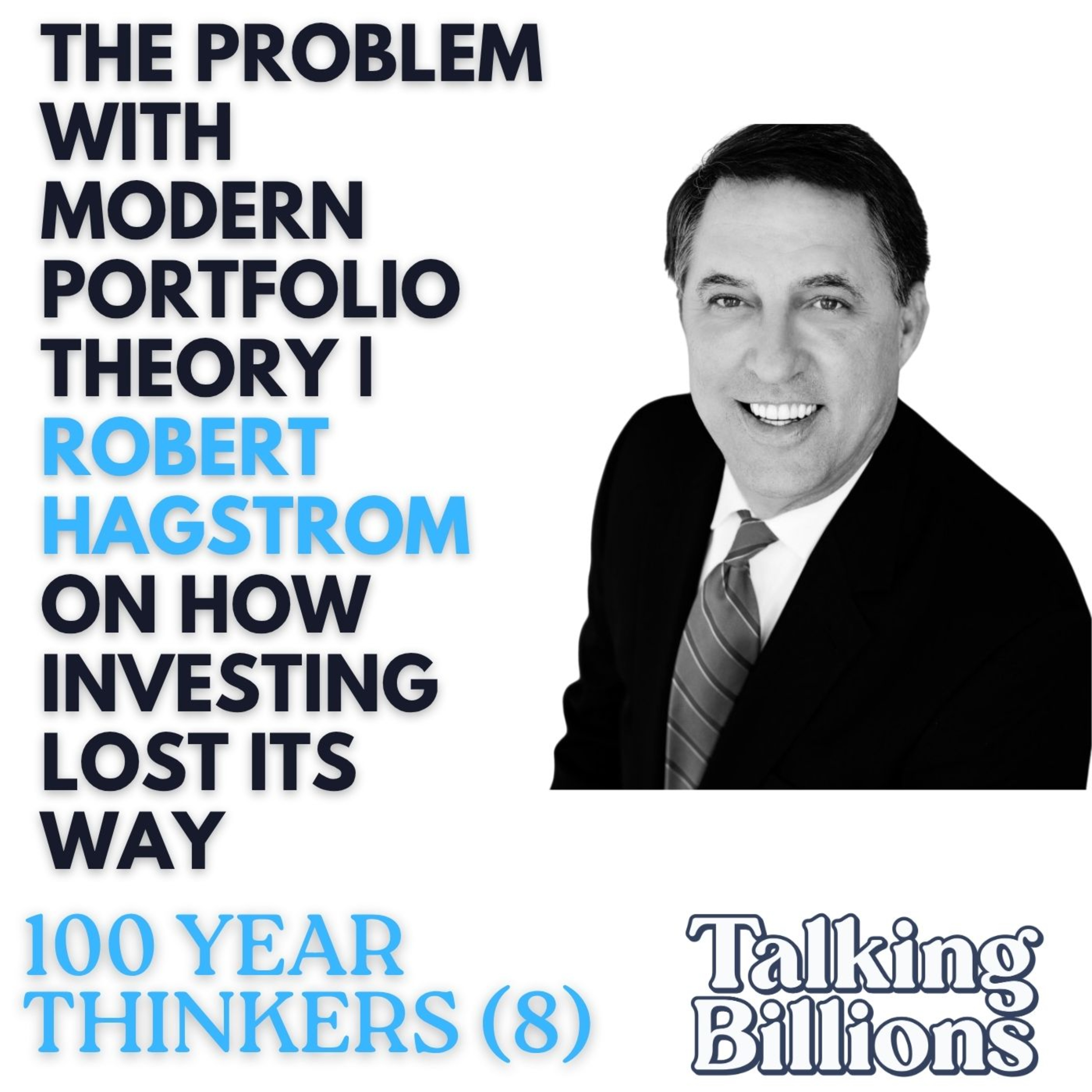
100 Year Thinkers, Ep. 8: The Problem with Modern Portfolio Theory | Robert Hagstrom on How Investing Lost Its Way
Jun 601:06:06Tap to summarizeIn this episode of The 100 Year Thinkers, Robert Hagstrom explains why modern portfolio theory pulled investors away from business analysis and toward portfolio math.We discuss Markowitz, beta, efficient markets, Warren Buffett, Charlie Munger, business-driven investing, owner earnings, benchmarks, and why thinking like a business owner changes how investors understand risk.The Warren Buffett Portfolio, 25th Anniversary Editionhttps://amzn.to/4uz8sZ3Topics covered:Why Hagstrom thinks modern portfolio theory changed investing’s objectiveThe difference between volatility, variance and real investment riskHow Benjamin Graham and John Burr Williams framed risk around intrinsic valueWhy beta became the dominant shorthand for riskHow the 1973-74 bear market helped institutionalize modern portfolio theoryWhy Berkshire preserved the business owner’s lensThe “cathedral and casino” distinction between owning businesses and trading stocksOwner earnings, return on invested capital and cost of capitalWhy business owners often make better long-term equity investorsLook-through earnings and building a “mini Berkshire”The difference between making money and beating a benchmarkHow benchmarks can distort investor behaviorWhy knowing yourself and your clients matters in portfolio constructionMatt Zeigler and I had the privilege of hosting Robert Hagstrom for a special 100-Year Thinkers Edition of the Excess Returns Podcast.Available now on Excess Returns Podcast and Talking Billions. 🎧I’m excited to share this episode with you—it’s reposted here with permission and blessing from the Excess Returns team. Don’t miss it! And follow their work, links below.https://www.excessreturns.co/https://cultishcreative.com/Podcast Program – Disclosure StatementBlue Infinitas Capital, LLC is a registered investment adviser and the opinions expressed by the Firm’s employees and podcast guests on this show are their own and do not reflect the opinions of Blue Infinitas Capital, LLC. All statements and opinions expressed are based upon information considered reliable although it should not be relied upon as such. Any statements or opinions are subject to change without notice.Information presented is for educational purposes only and does not intend to make an offer or solicitation for the sale or purchase of any specific securities, investments, or investment strategies. Investments involve risk and unless otherwise stated, are not guaranteed.Information expressed does not take into account your specific situation or objectives, and is not intended as recommendations appropriate for any individual. Listeners are encouraged to seek advice from a qualified tax, legal, or investment adviser to determine whether any information presented may be suitable for their specific situation. Past performance is not indicative of future performance.
Transcribe →