Loading summary
Transcript108 lines
- [00:00]
A
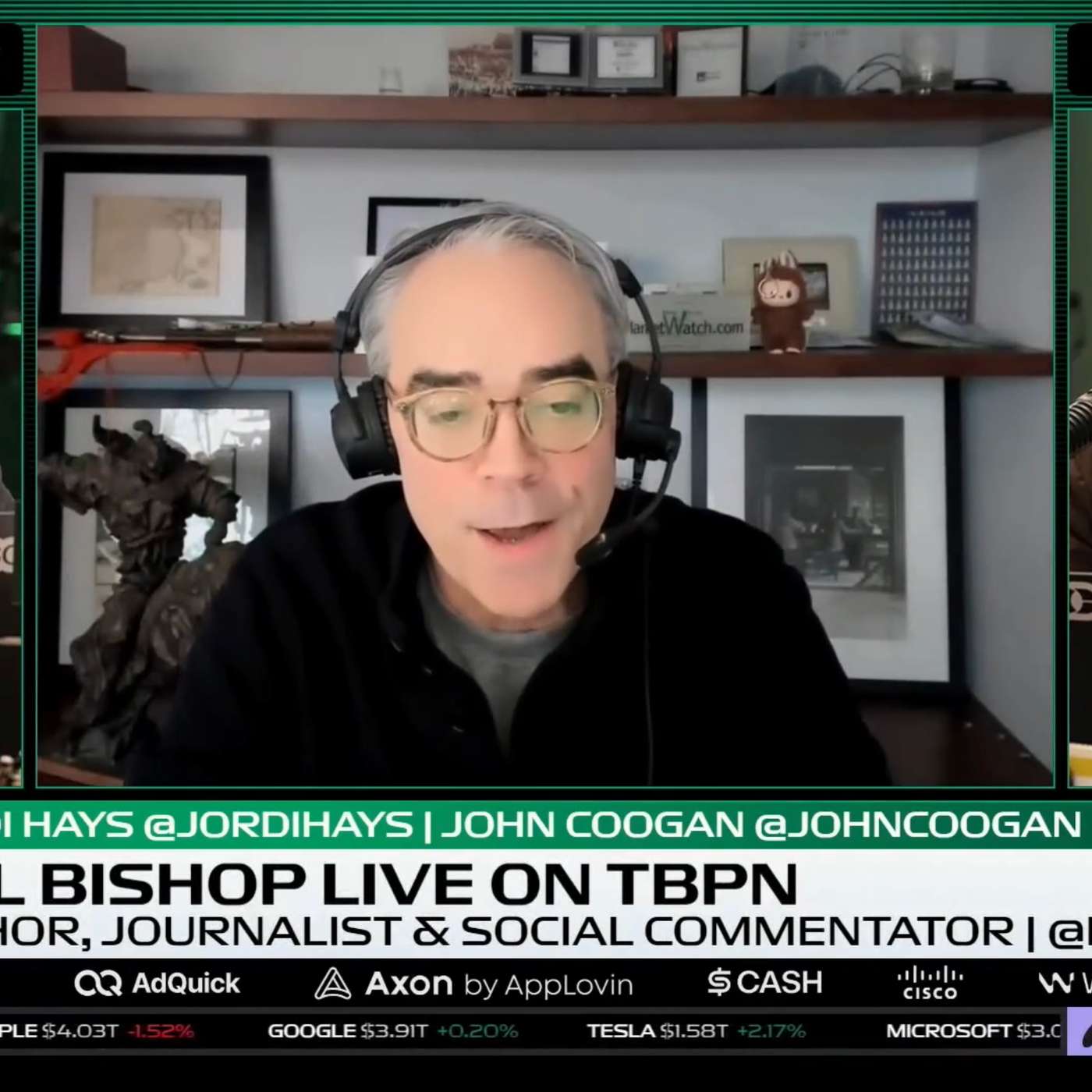
Without further ado, we have Bill Bishop. He runs Cymasism. Welcome to the show, Bill. Good to see you again. Welcome back.
- [00:08]
B
Hey, thanks for having me back.
- [00:09]
A
Happy New Year. How's your new Year going?
- [00:12]
B
It's going pretty well. Although it feels like we're near the north pole here in D.C. we've been iced in for two weeks. It's pretty nuts.
- [00:20]
A
Describe iced in. Are you actually. You can't go outside?
- [00:24]
B
No, I got everything dug out, but literally at one point, the guys digging out my driveway were taking selfies with the blocks of ice they could pick up.
- [00:32]
A
It was so big.
- [00:33]
B
Was.
- [00:33]
C
It was so big, it was frozen solid.
- [00:35]
B
Wow. And it still is.
- [00:36]
C
That's insane.
- [00:37]
A
Do you watch the Super Bowl?
- [00:39]
B
Of course. And congrats on your ad. That was awesome. Thank you.
- [00:41]
A
Yes.
- [00:42]
B
The earned media was. I don't know what your ROI, like the. The multiples on your 50k where you spent, but that was. What a brilliant hack. Congratulations to you guys.
- [00:50]
A
Yeah, thank you. Thank you. Anything else?
- [00:51]
B
The game kind of sucked, but, you know, other than that.
- [00:54]
A
Yeah, it was. It was not. Not the most exciting. Just a lot of field goals in the first half.
- [00:59]
C
Yeah, we. We unfortunately left, like, three minutes into the fourth quarter because it just. We knew it was insane chaos getting out, and then it just got really got. It got a little. A little more interesting.
- [01:11]
A
Yeah.
- [01:12]
B
So I have a question, but was that an interception or a fumble?
- [01:15]
A
Oh, I don't know. You're asking the wrong people.
- [01:18]
C
You're asking the wrong people. When did that happen in the game?
- [01:21]
B
That was their last touchdown right where they.
- [01:23]
C
Okay, so we had. We had. Yeah, we had left. Okay, we had left. We had to get to the airport. And to be honest, it was tough to follow because we went with the ramp team and a bunch of our friends. And so there was just.
- [01:36]
A
There were a lot of interesting conversations to have with folks, and so there's a lot of opportunity just to get lost in conversation and then turn around and. No, they scored.
- [01:45]
C
Anyway, any of the ads stand out to you?
- [01:49]
B
The robot vodka ad that you guys talked about a little while ago, which was pretty awful, but, you know, China's got the Lunar New Year's coming up next week, and Lunar New Year's Eve, the CCTV does this big spring festival gala with hundreds of millions of people watch. It's going to be full of robots. So I'm very curious to see how they spin the robot performances.
- [02:10]
C
Yeah, I mean, I think they're going to.
- [02:12]
B
Drinking vodka through the neck.
- [02:13]
A
Yeah, that was very Very weird.
- [02:15]
C
Yeah. Associating your alcohol, which kind of like tastes like engine lubricant, with heavy machinery, is an interesting decision. I expect the robots to perform incredibly well, just based on some of the demos we've seen where these things are flipping around, they're moving like actual fighters or dancers. It's incredibly impressive. And still worried that we're going to let them sell 10 million of those in before we wake up.
- [02:45]
A
Have you been following the DJI story?
- [02:47]
B
Which part of it?
- [02:48]
A
Just the ban and how fast it's rolled out, if there's any loopholes, because you always hear the headlines, Nvidia, the chips ban. Like, there's zero. Nvidia chips are going to China. And then it's like, oh, well, there's diversion, there's, there's cutouts, there's Nerf chips. The. That. That wound up. You could train deep sea, you could do a lot. And then the trade deal gets renegotiated. And so I'm just wondering, like, there were a couple founders who were sort of taking victory laps in the drone, American drone community, and I'm rooting for them. I love an American DJI. GoPro famously failed at this, mostly because of the supply chain pricing, all of that. But it's always like, I see people take victory laps and I'm wondering, it feels maybe a little bit like, will the new regulation stick? How, how, how. How all encompassing is the regulation?
- [03:37]
B
I think it's a bit premature, and I think you've seen already bits of it whittled away where now you can buy previous models and parts for it. And so part of the problem, I think, really is that DJI makes the best drones, both in terms of performance as well as cost. And so unless the American firms can actually make drones that, like, law enforcement wants or, you know, various companies want, you know, I mean, it's in an unfortunate situation. I certainly hope the American drone makers can catch up and maybe this regulation will help. But, you know, we have to be competitive, right? Yeah, yeah.
- [04:13]
A
I mean, it also just seemed like dji, yeah, there were a ton of, like, commercial applications, but it was just such a go to Christmas present for, you know, a lot of people, like, you know, the casual outdoor person that goes on hikes, they want to take cinematic video. Like, realistically, it's going to be collecting dust in three months, but it's going to be an epic present on Christmas. And so, I mean, that probably propelled a lot of sales and just helps get to scale, and that's important in these manufactured products. Right.
- [04:40]
B
And again, as we all, you know, you've talked about ad nauseam with lots of people. I mean, China has a supply chains for this stuff and we still don't. And so whether or not these regulations will pull that supply chain creation here, it remains to be seen. The challenge, of course, is you have to balance cutting off access to products that customers actually not just want, but need, like police departments, et cetera, but then at the same time just making it so that some companies can take advantage of loopholes, have some sales, but still kind of wash their components through third countries that actually still are probably Chinese components.
- [05:17]
A
Yeah, no, no, I mean the supply chain. I remember digging into the small drone motor market. So the motors that go on those drones, the small motors, and there are truly no American companies. There's one company in, I think Seattle that sold to private equity and they immediately offshored all of the manufacturing. And it's just like this Holdco now. And I think now they're starting to bring some stuff back. So there's like green shoots. But these things take years and years and years. Just look at like TSMC in Arizona. So years, maybe a decade to get actual to scale from like the initial plans. Anyway, let's dive into the PLA purges. We read through the Wall Street Journal's coverage and I have a bunch of questions, but how are you framing it? How are you thinking about what's happening in China today?
- [06:07]
B
So the PLA purges have been ongoing for quite some time. They've accelerated over really the last 18 months or so. I mean, they are part of a multi year process of Xi Jinping, both starting out, you know, taking control of the pla, but then also forcing through a whole series of reforms around structure, force structure operations to try and get the PLA to what they called world class fighting force with a specific goal for 2027. The centenary goals, which are the, it's the 100th anniversary of the founding of the People's Liberation army, where they want to be, you know, some people say they want to be able to invade Taiwan. Haven't explicitly said that, but it's to get, to get a force to the point where it could actually undertake missions like that. And the latest round where the PLA has a top structure, it's called the Central Military Commission and it's got a chairman who's Xi Jinping and then two vice chairmen and four members. So seven members. They're now two members, Xi and a vice chairman because he's purged the rest over the last year or so. And just for a couple weeks ago, they purged the remaining the one Central Military Commission vice chairman and one member. And it was quite shocking both because there have been rumors popped up and then three or four days later they were gone. But also the vice chairman who was purged was someone who was considered to be close to Xi, who she had kept on past assumed retirement age because he was supposed to be sort of Xi's guy. And so it's pretty shocking on the one hand. On the other hand, it's kind of a continuation of what's been happening. We don't know why. There's lots of speculation. The Wall Street Journal article you referred to, I think talked about possibly a briefing internally that said that this Vice Chairman John Shah was leaking nuclear secrets to the US Wish it were true. Haven't found anyone in DC who actually thinks it is. Would be impressive, right, if we had that level of a spy. But what I think it points to is, and then the question is how you interpret what's going on. There are lots of people who are trying to sort of put out versions of what happened. You know, there was rumors that there was a gunfight. Total BS as far as I understand. But it's a black box, so you can't say zero.
- [08:23]
A
So before we go into the implications and the interpretations, can you break down anatomy of a Purge history of Purging? It feels like a uniquely Chinese just event. Like we, you know, like when we elect a new president, a bunch of positions turn over, a new head of the FDA comes in or whatever. And we don't think of that transition as purging. Although of course some people get fired midterm, even if they've been appointed by the President. And so what's actually going on are these like forced resignations or these purges or these firearms?
- [08:59]
B
They are detained for investigation. Okay, so they are processing or alleged criminality or alleged violation of party or military rules in this case. And then they are. And all we got, you know, all we, all we got was a very terse statement from a very nervous looking Ministry of Defense spokesperson announcing that these two individuals, Zhang Yosha and Liu Zhengli, had been put under investigation. That was it.
- [09:24]
C
And so she has not come on the record, she has not come on the record about any of this.
- [09:30]
B
Not publicly. There, there have been authoritative statements in like the PLA Daily, which is the military's newspaper, but he has not yet said anything publicly. And there may be, at some point there'll be, he probably has talked about it internally. At some point, maybe we'll get a publication of some of his speeches, but we have very, very little information that's public about what's actually going on other than that these two have been taken away from investigation and so far they have not been replaced on this body.
- [10:01]
A
And then one way you could potentially read into this is that you're consolidating power, which makes it easier to perform military operations. The other is that you lost all your top guys who are going to help you with military operations. What's your interpretation?
- [10:17]
B
So it's a good question, and I think it kind of is both. There's clearly the number of generals and senior officers who've been taken out over the last two plus years is quite shocking. It's in the dozens, and so it's hard to imagine in the short term it doesn't have some impact on the military's ability to fight. But at the same time, there are a lot of officers and a lot of younger up and coming officers in the pla. The PLA has historically been an incredibly corrupt organization. And Xi Jinping has been, you know, he started, he really kicked off this anti corruption campaign in the PLA in 2014 in sort of full force. And so what may be happening is that he has realized that he just has to effectively decapitate one or two generations of the PLA to get down to a group of younger officers who were promoted not by buying their positions, as was very common through up until even I think, into the Xi era.
- [11:22]
C
How did those get, how did those get priced? Obviously under the table. Very.
- [11:26]
B
You guys, your audience may find this interesting. It's kind of like an angel investment, at least in some cases where actually people would collectively buy a stake in a rising officer. Because I'm not joking, right?
- [11:38]
C
Literally, no way. And then, and so they'd go, they'd go, basically they'd go out and say like, the officer would be like, hey, I've got some potential within the organization. I think I can get this job. Let me pull together some capital. And then they pull together that capital and then they take over, they pay off the person or someone to get the role, and then there would be a revenue stream back to the original pool of capital.
- [12:00]
B
The idea is you're, you're buying an option on a future revenue of corrupt goodies, right? I mean, I'm not.
- [12:06]
C
Because, because, because if said person gets the job, they'll be able to generate a bunch of revenue not just with their salary, but through like corrupt activities.
- [12:15]
B
They have they can create a whole bunch of opportunities for people who are close to them. Wow. And you.
- [12:20]
C
He basically gets a certain job, he's got access and control over some amount of budget and creates basically a little economy around, around within the stack. That is insane.
- [12:31]
B
And this was, and there are, there's been certainly, I don't think it's been in the media, but I'd certainly heard that among the funders of some of these officers in years past was our America's CIA because it was a great way to push people in and you know, eventually they owe you. Right. And so I mean it's actually, it's.
- [12:49]
C
Friends and family from the CIA.
- [12:52]
B
And this is something without going into detail, the party has talked about, about, you know, getting rid of this process of buying and selling promotions. And you saw from some of the previous cases of generals who were, who were detained early on in the XI era. I mean the stories of like, you know, the, the cars full of gold and the, you know, these suitcases of, of millions of dollars in Euros worth of cash hidden in one of their villas. I mean it's, the level of corruption was insane because there's so much money being thrown into military, you know, the military buildup.
- [13:23]
A
Interesting.
- [13:23]
C
Crazy.
- [13:24]
A
What's the state of.
- [13:25]
C
And so, and so part of that, if you have decades of corruption that have been like, that has been intimately intertwined with the military buildup, maybe doesn't give you that much confidence in a lot of the actual fighting force and the equipment, right? Because maybe it wasn't going necessarily to the, to the best vendor, it was going to the vendor that was pushing enough money out the back door.
- [13:47]
B
I mean that is certainly the risk and potentially the concern. I mean you look at, in addition to all these generals, they've basically taken out a significant chunk of the leadership of the military industrial complex. All sorts of defense contractor, defense weapons makers, heads of research institutes that were involved in weapons development. At the same time the weapons look like they work. I mean, think about China and corruption is, you know, China has this great high speed rail system, right? Well, the guy who really oversaw it is in jail because he was corrupt. So, but, but the thing is, is the corruption is just sort of like it's another tax. It still works.
- [14:20]
A
It still works, right?
- [14:22]
B
Unlike maybe other countries, you still get it done. It still works pretty well. But some folks, you know, but then you make a little money on the side.
- [14:28]
A
Wow, that's funny.
- [14:31]
C
He's like, I actually gotta make the trains run so I can keep the gravy train going.
- [14:35]
A
Yeah, exactly. The gravy train is important. Lots of lessons there. What's the state of communications or relationships between Donald Trump and Xi Jinping? Are they talking regularly? Are they meeting in person? Are we at, like, a local top or local bottom? Are things the worst they've ever been, somewhere in between?
- [14:57]
B
No, no, we seem like we're in a steady state. They had a call last week, which, you know, again, I think is an indication that so far, at least, things are on track for. For President Trump's visit to China in early April. There was one sort of wrinkle, though, in the readout from the Chinese side of the. Of the call he had with. With Donald Trump last week. He was. Had some pretty stark language around Taiwan and specifically around U.S. arms sales to Taiwan, because the U.S. sold 11, you know, announced an $11 billion arm sales package to Taiwan back in December, which was at the time, it's a very large number. The US has sort of been doing billion or so kind of packages and rolling them out. The Chinese get pissed off, but, you know, they move on. 11 billion was pretty significant. I had heard that the reason the Xi Jinping had mentioned sort of being prudent around arms sales to Taiwan last week was specifically because the US Was working on a big arms package. The Chinese had found out about it, and the Chinese ambassador here in D had basically gone to the White House and thrown a fit over the weekend. You know, we saw, I think, on Friday, the Financial Times reported, yes, there's a $20 billion package in the works, and it's something the Chinese don't want to have happen. And they have threatened to postpone or cancel Trump's visit. And I think. I think they might actually meet it. And so I would imagine that the Trump administration won't push forward that sale until after the meeting. What's interesting, though, again, is it's not clear Trump knew about it. This is people in the administration who maybe are more interested, who are sort of more pro. Taiwan not happy with this kind of. Whether you. I don't want to call it Teton, it's a little too early for that. But this sort of steady state in the relationship over the last couple months, and they want to make sure that Taiwan is still getting attention.
- [16:43]
A
Yeah, it's fascinating. How does China frame the Taiwan question? Internally in the west, we sort of all accept the premise that if we're doing an aid package, it's for defense, and that the only possible scenario is that China would invade at some future date. But Does China use rhetoric that's like, well, we don't want Taiwan to have weapons because we're worried about them invading us. Is that even something that they toy with, or are they saying like, we don't want them to have weapons because we're planning to do this at some point?
- [17:19]
B
Well, no, I don't think they're worried about Taiwan invading. I think it's more, you know, Taiwan is the first of their red lines, especially in the US China relationship. And so they, but ultimately they, you know, they don't want, I mean, the U.S. yeah. Saying we're going to sell you a bunch of weapons. Even if right now, for example, Taiwan, because of the political. What's going on, the Taiwan politics. You know, the Taiwan legislature won't approve the budget to buy the last package of weapons because it's the opposition party controls with a, with a coalition partner controls the legislature.
- [17:52]
C
So this $20 million and package, should we assume that CCP operatives have effectively infiltrated the opposition party, or is that too much of a tinfoil hat? Because I imagine if you were, it would be worth the time to try to get your team elected.
- [18:12]
A
Good seed investment.
- [18:13]
C
Yeah, good seed. So put an adventure.
- [18:16]
B
There are no questions. A lot of influence efforts. The Taiwan government under the current president, Light Ching Te, has definitely stepped up and talked more about these kinds of infiltrations and influence. I don't think there should be any surprise that that is going on. But ultimately, for these arms packages, it's also a signal of, I think the US Is trying to make it a signal of we still support Taiwan. So that because what Beijing wants ultimately is for the Taiwanese people to think that there's nothing, there's no help coming, they have no other choice. But effectively resistance is futile. Roll over. And the faster you roll over, the better you'll be treated. Is I think, the kind of the constant messaging they're trying to put out there. And so support from the US in terms of either rhetorical or big arms packages messes up that messaging. The comments from the Japanese prime Minister back in November mess up that messaging. And then they also complicate the PRC's planning. In the event that there is some sort of scenario where they have to use some sort of force. It's going to be a lot harder if the Taiwanese have better weapons, better training, and have support from, you know, the US and potentially Japan has to get involved.
- [19:29]
C
What economic indicators are you tracking in China? Broadly, things like unemployment rate, foreclosures, general, you know, development, infrastructure development, housing development, all that stuff.
- [19:44]
B
So, I mean, all those are worth tracking. You know, all you have to sort of filter through the data. I think the, the, the consensus of a lot of the folks who really tracked us closely is that generally like the economy is not doing great, but it's also not falling off a cliff. Right. It's, you know, it's not the binary like boom, boom or bust. The things to really watch over the next. I mean, we'll learn a lot more by the middle of March because the first week of March starts what's called the two sessions. And the one that matters is this national People's Congress, their legislature. And so we'll get a work report from the premier that will then lay out targets for this coming year in terms of things like GDP growth and et cetera. But then also this is the year where they roll out the 15th Five Year Plan. And that also includes not only high level goals, but also some targets in certain sectors. And so those ultimately I think are more useful to look for over the next few months than some of the sort of high frequency data, just because the high frequency data is noisy. And ultimately the Chinese, you know, again, the stock market's up 50% or so from the lows. It's at a new high. I think today the tech sector is booming. I don't want to say bubble, but there's a big AI boom in terms of the AI related shares.
- [20:56]
C
Yeah. Their AI companies are going public much sooner than ours, right?
- [21:01]
B
Yes. With much lower revenue raising, much less money, much lower valuations. And a lot of it is because they, you know, they, they actually need the capital. I mean, it's, I think they. But the amount of capital they need in raising is a frat. It's like, it's like, you know, a rounding error. For what, like open AI is raising? Not quite, but sort of.
- [21:19]
A
Yeah. I mean, you see some.
- [21:20]
C
What is the general pop. How does the general populace feel about AI? I think most of America is, especially after the super bowl. Nobody was seeing the Super Bowl AI ads being like, you know, this is amazing because it kind of sucks. Well, yeah, okay, so that, yeah, the ads weren't that great. A lot of them weren't that great. But there's just also a general fear around job displacement, lack of, you know, people are not excited even to put a data center in their state. Right. We have all this legislation going down the pipeline, but how do people in China actually feel. Unemployment rate for youth is already so high, it's hard to imagine it going much higher. So maybe There maybe people already feel like it's over.
- [22:02]
B
So, I mean, data centers, energy, obviously you have other guests who talked about it's not an issue for China. Right. It's somewhere they could build as many data centers as they want, as long as they can get the chips. That's the bigger issue. I think when you look at what the government is doing, they have this AI plus plan they rolled out a couple months ago where it's really to embed AI throughout the economy and throughout society. And so they're not really focused on as much as sort of getting to AGI and these, these massive models, they're really more focused on diffusing, you know, how do you use AI and all sorts of tasks in your apps, in WeChat, in for, for, for medical, for like seeing doctors for medical advice. I mean, there's a big boom right now in companies chasing sort of medical AI, including Alibaba. And so it seems like even though it may not be the models may not be like the ChatGPT or Gemini levels, at the same time they're being taking a much more pragmatic and practical approach to just diffusing it through society. And then in terms of what it does to employment, there's been lots of discussions about the impact. I think it's a country where they can incentivize positively or more negatively companies to not necessarily lay off as many people as they would if they were operating just purely on an economic basis. When it comes to sort of AI disruption doesn't mean unemployment is not a significant problem for the youth. And, and I don't know, I don't know that they have a good solution for that. But it isn't holding back what they're trying to do around AI at this point.
- [23:33]
C
That makes sense. Last week Jensen was on cnbc, I think it was Thursday or Friday, talking about, you know, how the overwhelming demand, obviously we had earnings last week. Everyone's raising their capex guides. You have legacy AI chips that are sitting at very high utilization, surprisingly high utilization and pricing compared to what a lot of the AI bears have been thinking about over the last six months saying, like, hey, all of these chips are going to be worthless. And turns out like Michael Burry and others. Yeah, yeah, those, those types. And so I think there was some conversation around, okay, and if Jensen wants to go like, hey, all these people are super chip constrained. I think the question comes up, why? Okay, so then why are we, why are we selling, why are we selling chips to China then?
- [24:24]
B
Right.
- [24:25]
C
If our leading labs are not able.
- [24:28]
A
To get the call Amazon, they'll buy them.
- [24:31]
B
Yeah, it's a great question and it's something that has certainly you've seen some movement on Capitol Hill asking that question, asking the impact on HBM prices. Right. Memory prices. And ultimately the answer is, well, Jensen Huang can go direct to Donald Trump and convince him to approve these sales. What's interesting, right, I think it was the Financial Times reported last week that even though like the Department of Commerce has signed off on the licenses to sell to China, the H200s that the Department of State. The State Department, which has this bureau of, I think it's arms control and non proliferation, they have yet to sign off on it. So the sales actually haven't happened.
- [25:12]
C
Interesting. And what is the general sentiment now from the CCP and various groups? Because when the first time we maybe agreed generally to a chip sale and then Howard Lutnick came out and said like we're going to get them addicted to the American stock. And then they were like, actually we don't want, actually they were like, no, we don't want them. But clearly all the companies want them. Their compute, they're way more compute constrained than we are.
- [25:37]
A
They're ready to rock.
- [25:39]
C
And so where is that actually, do you think that if it actually gets fully approved that they will all flow without any type of red tape on the China side? Yeah.
- [25:47]
B
Or no, there's been reporting, I mean various reports the Chinese are being careful about who they allow to actually order and they're talking about the H200. They didn't want the H20s. They need the H200s because China has enough like they can actually make looks like decent inference chips. They just can't make the chips they need for training. Right. And so that's the H200 fills that gap. And so I think the Chinese perspective is, look, we're not there yet. We can fill this gap. We have to sort of keep competitive in the AI game. Nvidia, the US Government has approved these sales. Nvidia will sell this to us. We're just going to make sure that if you buy these, you also have to also make sure you're buying Chinese chips to keep supporting our own indigenous ecosystem. Right. And then of course there are some, I think potentially some security, security concerns because of the, whatever the security review the US Is requiring, which is basically, I think just to make sure that the chips get shipped to the US charge the 25% licensing fee as a tariff, which makes it legal, and then ship them back to China. But you know, from the Chinese perspective, what's the security view where they have to do these, you know, who knows what they might do these chips. So there are certain places I think that like state owned enterprises, certain labs where they probably won't want these chips. But the issue also is right there's also still a lot of Nvidia chips in China. Right. So we should see in the next week or so. If you remember, you guys, it's been a year since the quote unquote Deep Seq moment. Right. And so now everyone's waiting for Deep Seq's next model which is supposed to launch on or around Lunar New Year which is next Wednesday the 17th. So we should have some sort of a deep seek model in the next eight or nine days. I think it was the information reported it's being trained on Blackwells which they're not supposed to have. Right. But somehow they have the black walls.
- [27:32]
A
They fell off the back of a.
- [27:33]
B
Truck and they can get as many Nvidia top end chips as they want hosted overseas in these cloud facilities.
- [27:41]
A
Yeah, right.
- [27:43]
B
So it is not a clean set of controls by any means.
- [27:46]
C
Yeah. What do you think China's reaction is to the latest election in Japan? Obviously Japanese equities responded positively to the result. But how are you tracking that whole situation?
- [28:03]
B
I mean I think that the Chinese helped Takechi because their reaction to her comments in early November which again she said she reiterated the Japanese position on sort of a Taiwan contingency, so to speak. She said it in a setting where it hadn't been said before by sitting prime minister and, and you know, but their reaction really I think helped make her case and other sort of more defense hawks in the Japanese government make their case that we need to do more because China's a threat and so now she really has a mandate. The question will be will the Chinese continue to really push on her or do they sort of find ways to over the next. It won't be immediate but over some period of time find ways to at least calm things down and then start re engaging with dialogues. I think, you know the fact that they clearly started playing the rare earth cards cardigan with Japan, you know also again in some ways there's no going back for Japan. Even if the Chinese were to find they were to find an off ramp and find a way to sort of get back to kind of the U S China sort of detentis like relationship around. I think the damages have done in terms of Japan needs a stronger military and Japan needs to move faster to protect itself from the weaponizing of certain parts of the supply chain that China can do, which we all know from rare earths.
- [29:29]
A
Yeah. Yeah, that makes sense. Anything else?
- [29:32]
C
This was super fun. Fascinating. We love having you on. The audience. Audience loves you, too. And I'm going to follow up and ask what headset you use, because we're making. Because not every guest of ours comes in with a sound video set up like this.
- [29:48]
B
It's a shure. It's a shure headset. And Ben Thompson got it for me, you know, because he. Because I do the Sharp China podcast with his team and with Andrew Sharp. And so Ben sent me all the gear.
- [29:57]
A
Very thoughtful.
- [29:57]
B
So I have this solid state logic little box and then I plug in this. This headset actually. Is it. Sorry, it's a Sensenhauer thing. Sorry.
- [30:06]
A
Sennheiser.
- [30:07]
C
Sennheiser.
- [30:08]
B
Sennheiser. Yeah, there we go.
- [30:09]
A
Sennheiser, Alpha. Well, thank you so much for taking the time.
- [30:12]
B
Have a great day.
- [30:13]
C
Great to see you.
- [30:14]
A
Good luck with the weather. We will talk to you soon.
- [30:16]
B
Thank you.