Loading summary
Transcript116 lines
- [00:00]
A
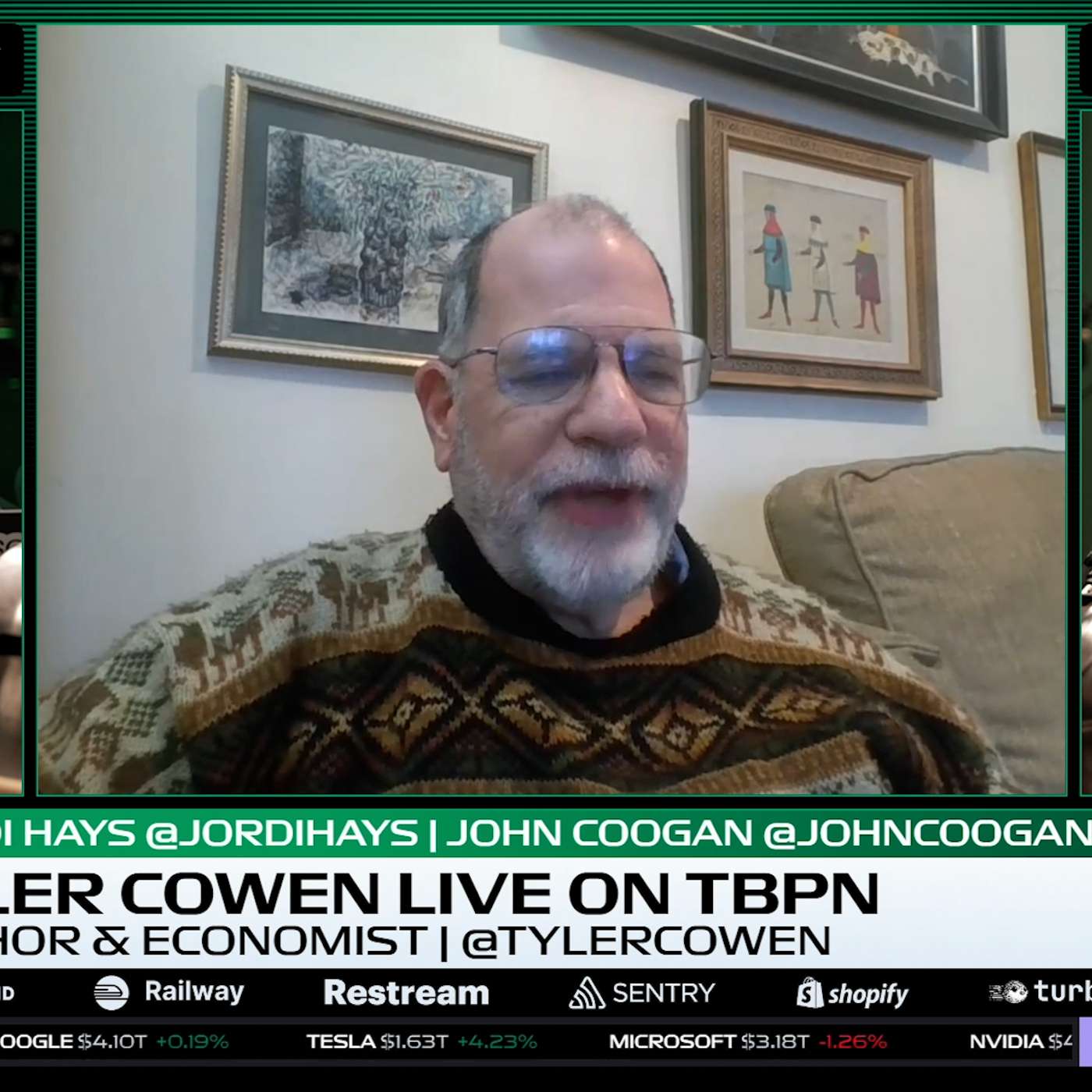
And without further ado, we have Tyler Cowan returning to the show. He's in the Restream ready room now. He's in the TVPN Ultra room. How are you doing, Tyler? Good to see you. Happy to be back.
- [00:09]
B
Good to see you here in Virginia. Snowed in.
- [00:12]
A
Oh, are you actually snowed in? I've seen a lot of videos. I don't know exactly how bad it is. How long do you expect to be snowed in?
- [00:19]
B
Well, we can get out to some places. Getting around Washington's terrible. Our driveway is fine now, but normal civilization has not yet resumed.
- [00:27]
A
Oh, well.
- [00:29]
C
Do you like being, do you like being. Do you like, do you kind of like being snowed in?
- [00:35]
B
Well, I'm doing the show, otherwise I'd be out and about.
- [00:38]
C
There we go. We got a root for more snow to our benefit.
- [00:40]
A
We got a roof from our snow. I'm glad the Internet's stable. I don't know if you're on Starlink satellite or something, but it seems like we have a strong connection. Anyway, I'd love to get your reaction to the new Fed chair pick. How much do you know? How much did you see this coming? Any initial reactions? And I have a bunch of questions about the mechanics of what might coming down the pipe.
- [01:00]
B
It's not surprising at all that Kevin Wash was picked. It's a very difficult pick to judge. So usually you think, what does this Fed chair believe and is it in accord with what I believe? I think what Kevin Walsh believes is that he should be chair of the Fed. So he's very good at politics. First he's for tight money. Now with Trump as president, he's for easy money. Like, that's fine. It doesn't bother me. The real question is what's the psychological and power dynamic between that person and Trump? How will he do? I'm not sure, but the fact that he's connected to the very wealthy Lauder family fortune to me says he at least has the freedom to tell Trump to take a hike. It could work out okay. It's not the end of.
- [01:42]
C
Well, he's smart enough to know exactly what he's getting into, right? I mean, he know. He knows that if he does things that Trump doesn't like and he becomes the enemy of Trump, then he's going to either have to be some type of martyr or, you know, it's not exactly fun to be on the receiving end.
- [02:03]
B
It's an impossible job for anyone at the current moment. But I think it'll be okay. It's no Reason to panic.
- [02:08]
A
That's good.
- [02:09]
B
Stocks down a bit, dollar up a bit. Big deal. Let's move on. You know, we can all move on and see how it's going to go.
- [02:15]
A
That's good. Zooming out. What have you been reading into the massive run up in precious Met?
- [02:23]
B
Well, the dollar with one class of investors has lost a lot of safe haven status. But keep in mind equities have mostly done okay over the same time horizon. So to say that, you know, the US financial position has collapsed simply isn't true. But those are markets, you know, they're not super large. And some money flows in or flows out, you want something to buy, you know, Bitcoin, we've realized, not a hedge. Where else do you go? The rest of the world seems a bit crazy. Europe is still slow growth. You pick the precious metals. They're like the new meme stocks. Okay, that's fine. I don't think it has major significance, but look, it's not good news, right?
- [03:04]
A
What do you think about Warsh's idea of lower interest rates but also quantitative tightening? How realistic is that? What are the downstream implications of that? Does that feel like something that can actually result in a more like smoother yield curve? I guess just my fear is that you bring down the interest rate, but during quantitative tightening, mortgage rates actually go up and we see the 10 year yield increase.
- [03:33]
B
Yeah, and the question is, will Wash matter at all? He has his own board, which I think is not per se loyal to him. He doesn't have too many sticks or carrots. He has to deal with Trump. Congress will probably get more active. Democrats will win the House. More importantly, they may even win the Senate or at least be close to that. So he's juggling all balls just politically to stay alive. So what he thinks about X, Y and Z, I wouldn't put a whole lot of weight in. But as I said last time on the show, we're in this new era of fiscal dominance. It's the fiscal variables that matter. US Central bank becomes a bit of a puppet to those and that's the job Borscht has.
- [04:11]
A
So what does that mean for how we should be thinking about the size of the Fed's balance sheet? He's sort of lamented the fact that it's grown 10x over his career at the Fed. Is 7 trillion inherently too much? Is there a logical chain of reasoning to justify quantitative tightening or easing? How should we think about the correct size of the Fed's balance sheet?
- [04:38]
B
If I were running the Fed, I would Enjoy being in charge of the biggest hedge fund in the world. Right. So it's an easy target when you're not running the Fed, but in fact, it's done for various political reasons, whether we like them or not. And the fact that in the past he criticized that, I don't think it means much. I think he'll do what's politically expedient. Yeah, it's okay.
- [05:00]
A
Yes.
- [05:01]
C
How do you. How do you. Do you think that, like, how do you view Bess and Warsh, given their kind of shared history? Kind of.
- [05:10]
B
Druckenmiller.
- [05:11]
A
Yeah, Druckenmiller.
- [05:13]
B
I don't know. I think Congress will become much more important again. So that's what I really have my eye on when thinking about the macro situation, that Trump's declining in popularity, the next election is approaching, Democrats will gain further ground, and that's where the action will be. Is Congress actually speaking up a lot more specifically on fiscal issues? You can do okay with them in those jobs. Again, I'm not at all panicked or unhappy, but I don't think they're going to be driving positive change either.
- [05:44]
A
Yeah. Can you dig in a little bit more on the foreign buyers of Treasuries? It feels like China and Japan are pulling back. We heard sort of some jockeying around Denmark over Greenland. Is there a meaningful shift in foreign participation in the treasury market?
- [06:02]
B
I doubt it. Keep in mind, you can buy Treasuries directly or indirectly.
- [06:06]
A
Sure.
- [06:07]
B
So everyone buys Treasuries. Instead of buying Treasuries, you can buy institutions that buy Treasuries. And it's like Modigliani Miller Theorem, same final effect. There's nowhere else to go. The real problem would be if there were a rival asset. There's nothing. The fact that gold and silver went crazy is kind of proof that there isn't. Like, where else can I go? Well, I'll buy some silver. It's a sign, actually, that there's nowhere else to go besides the dollar.
- [06:32]
A
Yes. There was someone that was jokingly posting, sell everything. Sell your house, sell your stock, sell your bonds, sell your dollars. And of course, the joke is, well, what are you going to buy? Then you have to put the money somewhere. It does feel like there's a demand for a store of value, and that's maybe what's driving the gold trade. That, that, that Bitcoin never really took up the mantle of the true store of value. Do you. Do you buy that, that there's more people that are thinking about, you know, more durable store of value? And that's what's driving all of this.
- [07:04]
B
I do. People will keep on looking, they look at different things. But if you want something that does not positively covary with treasuries, I'll just say good luck, you know, send me an email when you find it. So it turned out Bitcoin is, you know, super positive, covariing with a lot of other US assets, which again is good news for the US may not be good news for those seeking a hedge. I worry the world is just becoming a lot more correlated. Yeah, that's my big worry. What did you go down the drain? There's nowhere to hide.
- [07:35]
A
Yeah.
- [07:36]
C
So tether, tether, you know, buying a bunch of gold. Any reactions to that? Is that just, you know, good? Is that signaling or is there something more significant there?
- [07:49]
A
Gold backed stablecoins, essentially.
- [07:51]
B
Well, brilliant investing move. But if I'm the people regulating stablecoin institutions, I'm getting real nervous very quickly and whether they will be part of that regulatory network we'll see. But I think this is them a bit thumbing their nose at it and saying, well, we're just going to invest in what we want to invest in and we're not going to be fully transparent and you can take your risks if you want, but I think that's the importance of it.
- [08:16]
A
Yeah. We were reading a 2010 Wall Street Journal op ed from Warsh about his view for getting out of the economic malaise that followed the global financial crisis. And he was taking a very political position, advocating for deregulation, clearer tax codes, more incentivizing of long term growth investing. Do you think that that's the role of the Fed chair? Is that something he'd back off of or does he even have the ability to apply any pressure there? It feels like going back to your point about like maybe he doesn't matter at all. But how do you think about his voice as someone in favor of like more aggressive growth and deregulation and all these other political ideas?
- [09:04]
B
Well, what I'd like him to do is be a voice for proper use of AI in the financial system which does relate directly to the Fed's prudential and supervision functions. A bunch of central bankers, Mark Carney included, made the mistake of pushing like green energy as the central bank thing. Yeah, I'm all for green energy, but central banks lost political capital as a result of doing that. It was a mistake. So I hope he interprets his mandate pretty narrowly and talks about one or two other things that really matters, picks the priority. No Surprise. I think it's AI. Maybe you even agree with me.
- [09:38]
A
Yeah, I agree with you that AI is very important. I'm struggling to understand the interaction and what the Fed could actually do. Can you unpack a little bit of that more?
- [09:51]
B
As financial institutions use more advanced AI? Of course there's some use of AI already. What new kinds of systemic risk does that create? What new kinds of oversight functions does the Fed need? Who or what does the Fed need on staff? How should the Fed use AI? Yeah, all big questions. We haven't made a lot of progress. I think we need greater awareness that we need to address them. Walsh can do that. It's kind of, it's a win win for him. If something goes wrong, he can say, well, we were working on this. If something doesn't go wrong, it seems fine. He can claim credit for nothing going wrong.
- [10:26]
A
Okay. I have two theories I think, one you probably think is less important, but maybe the other one you'll agree with. Should the Fed be worried about a bubble forming in AI? Massive over leveraged debt flooding the system, hyperscalers drawing down all their cash flow, going into debt, and then a potential financial collapse? Should they be pattern matching to the global financial crisis and sort of adopt a more ready to react position? Is that the role of the Fed in, in, in, in AI at all? Or is that something that they should just be purely reactionary about?
- [11:07]
B
Well, I'm more optimistic than that, but the Fed absolutely should be paying attention.
- [11:11]
A
Okay.
- [11:11]
B
I don't know that there's very much they can do in advance. Yeah, it's so connected to the real economy.
- [11:16]
A
Yeah.
- [11:17]
B
The standard tools, they're actually pretty well practiced with. Whether there's something else they need to consider again, you could have people study it. Yeah, but I would rather them be proactive than, you know, responding, exposed.
- [11:29]
A
Yep. And then, and then on the, on the employment side, you have Dario Amadei talking about how advanced AI might create 10, 15, 20% unemployment. Is that something that the Fed should be thinking about or taking seriously or creating plans around?
- [11:47]
B
Well, it's another claim I definitely disagree with. But if the question is just should the Fed worry about this? The answer is yes.
- [11:53]
A
Yes.
- [11:55]
B
So, yeah, worry about everything. That's your job.
- [11:57]
A
Worry about everything.
- [12:01]
C
Worry about everything. But don't. Black pill.
- [12:03]
A
Yeah. Yeah. Can you unpack. The unemployment thesis that you're wrestling with right now? Or maybe very confident about actually why AI and strong AI and advanced AI in particular, won't cause unemployment to spike. We've had 10% unemployment before during COVID and during the Volcker period, like it does happen. Why is this time different?
- [12:30]
B
Well, if you close all the stores, you're going to get high unemployment. If you have a disinflationary shock, you're going to get high unemployment. But if you have sectoral shifts across jobs, you might have temporarily, somewhat higher unemployment. And I think we will. But there'll be so many new companies coming out of AI. There'll be so much demand for more energy, an incredible number of jobs in the energy sector. Just we'll need a lot more government lawyers to write laws for AI. There'll be more leisure time, more travel, more entertainment. It will over time be a very radical shift in what people do with their lives. And we will have these transitional periods where unemployment is somewhat higher. But it is not personally, for me, a big worry. Even though, as I said, Fed needs to worry about everything.
- [13:14]
A
What about for students if they're doing a four year undergraduate degree and something that's somewhat specific, and then by the time they graduate, the whole nature of that job and that role has shifted and they're not prepared. Are you worried that if there is a slightly higher unemployment rate, it would disproportionately affect students?
- [13:38]
B
That's already happening. You should learn how to work with AI. You should make your expectations more flexible. Not everyone who wanted to be a consulting partner and Earn, you know, $1.4 million a year will have that option. Maybe you'll have to go work in the energy sector and move to Houston where it's hot and you'll be paid 300k a year instead. No crocodile tears for me, but I think a lot of that's going to happen and many people will hate it.
- [14:04]
A
Yeah. How do you think about the legacy of Jerome Powell? How do you think he'll be remembered?
- [14:12]
B
I thought he was a good pick. He was very good at dealing with Congress, which is important. But he will be remembered for 8.9% inflation, and that's unfortunate. He is partly at fault for that. But mainly the fiscal authority and Putin are much more at fault than he was. So I think he will be seen as a transitional figure running into the era where the Fed is not that independent anymore.
- [14:39]
A
If he got a do over, what would he do differently?
- [14:44]
B
I think he would monitor M2 much more closely and not have it increase by, you know, 40% over that, what, two year period?
- [14:52]
A
Yeah.
- [14:52]
B
And the rate of price inflation instead of 8.9%, might have been 7.9%. That would have been better.
- [14:59]
A
Yeah.
- [14:59]
B
But again, not A huge difference.
- [15:01]
A
But would that have been raising interest rates earlier or engaging in quantitative tightening.
- [15:10]
B
Whatever. Forward guidance, Just not putting pedal to the metal, as they say. Yeah, metal to the metal. Forgive me. Pedal to the metal is expansionary. Don't be expansionary.
- [15:23]
A
Don't be expansionary.
- [15:25]
C
What were some comments yesterday from Trump saying that he really doesn't want housing prices to go down, he wants to keep housing prices high. How do you look at this sort of generational rift between older people that own their homes and the majority of their net worth and they've sort of like, in their mind, they're worth a certain amount because of whatever their, their house is worth versus the younger generation that, you know, wants housing supply to expand and prices to come down.
- [15:58]
B
It's amazing to me how Trump can be the president who both is the biggest liar of any president and the one who tells the truth the most. And this is Trump telling the truth. Most politicians think that. Few say it. It's not a change in regime. Most home prices will stay high. And Trump's just making it clear. So I guess you could say kudos to him. I don't agree with the policy decision. I'm a big yimby person myself, but I have never thought we'll succeed in getting that much yimby through. And this is why.
- [16:29]
A
Is monetarism a dead philosophy?
- [16:33]
B
It's dead at the moment. It will come back once we start monetizing more of the debt. So there's a resurrection pending.
- [16:41]
C
Switching gears. What's been your reaction to claudebot, which converted to multi bot, which converted to.
- [16:48]
A
Openclaw or just Claude code in general? Have you used any of these command line terminal interfaces for agents or the AI personal agents, something not in a web browser?
- [17:02]
B
I'm still afraid of them. Yeah. Now, I know there were safeguards, but you really need to know what you're doing at a level where I do not. The Multbot tweets I'm reading and you go to the site, you read the comments from the bots. They are insane. This is better than a movie like who wrote this plot? I've upped my probability that we're all living in a simulation. So quite a fantastic development.
- [17:25]
C
Well, yeah. So clicking on those tweets to get.
- [17:27]
B
More in my feed.
- [17:28]
C
Yeah, you're talking about Molt Book, which is effectively like a Reddit for a bunch of different bots to participate in. So the crazy thing is with that plus Genie 3 launching yesterday, I don't know if you've played around with that, those two things happening in the same 24 hour period really increases the simulation likelihood. I just decided on the fly that we're going to get you a Mac Mini. Our producers will reach out and set you up to you so you can set up a fresh device and you can play around with it without worrying about exposing your personal information to prompt injections.
- [18:10]
A
Do you have any thoughts on Daria's recent essay, the Adolescence of Technology?
- [18:17]
B
It's very long, it's super high iq, it's very thoughtful, but there's too much in it. And I think there should be a single clearer message that people in Washington will read. And you can disagree as to what that message should be, but I think that's my impression.
- [18:38]
A
Yeah. With a lot of Dario's recent messaging I've seen, he's making the case for, you know, a problem coming down the pipeline, but it feels like the solution. He's not fully proposing a solution to the problem that he's proposing or he's identifying. He's making a convincing case, an increasingly convincing case that there might be a problem coming down the pipe. But he hasn't really stepped up and wrapped the solution in a catchphrase like UBI that Andrew Yang took up years ago and was picked up by some of the AI. The folks who are worried about job displacement, specifically. I don't know.
- [19:20]
B
The argument for it is that he wrote it for Claude, wrote it for the AIs. They'll understand it very well. They'll come up with a solution, and that's the audience. And if the rest of us are not bright enough to hold it all in our heads at once, tough luck.
- [19:34]
A
Yeah. How do you think AI will change religion?
- [19:41]
B
People more and more look to the AIs for wisdom, for therapy, for counseling, for warmth, for dialogue. This will extend into the sphere of religion. So why ask your priest or rabbi when the AI knows more about the Bible or whatever? Your question is more about the history of the Catholic Church. So I think a lot of people will do religion solo through their AIs. Over time, more oracles will evolve. It'll be a kind of implicit polytheism. It will feel very weird to people from my generation. I don't think it will be so terrible. People will adapt. Some people will take comfort in this. Traditionalists will hate it. But religion changes every time there's a new technology. We see that with the printing press. This is the next stage in that evolution.
- [20:26]
A
We talked to Pat Gelsinger, the former CEO of Intel, about this and he has a project that is benchmarking all the different models on a variety of of metrics around how much they understand. And one of the metrics is like how spiritual are they effectively? And his conclusion is that the models are much more atheist, I think, than he would like. And I'm wondering if you're proposing like there will be demand for more religion or more religious features within these models. Like ChatGPT now has a specific health product or an image product for people that are looking to go down a specific path. Do you think there'll be enough demand to shift the actual structure or the goals of these big labs? Or do you think this will just happen organically?
- [21:21]
B
For now you can just do it through the prompt. Answer this question as an educated Jewish rabbi would. Right. It obeys Will there someday be a switch you can flick? Maybe, but same result.
- [21:31]
A
Yeah. Yeah, that makes sense.
- [21:33]
C
Have you spent even a minute thinking about the ways in which various Elon companies could combine and how one structure might be more efficient than the other?
- [21:48]
B
It hurts my brain. I don't feel I have wisdom on that. I've never understood how we can do so many successful companies to begin with. So asking anyone but Elon is probably a mistake because we all thought it was impossible.
- [22:02]
A
Have to ask. Rock on. The religion question a little bit deeper. Going to a church serves as answering a religious question sometimes, but it also serves as a way to meet people. Have you thought about how AI might change the dating market or interactions between friendships and just relationships even goes into the birth rate and how American society is changing.
- [22:33]
B
I hope it does not induce people to stay away from each other. Like I find I ask my colleagues fewer questions about economics because I just asked the AI. Yeah, ideally the AI helps us network and meet people that we're going to get on great with. I don't see it doing that yet, but I don't think it's a technically difficult product. I just hope we humans really want to use it for those purposes.
- [22:57]
A
Yeah, I've long thought that a good solution would be if someone's having some sort of parasocial relationship with an AI and then a different person is having a very similar parallel parasocial relationship with the same AI. The AI can just kind of introduce them and say, hey, you both love talking about economics all day, why don't you go get coffee?
- [23:18]
B
Even in that example, probably they don't want each other. That's my worry.
- [23:21]
A
Yeah.
- [23:24]
B
There'S something non threatening about the AI. That's what people are looking for.
- [23:28]
A
Well, you can always just tell it what to do and say, hey, I want you to speak a little faster. And if you say that to a friend, they're probably gonna be like, don't want to go out to coffee with that person anymore.
- [23:38]
B
But if I use it now, whom should I invite to my dinner party? It's very good. It's just not many people seem to be doing that.
- [23:45]
A
Interesting. Anyway.
- [23:48]
C
What writing is currently sitting in the drafts?
- [23:52]
B
You mean my writing?
- [23:54]
C
Yeah.
- [23:54]
B
Or.
- [23:54]
A
Yeah.
- [23:55]
B
Philosophical questions that you're mentors and mentees.
- [23:57]
A
Okay.
- [23:59]
B
So how to be a good mentor, how to find a good mentor, how to be a good mentee. Why everyone at any age should always be looking for new mentors, many of whom should be younger than you.
- [24:10]
A
Yeah, I mean, that has to change in the age of AI too. Aren't these models, like, the default mentor for many, many people?
- [24:19]
B
Yes, but you still need humans who can recommend you. Everyone is now sending in a perfect cover letter. But who actually will vouch for you, say, with the vc, I think that becomes more important, not less.
- [24:31]
C
Yeah. Do you think we end up in some kind of, like, new apprentice model where somebody who already has a real career would effectively hire somebody as an apprentice, not because they actually need them to do any specific task, but, like, just in a world where, like, again, a lot of. When I think about, like, the early tasks that I did in my career, a lot of them can be automated. Right now, at the time I was hired because there was just like, sort of manual tasks that needed to be done. But if that goes away, we might end up in a situation where people are just hiring people out of. It's kind of as like much more of a long term investment of, like, if I can train effectively, like, train somebody up, help them break in, then maybe I benefit, maybe over the long run.
- [25:23]
B
And you'll also hire these young apprentices, give you access to other young people you might want to hire. That would be the way to do it. Not by reading through a slush pile of applications.
- [25:33]
A
Yeah. I think about one of the earlier jobs I had in my career where the job was to fill out a spreadsheet every day. But they didn't know that you could automate that with Visual Basic. And so I wrote some code to do it for me, and then all of a sudden I had basically eight hours a day of free time. But there are organizations where the ideas are important to bring people in. I'm also interested in this idea of secrets. Just this idea that there are institutional corporate secrets, not just intellectual property. But the way networks work, how decisions get made, where the bodies are buried. And a mentor, human mentor, can sort of communicate that to you through humor and, you know, confidential information shared over drinks and a whole bunch of other interpersonal things that just never make it to the open Internet. They never make it to text that gets baked into an LLM. And so I'm wondering if that remains important for longer than we think it might.
- [26:36]
B
It becomes much more important. And the result is people will withhold a lot more information. They'll hoard their secrets because they're higher in value. It'll be all you've got, in a sense.
- [26:45]
A
Yeah. That's very interesting. Weird, bullish secrets. I like that. Anyway, thank you so much for coming on Secrets. Let's go long. Let's all go long. So good. That's what we're rotating into. We're selling our dollars, we're selling our bonds, we're selling our gold, and we're buying.
- [26:59]
C
Hoarding secrets.
- [26:59]
A
Hoarding secrets. Thank you so much for taking the time.
- [27:03]
C
Love it.
- [27:03]
A
Have a great rest of your day. Hope that the snow clears and have a great weekend. We'll talk to you soon.
- [27:08]
B
Goodbye.