Loading summary
Transcript337 lines
- [00:00]
Jason Calacanis
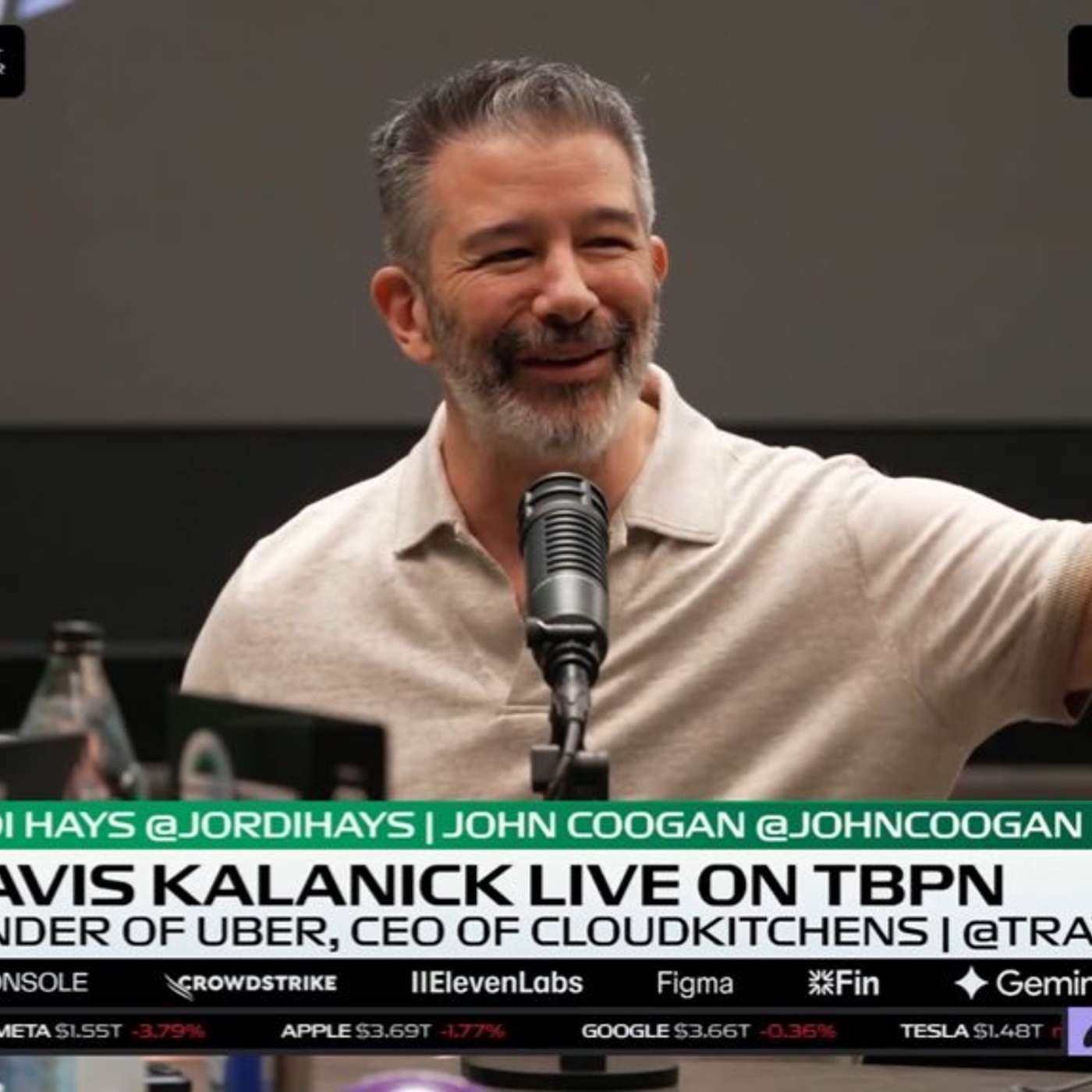
We have our next guest ready to join us live in the TDP and Ultradom, we have Travis Kalanick. He is the CEO of Cloud Kitchens. Welcome to the show, Travis. Great to meet you. Appreciate you coming on down to our studio. Our humble boat. Great to meet you.
- [00:17]
Alex Blania
We are truly an honor.
- [00:18]
Travis Kalanick
I'm just down the street.
- [00:19]
Jason Calacanis
Yeah, yeah, that's right. That's right.
- [00:21]
Travis Kalanick
Yeah.
- [00:22]
Jason Calacanis
We were actually. We started the show in downtown LA at the Jonathan Club on Figueroa, and so I think we were even closer then.
- [00:29]
Travis Kalanick
There you go.
- [00:30]
Jason Calacanis
Not far. How are things going? How's life?
- [00:35]
Travis Kalanick
Whoa.
- [00:36]
Jason Calacanis
Can we turn that down? We're getting some feedback.
- [00:38]
Travis Kalanick
That was crazy, man. It's crazy.
- [00:42]
Jason Calacanis
Yeah. What's crazy?
- [00:43]
Travis Kalanick
The building doesn't stop. Okay. I mean, I don't know how much you guys. I mean, I just. I've been in hiding. So I've been. I've been doing this. I run a company called City. Up until today, let's just say I was running a company called City Storage Systems, which was basically about the future of food. A conglomerate operating in about 30 countries. The whole idea was, can you get a meal that's prepared and delivered to you so efficient that it starts to approach the cost of going to the grocery store? Because if you do, you do to the kitchen what Uber did to the car. So I've been doing that since 2018. Yeah. And after just the intensity of Uber from. In terms of, like, being in the public sphere, dealing with 100 headlines every day, deciding what you do or the actions you take based on what the New York Times is going to write, I was like, I would like to.
- [01:44]
Alex Blania
That's a tough way to run a business.
- [01:45]
Travis Kalanick
It is very tough. So I was just like, I gotta wake up every day and sort of just get to work and build.
- [01:53]
Jason Calacanis
So did you.
- [01:54]
Travis Kalanick
So I went under the radar.
- [01:55]
Jason Calacanis
Do you think of this as, like, stealth mode? Is that the right term?
- [01:58]
Travis Kalanick
We've been in stealth mode for eight years.
- [01:59]
Jason Calacanis
Okay.
- [02:00]
Travis Kalanick
And that's like, till today. Yeah. Employees were not allowed to put the name of the company on their LinkedIn. We have thousands of employees.
- [02:10]
Jason Calacanis
Yeah. That's crazy.
- [02:11]
Travis Kalanick
Okay. So today what happened was, is like, for my company and I just got out of an all hands and then came right here is. We went out of stealth. Yep. Now City Storage Systems is like a hilarious name. It was like.
- [02:23]
Alex Blania
It's like the most. Like, let me choose the most.
- [02:25]
Travis Kalanick
It was like the most generic name
- [02:26]
Alex Blania
that no one will ever.
- [02:27]
Jason Calacanis
Business Corporation of America.
- [02:29]
Travis Kalanick
It was on purpose.
- [02:30]
Alex Blania
Yeah.
- [02:31]
Travis Kalanick
Okay.
- [02:31]
Alex Blania
And it worked.
- [02:32]
Travis Kalanick
It Was like we had two choices when we, when we launched.
- [02:36]
Jason Calacanis
Yeah.
- [02:37]
Travis Kalanick
We had what my sort of normal instinct was. Remember, it was only seven, eight months after I left Uber when I started this.
- [02:46]
Alex Blania
Yeah, yeah.
- [02:46]
Travis Kalanick
And it's. Let's just say the mission is infrastructure for better food. Okay. We have hardcore real estate assets. We buy the assets, we do construction, we sell restaurant tours on a delivery only location. I have a software stack that's like ARR Life. I've got a robotics company, I have a marketplace for, for corporate lunch. Like, there's a ton of stuff going on. Oh, yeah, that's right, that's right. Of course.
- [03:10]
Jason Calacanis
Yeah, it's great.
- [03:11]
Travis Kalanick
All right. Okay, so I forgot what I was saying. So.
- [03:16]
Jason Calacanis
So it's just a very different business from Uber. Some people would leave that company and be like, I'm gonna start the exact same thing. I got the playbook.
- [03:23]
Travis Kalanick
This is what, this is what the Uber guys, when I left were, were like a little bit worried about. This is, we're talking about 20, 17, 18. They're paranoid. So my, my instinct was, okay, I left. It's seven months later. I'm going to name my company Super. You call it Super, I'm calling Giga. I'm like, you go from Uber to Super, you're like, no, that cannot be a thing. And so I did the opposite.
- [03:48]
Jason Calacanis
Yeah.
- [03:49]
Travis Kalanick
Full underground, full stealth. Put the toothpaste back in the tube, the genie back in the bottle, and built literally thousands of employees. And it's like a vacuum of information. Full lockdown. It's been great building, but today we sort of came out and we renamed the company. We renamed what we do, we call it Adams. Okay. But we started a new company at the same time. And so let's just say like physical AI and robotics. Action and movement through the physical world. Of course, on the food side, we already have all the things I just talked about, but think of it as like. I'm trying to get the mission. Like, I'm so riled up. Yeah. It's so fresh, but basically it's. Yeah. So I'll leave it at that. We can get rolling here. I'm like super caffeinated on four hours of sleep, so.
- [04:53]
Alex Blania
I love it. I love it. What? How much harder. In many ways, I think building in stealth for so long made a lot of things easier. Right. You're not running your business based on headlines or thinking about what headlines are going to come. What are, what are the ways in which it made it harder? I imagine there's a lot of, there's a lot of. There's a lot of talent out there that wants to go work at the hot company that's in the news constantly. I'm sure you got the benefits of people maybe so opting out of that path and saying, hey, I just want to come in with you, build. And I don't care about the hype, and I don't want. I don't need every recruiter hitting me up constantly because of whatever's on my LinkedIn. But what were the kind of key challenges and what are. Why. Why was now the right time to. To come out and start to get loud again?
- [05:41]
Travis Kalanick
So, like, first, I mean, 100%. So imagine every recruiter has to be outbound. Every salesperson has to be outbound. There's no inbound. Yeah, that's where it starts. You get good at your craft when that's what you have to do. Like, I believe we have some of the best recruiters in the world because of it, and one of the best recruiting systems now, they leverage. Okay, you're working with Travis, former, you know, founder of Uber. Like, there's leverage there. But then you. You have a name like City Storage Systems, and it's like, so do you guys just have, like, these. These, like, boxes sitting in parking lots? Like, what is this? And that's sort of like the reason it's different now is because, look, number one, lots of time since the Uber, you know, from having to live that life. But two is the world is different. Like in 2016, 2017, the world of let's call it business, press was just beginning to say business is politics, but people didn't know it. They're like, if New York Times says something, everybody just treated it as the gospel. Like, it just must be true. And if they say something bad, it must be true. I believe everything I read on the Internet as an example. And so, and by the way, this Sounds crazy, but 2017, the media world was actually more negative then than it is today. And I think partly because of even shows like this, it's like, let's bring some optimism to the party. Sure. Can we get excited about what the future looks like and what's being built? And that's the difference between today and then. And so when you go 95% of all press is negative, you're like, why engage when the world is used to business being politics? Let's just say, and if I thought of my favorite journal, sorry, my favorite politician, and say, what does the Internet say that's bad. Bad about them. And it's like an insane amount. What does the Internet say that's neg or sorry untrue about them? And it's a ton of stuff. And you go, well, that's how they're going to think about our company too. That's how it's going to play. We're now we're desensitized to that stuff. And now we can get back to optimism and building and not be so worried about, you know, 95% of the media just being negative. Sure.
- [08:00]
Alex Blania
Yeah. I mean, this is pre whole trend of going direct. Totally like Lulu. I'm sure you've met it at some point. Basically coached a generation of CEOs on, you know, you just can't. If you, if you want to have any control over how people perceive you, you need to. You need to tell you.
- [08:19]
Jason Calacanis
You have to counteract with like a story, not like a statement. And the boilerplate, like, you know, official statement just doesn't. It doesn't entertain people as well as a full read.
- [08:29]
Travis Kalanick
I mean, and it's also guys like Elon owns Twitter now.
- [08:33]
Jason Calacanis
Yeah. X. Yeah.
- [08:35]
Travis Kalanick
Right. Pre post is like a massive difference in the mix of sort of ideas that can get out there. And again, you're allowed to be optimistic about things where maybe before everything had to be negative and sort of.
- [08:50]
Alex Blania
Yes. You talked about the initial idea of naming the next company. Super. That would have in many ways, I'm sure, turned into a. Basically a spite company. Yeah. Where you're just in this case, like kind of taking the high road was I'm just going to be quiet. I'm going to do the years and years and years and years of just like chewing glass, building up infrastructure, getting to scale, getting to thousands of employees, getting to operating globally before you even poke your head up again. Which I think is to any of your former critics, that's. To me, that's taken the high road, basically.
- [09:27]
Travis Kalanick
Yeah. And what you get when you create a culture around that is you then build a culture of builders. You build a culture of people that want to build and do not need to be famous when they do it, which basically means emotional intelligence. Now, it's a human nature. I want to be acknowledged for the things that I do. I'd like the things I build to be seen and I'd like somebody to know that I did it. And so this is when you cut against sort of the core of human nature and we sort of went all the way. And so we have a very high EQ culture. But like, it is like you have to go the extra mile to recruit, the extra mile in sales, et cetera. Again, the world's different.
- [10:10]
Jason Calacanis
Lfg are the laws of physics of the different businesses slightly different? I'm just thinking about your career arc with like Red Swoosh is enterprise communications. You're in a very particular industry. Uber's a consumer company now. You're working on something that looks. You probably run into like real estate developers. It's like a different industry, different community. Has there been adjustments and what's different? What's the same? Like what can you just be like a good business operator and power through? And what do you actually have to learn about the new industry?
- [10:47]
Travis Kalanick
Look, I think probably the biggest one is when you go from consumer to. Cause I have a. I mean, when you go from consumer to B2B, the number one mega challenge that you must master is called LTV to CAC. Yes, you can make that argument on consumer, but when you have a sales funnel that starts with, I'm going to talk to customers and I'm going, I have to make LTV to CAC work versus like my LTV to CAC is the App Store. It's a whole different ballgame. And LTV to CAC with a sales machine, especially if you go small business. This is like life in hard mode. Yeah. And talk to anybody who's. Who's crushed it on SMB.
- [11:30]
Jason Calacanis
Yeah.
- [11:32]
Travis Kalanick
Like those guys are special individuals who've made that happen. Because life in the SMB B2B world is no joke. Yeah, right.
- [11:41]
Jason Calacanis
So talk about Moats. I feel like Uber is the greatest example of network effects and runaway scale. What do. What did Moats look like at Red Swoosh? What were you thinking then?
- [11:53]
Travis Kalanick
And then?
- [11:53]
Jason Calacanis
And then. What does it look like now?
- [11:55]
Travis Kalanick
So like nobody knows what Red Swoosh is.
- [11:57]
Jason Calacanis
Yeah, sorry.
- [11:57]
Travis Kalanick
That's all good. So, guys, I started a company in 2001 that was. Let's call it BitTorrent meets Akamai. Before BitTorrent existed. Yeah. Okay, that's crazy. You click on a link and you can pull from other PCs that already have that file or that video stream, but it looks like the Internet. That's basically what it was the first four years. No salary. Wow. Lived at.
- [12:25]
Alex Blania
Had some famous investors.
- [12:27]
Travis Kalanick
Famous investors. You know, like Mark Cuban was on the board of Red Swoosh. So before that, Scour was Ovitz and Ron Burkle. That was the company before that.
- [12:40]
Alex Blania
Oh, oh. So anyways, I was confusing the two.
- [12:43]
Travis Kalanick
Yeah.
- [12:43]
Jason Calacanis
Anyways, so there's a network effect there. Once you get The CDN up and running.
- [12:48]
Travis Kalanick
That company wasn't meant to be. And I willed it into being. And I sold it to Akamai for, like, I think it was like 19 million bucks. And probably to this day, still the happiest day of my life. It was crazy. It was crazy. Like, I cleared 3 million and I was like, praise the Lord.
- [13:07]
Jason Calacanis
Okay, so then Uber. Very obvious. Very obvious. Moats and scale economies. Like, what does this look like with Adams? What does this look like in. In both the food delivery, kitchen model, real estate model, but then also where we're going in autonomous robotics.
- [13:26]
Travis Kalanick
Look, if you look at where moats are, and really you're looking for network effects in different places. Right? So right now I have these facilities. There's 30 restaurants in each of them. Picnic is like a perfect example of this. Right. You order from your office. Looks like Uber Eats or DoorDash. You get 100 options. Except all the meals are coming out of my facilities. There's one courier that brings 100 orders at a time, but it's on demand and it's personalized for you. And we've got enough facilities near here that you can basically get anything. And so who's going to. Who can play ball? Yeah, like, you got to have the real estate that's a fricking moat. You have the network effect now of like, what if I sell every floor on every tower, meaning every office floor is on this and I. More efficiency then in all of these floors, that means that one courier can bring 100 orders. And by the way, I'll have five couriers going to a single office with 500 orders hitting every shelf, and you get notified when it arrives. If you even took one floor, you would be like, sad because your economics are going to be screwed because you don't have the efficiency or the operation sort of depth to make it work. So there's network effects of a building. There's network effects on a facility with kitchens in it. There's. But then there's the moat of, like, we own real estate.
- [14:45]
Jason Calacanis
Yeah.
- [14:46]
Travis Kalanick
Okay, so, like, if you want to
- [14:48]
Alex Blania
compete with us, go buy 100 million.
- [14:50]
Jason Calacanis
So.
- [14:50]
Travis Kalanick
So very high billions of dollars of real estate in every major city in the world. And then we're going to go head to head.
- [14:57]
Alex Blania
Yeah.
- [14:57]
Jason Calacanis
Talk about capital.
- [14:58]
Alex Blania
Yeah. The other, the other, the. I don't know exactly what. What bucket this falls in, but just. Just the moat of. You would have to be absolutely insane to compete.
- [15:10]
Jason Calacanis
But people were. People were like, this is how I remember the Uber vs Lyft battle. Was Uber.
- [15:15]
Alex Blania
No, no, no.
- [15:16]
Jason Calacanis
And then, and then all of a sudden a whole bunch of VCs were like, I want a piece of that. And I didn't get Uber. So I'm funding the.
- [15:21]
Alex Blania
But I'm saying in the context of, of cloud kitchens.
- [15:24]
Jason Calacanis
Yeah.
- [15:24]
Alex Blania
City storage. Like, even though people generally figured out what you were up to, Right. You did have to share some little things along the way. Or you buy this company or you
- [15:35]
Travis Kalanick
got to, you've got to go to a website and say, what is a delivery only location? What the hell is that? And so somebody had to know. But even then we're like, we're going to say the cross streets of the facility, not the actual address. These are the little moves you do to be stealth.
- [15:54]
Alex Blania
When I look at the new site and how everything's positioned, a lot of it feels insulated from all the changes and progress that we're seeing in AI and in many ways accelerated because you get, you'll get a lot of the benefits of AI progress and progress in robotics, but you're moving physical atoms around the world. In an era where you can generate any piece of software fairly quickly, this feels like you've been kind of planning for this type of technology.
- [16:30]
Travis Kalanick
Progress Sounds great, dude. I love that. I love. It's all in the plan. Look. I think it's always been the plan. A meal that's efficient. Efficient, you know, so efficient it starts to approach the cost of going to the grocery store. Meal that's prepared and delivered to you, that's real. You must do automated production of food. You must do automated delivery of the meal. I call that autonomous burritos. Which is why I'm moving into this, making this move on Adams, which is, okay, we're still doing the food thing, but then we're adding mining and transport. Okay. Mining being like more, you know, we like to say more efficient. Mines for Earth's industries or on transport. It's just robot wheelbase for robots. Okay, okay. Because if you're going to do specialized robots, not humanoids, but specialized robots, they need to have wheels. Okay? Right. I like to say, like, if you saw the Beijing, in Beijing, they had the humanoid Olympics or whatever and the half marathon and you're watching wheels cruising. I'm like, dude, could you imagine if that thing had wheels? That'd be crazy. So, like, humanoids have their place, but there's a lot of room for specialized robots that do things in an efficient sort of industrial scale kind of way, which is sort of where we play.
- [17:54]
Jason Calacanis
I want to go back to Capital wars. Lessons from capital wars. When these play out, because we're seeing this og. Og and you.
- [18:02]
Alex Blania
Yeah.
- [18:05]
Jason Calacanis
Were you the OG because. Or when this capital war kicked off, were you looking to lessons from the 90s?
- [18:11]
Travis Kalanick
I mean, look, you can always say there was the guy before. Yeah, okay. Like, like, you know, Rockefeller was the og and then before him, was it like the Medicis? I don't know. But I was. I was the goat for a period of time. And now I'm a baby goat.
- [18:28]
Jason Calacanis
Yeah.
- [18:29]
Travis Kalanick
And that's okay. And so then one day the baby goat will grow up again. Yeah, that's fine. It's gonna be fine.
- [18:38]
Jason Calacanis
I just mean, like, this idea of, like, you have a network effect, it's growing. And then you see a bunch of venture capitalists sort of throwing money at, like, the second place, and there's this debate over catching up. And, like, how do you. What moats do you retreat to in that moment? Like, I feel like that's the. That's the lesson from the Uber story that gets missed amid all the random drama is that there's actually, like a very interesting financial war happening.
- [19:03]
Travis Kalanick
Yeah.
- [19:04]
Jason Calacanis
And it played out very well for you. And I'm wondering, like, what level of confidence you had. What did you do strategically to set yourself up for success?
- [19:11]
Travis Kalanick
A super interesting thing because, of course, all the guys are playing that game. Right, Right. Which is the ability to attract capital. The capital wars becomes a strategic weapon. Capital becomes a strategic weapon, which means you must be the best at getting capital in order to win. And we realize that early on in the Uber days, of course, that's happening times 10 in the sort of, let's call the digital AI wars. And look, the last round of funding that I did at Uber, we were like a 70 million. You know, I don't know, it was like a 60. 70 billion dollar pre. Let's see that. Yeah. When that used to be a thing now, like. Oh, that's small stuff. But we had four rooms. This was our. How we'd fundraise. We had four rooms in our New York office booked for a week with an hour and a half slot on each. So, like for 12 hours in a day, four rooms going in parallel. I was in.
- [20:12]
Alex Blania
Are you bouncing between.
- [20:13]
Travis Kalanick
No, I'm in the $250 million and over club. Okay. That's one room. And it goes all. There's all these other. There's these other rooms. To the fourth room is like $25 million checks.
- [20:24]
Jason Calacanis
Okay.
- [20:24]
Travis Kalanick
Okay. There's a guy who works for a guy who works For a guy who works for me who's doing that room.
- [20:30]
Jason Calacanis
Yeah.
- [20:30]
Travis Kalanick
Okay. And then. But we're oversubscribed, so we started putting multiple investors in the same room. We're like, dude, we're just out of slots, dude. Like, let's go. But what it means is about the system. It's about the system for sort of acquiring that capital at scale and super efficiently. And what it means is that storytelling that we did. Anybody in my team could tell that story, let's say, on the strategic finance team, could tell that story and make it happen.
- [21:04]
Jason Calacanis
Yeah.
- [21:04]
Travis Kalanick
And that was a big part. It was a story that's just like. Of course. Is like, if I'm pitching it, people like, holy shit, let's go. Then there is making it scalable so that there are 10 different people in a company that can pitch it at any given time. Yeah. And that's when you take it all the way. And then there's like, even auction dynamics of how you would do it. We would basically, once they said they were interested, we would then give them a piece of paper. It was like, digital, but it was like, you need to fill out this table, which is this valuation. How much money you want to put in this valuation? How much money? This much money. This. This valuation. How much money? And then we would aggregate the demand.
- [21:45]
Jason Calacanis
IPO book.
- [21:46]
Travis Kalanick
Yes. But, like, done way better because you don't respect to the bankers. But like, yeah, I was in charge of pricing.
- [21:54]
Jason Calacanis
Sure, sure.
- [21:55]
Travis Kalanick
And so. And then you're like, oh, we're trying to clear $5 billion. That takes us to this price. We would tell all these guys, hey, your price isn't big enough because you don't make it under the curve. And then they would move their price, and then that would change the curve, and you would do it again.
- [22:10]
Jason Calacanis
Makes sense. Were you. Were you bringing new investors to private markets at that time? I feel like if I go back to Facebook, I think they IPO'd around 50 billion. You're doing a $70 billion raise. There's a lot of different. It's a completely different shape of investor. What were those conversations like?
- [22:27]
Travis Kalanick
Look, I. Like, I. In some ways, I have to give some credit. The. This was. It was an era where this was happening. You had, like, the fidelities of the world and other guys that are moving in.
- [22:38]
Jason Calacanis
Yeah.
- [22:38]
Travis Kalanick
I have to give credit to Drew at Dropbox. He was, like, the first guy in that game. Yeah. And, you know, Drew and I'd meet up, and we, you know, have, like, flex. I'm like, dude, what's up?
- [22:55]
Alex Blania
You're like, this is our little safe space.
- [22:57]
Travis Kalanick
Like Chesky at Airbnb, like, that was the crew that was doing it in the 2010s. Yeah. And sort of pushing the boundaries of what it meant to be. Like, people didn't even know what private equity. What is a private. What is private equity?
- [23:11]
Jason Calacanis
Yeah.
- [23:12]
Travis Kalanick
Now we're just like, yeah, private equity, that's vc. It's the same thing. And. But back then, private equity is like, I do leverage buyouts. And so you're bringing private equity, mutual funds, those guys into the game in a way that didn't exist before. Now it's just old hat.
- [23:27]
Alex Blania
Have you coached any of the AI
- [23:29]
Jason Calacanis
founders culturally, like that crew that you just described? Most of them have been on the show. It feels very different aesthetically than what we're dealing with today.
- [23:41]
Alex Blania
Yeah. But I'm sure Chesky's pumping up Sam.
- [23:44]
Jason Calacanis
I love these guys. I love them all.
- [23:46]
Travis Kalanick
That's so interesting. Look, the. The times when I get hit up.
- [23:51]
Jason Calacanis
Yeah.
- [23:53]
Travis Kalanick
Are usually when the. Is about to hit the fan or it's actually hitting the fan. They're like, dude, somebody needs to call Travis immediately. He'll know what to do. So I use Travis.
- [24:09]
Jason Calacanis
What do I do?
- [24:10]
Travis Kalanick
My phone's like, what are the crazy, wild, wackiest things going down? Or like here. Because that's when I usually get the call and I'm so underground. That's what happens. But, like, I should, you know, I should give, you know, I know these guys. I should give them a call and be like, dude, we should.
- [24:26]
Alex Blania
Let's cook.
- [24:27]
Travis Kalanick
Let's. Let's cook. I still think we probably did things better than anybody. That some of those things probably are still better than anybody even today. But obviously the check size, much bigger.
- [24:40]
Alex Blania
Is that approach like systematizing fundraising. Fundraising, productizing it? Do you apply that across the entire. Is that like everything that you do that is important, you're. You're creating like a ground up kind of solution for it?
- [24:55]
Travis Kalanick
Well, like, for instance, I mean, this will, you know, this is just crazy. But like, how about when you do construction? You know how effed up construction is?
- [25:05]
Jason Calacanis
Yeah.
- [25:05]
Travis Kalanick
I tell my guys that in the, in the real estate department. I'm like, your entire department is the anti fraud department.
- [25:14]
Alex Blania
Oh, yeah. You know, guys just are incentivized to just run out.
- [25:18]
Travis Kalanick
How do you do epic, high quality construction at an insanely efficient price? There's a way. Not going to tell you to tell you, but there's a way.
- [25:29]
Jason Calacanis
Do you have. Do you have any, like, white pills or ideas that potentially AI speeds up the rate of building broadly, like solving the housing crisis through permitting. Permitting, stuff like that.
- [25:41]
Travis Kalanick
This is so. One of the things is that. And I think people are starting to come out of this now. This whole, like, the jobs are gone. Like, I know still. People still say that, but there is another side to this story. And, like, I'll just make this. Cause I'm the Adams guy. I'm like, let's just talk about plumbers. Okay. Let's say the entire world, everything in our world was automated except for plumbers. Okay. Okay. You had machines making buildings. You would basically have, like, 1,000 buildings a day. 1,000 buildings being built at a single time in Los Angeles alone.
- [26:16]
Jason Calacanis
Sure.
- [26:16]
Travis Kalanick
Just machines doing.
- [26:17]
Jason Calacanis
Yeah.
- [26:18]
Travis Kalanick
Except plumbers.
- [26:19]
Jason Calacanis
Okay.
- [26:21]
Travis Kalanick
How valuable would those plumbers be?
- [26:22]
Jason Calacanis
Extremely valuable.
- [26:23]
Travis Kalanick
Okay. Those guys. Each and every plumber would be like LeBron. Why? Why? Because plumbing is the long pole in the tent to progress.
- [26:34]
Jason Calacanis
Sure.
- [26:34]
Travis Kalanick
That you can't get those thousand buildings unless you have a plumb.
- [26:38]
Jason Calacanis
Sure.
- [26:38]
Travis Kalanick
And by the way, you got so much efficiency everywhere else that you need millions of plumbers.
- [26:44]
Jason Calacanis
Yeah.
- [26:45]
Travis Kalanick
And then plumbing is like, what's up? And so once you realize that, then you're like, until we get super AGI.
- [26:55]
Jason Calacanis
Yeah.
- [26:57]
Travis Kalanick
Humans are valuable, and they are going to become more and more valuable because they will be the long pull in the tent to progress. And that progress is going to accelerate and get faster and more, you know, more robust. Except if you're a plumber, you're crushing. And so until we get to. Humans are replaced, like, fully. Fully. And by the way, I have. I think we have solutions for that. I think Elon's got that at Neuralink, where it's going to be all good. Okay. And then people are like, oh, God. But until we get there, we're gonna. I believe we're gonna be super fine. That's my white pill.
- [27:36]
Alex Blania
Yeah, yeah, yeah. It does. If you have plumbers that are getting paid like LeBron, it obviously increases the, you know, the prize pool of automating. But again, there's, like, these kind of
- [27:47]
Travis Kalanick
windows, but there's gonna be a bunch of things like plumbing. And it's not just plumbing. It's gonna be all over the place. And even when it comes to software. So, like, for instance, look at, like, autonomous cars. They like. Like Waymo has people that oversee the rides.
- [28:02]
Jason Calacanis
Yeah.
- [28:03]
Travis Kalanick
Okay. And it starts with, like, okay, five. Five rides for every person. Then it goes to 20, then it goes to 100. But, like, if we get to this place where autonomous cars are everywhere. Okay. And let's just say it's one in a thousand. And like, nobody owns cars. There's just ride sharing everywhere. I mean, some people own cars, but it'd be the top of the top of the pyramid, let's say. Okay, so what do we replace billions of cars with ride sharing? If it was 1,000 to 1, you still probably have, I don't know, 20 million jobs, 50 million jobs. I'm just riffing on just the concept of this. You will see this everywhere is that until humans are fully replaced, we become the long pole in the tent to progress. And that progress, by the way, is to serve us. Yeah. Robots yet don't yet have bank accounts. So that plumber gets paid.
- [28:55]
Jason Calacanis
Yeah, yeah.
- [28:56]
Travis Kalanick
Anyways, you get the idea.
- [28:57]
Jason Calacanis
You mentioned mining.
- [28:58]
Travis Kalanick
Yeah.
- [29:00]
Jason Calacanis
Have you been to a mine recently? You visited a mine? Like, what, what's going on in mining? I imagine that mines are fairly automated already.
- [29:09]
Travis Kalanick
Like, there's machinery, there's thousands of employees at a given mine.
- [29:14]
Alex Blania
And that's work. That.
- [29:15]
Jason Calacanis
And there's so many resources.
- [29:17]
Alex Blania
Children, Children yearn for the mines of minecraft. But it's not the best best.
- [29:22]
Travis Kalanick
Well, like, maybe that's actually how it gets, you know, maybe that's where it goes. Ender's game situation. Look, the. It's interesting. You go, a lot of times they're like, oh, oh, well, is labor really the issue in mine? You know, is that really a thing? But what it really comes down to is productivity. Okay, Right. So if, if a mine is automated, then it can run all hours of the day and night. It doesn't have, it doesn't have off hours. The way machines queue up doing that really efficiently, like computer science style, I call it digitizing the physical world. You can make that mind substantially more productive. What is the value of a more productive mind? And by the way, let's get to the real sort of the outcome here.
- [30:14]
Alex Blania
Yeah.
- [30:15]
Travis Kalanick
Is does the world, as we enter this sort of new golden age that's about to come. Do we need more minerals? Do we need more materials? Look around us. Like, look around us in this studio or walk outside. Everything you see is grown or mined.
- [30:33]
Jason Calacanis
Yep.
- [30:34]
Travis Kalanick
Yep. Manufactured and moved.
- [30:36]
Jason Calacanis
Yeah.
- [30:38]
Travis Kalanick
So if you're not in the mining business, like, you're like, let's just say the. I shouldn't say that, but like, it's a very critical part of the situation. I can't wait till we're putting some machines on SpaceX's rockets to go mine an asteroid or a planet. Or whatever. In the meantime, lots of mines on planet Earth.
- [31:01]
Jason Calacanis
What abstraction do you want to operate at? Do you want to go and find land and mine it? Because that's sort of on the table. If I look at what you're doing in food, you own real estate. Or do you want to sell tools to mining companies that already have explored and they understand and they're running up and running.
- [31:19]
Travis Kalanick
Yeah, like I'm.
- [31:19]
Jason Calacanis
How do you think?
- [31:20]
Travis Kalanick
I'm not. I'm not buying land for mines anytime. That's just not anytime soon.
- [31:26]
Jason Calacanis
But in the next three months.
- [31:28]
Travis Kalanick
Yeah, 120 days out. I just think it's super fascinating. Again, it's just like, like I'm an atoms guy. I'm like all about digitization of the physical world. And you know, I have this framework for it which is like CPU manipulates bits, storage stores bits, network moves bits from point A to point B. I was a computer engineer at ucla. I didn't graduate, but. But I loved it. Yeah, those are the three core computing resources that you're told about on day one. Yeah. But if you're treating atoms like bits. Digitizing the physical world, CPU manipulates bits. What manipulates atoms? Manufacturing storage stores bits. What stores atoms? Real estate network moves bits from point A to point B. What moves atoms? Transport logistics. I didn't know it then or I didn't think about that way exactly. But at Uber we were building network for the physical world, also known as digitized transportation. Yep. City storage systems then make sense. Storage for the physical world. That's real estate. We are building atoms based computers with a real estate foundation. Storage. Right. But now leveling up and saying, okay, we have a food computer, what about a mining computer and what about a wheel based platform to serve industry generally?
- [32:53]
Jason Calacanis
Yeah. If I look at the last two decades of your career, you're uniquely good at managing very geographically spread out workforces. What is the secret? I could never get behind the remote work thing. Everyone here works in one studio.
- [33:13]
Travis Kalanick
But I'm all about it.
- [33:15]
Jason Calacanis
But you've had to do it basically because you had to have a presence in New York, you had to have a presence in LA. And you can't be in 10 places at once.
- [33:22]
Travis Kalanick
It's all good. There's a difference.
- [33:23]
Jason Calacanis
How do you do it?
- [33:24]
Travis Kalanick
There's a difference between remote work, where somebody works at home and they're like in boxers and then a suit. Okay. Versus we have an office in every major city in the world. And whatever city you're in, you're going to that office every Day, five days a week, and sometimes six or seven, and that's it.
- [33:43]
Jason Calacanis
But satellite offices still feel like a headache. How did you solve it? Because you can only be in one place.
- [33:48]
Travis Kalanick
Yeah, I guess I just. I cracked the code so thoroughly in Uber times before, I think maybe even before anybody else, it almost feels like normal.
- [33:58]
Jason Calacanis
Yeah.
- [33:59]
Travis Kalanick
But like, I basically have figured out sort of the. The management and leadership structures where you. The real. The real thing is about empowerment. Okay. Is you must be able to empower teams. But I. It's like, I like to say the fewest number of rules while staying out of chaos.
- [34:19]
Jason Calacanis
Sure.
- [34:19]
Travis Kalanick
And once you have those systems in place, you know, your imagination is only constrained by management capacity. So once you figure out the management piece, your imagination can go pretty damn far. And so it's just figuring out the management part of this is the thing.
- [34:37]
Jason Calacanis
Talk about empowering young people. We've had a ton of founders on the show who have the origin story of like, yeah, I was the GM of Miami or so. Or he sent me to Atlanta and I was me in a hotel room with a bunch of energy drinks. And we had to open up this market, so we had to do a stunt and hire some people. And it just felt like a lot. You know, startup within a startup is a bad phrase that gets sort of misused. But why. Why were you. You know, you weren't. This wasn't your first company with Uber. Why were you so heavy on leaning on young people, empowering them, pushing them?
- [35:13]
Travis Kalanick
It wasn't on purpose. It was just the right answer.
- [35:17]
Jason Calacanis
Okay.
- [35:17]
Travis Kalanick
Why? Yeah. I mean, once you have a city team and you're like, okay, I need to find people that can run this. Like, old people aren't the answer. Like, I need fresh. I didn't think of it as like, I gotta get youthful people or not.
- [35:35]
Jason Calacanis
Sure.
- [35:35]
Travis Kalanick
I'm just like, I need good talent that can go do X and who has no judgment on what it is we gotta get done.
- [35:41]
Jason Calacanis
Yeah.
- [35:41]
Travis Kalanick
And it was just like, water flows downhill. So what do you. Look. It was a. You know, like the. The first driver ops guy that we brought in in San Francisco in 2010. We basically took 200 cards and put names on them and we said alphabetize them. Click. And we just would measure how much time it took to alphabetize. We would give them like, crazy analytics tests. And then we're like, okay, this is our guy. You know what I mean?
- [36:13]
Alex Blania
Free. Free AI.
- [36:14]
Travis Kalanick
If you're on the marketing manager. If you're on the marketing manager. But even today, you'd still want that guy? Yeah. Even today. So like you can't use AI now. Alphabetize in the most efficient way. Now if you're, if you know computer science, sorting is like a big frickin deal. Sorting efficiently and being able to do that in your brain, not in software, is a thing. That's what ops people do.
- [36:37]
Jason Calacanis
Yeah, yeah, that makes sense.
- [36:39]
Travis Kalanick
So I don't know. I don't know how to answer that question. Other than problem solving, whether you're young or old, executive or junior, who can solve problems, is number one. When you interview, simulate what it's like working together. So that day one is really like week two. And you're already pumped because you saw them in action.
- [37:02]
Alex Blania
How are you with Adams? How are you thinking about recruiting and how are you going to change your approach to building the company? You've been kind of holed up in la. This is your kind of hideout.
- [37:14]
Travis Kalanick
Yeah, totally.
- [37:14]
Alex Blania
But I imagine like, do you, do you push into. Back into sf? Go back to being the king?
- [37:20]
Travis Kalanick
Well, here. So first, let's just be clear. On December 18, I moved to Texas.
- [37:24]
Jason Calacanis
Sure.
- [37:25]
Travis Kalanick
You know, I don't know what's so specific about December 18th, but let's just say it's prior to January.
- [37:31]
Alex Blania
Yeah.
- [37:33]
Travis Kalanick
So I'm a primary resident of Texas. But the action for a lot of this Adams type technology I'm talking about, of course, like the bay is a real thing. My head of the advanced technology group at Uber is running my robotics division at Adams. It's called Lab 37. That's Anthony in Pittsburgh. No, no, that's Eric Meihofer.
- [37:55]
Jason Calacanis
Okay, Eric Meihofer.
- [37:56]
Travis Kalanick
So that's robotics on the food side. Yeah. Anthony Lewandowski was running Pronto. I was the largest investor in Pronto. And then we just were basically right in the final, like we're checking off the list, maybe closing today or tomorrow on that deal.
- [38:14]
Alex Blania
Amazing. Let's talk about that deal. Yeah, give us, give us, yeah, give us like what's the kind of background on, on Pronto and then how it fits into the, to the empire.
- [38:23]
Travis Kalanick
Well, look, I sort of broke out how mining fits. Yeah, right. So we got that. Look, I bet I'm the largest investor in Pronto and it's super inspiring work. Like, like go to a mine, right? Check out how these things work and let your mind imagine what that might look like when you bring automation to it and how much more productive it is and what that means for industry. When all mines are producing more, where does that go? And in some ways you could say low Hanging fruit on the autonomy problem. Because yes, there are different problems off road, but they ain't like they're way more controlled than what's going on on road. Okay. But then you get into the physical action. Like cars on the road, the waymos on the road, you know, they're moving but they're not acting on atoms. Right. So when you think about excavation and you think about crush, like when you get the material and then you move it, then you are basically crushing the material and then you process it and you think about all of the automation through that stack. It's fantastic. And it's like it's hard, right? Like somebody asked me, like, we have a bunch of roboticists that make some of our food machines. And somebody came like, hey, like is AI going to help us design food machines? We're like, dude, let me show you. Like this thing has like an insane number of parts and let me show you just the design of a single part.
- [40:01]
Jason Calacanis
Yeah,
- [40:03]
Travis Kalanick
like that AI can't even do freaking math. You know what I mean? It's like we're not there yet now. Could it get there? Yeah, but then you're really an AGI if you look at how much harder it is the physical world, how much harder it is AI in the physical world versus in the digital world. And I'm not defeating it in any way, I'm just saying it's like maybe let's call it a different problem set.
- [40:26]
Alex Blania
Yeah, we're just far away from one.
- [40:28]
Jason Calacanis
There's just way less training data.
- [40:29]
Travis Kalanick
Yeah. It's like one shotting on software. Do you have one shotting on designing a machine or a robot who. We're just not there yet. Yeah, but that makes it more fun. That's the point is like do the hard things. If you are in the Adams world, you have decided, I like hard things, I like pain more than anybody else.
- [40:48]
Jason Calacanis
Yeah.
- [40:48]
Travis Kalanick
This is kind of what you got to be about.
- [40:50]
Alex Blania
Chewing the glass.
- [40:51]
Jason Calacanis
I love it.
- [40:52]
Alex Blania
So I can see how AVs at Adams fit into mining. What other and just heavy industry broadly. What other kind of categories of AVS are exciting? How do you see the space evolving?
- [41:07]
Travis Kalanick
Yeah, look, anything. I mean the mission is wheel base for robots. So then you're just like, okay, what moves? And you go, okay. You have to find the businesses that make sense. Of course. So we're like, okay, mining is a no brainer.
- [41:24]
Alex Blania
And how do you, how do you think about sizing for a wheelbase for robots that can scale up and down like crazy?
- [41:30]
Travis Kalanick
Like I tell my team like, dude, there's, like, a ton of silver metals here, and there's actually a few other gold medals just in the category. So let's just go with delivery robots, like food delivery, which, of course, is near and dear to my heart. You make your 20. Yeah. Your 30. Your $15 bowl became 30 bucks.
- [41:54]
Alex Blania
Yeah.
- [41:55]
Travis Kalanick
Okay.
- [41:56]
Alex Blania
And this is. This is, like, I would put it up there as, like, one of the number one annoyances of the average American, regardless of where they are in society. Food is just the cost of food delivery. Everybody wants food fast, cheap, hot, et cetera. And there's all this data that just came out this week that just shows, like, it doesn't matter even how much money you're making. You're spending a lot on this category.
- [42:25]
Travis Kalanick
Isn't it interesting? Right? Remember I talked about the plumbers?
- [42:28]
Jason Calacanis
Yeah.
- [42:29]
Travis Kalanick
But, like, you could take whole categories, become the long pole in the tent. Food boring to a lot of people. Boring as that for me. Interesting.
- [42:40]
Jason Calacanis
Let's go. Let's go.
- [42:43]
Travis Kalanick
Look, I did taxis. I did taxis. Yeah. When they're, like, people looking at me
- [42:48]
Jason Calacanis
funny, it was a weird idea.
- [42:50]
Travis Kalanick
Okay. They're looking at me super funny. So Jason Calcanis, the most famous investor in Uber of all time.
- [42:56]
Jason Calacanis
More famous than you.
- [42:57]
Travis Kalanick
And so whenever I knew them, like, dude, I'm so honored to be meeting one of our early investors. But he. There was, like, an angel group that I pitched.
- [43:07]
Jason Calacanis
Yeah.
- [43:08]
Travis Kalanick
There are, like, 30, 40 people in the room. I think it was like, three or four that invested.
- [43:12]
Jason Calacanis
It's crazy.
- [43:12]
Travis Kalanick
Okay. The 10 grand check became, like 100 million bucks. It was crazy. But the boring places are the places.
- [43:21]
Jason Calacanis
Yeah.
- [43:22]
Travis Kalanick
You know, less competitive, but also just weird and hard.
- [43:26]
Jason Calacanis
Yeah.
- [43:27]
Travis Kalanick
Why? It's that way.
- [43:28]
Alex Blania
The graveyard is stacked of tech guys that thought they could crack food. Which is why. Which is again, like, go back to what? Yeah, you can go. You can go compete in this category, but you have to actually be insane and you have to have.
- [43:45]
Travis Kalanick
Yeah.
- [43:46]
Alex Blania
And. And you have to attack at all. At all.
- [43:49]
Travis Kalanick
In my. So my head of the robotics division.
- [43:52]
Jason Calacanis
Yeah.
- [43:53]
Travis Kalanick
We're like, yeah, let's do this. Get the band back together. Let's go. Right. This is Eric Meihofer. Yeah. And. And he's like, okay, we could make a food robot. I'm like, I got one. There's one requirement, though. I got one hanging chatter, one string attached. He's like, what? I'm like, you're gonna have to build a restaurant that the robot serves. So my roboticist team in Pittsburgh made a restaurant that is the restaurant that Our first robot went into, because we had to make sure that we understood how a restaurant worked. We had to make sure that this wasn't just a machine that made food, but a machine that makes food in the ecosystem of machines called a restaurant. And people don't understand, but a restaurant is a manufacturing facility. In fact, if you look at like labor statistics, etc. Restaurants fits under manufacturing for obvious reasons. It just hasn't changed in 50 years.
- [44:53]
Alex Blania
Anyways, back to sorry, I'm all over the place. No, I love it. I love it. Firing on all cylinders. So again, do you want to move people with AVs, do you care more about commercial?
- [45:07]
Travis Kalanick
Look, the industrial thing is sort of like probably our main jam. But the bottom line is once you crack, once you crack movement in the physical world, there's lots of people who want access to, to that.
- [45:22]
Alex Blania
Yeah.
- [45:23]
Travis Kalanick
And in fact, you need partners because you know you're going to be putting billions to billions of dollars to work to make it happen. So there's going to be lots of partners across different categories that are going to probably want some of that. And I have no issues with that. We're not like a, you know, this is ours and this thing, it's more like, hey, there may be ways to work with ours. We're happy to do it. Yeah, what about our spots? But you get the idea.
- [45:48]
Alex Blania
What about manufacturing? Broadly, you're doing it in food. Are there other categories that are interesting? Are you happy to be kind of the transport rails?
- [45:58]
Travis Kalanick
Look, I think once you are in physical AI, you should basically understand that manufacturing is part of your tech stack. It just is. And by the way, energy is part of your tech stack. Land development, real estate is part of your tech stack. That's just what it's going to be. People don't think about it like that, but it's true. Of course. They're, you know, Tesla just crushes. If you look at this list of things, you're just like, they got it all so good, but there's just so much to do.
- [46:33]
Alex Blania
Yeah, yeah.
- [46:33]
Travis Kalanick
You know what I mean? We can see all the things. We can see all the things Tesla's doing. That's cool. I'm like, there's a million. I can still help you. Mine. Yeah, I could still, I can still get some food to some peeps. You know what I mean? So you get the idea is that,
- [46:47]
Alex Blania
is that, is that really when you're pitching investors around Adams in this new vision, is it basically like there's a lot of jobs to do in the world? We're going to do it with physical AI and you're basically betting on applying my general ethos to all these categories over time.
- [47:05]
Travis Kalanick
Now you got, you got to be able to pick your spots. If you are too broad, people are like, dude, what's wrong with you now? You know, I think every entrepreneur always gets that. Like, you know, I joke around like in the 90s, like, dude, I'm an old guy. What are you going to do in the 90s? It's like, dude, Microsoft's going to kill you. Like, why do you think? Then in the 2000s it was like, why isn't Google going to do this in the 2010s? It's like, dude, that looks like Uber's thing. And now it's like, if you're talking about physical AI, it's like, that's Tesla. That they are the, they are the incumbent. They are. And not just the incumbent, they're also just doing great, awesome stuff. But find your spot.
- [47:45]
Jason Calacanis
Yeah.
- [47:46]
Travis Kalanick
Know yourself, know what you're good at. Be self aware and find the thing that is your business soulmate for sure. But also know that you're in an ecosystem and you need to find your spot.
- [47:59]
Jason Calacanis
What was your experience like in dot com and the, the financial Crisis broadly in 2000, 2008?
- [48:06]
Travis Kalanick
Okay, so basically I sold, I sold my peer to peer CDN, Akamai meets BitTorrent in 2007 to Akamai.
- [48:15]
Jason Calacanis
Okay.
- [48:16]
Travis Kalanick
So I was earning out when that happened. And I was, I just started, I think I didn't last very long in that earn out. Sure. So I was the cxo. I was like an advisor and a cxo. Okay. Little known fact, I was blogging.
- [48:33]
Jason Calacanis
Okay.
- [48:34]
Travis Kalanick
I was like a tech influencer, blogger. There is a blog still out there called Swooshing. Okay. Crazy, amazing, ridiculous content.
- [48:44]
Alex Blania
Okay, we're gonna dedicate.
- [48:45]
Travis Kalanick
I was in the click. I was in the click economy, guys. I was in it. Okay, but so I was an advisor in CCXO for like five different companies at a time. And so I'd help them on their deals or I would be their cto, or I would, you know, help them sell or product or whatever, but I could always just put the phone down and forget.
- [49:08]
Jason Calacanis
So somewhat insulated from like the mortgage crash. Like.
- [49:11]
Travis Kalanick
Yeah, I mean, my thing was I was trying to figure out, I was getting a bunch of my friends together and saying, okay, do you have a mortgage with bank of America? I do too. Let's pool our thing. I'm going to go to bank of America and say, I will buy these mortgages off for 40 cents on the dollar because you're selling them on the market for $0.10.
- [49:29]
Jason Calacanis
Interesting.
- [49:30]
Travis Kalanick
Could be fun. And then they're like,
- [49:33]
Alex Blania
get out of here.
- [49:36]
Jason Calacanis
You're not a hedge fund. It's wild. What about Dot com?
- [49:40]
Travis Kalanick
You're talking about the 90s?
- [49:41]
Jason Calacanis
Yeah, the 90s, like late 90s. I mean, at that point you're sort of starting your career, right? But it's an interesting place to start a career in tech. Like a lot of people watched that and said, so look, that was a.
- [49:54]
Travis Kalanick
We did peer to peer file sharing at a company called Scour.
- [49:56]
Jason Calacanis
Yeah.
- [49:57]
Travis Kalanick
Okay, so some people did Napster, some went to like, you know, all the ones that came after bittorrent all the way to like, what was the one that Zenstrom did? Kazaa or some of these others? Right. We were the og. File sharing.
- [50:13]
Jason Calacanis
Yeah.
- [50:13]
Travis Kalanick
Okay. Michael Ovitz was on the board. Ron Burkle was on the board. La. Okay. Doing a tech. Doing tech in LA was like being a finance guy in Fresno. They're like, don't know what the hell is going on. They're like, who are you? And you're a little bit sheltered from it in la. Every time you went to the, the Silicon. Silicon Valley, it was like wild and crazy and like every bar was like packed, like after hours, like happy hour thing. Like things were bubbling. And the crazy part is not just what happened during the run up. It was post. I was raising money on this peer to peer CDN that I didn't have. I didn't pay myself a salary for, for four years. I was raising money in two in late 2001 for a networking software company. Are you freaking kidding me? And so I remember going to one of these, going to a bar to meet up with a VC and this is like 2002 and it's empty. Like this thing that would be mega packed just two years earlier. I mean, we're talking dust bowl tumbleweeds empty. And this vc, I wish I remember who it was because it'd be amazing. Was like, yeah, Travis, dude, I think, I think it's all done.
- [51:34]
Alex Blania
It's over.
- [51:36]
Jason Calacanis
I told you it's over.
- [51:37]
Travis Kalanick
I'm like, what do you mean here? He's like, all the software that could be invented has been invented. Wow, we're done. And he meant it. He's like, it's been real, dude. Let's have a whiskey. Let's go.
- [51:49]
Jason Calacanis
We're done. That's incredible.
- [51:51]
Alex Blania
How have you processed the last two years when people are Able to raise an amount of money that took you four different rooms in this entire process. And they can just raise it literally without it, without a deck. Often they can just pull. Pull it together.
- [52:09]
Travis Kalanick
Look, it's all good. Like, I don't. I just have. Because, you know, when you build a company the way I built it, which is like my current one, where you're literally under the radar, it means that you are powered by. You have an internal fulfillment. You're not like, caring what others think. You. You get internally fulfilled with building.
- [52:29]
Jason Calacanis
Yeah.
- [52:31]
Travis Kalanick
And I don't look at somebody and go, oh, dude, I had it so much harder uphill both ways to school, whatever, you know, I don't think like that. It's more about the excellence of the process. So I'm like, well, how do you raise money? And they're like, oh, yeah, just throw a deck to the guy. I'm like, okay, well then that's not a thing. What is a thing is going all the way until it hurts. If you're doing something and it's easy, it's not valuable. And I'll explain. Like, let's just think of like a. Like a marathoner. Yeah. World class marathoner on mile 21. Is that dude smiling? No, he's not smiling, by the way. If he is smiling, you know what's about to happen? He's about to get his ass whooped.
- [53:18]
Alex Blania
Okay, it's over.
- [53:19]
Travis Kalanick
Because why? Because somebody else who's down for the pain will go harder and further and pass him. Yeah. And so if you're getting money easy, I'm like, why didn't you go harder? You could have done it better and more. Now you don't do things hard just because maybe it's like, it just doesn't matter, dude. Like, I gotta go do something else. That's hard. But the key is, like, if money matters, which I think we would say it does, especially in certain categories, you need to be the best in the world at it. And it's not enough to say it was easy. If anybody comes to me and says a strategic thing was easy, I'm like, you messed up. You could have been way better and gone way further. More competitive advantage, more differentiation. Get it together.
- [54:04]
Jason Calacanis
Give me the update.
- [54:05]
Travis Kalanick
Feel like Tony Robbins, right?
- [54:06]
Alex Blania
I love it.
- [54:07]
Travis Kalanick
I love it.
- [54:07]
Alex Blania
No, I think people. I think people need to hear this.
- [54:09]
Jason Calacanis
They do, they do.
- [54:10]
Alex Blania
And yeah, the challenge is like, when, when. If raising money is super easy and then you actually start building and you're like, whoa. Actually, money doesn't. Money makes this possible. But it doesn't make the work easy.
- [54:22]
Travis Kalanick
Yeah.
- [54:23]
Jason Calacanis
And it is funny that some of the greatest fundraisers, the critique is always like, oh, well, they are raising too much money. You look at Elon, Sam, all these crazy deals, and people are like, well, like, okay, well, it's nice that you're good, but, like, are you too good? And look, here's the thing.
- [54:37]
Travis Kalanick
You know, back in the day, 2010's reference, like, there was a problem with getting Masa money. Yeah, there was a problem with that. Yeah. Because it was easy money.
- [54:48]
Jason Calacanis
Sure.
- [54:49]
Travis Kalanick
And it was too loose.
- [54:51]
Jason Calacanis
Yeah.
- [54:52]
Travis Kalanick
And so people would get loose with the culture of the investor that they were getting the money from. And so you had to be careful. So if somebody got Masa money, I'd be like, dude, you gotta. You gotta grind. It was. It was maybe a little too easy. Yeah. And you still change your mind? Still. Still to this day. So there's nothing wrong with money as a sort of a competitive advantage or a strategic weapon. It's okay. Like, that's part of business. It's necessary. But treat it with respect.
- [55:27]
Jason Calacanis
Last question about Texas. For the Californians that are thinking about making a trip out there, Austin, Dallas, Houston, what do you recommend?
- [55:36]
Travis Kalanick
Well, look, I'm Austin now. I own a place in Austin. I've owned it for five years. I'm a avid, I would say almost professional water skier, slalom skiing. I'll send a video.
- [55:50]
Jason Calacanis
Put it up.
- [55:52]
Travis Kalanick
It's sick. Don't even get me started. So I've owned a place there for five years. Right on the lake, Lake Austin. 20 minutes from the city. There you go. Lake life. Hell yeah. Go for it. I get a little bit FOMO on, like, these people going to Florida. I'm like, dude, so much Florida action. Like, come on, homies.
- [56:15]
Alex Blania
I know it's been a bloodbath for
- [56:19]
Jason Calacanis
every Griffin, but like, yeah, like, every
- [56:22]
Travis Kalanick
weekend this year I've had this year's in Texas.
- [56:26]
Alex Blania
You ever take calls while you're water skiing? Like AirPods?
- [56:29]
Travis Kalanick
Dude, I should be good. I love it. Don't get me excited. Well, I went to Saronic, which does the boats, the autonomous boats.
- [56:36]
Alex Blania
Yeah, yeah. And I'm like, build me a water
- [56:38]
Jason Calacanis
skiing, water skiing boat. Oh, okay.
- [56:41]
Travis Kalanick
I just want a water ski. That's good.
- [56:44]
Jason Calacanis
Skiing behind a Serrano boat is so funny. I'm like, autonomous water ski. Pretty viral.
- [56:52]
Alex Blania
Who should. Who should come. You're poking your head up. Who should come work for you?
- [56:56]
Jason Calacanis
Yeah.
- [56:57]
Alex Blania
60 seconds. Who do you want?
- [56:59]
Travis Kalanick
Not.
- [56:59]
Alex Blania
Not any individual. Like one individual person, but like, I
- [57:03]
Travis Kalanick
have a message for this one guy who didn't take my offer. Look, I think the thing is, is like we're just getting the best. This is so cliche and like whatever, banal. But look, we are in the physical AI space. So it's a mix of sort of, let's call it sensors, compute, the software that sits on top of those things. I mean it's just going to be great engineers. And then you go through what I would call the physical AI stack and you would, you know, but it's a
- [57:44]
Jason Calacanis
long project, it's someone for, who wants a career.
- [57:46]
Travis Kalanick
It's like infrastructure software guys. Because you've got to have epic AI on the back end. And the way to use that sort of has to be epic. You have to have physical AI model people who are sort of translating foundational models into the physical world. And there's some core research and some just like I know all the white papers and we're just going to, we're building and going end to end or some hybrid version of that. You have just normal software because you've got applications that sit on top that then of course customers see in some fashion or another actuation and manipulation on the mechanical and sort of robotic side of things. And mechanical engineers that build machines. Wow. I, you know, and then of course, remember I've got construction, real estate, like I could go on. It's lots of cool stuff. Go to the website. There's lots of stuff.
- [58:37]
Jason Calacanis
Go to the website, folks.
- [58:39]
Travis Kalanick
Adams Co. And by the way, Adams Co. Vision I just threw down.
- [58:43]
Jason Calacanis
Oh, okay. I know, read it.
- [58:45]
Travis Kalanick
I know, check it out.
- [58:47]
Jason Calacanis
Well, thank you.
- [58:47]
Alex Blania
It's amazing with us.
- [58:50]
Jason Calacanis
This was awesome.