Podcast
Teka Teka
Hosted by PumaPodcast · TL
Balitang thinking, hindi breaking. Teka Teka is the news podcast that takes its time to explain the issues you need to know. A PumaPodcast production.
Join our community!
Get podcast updates and exclusive event invites when you sign up for the PumaPodcast newsletter!
Hosted on Acast. See acast.com/privacy for more information.
54episodes
Episodes
Newest firstAll episodes
RECAST: On EDSA's 40th anniversary, listen to the sounds of revolution
Feb 2300:31:30Tap to summarizeWhat does toppling a dictatorship sound like? In this special episode from 2022, we bring you the first three parts of Radyo Malaya, a radio drama we produced for the Cultural Center of the Philippines using archival sound recordings from Radyo Veritas and the Philippine Information Agency. Listen to all ten parts on Spotify. Hosted on Acast. See acast.com/privacy for more information.
Transcribe →Fact-checking won’t die: How Filipino fact-checkers are keeping the truth alive
Feb 1900:24:05Tap to summarizeAfter years of partnership with Meta, fact-checkers worldwide are facing an existential threat. Journalist Nica Hanopol speaks to Celine Samson from VERA Files, who takes us inside the day-to-day reality of fighting misinformation while platforms shift their priorities and funding disappears. Samson unpacks why this moment is a turning point for Philippine audiences and how fact-checkers are remaining the work despite dwindling support.This episode is produced by Nica Rhiana Hanopol and engineered by Anthony Tobias. Jaemark Tordecilla is our editor-at-large.Listen to our episodes on: Spotify, Apple Podcasts, YouTube, or wherever you get your podcasts.For more updates, follow Teka Teka on these platforms: Facebook, X, Instagram, and TikTok. Hosted on Acast. See acast.com/privacy for more information.
Transcribe →Chinese New Year 2026: Why some Feng Shui advice doesn’t work
Feb 1700:16:12Tap to summarizeEvery Chinese New Year, feng shui advice floods our feeds—lucky colors, money corners, quick rearrangements meant to “reset” the year ahead. But what happens when those changes don’t seem to do anything?In this episode of Thought Bubbles on Teka Teka, we sit down with Pauline Rana to unpack the gap between mainstream feng shui tips and the more personalized framework behind classical feng shui.Instead of adding another tip to the pile, this conversation looks at why following broad advice can sometimes leave people disappointed — especially when the system behind it isn’t meant to be one-size-fits-all.If you’ve ever tried feng shui and felt unsure whether it worked, this episode explores why that disconnect might happen.If you want to learn more about Pauline Rana’s work, you can find her on Facebook, Instagram, Tiktok, and her website fengshuiandfortune.com. We will leave her social media handles in the episode description below.Facebook : https://www.facebook.com/fengshuiandfortune/Instagram : https://www.instagram.com/fengshuiandfortune/Tiktok : https://www.tiktok.com/@fengshuiandfortuneThis episode is produced by Bubbles Magpayo and engineered by Jem Bunao. Jaemark Tordecilla is our editor-at-large.Listen to our episodes on: Spotify, Apple Podcasts, YouTube, or wherever you get your podcasts.For more updates, follow Teka Teka on these platforms: Facebook, X, Instagram, and TikTok. Hosted on Acast. See acast.com/privacy for more information.
Transcribe →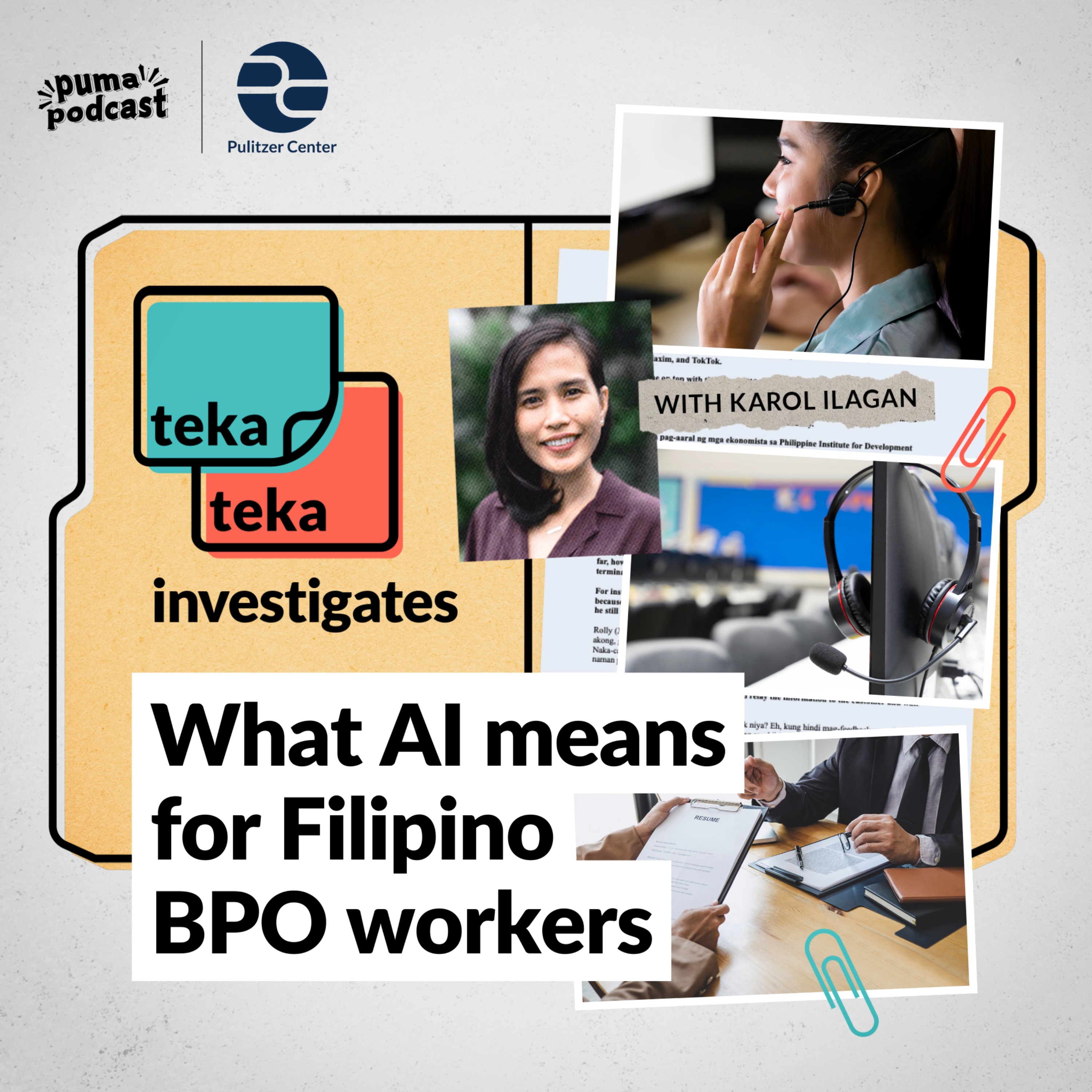
What AI means for Filipino BPO workers
Dec 9, 2024Tap to summarizeThe Philippines, a leading global destination for business process outsourcing (BPO), generates around $30 billion annually from the industry. Despite challenges like expensive and slow internet, factors like high English proficiency, cheap labor costs, and government tax incentives help maintain its competitiveness worldwide. However, the rise of artificial intelligence or AI is projected to reduce agent labor costs globally, posing challenges to the workforce.This development highlights the need for BPO workers to upskill and for call centers to offer more complex services. While AI is seen to displace some jobs, could it also present opportunities for job creation and worker advancement? To explore these dynamics and their impact on Filipino BPO workers, we spoke with Renso Bajala of the BPO Industry Employment Network (BIEN) to learn what it’s really like at the workplace. We learn that all these predictions are so much more complicated than they seem. BPO workers experience the impact of AI systems from recruitment to assessing their job performance. Bajala also talks about how the so-called “upskilling” or “re-skilling” plans must start beyond the BPO sector. This episode was produced by Karol Ilagan. The script was edited by Jil Caro and Carljoe Javier. The episode was edited by Pidoy Blanco and Anthony Tobias. This podcast was produced by PumaPodcast in partnership with the Pulitzer Center’s AI Accountability Network. Hosted on Acast. See acast.com/privacy for more information.
Transcribe →