← Texas Family Law Insiders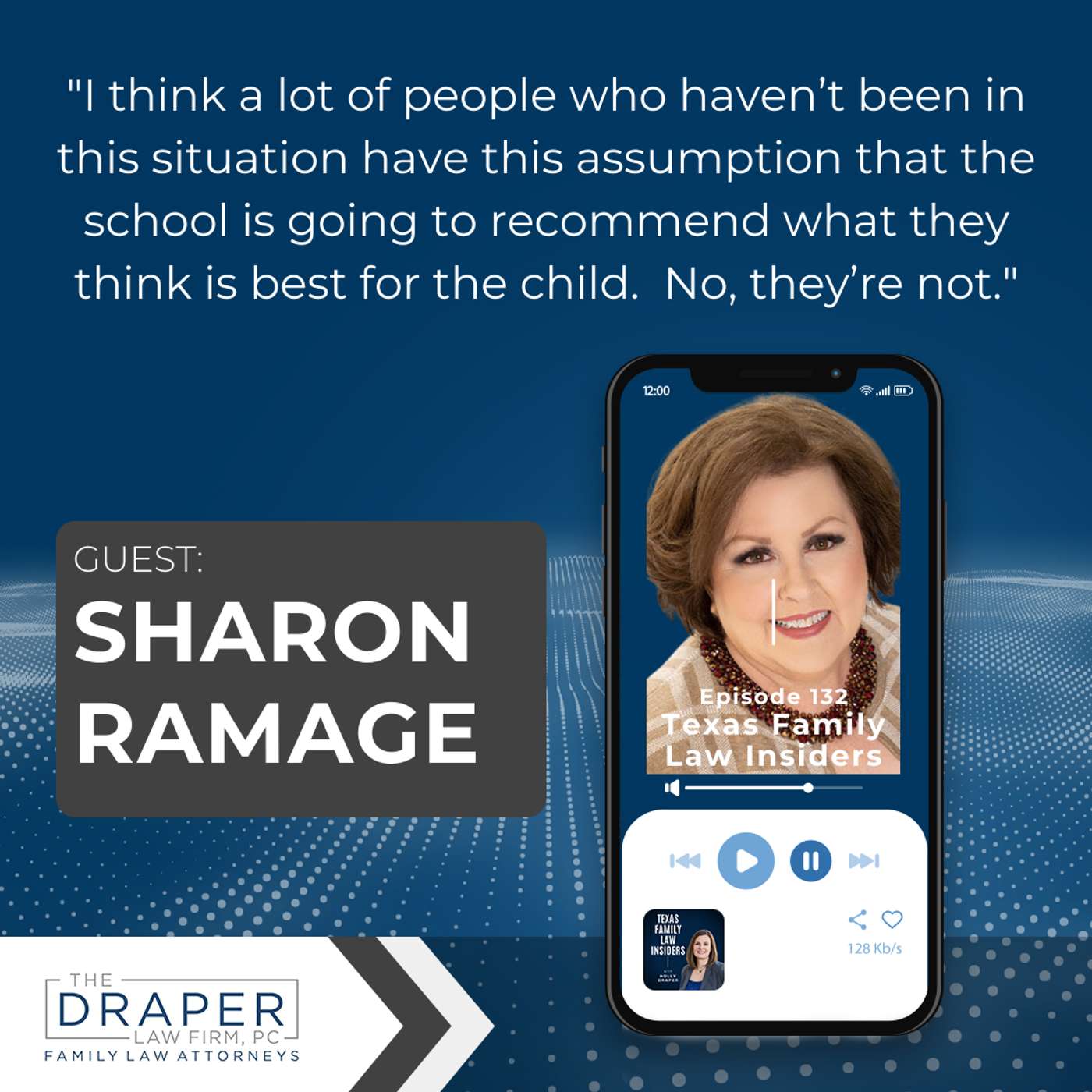
Loading summary
Transcript75 lines
- [00:00]
A
Education law in and of itself is a niche, and special education law is a niche within the niche.
- [00:10]
B
You're listening to the Texas Family Law Insiders Podcast, your source for the latest news and trends in family law in the state of Texas. Now here's your host, attorney Holly Draper.
- [00:24]
C
Today, I'm excited to welcome Sharon Ramage, the Texas Family Law Insiders Podcast. Sharon is the founder and CEO of the Ramage Law Group in McKinney, Texas. She's a former social worker who has devoted her law practice to helping families and children. In addition to family law, Sharon is passionate about helping families with disabled children obtain the services they need and deserve. She served as a special education hearing officer and mediator for the Texas Education Agency, conducting special education due process hearings and mediating disputes between schools and parents. She regularly speaks on both family law and special education topics. Thanks so much for joining me today.
- [01:01]
A
Thank you for having me, Holly.
- [01:03]
C
So why don't you start and tell us a little bit about yourself?
- [01:07]
A
Well, I think you kind of described it. Well, most of my career, my professional career, has been devoted to helping families and children. I started out as a social worker, believe it or not. I was a child protective services worker and then went to law school, but became interested in education law when I was in law school, as well as family law. So after a brief period of time working as a prosecutor prosecuting child abuse cases, I stepped out onto my own and started doing family law and kind of fell by accident into special education law. Somebody thought it would fit with my personality and with my interest. And so when I left the DA's office, I thought, well, I'm going to take 90 days to study. I was going to go into my office every day and read books and learn everything I needed to know to start practicing special education law. And that lasted about a week before started calling me. So I learned by fire. So I've had a family law practice and on special education side, I have represented families. I've represented school districts because for a period of time I worked for a law firm that only represented school districts. And then I went back to representing families. I was a special education hearing officer for about 14 years, and during that time I presided over due process hearings, which are basically trials when there's a dispute between a parent and a school, and then also media those cases. And now I'm back to representing families again, or our firm does. We also practice family law, and we find with a lot of our cases there is an intersection between family law and disability law because there is a high incidence of conflict in families with children with disabilities because it's a stressor and those cases actually require some additional care.
- [02:56]
C
I think most family lawyers that don't have any background or don't have children with disabilities or haven't touched that piece in their own personal lives don't even think about the fact that there are all these unique issues if you have a case that involves a child or special education is an issue. So hopefully today we can talk about some of those pieces and help educate some of the family lawyers out there so that they are better able to take care of families with special needs kids and kids who are in the special education system. So why do you think it's so important for family lawyers to understand special education law at least to a certain extent?
- [03:38]
A
I think there needs to at least be a broad overview and just a general like 30,000 foot view of what special education law is because there are so many children with disabilities in our cases and they have very unique needs and it impacts the parenting plan significantly, it impacts decision making and what should be done. I see a lot of mistakes that lawyers make just because they don't understand the basics from, you know, what is the difference between idea, which is the Individuals with Disabilities Education ACT and section 504? They're two very different animals. They don't address the same thing. One is an entitlement statute. It's all about services for the student. The other is about access and it's not an entitlement statute. And it gives very little enforceability rights, very little teeth to a 504 plan because they don't serve the same thing. One is designed, 504 is designed to level the playing field just so that child can actually have access. And the other is so we make sure the child gets specialized instruction and services to meet their unique needs.
- [04:50]
C
So does IDEA then govern IEPs?
- [04:54]
A
Yes, yes. IEPs, ARD meetings. Everywhere else in the country they're called IEP team meetings, but in Texas we call them ARD meetings or ARDs.
- [05:07]
C
So what is the difference? I know 504 often can turn into an IEP. Where's kind of the line and what are the differences between a 504 plan and having an IEP?
- [05:20]
A
Well, the key difference is does this child require specialized instruction? So for example, instruction not just reading, writing and arithmetic. Right. It's about all things instruction, whether it's behavioral instruction, social skills instruction, academic instruction. So those things are addressed in an iep. But let's say you have a student who maybe is Hard of hearing or deaf. But all they need is the ability to access the their campus and access their education. They maybe don't need direct instructional. That's probably a bad example because they may need deaf education or they may not. Or a student that is. There are many students that have just very mild disabilities. And the term disability is very broad. Under 504, it's a lot. It's any mental or physical impairment that impedes their access. Where special education falls under specific eligibility categories, such as learning disabilities or emotional disability or autism, deaf or hard of hearing, visual impairments, multiple disabilities, there is a broad category and it's a very strict category about do you have this disability? And because of this disability, is there a negative impact on the student educationally? And because of the disability, does this student require specialized instruction to. Not necessarily to remediate, but to meet their unique needs? Where 504 is, we're just going to give you access. And this is an error that a lot of school districts make. A lot of times they'll be serving kids under a 504 plan. This kid is getting nothing, absolutely no additional services and really is a disservice to these students. So it's a matter of knowing what you need. Do you need access or do you need actually a lot of different support?
- [07:22]
C
So I've reviewed some 504 plans in my day, and my reaction as a lawyer when I read a 504 plan was like, this is the most unenforceable document I have ever.
- [07:34]
A
It's very unenforceable.
- [07:35]
C
It's very vague. It's very. I'm like, how do we know if teachers is doing this or not? Is an IEP plan similar or is it. Does it have a little more teeth to it? It's more.
- [07:49]
A
It has a lot more teeth. The difference with the IEP is there are procedural safeguards that must be followed. There are notice provisions that have to be done. One key difference, a school district can have a 504 plan meeting and not even invite the parent. Just say, this is what we're going to do to give this child access. You can't do that with an iep. You have to have that ARD meeting and invite that parent to the ARD meeting. Now, if the parent elects not to show up, that's on the parent. But you have to actually invite and engage the parent because the parent is a meaningful participant in the development of that child's educational plan. That's one key difference. The other key difference is there are very specific safeguards in place if there is a disagreement between the school and the parent, and there is a hearings process that is set out under federal law that the school district districts must implement, or actually the state educational agencies must require the schools to implement. If I have a dispute with my school district on my child's 504 plan, I just go to the principal and they call their buddy at the neighboring school district and say, hey, can you come resolve this dispute for us? There's nothing impartial about it. If I have a dispute with my child's iep, I file what is called a request for due process with the Texas Education Agency, which is basically like a pleading you would filing court outlining my complaints. And then an independent hearing officer who has specialized expertise in special education law but is independent of the school district is assigned to hear that matter and issue a written ruling that is then binding on the district that they must follow.
- [09:35]
C
Who qualifies as a parent under idea?
- [09:39]
A
Well, biological parents, obviously. Foster parents, if adoptive parents, too. Let me say a parent is a parent. Adoptive versus biological, no difference. A foster parent, Unless the state agency says foster parents cannot serve as the parent. You can have a guardian if that guardian is given the right to make educational decisions. You can have anyone that the child resides with, any adult, if that adult is responsible for for their care and is given educational rights or that has been delegated to them in some sort of legal manner, or a surrogate parent. This is where a lot of people screw up. They think, oh, a surrogate can just be anybody. I'll just go in and be a surrogate. And that's a very specific type of appointment by the district. And it's not just anyone. CPS workers, if a child's in foster care, they specifically, by statute, can't be the surrogate parent. So a parent is a parent until their rights are taken away from them.
- [10:47]
C
So jumping into the family law connection here, when we're dealing with conservatorship and educational decision making, what are the types of educational rights that we see as family lawyers in Texas orders that we should be thinking about if there's a special education issue?
- [11:09]
A
Well, first of all, I truly believe, and in my office, if this child even has a hint of a disability, because sometimes when they're young, you don't know they're not really being served in special education right away. But you've got to give exclusive rights to one of the parents. The buck has to stop with one of the parents. If you do not, it creates too much confusion with the school district. It creates a situation where maybe you have one parent that consents to services and the other one that doesn't. And there's some guidance out there from the Department of education says that refusal controls over the consent. And so if you, you need to make sure that one parent has that exclusive right to make educational decisions. And the other, my big hot button issue that I will preach to the choir every day of the week. Do not appoint tiebreakers. Do not. They're at best ineffective because they're not binding on the school and they really, really cause a lot of problems. And it's because of what it does to the school districts and that relationship between. They've got to know who they're going to. Because consent is required for an evaluation, it's required for the initial provision of special education services, it's required to exit them from special education unless the district otherwise has gone through other procedures, it's required to reevaluate them. So every step along the way within special education requires parental consent. And if you've got two parents that don't agree, which is frequently the case when they're divorced, you set this kid up to fail. Because what happens is a delay in the child services, it can create gamesmanship with the school because, you know, it's human nature. You're going to rally around the person that is causing the least friction. And a lot of times you've got a parent that says, hey, my child's not getting the services they need. And you know, sometimes school districts behave badly and they'll go rally behind the, the one that's not going to push them and this kid gets lost in that and they end up really not being served appropriately. And then the chicken's way out, which is what I call it, is, you know what, let's just appoint a tiebreaker. We'll just have an educational advocate. And that person is not by law a consensus member of an ARD committee. So they can never sign an agreement or non agreement with the IEP because they cannot do it legally, ethically. There's just no mechanism. And so the only person can be a parent and then other designated ARD committee members, such as an administrator, special education provider, general education, teacher evaluation staff. There are very specific provisions of who can sign an agreement or disagreement on an iep. I had a case once and it was just a nightmare. And I know people meant well, but they're like, you know what, if the parents don't agree, then we are going to have a provision that they have to then Go consult with this educational psychologist that's never been to the ARD committee. Mind you, she didn't go to them. They just had to go consent with her. And it caused all kinds of problems with the school district who really wanted to do the right thing, but they could not do anything because the parents would break, they would go talk to this advocate and then they would have to go back to the ARD meeting. Well, you don't always have that type of time. And B, the school didn't agree with her, so they were just going to do what they wanted anyway. Because at the end of the day they can make the school district. If the parents are not integrated, the school district can say, well, the school members of the art committee have deemed that this is what we're going to do. This is the service that's going to be provided, this is the placement that the child will be in. And we're giving you five business days notice that this is what we're going to do and that's it. So you have no one to really hold them accountable. And then you have no one that really has the legal ability to actually file a request for due process because one parent files it, the other one wants to come in and dismiss it. Hearing officers wants to want to know who has the right to do that. So there are all kinds of problems. Aside from the constitutional issues which you and I have talked about on parental rights, there are all kinds of problems that this causes in the long run. And I know there's a cottage industry out there with people that say, oh, just appoint me. It's your educational advocate. And just would tell every special education attorney, just don't do it.
- [16:01]
C
So you just brought up a lot of things. Let's go back and kind of tick through those a little bit deeper. So you mentioned that you want one parent to have exclusive education decision making rights, correct? Well, in my experience, a lot of parents are not too excited to give the other side exclusive anything. So what is the harm or is there harm in, you know, let's say that dad's just really not super involved, but he's, this is a hill he's gonna die on. He's not giving mom exclusive rights. So everybody's gonna have independent rights. And a lot of times I see judges default to independent rights on things. What are the risks of having independent rights?
- [16:48]
A
The risk of having independent rights is if ever dad decides, hey, I do disagree, he's going to throw a monkey wrench into things because school does not have, I mean, it can result in the child not getting a delay in services. The other thing that it could potentially result in is basically the, the mischief, what I call when it comes to due process about what the school district rallying behind the one that's not really holding their feet to the fire. The other thing it does, it's a standing issue. I mean, who's to say if both parents have independent rights? You've got to have, even in mediations that we do in special education, if one parent doesn't have that exclusive right. We've had sometimes significant delays in getting services to kids because we have to go track down that other parent that's pretty kind of non involved to get their consent on the mediation to even have that go into effect. So it affects everything from due process to complaints to mediation. If you. It's really not that innocent. I mean, I've heard people tell me in mediations before, but Sharon, they're not going to, I mean, you're not going have to worry about anything with them. Well, you do.
- [18:08]
C
So with independent rights. So let's say we have a pretty MIA parent who really is not going to interfere. So let's say mom has the independent right to make educational decisions. Dad has moved away, doesn't care, doesn't really see his kids, but he, you know, got the independent right or he signed off on the independent right. Can the school take action based on mom's requests or what mom is doing because she has the independent right or are they going to insist on tracking down dad?
- [18:40]
A
No, typically I will tell you, for the most part it works till it doesn't. Right. So if you have only one parent going to the yard meetings and they have independent rights, the school is going to. If the parent is either in agreement or they're going, it's going to be okay, or they're doing that consent. Where it becomes a problem is if there is a dispute between the parent and the school that requires any sort of due process or remediation, that's when we can run into issues.
- [19:10]
C
So that next level, once you're bringing in the state, that's when they're going to require that other parent to be involved.
- [19:18]
A
And that's assuming the other independent parent is kind of the silent one and isn't really participating. But if you've got two independent parents and they're both going to all the ARD meetings and they're in disagreement, it creates chaos.
- [19:35]
C
So you talked a little bit about your pet peeve of the tiebreaker. And I know there are a lot of Orders floating around out there where, whether it was by agreement or whether it was by a judge doing it. I know tiebreakers are appointed in a variety of rights situations, one of them being educational. I've seen the school counselor listed, I've seen the school principal listed. And I, I know, I always have heard they don't want that job. They don't want to be your tiebreaker. They're not refused to be your tiebreaker.
- [20:11]
A
Ethically, they can't.
- [20:13]
C
So is there any type of tiebreaker that you've seen that actually would work?
- [20:19]
A
No, not in the special education context because they don't have authority. Federal law is very limiting on who can actually be a consensus member of that ARD meeting and not one of them. And so I do not see it as being effective. Now, the whole deal with the tiebreaker. First of all, I had a case once where a judge and I will not say who had appointed the campus guidance counselor as the tiebreaker. Well, did you know that? You probably know this from your husband's work. Almost every school campus guidance counselor has zero special education background. There's a difference between a campus level counselor and a special education counselor. They're not even going to understand the special education component to begin with. And you don't have to have a special education background to be a school principal or a school teacher. So they potentially appointing somebody that doesn't have the expertise in it. But I've also told people it's kind of like appointing the fox to guard the hen house. Why would you do that? They have an inherent conflict. If there is truly dispute. Schools do not always act in the child's best interest. They just don't. Especially nowadays where you've got all kinds of funding cuts and you've got political issues that are impacting us. Schools don't always act in the student's best interest. And so the whole point of the statute is to hold schools accountable, to hold their feet to the fire, to give some real enforcement and entitlement to educational services to students. So the very person that you're saying, or the very entity that you're saying, hey, they're not doing right by this kid, you're going to put them in the position of being the one that say, oh yeah, we are. That's like saying you can let the doctor be the decision maker on whether he's engaging in medical malpractice. You just wouldn't do that. But for some reason or another, since it's school and it's education, it's like, I'LL let the teacher decide. If we could let the teacher decide, the statute would not exist. That's the whole point of it.
- [22:31]
B
This episode of the Texas Family Law Insiders podcast is sponsored by the Draper Law Firm, providing family law appellate representation for non parent custody cases, jurisdiction issues, property division standing conservatorship, possession and access termination, parental rights and grandparent access. For more information, visit DraperFirm.com or call 469-715-6801.
- [22:58]
C
When I think a lot of people who haven't been in this situation have this assumption that, well, the school is going to recommend what they think is best for the child.
- [23:07]
A
No, they're not.
- [23:07]
C
So you think that's why you we should be just deferring to the school. Same thing with a pediatrician or something like that. And you know, I've just through friends and stuff have seen when you have severe special needs, there is a big resistance on the part of schools to do what is required because it's expensive.
- [23:29]
A
Very expensive. I just had a child and in fact, we actually had to end up going into family court over the parental rights issue because this child needed residential treatment. And until we had the exclusive rights to my client, it was very difficult to get anything done because we had a parent that they had independent rights and he would just object, just to object. And this kid desperately needed it. The school didn't want it because it was expensive. I mean, when you're talking residential treatment, you're talking about $250,000 a year. There's some ways that schools can defray that cost, but this kid really needed it. And it had it not been for us being able to get into court and get exclusive rights to the mother. And then we ended up working it out with the school, we ended up mediating. It all worked out, but we just, she didn't have that ability. Were tied. And even schools that want to do the right thing, they feel like they're stuck in the middle. They're, they're like, we don't want to be stuck between two warring parents. Just give us one. And I have yet to find a school district that thinks having independent rights with parents is a good thing. Not when it comes to special ed because they want to know who they're dealing with. It's also important too that if you're the attorney that you make sure you're school district, your client's school district gets a copy of that order and it outlines those rights. Because let's say you have one parent that has exclusive educational rights. They're kind of warring. And so one of them has that exclusive right, but the other was still involved with the kid. They go to meetings, that parent shows up and that doesn't have those rights and is signing off on consent forms and doing everything else. They have no authority. And so it's really, really important to identify who can do those things and that you also communicate that to the.
- [25:24]
C
So you touched on this a little bit. And this is something you and I have chatted about before. The constitutional issue of appointing a tiebreaker. I know. I think that's the one we've talked about. Oh, yeah. And obviously if a parent does it by agreement, that is not a constitutional violation. But if a judge does it, which I think you and I have both seen that happen over the years, why do you see a constitutional issue with that?
- [25:53]
A
Well, you're appointing an outside non parent to actually make one of the specifically enumerated parental decisions to a non parent. This is no different than designating somebody the exclusive right to make or determine where the child's residence is or medical decisions. First of all, that person's not even a party to the lawsuit. They're not a party to the case. They have no dog in the fight. Right. So it's probably, probably unenforceable from that standpoint alone. And I think that's what the South Texas case had. But all of those rights are the rights of the parent. And to take that away. Would it pass constitutional muster to have two parents be joint managing conservators, but say grandma down the street is going to be the one that decides where the child lives? And I think the answer from everybody would be no. Well, this is no different. It's in the same section of the family code. It involves the same level of scrutiny because it is a core parental right.
- [26:55]
C
I think there's another interesting constitutional issue that could come up when there's not a tiebreaker or non parent involved with a court issuing an exclusive right to one parent over the other. Because you are taking away a constitutional rights from one parent. And I'm going to be arguing you have to have clear and convincing evidence that my client is unfit in order to take away one of these rights. I don't know if anyone is out there making those types of arguments yet. I can see that as the next battle.
- [27:37]
A
Would that apply then to the exclusive right to determine the child's residence? How was that different? The core parental functions. You're going to decide where your child lives, who your child's associations are, your child's Education and upbringing. Right now, parents, when they divorce, they are submitting part of that to the court to allocate among the parents that you, by invoking the court system, you are invoking the court's ability to allocate those rights among the parents as it deems as, as is fit. I think that's very different when you're looking at saying, hey, we're just going to go appoint the therapist down the street to make all these decisions because that is truly a non parent. That did not, you know, you did not say, when I submit myself to the jurisdiction of the court to allocate these parental rights, but, oh, go find somebody else that's a stranger to us and they can make those rights instead of us.
- [28:38]
C
It's an interesting, interesting discussion, I think, but I think it is, I think.
- [28:41]
A
It is, but it is. But I, and I'm not ashamed of saying that it's my soapbox because, just because from where I sat, even when I was a hearing officer, there would be conflicts. You know, there was nothing more frustrating to sit in a case as a hearing officer brought by one parent and then the school district is over bringing in the other parent to say I disagree, you know, and if they both had that independent decision making, it becomes an issue. And it's very, very frustrating to see kids not get services that they need, that they desperately need. Right. Because one parent doesn't believe the child has a disability. And the case that I had where child really needed residential treatment, we had a core disagreement over whether the kid had a disability. And it was very significant and serious. And it required this child to have a specialized level of instruction and care. And if we had not had those exclusive rights to one of the parents, I think the outcome for this kid would have been very bad. But it's also an education. It takes bringing in somebody to educate the judge about what these rights mean. And I think, you know, into most a lot of the world that you disability has not touched you and you have not had to deal with that as a parent. There's just a lack of understanding of how, what all is involved. It's not just deciding which campus the child goes to.
- [30:12]
C
So let's pivot just a little bit and talk about drafting of orders. When we have families that have special needs, kiddos with special education needs. I know the Texas Family Law Practice Manual doesn't have a whole lot to say about special education. And it's just going to give the generic, you know, right to make educational decisions. What are some things that we should think about putting into orders when this is an issue in a case.
- [30:41]
A
Well, my kind of go to language is giving one parent the exclusive right to make educational decisions and I'll do after meaning after, after meeting meaningful notice to the other parent. Right. You know, you want to keep them in the loop if you can. And, but having the buck stop with one parent, but combining with that also the right to enforce the child's educational rights under applicable federal and state law. That's kind of my broad overarching language that I like to see in our orders. If a child has a disability, because you want to know that they can actually be the one that can go request a mediation from tea that they're the ones that can actually file a request for due process or you know, let's say it's, it's 504 or an ADA issue that they can actually file suit. But you want to know that you have the right person in place to make educational decisions that can then do something about them. So it's not just go and sign off on an ARD meeting and saying yes school, I agree, but what happens in the event of a disagreement, and I've been guilty of it this, if you get too, too, too into the weeds and details, then that creates even even bigger issues. I had a case where once where we wanted to limit kind of what type of placement it could be and I had to explain to the other side that the parent is not the one doing the placing. It is the school district doing the placing. So we're, we cannot by the family court court order limit what the school can do as far because they wanted to guarantee that there would never be any sort of residential placement or out of district placement. And that is a tool for the school districts to use. Residential placement is out of district. Behavioral schools are out of district. Some different types of out of district placements. If the school does not have the resources, they have an obligation to actually go find the resources and place the student within, within them. And, and so there were too many wanting to put too many limitations on it. And then it's like, okay, well can we say if there's a residential treatment center that will only be within a certain mile radius of the, of the child's residence. And the problem with that is what if there isn't one? I mean the case I most recently had, this kid was in the Ozarks in a resident because that's what that was the only thing that was available that was appropriate because you. There are so many differing factors that you have to look at. So I think broader to give that ability to make them. But if you want notice to the other parent and you want to involve the other parent, that's how you do it. Even with exclusive rights, is it important.
- [33:33]
C
To specify certain things related to evaluations, consent, authority, ARD meetings?
- [33:41]
A
Yes. Well, generally the person who can have the exclusive right to make educational decisions is the one that will need to be signing the consent for evaluations because it is an educational decision. This is not like going to the psychologist down the street or going to the doctor down the street. But whoever has those educational rights needs to be the one. They'll be the one assigning the consent and consenting to the services. It's all one big package. I think that's where you get into trouble if you start to try to parse those out because then it's also confusing to the school. The school needs to know who's making the decisions.
- [34:17]
C
So if we have a family that is a problem in this area, they have independent rights, they have joint rights. And we're at a roadblock because they're not agreeing. What steps should we as family lawyers take in that scenario to help this family?
- [34:34]
A
What I've typically done and have been successful with is getting a temporary order set pretty quickly. And in fact, in one case I've even gone and gotten a TRO and we've gotten in very, very quick because we were going to lose a sp. A placement that the school needed at the end of the day. In one case in particular that I had, we couldn't get into court quick enough. And the school just said, you know what, this is the school member's decision. Child is going to this private placement. Whether you like it. This is what we are deciding. And we agreed with the school so it wasn't a problem. So it happened in spite of the non consenting one. But if you. It's real important to get in, I think to the court as quickly as possible. And you've got to have somebody that knows what they're doing that can explain this to the court and how critical it is and why it is needed.
- [35:25]
C
So let's go back to that example you just gave where the school took the initiative to send the child to the placement. If you're on the side that does not think the placement's appropriate or does not want the child to be placed, is that a family law issue or do you need to go deal with that somewhere else?
- [35:45]
A
That is a tea issue and that is a request for due process.
- [35:49]
C
Does that get addressed quickly if they file that?
- [35:54]
A
No. In theory, yes, within 75 days from filing. But if you've got two parents with independent decision making, the first fight that there's going to be, sue has standing to bring the suit. And the second thing is these cases are not timely. I mean, on paper they're timely. There can only be continuances for good cause. But we have cases that we filed back in August that I think we are going to be doing good to get a decision by June.
- [36:22]
C
So in the meantime, is that kid in the residential placement that the school wants?
- [36:27]
A
It depends. If the parent files timely, then the, the stay put placement would be the last placement that was, that existed before the due process was filed. So it could cut off that placement. It depends on the timing in which they file.
- [36:44]
C
What can we do as lawyers to help educate the judge on special education issues when we are severely limited in time?
- [36:54]
A
Well, first of all, I think you need to be asking for additional time. Secondly, I would get a report because, you know, we can do summaries of testimony in Collin county anyway for temporary orders, I would get a report from your expert, have your expert testify. You're going to need to have an expert at temporary order. If it's a temporary orders hearing, you're going to have to have somebody to explain why this is needed. If you have the school on your side, all the better. You just call from somebody from the school. But frequently that's not the case. And so you're going to have to have, especially if you're wanting to go contrary to what the school is recommending, you're going to need to have that person on board with you at the hearing.
- [37:32]
C
At least in my experience, judges tend to listen to what the school wants. So I think if you don't have an expert, you gotta have scenario, you're sunk.
- [37:42]
A
You gotta have an expert.
- [37:44]
C
When does the family need to bring in a special education attorney or advocate?
- [37:49]
A
First of all, there are two different things. Let's talk about them one at a time. Because there are advocates who do not have to be lawyers, right? There are good advocates and there are advocates that aren't as good. And advocates can assist parents. They just don't understand the process and they want to have somebody accompany them to an ARD meeting because they can bring anybody they want to an ARD meeting. That advocate's not going to be able to make a decision for them. But they can bring somebody to their ARD meeting to help the process and help explain it to them. Help Come up with suggestions for the school. We do that in our firm. I have advocates that work for me and they will go to ARD meetings with people just. And a lot of times we can get a lot more done that way because it is not adversarial. So that's the first one. If you just want some tweaking, you want your education, educational records explained to you, maybe you want some services, but you just don't want to be in an adversarial fight yet. Take an advocate. You can take a special education attorney for that matter too. That just the attorney presence at an ARD meeting tends to heighten everything a little bit. I have an advocate that works for me that's out of the school system. She's a PhD psychologist, was a special education director. She speaks their language. We get a lot done for families, families with her. And so. And we're about to hire another one. So that is one way to handle it. Advocates can file for due process, but they're not lawyers. But you got to remember they're going to be held to the same standard as a lawyer. So, you know, being a lawyer, there's a lot at stake. There are legal rights at stake. I'm going to say you need a lawyer, a special education attorney, but hire an attorney that actually has a background and expertise in special education. If you're at a point in a crosswords with the school district that you really are in a disagreement with the school, you don't believe that they're serving your child's needs. Maybe your child's not getting the services they need. Maybe they did a different type of placement or they're just refusing special education because that happens too. Then you bring in an attorney and we can file for due process. Almost all of these cases, like all other areas of litigation, are resolved in mediation. But it's really, really important that you get somebody going through that process with you that understands it. Because people will bring lawyers that have no background in special education and they don't, they do more harm than good. This is a highly specialized area of the law, even within the field of education law. You can go to any firm that represents school districts and somebody comes to a general education attorney with a special education question, they're going to throw their hands up and say, no, go down the aisle. That's not me. Because it is. Education law in and of itself is a niche, and special education law is a niche within the niche. And so it's really important that you get that expertise and they'll tell you like, we will. If you talk to us, we're going to say, yeah, this is a viable due process claim. Or, you know what? I think maybe you just need an advocate because not everything needs due process.
- [40:48]
C
So what are some questions that family lawyers should be asking clients early to determine if there are special education issues and to help those families?
- [41:01]
A
Well, first of all, get past your own biases, because special education is not like when I grew up and I'm aging myself, which is the room down the hall that you tiptoed past. You know, special education. You know, more often than not, these children are in general education classrooms. They're not pulled out. They don't. They get some, maybe some modified instruction within the classroom or they get maybe some light pull out, but they're not in what we call a special education class. And so it's real important to find out. Okay, tell me about the meetings you go to at school, because a lot of times the parents don't understand what they're going to. Right. Have you ever gone to. I can't tell you the number of times I've asked. People will tell me about your ARD meeting and they'll send me, bring me a 504 plan because it's not the same. So you need to, as the attorney, ask for those documents. What do you have? What school records do you have for your child? Look at them. And if you see the words admission, review and dismissal at the top of the page, that means your child has an. This child has an IEP and receives special education because that's an ARD committee paperwork. If you see 504, it's a little different. Then you need to ask a little bit more. Well, tell me how your child does in school. Now, obviously, a lot of times parents will come to you if their child has autism or they're on the spectrum. I mean, those are. I mean. But you'd be surprised the number of kids that have autism don't have IEPs. It's appalling. And. And so you need to ask what records to look at. Who do you talk to? Tell me what your child's school day is like. Just get them to tell you. Or if they're having difficulty reading. Oh, really? Well, tell me about that. And maybe they have dyslexia. And dyslexia actually qualifies students now for special education in Texas, for a long time it did not, but we've changed. And so that is a specific learning disability. If they're telling you things like, oh, well, just they're Slow learner. You know, you know, I've had people tell me that, and I dig further and find out their child has an intellectual disability. And so you need to really press the parent about what their child's school day looks like and what their involvement is. Because if I'm representing a parent, this child has a disability. I want to know that you've been to every ARD meeting. I wanted to know you've taken an active role in it and you're not just creating a stink. I want to know that you are actually engaged, and that's very, very important. Have your client request their child's special education records for you so you can have them, but the school has to turn them over. A mistake I see attorneys make a lot is serve subpoenas for school records on the campus, and that's not where those records are kept. And so you're only going to get campus records if you serve the campus principal. So you serve the special education department. You ask for their entire file. They're going to have to turn it over to you. It's not that hard. And so ask for the right records. Ask your clients about just what day to day looks like with their child. Maybe they have adhd. What does that look like? Because that qualifies a lot of kids for special education education.
- [44:06]
C
I think most attorneys, unless you see your client has a child with severe, severe, severe disabilities, you don't even think about it.
- [44:18]
A
Yeah.
- [44:18]
C
And the number of kids out there who have an IEP or 504 is probably shockingly high compared to what most people think that number is.
- [44:27]
A
Correct. Well, and it's the latent disabilities, too. I think a lot of people may make mistakes not addressing this when kids. Before they're in school. Right. Because there are things that sometimes they're just not going to show up to. Maybe they show up slightly. Maybe the child's a little slower to identify their letters. But, you know, there are things that you can see when they're for. This child is very likely to be identified once they hit school. And don't assume because they've never been identified that they shouldn't have been identified, because that's a big issue. Issue, too. I just. We just recently had a case come through our office that the child was being identified with an intellectual disability for the first time as a senior in high school. Now, how on earth does that happen?
- [45:10]
C
Wow, that's.
- [45:12]
A
That's just outrageous. And so it. It just. So don't make that assumption. You know, you need to know, hey, and I think if you're representing a parent and they're wanting custody, you need to know all you can know about this, that kid, what makes them tick, what's their day to day life like? Tell me, what's your, what's the other parent going to say? Because a lot of times you'll have this, you'll have one parent come in and say, oh, there's nothing wrong with my child. He doesn't have. It's all her. She just, she has Munchausen. You know, when I ever hear somebody tell me the other parent has Munchausen, it's kind of like, okay, let's talk about that. What is the other parent going to say is your child's issue? You know, and so you have to look at those things. Sometimes you'll see things in their pediatric records. Has the pediatrician addressed ADHD or administered the Conners or if they have they done it, you know, you have to look at those things. And is the kid in therapy? What's the therapist saying? So just dig for how the child's educational, behavioral, social development looks.
- [46:21]
C
Are there any resources out there we can point family lawyers to that can help them become more knowledgeable about these issues?
- [46:29]
A
Well, the Texas Education Agency has a wealth of resources on their website for people to go to and to look at just different resources educating them about special education. Disability rights, rights of Texas, I always refer people to because they also, even if they will not take on the case, they also have a wealth of resources for people. And most school districts have disability groups for parents with children with disabilities. And that is a good starting point. And of course, people are always welcome to reach out to us because if we can't help, we will refer people in the right direction. Special education law is fun. It's a fun way to help people because it's a big area and it's an overwhelming area, especially for attorneys. I have attorneys call me all the time saying, hey, Sharon, can you help me on this case? I've actually gone to ARD meetings with people because, you know, they've had some issues. And so, and I have pretty good, we've developed pretty good working relationships in the, in the community. I practice statewide. But we've developed pretty good relationships with school attorneys because it's the same handful of people that, you know, it's a small bar and we all know who the, the dabblers are. And you don't want to be a dabbler in this area because there's too much at risk.
- [47:55]
C
So we're just about out of time. But one thing I like to ask everyone who comes on the podcast is if you could give one piece of advice to young family lawyers, what would it be?
- [48:04]
A
I'm obviously not going to say don't do it. I would say don't get dug in. You know, go into everything with an open mind. You are not your client. Don't take on your. Don't become your client in the process. Have good boundaries for yourself. And because it will not only help you be a better lawyer advocating your client's position, but you will gain the respect of judges and opposing attorneys. Because I can't tell you the number of times. I mean, I think we. I had a pretty contentious case with your firm back in the summer, and we were hanging out at the Advanced Family Law, having lunch together afterward, you know, during the. I mean, because at the end of the day, you didn't create your client's problems. So don't be a part of the problem going forward. Right. So be objective. Tell your client the truth. I've always told people you're gonna. I'm gonna shoot straight with you. If you don't have a case, I'm gonna tell you have a case. And if you're taking the wrong position. Position, I'm going to tell you so. And we are not your mouthpiece. And I will tell young lawyers you're not your client. I've told people in my office you're not. You're not the mouthpiece of your. Your client. We have to wear our counselor hat as well. And that doesn't mean therapy. That means we need to give them advice and counsel as well as represent them. And sometimes that means we tell them hard truths, things that they don't want to hear. But you never know what you're going to open up for the other person who receives that truth. I've actually had that experience once. So be always tell the truth. Don't dig in, and you're not your client.
- [49:47]
C
Excellent advice. And I think that also helps you avoid burning out really quickly. Yeah. So where can our listeners go if they want to learn more about you?
- [49:57]
A
If they want to go. Our website is www.ramagefamilylawfirm.com. that's a link to our overall firm's website, which has family law and special education law. We have a special education website, www.texasspecialeducationattorney.com and so feel free to reach out to us through either website.
- [50:18]
C
Perfect. Well, thank you so much for joining me today. For our listeners, if you enjoyed this podcast, take a second to leave us a review and subscribe so you can enjoy future episodes.
- [50:28]
B
The Texas Family Law Insiders Podcast is sponsored by the Draper Law Firm. We help people nail navigate divorce and child custody cases and handle family law and appellate matters. For more information, visit our website at www.draperfirm.com.