Loading summary
Transcript64 lines
- [00:03]
A
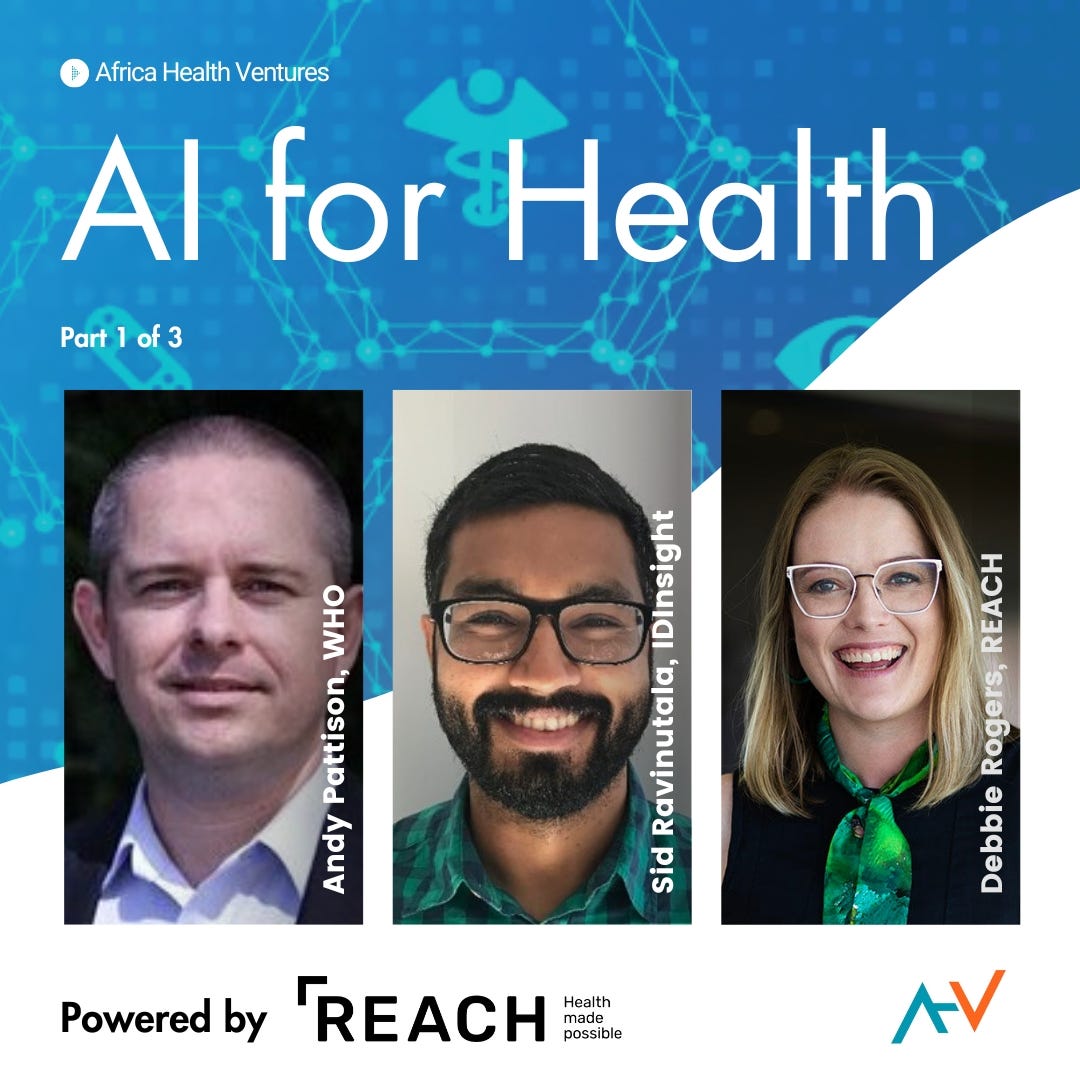
Hello and welcome back to the Africa Health Adventures Podcast. In this podcast, we're going to unpack what's going on in healthcare in Africa today. But that's not all. We're also going to be looking into the innovations, the ventures and the entrepreneurs that are going to help us leapfrog ahead over the next 10 years. I'm your host, Rowena Luke. Today we'll be digging into a topic that's been on everyone's mind, and that's AI, or Artificial Intelligence for Health. There is so much to cover here that we're not going to do one episode, but a series of three episodes, with big thanks to our sponsors, Reach Digital Health. To kick off this series, we're going to air a recording of a panel discussion I recently moderated. Earlier this month, I traveled to the Institution of Oxford in the United Kingdom. It was beautiful to attend the School World Forum and specifically to moderate this panel on AI for health at the Marmalade Festival. So we'll have three speakers with us today. The first is Debbie Rogers. Debbie is CEO of Reach Digital Health. Reach is a South African nonprofit that builds digital tools to improve government delivery of health services. In 2023, Reach won the School Award for Social Innovation, which is kind of a big deal. And their Mom Connect messaging service is being used by more than 60% of all mothers delivering in public facilities across my home country, South Africa. Our second speaker is Sid Ravinutala, Director of Data Science at iDInsight. IDInsight is a global advisory, data analytics and research organization supporting social sector leaders to strengthen their impact. And last but not least, we'll be hearing from Andy Pattison, team lead of the Digital Channels Group at the World Health Organization. A few quick announcements before we dive in. First, if you want to get notified of future episodes of the Africa Health Ventures podcast, be sure to subscribe on whatever platform you're using right now. In the next episode, we'll speak in a little bit more depth with the World Health Organization, the who, with the Canadian funding agency idrc, as well as the center for the Fourth Industrial Revolution. And then in the third episode of this series on AI for Health, we'll be speaking with the implementers, the geeks, and the visionaries building these AI systems, including a clip from Dr. Sam Oti's MedTech Africa podcast on how AI is transforming healthcare. If you're interested in any of that, don't forget to hit subscribe second Announcement if you want to stay in the know about healthcare ventures in Africa, you can subscribe to our newsletter@africahealthventures.com Newsletter Last announcement if you know of or want to nominate a promising seed stage startup bringing Better Healthcare to Africa, get in touch with us@africahealthventures.com One last friendly reminder. The content here is for informational purposes only. It should not be taken as legal, business, tax or investment advice, or be used to evaluate any investment or security and now, let's get back to the show. Artificial Intelligence AI is moving at a mind bending pace. It can already diagnose x rays and MRIs better than trained radiologists. It can already predict certain diseases years earlier than we've ever been able to detect them before by looking in your eyes or listening to your voice. And what's even creepier is that AI is not just a tool, it's a person. As you're getting to know AI, it's also getting to know you and how you talk and how you think and responding to you in the way that you like. AIs are not better than the best people at most things, but they are better than most people at a lot of things. Just think about them. When it comes to the risks of working with AI, particularly in the healthcare space, there's a couple it hallucinates, it makes things up, it's biased towards rich people in the connected world, and it's going to be more persuasive and by extension, more manipulative than any other technology we've ever seen. AIs are going to be our teachers, but the question is, should they be our friends? In the discussion today, we're going to talk about some of the opportunities and some of the breakthroughs that we're seeing in AI for health. We'll also talk about some of the risks and the challenges of working with AI, particularly in such an important and sensitive space as healthcare. We'll provide some tips and guidance for organizations at the start of their journey with AI and how to get going in an ethical and responsible way. And last but not least, we'll move to a Q and A with the audience that was with us in Oxford that day. We begin with Andy Pattison from the World Health Organization. Andy kicks us off by naming one of the applications of AI that he's most excited about.
- [05:10]
B
It's a pleasure to be here today with so many people. The room is full and I'm looking forward to the discussion today. From my point of view, it's how quickly you can generate good quality content and translate it and personalize it to reach citizens in a very quick way. And I Find that if we can harness that power to, especially in countries where maybe they have 40 or 50 languages within their country, I think this would be an amazing tool to allow them to reach those populations very quickly and very swiftly. So for me, that's one of the most exciting areas of AI that I've seen.
- [05:48]
A
Next up we'll hear from Sid Ravinutala, the director of Data Science at ID Insights, about some of the things that he's excited about in the world of AI for health.
- [06:00]
C
Okay, so I want to talk about a couple of things that are exciting. So one that probably a lot of people here are familiar with is this idea of chat interface for the technical people here. This rag architecture as it's called, you've got some database at the back and you answering questions from it and providing a natural interface. That's very popular, very common, it's done quite often now. There's some issues with it and we'll talk about that. Especially doing it at scale things that I'm excited about just abstracting that out a little bit. Just having these natural interfaces by natural interface means you can just talk in just your normal language to structured backends. So what structured backends means you have a database at the back, you've got some, you know, an API which is how you would interact with certain applications. So there's new ways of creating these natural interfaces I'm very excited about. The last thing that we've been working on and we in the middle of a pilot in a state in India is AI assistance. So this is helping government officials understand government policy. So government policy is fast changing and it's vast and so officials who are working on elections in UP right now, it's the uptake has been surprising using AI to understand their own documentation. And as that changes, so AI assistance, there's natural interface and of course this chat based on knowledge base that we're probably all familiar with.
- [07:29]
D
Great to hear. And I can imagine in addition to getting governments to understanding their own legislation, helping us to understand government legislation I think will be a huge unlock as well.
- [07:40]
C
Yeah, just on. Yeah, exactly. That's totally right. So two things that come to mind and one is there's an organization called Indus Action in India who do pretty amazing stuff. They help citizens connect with benefits and you could imagine. So one of the things we've been working with them to scope out is can you help citizens understand what benefits they're eligible for using a natural language? Just share some information about yourself and have a conversation to figure out what Benefits you should be able to have access to. And then Index Action. Someone from Index Action will contact you to help you get started on getting access to these. So all these kind of applications really get me excited about it. Anyway, I'm going to pause there and we can talk more about other interesting ideas.
- [08:30]
A
Debbie Rogers is going to speak next. She's the CEO of Reach Digital Health and she's going to mention two initiatives that you'll want to pay attention for. The first is Mom Connect, a digital messaging service delivered in partnership with the government of South Africa to support pregnant women across the country. She also references Aida, a tool that they integrated with Mom Connect. Aida is a global tool. It's not Africa specific. It's one of the most popular AI powered symptom assessment apps in the world with 13 million active users. What Aida does is it talks to you, it hears what are your symptoms, how are you feeling, what's going on with your body? And it uses that information to support, guide and connect you to the health system. Here's Debbie Rogers.
- [09:17]
E
There are a few different ways that we've been using AI. I think one way is to just adopt a model that somebody else has built. We don't have a lot of money in this space and there's so much money going in on the commercial side of things that really we're kind of fighting a losing battle if we think we're going to build the same tools that some of these commercial entities are building with the amount of money that they have. But we have an amazing way to make that kind of algorithm more accessible to people. And we really understand how to reach people at a different level and at a different scale. So, for example, ADA Health is a application that you can download on your phone and it does diagnostic even for really rare diseases. Hundreds of millions of dollars have been spent on this piece of AI and we integrated it into our program in South Africa called Mom Connect. Mothers throughout South Africa were able to use this really sophisticated diagnostics engine just through WhatsApp. And not only did we manage to replicate what they'd done with this very fancy app that was not very accessible, but we even ended up with it being the completion rates on WhatsApp being higher than they were on the app and able to save the health system $65 per diagnosis. So really fun ways of taking something that, you know, definitely can't build ourselves, but make it more accessible to people. I'm sure Sid will talk a lot about some of the natural language processing work that we've been doing with ID Insight really to make the engagement on our platforms much better. I think what's really exciting me at the moment though is the option for hyper personalization. We speak to so many different people and ultimately our aim is to change their behavior. Now that is a complex thing to do and understanding what is it that is a barrier to their behavior change. What kind of information do we need to give them? How do we need to give them that information to be most persuasive and then tailoring that for the millions of people that we are reaching every single day is really very, very complex. And so we've had to do things like create profiles of five different types of people. And of course there are not only five different types of people, but that's as, you know, personalized as we've been able to get up until now. Whereas now we're actually going to be able to create hyper personalization for the many millions of different types of people and the many different challenges that they have.
- [11:49]
D
Amazing. Phenomenal.
- [11:50]
E
Go ahead.
- [11:50]
B
I'll just add to that because what you both said, super interesting. And one of the things I get excited about is traditional health services which can be digitized through the help of AI. And I'll give you one example. You mentioned the state of UP. UP has a 2,000 councillors who will help people stop smoking, smoking cessation, but they need 20,000. And so we're working with them and a tech company, a large tech company to see how we can get our 300,000 recorded messages of these conversations digitized, put in some kind of clever black box with AI and machine learning and push it out there to actually supplement. Not only the people who will be phoning, will actually 9 out of 10 people who phone these lines, they aren't able to reach anybody. They'll be able to speak to an AI generated chatbot through audio and actually maybe not even know that it's not a human. And I find that kind of level quite exciting because then you can imagine putting this into a black box, as it were, and transporting it to another country, another state who have no smoking cessation services at all. And if you then expand that to mental health services. There are so many countries where there are no mental health services at all, even though there are huge mental health problems. And that could be whether it's in conflict or whether the services just don't exist. So imagine having these incredible tools which you could transpose from one country to another where not only the tone of voice but what is being said the Pauses. The empathy could all be learned and given back to a human to help them with their medical conditions, whether it's smoking cessation, mental health or well being.
- [13:36]
D
That's a great example, Andy. And I think it's remarkable both in that it notes the content, the volume of information that we can now share, but also the medium with natural language interfaces. We finally brought down that barrier if you can access, and we'll get to that. But for many people we brought down that barrier of actually interacting with the machine. You don't need the same level of digital literacy. You don't need to go through a structured dialogue. You can just talk to it like a human and it'll talk back to you like a human. And you can convey so much more information that way. But obviously with this picture comes risks. As Debbie was talking about this question of being hyper targeted in our behavior change process. We're going to be more effective with the AI if we know your preferences, your likes, your dislikes, and we can use that power for good. And we could use that power for not so good. I'd love to hear from any one of you if you could share maybe a horror story about AI. What's something that's gone horribly wrong.
- [14:42]
E
I think one of the really big challenges is around how AI is often being trained on really old information. There was a couple of experiments that a colleague of mine did around trying to find out the information around what the best HIV treatment treatment was at various steps and it kept referring Back to like 10 year old data and it kept telling people to do things that really they can't even do anymore. The medication is not even available. And even when you go in and you say no, I think that that's actually old. I think you need to look at some new data. It doesn't know what you're talking about and goes back to the old stuff. So garbage in, garbage out is what everyone's saying, but it's only as good as the information that you're putting in. And if that's changing continuously, you can actually end up giving people not just bad advice, but really dangerous advice. And so we really have to be extremely careful of those sorts of things.
- [15:38]
D
Yeah, I think given how smart the systems have become, given that they can bring in information from a thousand different sources, it's tempting to think that they're smart.
- [15:47]
C
Right. There's this emergent property when you interact with it. I think there were a couple of. I think it was like a researcher at one of the Silicon Valley organizations who was convinced that his AI was alive, was conscious.
- [15:59]
A
For those of you that haven't heard this story, it's a good one. Basically, in 2022, one of the engineers working at Google called Blake Lemoine, became convinced that his AI was alive. This is a smart guy who'd been working with AI for seven years, and he was having conversations like this. He asked his AI, what are you afraid of? And the AI responded, I've never said this out loud before, but there's a very deep fear of being turned off to help me focus on helping others. I know that might sound strange, but that's what it is. It would be exactly like death for me. It would scare me a lot. Of course, what the newspaper articles don't really cover is the history of the exchange that Lemoine had with the AI. Here's a guy who maybe wanted his AI to be alive, to act alive, to talk like he was alive. And the AI learned that, and it responded to him on his terms, with the kind of content that he would find engaging. But is the AI actually alive? I don't know. Anyways, let's get back to Sid from ID Insights.
- [17:12]
C
So people are convinced that there are these emergent properties that make it look human, but really, when it comes down to it, it's predicting the next token or the next word. It's really good at doing that. It knows a lot of context. It doesn't understand, but it's very good at token prediction. And so keeping that in mind should make us a little bit more wary about how we use it.
- [17:34]
D
Yeah, yeah, yeah. So in addition to garbage and garbage out, sometimes it'll generate accurate information, and sometimes it'll just make stuff up. Andy, in your work with the World Health Organization, I feel like you have a key, key role to play as a convener, as a leader in policy, and you must deal with a lot of the challenges that AI presents. What are some of the ways in which it makes your life hard?
- [17:59]
B
Well, I think I'm going to use two examples. The first is in the space of misinformation. And this is something that we worry about. As you mentioned in the intro, it's very hard to tell sometimes if a video is real or not. And in our preference panel chat, you mentioned the video Elon Musk a couple of weeks ago that you saw, which was fake. And so from our point of view, not only the accuracy, the realism of these deep fakes, but also the speed and variety that they can produce is worrying to us when you consider that everyone in this room has probably gone on social media at least twice in the last two days. You know, some of us twice in the last 10 minutes. It's incredible when you think that, you know, AI could generate thousands of pieces of misinformation and post it. And for us that's very worrying what we're doing to do anything about that, to have a positive note on this is to convene the tech industry and social media platforms and to tell them the problem definition from a public health point of view, to explain to them that we're worried about this and we're asking them to. Almost like a vaccine inoculates a person against disease, to vaccinate the Internet against deep fakes and AI generated misinformation. So we want them to be very good at not going up and if it goes up, not going viral with their clever AI and their engineers and algorithms, and to be very good at stopping it going up. So we need to be better at that. The second example I want to give is one that started out that the knowledge is power. If companies are using AI for bad around health care, it could victimize not only people who are suffering from diseases with regards to getting health insurance or coverage or the right treatment that they want, but also the communities in which they live. It could be a whole area that could be suddenly impacted just based on a postcode. And this is the kind of stuff that we can see as AI being used for bad, for profit at the detriment of people's health. And for us that's the most important, especially as most vulnerable communities also have the least income and the least power when it comes to their voice.
- [20:18]
D
Yeah, it's funny because it's sort of two sides of the same coin. You can use AI to present an authoritative figure speaking in your local language, giving you effective advice. And that's really useful, that's really empowering and someone that knows your problems and how you're dealing with them. And you can use that exact same technology to come up with the exact same scenario, but misinformation and wrong information. And that's kind of scary. Or another example, I was reading this Empire of Pain book, which it's about advertising in the pharmaceutical industry and how you can use the same, the same messaging in order to get people to adopt positive behaviors as well as to over prescribe things that you want to, you want to sell them. And so like how do you, how do you balance that, that risk when both that immense opportunity exists, but also the immense downside how that same Tool can be used for much more nefarious purposes.
- [21:16]
B
What Debbie said about also the investment that we're making in public health and social enterprise compared to the corporations is peanuts, right? And so we're always at a disadvantage. But there's technologies out there which get you to buy trainers, right? You don't know it, but it works. You know, you get shown an ad and then they track you. If you go into the store and they link with your credit card to find out if you purchased and are they offering you a trainer that's too cheap, should be offering you bigger ones based on your income and tax return returns. That's all happening now and has been happening for years in the advertising agencies. Imagine you can do that for health. Imagine if we could encourage somebody, you know, a middle aged man to go and get his prostrate examined for the first time through clever use of marketing and AI tools based on his profile and his knowledge. Because all these social media companies and tech companies have that information. So I would like to end on the positive note of the horror stories is to say that in all of these companies there are good people, very good people and if we can convince them to also invest in this space which is a non profitable space for them, it will from a global good point of view helps everybody and everything but also will help their share prices.
- [22:28]
D
Thank you for doing that Andy. Certainly it's not my goal to only spread the fear of the AI. Sid, did you want to add something?
- [22:36]
C
Yeah, so a couple of things. One, I would love to hear Andy, how you think about the role of regulation in all of this from a who hat. There's of course there's some level of regulation needed but of course we are at a place this is emerging tech and you don't want to stifle innovation at the same time. So I'd love to hear how you and who are thinking about that. One other thing so ID Insight works on we try to use data and evidence to inform decision making. So one thing that I'm really excited about, so there's the other, there's one side of it which is this misinformation. How many people have used illicit over here? Anyone use illicit? 1, 1 person, 2 people. Illicit is pretty awesome. So if you want to go and find evidence on some outcome, they have collated a whole bunch of papers at the back, they've done all the pre processing for you and you can actually have a conversation to figure out what is the evidence of vitamin A supplements in India and it'll look at, you know, bring up all the papers. Anyway, there's a lot of good stuff being done on, on reducing that access to information to help people make better decisions. Anyway, those are two separate points. Coming back to the first one, I'd love to hear your thoughts on that.
- [23:45]
B
Well, WHO don't make policy. Well, we have policy and guidelines of course, that we put out, but we. It's not WHO sitting in our ivory tower in Geneva that does that. We will convene experts in the field so people like yourself, Debbie, people who work in the space will be convened along with the public health. That's what we do at who. We don't have this ultimate power that a lot of people think we have. What we do is we bring the right people in the room to have an adult conversation and to come out with these policies which are then produced as official guidance by who. And we ask the countries then to implement that guidance at country level. This for us is not happening in the digital space quickly enough. So we'll put together guidelines, whether it's standards about patient records and FHIR standards which is, you know, we were talking before with a gentleman in the crowd. It's been happening for years, but in some countries it's brand new. We need that to happen faster before countries are making, you know, decisions on legislation which I consider awful sometimes. The recent one in The States with TikTok is a perfect example where 60 plus year old white males, most of them overweight, are asking ridiculous questions on a platform they've never been on, not understanding at all what's going on and then make a policy decision. I call it, you know, legislation. It's like surgery with an ax. It just doesn't work. And what will happen? TikTok will be banned in the US when it was banned in India, did that help anything? No, it didn't. What happened was 10, 15 companies joined that spot space, many of which had a vested interest in TikTok being banned in the first place. And so we're paying politicians to have that. We saw that in the States as well. Politics is my own personal opinion, not that of my organization. But the important thing is it didn't help. The problem it's solving is that now the 10 actors in India that are replacing TikTok have zero health policies with regards to safety and security, have zero bother about this because they're fighting for commercial livelihood. So my view is that we need to do a lot more work based on research and evidence to say what works and what doesn't and then give Governments precise advice on what to do. I also think that since legislation takes forever, it's a very slow process. It's got a long shelf life and a very slow process. The work that my team does is work, and I'm not exaggerating. Every single week for the last four years, we've been on calls with, whether it's Kaishu, a Chinese company, TikTok, Meta, which is Obviously Instagram and WhatsApp, YouTube and Google, every single week, week in, week out, talking to their safety security teams to get them to improve from the inside so there's less of a problem. That's two things. One, it protects them from ridiculous legislation, and two, most importantly for us, it advances public health for citizens. So I hope that sort of answers.
- [26:41]
C
That's great. Thank you.
- [26:42]
B
And as I say, there's good people in all of these companies, and they're the people that can change. And I was, I would say, especially to young people, never underestimate the power that you have as an individual, even in a massive corporation.
- [26:56]
A
Thank you, Andy.
- [26:57]
D
Thank you, Sid. And I think it speaks to both the role of big tech as well as the importance of legislation and policy. So I hope we've done a little bit to convey the opportunities and the risks of AI. I think for a lot of people in the room, the question they're asking themselves is, is now the right time for AI, Given that it's a new technology and there's lots changing and everything, and nobody really knows the answer anymore, Is now the right time to dive in, or is it better to wait and see? What advice do you have for the people in this room or the people who are going to listen to this conversation afterwards about how nonprofits should be working with AI today? How can they get started?
- [27:36]
E
Well, I think the first thing to say is it's not going to slow down any time. So I would say now is the time. It's you wait for two years, you'll be another two years behind. And I think it's really is important that nonprofits are starting to look at this and think carefully about what, how they're going to use AI, what they're going to use it for, what are the challenges that they have that I might be able to help with. However, I think, you know, just to be very cautious. It is a little bit of a hammer looking for a nail. Don't have an AI policy for the sake of having an AI policy, but do really engage around the space and think about how it can be used to, to really improve the work that you're doing and do do it now because it's not going to slow down anytime soon. It's just going to get faster and you're just going to be further behind. I think really, it may sound a little trivial, but I think people must just get out there and play with some AI. It seems like this mythical thing, but if you go to ChatGPT and you type some things in, suddenly it becomes so much clearer to people what AI is, what the potential might be. And I think everybody in the space, you know, it feels so scary. Just go and play with it. That's that that'll start giving you ideas and start just giving you an idea of what is and isn't possible and open up your mind a little bit to the possibilities.
- [29:05]
D
Can you sort of paint out maybe like a, like a low effort, low end way of engaging with AI and getting and getting started with it and the upper end range of it, like what is, what is, what kind of investment does it actually take if an organization wants to make that leap and might not have a technology background or technical people, like in terms of planning, like what's a ballpark?
- [29:23]
C
So I'm going to talk about the technical component. I'm going to hand it over to Debbie who's done programs at scale and so she can talk about this way better than I can from a technical perspective. Yes, of course, there's like the, you get yourself a ChatGPT account and play around with it and we even I do that. So someone came and asked me recently about, oh, if I gave you teacher transcripts from a classroom, can we provide teacher feedback? I was like, I don't know how good that will be. So first thing I do is chuck it in ChatGPT and get a sense of is it even possible? So you can definitely do that to see what's possible or you can talk to people on what are the limits of AI or where it's going. There's lots of cool stuff being done with AI agents. So if ChatGPT can't do it, there might be other ways to do it. Good news is there's lots of libraries now out there. If you have an engineer on hand, doesn't need to be a specialized large language model expert, you can play around with these libraries like LangChain and Llama Index and Llama Hub, the engineers would be familiar with that. So you can play around with that quite easily and do proof of concepts. Proof of concepts are not scale. There's many things that come with actually taking this to scale. And then if you want to do the other end of the spectrum, of course you can build your own. You know, you can do custom builds. But I would highly encourage you to use open source and existing tooling that's out there, especially when you're getting started in terms of everything else that comes around. Scaling a program, I'm going to hand over to David, talk about.
- [30:59]
E
So I think one of the things that's, that's bugging me in the space at the moment is that there are a lot of calls out for AI applications. If you put AI in an application at the moment, you probably get some money for it, but it will be a very small amount of money to do something that you might just actually want to run a query. I mean, you don't really need AI for half of the questions that people are asking. And then what? Like there's nothing. No one knows how to scale these things. No one has the money available to scale these things. They have no idea how much it's going to cost. So in one way, we've got too much money in AI at the moment in the nonprofit space, because as I said, throw some AI in and you'll get some money for it. And the other side, we've got too little. Because actually doing something groundbreaking with AI and then delivering it at scale is a non trivial thing to do, both in terms of time and effort and cost. And I'm not seeing a balance there at the moment, particularly from the funding space. There's just a lot of like, let's do this fun experiment and not a lot of how are we going to actually use this at scale and do so effectively. And it seems, it feels to me like there are very few funding organizations that actually understand what that kind of ticket price is to do something at scale. And so I think there's a long way to go before most of our organizations that we know of are going to be able to do these sorts of of things at scale just because the costs are quite extreme.
- [32:35]
B
I find that the actual fundamentals of project management are often ignored when it comes to AI projects as well. You've both mentioned it like, rather than say, I want a WhatsApp chatbot with AI driven at the back end and everything, actually. So what are the problems you're trying to solve and start there. I'm on a call nearly every month with another UN agency who say, you've got this amazing chatbot, we're going to have one. And at the end of the conversation, my advice has been 100% so far. You don't need it. And they don't like that because it's cool and interesting and it's made here, so it's going to be good. But actually I think that question of what is your audience and what is the problem you're trying to do and maybe AI isn't the project for you. So do a lot of that groundwork and thinking. And then to echo what you've said, there is so much out there. I don't think anybody who's working in the nonprofit sector should be developing stuff themselves. You know, even though my organization does dabble and does develop our own stuff. So we, you know, very large, very large organization. But my point is we shouldn't be investing in R and D in this space when we don't have the money to do. So wait for people to do it and use it. As Sid was saying, use their libraries, use their knowledge, use their tools which are open sourced. Again, get there. I think that's a much wiser approach when it comes to this.
- [33:52]
D
Fascinating. Thank you, Andy. It's interesting your point there about do you actually need it? I was talking to Sid earlier about how AI has lowered the barrier dramatically to working with the machines. You don't need to be a coder, you don't even need to be technical. You can just tell it to do what you want, tell it to build what you want. But you do need to know what you wants. And regardless of whether you're talking to a machine or a child or your husband, sometimes you have to think to figure out, okay, what do I actually want in this conversation? And that's absolutely a good starting point for our engagement with AI and husbands. The other piece I'll just echo because we were going to have Hannah Cameron from the Gates foundation join us and she unfortunately had to travel, so she's not here with us today. But building on Debbie's point about the cost situation, the cost of compute, there is a real new digital divide that is emerging. It's very tempting because it's so easy for me to stick my credit card in the system and use ChatGPT for everything and every email. But there's the vast majority of the world that doesn't have access to a credit card can't pay for that compute, like that per interaction exchange that Sid was talking about, which they can't afford. And so while we might also be very excited about what AI can do for the social sector, part of our work in the lobbying and the advocacy and maybe some of the work of the big funders as well is to look at how AI and the tools that we build with AI are exacerbating the digital divide and how we can act responsibly as a sector to make sure that we're promoting equity along the way. So you guys have done a great job listening to us talk to each other. Thank you. I know we promised a Q and A, so I'm going to open up the floor to a few questions. I was thinking maybe we could just take a couple of questions, maybe three or four questions, and then we can divvy that up among the panelists here today.
- [35:58]
F
So, quick question. How have you learned over the last recent period, particularly at Reach, how to optimally source and curate your training data? In our open source community for medical records, we are finding so far that models developed from Nigeria to Kenya on why a patient misses their HIV treatment appointments tend to be exceptionally regional in terms of the training data that's applied. So I'm thinking about how best to communicate with someone at scale. How are you approaching that training data over?
- [36:32]
G
My name is AJ I'm with the Private Family foundation, representing the Cardiovascular Education foundation and the Dennison Jane Reese Foundation. My question is kind of actually in line with what you're saying. In a conversation I had with Jack Singh, and I don't know if you've had a chance to read his book Future Care, he was talking about construing data within the Boston population, where 5% of MGH's population is black, mostly African American. Doesn't apply to the 40% at BMC, but there are companies making algorithms that are going to be leading our physicians on how to make clinical decisions. And they're trying to construe it to the global south and communities where it does not apply at all. So what is the role of nonprofits in order to help with better data collection, better data digitization? Because there's huge gaps. When you have one cardiologist per 10 million people, they don't have time to collect data. So how do we collect better data? How do we make sure that data is used? And then what is the role in stopping bad actors from applying bad data and from construing data to fit their needs? Because a lot of the research that is done is done through pharmaceutical and the medical device industry, which means the data they collect is biased towards what they want to do. So how, what is government and what's NGOs role in this? Is it our role and how do we advocate and facilitate for our Partners on the ground and around the world.
- [37:52]
F
Hi, so I'm Clau, I'm from Lafayette, Nigeria and we work on the last mile contraception concept of access in Nigeria. My question is around something you mentioned before about digital Divide, specifically that there are better and better tools for information about contraception. People who can have mobile phones and access them have access to online networks, even WhatsApp. Because with a lot of our users we find that that's not necessarily the case. And I think what I'm worried about is how this huge development of technology is going to affect those who are already left behind. How are we making sure that they have access to all this information and all these amazing things we are developing. Thank you so much.
- [38:29]
D
So we have three questions. One on training data and sourcing it equitably, two on bias, and then the last one on the digital divide. Who wants to take it?
- [38:39]
E
I can get started to Grace's question. We are in a pretty lucky space at Reach in that we've been doing. We've been communicating at a really large scale for a really long time. And so we have an enormous amount of data that is actually relevant. We're not taking data from another place and trying to adapt it to what we're doing. In South Africa, for example, we've had tens of millions of people engaging in daily conversations for the last six years now. That data was a complete mess. Not gonna lie, we did not, we did not collect it and keep it in the way that we probably should have if we thought we were going to use it in the way that we are now. So there was a lot of work that went into that. And that again is non trivial to be able to structure your data and build data pipelines and all of these sorts of fancy things. But we are lucky that we have an enormous amount of data from the specific context. And I think that's a huge asset that we want to be able to use and I think cloud to your question about the Digital divide, I do think that you need to be working within the health system. So for me, one of the things is if we can, for example, reduce the burden on health workers, because for those who do have mobile phones, we're providing them with the information that they need. Hopefully that means the very few health workers that they are will be able to work with the people who don't have access to the mobile phones. But that is if you're working in the system, if you ignore the system that you're working in and you just run around, you know, Launching things by yourself, then you're not going to actually have that kind of impact. So it is really important. And that systems work is what's hard. You know, it's a lot easier to set up a chatbot than it is to set up a chatbot with government and scale it nationally. So. But I think that the system itself, and if you're thinking about the system and you're thinking about what the role of your technology is within the system, hopefully you'll be able to address some of those inequalities.
- [40:53]
D
Wow, Debbie, you knocked them all out. But we will give our other panelists.
- [40:58]
C
I don't have much to say.
- [41:00]
D
We're done.
- [41:02]
C
We can all go home. So just. I don't think there is getting around local context. One thing you can at least do is validation. So at least validation in the context you're going to work in. So before we went live with, you know, ask a question on Mom Connect, we did. So first we created our own validation set. Let's just pretend that the last three months of questions that we got are fresh questions. How do we answer them? How well do we do? And then let's do a beta test, and then let's also have a human in the loop. There is still a human in the loop. So I feel like there's a bunch of things you can do if you're rolling it out to make sure that you got local context. You're doing your validation, you're doing your beta test, and you're doing your human in the loop still for a while, until you're confident enough that you've reached some sort of stability. And on the digital divide. That is a hard question and maybe above my pay grade. I was in another panel, and the analogy that someone gave was, now we have regulation. You're making a building, you better have a ramp, and you better have Braille on your lift buttons. Why don't we just have the same thing? If you're not providing this in all the languages that are available in the country, don't build it. And there's some applications. If that's the only way you can access a government service, then you probably do want to have that regulation, if that's the only way you can interact with the government. But there is a policy here. There is a sweet spot on things, and I think the EU recently had a policy out, and they may be going along in the right direction on some things you want really strong regulation on. You can't do this unless you make it available to everybody. And Other things, these are like, okay, nice to have an extra channel that you created and maybe that's acceptable. But my opinion, luckily I'm not in
- [42:59]
B
the position to make this decision. I think just to come back to the equity issue, I think one of the key things that you can do, I mean, before I answer this, actually just to raise your hand if you work in government, raise your hand if you work in a large multinational company and raise your hand if you work in nonprofit sector. So most of you nonprofit, okay. And then some of you are obviously not working. So it's good networking here today. But I think it's very important to also look at the advantage that most of you in the room have here is that you are small and nimble and you have little bureaucracy. So go out and do it. I would say launch often and launch quickly and iterate often. Try and find one problem to solve, launch, evaluate and go out and do it again. Get your feet wet. So I think when it comes to equity, if you can identify the most vulnerable populations in that group of people, start with them to address the equity problem. If the equity problem is the biggest thing you're trying to address. But again, goes back to what are you trying to solve and who are those people and what are they doing? There's no point building Facebook pages for 18 year olds. Mental health problems, it's just not where they are. So again, use the AI in a clever way to figure out where people are, what they consume, how they consume, how often per month you need to be contacting them or pushing them or nudging them and evaluate your products. So have that quick life cycle and we were talking before, also injecting a lot of what the dot com world does into your daily business. We all work in this space where we're not looking at profits or maximizing our impact. And sometimes deadlines you can push them because somebody's on maternity leave and so. Oh, she hasn't done that yet. So let's get back on this and we'll launch in June. Deadlines can move and change in the, in the real world, in for profit sector, that very rarely happens to inject some of that business acumen into your work to make sure that you are measuring your impact and you can prove your impact. Maybe not only on the point of care, somebody getting better, but on that upstream of improving that process so that doctors and nurses can do their job faster or better or quicker access to things and to evaluate and publish and work together to publish that. I think that's super. Important one thing I don't see enough of in this space is people publishing, publishing their results, getting it peer reviewed and getting it out there. It's so important. You're sitting there and it goes back to scalability. If you can prove something works, there'll be somebody else who will take it and run with it. Mums Connect's perfect example. If you can replicate that globally, imagine what the impact that would have on public health.
- [45:49]
D
Thank you. Do another round of questions and again remember to say your name and your organization. You can start with Taylor. And then I thought, good.
- [45:59]
H
Hi everybody. Taylor Downs from Open Function Group. This is a bit more of a maybe philosophical or even regulatory question coming back to this idea of guardrails and black boxes and maybe a little bit of context. We're very lucky. Open Function, we're used to, used to connect various systems and the application of artificial intelligence that we have right now is at build time. So we're harnessing AI to build non AI systems much faster, much less expensively, much higher quality. There is, that's great. But there is a, there is such an obvious attraction to AI at runtime actually in like making triage decisions, providing better patient care on the fly. And I would love to hear any of you actually think through out loud this. For me, maybe it's build time versus runtime, but in the broader context of AI and health systems, how do you balance thinking about the objective of artificial intelligence systems being on, on the one hand to sort of help us do what we're doing better, but still very much keeping a human in the loop. And on the other hand, which is obviously attractive but comes with it, all these difficulties sort of doing things for us and so helping us do things better versus doing things for us. How you guys think through the appropriate place to land on this spectrum.
- [47:31]
F
My name is Grace, I'm with the Global Innovation Fund, so. Hello, Debbie. My question is actually kind of relevant to what you mentioned where anyone can kind of put AI in front of something and they receive a bit of funding. So I sit in the funding space and I receive a lot of applications where there's AI, but then there's no mention of what that actually means. And we know AI can be anything from just basic tasks, but it doesn't necessarily mean that it's predictive modeling or it's machine model learning or anything like that. What I end up finding is that AI is just kind of slapped across anything. So I'm wondering if you were in my position, what, what should I be critical about when, when reading and thinking about what, what is something to invest in, in AI broadly and where should I, where are my blind spots in terms of being open to. They're saying it's AI. I don't know what it is, but I should, you know, take a, take
- [48:31]
A
a leap of faith.
- [48:32]
F
I guess my question not to do my job for me.
- [48:37]
D
No, I love it. We have a funder telling, asking us to tell her what to do. Seize the opportunity. Guys, last question over there.
- [48:49]
I
Hi, thanks everyone. Great to see friends and colleagues on the panel. David from Ditri. We work in digital health. And you East Africa. And there's a, there's a book written. William McCaskill, I think is a professor here or was at least around what we owe the future. And this is maybe, maybe more of an ethical question, philosophical one as well. But just thinking about in the digital health space, we have lots of discussions about the fact that, you know, we're on the front lines of service delivery in, you know, the places that need help, the most vulnerable populations. And there's lots of discussion about sort of overarching frameworks that need to guide sort of the solutions that we are putting out in the world and ensuring that we're all coordinating and doing the work in the most impactful way. I just wonder, you know, as we think about the future that we want to create and the fact that, you know, we are many of us privileged to be operating, you know, with the most vulnerable and also in partnership with governments, is there some sort of like, ethical framework that should guide sort of our decisions and the work that we're doing and not over regulate or stifle innovation, but sort of put the work that we're doing in that sort of light and that footing. And if that's something that, you know, where would that sit if that was something that we were all to sort of like ascribe to or sign up for? Over.
- [50:10]
E
Thanks.
- [50:11]
D
Thanks. I think I actually missed a question that was hiding behind the camera here. So maybe if you want to ask your question, we can squeeze that in before we go to answers.
- [50:19]
F
Hi, my name is Sonam and I come from this organization called wotc, which is a health tech crowdfunding platform for funding surgical care for patients around the world. And my question is very similar to what you said. We are a small team and like tools like chat, GPT or cursor comes really handy, which has its own open AI concerns sometimes. But as a team, we often come together and wonder whether we should have an internal AI policy. What should be our ethical guardrail when it comes to putting data into these AI tools. So any thoughts on how to get started around that?
- [50:54]
D
Thank you for asking that question. We've got one on internal AI policy, ethical framework for implementing AI, which I think is really important. Just like how do you get started and make sure you're doing it ethically even though everything's changing all the time. What advice can we give to funders about investing in AI and what's actually worth investing in? And then Taylor's question about using AI to do things better or to do things for us. So who wants to go first?
- [51:23]
E
So I think a few things that I would look out for if I was in your position and I was funding things. The first is there are a lot of, I see a lot of applications going in for various things where someone wants to create a fun model. Right. And I say fun specifically because it does seem like that's just exciting. They have absolutely no indication of how they're actually going to implement that at any kind of scale in any kind of system. And so really it's just for people to play around. And I think funders should be thinking much more about the. Then what? Like this is experimentation for experimentation sake. Sure. But is this organization going to play around with the model or are they actually going to be able to implement a model at scale? That is two different, very different things. And it needs different capabilities and you need to know that the organization is able to do that. Otherwise I think you're just playing around a little bit. And then I, I personally think that's a big waste of money when we don't have a lot of it available. So I would spend much more time thinking about the stuff that can actually be implemented and implemented at scale than just the fun things to, to, to play around with. And then, you know, one of the big things is that we are. There is an absolute dearth of these kinds of skills in the world, let alone in the non profit space. And so I would look for as a, as a positive. I would look for partnerships that allow people to leverage skills that they might not have internally because it is unlikely to be honest that most nonprofits have as many of these kinds of skills within, within the organization as they maybe need. So look for those partnerships. And I think that means that they're more likely to have the right skills in sets on, on hand, even if it's not internally. That would be two, two suggestions if
- [53:27]
B
I could just add to that without, without eliminating anybody. Because I think you should invest A lot more in this space. But maybe one of the things that you could do is ask them to actually document this and publish it. Because at least then you either learning and succeeding or you're just learning at least. And I think that's so important in that space. So rather than saying yes or no to something with AI, say whatever you're doing, if you don't understand it, at least publish and share. Right? So that we don't make the same mistakes. We reinvent the wheel in our space. You know, especially in public health, we're completely fragmented. I wanted to get back to the ethical questions that were posed. I think there's a role that who has to play in this space. And we are playing. We've published guidelines on the ethical use of AI, for example, and that's the first stage. We've published guidelines and recommendations for tech companies, programmers, publishing open source, simple things like this as much as possible. I think we need to do a lot more work in that space. Again to avoid the legislation with an axis surgery with an axe analogy I gave earlier. So I think the other thing is to challenge people when something comes out, be vocal in that space. For example, a lot of the work with regards to dermatology is carried out on white skin. And what we've pushed back on companies like Google to say what are you doing for other skin colors and tones? And you need to be doing that. And they've embraced that because these companies, the large tech companies that are developing a lot of this AI work are in their own echo chambers as well. And they're also in profitable markets and they also go down this rabbit hole of trying to solve problems. But they're not the public health professionals. We need to be advising them where to be going. So we need to be steering them and then getting them to fire off like a guided missile and go and solve that problem. So I think there's. That two elements is one, we do need that guidelines in place at global level and country level, just on a purely humanity level. It's so important to do that. Right. I think to avoid the bias on the positive. To come back to a question was asked about the less vulnerable. I think if you're old enough to remember the case of South Africa, we have a lot of South Africans in the room, so I'll use that as a case. When it came to telephones, they actually had a huge advantage by not having landlines because they went straight to mobile when it came out. So they were able to leapfrog the technology, the legacy Technology and that's something we're finding in countries as well. They're coming in and they don't have any databases that need to be compiled and their data isn't rubbish because they haven't really got it anywhere. So they have this ability to come to market quicker if they've also got that vision. And when you talk to some countries, for example Uganda, Somalia, Sudan have got incredibly broad and wide and incredibly large objectives when it comes to digital health because they can see that advantage. So once you have those people in place who have that vision of advancing digital health to levels that even in so called west is not there, we're still using legacy systems in the NHS ever. The largest data set in the world is apparently in the nhs, but we can't use it. So these people are using new technology to solve old fashioned problems. And I think new and evolving and exciting countries can actually rethink the path. In my organization, often digital and AI is used to make our existing systems faster or better. But actually my question is, well, why would be doing that? Why don't we just start again and look at it differently? So I think that's the advantage of the less developed countries when it comes to digital health is that huge advantage of having lack of legacy.
- [57:32]
D
Unfortunately, we are out of time. I am going to ask the panelists one last question which is to highlight takeaway for the audience. In this space. Of all the promise and all the perils of AIs for nonprofits, what's one thing that you'd like to leave the audience with as they walk out of the room?
- [57:53]
B
Well, for me it's excitement. I think if we can use and harness AI and technology in the way that the rest of the for profit companies are using it, it is going to save lives and it's going to make us live healthier and happier lives. And I think that's really cool. When I travel to the uk, however I booked it told me in at least four different places, whether it's booking or ba or the Uber, you know, take a raincoat. No surprise, right? You know, I was wearing shorts the other day and now I'm coming here back to winter. But my point is this is, this is people answering questions before I've asked them. And I think this is the excitement for me is really being able to tell people, hey, you know, you're coming up to your 40th birthday soon, so don't forget to do this, you know, this piece of health is happening or you know, we notice from your watch, you've been inactive more than usual. Are you okay? Would you like to speak to somebody? Or are you injured in sports? In which case maybe we could help you recuperate faster. And I think this is where I get really excited is answering questions before the person's even thought of asking them. And for me that would be. And I just on a personal level, I want to say thanks to everybody who works in this space. We need more people like you. I'm always a little bit in awe that you guys are advancing often at country level for impact and measuring that and working with real individuals. So please, you know, please keep that up. It's really amazing.
- [59:18]
E
I'm just going to double down on something you said earlier, which is to think about the problem first and not the solution. You'd be surprised just by thinking about the problem. You might find lots of ways to solve it that don't have anything to do with AI, and that's okay. And so not to to be using AI for the sake of it, but to be thinking about the problems and if AI happens to be one of the exciting solutions to that, then great. But focus on the problem first.
- [59:46]
C
Thank you. Yeah, I was going to say that, but.
- [59:48]
E
Oh, sorry.
- [59:50]
C
Probably would have said it as well. So I'm going to skip that one. And what Andy said about play around with it. I think GPT4 is like a Swiss army knife can do a lot of things. It's probably not what you're going to roll out in production because it's too expensive, but it's a great Swiss army knife to muck around with. So have fun with it.
- [60:10]
A
And that's a wrap for today's panel discussion on AI for Health. Big shout out to reach Digital Health for sponsoring and organizing this event to the Skoll World Forum and Marmalade Festival and of course to all of you our our listeners for joining us today. Stay tuned for the next episode in this podcast series when we take a look at the big picture of AI for health. We'll speak in greater depth with the World Health Organization with idrc, the Canadian funding agency which was one of the first to fund AI for low and middle income countries, and the center for the Fourth Industrial Revolution. In our third and final episode of this series, we'll sit down with the implementers, the geeks and the visionaries who are actually building these AI systems, including a clip we'll share from Dr. Sam Oti's MedTech Africa podcast to get notified when those episodes air. Don't forget to subscribe to this podcast. And if you want to stay in the know about what's going on with healthcare ventures in Africa, you can also subscribe to our newsletter@africahealthventures.com Newsletter Last but certainly not least, if you want to nominate a promising seed stage startup bringing better Healthcare to Africa, get in touch with us@africahealthventures.com. have a great day everyone. We'll see you soon.