
Podcast Summary: The Africa Health Ventures Podcast
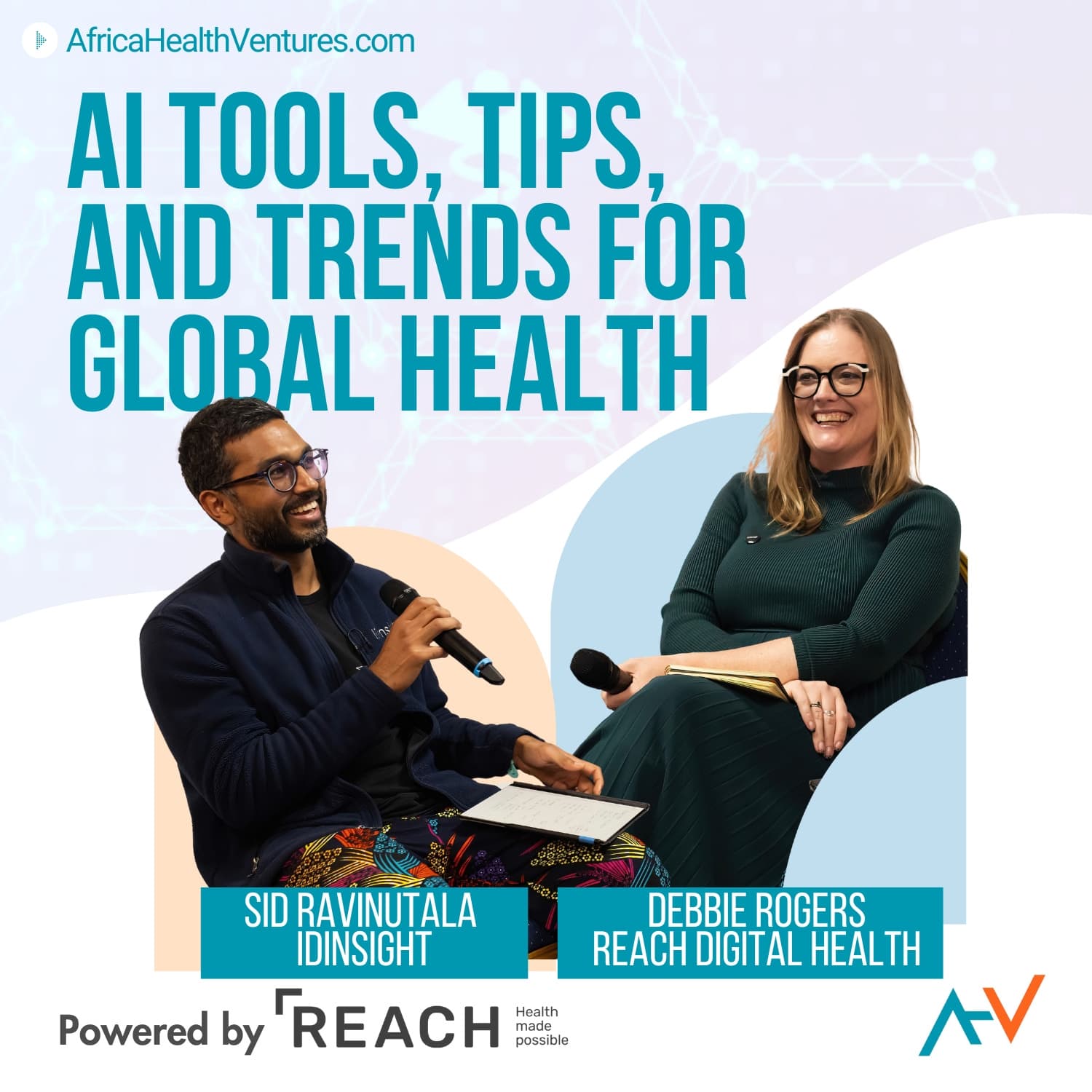
Episode Title: AI Tools, Tips, and Trends for Public Health
Host: Rowena Luk
Guests: Debbie Rogers (Reach Digital Health), Sid Ravinutala (ID Insight)
Date: July 3, 2024
Episode Overview
This episode concludes a special series on AI for Health by diving deeply into South Africa’s impactful maternal health chatbot, MomConnect. Host Rowena Luk speaks with Debbie Rogers, CEO of Reach Digital Health, and Sid Ravinutala, Data Science Director at ID Insight. Together, they explore the evolution of MomConnect, how AI is transforming digital public health tools, present-day impacts, challenges with AI deployment, and future opportunities for innovation, particularly around personalization, language, and equity.
Key Discussion Points & Insights
1. Origin Story of MomConnect
- Debbie Rogers recounts how the project began over a decade ago as the MAMA program, with the goal of sending stage-based messages to expectant and new mothers across numerous digital channels (SMS, Mobi, etc.).
- "The first day that I had a first MAMA meeting, our first workshop for MAMA, I found out I was pregnant that morning. So it was a very personal journey for me." – Debbie Rogers [05:08]
- Early meetings highlighted the need for women-centered design and for digital products to deliver immediate value to users, not just health system data.
2. How MomConnect Works and the Role of AI
- Pre-AI Era: Communications were based on simple decision trees; messages were personalized only by estimated due date and language, and incoming responses were manually managed in a basic helpdesk system.
- "It was a very automated process, but certainly very much based on decision trees... personalizing it in a stage-based way." – Debbie Rogers [07:37]
- Current AI Integration: AI now powers intent detection, triaging, and urgency detection. The system can prioritize urgent messages (like signs of pregnancy complications), automatically addresses frequently asked questions, and delivers content in multiple languages.
- "Now we have much more personalization... using AI to detect what the intent of the different messages are, help desk and prioritize them, do urgency detection, all of these fancy things..." – Debbie Rogers [08:50]
3. Personalization and Language: The Next Frontier
- Hyper-Personalization: AI enables the shift from static stage-based advice to dynamic support, responding to risk factors, prior questions, and real-time context.
- Language and Equity: Translating content into 20+ languages for all stages of pregnancy and early childhood is an enormous, expensive challenge. Generative AI can help by rapidly adapting content for language, literacy, and context, lowering cost barriers and promoting equity.
- "Generative AI is going to help us to certainly at least adapt content, if not create content... far more cost effective." – Debbie Rogers [11:41]
- Inequality Risks: Debbie cautions that limited language support risks deepening inequalities in care access. AI can bridge this gap if implemented with care.
4. Inside the AI Implementation (Sid Ravinutala)
- Ask a Question Feature: Sid’s team developed triaging for incoming questions and matched queries to an approved FAQ corpus to safely answer common questions.
- "We built... a triaging service. If you're sending a message saying, I can't feel my baby kick... you want to escalate that right to the top." – Sid Ravinutala [15:03]
- "So we reduce [the nurses’] load by 60% and we're helping them prioritize which ones they should attend to more urgently." – Sid Ravinutala [16:12]
- Limiting Hallucinations: Answers are drawn from exact government-approved language, preventing AI “hallucinations”—critical in health contexts.
5. Recent Developments and Exciting Innovations
- Natural Language Interfaces for Government Services: Sid describes pilots in India allowing citizens to access social benefits via conversational AI, making bureaucracy more accessible and reducing digital barriers.
- "Now you can have a natural interface where I can just go and say, hey, I'm a 40 year old guy living in Delhi. What benefits can I get access to?" – Sid Ravinutala [17:36]
- Qualitative Studies at Scale: AI can now automate and scale nuanced qualitative interviews, unlocking new ways to generate evidence from stories, not just quantitative data.
- "This is what excites me about AI is now... you can use AI agents to have at the back, you have an objective look, I want to explore a woman's experience through this journey..." – Sid Ravinutala [22:52]
6. Challenges and Guardrails
- Hallucinations and Risk Management: Both health and non-health AI applications face accuracy risks. New tools (e.g. Nvidia’s Nemo Guardrails) offer open-source ways to implement content validation.
- "Guardrails should be like a bare minimum feature that every AI application comes with." – Sid Ravinutala [27:24]
- Cost and Scalability: Population-level AI is expensive to implement and requires careful product discovery to justify investment.
7. Advice for AI Newcomers in Social Impact
- Begin not with technology but with user needs and product discovery
- Use "user story" frameworks to articulate if AI is truly the right solution
- "I would say before you even start messing with the technology, a strong product discovery to figure out your use cases is extremely important." – Sid Ravinutala [31:29]
Notable Quotes & Memorable Moments
-
On Being a Mom and an Innovator:
"[I] was called into a meeting at the CSIR around Mom Connect... all of the men in the room were talking about how the way that they would get mothers to give in their personal information was just to tell them... at which point I mentioned that as the only mother in the room, perhaps they should consult me..." – Debbie Rogers [05:53] -
On AI's Impact on Feedback Loops for Mothers:
"We needed to make sure that mothers got just as much value out of things as the National Department of Health did by collecting the data..." – Debbie Rogers [06:35] -
On the Need for Human Oversight:
"As long as there's still a human in the lab, as long as the mother and all the other actors are still in the loop somewhere..." – Rowena Luk [13:19] -
On AI and Language Equity:
"Generative AI is going to help us... in a way that's going to be far more cost effective... what that might mean in terms of reducing inequality and being able to offer our services... which is hyper personalized." – Debbie Rogers [11:50] -
On Scaling Qualitative Research:
"Qualitative studies are extremely powerful but extremely hard to do at scale and extremely expensive. But that's changed." – Sid Ravinutala [22:45] -
On Product Discovery and AI Hype:
"I play the anti-hyper role... AI is doing enough hype for itself... So I would say before you even start messing with the technology, a strong product discovery is extremely important." – Sid Ravinutala [29:44, 31:29] -
On Open Source Innovation:
"Shout out to everybody who's working on open source and contributing to this knowledge. I feel like it's an emerging space and this is the only way we can to get better." – Sid Ravinutala [33:40] -
On Digital Public Goods:
"Digital public goods is what I'm really excited about from governments on AI." – Sid Ravinutala [35:11] -
On the Next Decade:
"Everyone recognizes that AI is here to stay. It's not an if, it's a when... I do think that there's going to be a period... where unfortunately, AI is likely to deepen inequalities rather than to fix inequalities... But if we apply ourselves, I do think that it does actually have the ability to reduce inequality. As long as we are considering those principles of being transparent, responsible and just." – Debbie Rogers [36:14]
Important Timestamps
- Introduction & Context – [00:03–01:50]
- Debbie Rogers Introduces Herself & MomConnect’s Origin – [01:51–06:55]
- How MomConnect Worked Before AI – [07:28–09:27]
- AI Advancements: Hyper-Personalization & Equity – [09:42–13:24]
- Sid Ravinutala: Inside MomConnect’s AI and Triaging – [13:54–16:45]
- Expanding AI’s Applications (India Case Study) – [17:24–19:50]
- Qualitative Research at Scale – [21:52–24:50]
- Managing AI Risks (Hallucinations, Regulation, Guardrails) – [25:13–29:17]
- Advice for New AI Projects and Resources – [29:44–32:59]
- Shoutouts and Digital Public Goods – [33:06–35:11]
- Looking Forward: The Next Decade in AI and Health – [35:32–37:46]
Further Resources & Shoutouts
-
Open Source AI initiatives:
- Jakarta Health (Kenya) – Swahili language model
- Juggalbandi (India) – Bhashini service
- Dimagi – AI application code
-
Technical Libraries:
- LangChain, LlamaIndex, LlamaHub
- Nvidia’s Nemo Guardrails, Guardrails AI
-
Policy and Regulation:
- European Union’s AI Act
- India’s Bashini digital public good
Final Reflections
With candid, hands-on insights from practitioners, this episode highlights both the transformative potential and the real-world, on-the-ground complexity of deploying AI in public health—especially across diverse, multilingual populations with unique accessibility needs. The conversation closes by emphasizing the critical importance of transparency, responsibility, and equity as Africa and the world continue to integrate AI into health systems.
Three words to remember for AI in health: Transparent, Responsible, and Just.