Loading summary
Transcript77 lines
- [00:02]
A
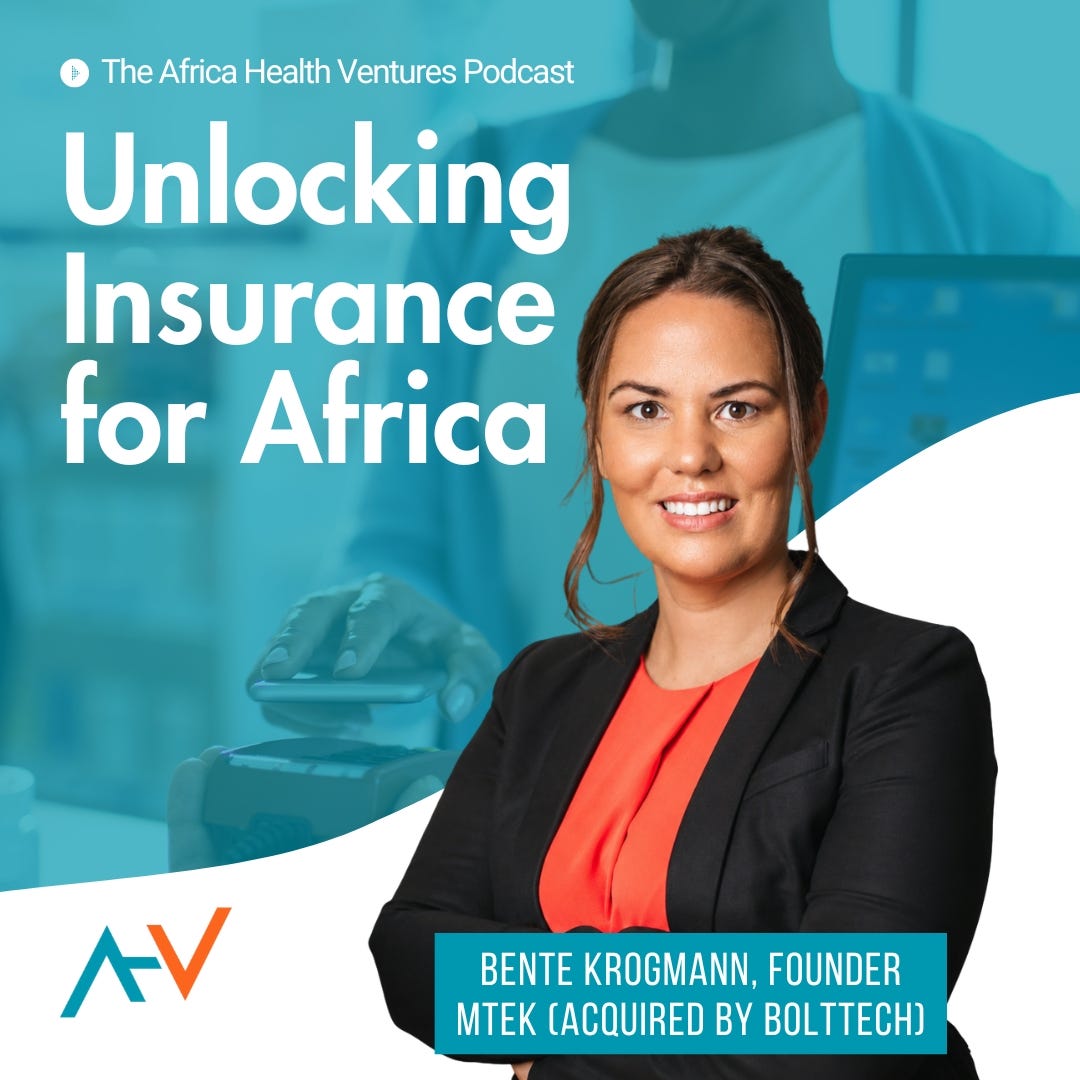
Hi everybody, I'm Rowena and you're listening to the Africa Health Ventures podcast where we explore the founders and companies reshaping healthcare across Africa. Today's guest is Bente Krogman, founder of Emtech, one of Africa's leading insurtech companies. Founded in Kenya, Emtech works with more than 40 insurance underwriters and has digitized over 100 insurance products, helping bring health, motor, device and travel insurance into a fully digital economy across East Africa. We hunted down Bente recently in Nairobi because emtech is tackling one of the biggest questions in health care for Africa, which is this, who's actually going to pay for health care at scale across much of the continent, health insurance penetration remains low and millions of families still pay out of pocket when medical emergencies happen. Insurance matters because it doesn't just finance care, it also creates the incentives that align prevention, continuity of care and healthier populations overall. The challenge is that traditional insurance models were never really designed for African consumers. Insurance today is often too expensive, paper based, difficult to access, difficult to pay for, and disconnected from how many people actually live and work, especially in the informal economies. Mtech's bet was that insurance had to become simpler, digital and embedded into everyday life. So instead of meeting up with an insurance broker, you might access coverage while buying a phone, financing a motorbike or visiting your local pharmacy through businesses you already know and trust. And that vision has turned emtech into one of the continent's most important insurtech players. Last year, the company reached a major milestone. Emtech was acquired by Boltech, a Singapore based global insurtech unicorn company operating across nearly 40 markets worldwide. Why does this matter? Because an exit is the moment in the life of a startup when a scrappy mission driven team joins forces with much larger institutional engines, companies with the resources and the reach to grow to a global scale. And with the Runway to pursue this mission for decades into the future. For the founder, it's a moment when they can finally cash out some of their shares, realizing a payback for years spent sweating it out in the trenches. For investors, it's the moment where we get our capital back with profit. An exit is proof that building a healthcare venture in Africa is not just an a noble idea, it's a viable business relevant to global markets. To recap today we're sitting down with Bente Krogman to talk about building emtech from the ground up. How she digitized a fragmented insurance industry, the ins and outs of a founder navigating a major international acquisition, and why embedded insurance could fundamentally reshape healthcare access across Africa. Before we dive in today, a quick public service announcement. If you're interested in healthcare ventures in Africa, you can subscribe to our newsletter@africahealthventures.com newsletter. If you want to refer a promising seed stage startup bringing better healthcare to Africa, get in touch with us through our website@africahealthventures.com One last friendly reminder, the content here is for informational purposes only and should not be taken as legal, business, tax or investment advice or be used to evaluate any investment or security. And now, on with the show. We begin by diving into the backstory of who is Bente Krogman and how did she come to Kenya?
- [04:24]
B
My name is Benta. And then we're always saying proudly, german by nature, Kenyan by heart, or African by heart. I came to Africa more than 10 years ago. I spent some time in Rwanda, I spent some time in Tanzania, and then I finally landed in Nairobi in Kenya. Mtech has been my second venture. Previously, I built a company car wash, actually, where everybody is asking themselves, how does car wash and how does intratech kind of become together? But I think it speaks about my character being an entrepreneur. Right. And so I built a car wash, sold the majority of it, and then I went into Inchotech. And then over the last six years, we built emtech in East Africa, scaled it to three, four markets in East Africa, and then just recently got acquired last year by Baltech.
- [05:10]
C
So it's not your first exit. You've done this before.
- [05:13]
B
I would love to say, though, that gets easier, but while I've done it before, it doesn't get easier.
- [05:17]
C
Yeah, it is my second exit. Yes, we'll dive into that. Is there anything else you want to say about the MTech journey? In particular, how you found your way towards what the company does, the specific product that it builds, or did you know right from the beginning that this was the platform that you were going to build?
- [05:34]
B
Show me one founder who knows from the beginning what they're actually going to do. Right. I think you're going to ask like a hundred entrepreneurs and I really think everybody will tell you their idea of what they have. A building was very different at the beginning than it came out at the end, if there's ever an end. Right. So look, we started mtech really with the idea of obviously insurance penetration is low, and especially me from a cultural background as a German, and you know that Germany is probably the highest insured country in the world. Right. So culturally I really believe in the concept of protection to Build yourself to build communities and even, like, countries. So when I came to Africa, I still have that moment in Rwanda where I was driving in a cab and we were passing like an area where people were clearly struggling. And I'm like, okay, they struggle, food, et cetera. But. And I don't know why it drowned in me on that moment. It was that healthcare thinking, right? What really happens to them when they get sick? And, you know, I grew up very protected in Germany, so it really hit me in that moment how privileged we were in Germany. And it got me to about thinking, like, okay, what can we do to make protection more accessible in whatever form? And you see, obviously we're speaking about health protection, but we're also speaking about protection of assets, protection of businesses, basically creating a parachute for people to grow.
- [07:11]
C
Tell me a little bit more about emtech. Walk me through it. For a random person on the street, what does mtech actually do and what are some of the achievements that you're proud of?
- [07:21]
B
I think at the beginning we were looking at the B2C angle, right? So when we started to take you a little bit down memory lane now, so we started and we thought B2C is the way to go. Yeah, build a platform, put products on the platform and sell them right, easy online, etc. We then came to realize, I think one or two years down, down the journey, that protection remains a very emotional kind of product and it sometimes needs that personal touch for the last push. So we were going more into, okay, how can we use the existing ecosystem, whether this is agents or distribution partners, to distribute protection products like, like health care, SME, life, domestic devices, Moto, obviously in the East African context. So this is where we came from, a B2C marketplace where we have, and we still running it, more than 40 underwriters here in East Africa providing their products. I think we have digitalized around more than 120, I think it's 126 in like nine product groups to a focus of embedded protection or B2B2C. So at the moment, we are enabling insurance agents, like distribution partners, to distribute insurance products through their normal core businesses. Right.
- [08:49]
A
What Dente is talking about here is a key strategic shift that emtech made when it decided to move into embedded insurance. Embedded insurance means exactly what it sounds like. Instead of selling insurance as a standalone product through an agent or a dedicated app, it's woven into the transaction between a customer and a product or a service they're already using.
- [09:17]
B
That can be a car dealer who's upselling motor Insurance, it can be a pharmacy who's upselling health protection. It can be like we having people like Maidava. You probably know we're using opportunity obviously to promote health insurance because look, ultimately it also benefits their core business. Right. If people are better protected.
- [09:40]
A
Maidawa, for those unfamiliar with it, is a leading chain of Kenyan pharmacies that allow users to order medicines, consult doctors and access health services online. It's one of East Africa's better known brands and exactly the kind of trusted distribution partner that makes embedded insurance work.
- [10:01]
B
We have travel insurance which we are distributing through travel agents, through airlines, etc. Today more than 90% of our business is embedded protection and that follows different kind of use cases. Right. From mobility to health, travel, etc. Like I said, around nine product groups, but initially we came from a B2C framework. Gotten a rough awakening. That entry instilled in today's time needs that personal touch or that personal trust to really close.
- [10:34]
C
That sounds incredibly powerful and I love what you're doing there about working through the people and the vendors that individuals already trust and know. The pharmacy example you gave, obviously they would be the natural person to engage you in a health insurance offering. Just for clarity, for someone who runs a pharmacy that wants to use emtech in order to sell an insurance offering, how does that engagement work? Do they work with one of your sales agents? Is it an interface that they work with or how would they sign up to use emtech?
- [11:04]
B
Very good question. Yeah, so I mean different businesses, different ways, right? So we are quite flexible. Some pharmacies have online channels. You're looking at a MyDava. There's obviously online there. When you go into the MyDawa website, you can actually access an insurance through the website and you can purchase it end to end, paperless. So you can sign up for the insurance, you get your insurance certificate and you're protected right there. It really comes through the digital interface. If you're looking into more branch driven partners, like a pharmacy which has branches all over Kenya, East Africa, you could for example have a QR code in the branch where you scan the QR code, you get to a landing page which is branded in your design. We are white labeled, so we care about the brand of our partners and obviously we want to bring the benefit to this partnership about the platform and to create that trust, we usually white label as per our partners needs. So let's say you're walking into a branch of a pharmacy, you scan a QR code, it takes you to a signup page, you sign up you get your insurance protection there instantly online. Again, I mean, there's other ways to do it. We did campaigns where we send WhatsApp messages, whatever the partner has, because we are an, we have an API infrastructure. Right. And we also have capacity to align front end, whether this is web app messaging, et cetera. So we can really look into the partners and say, okay, what works? How do they communicate with their database? Right.
- [12:44]
C
That's phenomenal. I think we would all agree that we need to see more insurance penetration on the continent. We need to grease the wheels towards that uptake. And I love this white labeling approach you're taking in order to embed it in the goods and services that people are already using and already comfortable with.
- [13:00]
B
I mean, think about it. There is products in this market on, on the health side which are Starting at around $5 a month inpatient, outpatient coverage and inclusive of sub limits micro insurance. Right. Monthly payment, not annual payment. Because the biggest challenge we have in health is also that we are asking end users to pay an annual premium which, which is going against, you know, their income system. Yeah. Most of the people earn month to month, week to week, day to day. Right. So, but when you're thinking about it, there is here in Kenya policies which are $5 a month. A lot of people can afford $5 a month. But the question we have to ask ourselves, how are we going to ask them to pay for it? Look, when you're thinking about a Kenyan, for example, who takes my tattoo every day, if you would ask them every day to add on 10 shilling to their transport, they can do that. True. To save up for $5 health cover a month. If you have all these loyalty cards, right, which the supermarkets have, which petrol fuel stations have. And I mean there's so many loyalty cards in this market. If you use some of that to actually go into health protection, you actually want to go a long way. And this is also the power we are seeing in technology. It's not about Baltech becoming an insurance company. Right. But how can we use the technology we are having and the technology we have been building over the years to actually increase protection? And obviously what is very dear to our heart is health. I mean, look, mobility, all important to drive economies. Device protection, very important pillar of our portfolio because the phone keeps us going. Right. But health, I think everybody will agree, is the core of a functional society. Right. So that is personally a product development in the Mtech Baltech kind of roadmap, which we are super proud of and where we are having Together within our insurance partner, who in that case is Britain. A very aggressive rollout for this year, but it's a prime example about how can technology create efficiency, how can technology drive pricing and accessibility.
- [15:20]
C
You're speaking my language clearly. I'm sold. You mentioned Baltic and everything that's happened over the course of this full year behind us. I would love to hear more about that journey. I think every investor on this continent would agree with. We'd love to see more exits, we'd like to understand them better. We'd like to see how it is that investing in effective, high impact, profitable businesses like emtech can pay out when an exit opportunity comes. In your case, the acquisition by Baltic. Can you paint the picture about how this acquisition came about? Were you looking for it? Did it find you? What's the backstory here?
- [16:00]
B
I think it was finding us, but we were happy that it was finding us. And let me put it like this. I think Baltech obviously is and wants to stay the most global intro tech in the world. Right. And if you want to be the most global intro tech in the world and the most scaled intro tech in the world, you have to have a play on Africa. Right. As futuristic as Africa might be. I mean, I think we all understand that our revenues in Africa are not compared nothing compared to Asia and nothing compared to EMEA or America today at this point. Exactly. But it is a continent of the future. To answer that question, I think it was finding us, but we were very happy to be found because from an MTech perspective when we were approached by Baltech, it's a long play. There is investments which can scale quicker. Right. Because obviously here in Africa, especially in Africa, we are speaking, or we are working a little bit against the cultural understanding of how you should protect, which is not necessarily insurance. Right. So you're going up, uphill. You have low penetration. Right. You are not just digitalizing yourself, you're digitalizing a whole ecosystem. So it is an uphill task. So when we were approached by Baltech, I think for Baltec, the point has really been we want to be in Africa and we want to be bullish about the African opportunity and we want to be there now to be really prepared when the time is right.
- [17:30]
C
That makes complete sense. The average Asian Africa is 19 years old and by 2050 will be a quarter of the world's population. We're the one continent where the workforce is booming, where the labor force of the future is located, and anyone who's looking at the growth opportunities is going to be looking at Africa. And how can they expand their footprint in Africa? So Baltic has a strategic interest in Africa. It understands the growth story behind Africa. For you, how did it show up? Were you just working day to day job at mtech one day and you received a phone call from them but like the reality for you as a founder?
- [18:06]
B
Yeah, it was a little bit like that. I mean it sounds very, it sounds very simple. But this is really, I mean look, to be honest, I think they heard about me through LinkedIn. Yeah, I think we look, there's not so many intro techs in East Africa. I guess we are less than 10. So if you are interested to understand who could be a potential partner in Africa, it's a very close ecosystem. Right. When you know what you're looking for, let's put it like that. The second thing is the Baltech partnership started with a partnership. So it wasn't from day one a discussion about acquisition. Bold Tech has a project in the Kenya market loop where they asked us to support them on the technology. That was really our first touch point. So, you know, we were engaged before we got married, if that makes sense.
- [19:01]
C
Always a good idea.
- [19:02]
B
Exactly, always a good idea. So they approached us really like that. Like, look, we're having a project in Kenya. They have one, they had and have one person on the ground who was understanding the market a bit better. And then it was really that question about okay, how can you support us on the tech side and local infrastructure.
- [19:21]
C
So they came in as client.
- [19:22]
B
As a business partner, yeah. On the product, basically. Client, yes.
- [19:26]
C
Amazing.
- [19:26]
B
So we worked with them and, but within that working relationship, partnership, we were then saying, okay, what can we do more and how can we work closer together? Obviously our vision is aligned, which is super important. I mean BoldTech is all about embedded protection and the other thing, Baltech core businesses is obviously device protection. And emtech had actually rolled out the first device protection program in East Africa. So it was really like, okay, we have abandoned insurance. Emtech, we have device protection in the market, life in the market. So we were protecting phones, we are still protecting phones against theft, loss and accidental damages. So I think from all of that coming together there was at some stage then the question, okay, can we. Do you want to marry me?
- [20:16]
C
So, and they buy you a diamond ring.
- [20:20]
B
I should actually take that up with the CEOs. Yeah, send them a memo. Yes, I will. And, and from that then the, the train started moving. Right. You know, you test each other out a bit. Okay. From what we think this marriage should look like, are we too Far off. Right. And then it goes into acquisition discussion and. But it really started with a partnership first.
- [20:44]
C
I really like that analogy and I think all of us can relate to the ins and outs of understanding what do I want, what is, what does he bring? Is it a fit?
- [20:53]
B
It was really like that. I mean, and I'm just recommending to anybody, whether it's in private or in business. Right. Get engaged before you get married. The good and the bad and the ugly. Right. Everything you will understand and then you can make an informed decision. Just think about it, even from an investor, like forget about acquisition for a bit. But I would believe there's a lot of founders out there. They raise money, they obviously needed money, otherwise they wouldn't raise. Right. And then they got an investor in which probably on the medium to long term might have not been the best decision for various reasons. And the reason I think that can become a real issue, especially also as a part of an acquisition later. Because at the point of an acquisition, you need to get everybody on your cap table aligned.
- [21:40]
C
Yes.
- [21:41]
B
I have been so extremely, extremely thankful to all of my shareholders that at the point we all came to the table, happiness has many faces, like I'm always saying, but we came together. And sometimes in hindsight that has been really one of the most eye opening experience in that whole process where I know a lot of series A businesses, series B have a massive cap table in Africa. Yeah. I mean 20, 30, 40, 50 is not where you know that better than me. Right. And just imagine you're going for an acquisition to get let's say 50 investors all aligned around the same goal. It's hard.
- [22:24]
C
Yeah. I think you make a really powerful piece of advice there, which is that for a founder the earlier you can have a sense of what kind of exits, you know, how does the story end for you? You want to bring, make sure that everyone who comes to the table, there's your exit partner, who's one kind of partner, but there's also your other investors and they're walking with you.
- [22:44]
B
You got to align them. You got to. They are part of the business. They are owners of the business. You have to respect that. Look, it's a chicken and an egg situation. Right. Because in Africa fundraising is not as easy as in more developed markets. So sometimes for the sake of survival, you need to make decisions. As a founder, I'm just, in hindsight I've been just so lucky that a, I had a very, very, very small cap table. So the people and funds I had to align were relatively it was a small number. And secondly, they were really all in a good spirit about it. That makes sense. Sometimes when I talk to now, you know, founder friends. Right. And we share what we share, they're sitting there and telling me, you know, with the cap table they have, you either need to go into a secondary round first to reduce maybe your cap table a bit with whatever tools you have, or you really have a hard job in case. In the fact that an acquisition is coming to really get everybody aligned. And that's not easy because funds have different goals, angel investors have different objectives. Right. And people are in different people funds, they're in different stages. Right. So in that moment, it just needs to be. Everybody needs to. The stars need to align. Right. For everybody. And that has been one. I wish I can tell you, you know, I planned that from the beginning. I didn't. But in hindsight, that was probably where somebody watched after me right. In that moment, because, yeah, I had a lot of support and a lot of goodwill.
- [24:24]
C
That's great to hear. Amazing, amazing kudos to all of your investors and shareholders for that. Going back to this courting and this dating process that you're talking about, you've already spoken to what Baltek found exciting about the opportunity and the market and the penetration and the footprint that you could give them. And in Africa, as you were having those conversations, do you have a sense of some of the biggest risks and considerations that they were looking for and what you had to do in order to mitigate that in order to bring them in to this ecosystem, in this market?
- [24:57]
B
First of all, I think there's two sides to it. There's the market and there's the business. Right. And look, while we all know the opportunity of the African markets, it's. We all also do not really know when is the time for Africa. Is it going to be in five years? Is it going to be in 10?
- [25:17]
C
Timing is key.
- [25:18]
B
And exactly timing is key. So Africa is now, you know, there's the saying. But we have been also. We need to be honest to ourselves that we have also said this three, five years ago. Yeah. And we are seeing. I mean, I think last year or last Q4 was the first time actually the African growth rates were overtaking Southeast Asia. Yeah. Which is a very good indication that be on the right track. And let's also be honest, we're coming from a much lower baseline. So I think. So there was some insecurity about the market. How much do we want to do? How bullish do we want to be? Yeah. And then the second thing about the business, I think the biggest thing you need to take off as part of an acquisition is cultural fit. You know, you're coming with a start upish kind of business. Yeah. Or scale up, whatever, wherever you are, you're coming into a corporate. So all of a sudden, rightfully so, you, you, you are corporate. Right. I, I mean, and I mean we have all been in business, we know corporate works very different to a scale up. And I think the question around it is how do we take our teams on this journey? How do we make them buy in? Yeah. As much as maybe not for everybody the corporate life is the right solution. But I think that has been one of the biggest question marks and risks. I was looking at the founder, knowing my people, knowing how we worked, embarking on that journey. And I think it was the same on the Baltic side. So it was not about are we fitting together in terms of what we do and how we do it. It was more about how do we get a scale up now very quickly into that kind of corporate but agile because Baltic obviously is growing very quickly. So while they're corporate they're also still very agile. You have to be on that growth rate. Right. And I think then obviously also paired with that, it's an African business. The African culture is different than the Asian or the American or the European. Right. And I think in Baltic we are now in 39 markets. I think the team is coming from way more than 39 markets. So. And they're all working together globally. And how do you again take this team on a journey that maybe when, look I'm German. Right. We are culturally very different to a Kenyan. How do you get them a little bit on a cultural crash course so that they taking the things which are being said in the right spirit. Yeah. So these are really the three things. So it is a market in itself. It's not about if but when and how much do we want to do for now. But then it's really scale up into corporate agile, corporate and culturally how do you get that all aligned?
- [28:21]
C
Yeah, yeah. Which is interesting particularly for, for a founder. I think a lot of founders think their job is their product and their team and building greatness, which it is. But also in this conversation you needed to present the market, you needed to cross those cultural dividends.
- [28:37]
B
I still have to do that. It's non stop.
- [28:42]
C
Oh bless you for educating the world on all there is to know about the good work.
- [28:46]
B
Look, when you're in a corporate like that you need to do PR For Africa. I'm always saying I don't want to be a rounding error in the group P and L. Right. And that's my own aspiration to myself as a gm. And it's. And I mean, I. You. You can believe it. Like Baltech, I think is. Is processing billions of premiums every year. So you can kind of understand the portion Africa is having at the moment. Right. So. And my own aspiration is how do we make it a substantial part of the P and L of the group P and L. Now, obviously it's. It's a little bit like you're putting a Ferrari next to a vis for the time being. Right. But I get a lot of support, but it, it entails me doing internal PR as much as external to speak about the opportunities, speak about the growth, speak about where we are on this journey, but what we can do. Right. And there is something in Africa because we also seeing way more competitors coming to the market. We are like three years ago, you would only see regional, local players in intratech. Now all the top 10 intra techs are looking at Africa is a good opportunity because we know there's a market. So obviously there's also more competition coming. But, you know, where there's competition, there's business.
- [30:08]
C
And Boltech is ahead of that game. They took a step in front.
- [30:11]
B
I think we are. Yeah.
- [30:14]
C
And that's an important part of the story as well. For some people, they think the journey ends when they redeem their stake. But obviously a successful acquisition is successful for Boltec as well as taking the acquisition of emtech and seeing that play out within their corporation as the economy grows and as the opportunity emerges. So it's great that you're, you're continuing that journey that you have. Can I ask, as this deal was coming together, were there any moments where you thought the whole thing might just fall apart?
- [30:45]
B
There were very many sleepless nights. And I think that the reason for that was because you obviously, you need to align all the different parts of the acquisition. Right. I don't think I ever had the feeling the acquisition will fall apart, but it was always about how can we get it done and how can we get it done quickly. Because an acquisition is always a distraction from the business. Yes.
- [31:13]
C
It's a whole giant process that you're running alongside, still running the business and taking care of your other investors and growing and scaling.
- [31:21]
B
Do not have an acquisition team and you can't outsource it. Like we saw it on the. I'm not joking. Like when we were on the board, when we obviously embarked on this journey, we were like, okay, how do we handle that? The problem is, as a CEO, you're always the head of bd. You will, especially in Africa, where it's a people business, you will be the head of bd. And the second thing is you can't outsource that acquisition process because you know the business, you know the nitty gritty. Right. In so many things, because you've been there from the beginning to the end. So it was a very. It was a stretch on me, on my leadership, because they now, all of a sudden, they wore many hats, obviously. Making them understand the business, the nuances of the business, but also hitting the budget. That was rough.
- [32:08]
C
What was the hardest part? What was the hardest moment? If you look back on the year behind you, where it all kind of came together or didn't.
- [32:17]
B
I mean, ultimately it came together. I think the hardest thing was really making a global player understand the nuances we are dealing with in Africa and why we are doing certain things, how we doing them. Because you run a business different in Africa than you're running it in Europe or in Asia, et cetera. You're making different decisions because of market. Right. And always translating that. We have done this because of this. That was, I think, the hardest. Creating that understanding of the why we are doing things the way we did them. Beyond that, I think one of the hardest things was really dividing the time between running a business and handling an acquisition.
- [33:00]
C
Yeah.
- [33:00]
B
And dealing with stakeholders of many ways. You know, once you're acquired, then your partners call you, then you're being integrated. At the moment, we are in integration. Right. So I. I was saying the other day to Stefan Tan, who I'm reporting to, I said, you know, Stefan, I can't wait for us to really build a business. You know, because you are in acquisition, then you are really going a little bit into stakeholder management, and then you're an integration. You see, all the verticals have to be integrated, whether it's finance, hr, you know, anything. Right. So doing the right division of times and pockets is, I think, the hardest thing.
- [33:42]
C
Sounds impossibly hard, as a founder's job often is. There's too many things to do and too few hours in the day, but you make it work out. You just do the most important thing somehow.
- [33:51]
B
Yes.
- [33:53]
C
Looking back on this journey that you've completed over the course of the year behind you, what advice do you have for other founders out there that are building their businesses? Maybe they're talking to a potential acquisition. Target, maybe they're building out their partnerships. What have you learned from this whole experience that you would share with a younger Bente?
- [34:13]
B
Looking back the whole five, six years I've been building emtech, I wish the younger Bento would have known. It's never that serious. I think as a founder, especially as a female founder, you take a lot of business things at heart and it can kind of distract you from what you're building. I really like it's for me, if I really would go back even like three, four years ago, and I have taken so many things too serious along that journey. Opinions, feedback. If people said no to something, you know, all these kind of things where
- [34:51]
C
I'm like, people say no every day.
- [34:53]
B
Exactly. Entrepreneurship is rough and the marathon, it's not a sprint. And you, as much as we're always saying we want to be unicorns in five years, right. So to survive that mentally, right. I think you need to see it to a certain extent as a game you want to win. Huh? Interesting. If that makes sense. So I would really love to tell my younger. Because I've cried in the evenings. I had a bottle of wine in the evenings. Right. And in hindsight, it's a game you want to win and that you only do when you. When you stay focused and accept sometimes you win, sometimes you lose and just take it as a game. That's number one, number two, if possible. And you're building something, really understand your exit strategy. Look, we talked about that briefly, but we have not seen many, many listings in Africa, successful ones. And as much as I understand, there is stages of business life where you need funding, really try to make a good decision who you're going to get on your cap table. I've been very lucky. I'm so thankful. I said this to all of my shareholders many, many, many, many times. And when it mattered, they were going with my recommendation and trusted me. As a founder, I know very well that not every founder has that. So if possible, know a little bit what you are aiming for in terms of an exit. Maybe there's never an exit. That's also a way to run a business. Right? But if you're thinking about an exit and acquisition, put yourself out there, make people internationally understand what you're doing. Because an exit will likely come from an international player. Like I remember, I would go to InsureTech Insights every year, right? Probably if I wouldn't have gone, I would have never had this opportunity. And sometimes I would spend this money on three days in London and ask myself, would have There been a better way to spend the money.
- [36:51]
C
Right.
- [36:52]
B
But put yourself on the international stage if you are thinking about an acquisition exit, right. But really like number one, take it as a game, right. Which you want to win. Number two is trying to be very clear about your exit what you want as a founder and work towards it. Try to keep your cap table as small as possible and get the right people on the cap table and then just go for it.
- [37:18]
C
That's incredible advice. I love it, particularly the game one. I feel like it speaks to so many tears and sorrows and sadness that so many founders feel every day.
- [37:28]
B
Entrepreneurship is suicidal. I'm really telling you that it's suicidal if you are not having the right backing in terms of, you know, also your environment because it's paired with so many highs and lows. And I remember my husband would always tell me, you know Ben, to get used to never go too high when it's high and never go too low when it's low. And that was one of the best advices. I, I'm carrying too hard in, in that journey because at the beginning, you know something will be great, I will be yay. And then I will be very low when things don't be good. And you know, it's like your pulse, you know, it's never good if the pulse is too low and if it's too high. So you're always at your best when it's kind of stable. So you need to, in that roller coaster of entrepreneurship, you need to stay very emotionally stable. So find your ways to deal with it. Right. And there's, look, everybody has different tools and systems, but take care of yourself. I guess that's what I'm saying.
- [38:24]
C
Yeah, that is incredibly helpful. What's next for you for BullSec? What are you looking forward to?
- [38:30]
B
I'm staying with Bulltec. We want to build the biggest insurance platform in Africa. So we bring what we have done best internationally and we're going to bring it to Africa. And really if you and me see each other again in a year from now, in two years and three years, I would love to have a scenario where we're speaking about the lives impacted by enabling protection on the continent. And I think Baltech Africa can plays such a crucial role in that that we are ready for the ride and I'm definitely going to stay on.
- [39:02]
C
Amazing. Two last quick questions for you. One is if you wanted to give a shout out to another startup venture innovator who you personally think is doing great work.
- [39:12]
B
You know, my go to person Who I think is the most amazing founder in East Africa is Caitlin from Rescue CEO.
- [39:19]
C
Yes.
- [39:19]
B
I think she. Not just one of my closest friends, but how she is building Rescue CEO, the determination she's putting there, the know, how she's having, the passion she's having about what she's doing and then, you know, holding it all together, you know, the private, the business, etc. That's. That, that has been. She has been really one of my biggest pillars and my biggest inspirations when it comes especially to female entrepreneurship.
- [39:46]
C
She is a force. She's unstoppable, that one.
- [39:49]
B
And, you know, on top of that, a super, super nice person, you know, like, like, like I said, one of my closest friends. And I'm always like, no. Very inspirational.
- [39:58]
C
Amazing. What's the best way for people listening to this podcast to stay tapped into you and the work of Bulltec as it evolves, particularly in Africa?
- [40:07]
B
Follow me on LinkedIn. Follow Bulltech. Engage with us. Look out what's coming next for us.
- [40:13]
C
Thank you so much for joining us today, Bhente. It was a pleasure.
- [40:15]
B
Thank you very much.
- [40:17]
A
And that's a wrap. That was our conversation with Bente Krogman, founder of eMtech. For entrepreneurs listening to this podcast, let me call it a few key takeaways. First, entrepreneurship is just a game. The highs will be epically high and the lows will be devastatingly low. Your best work happens in between, when you stay stable, grounded and focused, following your passion and knowing what you love. Second, before you get married, you gotta get engaged. Whether you're bringing on investors, signing a major partnership, or entering acquisition talks, take the time to really understand who you're getting in bed with. Venti and Boltech started as client and vendor long before they started talking about acquisitions.
- [41:08]
C
And that foundation really made a difference.
- [41:10]
A
Third, be deliberate about your cap table from day one. If an exit is somewhere in your future, a small and aligned group of investors is worth far more than a crowded one. When the moment comes, you need everyone rowing in the same direction. And last but not least, if you're going for an international acquisition, you have to be on the global stage. Age big companies can't work with you if they don't know you exist. For those of you who are also building healthcare markets in Africa, I hope you found something useful in the conversation we shared today. Some tidbit or tip that might help you in your journey. If you like what you heard today, don't forget to subscribe to this podcast so you don't miss an episode when it drops. And if you want to stay in the know about what's going on with healthcare ventures in Africa, subscribe to our newsletter at africahealthventures. Com newsletter. Thank you for tuning in. We'll see you next time. Bye now.