← The Africa Health Ventures Podcast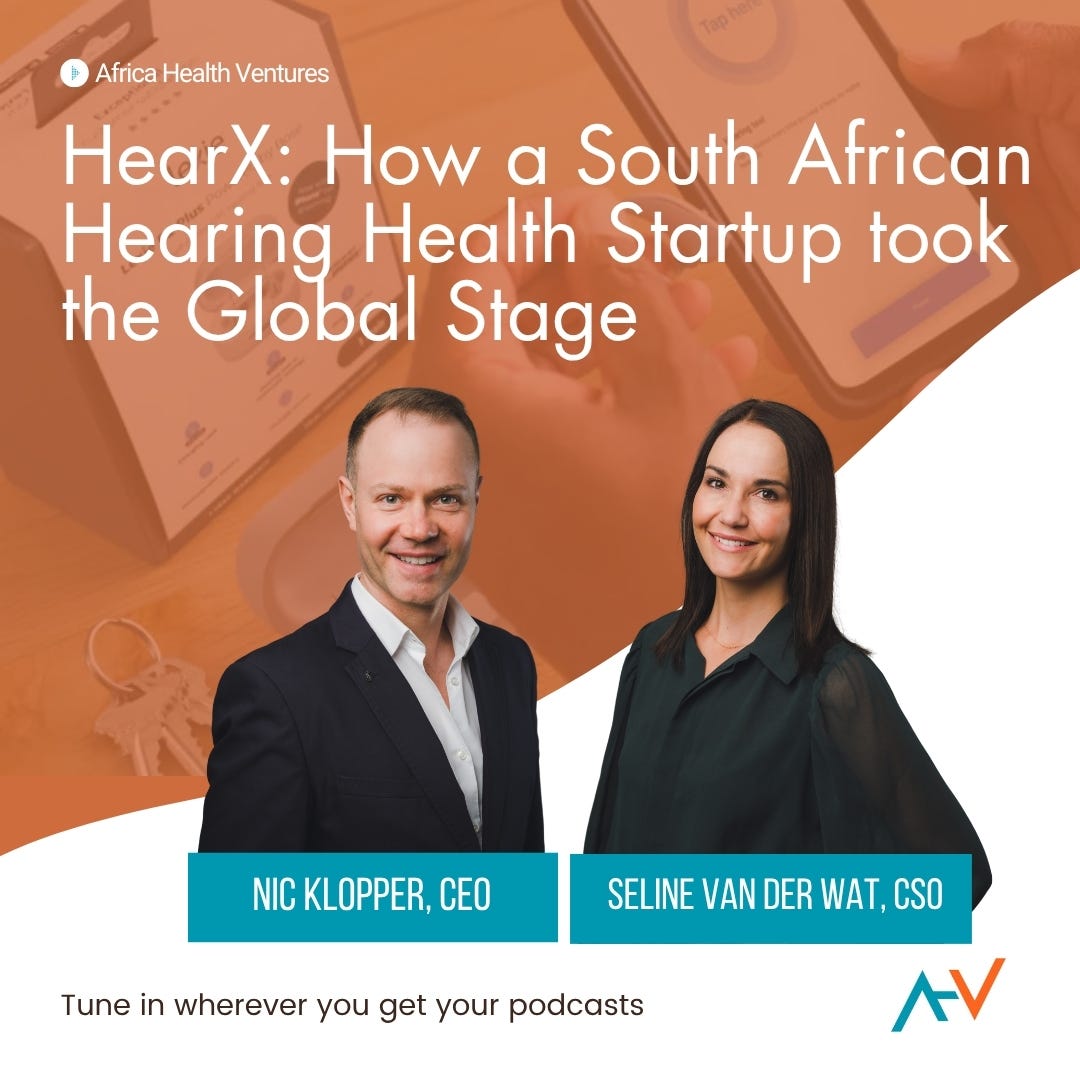
Loading summary
Transcript27 lines
- [00:03]
A
Hey there. Welcome back to the Africa Health Ventures Podcast. I'm your host Rowena Luke and today we're digging into one of the most exciting health tech stories coming out of Africa this year. We're joined by the leadership team from LX E Hearing, formerly hearex, a South African company that's gone global. They just raised $100 million and they're shaking up a 100-year-old hearing aid industry from the inside out. CEO Klopper and CSO Celine Vanderwalt walk us through how they took on industry giants, launched into US Retail and built a business that puts accessibility, affordability and impact at the center of hearing care. Before we dive in, a few quick announcements. First, if you're into healthcare ventures in Africa, subscribe to our newsletter@africahealthventures.com newsletter. And if you're a founder, investor or donor interested to learn more about our work, head on over to Africa Health Ventures. Last quick PSA this podcast is not investment advice. The content here is for informational purposes only and should not be taken as legal, business or tax advice or be used to evaluate any investment or security. All right, let's get into it. Here's Nick Klopper, CEO of LXE Hearing, formerly known as hearex.
- [01:29]
B
I'm Nick Klopper, the CEO of LXE Hearing which includes the leading OTC hearing aid brands called Lexi Hearing and Eargo. We are disrupting a hundred year old industry and that's been dominated by these billion dollar companies by transforming hearing healthcare and making it higher quality, more accessible for everyone everywhere. And we're doing so by powering it with our cutting edge technology and a deep focus on affordability and simplicity. First, it's important to understand the problem we are solving. So according to WHO, there's about 460 million people globally suffering from permanent disabling hearing loss. And if you look at the US alone, there's about 40 million people who need access to a hearing aid who don't have that. And that just is exacerbated in markets where we don't have amazing access during healthcare services like the developing markets. About Alex Ehearing we just closed a merger with Ergo and we raised $100 million to accelerate the business and specifically bring these healthcare services to the people who need them. We have fitted collectively between Earago and Lexie More than 300,000 years with hearing aids in our time servicing people with hearing loss. Correct?
- [02:48]
A
Next we speak with Celine VanderWaalt, CSO of LXE Hearing and one of the first seven employees at Hearx. Our first question for Celine was this. Hearx was founded 10 years ago by two professors at the University of Pretoria, a far cry from its current reach. What was the breakthrough that turned this research project into a high growth business?
- [03:14]
C
It's actually a crazy story, right? And I think I was employee number seven. So I've pretty much been here 12 months into the founding of the company and, and it's such an incredible story to be a part of, but also one to tell because I think you can learn so much from the story. But essentially one of our founders, Prof. Davet Swanerpoel, he's a professor in audiology at the University of Pretoria, still is, had this idea for using smartphones to recreate an audiometer because everyone's carrying smartphones around in their pocket at that time. It was a far cry from what smartphones look like today. But he thought, if we can turn this cell phone into a medical device, surely we can decrease the cost of screening and testing across Sub Saharan Africa. So he met up with one of the professors in computer engineering and asked him if he didn't have a student they could throw on this research project to figure out whether or not they could conduct the test. And once they had figured out the proof of concept as like a final year engineering student project, they realized they had something there that could be pat and that could really change the face of hearing health care in underserved communities because we really do not have enough healthcare professionals, especially in the audiology space, to get to everyone, test them and intervene for them. But that was really the beginning of the story. Right from there we built out a number of different screening and diagnostic technologies. And this was probably in about 2018. We were working with the Google Impact Challenge on a screening project in Gauteng and we were submitting our reports as per the project plan and what we needed to do. And I kept getting this question back from them. They're like, okay, well we've tested tens of thousands of children. This many pass, this many failed. We were doing a combination of vision and hearing screening because those sensors typically work together. And so we worked with a local partner, Vuler Mobile, to actually create a vision test. And then they kept asking us, okay, but then what happened to the kids? We're like, well, we have this really cool geolocation technology that pins them to the closest clinic and then we ping their parents and remind them to take them to go get their hearing further evaluated and intervene for them with hearing aids. They're like, okay, but how many? How many got this? And it created this little moment of like, almost like a crisis of faith for us, because up till then, we believed our vision and mission was to create the technologies that would allow healthcare practitioners to do testing cheaper, faster, and without the requirement for a soundproof booth or without the need for a healthcare practitioner in the room, which is what we had done. And Google just put a mirror up to our vision and said, but then what? So Nick got home from a business trip one day, we're sitting in the boardroom and he just said to me, you know, I think we need a vision and value realignment here. We are really good. We're the best in the world at finding people, testing them, screening them, diagnosing them. But then we're sending them into a broken health care system where the professionals that need to do the fitting are few and far between. And then when they do get prescribed devices, it costs an insane amount of money. I'm going to speak in dollars, because that's my context nowadays, but $5,000 is the average cost for a pair of hearing aids. And you tell me how many people in your family and community can afford that? So it was kind of a service that was reserved for the wealthy and the influential. So we pivoted the strategy of the company. At that point in time, we decided that we would use our scientific knowledge, all the data we had collected through all of our screening programs, online tests, clinical tests, and the user or customer journey experience that we had collected over those years, and we would build Lexi Hearing, which was the first truly consumer centric hearing aid brand and platform. So essentially it allows us to not only do the screening and testing, but allows people to buy hearing aids at 80% less cost, but with the same proven efficacy and health outcomes as the gold standard care. And that's really what just shifted the business and put it into high gear.
- [07:43]
A
What Celine did next was a major evolution. Many companies will stop at the screening problem. They'll stay within the diagnostics bubble. But Celine zoomed out and looked at the full continuum of care, asking what actually happens to people after they discover they have hearing loss. And they didn't stop just at identifying the problem. They looked at the whole continuity of care and addressed the gaps wherever they found them. But it wasn't just about building great tech. They also knew they'd need the right partner to scale. And that's where the story takes an even more interesting turn. This next segment is about the journey that Hearx took in order to team up with one of the biggest names in the world in consumer audio, the company Bose.
- [08:32]
C
So we have a range of different technologies under the hearx brand, including a smartphone app that we built for the who, called Hear who, which allows for in app screening of hearing in 191 countries globally. So that's really where the hearing screening apps come in. But then we also have this brand of professional products, which is hardware and software combined that creates that clinical experience at a lower cost. But Lexi Hearing has an app that is your point of contact with us. It's how we fit your hearing aids, it's how you acclimatize to wearing hearing aids and how you get all of your support. But then we took a buy strategy approach to the hearing aids because we were entering into an industry where the top five hearing aid manufacturers have been doing this for longer than at that point, our combined team had been alive. They have huge books and bank accounts and like, well, how do we beat them? We're going to beat them by taking a consumer approach and replicating the clinic experience in a way that resonates with consumers. But in order to do so, we need a hearing aid. So we went shopping for a hearing aid to integrate into the platform and got laughed out of the room more times than I can tell you, because the big five all told us, no one's ever going to buy a hearing aid like that. It's a silly idea. No, we're not going to give you hearing aids. We eventually found a Tier 3 manufacturer, worked with them on upgrading the firmware and changing the product in the way that we wanted. And that was our initial product launch. But then Bose came to us a couple of months after the change in legislation in 2022 that we'll talk about a little bit later. And they said to us, well, don't you want our hardware? And you can take our brand along with it? So we essentially want to build Lexi out to be the platform through which every hearing aid is sold and fitted 10 years from now. And we just were lucky enough to get hardware partners that were working with us on creating that incredible hardware experience, but within a considered consumer journey.
- [10:40]
A
Fascinating. That sounds like a match made in heaven in terms of business partnerships, because you already knew what you wanted, you were already looking, you were already talking, and then they saw the potential in what you were doing and they came to you. And that just sounds like an unusually good partnership. But to your point, let's dig in on that question. I remember reading an article, maybe circa 2020, in which Herex was portrayed Like a lot of African startups are portrayed, here's this do Gooder tech company, kind of cute, working with here the World foundation, doing screenings in the slums or in the townships of South Africa. And then 2022, you're on shelves across the United States of America. You're a truly global brand. How did that happen? How did you make that leap from South Africa to the world?
- [11:24]
C
A lot of time on planes and a lot of time convincing people that the world was about to change. So we knew that the legislation that was approved in 2017 would deregulate the hearing aid industry and open up a category for over the counter products. I mean we've seen this in pharmaceuticals, we've seen it in the optical space. And it was the hearing industry's time to change. Right. So we were waiting for the FDA to publish the regulations that would guide how the legislation is implemented and what the safety protocols, et cetera would be. And then Covid hit and they got a little bit distracted with big efficiency, right. So we kind of used the time during that delay because we had already designed what we were going to do with Lexi and we were building it. We are actually going to launch in June of 2020. You know, Covid was time that tested all of us. But we use that delay in the regulations to really get our foot in the door with a lot of our retail partners. We were their trusted partner for online hearing screening because of our history with Hear Ex. And what was happening that was really interesting is they heard rumors on the street that we were launching OTC hearing aids and they would start coming to us saying, but if you're launching this, don't you want to launch it in our store? But it was really because of the relationship and reputation we had built up with them as this like health tech company that believes in scientific validation that like is always on the call if they need support and like making all the changes for them last minute. Like it was a long term play for us to build those relationships so that we could end up in store. And we also use the time to really refine our product and do additional usability studies or user studies to really investigate and continue to elevate the consumer's point of view in the product we are launching. So in addition to that, me and my legal team were like sitting with a draft regulations as they were coming out, trying to anticipate what's going to happen, reading through the thousands of comments being fed back to the FDA to see where do we think they're actually going to take someone's advice or not, we guessed it pretty damn closely to what was actually published. And then they gave us 60 days until the effective date. And I think because of the work we had been doing in the background, we were the first company to launch in store on the actual effective date of those regulations. And I think we just captured all of the media attention as a result and it really helped us 10x our business overnight. So it looks a little bit like luck from the outside, but it was an incredible amount of planning that really went into it. And I think the industry incumbents were taking a wait and see approach to what this category is going to do to their long established businesses. And you know, we're a young startup, we like a little bit of risk. So we just jumped two feet into the deep end and it worked out really well for us.
- [14:29]
A
Wow, that is phenomenal. What a story. You know, my dad used to tell me advice about starting a business and he was saying it's about skill, it's about hard work, it's about years of grit and a tiny bit of luck. And in this case, it's fascinating to hear how it all played out because certainly you had to be in the right place at the right time and you were, and that's phenomenal to see. Can I ask, My experience has been if you have an African company, even if with world class tech, just because you don't have a Harvard alum or a Stanford alum on your C suite, there's this African tax, this trouble of winning people over to yes, this is actually a world class technology and it deserves to take a global stage. In your experience, as you were expanding to the United States, was there any particular strategy that you took in order to pay the African tax?
- [15:19]
C
I think I would answer this in three ways. Right. I want to answer your question in with three questions. One, is it true that there is a misconception and this African tax we need to pay what is true? And then thirdly, like, how do we change it? Unfortunately, I think it is definitely true. There is a misconception regarding the value of work and innovation that comes out of Africa. And unfortunately I've come up against it continuously over the last eight and a half years that I've been with a company and it's not fair. It's not fair. Right. So what is true in my mind, I'll tell you why I think people should believe in Africa's ability to grow world class tech companies. We're forced to be innovative. We are. Everything is not just handed to us on a silver platter. It takes longer to raise funds. It takes a longer time and more data to convince people that your financials are what they are, that your impact is what it is. We continuously operate on limited resources, whether that is in funding or because we operate in countries where the infrastructure is not always as stable as what it should be. We could always just throw up our hands and stand back and say, it's not possible. Let's just wait for someone else to solve our problems. But as a collective, I believe we have this innate belief and culture within ourselves that drives us to make a plan. And necessity breeds innovation. We went up against the industry giants, larger bank accounts, big law firms and endless funding and we won. Lexi is now the number one OTC hearing aid brand in the US and we didn't get lucky. We built it from the perspective of necessity and it worked in the largest market in the world. I believe that if it can work here, it can work anywhere, like limited connectivity, power supply. And it really is an innate culture that we have in ourselves, especially as South Africans, to make a plan and move forward and to solve the problem instead of throwing more money at the problem. So I think it's our attitude towards partnership, working with our partners and always going out of our way to make things great for them or to make changes or to add a little bit more sugar to the pieces that has really just driven us forward. But I want to just like caution, one thing is your reputation is so important, right? It takes years to build up and it can be destroyed with one email. And I think we have a collective responsibility towards one another in this environment to continuously act in the best interest of patients, the best interests of consumers, and to continue to set a good example. And I think that's part of my how do we change it is like some people put their money where their mouth is. We don't always have money to put there. So you put your performance, you put your patient outcomes and you just do what you say you're going to do when you say you're going to do it. And I think how we continue to change it is spotlight stories that are really important so that other people just change their frame of reference to believe that good, innovative, incredible things come from Africa because they do. And then we invest in them. We need to get more investment into these startups or middle tier companies within the African ecosystem. And then I think it would also be really helpful for us to just grow a network of like health tech founders and executives in Africa because We face unique problems. We face the same problems once we try and go international or try and raise funds internationally. And it's really lonely at the top. And I think it would be helpful to just have a group of people where you can lend a year, lend a hand, and sometimes lend a checkbook.
- [19:19]
A
Yeah, absolutely. We're working on it. We got that. And I'll definitely second your point as well about celebrating our successes, which is one of the reasons we're chatting and we're having this conversation. So very much agree. Well put, well put. Can we talk a little bit about the times that didn't go so well? I'm sure there are countless days where you woke up in the morning and you thought to yourself, I don't know if we're going to make it. Can you tell me about one of those moments and what you did?
- [19:46]
C
Yeah, I mean, there are always those moments, right? I think it's the fun part about being an entrepreneur or working at a startup. One moment I remember in particular we were just about to kick off our next funding round when Covid hit and we were still planning to launch Sexy three months after President Ramaphosa sent us into lockdown. And we're like, well, now what do we do? And now we can see the data in the back, like when we look back, because Covid decimated so many businesses and ours, honestly, it came close. In April of 2020, we invoiced a total of $1,000 to our customers. At that point, we didn't have our consumer business, we just had our audiology business. And all of a sudden no one's allowed to touch anyone. No one's allowed to come into clinics for screening. And an audiologist's typical customer is over the age of 60. So they were like a really vulnerable part of the population. So we're like, okay, we're in serious trouble. Now what do we do? And I think this is something you need to know about our management team is we're tenacious to the point where it's almost dangerous.
- [20:56]
A
Right.
- [20:58]
C
We like to turn negatives into positives. And for a few months, Nick and I just didn't pull a salary and we made sure no one ever missed a single rand from their salaries in the company. But we essentially saw an opportunity that when the industry was really kicking against or pushing against embracing teleaudiology and we realized that in this situation, the only way clinics audiologists ents are going to keep their doors open is if they're able to provide remote testing. So the beginning of April, we didn't have this product. It took us four weeks to build it. And essentially we turned our existing product suite into a remote testing, self administered test that people could ship out to customers. They ship it back, they clean everything, they read the data from the cloud once it syncs and they're able to remotely update their hearing aids, sell them new ones, counsel them via teleaudiology. And in that May, we sold more of our hardware kits in one month than in the entirety of our company's history. And then back in the game. But it was very, very close there for a second.
- [22:10]
A
Now that's a hell of a story. That four week Sprint in April. Getting a product to market under that kind of pressure is no small feat. And this wasn't a brand new startup just getting off the ground. Herex was already an established company pulling that kind of a turnaround. At that stage, many startups wouldn't have made it. I'm impressed. To close out the episode, we shifted into our final segment, Rapid Fire. We asked Celine what advice she'd give to other builders, founders and entrepreneurs working to create the next big healthcare or health health tech company in Africa.
- [22:47]
C
I think my number one piece of advice would be to fail fast and to not be afraid to test out different go to market strategies. But more importantly, if it doesn't work, just shut it down. I think sometimes we get so obsessed with like pushing something into the market, but if it doesn't work, it's okay as long as you learn from it, shut it off and try again. And then most importantly, I think stay humble and stay agile and remember that you can't do it alone. So find great partners, great management team and build a culture of trust, accountability and more importantly, authenticity.
- [23:24]
A
Great advice speaking to the other side of the table. Investors, donors, people writing the checks. What advice or chastise, what words would you like to share with the investors and the donors?
- [23:38]
C
I think my advice to them is a little bit vanilla because you hear this all the time, right? But I would tell them to look for companies that are solving real measurable problems and have a clear path to scale. Look for those founders who care deeply about the mission and why they're doing something and that have the humility to learn from their mistakes and the tenacity to see the vision through. And then my little bit of chastising would be when you find these people, don't put them through 500 pages of due diligence and like fundraising documents and everything, just have a founder friendly process. We were very lucky to have incredible investors on our cap table who have always just told us that they want us to get back to running the business. So let's get this done. But I think that's not a sentiment that's shared widely.
- [24:35]
A
Yeah. That I can empathize with all sides of that question. But I hear your points. One of the things I love about working in Africa is that you have the chance to solve real problems. There's enough real problems that we don't need to fabricate problems or make up markets. And that's one of the things that makes this work so rewarding in the first place. On the reading side, what is one resource could be a blog or a podcast or a newsletter you use to stay up to date on what's going on in your industry or in any industry.
- [25:03]
C
I subscribe to MedWatch, which I find really interesting. And from a hearing perspective, Hearing trackers always had great resources, but I actually prefer to listen to podcasts and follow blogs outside of the hearing industry because we've taken a disruptive position. It's interesting to me to understand what other people have done in adjacent industries. So my go to is the acquired podcast, Ben Gilbert and David Rosenthal.
- [25:30]
A
That's a great one. I listen to it as well. Would you like to offer a shout out to another up and coming business or entrepreneur that the world should keep an eye on?
- [25:38]
C
Can I have two?
- [25:40]
A
Sure, by all means.
- [25:42]
C
So from a health perspective, Elara Health, they're in Kenya, Emilian Papa is the founder and they use AI technology to reduce their exposure expense of diagnosing patients. So they don't just provide telehealth services or connect people to care, but they're actually using robotics and AI to lesser the expense of diagnosis. So that when people go into the healthcare system, they already know what's wrong with them and just need the treatment. So it removes the burden on the healthcare industry at the same time as giving the patient power over their care journey. And the second one is not a health startup, but I really just find their mission and their impact quite inspiring. It's a company called Motion Ads out of Cape Town in South Africa and it's founded by John Berkowitz. They're essentially a marketing company, but they're driving social impact by creating an additional side income for drivers that drive around to bring us all our Uber eats or our Checker 6060. They've built out an entire program that tracks and provides further income to people like that. So I find it quite inspiring.
- [26:51]
A
Very cool. Very cool. And we're actually an investor in Alara Health, so you have good taste. I like your shout out. Thank you. Last question for you Celine. How do people listening to this podcast find out more about you, about hearax or Elixe Hearing as it now is? What's the best way?
- [27:06]
C
Well, you guys can check out either of our Brand's websites@alexihearing.com, lexihearing.com or eargo.com and you can follow along on my story on LinkedIn. I regularly share updates on our work, our values and what the future of hearing health could look like.
- [27:26]
A
What a journey. From Pretoria to Walgreens, from a university startup to global disruptor lxc, Hearing is a reminder that world class innovation can come from anywhere. Big thanks to Nick and Celine for joining me and for dropping gems about grit, global expansion and what it takes to build in Africa and win anywhere. What resonated with you? Head over to our LinkedIn page at Africa Health Ventures and share your thoughts. Don't forget, if you're interested in healthcare ventures in Africa, sign up for our newsletter@africahealthventures.com newsletter. And if you're a founder, investor or donor interested in learning more about our work, you can find us@africahealthventures.com. until next time, thanks for tuning in everyone.