← The Africa Health Ventures Podcast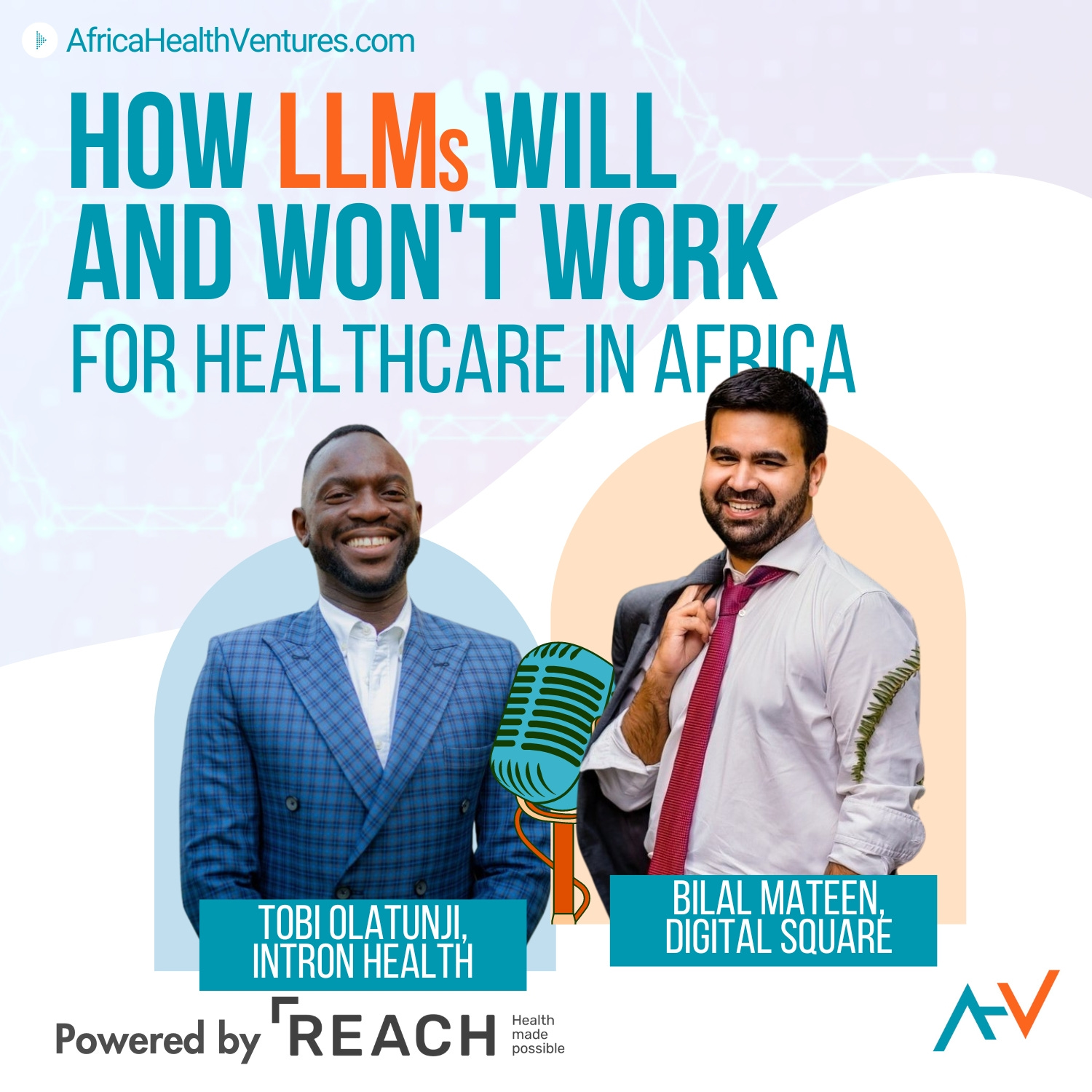
Loading summary
Transcript74 lines
- [00:00]
A
So a few weeks ago, OpenAI released ChatGPT4O. Did you see the demo? It's wild. Basically, you can now ask your AI to tell you a story and not only will it convey that story with drama, with emotions, with conviction, it'll listen for the emotions in your voice, it'll see your face, and it'll interact with the real world in a way that's much more human than the crummy text interface that we've been using so far. Now imagine all the things that are awesome about that voice interface just weren't available to you. Imagine it couldn't understand your accent, however perfect you think your English is. Or it didn't recognize your emotions because the way you express it is a little bit different than what people elsewhere in the world do. That's one of the reasons why Intron Health exists. Intron Health is a startup out of Nigeria which is working to bring natural language processing to African accents, particularly in the healthcare context. In today's episode of the Africa Health Ventures podcast, we'll be speaking with CEO and founder of Intron Health, Toby Olatunji. My name is Rowena Luke and I'm
- [01:23]
B
going to be your host today.
- [01:26]
A
Intron Health has had some big news recently. They're just about to launch the largest study that's ever been done on the use of large language models like ChatGPT in the context of African healthcare. They're going to be benchmarking 20 of the most common models that you've heard of, including ChatGPT, to find out what's actually going to work in Africa with these voices in this cultural and medical context. This is an ambitious study and Intron is certainly not working alone on this. Among the many collaborators coming to the table today, we'll be speaking with Bilal Mateen, the Executive Director of Digital Square at Path. Digital Square is a market shaping entity that has played a key role in making this trial possible. Toby also insisted that I give a shout out to Google Research who provided the seed funding for this project and have supported it in many ways. Full disclosure, I am an investor in Intron Health, so I am biased in my assessment of their work. I've seen how powerful natural language processing can be and if we don't take steps now to make that power accessible to the continent of Africa, we're going to miss out A few quick announcements before we dive into our show today, I wanted to give a big shout out to our sponsors, Reach Digital Health, for making this entire podcast series possible. Second, I acknowledge I said this was gonna be a three part series but I couldn't resist. So there is gonna be one last and final episode about AI for Health releasing later this month. So be sure to subscribe to this podcast if you'd like to be notified when it drops.
- [03:08]
B
If you wanna stay in the know
- [03:09]
A
about healthcare ventures in Africa, you can subscribe to our newsletter@africahealthventures.com Newsletter Sidebar we actually just got our first founding supporter of the newsletter. Big shout out and thank you to Grigor whose generous support helps us to compile this monthly resource. Grigor, you rock. I'll be honest, when I saw the check I thought it was an accounting error. Okay, last friendly reminder. The content in this podcast is for informational purposes only and should not be taken as legal, business, tax or investment advice or be used to evaluate any investment or security all right, let's get back to the show. To start, we're going to learn a little bit more about our guests today. We begin with Bilal Mateen, Executive Director of Digital Square at path.
- [04:02]
C
I am a physician by training academic in the space of machine learning that about a year ago took on this weird new job for me being the executive director of this initiative called Digital Square. That really came out of a series of reflections that happened in the aftermath of the West African Ebola outbreak. A whole bunch of implementing partners, donors came together and upon reflection really called out the fact that the fragmented digital health ecosystem was what undermined a coordinated response and led to a lot more people dying than really needed to. And so they came together, created this market shaping entity that is Digital Square. And really what we do happens at three levels. It's the assets we create to address information asymmetries that lead to ineffective procurement, decision making and other types of policy making at the national level, supporting governments with digital health strategy development and coordinating donors so that we can align investment with that vision that is kind of locally owned and grown and then providing technical assistance and project management for the scale up of pilots up to national level digital health infrastructure. What's been really cool is over the last seven years we've catalyzed something like $150 million across 30 African and Asian countries. We've made a lot of progress, a lot left to be done, but it's been an incredible journey.
- [05:19]
B
That's incredible. I didn't know those numbers.
- [05:21]
A
Impressive.
- [05:21]
B
Bilal Toby?
- [05:23]
A
Who are you?
- [05:24]
B
What are you doing here?
- [05:25]
D
I'm Toby. I'm a physician. I like to say was a physician because I've since deviated far from that.
- [05:32]
B
You've strayed how you've strayed.
- [05:34]
D
Yeah, very, very, very far. Most of my work over the last eight to 10 years has been on machine learning for healthcare, specifically natural language processing and speech recognition. More recently, just because I have both backgrounds, I'm able to critique problems from both sides. I see a lot of gaps in the way we build software for healthcare, and I've seen too many mistakes because of the kind of exposure I've had. It's easy for me to help teams now think about how do we do this better, how do we serve health care? It's one thing to understand a problem as a clinician, but it's very different for a technology person to understand the same problem the same way. There's a huge gap there. And then when people with technological expertise or tools are thinking about what to do for health care, many of them have a problem selecting the right kind of use cases, the right kind of products, and how do you translate, even when you built, how do you translate it? So I think having that dual expertise has helped me think about doing things for healthcare much better. And of course, we started Intran a few years ago just because we've seen a lot of failures in deployment. So there's a lot of cool software. Yeah. But then when you get to the hospitals, you see a lot of that technology doesn't translate to healthcare. And then how do we bridge that gap? And of course, we found that one missing piece was speech. There is no voice interface. So if you're deploying technology to an environment where there's a limitation in how much exposure people have to computers, then maybe you also need to deploy something that helps break that gap as well. And I think that's where a lot of the work we've done with AI started, basically.
- [07:06]
B
Thank you for the introduction, Toby. Toby, it can be. Sometimes we get a little bit distracted or when we're a couple levels removed with our market shaping entities. Bilal, I'm looking at you. What can I say just to ground us, to ground this conversation that we have. Toby, can you just paint a picture of, you know, an image in a hospital that you've seen, that you've worked with and some of the challenges that are faced by, by a doctor in a hospital today in Nigeria, there's two
- [07:35]
D
extremes, and I'll try to describe both. There's obviously the, the small hospital for rich people in some rich area where everything works and it's the same thing as if you were somewhere abroad. But then it's the other extreme, where there's like 60 patients, 100 patients in the waiting room, everyone's sweating, they've been waiting. Patients get there at 5am in the morning just to be first in line to see the doctor. And by the time the doctor, let's say I get to clinic at maybe 9am, it's packed already and everyone needs help, everyone needs care. There's many people present very late instead of coming very early because the hospital is very far from your house, so you have to travel X meters to gets the hospital. So there's all that, there's that challenge already from the patient side and then you, as, as a doctor, you have very few tools. Sometimes in those large hospital settings, there's almost no clinical decision support, there's almost no technology most times, honestly, to help you figure out what you need to do, what you might forget to do. Sometimes just a load of patients, even if you start very early, very happy, enthusiastic, and you're working hard, by the time you get to patient 46, you know, sometimes some things can start to go wrong. I have a colleague who said there's a day he counted to patient 87 that he was seeing and I'm just like, how do you live there? But yeah, there's both extremes, honestly.
- [08:59]
B
Yeah. Looking at that picture, Bilal, Toby, what possibility do you see for AI or gendered AI in that picture? What are some of the things that you think this new technology could introduce? What are some things that we maybe didn't think were possible beforehand that you're looking forward to and some of the things that you're worried about at the same time?
- [09:21]
C
Yeah, let me. I don't know if the people who will pick up this podcast and listen to it have a clear conceptualization of how even gen AI might manifest in the clinical workflow. So I wonder if. Yeah, please, we spend a second there on just what the opportunity is. And I put it into four buckets in my head. There's the interesting, more empathetic direct to consumer product. So the chatbot that coaches an individual through an HIV self test and is compassionate and empathetic in doing so and is helping them understand what the potential diagnosis might be before they even do the test, how they do the test effectively and then what to do once they've got a potential positive result. Where do they go? Who do they speak to next? Then you have the interesting operational tools. Right. Where again, I'm going to keep using large language models and really chatbots. Imagine a community health worker or a frontline health Worker trying to, having made a diagnosis of malaria, figure out which pharmacy to send you to. What a wonderful world. If you have a robust supply chain infrastructure for that community health worker to be in real time, be able to ask which pharmacy do I send this person to? So I'm not sending them to the one with the stock out, right. It's getting the right drug to the right person at the right time. So that's the operational stuff. Then you have the classic clinical decision support the co pilot for a frontline health worker. Try and reduce the burden of documentation or help them make a decision when they're at an impasse with the information they have to hand and need to know what to do next. And the last one is really reducing the cost of training. How do we create a conversational interface that teaches a community health worker how to do motivational interviewing to get a person to be more compliant and consistent in taking their antihypertensive medication given the enormous burden of non communicable diseases that we know exist. So that's where I kind of see the breadth of opportunity. And I think what we're arriving at is this confluence. There are these products getting to market. We're seeing the infrastructure around connectivity finally begin to get there. We're not there yet, but we are reaching. You're seeing the use of low earth orbit satellites for Internet access, you're seeing solar for energy access, rapidly decreasing cost of compute and you've got this entropy in the entrepreneurial ecosystem where we're at, I think near record youth unemployment rates in Africa. You have so many brilliant people that are hungry to do something and at the same time you've got this enormous demand to address an unmet healthcare need. So I think we're rapidly approaching this breakthrough moment where AI could help service that need. And what I'm worried about is there's not enough investment in the safeguards. What we've seen over the last year or two in high income countries is that our regulators may not know how to deal with this technology yet, but they know enough. We have the safeguards infrastructure to understand when something is going wrong, see that safety signal and do something about it. When you look at the regulatory ecosystem, the post market surveillance ecosystem for innovative medical devices and healthcare products, it's just not there yet across most of the continent. And I think that's the concern. Will we allow something to the bedside before we know it's safe and effective?
- [12:25]
B
Yeah, that's a really important point Bilal. And I'll just add to that like I'm glad, I'm glad that those checks are in place in the United States. And there's many people that would argue it's still not good enough. I think, I'm sure we all have the friends who are screaming now, stop, stop the engine. And then the rest of the world just keeps on going.
- [12:43]
C
But don't get me started on 510k or don't get me started. I have friends in the SDA who will listen to this.
- [12:51]
B
Back to you.
- [12:52]
C
And this brings me to really what we're trying to do is around products. People process. The product piece is create the evaluation toolkit to ensure that this product is sufficiently localized so it's appropriate for use in that context. So the benchmarking multiple choice question data sets, why are we using the usmle? Why do we not have an African
- [13:12]
A
equivalent for those of you that aren't doctors or maybe don't work in the United States? The USMLE is the United States Medical Licensing Exam. It's how we license doctors in the United States.
- [13:25]
C
India already figured out theirs. It's called the medmcqa. It's not hard. So that's kind of the top level. Going a level down. There are more complicated versions of question and answer datasets we can create based on what we call vignettes. That gets us slightly closer to understanding the individual use case rather than just what physicians would be expected to know and then starting to run the trials. Right. And as part of this grant that we've got from the Gates foundation, we'll be doing all three.
- [13:51]
A
You can tell Toby and Bilal are both recovering machine learning academics. There's two acronyms they mentioned which are going to come up a MCQ and saq. For those not in the machine learning space. MCQ stands for multiple choice questions and SAQ stands for short answer questions.
- [14:10]
C
How do we create the MCQ dataset, those vignette datasets and fund three trials in Kenya, Rwanda and Nigeria? And that's the product piece the people is thinking about digital literacy of frontline health workers. And the process piece, I've already called that regulation. We need to see investment in both of those. But if I'm lucky, you'll get to hear an announcement about them in the next year or so.
- [14:32]
B
I'm intrigued, I'm excited. I'll keep my ears to the ground.
- [14:36]
D
Okay. So I want to just touch on something that Bilal said. So I think one of the other challenges with delivering LLMs or just basically because there's this huge surge in LM use. There's a lot of hype around it and everyone's trying it out. I mean it writes great, great, great newsletters and all that. But I think one of the issues that we've had to think through in sort of like deploying this technology is one I think about that whole world of tools out there and I think about the doctors we interface with every day and I just wonder. I've seen many shiny demos. I'm like, this is too much information. Like when everyone wants to suggest this, suggest that, what drugs you use. I'm like, the guys I know they would, they would not, they wouldn't even open that because that's just too much information as it were. The first problem that we try to solve is what's, what's the most valuable thing that this, this, this, this doctor needs? This, this nurse needs, what do they need and how do we streamline it and just make that experience seamless and plug it in, in their workflow in a way that's not disruptive? We're not sending them more alerts because I, I saw a demo of God knows how many alerts they want to send doctor. I mean like even if you are scared the doctor is going to forget stuff like he's not that bad or she's not that bad, honestly. So just. So that's the first thing. And then of course going back to the issue of the models that are actually given this suggestions, do they have any clue about the challenge that this specific doctor nurse faces, pharmacists or whatever? And then even if you had a model that's now equitable, that's now bias free, how do you deploy that? Because I mean, so we have to think about those three pieces because yes, you have the software piece, you've streamlined it, you have the direct model. But then which solutions you should do in real time, which ones you do on device. So those are kind of problems we think about every day. And I really like the fact that you talked about satellite Internet. We're using Starlinking with some of our sites just to help bridge the gap. So I mean there's a lot to think about about how do we deploy these tools in a way that they are useful, not just another shiny object in the hospital. And that's where we start to think about the Afromed qa.
- [16:47]
A
All right, finally, here we go. It's time to actually talk about this. What exactly is the affirmed QA project? What is this massive project that's brought Toby and Bilal together?
- [17:01]
D
So the aframed QA project creates a data set of 20,000 questions from across Africa. Right now we're, we have data from about 15 countries and over a thousand contributors actually both clinicians and non clinicians who are coming together to contribute questions to help evaluate. And these questions cover about 32 clinical specialties and from pediatrics, geriatrics, surgery. Yeah, and so that's what the data set is. So that's phase one is to just create like this, an African or culturally attuned data set and then we take that data set and see what elements are out there and how are they performing outside Africa and then see does that performance translate to Africa. And then so there's a benchmarking effort to test about 20 of the leading large language models, open models, closed models, super large models, 500 billion parameters and smaller 7 billion parameter models. And just see where do these models work? Well, where do you they not work? Or which of them can we ship on device? Which one do we have to send to the cloud? And just figure out where this models are used to and where they are absolutely useless because we'll find different things fascinating.
- [18:21]
B
Can't wait to hear which one turns out the best. Like you're definitely going to have a
- [18:24]
A
first place winner, right?
- [18:25]
B
And you're going to send that out and we can all use it, right?
- [18:28]
D
Bad news for some people, but yes,
- [18:31]
B
that's fascinating and I think it'll be really important to have that perspective on what actually works in the African context because it is so different and because you can't just pick up a solution in one place and drop it in another.
- [18:43]
C
Maybe again it's helpful to tease out the principle of why you can't just assume it jumps over and you can drag and drop solutions. Because I think most people will assume that if I buy paracetamol in the UK and I buy paracetamol in Nigeria,
- [18:56]
D
it should be the same thing.
- [18:57]
C
It should work, right? The principles of pharmacology, highly conserved human biology. It comes down to the idea of the active ingredient being different. So I don't know if most people will know, but paracetamol is the trade name. The actual drug is called acetaminophen. Acetaminophen, manufactured properly is going to be the same biological thing every single time. Whereas the active ingredient in a lot of these AI tools, whether it's large language models, generative AI at large or machine learning, the active ingredient is dynamic. It's trained from data that is picking up a lot of nuance from the environment. The context. And even though you're not baking it in by design, it picks it up. And a lot of that doesn't translate across borders, which is why I think, and we were so excited when we saw Toby's work that we wanted to support it. Even when you take out the questions about Nigeria and this is just about physician knowledge, we expect there to be a difference, much like we've seen a difference between LLMs performing on the USMLE which is the American postgraduate exam, and the MED MCQA which is the Indian postgraduate graduate exams. They took out all the questions about India. This is just about postgraduate medical knowledge. So why is there a 10 point difference between them? There's something going on here. Right. And I think that's why we're excited about Toby's work. This isn't just duplication for the sake of inclusivity. I think there's an important result here that we need to tease out.
- [20:17]
B
That's an important point. Even if it's the same medical piece, it's packaged differently, it's used differently, it's regulated differently, people understand it and their habits of using it. Ultimately, health care is about the cultural context in addition to the medical context and other aspects that vary dramatically from one country to another. And it's, and Africa is a huge and growing continent that we got to
- [20:38]
A
make sure to get it right there.
- [20:40]
D
Just one more thing to add to that transition bit. I think the thesis actually is that there is, if you look at the data this models are trained on, I think it's about 80% of it would come from Western European US sources. And so in that like 20% that's left, how much actually comes from Africa like sourced from, from African research, maybe 5, 10%, who knows? And so just because of that, that, that difference in the, the, the distribution of the training data, you expect that the answers the model will give because the model is trying to optimize a function to get the, the next, the next word correct. So if most of the data it has seen is like US data, for example, it's incentivized to be more correct there. So when you give it something different, you have to argue with its weights to say, hey, I'll be more correct if I do the more correct thing basically. And so it might more than not default to like the more popular data. So that's, that's, that's again another reason why translation may not actually happen. If you just put it out and
- [21:45]
A
plug it somewhere else that makes sense.
- [21:48]
B
Once the study is done, once it's done and dusted and we have the answer on how much we can use the LMS and how much they translate to different contexts. Are we done? What is the path ahead that exists after the end of this study and what does that mean for other implementers, technologists, nonprofits, donors, in terms of ensuring that the long path to health equity with AI continues?
- [22:14]
C
I think what Toby's study is going to do really effectively and the work that Intron and their partners are doing with this project is help us understand where LLMs are useful in the context of supporting physicians based on expectations of postgraduate knowledge. What you expect of a physician is profoundly different to what you expect from a clinical officer to a trained nurse, to a midwife to a community health worker. So the question becomes where are the data sets for those people? And in the rest of the work we'll create some of them, but only in three countries. So you need to think about all the cadres of health workers in all the individual countries, because as my South African friends love to remind me, the word lamb chops is really common slang in an STI clinic in South Africa. And yet if you ask GPT4 what to do if you've got lamb chops, it tells you how to season them. Which I'm just going to let your listeners go and ask ChatGPT if I'm in a South African sexual health clinic and I say I've got lamb chops, what does that mean? They'll find out and the correct answer is not right. So huge distance to go just with creating more of the evaluation tools. But again, I'm sure Toby will know and I would love to hear his thoughts on this downstream. It's all of the work around productization, right? The LLM is one piece of a product that needs to be built. You need to understand the clinical workflow where it slots in in what it's doing to help the health worker run the trial, prove it works, go through regulatory approval, set up the infrastructure to capture the post market safety data to make sure it continues to work, figure out how you're going to update it based on the drift that you expect in performance because things will change over time and on and on and like we're at the beginning of a decades long journey, which is why it's so exciting, right? Because this is where we can have the outsized impact if we can get the little thing right today we save ourselves thousands of hours a year from now, two years from now, three years from now. But equally, getting it wrong is kind of outsized, harmful.
- [24:12]
B
Absolutely.
- [24:12]
C
So just to start. Just to start.
- [24:15]
B
Wow, love how you position that and particularly the urgency about acting today.
- [24:19]
D
Let me just follow that quickly. One of my friends called me the day after the GPT4O demo and it was like, oh, it looks like intron is going to cease to exist. Like GPT4 has done everything.
- [24:30]
B
What kind of red is this?
- [24:34]
D
I'm like, who are you?
- [24:35]
C
Who needs enemies, right?
- [24:38]
D
I'm like, I'm like, I mean, because I mean I have friends that like become very like real with each other. And I reminded him that the day before. We're working with this big hospital and the problem we're trying to figure out is how to configure their network. That's it. So GPT4 is fantastic, but there's not there. We're like light years away from even worrying about that problem right now. For this hospitals and the interesting about just the future of LLMs, I think two things that are very real to us. First of all specialties. That is because we've noticed even with our speech recognition models, our voice to text models, even though we are able to capture multiple accents across different parts of Africa, currently we support almost 300 accents right now. But then when you switch from specialty to specialty, it's very easy to forget that the soft specialties are very, very different. The distribution of conditions, cases, they may not be as represented in your training data. And then when you get there, you then see that oh, a lot of work needs to be done here. I think that's one of the things that we're hoping that the Alphabet QA solve for. So that's the first problem. The second problem is languages. I don't, we haven't seen any like medical translation, real time medical translation software. So that's, that's something where we're already thinking about, already working on. And then if you didn't have text in a different language because you, you want to, there's, there's, there's the paradigm of designing LLMs for doctors, but then you also want to think about supporting patients as well as well. So imagine all the languages are available across Africa and people want to ask questions about like, like sample drugs, pharmacies and all that and they want to ask a different language. We're still light years from having medical so biomedical models, right? There's, there's general LLMs that support multiple languages today, but there is no medical biomedical in Africa. Languages. I mean there's, I think one that's probably Swahili alone. That's one language out of maybe 3,000. So that's, that's another long tail problem that we're starting to solve, like at interim, the first, first few languages. But there's definitely many years of work
- [26:52]
A
here, so lots still to be done in this space now and in the years ahead. But I will say this, this study which has been the focus of our conversation today, it's not the end of the work that Toby and Bilal will do. This is one piece of a larger program that the Bill and Melinda Gates foundation has already funded Digital Square to support, which will see them partner with a series of brilliant local organizations like Intron, but across Rwanda, Nigeria and Kenya to create a step change in the evidence of effectiveness for LLMs in African healthcare, or lack thereof. So keep an eye out for the next announcement about the clinical trials they'll be supporting. Before we wrap up today, I did have a few final questions for Toby and Bilal. First, what message do they want to share with you, our audience? What's one next step to take away from this podcast for those of you that are working in global health and thinking of bringing AI into the picture?
- [28:02]
C
So as a medic, I know Toby will enjoy this. I'm sure he hated Geoffrey Hinton, one of the grandfathers of AI. Very often quoted moment on stage when he said we should just stop training radiologists because we won't need them in five years. It's been more than five years. My friends who are radiologists still have jobs. I much prefer the quote which says doctors that use AI will replace doctors that don't. I would say much is the same with global health professionals. Those that do will replace those that don't. And so I would encourage everyone listening to this to find the hour, learn how this stuff works. You don't need a PhD in applied mathematics or computer science, but it will make you a much better practitioner to understand the opportunities, the benefits, the risks of this technology because it is going to become ubiquitous.
- [28:47]
B
You hear that audience? Listen to Bilal. He's got some wisdom to share.
- [28:51]
A
Go do it now.
- [28:54]
B
Toby, any call to action for you, for our audience?
- [28:57]
D
Yeah, I think Alci collaborates, collaborate, collaborate. I was at a talk last week and people were asking me about like, I'm a doctor, how much time does it take to learn all this data science stuff? And I was like, I think that's the wrong question. I think instead of trying to become like a machine learning science, so an engineer like me, I think it's probably more valuable to collaborate, find people. So you bring your expertise. There's a lot you know already communicate that. Build a team, get someone who knows stuff, and then you guys can work together as a team to build solutions. Because there's so many problems that need to be solved on the ground in different areas and you have that knowledge and if you could find someone who has some expertise on the technical side, you guys can come together and do something great. There's just too many problems. I feel everyone is trying to race to the radiology solution, pathology solution, and miss out on just a lot of basic problems that we can solve together in healthcare. So I think that's what I'd encourage people to do.
- [30:04]
B
As our conversation drew to a close,
- [30:06]
A
I asked Bilal and Toby if they wanted to give a shout out to an innovator that they thought was doing really groundbreaking work in healthcare. Bilal mentions a group in India that's building a better kind of insurance product to keep people healthy and protect them from the effects of climate change.
- [30:26]
C
My shout out would be to a group called Blue Marble that's been working with the Arch center for Resilience that sits within the Atlantic Rock Council, with the Self Employed Women's association of India and with a whole bunch of other people. They've created a parametric insurance product that supports farmers when it rains too much because they're going to get decreased crop yield. With the Self Employed Women's association, they've created a parametric product that pays out on days when it's too hot and therefore it'd be a risk to the women's health to go out and work. And so it gives them $3 to cover their lost daily wages. And the long term benefit being we know that repeated exposure to high heat is a risk for chronic kidney disease as well as a whole bunch of other cardiovascular disease and comorbidities that they might experience later in life. I think that's super cool. They've been doing a lot of work in Africa with farmers. I can see a real opportunity to take that micro insurance thinking to increase access as we see the consequences of climate change and their impacts on health increase.
- [31:27]
A
Wow, that's fascinating. That sounds awesome.
- [31:28]
B
I'll have to check them out. Toby, anyone you want to offer a shout out to?
- [31:34]
D
I mean, yeah, obviously there's a team I've been working with on the Afromed QA project. Fantastic group. Honestly, I think Sisonke Abiotic does a fantastic job of getting the word out of what's happening in healthcare, in health tech, basically to the community Masakane the same for natural language processing. And so just getting the chance to work with these groups bioram and I think there's a big opportunity for us to make a difference, to do some foundational work that will last for many years. And so I think these groups are doing excellent work and I just want to shout them out.
- [32:10]
B
Toby just tossed out a who's who
- [32:12]
A
of the machine learning community in Africa, so let me slow that down and play it back again. First there's Masakane, a grassroots natural language processing community built for Africa by Africans. Next there's Cisonke Biotic, another grassroots community aimed at bridging the gap between healthcare practitioners and machine learning practitioners. The last is BioRamp, a global research community that Tobi helped set up at the intersection of healthcare and artificial intelligence. All awesome groups. Check them out if you're interested in the space. Now onto my last question for Bilal and Toby, which was what message do you have for the people who shape so much of this global health industry? What do you have to say to the donors listening to this podcast today?
- [33:03]
C
The big problem that we need to address is that donors are fickle and I say that as a former donor. I worked at the Wellcome Trust for several years and we have this brief window where the philanthropic community is willing to put their catalytic investments behind Genai LLM AI at Large for health. We've been through this cycle several times, but we know it's going to end. And if we don't figure out how to prove the value proposition quickly and transition that cost to either national governments, public services or the investment market for a product that is potentially revenue generating, if not profit generating, we're going to fall into the same translational valley of death that we have every single time where we get just far enough where it's really exciting and then no one ever experiences the benefit when it comes down to human health morbidity and mortality outcomes.
- [33:51]
A
Damn, we better get on it.
- [33:53]
D
One last thing. Yes? On the issue of funders, this is something I've been thinking about for over 10 years now.
- [33:58]
B
We all have so much to say about funders, don't we?
- [34:01]
A
Please.
- [34:01]
C
I'll take none of it personally.
- [34:03]
D
Since you guys have access to funders, can we encourage funders to maybe just take 10% or 9% or 8%, whatever percentage of the existing budget they give to countries and super large projects that are difficult to manage? Can they invest that money in startups Instead? Just take 5%, 10% and just put it in startups if it's just a thought experiment for three to five years, there definitely will be a difference in the outputs because there's down like the country level and then bottom up. I know we've done NGOs forever. I think that's where everything has been. But I think I've seen enough startups that are doing fantastic work that they can literally change the world if they had just a tiny bit of the support that's given to nations and governments and ngo. I think let's try that for a bit.
- [34:55]
A
Those were Toby's words, not mine, but I couldn't agree more. Why not give a little bit more dry powder to the entrepreneurs creating jobs in these economies who are best positioned to drive innovation forward within their own healthcare markets? Why not? And so this brings us to the end of our show today. Thank you so much to you, our listeners, for joining us. And stay tuned for the next and this time, I promise final episode in this miniseries when we speak with Debbie Rogers, CEO of Reach Digital Health in South Africa, and sid Ravinutala of iDInsight, we'll be sharing Debbie's personal story of launching Mom Connect. We'll take a peek under the hood at the tooling with Sid Ravinutala. And last but not least, we'll be sharing a few thoughts about what happens in the next 10 years. To get notified when these episodes air, don't forget to subscribe to this podcast. And if you want to stay in the know about what's going on with healthcare ventures in Africa, sign up to our newsletter@africahealthventures.com newsletter. We'll see you next time.