← The Africa Health Ventures Podcast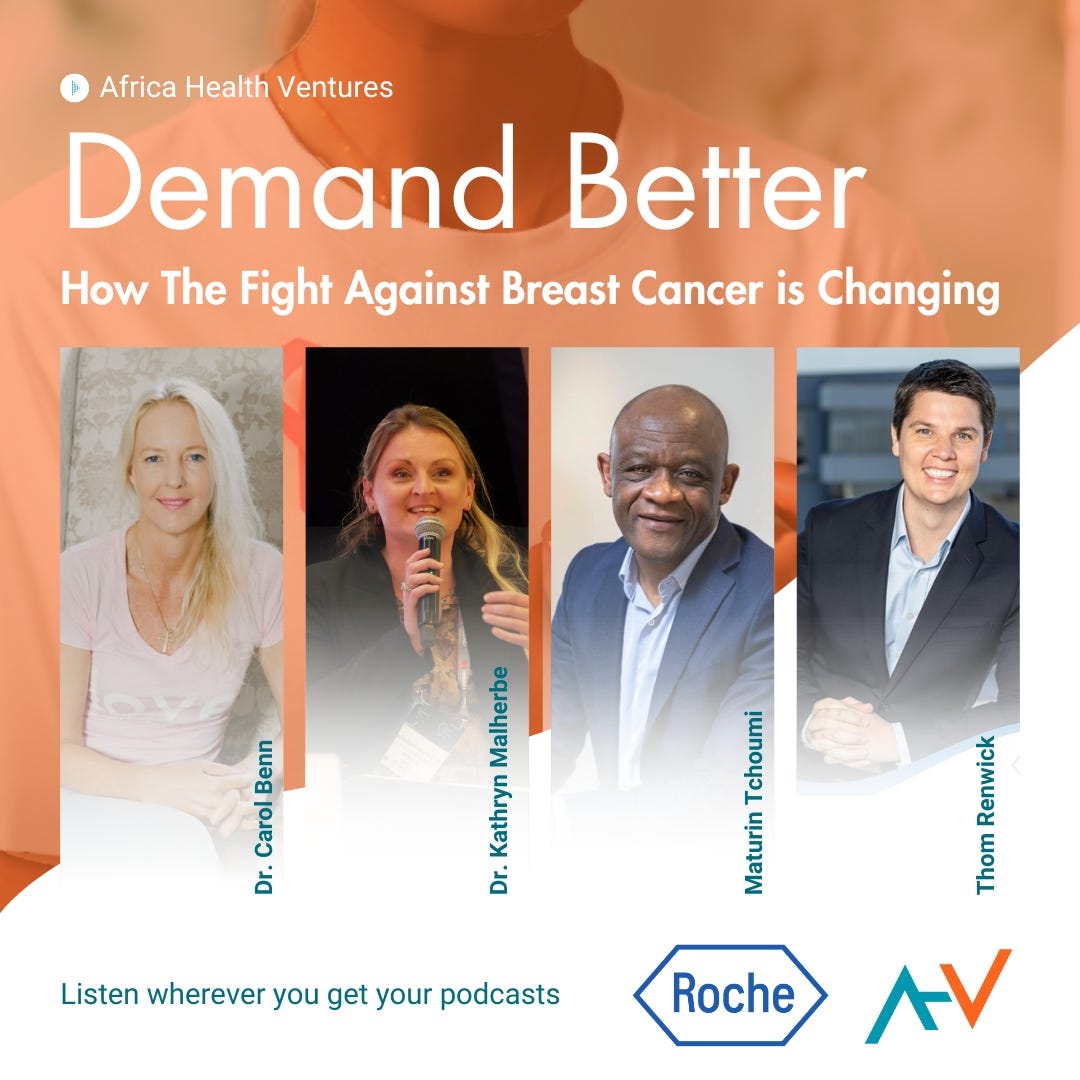
Loading summary
Transcript37 lines
- [00:01]
A
So I want to start today with a scene. It's 9:30 in the morning in Johannesburg, and a young mother, she's 31 years old, is sitting on the edge of a plastic chair in a crowded clinic waiting room. She's already been to two doctors. Both told her the same thing. You're too young. It's nothing. But the lump in her breast hasn't gone away. She scrolls through her phone, checks the time. She's missing work again. And all she can think is, what if I'm right? What if this is something? And what if no one will listen? This isn't one woman's story. This is something that happens every day across Africa. Not because women don't care about our health, not because we don't know our bodies, but because the system around us, the information, the infrastructure, even the attitudes, weren't built for this disease. And yet, it doesn't have to be this way. For today's episode, we pulled together a cohort of people driving for a better way to tackle breast cancer in Africa. These include Dr. Carol Benn, a surgeon experienced with severe trauma, who today is one of Africa's leading breast cancer experts and the founder of the Breast Care center of Excellence. We speak with Dr. Dr. Catherine Melherbe, a mammographer who saw a need and rose to the challenge of becoming a tech entrepreneur because no one else was building the tool she knew her patients need. You'll hear from Tom Renwick, the head of Roche in South Africa, about the societal impact of breast cancer, as well as Maturin Chumi, the head of Roche across Africa, on what could be possible with digital innovation and entrepreneurship. Through these voices, you'll hear a different narrative. Innovation isn't just about technology. It's about awareness. It's about agency. It's about giving people the chance to make informed decisions about our own bodies and to grapple with disease on our own terms. I'm Rowena and this is the Africa Health Ventures podcast. Before we begin, a quick note. This episode is made possible with the support of Roche. Roche is an industry leader and global pioneer in pharmaceuticals and diagnostics, focused on advancing science to improve people's lives. All of these conversations were recorded live as part of Africa Tech Festival in Cape Town, where for the first time In November of 2025, we celebrated healthcare innovation with a dedicated healthcare track. Big thanks to Roche for bringing together these thought leaders and making this dialogue possible. Please note the perspectives shared here belong to each of our individual guests. If you'd like to learn more about healthcare startups, and investments in Africa, please subscrib to our newsletter@africahealthventures.com newsletter. If you'd like to nominate a promising early stage healthcare venture for investment, please do so@africahealthventures.com apply one last disclaimer. The content here is for informational purposes only. It should not be taken as legal, business, tax or investment advice or be used to evaluate any investment or security. With that, let's dive in to understand how we even got here to this moment where early detection feels both desperately needed and suddenly possible. I wanted to start with someone who has spent her entire career on the front lines of breast cancer in South Africa. Dr. Carol Benn began her career as a surgeon in the trauma unit of Chris Hanibera. Chris Hanibera is the largest hospital in South Africa. It's located on the outskirts of Soweto, the impoverished township where Nelson Mandela lived for many years. In this chaotic high adrenaline world of emergency response, Carol was regularly treating for gunshot wounds and traffic accidents. But it was the contours of breast cancer that captured her heart. What she witnessed in those early years changed the course of her life and ultimately helped spark a shift and how breast cancer care is understood across the country. So I asked her to take me back to that moment.
- [04:28]
B
I'm actually a surgeon by trade. I started in trauma and then moved into breast because I saw how traumatic and how badly women were treated. There's a big hospital and I was a trauma surgeon so I needed to learn it for my final exam. So I found this really all nice Jewish guy surgeon and I said, please teach me about breast cancer in case I get one in my exam. Chad did and he fell down the stairs and joburg and hurt his nose. So he said, I always say if you ever need something, you help me. So I went down into this clinic in the dungeons in the basement and the male surgeons were sitting there, mainly male surgeons. There were a few female surgeons and reading the newspaper saying, you've got a breast cancer. We booking you to take both your breasts off. And I'm like, hold on a moment, is this how it should be?
- [05:19]
A
And it wasn't a quick explainer here. For most of the 20th century, the standard treatment for breast cancer in the United States and Europe was something called mastectomy. Basically a surgeon would remove all or part of a breast and sometimes a significant part of the muscle and lymph nodes underneath to get the cancer out. Obviously this is a part of the body that has huge emotional and cultural significance everywhere in the world. But this practice started to change. By the late 1970s and 80s, big clinical trials were proving we didn't have to do this anymore. You could save the breast, use radiation and other kinds of therapies to get the same or even better survival rates. So high income countries moved away from mastectomy pretty quickly. In South Africa, though, that change took much longer. Some of it was training, some of it was old medical culture, and some of it was just the reality that updating systems and mindsets takes time. That's why people like Dr. Carol Benn were so disruptive. They were pushing for breast saving surgery long before it was widely accepted locally.
- [06:33]
B
So from the 1970s in the US and in Europe, they were pushing for women to save their breasts. Mostly women empowerment movements and studies. And it's amazing how times changed. I brought it back into South Africa as an innovation and most people were like, no, shouldn't be doing this. And so I realized that if I wasn't going to change the doctors, I needed to already then get out there and speak to people, put the power with the woman. It's the person's body, not the doctor's body.
- [07:04]
A
You went up against the medical community and a lot of resistance, a lot of attachment to the old ways, even though you'd seen better elsewhere overseas. Absolutely. Okay, I've worked with the medical community. Let me talk to people, let me help people understand their bodies and that they deserve better people.
- [07:20]
B
If you empower people to understand, it's your body and it's about you and you need to understand what's going on and participate in the healthcare decisions. And in fact, in the last 50 years, we from taking breasts off to knowing it's actually better for the patient to save them. So there's so many rapid developments in breast cancer care and what we want to do is we want to be able to. I think medicine is more than the service of the doing, it's the service of the teaching.
- [07:48]
A
Today, Dr. Carol Benn has left her mark on the industry. She's recognized as an industry leader in South Africa in the fight against breast cancer, both as a surgeon and as an advocate. She's chair of the Africa Breast Cancer Council, a prestigious Pan African community addressing breast cancer across the continent. And among her many achievements, she founded the netcare Milk Park Breast Care center of Excellence, one of only three breast care centers outside the USA achieving the quality needed for the national accreditation program for breast cancers. But let's circle back to the specific question of screening for breast cancer. It sounds simple, right? Get tested early, get screened, take care of yourself. But unfortunately, even among people who have medical insurance in South Africa and have access to screening, only one in four people are actually getting tested. Why is that? Why is it so hard for people and for healthcare workers to get ahead of breast cancer? For one, the contours of the disease are changing. It's coming for women younger and younger.
- [08:59]
B
So if I just look at my meeting this morning, people came from all over. I looked at almost 45 newly diagnosed patients and I was horrified at the numbers of young people with advanced cancers, big cancers. So we have a 31 year old who's presenting with a really, really big cancer. It's been there for a while, but people are not ignorant. So when things are ignored, they are ignored for a variety of reasons. Her story is she went repeatedly to doctors and they said, you're too young. It can't be a breast cancer. It's not painful. So there's so many myths out there. And until she eventually came forward now, and we've just diagnosed her cancer.
- [09:39]
A
Another reason people don't get tested early is because we're afraid. We're afraid of what it'll take and what it'll mean.
- [09:46]
B
People ignore either because they're scared of healthcare systems. Healthcare systems are very much hostile environments. People are scared of oncology treatment, they're scared of losing their breasts, which they don't need to many things that they picked up on social medias, or they're ignoring it because they've been told by someone who they trust that this can't be. So I always say if there's something wrong, you need to go for an ultrasound, simple needle biopsy and understand what it is. So we want to change the dynamic of education, education, doctors, education, patients, and then how can they access the right service?
- [10:24]
A
You make an excellent point there. Healthcare is scary facilities. No one wants to go to a hospital. In Africa, you go to a hospital to die. No is the misconception.
- [10:32]
B
So there we go. That's another.
- [10:33]
C
Why do you ignore it?
- [10:35]
B
Because my aunt went there, she had a cancer and she died. 65% of people who are diagnosed with breast cancer have no risk factors whatsoever. How's that for interesting? 65%, they've done everything right. They're not overweight, they don't drink, they don't smoke too much, not got a significant family history, they've breastfed their children. All the things that we learned at Medical School. Only 25% of people have family history on their father and their mother's side,
- [11:03]
A
listening to Dr. Carol Benny. You get a sense of the human cost of late detection, the fear, the delays, the unnecessary suffering that could be avoided with better systems. But breast cancer doesn't just affect individual women and their families. Its impact ripples out across communities, societies and economies. Next we'll hear from Tom Renwick, the head of Roche in South Africa, who provides additional context on the impact of breast cancer in a society.
- [11:34]
D
So the effects of breast cancer on a woman's health is really well understood. And let's not beat around the bush, it's absolutely devastating for women and for their families. I think one of the consequences of breast cancer that's less reported on is the economic impact that it has on an economy and what it has on a household. Women are quite often the heads of a household. They're also working in today's society. And therefore when one gets breast cancer and women go through that devastating disease, they're not only taking a health hit, they're less economically productive, as one would imagine. Recently with the Wife War Institute, which is a German think tank that really focuses on economic aspects, they published a report recently that looked at seven African countries over a five year period. And they looked at her two breast cancer and the economic impact of knots treating early enough and not diagnosing early enough. And they found that actually the Results were staggering. 10.3 billion in economic productivity loss over a five year period. And I think it's very pertinent here in Africa as a continent. Not only do you have a very young population when we look at it, versus other continents, but also because we're seeming to detect late stage breast cancer a lot earlier here in the continent than we are in other places. And so for those at your most economically prime time, we're taking a lot of these women out of the workforce. I think it's totally unreported or underreported, should I say, as you often hear, women are the very heart of a family. And so a devastating diagnosis and then unfortunate death of a heart of a household has huge ramifications not only on that individual, but the family around them. If you think about kids growing up without a mother, statistically proven to do less well in schooling to have a huge socioeconomic impact on them. And then when we look at the individual woman themselves, once they're taken away at their prime, might I add, obviously that economic activity that they once had is completely gone from the economy. I truly believe that health is wealth.
- [13:32]
A
Tom gives us a sobering look at the scale of the problem, not just for individual women. But for families, communities and the economy, it's a reminder that late stage breast cancer is not only a medical issue, it's a structural one. So the question becomes, what do we do? What are the levers for real change? Well, this is the Africa Health Ventures podcast. So of course we're going to dive into one pillar of that change. Technology, innovation and entrepreneurship. Here's Maturin Chumi, the head of Roche Africa, who introduces us the opportunities of digital innovation in the fight against breast cancer.
- [14:14]
E
We know that technology and digital is an efficiency multiplier. We have seen that in different industry. You know, we have experiences in Africa in banking, M Pesa in Kenya. Right. We experience in telecom. I remember, you know, at home I didn't have a phone. Today when I go back home, everyone has a mobile phone. Technology and digital has transformed that space. Right. Research also show that in Africa there could be a gain of efficiency of close to 15% in the span that countries such as South Africa, Nigeria and Kenya have.
- [14:59]
A
Maturin gives us the big picture how technology can make whole health systems smarter and more efficient. But ideas at the system level only matter if someone is willing to turn them into real tools for real people. Next up, we're going to dive into the journey of Dr. Catherine Malherbe, a clinician who didn't just spot the gap, she felt it every day. Katherine is a mammographer by training. What that means is that for years she was the person you saw when you went to get an X ray of your breast to find out whether or not you have breast cancer. Every day she was interacting with women at risk or diagnosed of breast cancer. In this work, she could see clearly that X ray machines, particularly in Africa, are few and far between. So often by the time a woman shows up at the lab, it's too late. She couldn't stop thinking about all the woman she could be reaching and wasn't. That wasn't a status quo she was willing to accept, as she's going to tell us now. Even though she did not have a background as an entrepreneur or as a techie, Katherine went on to found Medsol Breast AI. The company has built an AI algorithm that allows clinicians to detect breast cancer using low cost ultrasound machines, which are widely available in primary clinics. Early studies have shown it's 90% accurate and cuts the cost of screening by over 60%. Here's Dr. Catherine Malherbe of Medsol AI.
- [16:43]
C
I'm a radiographer, mammographer. I've been working in the field for over 20 years. My key interest is in breast imaging. My interest, or how the company came about, was actually born from the frustration of how many women we saw walking into our practice arriving with late stage or advanced stage breast cancer. And it was simply because they didn't have access. A lot of the patients I've met in their early twenties were trying so hard to save to come for a mammogram or imaging for a good eight months, and in that time period, it actually gave time for that cancer to grow and get bigger. So it's been quite a sad awareness and awakening for me, having worked in both public and private, to see the massive gap. And then it was during my PhD, I developed one of the largest data sets in our country. And that was the groundwork for breast AI. I don't work in Python or JavaScript, but I was adamant to find a solution. So I figured it out. I taught myself, I made connections with groups overseas to explain to me how it works. And I was able to develop the basic algorithm, more like the toddler version of the algorithm. And then over time, I met some wonderful individuals from dotcloud Digital and we then started together the company. And basically our company was built to answer the very simple question, how do we make early detection possible for every woman everywhere?
- [18:10]
A
Just on that beginning part of your story, when you talk about the woman that came to your attention at late stage, is there a particular one that you remember that you'd want to talk about?
- [18:21]
C
Yes, there's one that sits with me. Over 10 years ago, it was a very young patient. She was 28. She went to a local clinic to have a thermogram done. Thermogram is not a FDA approved procedure, but they do make quite an effort to market and advertise it. It was shown on the heat map that it produces something as fishy. She didn't know what it was, so she saved up for months, up to a year to be able to come to the practice for a mammogram. And she had a very aggressive form of breast cancer. It's called inflammatory breast cancer. It's literally like, we call it a felt fire. It's literally like a brush fire. It expands drastically. And by the time she came to us, it was already too late, it had already spread. She was a young mother with children and it made me frustrated and angry at the lack of access and also just the lack of education. It's not just the infrastructure, it's this lack of education. She didn't know she didn't come from a well or Family, they weren't from your high income groups. Normal everyday person, she just tries to get by. And she was done a complete injustice. And on the other side of the spectrum, when we first rolled out the product, I was very nervous. And I remember one of the first patients at one of the clinics we referred to, we tested out the whole referral process. And I remember that afternoon I came home and they called me and they said she managed to get a booking at the breast clinic using our system within a week. And I remember I nearly cried. I looked at my husband, I said, it actually works. It was one patient. And I know we're trying to 2000, but that first one where we had that affirmation that our product works really set the tone for me, like we're onto something that has meaning.
- [20:07]
A
Amazing. That's an incredible story. Thank you for sharing that. You've had a long career as a practicing clinician, as a professor, as a nonprofit director. I know the Prospect of starting MedSoul AI sounds like a leap from your previous work. Obviously you're building on your other achievements, but it's a big step. Do you remember the moment where you decided, hey, I'm going to start this. This is a real thing.
- [20:32]
C
It was twofold. Initially, when I developed the algorithm, I just thought by myself, oh, this is a cool algorithm. Look at me, I'm writing script. I didn't think much of it, but then I. There was a lot of calls for research concepts to move it into a product. And I attended one of these sessions at the Tech Innovation Agency, or they're known as tia. And I must say, after that weekend, I had this realization that, oh my, this is actually a product, Catherine, you can make this a tangible thing. It isn't just a cool idea or cool research topic. It's something that's tangible. I think that really pushed it was just the fact that I'm in that work environment every day. I know the need and I was adamant to find a solution. I didn't want to sit back and be the one to complain and say, oh, the poor patients, and not be one to give a solution. On the other side of that, four years back, I was very busy in work, day and night, working long hours, putting work in front of everything. My own health. I remember that specific week, I had a terrible headache and I just went on working and by the end of the week, I had to have an MRI done and they diagnosed the brain tumor. That was a very big realization for me afterwards. I'm 100% fine now. There's no recurrence or anything, but it was a complete 180 of how I look at life. I was looking at my husband, I was looking at our son back then. He was about 44 years old. And I realized that my health comes first. And the work that I had been doing at different places, universities and practices, I stopped it. I went completely cold turkey on the grunt, the nine to five type of job. And I decided I'm going fully into this and just focusing on my passion. I must say I haven't looked back since then. It was quite a harsh awakening, but I felt like it happened for a reason, because it made me relook at what's important in life.
- [22:30]
A
I love how you took that opportunity out of that face to face with death, basically. And with. I think you drew from that experience today. Looking at MedSL, AI and everything that you've built. Can you give me one or two highlights that you're most proud of?
- [22:45]
C
The first one is that we're a SAPRA approved medical device. So that's our local health authority. Very few of the startup AI medical devices in our country actually reach regulatory maturity. So we're quite proud to say that we've reached that and we've pushed ourselves to reach that point. And the other thing is all the clinical studies we've done the past year, it took a lot of effort across South Africa to build on clinical trials and studies testing it in the real world, not just from a research point of view. And we were able to still achieve high sensitivity rates like at the Breast Care center of Excellence where myself and Professor Carol and Ben worked. We reach a sensitivity of 94% and specificity of 89%. And that really confirmed the typical older age that AI can actually meaningfully amplify clinicians. It's not there to replacement. We're multiplying them. We're providing more access to high accuracy rates. Not every day is easy. Some days you're thinking, are we going to make it? Will this be successful? There's a lot of days of doubt, but when things like that happen, you realize, okay, no, we're on the right track. We just need to keep our heads up and really need to, to push doing this.
- [23:57]
A
That's great to hear. Can you talk to me through some of the challenges that you faced in building and scaling this solution, what were some of the moments where you thought you might just give up?
- [24:08]
C
So the one we're looking at now, which seems like a massive wall in front of us, is international regulatory hurdles. So AI for medical diagnosis still seem quite niche globally as well, and the regulations often lag behind the innovation. So for us now to enter into ISO, the international standard and CE marking, it's a massive, massive thing for us to approach. We're not a massive company, we're still a small group. Along with that, the trust and adoption from clinicians that AI can be used actually in our field in radiology, it's been the computer aided detection and AI, especially in breast imaging. It's been there for the past 20 years. It's just that the race of the medical world has now catched up and now everybody is seeing it, but it's always been there, but it's being shown more and more how much value it adds, how much more accuracy. And it's not trying to sort of nitpick your own faults. It's there to enhance and to actually allow clinicians more time one on one with the patients, which is more important than just pushing out a report. And then a big one is. Funding for African medical innovations is hard. We don't always fit the traditional VC boxes. Many investors want proof before they fund. But the thing is, we need funding to get the proof that they require for future funding. So it's a bit of like a conundrum. They're like, yes, give us the proof, but we need to fund pilots. We have a lot of interested partners in Malaysia and India. But to be able to get it into the market, you have to first run it through a pilot. You need to understand the market better. You first need to see how it will fit in each country. The way our product is positioned will be different for that specific markets. You need to understand that and get a better idea before rolling it out and before scaling it out. So those have been some of the challenges we faced.
- [26:01]
A
I think the point you made about trust is really interesting. I can imagine you're working on the solution, which you know is leaps and bounds ahead of status quo. You know, you could change the system and yet you face these institutions, and often individuals as well, who have been doing work in a certain way for their whole lives, for decades. And you come and you, you know, there's a better way, but there's resistance, there's pushback, there is, you know, just like it's, it's work to change, it's hard to change. How do you navigate that piece? How do you come in as an agent of change and actually shift the world to a better place?
- [26:41]
C
We're focusing on providing evidence with the clinical trials we've done locally. We're not focusing on the hype of the product. We've prioritized running clinical trials, doing proper peer review research. We're giving independent validation rather than just telling a story of a great product. Also, the fact that we're partnering with clinicians, so we are working with the top breast surgeons, oncologists, radiologists and nurses to actually shape the tool into something that is practical and clinically safe. And the fact that we're testing it at grassroots. We didn't develop this product as a high end, top notch, very high tech. We practice or tested out this thing on mobile screening days and community clinics. Some of them don't even have a roof over their head, if I can put it like that. So we've tested it in a real world environment. We didn't put it in an ideal lab condition, which is typically done with products like this. We've tested it from the ground up and we've developed and adapted and changed it so that it actually speaks to that group. Most of the naysayers when it comes to these products are your larger private firms. I think there's a fear that you might impose on the income. But the sad thing is that the people that need this aren't the ones with medical aid and the ones that have the means to go to private institutions. The majority of our country and actually globally in the world are those without medical funding, without access, and those are the ones we are trying to help. And it's not as much. Yes, of course there's the income one needs to generate to keep a business running. But it's, it's really focusing on making a difference for them. I don't think the larger private firms realize for patients the cost and the worry for them to have to go to a public hospital to be tested means the entire eight hours that they sit there from 5am till 4 in the afternoon and maybe they'll be lucky enough to get access to the clinic. It might not be that those are the ones that need it the most. And usually then they leave their children, they're quite young, alone at home because they there's no one to care for. They don't have money even to buy a sandwich while they're waiting there at the hospital. Those are the patients we're trying to reach. We want to break that cultural stigma and help people who need it the most.
- [28:56]
A
Absolutely. You're not going head to head against the existing market. You see opportunity in the woman and in the families who are not getting screened, who can't make that journey who are stuck in the waiting room, who get turned back. You're bringing a lower cost, more effective solution to market and that's an incredible impact and economic opportunity that you're working with. So you listed several challenges. Each one of them sounds immense in their own way. What's your secret? How did you overcome.
- [29:24]
C
I know a lot of startups have come to us and said, but how have you managed? And it's almost like if you know that, you know that, you know, it's like an older days. I work in the field, I know that this is a gap. I know it needs. And I am positively assured that what we are doing, you have to absolutely believe in what you're developing really is the solution. It kind of pushes you through all of that, knowing the difference it's going to make. It's not like a product we developed and we're like, okay, let's see, maybe it'll work, maybe it won't. Let's see how. I've seen this work at grassroots level, I've worked with these clinics and seeing it at that level, it sort of pushes you to know that your belief, you know, the gap is there. You're working with it, you're getting your hands dirty from day one working with this product. And you always have to dream. It's tiny little steps, tiny little steps of achievement pushing you in the right direction. Rome wasn't built in a day, it's not going to work overnight. It's tiny little achievements that we make over time and just looking ahead and focusing on the end goal.
- [30:33]
A
Absolutely. The life of an entrepreneur is hard. Every year is hard for its own particular reason. And the only way you can make it through is if you have that dedication, if you are committed to what you're doing. And in your case, with the work that you're doing, you know the problem is real. You've seen it with your own eyes and you know the evidence is there. You know you have better technology, better innovation, better science that can be applied in the field. And so through all the ups and downs of navigating regulatory approval and the vagaries of funders and everything else, you know you're working on a problem that matters. And I think that's part of what's exciting about working in innovations in healthcare and innovations in Africa is that this is a real problem. This is a real, a real opportunity that could change lives. Unlike many other other things you could be doing or we could be doing with, with our time in our lives, that makes it significant, that makes it matter, that gives you the strength to get through all the closed doors and all the confusing mixed messages you might be getting as you navigate your way through this journey. So thank you for sharing that. What's next for you and for Medzel AI?
- [31:40]
C
Our next steps is to cross over the massive wall, scale the wall, for lack of a better word, to complete the ISO certification, we want to expand to more clinics. The fact that it's such a mobile and easy thing to scale, we want to get into more rural primary care centres, to more general practitioners, we want to try and get our product registered with local medical schemes because then we can also access the private sector and like I mentioned, to actually further develop our verticals and we can follow with all of them that same accessible point of care model. And then again, big dream by 2028 is 1000 breast AI units to be deployed as digital diagnostic independence for the entire continent.
- [32:26]
A
Dr. Catherine Malherbe's story ends there for today, but the patient journey continues. Screening is only the beginning of a patient's experience of breast cancer. As Dr. Carol Ben said at the start of this podcast, it's not enough to identify the problem. You need a response. Technology, innovation and entrepreneurship can play a pivotal role in the fight against breast cancer. But there are many more pieces and more actors that need to come to the table for a solution. We all have a part to play, whether it's corporate giants like Roche, governments and ministries of health, healthcare workers and regular people like us. As we wrapped up our conversation at Africa Tech Festival, I returned to Maturn Tschumi, the head of Roche Africa, and I asked him whether he had any words of advice or next steps. What can we take away from these conversations as individuals, as healthcare providers and as agents of change?
- [33:38]
E
My priority work will be in three points, right? The first one is we all have either an iPhone or a smartphone at home and we use this smartphone for our media, we use this smartphone for our finance, we use this iPhone to communicate among us. Look at number of WhatsApp we send per day. Why should we not use it for our health? I invite all our listener tomorrow when they go to a healthcare provider to be curious how they can use their smartphone for a better health. That's my first message for each one listening to this. My second message is for healthcare provider. It is important that we start thinking about a paperless healthcare delivery. Why do we have to continue writing on a sheet of paper the diagnosis that we are making, which most of time might not be readable? Technology in place, to capture it, to share it, to integrate it and make it interoperable so that that information follow the patient wherever he wants and the next healthcare provider we will see do not have to wait three months or four months to know what's happening. And lastly, my call is for stakeholders. You have to pay attention to mobility, you have to pay attention to finance, you have to pay attention to entertainment. And all this has been transformed through technology and digital. The time is now to join us in the journey of bringing this multiplier effect into healthcare.
- [35:36]
A
That was Matiran Chumi, head of Roche Africa, with a powerful reminder that the future of healthcare isn't something we wait for, it's something we built. One question, one tool, one decision at a time. When you zoom out from these conversations, the surgeon pushing against old norms, or the mammographer turned tech founder so that no woman has to wait eight months for a diagnosis, a pattern emerges. It's easy to talk about health systems as if they're abstract policies or budgets, but sitting with these stories, you really start to understand the evolving realities of breast cancer today, how it's reaching women younger, how low income communities are disproportionately affected, how in Africa, when it's diagnosed, most of the time it's already quite advanced. Alongside this, we look at solutions like Medsol AI from Dr. Catherine Melherbe, which is allowing women to be screened earlier, more cost effectively in their communities. We looked at how screening can be linked to access to care through a common digital health ID and other kinds of data infrastructure. And we looked at the role of every stakeholder, from individuals taking charge of their own health to healthcare providers trying something new to policymakers. And if there's one thing I'm taking away from these conversations, it's innovation doesn't always look like a shiny device or a breakthrough announcement. Sometimes it looks like someone just refusing to accept the way things have always been done. Someone believing that women deserve better. Thanks to all of you for spending this time with us. Before we sign off, I want to give a big thank you again to our sponsors, Roche, for supporting this series and for making these dialogues possible. If you'd like to learn more about healthcare ventures in Africa, you can subscribe to our newsletter at africahealthventures.com/newsletter. And if you have any thoughts, reactions or questions about this episode, please share them with us on our LinkedIn page. At Africa Health Ventures, I'm Rowena Luke. See you again soon.