Loading summary
Transcript29 lines
- [00:02]
A
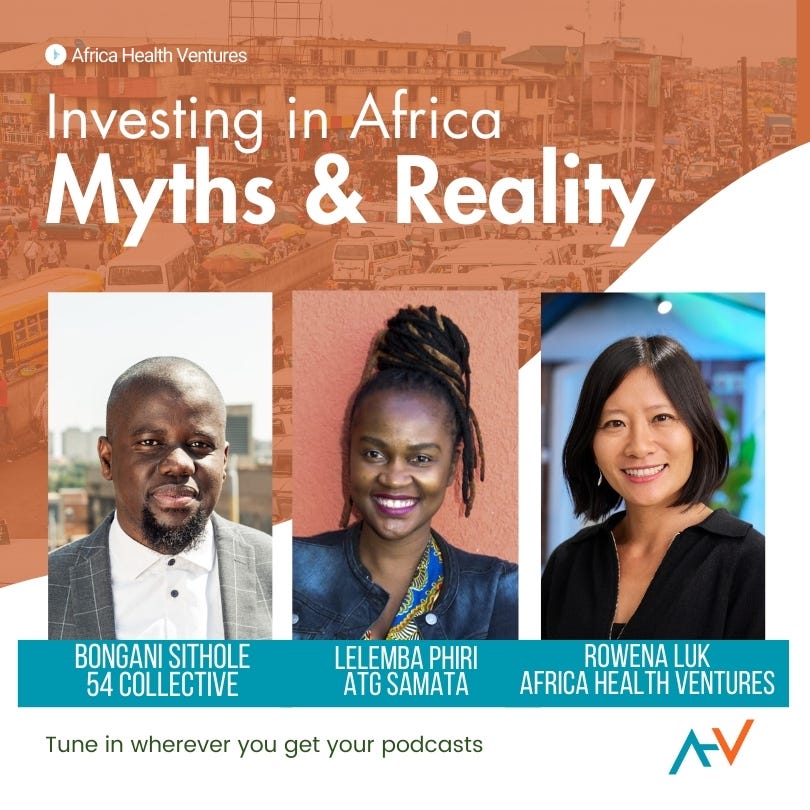
Hello everybody. I'm Rowena Luke and you're listening to the Africa Health Ventures Podcast. In this podcast we explore the entrepreneurs, the investors and the innovations that are going to shape the next 10 years of healthcare in Africa. Today, we're going to dive into a question that I've been getting a lot recently and it's this. Why invest in Africa? People think of Africa as a basket case, poverty, war. We're comfortable donating here and there to Africa, but for many the concept of investing is new. So why invest? Why take a step into the forefront of this emerging market? To answer this question, we've brought together two of the leading fund managers on the continent who have devoted their lives to to the Africa Opportunity. The first is Bongani Sitole, CEO of 54 Collective, formerly known as Founders Factory Africa, which is the most active venture capital fund on the continent. They manage over $100 million geared towards supporting and investing in startups across Africa. Our second speaker is Lalemba Pieri, one of my favorite human beings. Lalemba is co founder of ATG Samata, a gender lens venture capital firm investing across east, west and Southern Africa. She's also a seasoned development finance expert, investor, educator and writer. But don't worry, this isn't a pitch, this is a conversation. We're going to be peppering Bongani and Lilemba with the real questions and risks that people have about investing in Africa. We're going to talk about political stability, access to talent, geographic fragmentation and more. This conversation was recorded live in November 2024 at a tonic gathering in Cape Town, South Africa. Tonic is a global community of over 500 impact investors from around the world who sit at the forefront of the global impact investing movement. Before we dive in, a few quick announcements. First, if you want to learn more about what's going on with healthcare ventures in Africa, you can subscribe to our newsletter@africahealthventures.com newsletter. If you're ready to get a little more hands on supporting or investing in healthcare startups in Africa, get in touch with us again on our website@africahealthventures.com and finally, a friendly reminder. The content here is for informational purposes only and should not be taken as legal, business, tax or investment advice or be used to evaluate any investment or security. Now back to our show. To kick us off, we begin with a few words to introduce the Africa Opportunity. Here's Christophe de Montil, a principle of Beyond Capital Ventures.
- [02:57]
B
When we think about Africa, right there are simple things. By 2050, 70% of the world's youth will be African American. One in four people in the world will be African. When we think about health care, which you know, rowena knows well, 25% of the global disease burden is here and 3% of the actual health workforce is here. So how do you triage those things? So there's this immense opportunity, there's global demographic shifts which are happening here and it is going to be the continent that shapes the future. And there's a lot of issues that can be solved if we, we directed more private and public capital towards it.
- [03:34]
A
You take what Christoph is talking about, the 2.5 billion people that will live in Africa by 2050. You pair this with Africa's track record of leapfrogging new technologies, first with cellular phones, then with mobile messaging, and of course with mobile money. You look at the aggressive growth in investment on the continent over the past four years, the same period which has seen a dramatic decrease in funding towards China, Asia and Latam, which were supposed to be the high growth markets. And you realize in the next 10 years Africa could be the exponential growth market that escapes the doldrums of the more mature but also more saturated markets elsewhere. With that high level opportunity before us, let's dive in a little bit deeper. Let's hear from Bongani Sitole, a 54 collective. His take on building and seeking opportunities in Africa.
- [04:27]
C
So as an excellent entrepreneur, I've been in this space for the last 20 years. I've built businesses, I've sold business here. And I think my approach in how I look at Africa is purely because of my background and I've seen firsthand the ability to build businesses and influencing the next generation of entrepreneurs and of course being able to create jobs and thinking about what their systematic change that Africa needs might look like. So based on that background, I think one of the greatest things about being an entrepreneur is to continue going right, it's just to keep going. And the reason why that is important is because emerging markets and Africa is no different means that there's always many challenges that one is faced with. And if you consistently try and figure out how you focus on those challenges vis a vis how you build a business, you'll never start. And what we continuously say to both entrepreneurs and investors is to look at the future of Africa despite the challenges that we face. 54 Collective is a pan African VC firm. So what that means is that we have seen quite a bit, you know, share of investment across the continent. We have over eight investments across all the four major geographies and we invest in early stage. So that means that we look at businesses from idea to Series A. And one thing that we have actually learned early stage when we started was that capital alone is not enough. And hence the reason why we've built an investment firm that combines providing capital and hands on support. And the reason for that is very simple. In a nascent market, what it means is that an entrepreneur can identify a problem, but for the most part they're first time entrepreneurs, so they might not know what they don't know. So they need some sort of support to be able to combine capital that they receive and how to use that capital to be able to build businesses. So the reality is that Africa's got many, many challenges from infrastructure to lack of capital, to some of the things that the previous session touched in terms of you don't have electricity. In some countries we talk about the digital penetration, but the reality of Africans is that we are still analog in many ways, right? And the question is, how do you start to build these businesses? How do you actually put in capital? And I think in my point of view, it's really thinking about two things. One, what are the immediate things that we can be able to do to support entrepreneurs? But secondly, when we look at the future, I think some of the statistics that speaks to in the next decade, two decades, Africa will be 2.5 billion people, right? That is an opportunity for me, you know, my younger self, I thought I want to live in other continents, but I actually not my later years over 40, I don't want to go anywhere. This is my continent and I think there's huge opportunities here. So I think it is actually Africans who are looking at inviting global expertise to bring those expertise to come and build and support entrepreneurs to be able to solve African challenges in order for us to foster a new future that I so believe Africa holds. So yes, we have problems, but we have big opportunities.
- [07:43]
A
One of the many things I appreciate about Bongani's comments is yes, there are challenges here. Certainly many places don't have electricity or connectivity. And that's a reality we need to face. But what that also means is that there is a greater opportunity to solve real problems here. And sometimes it's just a question of looking at what's worked in other geographies. What can we learn and what can we scale here in these frontier markets. So let's apply some of our brightest minds and the capital and the resources that we have to create those solutions. The next question we got from the room full of Investors there that day was about all the many countries of Africa and how different they are. Anyone who's worked in Africa has a pet peeve about the world. Talking about Africa like it's one country. So what does it mean to invest in Africa? What does it really mean to invest in 54 countries with anything like a unified or coherent strategy? Here's Lelemba Piri of ATG Samata to address that question.
- [08:48]
D
I'll start with the second part of the question, which is really talking about how heterogeneous Africa is. If you can think of it in terms of blocks, I think it helps remove some of the confusion. We have a number of economic blocks across the continent. For example, we've got the Southern Africa Development community, which is 16 countries in the southern part of Africa. Within this community, you will have very common incentives around investments. You might have a common plan around how do they want to see the development of the region happening as a block. And. And a lot of bilateral and multilateral agreements amongst the countries on how to trade. This makes it slightly easier. If we take SADC for an example, we've got 330 million people in SADC, which is similar to the population of the United states, but only 16 countries, as opposed to 50 states in the United States. Right.
- [09:42]
A
Lemba refers to Sadc. She's referring to the South African Development Community, a coalition of 16 countries working together to make it easier to do business. It's not unlike NATO or the European Union.
- [09:55]
D
And so there's slightly less complexity about expanding your business within a region like that. There's similar things happening in the different blocks. We've got an East Africa block, a West African bloc, a Francophone West African block, then North Africa, for example. And so if you take it block by block, I think it makes your job easier to research the block and get a little bit more insight as to what works in one region versus the other. What's exciting me is the really shift around thinking about more sustainable energy, for example, a real conversation around climate. I got into the climate space a little bit begrudgingly. I felt like, oh, my goodness, the west has ruined the world and now we must fix it. But over the last few years, I mean, we're getting the disproportionate impact of climate change, and it's imperative that we start having that conversation and producing the solutions that we believe will matter for our continent, but which I also think support the rest of the world to be able to leapfrog and create new solutions which don't exist. We did this in the fintech sector, for example, with creating solutions that were not available globally and exported that. And I think that the climate space has a similar opportunity for us to be leaders in that space. I'm still excited about technology because we still have a lot of infrastructure challenges and technology helps us to, you know, circumvent some of those challenges. I've got two sons, my younger one is 18 and he launched a business selling apparel. And it was a mission just getting a payment system that actually works. And so even the very basics, right, there's major opportunity. And so when you think about the challenges, you think about the other side, which is the opportunity. And to Rowena's point, like, you know, we have an opportunity to solve real issues, right, that create massive impact, but that means it's also a lot of low hanging fruit where the opportunities and propositions don't have to be that complex. We really can be solving very basic things at scale very easily. And I think for me it's always the intersection of thinking about how do we make sure that women are part of the evolution and the development of the continent. You know, Globally women are 50% of the world. In Africa are similar. And so, you know, leaving a whole demographic behind that actually really dictates a lot of the purchasing decisions is really just bad business. And also we know that with diversity we're creating better return on investments. And so the intersection of gender with a lot of these impactful sectors like climate, like finance. And more importantly, we're starting to see food security issues globally. And Africa really is a place with still a lot of land that's arable. And so thinking about more sustainable food agri systems that can support the world and make Africa the world's food basket.
- [12:44]
A
One takeaway, both from Bongani's initial comments as well as Lembe's is about the growth that we're seeing on a continent, the opportunities that exist. If there is an innovation here to set the rails that will deliver essential products and services to a population that's growing much faster on this continent than anywhere else. One in four people on the planet will live in Africa by 2050. And the way we scale Africa today is going to determine how they live. And so there's some urgency to act now and not five years from now, not 10 years from now, because we have the opportunity to get ahead of that, of that demographic dividend. Next we're going to get a little more real and face head on the questions and perceptions that international investors have about investing in Africa as an investor, when you put money into a business, how do you get it back out? How do you exit? What does an exit look like in the African context? Here's Alemba Piri of ATG Samata.
- [13:52]
D
We have a couple of options that are going really well on the continent. Strategic buyouts are still top of the list, where we're seeing larger corporates consolidating and thinking about the continent as one. And so you might have a large corporate that had established itself within the South African market, for example, and wants to get into the rest of the continent and thinking more cleverly about how to parachute in instead of starting from scratch by buying some of the smaller players that might be in these markets. We've seen a lot of this happening, for example, in the logistics space and we're starting to see it develop as well in the clean energy space. Secondly, I think that we need to think about exits a lot more creatively on the African continent because such a high need for financing for projects on the African continent, there is a need for a diversity of instruments through, through which we invest. Right. And so if you think about your investment portfolio a little bit wider than just equity, you might be able to invest with debt and also like revenue based instruments and these offer a natural exit for you because the timeline can be a little bit more predictable and you can see how your patterns work out a bit quickly. So that's also an option. Diversity of instruments. We're seeing a lot more mergers as well from the smaller players coming together and exiting out some of the earlier investors just to clean up their cap tables and good returns coming out of there. And so I think the same things that you see in the west are starting to happen in Africa. Bear in mind the venture capital space, particularly for Africa, is still very new. We're just over a decade old, so expecting that the cycle will be faster than it has been in the west is not entirely reasonable. And so we're starting to see the early evidence of strong returns. We only just had our first unicorns in the last six, seven years as well. And so we're starting to see the market just getting into this space where exits are actually happening. And it's very exciting. Also management buyouts, actually, when the entrepreneurs do well, we are seeing a lot of excitement about just trying to exit the entrepreneurs at healthy multiples. And so they are happening and the data is out there and we're happy to share all that information after.
- [16:12]
E
Yeah, one point of that that I'm going to echo is about the Standards that we hold Africa to versus the standards that we hold ourselves to. Like how long did it take for Silicon Valley to mature and to start demonstrating exits in Africa? It's only 10 years old. And so we look at a continent with, with the challenges and the opportunity that Africa has. And is it, is it fair to say that it needs to move faster than California did with all the resources at its disposal? I think that's something that this kind of double standard is a thing that permeates various aspects of how we think about and how we invest on this continent.
- [16:48]
C
On top of what Lemberg said, part of the challenges that we see in the continent when it comes to exits is the fact that sometimes the valuation of startups so expensive that even a corporate can buy them, right? So you then look at the market cap of potential buyers in Africa and you ask them, you ask yourself a question, whether we've got potential buyers, right? There are pockets to what has been shared, that we are starting to see numbers going up. But the reality of it is that if we want to see that faster growth going up, we need to find alternative ways. What we have started to do as a fund is to intentionally create rails outside the continent. So we are creating opportunities with Southeast Asia, with Singapore, with the US et cetera. The intention there is very simple for us. We've realized that some of the solutions that we're building in Africa, they're not necessarily just on the African, right. We've seen that we can be able to connect the world to Africa through technology. There are various examples in our portfolio where we've done that. The intention is very simple to do two things. To expose the technology that we find in Africa to the global so that they can be able to be a potential to buy this innovation back in Africa because of the question of liquidity. The second is we see many African businesses that are getting dollar based investment and yet they're operating in local currency. And the problem with that is you actually lose performance, so to speak, when you have to now convert your Naira or your South African rents back to your dollarized performance. And to be able to do that, to rather bypass or to hedge that, what we do is we expand these businesses into dollarized markets so that when you look at the performance of the business and the valuation thereof, you're not just looking at the local market and the local currency performance, you're looking at the business more holistically. So we look at how we can expose these innovations to the outside markets so that we can be able to try and foster an acquisition, whether it's management, buyouts, et cetera, et cetera.
- [18:58]
A
What about navigating bureaucracy and political instability? Africa holds many of the youngest democracies in the world, and certainly some of those countries have been eventful. So what do you need to know as an investor in order to navigate that reality?
- [19:13]
C
When it comes to the question of regulation and government challenges, you have to look at it in multiple ways. One is that depending on whether you treat a generation as 20 years or 40 years. As an example, if I take South Africa and you take 40 years as a generation, we just came out of 30 years of, you know, new sort of leadership after apartheid. What that means is that we Left with around 10 years to see a complete shift of leadership, right? And that means that we are going to see a new wave of thinking in terms of how we approach leadership, how we approach government, how we approach startups, how we approach technology, et cetera, et cetera. And the problem with Africa is that if you look at leadership across the board, you have difference in terms of ages and stages of that generational leadership. So in one way you've got first generation of leadership coming out of the history that we come from other countries, that in the second generation, I think it's really a challenge of time. Even though we are starting to foster certain things as a continent, Africa free trade as an example, which is taking too long. The second is in a startup ecosystem world. We are creating what we call startup acts, right, that enable cross pollination between markets.
- [20:34]
A
Bongani is referring to two fascinating and important trends that are emerging on the continent. One of them is the Africa Continental Free Trade Agreement, which would create a unified trading zone across the whole continent and really unlock the opportunity to do business across Africa. The other is the emerging popularity of startup acts which have already been implemented in multiple countries on the continent that make it a lot easier to get started and to do business within a consistent and supportive regulatory framework from government. Both of these are not unlike the ecosystems that exist in North America to enable trade and innovation.
- [21:13]
C
So I think there's things that we can move forward slowly. There are things that are just time bound, but what it means is that we cannot wait for those things to be true in order for us to build. So political risk is always going to be there. In Egypt, you've seen currency devaluation, in Nigeria is the same, but yet we are seeing more unicorns coming out of Nigeria even with those challenges, right? It will change over time. We don't have control of Some of these things, the question is, what is it that we can do to remove the lines in between Africa? Because I think in our world, in an entrepreneurship space, we think that these borders along the 54 countries, it's what's constraining us. And I think technology is the common denominator across the board that can enable us to move things forward much quickly.
- [21:59]
A
While we're talking about political risk, for those of us coming from the United States or many countries in Europe think we need to take a long, hard look in the mirror when we're asking questions about political instability. For better or for worse, clearly not just an African problem. Next, we dive into the question of talent. Here's the question from one investor. Is there a shortage of talent on the African continent?
- [22:26]
B
Might it also be a problem that on the continent we are talking about lack of funding, that there might be just not be enough really experienced entrepreneurs, and that this is also like a reason for like the lower investments? I mean, we have obviously a huge talent pool on the market. But when I talk to some of the investors in Cape Town, they say, ah, they're just not so many good entrepreneurs here as, like, I find maybe in Berlin or in San Francisco.
- [22:51]
C
So how.
- [22:52]
B
How do you see that might be a bit provocative, but
- [22:59]
D
so, no, there's no shortage of fantastic entrepreneurs on the continent right at the gate with that one. I think what we might have are two problems that might present themselves as that issue. Venture capital is very network driven. And so if you're in a network, for example, of predominantly white males, you're going to find a network of entrepreneurs of white males that might be doing well. Right? And so how do we widen that net, that pool? If you keep fishing in the same pond, you keep getting the same fish, right? So how do we widen that network? And I think one of the things that's super important when you start thinking about investing on the continent is really partnering with local investors who have that network that's existing already and can open up your network to a wider pool of entrepreneurs. Secondly, what type of entrepreneur are you looking at? If we're looking for the Silicon Valley model, which is really just high tech, high growth, again, we're going to reproduce the same results. Because what we have found, for example, in South Africa, because tech was predominantly white and male, it's still predominantly white and male. And so if that's the space that you're looking for, because you're only looking at technology businesses, then of course that pipeline is going to be limited. But Africa needs Solutions beyond technology. Right. I think we've touched on the number of industries that, that really create impact, have got massive opportunity that will not look pretty on the outset as technology, but have got fantastic returns and wider diversity in terms of entrepreneurial representation. And so how might we look at Africa as its own unique landscape with its own unique challenges, which really requires its own financing solutions? We can't copy and paste what happened in Silicon Valley. It's just not going to happen as uniformly because we've got different infrastructure to just begin with as a basic and different politics and things like that. And so thinking through Africa's challenges and what solutions we can drive opens us up then to think wider about the types of entrepreneurs that we need to be backing beyond technology entrepreneurs and where to find them. And so how might we widen our net to, you know, see bigger and wider and in spaces where we can create real impact but also get very strong returns. Sarah and I have been investing together for the last five years. We have a portfolio of about 14 companies. Our multiple on invested capital is running at three times and this is just in five years we've invested across the board, for example, from technology right into your basic fast moving consumer goods like food and, you know, complementary medicines because, you know, Africa has got fantastic biodiversity. And so there's a lot of solutions that are natural around how we look at our health, for example. And so pick the space that you care about, that you're really passionate about. If it's health, if it's finance, if it's energy, you know, if it's food, the opportunities are there and the continent is massive. And so how do you link into the local networks as quickly as possible to. To 1, reduce the information asymmetry, which really is a real problem, but also two, to give yourself access to the best opportunities that can give you not just strong returns but also fantastic impact.
- [26:24]
E
Thank you. And I will just on your point about always fishing in the same pool, there is this aspect about investing in local fund managers who know the ecosystem can work with the entrepreneurs. Oftentimes it's easy to invest in fund managers that are in our city or in our country because you'll see them more often. But if we want to source those deals on this continent, then the ones that are here will have the networks to find those deals.
- [26:48]
A
Wangani, over to you.
- [26:50]
C
I just want to add on the question of talent, talented entrepreneurs. I look at my background and sometimes when I think about my life, I just think whether VC would have found me and the reason for that we've raised north 200 million US dollars that I manage today. And one would have said, maybe I'm not an archetype of VC. And yet life is different today, right? And hence the name 54 Collective. Because we are very ambitious about looking at finding entrepreneurs in the 54 corners of this continent because we strongly believe that talent exists. You just have to look harder.
- [27:31]
A
My last question for Bongani was what do international investors get wrong about investing in Africa?
- [27:38]
C
You really fundamentally have to understand the behavior of the customer in Africa in order to be able to understand the layer of technology and how it's actually going to create efficiency and how they do. They don't care about your product, they don't care about your app, they care about how fundamentally you're going to shift their lives and how they do just understanding the behavior of a consumer in Africa and what it actually takes to scale businesses. If you look at most of our unicorns and you ask yourself what was the biggest driver for them? Moneypoint was our latest unicorn in Africa. You ask yourself, how do they become a unicorn? It's because of fundamentally they understand the landscape of a consumer and a small business and really layering technology on top of that to bring efficiency, visibility and access to market. That's it, right? So I think an ability for us to treat Africa from that perspective and not from a perspective of technology, because technology is a means to an end, right? So if we can be able to understand and match the two, I think we'll be able to get there.
- [28:44]
A
To wrap up, I asked Lilemba where to from here. If you're listening to this podcast and you're interested in the opportunity in Africa, where can you get started?
- [28:55]
D
First of all, I think that your timing is fantastic. It's a great time investing on the continent. We have a growing population, we have enough technology infrastructure that has sparked so many other smaller opportunities that can be looked at and we still have not done development so wrong that we can't correct it. And so in terms of the climate opportunity, it's also massive from many standpoints. We can shift how we are building, we can shift our water systems, we can shift what type of power we invest in and so the opportunities there. Secondly, I think there are so many ways in which you can invest. You can look directly, we have a number of angel networks that you can be part of. We have funds that invest via syndicates, so you can do deal by deal if you want to tip your toe into it without being committed. And we've got funds as well, where you can just invest directly into the funds. I think this is super important to just widen your network to be able to look at the local networks and the ecosystem and figure out what you would like to back and so maybe start with your thesis, what you really care about and look at who's investing in that space and how you might work with them in the space.
- [30:12]
A
And that brings us to the end of today's show. Thanks for joining us. To recap a few of the points we've just heard. Africa is a frontier market and there's a couple things to understand about how it works. It is 54 different countries, but many of these are unified within economic blocs. Some of these countries are subject to political risk, a reality that's come to bear on most continents on our planet. And there is talent here, though it may not look or sound quite like our stereotypes of what talent should look like. At the same time, there is real opportunity here. Africa is home to some of the fastest growing populations and economies in the world. Here we have the opportunity to solve real problems that will set the rail for a quarter of the world's population by 2050. Most of the people who live here are under the age of 25, a young tech savvy generation which is primed to leapfrog ahead as Africa has already done in the past. It's a complex place, but there's no denying the opportunity that exists today. If you want to learn more, there's lots of places to get started. Of course, if you're interested in the healthcare opportunity directly or through a fund, get in touch with us@africa healthventures.com or subscribe to our newsletter at africahealthventures.com Newsletter. If you want to learn more about early stage investing with 54 collective or gender lens Investing with ATT Samata, we'll link to them in our show notes@africahealthventures.com podcast. We'll also link to a few of the angel syndicates and programs for early stage investors in Africa. If you have any other questions or reactions to this episode, please share them with us on LinkedIn. Thanks for tuning into our show today. That's it for now. We'll see you next time.