← The Africa Health Ventures Podcast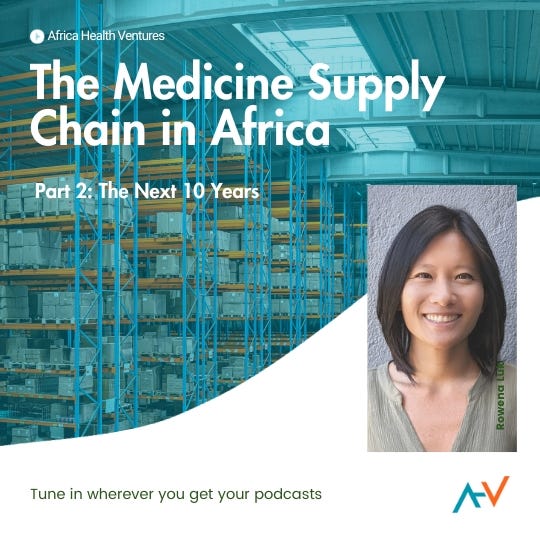
The Africa Health Ventures Podcast
The Medicine Supply Chain in Africa, Part 2: The Next 10 Years
00:22:38
Loading summary
Transcript13 lines
- [00:03]
A
Welcome back to Part two of the inaugural episode of the Africa Health Ventures podcast, formerly known as Aid Evolved. In this podcast, we're going to unpack what's going on in healthcare in Africa today. But that's not all. We're also going to be looking at the innovations, the ventures, the entrepreneurs that are going to help us leapfrog ahead in the next 10 years. I'm your host, Rowena Luke, and this episode is the second part of our coverage of the medicine supply chain in Africa. If you haven't already, I'd strongly encourage you to listen to part one, where we track the movement of a pack of medicines from manufacturer all the way to pharmacy. And we share that story in the words of people that work directly with the manufacturers, the distributors, the and the pharmacies themselves. Today, in part two of the Medicine Supply Chain in Africa, we're going to cover three segments. In the first segment, we're going to acknowledge that the private sector is only one small part of the picture. There isn't just one. There are many medicine supply chains in Africa, and the differences between them can often be traced back to the work and and priorities of governments and major global donors. That's our first segment. In the second segment, we'll highlight four key trends that are going to dramatically change the medicine supply chain in the next 10 years. Last but not least, in the third and final segment of today's coverage, we'll highlight just a handful of the social enterprises that are driving that change forward. Just before we dive in, a quick public service announcement. If you're interested in healthcare ventures in Africa, subscribe to our newsletter to get all the latest going ons, that's@africahealthventures.com newsletter. And if you want to nominate a promising seed stage startup bringing better healthcare to Africa, or if you want to be notified of future investment opportunities, get in touch with us@africahealthventures.com and we'll connect the dots. One last friendly reminder. The content on this podcast is for informational purposes only. It should not be taken as legal, business, tax or investment advice and should not be used to evaluate any investment or security. And now, on with the show. In part one, we laid out a pretty simplistic model of the medicine supply chain. I admit that included the manufacturer who makes the medicines, the distributor who moves the medicines, the health facilities such as a hospital or pharmacy that dispenses the medicines, and the patient. Now, in a podcast about the medicine supply chain in Africa, I wouldn't be doing my job if I Didn't mention a few of the big names that come up a lot. USAID Global Fund, pepfar, each putting in billions of dollars into this market. But what exactly do they do? Turns out a lot. Now, I'm not going to get into the mechanics of just how they engage with the different touch points in the medicine supply chain. That would probably be a textbook all on its own, but let's just point out a few high level things. Here's Mila Nipominishi, lead advisor to USAID's center for Innovation and Impact, describing how the PEPFAR HIV supply chains differ from other medicine supply chains on the continent. There's the world of the global health funded commodities and then there's the world that's predominantly either government funded or in many cases out of pocket. And so the supply chain considerations are very different for both of these groups. The majority of financing is actually out of pocket for most things in these countries. PEPFAR is funding all of the main HIV commodities for a number of countries. And it's controlled, it's highly controlled. It's a very centralized supply chain. Turns out when PEPFAR and its impressive resources get involved, there are systems upon systems upon systems to ensure that commodities are widely available. This kind of highly controlled supply chain is evident in USAID's Global Health Supply Chain Program, a $10 billion program that provides hands on support with staff in 37 different countries, buying medicines, choosing distributors and conducting trainings on core supply chain function. Not all of the big global donors are this hands on. The Global Fund, for example, puts a lot of its energy into pooled procurement. It pours about $2 billion a year into pooled procurement, which allows it to aggregate demand and negotiate favorable rates for medicines. Even in that process, though, they need to very carefully guide and direct how procurement is done at the country level. All that said, if there's one takeaway I'd leave you with about the effect of global donors on the medicine supply chain in Africa. It's that there's a world of difference between the private sector medicine markets and the other ones supported by billions of dollars of international donor funding. And this leads to some skewed realities like how medicines for HIV and tuberculosis can be widely available while at the same time basic maternal health and newborn or nutritional medicines are sometimes quite frankly forgotten. This brings us to the second segment of our show, the next 10 years of the Medicine Supply Chain in Africa. We are the Africa Health Ventures podcast and as part of our mission, we're looking to the future, to what's going to Be different about healthcare and healthcare markets in the years ahead. In the next segment, we're going to hear from our speakers about four key trends that could dramatically change the medicine supply chain in the next 10 years. First, we'll hear from Clinton D', Souza, the former director of Public Health at Imperial Logistics, one of the largest medicine distributors in Africa. He talks about major strides being taken by the African Union, a coalition formed by the governments of all the countries, all, all 54 of them in Africa.
- [06:39]
B
I just want to give a quick shout out to African medicine supply platform amsp. If you haven't heard of these folks, I encourage everyone to go and have a look. They were set up around covert to act essentially as a pull procurement mechanism for African countries trying to buy Covid product. Right when all the supplies just dried up and countries couldn't get what they needed. AMSP was established and they went to the market. They got lots of philanthropic money, foundational money, and other sources of funding to establish this. And it's been fully endorsed by the Africa Union as a mechanism to pull demand, because that's really what the market wants, right? If you can come here with aggregated demand, then you become a big player and people start taking notice. Not just one government, one central medical store trying to buy, you know, I want to buy a hundred thousand PPE units. You aggregate that, you go to the market and say, I want five million. Whoa, okay, that's a huge order. You jump to the front of the queue, especially if you got the money and you got the whatever.
- [07:51]
A
Clinton talks about the African medical supplies platform, which is a pooled procurement mechanism. You might think of it as Africa's homegrown response to global funds pooled procurement. Its mission is to lower the cost of medicines on the continent. There's two other trends I'll highlight on the government or regulatory front, both of them emerging from the African Union in the wake of their experiences during the COVID 19 pandemic. Recall in part one of this episode, we heard from Yusuf Rasul of Merck about the challenges of an international manufacturer working in 54 different countries in Africa. How does an organization like Merck, with new chemical entities, file for approval in 54 different countries? It seems almost as a direct response to that objection. One exciting trend is the emergence of the African Medicines Agency. It's not fully stood up yet, but it has traction in the African Union. And if it comes together, the promise of the African Medicines Agency is a single body to provide regulatory approval to medicines across Africa. Suddenly, that makes it a lot More possible to go to market with new medicines in 54 countries at the same time. The other exciting trend is the Africa Continental Free Trade Area, another agreement brokered by the African Union, which has been signed by 44 of its member states. This has cross cutting implications for the private sector in Africa, including what it could mean for the free flow of medicines between countries. If either of these changes comes together, it would create a massive new market for medicines in Africa. That's one of many reasons why we're so excited about the medicine supply chain here at Africa Health Ventures. This brings us to our next trend. We heard in the first part of this episode from Clinton d' Souza about the challenges of the middlemen, about how the price that a manufacturer sells at can be marked up by as much as three times when it gets to a patient because of this chain of distributors that exists in Africa, each adding their own markup. But that doesn't have to be the case. Yusuf Rasool, the director of Global Market Access at MSD or Merck, describes the role that vertical integration could play in removing the middleman and dramatically reducing the cost of supply chain. He explains this trend through the specific example of how mpharma is reducing the cost of medicines in Ghana. Here's Yusuf.
- [10:35]
C
One particular organization who we've partnered with is mpharma and they have a very novel way of making their products available in a cost effective way without the markups that we see in many African countries.
- [10:49]
A
How do they do that?
- [10:51]
C
So where we are right now, and I tell people, the more touch points they are to a medicine, the more expensive a medicine becomes. So yes, we might sell a medicine to a distributor who sells it to a wholesaler, who sells it to a pharmacist, who then sells it to other pharmacies and eventually it gets to the patient. It's not uncommon where a product that we would sell directly to a distributor would have a price of at least three times, you know, to the end user. And I think that's really unfortunate. Right. We don't see this in many developed worlds. And the patient, at the end of the day in these markets are ones that really suffer. Mpharma has a very novel mechanism in cutting the middleman out. So we partner with them in terms of a distributor or wholesaler. They have agreements with a number of pharmacies. They have this really novel ERP software which is called Bloom, where they cap and dictate what the prices are for every pharmacy. And a pharmacy has to be part of the mpharma network. So they you know, by, by signing up to being part of this mpharma network. Mpharma takes care of the logistics in terms of getting the products to them, stock all of the supply chain issues, but they also make sure that the prices are kept in some of the markets that have hyperinflation. They also make sure that patients prices are kept for a period of time. So at the end of the day it's a win for a patient, it's a win for a supplier because now we can actually, we can forecast demand and in that way we can make sure that supply is available, we can provide them better terms and they allows profitability for the company. Now extremely important, when we talk about supply chain in any business, we need to talk about commercial sustainability. So anything that we do needs to happen in a commercially sustainable way. Philanthropic activities is really great, but it does not necessarily mean that it will be supposed to sustainable over a long period of time. The moment a funder pulls out, that entire ecosystem may crumble. And that's why I say may crumble. Why we try and focus on commercial sustainability is because it develops the ecosystem as we move forward. And even then it can take a different company. So MSD doesn't need to be here. You can take another company, whether it's multinational, whether it's generic, whatever, you could plug them into this ecosystem and it works. The piping works because the ecosystems develop and that's really how you make a difference to patients.
- [13:19]
A
Now the vertically integrated approach that Mpharma has works to reduce the margin and gets drugs to market in a much more affordable, accessible way. For the third trend we'll explore today, we're going to talk about how supply chain is growing. Omnichannel. What does that mean exactly? In the old world classical example of supply chain like what I've presented in this podcast, I admit it paints a picture of a single chain that flows through private distributors or public health systems. But turns out there's a lot of different ways that people get stuff. You don't need to go to a pharmacy to get a condom. In many countries you don't need to go to a pharmacy at all. You can order off of Amazon or Jumia. You might pick up something at a smart locker like a DHL drop off point, or you might get it for free at a company wellness day. The way in which medicines make their way to people is itself changing. Here's Dr. Prashant Yadav, a globally recognized scholar, knowledgeable about supply chains in Africa and affiliated with INSEAD and Harvard Medical School. He talks about the evolution towards a more omnichannel supply chain.
- [14:33]
D
Global actors have traditionally thought about a single channel. So whether it is reaching patients through the government system, government purchasing medicines and distributing them through government primary health centers and health posts, or the private channel wholesalers and retail pharmacies, the new entrepreneurs are truly taking bottom up, patient centric, which then leads to an omnichannel way of serving the patient. So some patients want to be served at home. So there is an evolving direct to consumer or direct to patient channel that's evolving which gets medicines to people's homes or health products to people's homes directly. The pharmacy side of the system, the private pharmacy, the private retail pharmacy system is also seeing a lot of innovation, both in terms of new ownership models, but also providing third party management services to small retail pharmacies so that they're ordering their forecasting, their inventory management, their working capital flows. All of those functions can be carried out by a third party entity with a lot more technology than a single owner owned retail pharmacy can afford to have, and in a way that is more efficient than what a single owner pharmacy can do. So that's the other part, which is the retail pharmacy space. Then there are technology companies which are helping governments run their systems better. So the culmination of these three is what is truly creating an omnichannel opportunity where patients don't have to necessarily choose and say, I will continue to get my chronic care medicines from a government clinic or from a private pharmacy, or I'll get them at home. They can truly switch between these channels as and when their preferences and their personal needs change. And technology is acting as the layer that connects the three channels. Again, it's slow, it's not happening at a mass scale, it's not happening. It's something you call as mainstream at the moment. But we're seeing early signs of that and that's the trend that the new wave of entrepreneurs are bringing about.
- [16:47]
A
The last trend we'll highlight today comes from Sid Ruphani, senior advisor for supply chain at the Global Fund. In his words, we are living in the golden age of biomedical innovation and supply chains need to keep up with the explosion in product inventory and delivery mechanisms.
- [17:04]
E
I expect there to be substantially more product variety. We will be dealing with many more skews than we currently deal with, and the reasons for that is just medical innovation. We are in what I think of as a golden age for biomedical innovation. And if we can work to bring those innovations to our target markets rapidly, then we will have many more products to bring to our customers and citizens of the countries we work with. So having a much wider variety of products is challenging from a supply chain perspective because now we have to forecast, decide order quantities, track inventory, decide our entire replenishment strategy for a much wider set of units. I think that is going to change how we think about supply chains and we will have no option other than to go to smartly segmented supply chains. We should take guidance from what the private sector has done, which is matching your product to your consumer to the channel that they receive the product. Where we have been more in a one size fits all mentality until now on the public sector side. And there are starting points for change, right? On the HIV side we have what's called differentiated service delivery which is making the right HIV commodity available to patients in the channel that suits them best. And one exciting project that I'm looking forward to working on for the next grant cycle is on HIV differentiated service delivery for prevention products. So that includes prep, pre exposure prophylaxis, pep, post exposure prophylaxis, condoms, lubricant and HIV self tests. So if we think of that prevention bundle, then how do we make that prevention bundle available to consumers in the channel that suits them best so that we have more people using prevention, less people getting hiv?
- [19:35]
A
Pay attention listeners. These are our four trends, our four predictions for the future. First, government and regulatory changes that will create new markets such as through the African Medicines Agency from the African Union. Second, vertical integration of the supply chain, removing some of the distributor middlemen and dramatically bringing down the costs of medicines. Third, omnichannel delivery, leveraging non health supply chains and bringing medicines closer to people where they live, work and study. The last and fourth trend alongside omnichannel delivery is recognizing that we live in the golden age of biomedical innovation where the very concept of medicine is changing. It's no longer just a pill in a pack. It's a test we can take at home. It's a safety measure we can put in place or it's something we eat in our food. In the last and final part of today's episode, we'll hear from Dr. Prashant Yadav about some of the social enterprises which are leading the charge for change. Here's Dr. Prashant Yadav.
- [20:45]
D
I like what mpharma is doing with the idea of consignment stock so that retail pharmacies don't have to hold stock of medicines on their own books. I like what Mesha Metz is doing in providing, forecasting, sourcing, and other technology support to small retail pharmacies in rural areas. I like what Kasia is doing in bringing health products to women and girls at home, giving them the privacy they need and increasing their agency in choice. So I'm super excited about what Kasha is doing in that front. I also like many groups which are helping the government. Zertova and Kenya is one. Pendulum systems using AI and machine learning is another.
- [21:34]
A
And that's a wrap. Thank you for joining us. I hope you learned something of value too about how the medicine supply chain work, works and will work on this continent. If you want to learn more about any of the agencies we covered, the trends we talked about, or the healthcare ventures we highlighted, check out our show notes@africahealthventures.com podcast. And if you like what you heard today, don't forget to subscribe to this podcast so that you don't miss an episode when it drops. If you want to stay in the know about what's going on with healthcare ventures in Africa, subscribe to our newsletter@africahealthventures.com Newsletter and last but not least, if you want to nominate a promising seed stage startup bringing better healthcare to Africa, or if you want to be notified of future investment opportunities, get in touch with us@africahealthventures.com so we can help connect the dots. We'll be back in 2024 with a whole new episode about healthcare financing in Africa. Or put another way, how do we pay for healthcare in Africa?