Loading summary
Transcript36 lines
- [00:18]
A
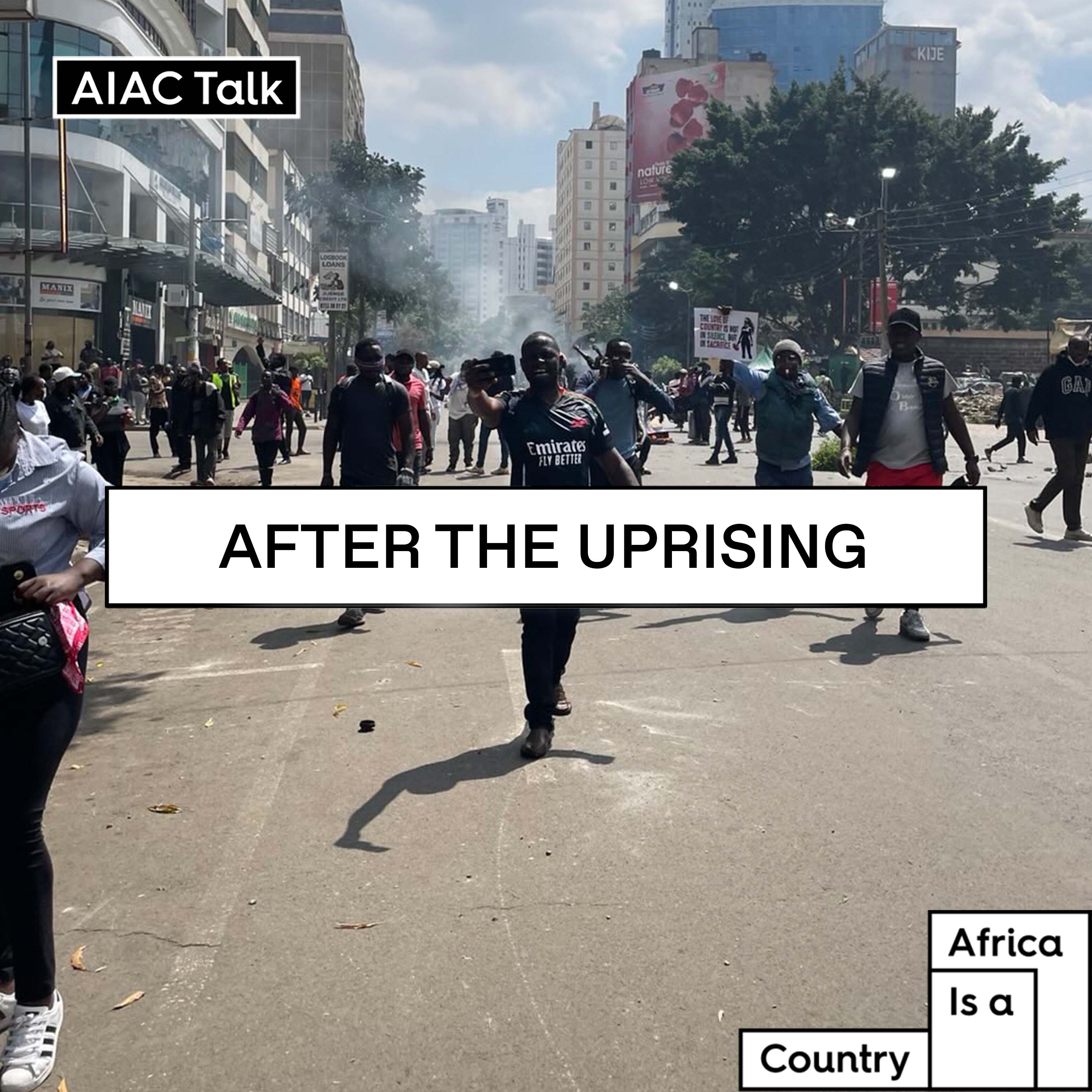
Hello and welcome back to the Africa Is a Country Podcast. My name is William Shorkey and you are listening to this, which is AIAC's not so regular destination for analysis on politics and culture and happening on the continent and on the globe from a Pan African and left perspective. Look, I will admit it that I've been scarce on here, but I'm trying to do better. My excuse for the last four months is that I've recently had a baby. My excuse for the months before that, I am still working on it, but it's besides the point. I'm here now and I'm excited to try my best to do these podcasts regularly. And I'm very excited for the conversation that we're going to be having today. It was spurred on by the recent visit of the AIAC team to Nairobi for our inaugural Festival of Ideas, which happened during a politically explosive time for the country. If you've been paying attention and been reading our website, you would know that over the past two years, Kenya has witnessed an unprecedented wave of popular protest. Sparked by the finance bull and fueled by years of economic hardship, elite impunity and the erosion of constitutional promise. These protests have captured the imagination of a generation and they've shaken the country's political class. But the movement has posed powerful questions and even still there remains the matter of answers. What comes next? How do we sustain this moment? Who's building a politics for the long term? These are questions that people were asking while we were in Nairobi. And one of those people is Sungu Oyo, who is a Kenyan writer, activist and community organizer and the national spokesperson of Kongamano Lama Pinduzi, a socialist political movement and a founding member of the Kenya Left Alliance. Sungu is also a candidate in the 2027 Kenya presidential elections. Yes, you heard that right. He's coming for Ruto's job. Grounded in movement experience and committed to anti capitalist Pan African and feminist politics, Sungu represents an emerging force in Kenyan public life, one that refuses elite brokerage and insists on a different future. In our conversation we talk about his political journey, the meaning of the protests, the failure of Kenya's post2010 democratic settlement, and the challenges and possibilities of electoral organizing from the left not only in Kenya, but lessons for us to learn internationally as well. We also discussed the Kenya Left Alliance's platform from land reform to food sovereignty, and its broader efforts to build a durable, mass based alternative to Kenya's ethnocapitalist status quo. So I hope you enjoy our conversation. A reminder to subscribe to the AIAC podcast. Wherever you listen to your podcasts, whether it's Spotify, Apple, et cetera, et cetera, the best place to listen is of course, the website. And most importantly, keep up with Africa as a country for the latest in analysis of politics culture from a Pan African and left perspective. So without further ado, here's my conversation with Sungu. Enjoy. So, Sungu, thank you very much for coming onto the AIAC podcast. It's a pleasure to have you.
- [03:36]
B
Thank you. Thank you. Thank you, William. It's been long overdue and I know we've really tried to arrange for this conversation and I'm glad that it's finally happening.
- [03:48]
A
Me too. I feel incredibly honored to be speaking to a candidate for the 2027 Kenya presidential elections. And I want to get into why you decided to run. But before I do that, I think it's important just to ground our conversation for you to tell us who exactly you are. You know, you have, alongside some other figures, emerged as the face of a new kind of politics in Kenya. One that is grounded in movement experience, anti capitalist political commitments and refusal of elite brokerage and co optation. But you as an individual were active long before the finance protests. So I'm interested to finding out who is Sungu and how did you come to the position that you are in now?
- [04:40]
B
My name is Sungwa Yo. I'm a Kenyan writer, an activist and community organizer, and by extension a Pan Africanist. I'm a member of mwamco, the Pan African Popular Pedagogy Collective which I co founded with other comrades a few years ago. But I think more relevant to this discussion, I'm a member of Kongamano Lamapinduzi, which translates to Congress of the Revolution. It's a political movement here in Kenya and I currently serve at Kongamano Lamapinduzi as its national spokesperson. Kongamano itself was a culmination or a renewal of. It was backed out of our experiences in organizing from within the student movement and the social movements because at some point we did our analysis and realized that a lot of the problems we were experiencing in our communities were actually political and they needed political solutions. And that is why that is how we embarked on a process to birth which is today part of the Kenya Left alliance, which is now the broader coalition bringing together all progressive forces. But apart from that, like ComradeShoki mentioned, I'm also running for President in the 2027 elections. Thank you.
- [06:06]
A
And could you tell us about what politicized you? How did you come to get involved in organizing and left politics in. In Kenya.
- [06:19]
B
I think I got politicized as a student from within the student movement. Though at that time, our organizing was mostly around our immediate issues and immediate concerns within the. What I would call the geography of the school. But then after school, when I got immersed within the social movements and got to better understand society, Kenyan society in particular, and the structures in this society, and how people are not necessarily, for example, poor because they are not working hard, but because the way the system was designed was such that, that is, the system was meant to keep them there. I then got more politicized and met up with some comrades who introduced me to left politics. I think I went through a period of great confusion trying to figure out, like, at a higher level, at an ideological level, how do we arrive at a solution to some of these challenges that we can see, some of these problems we see in society. But what made most sense for me was the circles within the left and the proposals they were putting forward. So I think that's the shot of it, of how I got politicized and got into. Into left politics.
- [07:43]
A
And do you think for you, obviously, comparing 2024 and 2025, which was a moment of political awakening for many young Kenyans, that comes out of a very specific event in 2024? Of course, it was Ruto's failed attempt to pass the full finance bill. And the reaction that that provoked. Was there similarly an event that was a Damascene awakening for you, a kind of aha, moment where in the midst of all of your great political confusions, which we've all been through, was sort of a moment when everything fell into place and you felt like you could understand Kenyan politics and the broader structures that produce the conditions that people find themselves in? Or was it much more of a slow burn, a kind of journey where you are finding yourself accumulating experience, reflecting on those experiences, and then coming to political conclusions about them?
- [08:49]
B
I think it would be both. It would be both in the sense that there was a prolonged period of learning and getting to understand society. But then there are also particular moments in time that will particular significance. So, for example, in 2013, I was part of a movement called Kenyans for Tax justice, and it was basically making the same demands that today's youth are making or have been making since 2024. It was advocating for progressive tax policies, exemption of basic commodities from tax. And we were able to push back against the system for a while and link up with other organized groups, for example, unga, revolution, conduct political Education in different settlements across Nairobi, and force Parliament to. There was a bill before Parliament at the time, the Value Added tax bill of 2013. So it would have imposed taxes on bread, milk, sugar, while disability, mobility, aids, and a lot of basic commodities, including books. And we were able to push back. And then in my mind, I thought we had won. And so I went back and relaxed and back to my normal life. But the following year, Parliament passed the same bill again. That's when I realized that our struggle is a continuous struggle. And even in those moments where we get concessions from structures of power and systems of power, we have to keep pushing so as to not only safeguard those concepts, concessions, but also arrive at a position of even greater wins, that we have to be eternally vigilant and that organizing is an eternal process.
- [10:39]
A
And what, after that experience sort of grabbed you in a way to say you want to devote your time and energy into continued organizing? Because I think one thing I could maybe ask you to do is to maybe set the scene for us a little bit. Because if I'm thinking about 2013, it's three years after the adoption of a new constitution in 2010. And the adoption of this new constitution was supposed to produce this political paradigm of accountable governance and more power and agency to Kenyan citizens, especially after the, you know, after the year, the many kind of decades before, where political regimes were not characterized by that sort of democratic spirit of openness, at least on paper. And so would it be, you know, would it be fair to say that, you know, this was a kind of optimistic time in Kenya's political history in the sense that, you know, of course, there's obviously, yeah, you know, the period leading up to 2010, 22007 was the election violence, 2010, the new constitution. And then there was a sense that a new. A new republic of sorts was being. Was being drawn. Would you say that was an optimistic time in Kenyan political history? And did you then kind of experience a dissonance between what the official narrative was and what your experience was like on the ground in actual organizing?
- [12:22]
B
I think it was. It probably was one of the most optimistic times in Kenya's history, because the struggle for a new constitution had been ongoing for decades. And for us to reach at a point where really progressive clauses and laws had been passed as part of the constitution, guaranteeing, for example, the most basic of the right to food, the right to housing, the right to water, a really stronger bill of rights, and like, independent commissions and constitutional commissions that were supposed to act as checks and balances to the excesses of the regime. A lot of Kenyans were optimistic, but one of the most unfortunate things, like Kenya's former Chief Justice, William Mutungu always says, we backed a new constitution. We backed a baby, then gave it to child traffickers to raise it. And so a lot of the politicians were not really interested in the progressive provisions within the constitution. Kenya's president today, William Ruto, who swore to uphold the constitution, was the leader of the NO Brigade, the team that campaigned saying this was a backward constitution and who were trying to argue that we should maintain the old constitution. Constitution. Which is why up to date or in the years preceding, in the years following 2010, we then see a systematic erosion by the political elite in this country of the constitution, trying to water it down through acts of Parliament, which are of course illegal, outrightly disobeying it, and doing everything to subvert this very constitution, because they have never really been interested in its full implementation. And so 2010 was one of those really great moments in history. But I think that within a few years, most Kenyans could already see that this is not really what we thought it would be. And for me, I think what really came to mind, or what hit me was the fact that struggle is a protracted process. It is not an electric switch that you just turn on and the lights come on. We won the struggle. And so realizing that this would have to be a protracted struggle, struggle, yes, we have this document, but its implementation would be another thing. It's one of the things that got me more immersed in the struggle.
- [14:50]
A
I like what you said there about, you know, struggle being this protracted fight. And it's not the flick of a switch coming to talking about the current conjuncture in Kenya. I think a lot of people look at the protests of last year and they read them as emerging seemingly out of nowhere. Could you trouble maybe that understanding, do you think? What do you think? The protests of last year that carried over into this year, what does that tell us about the failure of post 2010s Kenyan democracy? And where were the signs that such a massive explosion of discontent were brewing that people like yourself, I'm sure, were paying attention to, but that might have escaped the detection of onlookers from the outside like myself and even Kenya's political elite?
- [15:49]
B
I think the starting point is to look at what exactly Kenya is. Kenya started off as a business through the imperial British East African Company, and in many ways it has remained a business. The Kenyan state neither sees nor listens to majority of its citizens. And Kenya is a neocolonial state, as I'm sure you know. And the neocolonial state is created in the image of the colonial state. It every day subjects our people to poverty, to humiliation, to death, whether it's death through police bullets, or death because of poor healthcare, or death because of lapses in different segments of the system. And so it really is a system which a lot of times people say the system is not working, but the system is working perfectly. It's working as it was designed to work. It's just that it wasn't designed to work for the people. And so post 2010, or rather even after national independence in 16, there's a lot of questions that remained unresolved from the land question, questions around even just national identity and national cohesion and all these things. But post 2010, there was a short period where things seemed to be working. And then after 2013, a period where the economy slowly but gradually took a nose dive. And so you have a lot of unemployed youth, you have erosion of public institutions, and by 2022, the youth unemployment rate was already at 67%. And when you have such a huge youth unemployment rate and there's no solutions, the only solution that politicians could offer was political rhetoric. We will do this, we will do this, we will do this. But there was nothing concrete. The levels of homelessness in Nairobi had shot through the roof and they gradually kept increasing. The cost of essential commodities kept rising over the past decade. And yes, which is why even in the last election, William Ruto rode to power on the. On the backs of the working class. He wrote upon a working class narrative saying, kazi nikazi, work is work opportunities for young people. He wrote on the hustler narrative, so called hustler narrative, and he was able to deceive enough people. But come by 2023, we see an increase in the cost of university education. I think university education went up by four times in the public universities. They multiplied it by four because the government said it can no longer pay for this education. There was in 2024, large scale demolitions of people's settlements across Nairobi. At least 400,000 to half a million people are rendered homeless in a span of a few months because the government said, you've settled around the rivers, you need to protect the rivers. But the people didn't settle around the rivers because they like living. They settled around the rivers because the state had failed to provide them with housing and they had built their settlements here. So suddenly there's this explosion of homeless Kenyans Especially in Nairobi and other big towns, the youth unemployment rate is high. There's discontentment in the public universities, the healthcare system is not working. And so it was a confluence of very many things. And when in 2024, when the finance deal was introduced in the public domain and even in public discourse, Kenyans said, reject the finance, the Kenyan state came back to the people and said, no, don't reject. They said, no, they said, amend, don't reject. But the people insisted, reject it. Because if you. This bill, we already have a tax and it's seeking to increase taxes, seeking to exempt the rich from taxes, for example, exempting helicopter spare parts and whatnot. They said, if you pass this bill, we will die as a people. And when the state refused to listen their calls to reject the finance, they said, which was a strategic escalation in saying Ruto must go. One thing that must also be made clear, people are not just talking about Kenyan youth, are not just talking about Ruto the individual. They were talking about Ruto the individual and all the institutions that surround him and that enable this economic violence against them. This is why for the first time in a very long period at the protest, there are demands around the imf, demands around the World bank and the debt situation in Kenya, the government is in a debt crisis. There were demands around police brutality. But Ruto must go was the rallying call which unified all these demands. And so I think, and you know, the protest against the finance bill and the budget have been happening every year for the past few years, but they were smaller enough. But this in 2024, there was so much public anger and discontentment that anyone who had studied the political landscape in Kenya over period of years would see that this was going to extreme upload into something bigger, which I think is where we still are. Because this year. Oh, no.
- [21:49]
A
So I've resumed the recording. Sorry about that. I think you were, you were saying something about, about just so we can pick it up. You're talking about the transition from these process happening over the last couple of years being small in number, and then 2024 being the moment when they finally exploded. And explain, you're explaining how that happened.
- [22:11]
B
Yes, basically in 2024. One of the reasons why they exploded was because like I mentioned, there already was this high level of disillusionment. Houses had been demolished. University students were not content with the fee increase. They were protesting against it. The unemployment rate had shot over the roof and the government still appeared and told and told Kenyans that it was going to increase taxes on Basic commodities. And I think for a lot of people it was a slap on the face, especially since during the 2022 elections, this regime had had anchored its campaign on the promise that it was going to stick with working class people and make their lives bearable. So most of those who came to the street actually are people who voted for this regime less than two years before that. Yeah.
- [23:16]
A
I mean, I want to, I want to talk about, about the protest themselves, but I'm curious to hear, you know, your kind of theoretical sort of view on how it's happened that Kenya, as you've described since post independence, has never really had a substantive national economic vision. Right. Whether it's, you know, Harambe or NyanYo or Vision 2030 or Ruto's Green Growth, you know, no Kenyan regime has really tried to attempt radical, a radical economic imagining. If anything, the Kenyan state has long been associated as the one corner of East Africa that would always be, as you said, you know, quote unquote, open for business. And the country's post colonial elites have consistently prioritized foreign investment and external validation over its own economic sovereignty. And so I'm curious as to how has this been sort of the, the kind of underlying logic of Kenyan political economy? How come successive regimes and governments have always sort of looked outward rather than looking to care for and support their own people? You know, what is, you know, it strikes me as an untenable situation, as one which surely at some point elites who, if we believe that they are self interested, must surely see that this is a powder keg that is going to explode. So I'm curious to hear, you know, what, what has been the, the basis of the stability of the system and how come it is, you've, you've already started to answer it, but what is it about this moment in Kenya's political history and I suppose this, this sort of generational dynamic that is at play that has meant that the, the legitimacy and the stability of the system is starting to, to come apart.
- [25:37]
B
I think like you, that's a really important question. I think like you mentioned, the state really has not acted in the interests of the Kenyan people. The Kenyan state over the past 60 years, and like I mentioned earlier, it is a new colonial state and it is created in the image of the colonial state. Our war for national liberation was led by the Kenya Land and Freedom army, the MAU MAU, the Kenya Land and Freedom army, like their name says, basically fighting for two things, land and freedom. What we got instead in 1963 was independence. The MAU MAU had been fighting for land and freedom because this was a settler colonial state and the land had been taken from the people through the barrel of a gun. In 19, during the independence negotiations at Lancaster House, of course, where the MAU MAU were not invited, its moderates from the political parties, the dominant political parties who were invited, and a few radicals who were among their ranks. But during the Lancaster negotiations, one of the things decisions that was arrived at was, for example, for Kenya to buy back the land, the new state to buy back the land from departing British settlers, settlers who had taken the land from the indigenous people through the barrel of a gun. And so they started a scheme called the Million Acre Scheme, through which this new regime would buy back a million acres of land from these departing settlers. And the new state took a loan of £2 million from West Germany, the government of Great Britain and the World bank from those three entities. Together they put together 2 million pounds for Kenya to buy back this million acres of land and resettle those who've been dispossessed. And Kenya only finished paying back this debt, I think, in the 80s, because £2 million in the early 60s was quite a lot of money. And this is resources that could have gone to processes of social development. What is even more unfortunate, however, is that once this land was purchased by the newly independent state, majority of it ended up in the hands of the ruling class and their elite. And so a lot of those who'd been dispossessed were never dispossessed, which is why Nairobi's urban settlements, I see they like calling them informal settlements, but really cannot call them informal settlements, because that is to imply that the people living there are themselves informal in one way or the other. Human beings cannot be informal. So we'll just call them settlements. And so most of those who live in Nairobi settlements actually descendants of the freedom fighters, those who are dispossessed in the colonial era and who went to the forests to fight the colonial machinery. And so we can then already see the basis on which post independence, Kenya is established. It's established on the logic of dispossession. It's established on the logic of poverty for the majority. Which is why by 1975, a politician called Jim Karaoke described Kenya as a land of 10 millionaires and 10 million beggars. And today we can expand that and say maybe it's a land of 50 billionaires and 50 million beggars. Because a greater majority of Kenyans live hand to mouth. Over 80% of Nairobi's population lives on 6% of its total land loss. They are crowded in this settlement, while there's a small portion of Nairobi where people are able to live comfortably and live more dignified lifestyles. And so at 63, when Kenyatta was taking over power, he said he was fighting disease, ignorance and poverty. Marathi Ujinga Maskini he said, these are the three things that the state will fight in the last election of 60 years after independence. If you look at the manifestos of the major political parties, they are still saying they will fight disease, ignorance and poverty. And then you can see that in terms of the material conditions of the people, nothing much has changed for 60 years. It's the same thing that was said that the independent speech is what is still being promised in an election 60 years later. And so I think, for me, a lot of things have happened in between. But at a fundamental level, the land has remained in the hands of foreign concerns and foreign corporations. The Nairobi Stock Exchange is still likely in the hands of British companies and European companies. Mining concerns are in the hands of foreign companies. The fishing rights at the coast are not in the hands of local enterprises, and so on and so forth. And over the past few years, there's also been a renewal and an increasing of privatization of public entities. And so what happened last year, in my opinion, is that there was a leap in the collective consciousness, because at an instinctive level, people know that they are oppressed, that something is wrong. But people to arrive at a rational understanding of how this oppression is happening, the institutions involved, and to see that there is a local class, a comprador class, which is acting on behalf of the interests of its masters who live across the ocean in Europe, mostly in Europe and America. And then. And they could now clearly make these linkages and craft demands around them. I'm not sure if I answered your question, but I hope I did.
- [31:43]
A
No, that's a brilliant answer. Thank you for that. And I think it gives us a nice segue to coming back to the present and talking about this moment of heightened collective consciousness that you're describing. Obviously, there's been an explosion of protests for the last two years, and I suppose the place where Kenyans are at now is wondering what next? And so before we talk about what you're going to be doing to try and help change the status quo, I'm curious to hear this leap in collective consciousness that you're describing. Obviously, we can't paint it with one clean brush and reality is messy. But you were talking earlier about how there's been a crystallization of demands which even though Ruto must go remains the flagship rallying cry that people have started to talk about bread and butter issues such as housing, health care, police brutality, etc. Does that have an anti capitalist character yet? Or not quite. Or how would you, how would you, how would you sort of characterize in two things. One, the, the orientation of the people who have participated in these protests and two, their class character. Because, you know, I think, and I, I was guilty of this myself where when one looks at this, you know, in the international press, it's, it's sort of reduced to being a quote, unquote, Gen Z revolt. And some of the descriptions of this is that this Gen Z revolt is very media savvy. It comprises of people who know how to brand protest well and deploy hashtags effectively on social media. And so, you know, looking at it from afar, what I will admit, you know, until I was actually in Nairobi, is that I saw it through the lens of other sorts of Gen Z or youth uprisings that have taken place not only across the continent, but internationally as well. And so my sort of archetypical read of the situation in my mind was that this was primarily comprised of, you know, downwardly mobile university educated students or youth and young professionals who main complaint was sort of a feeling of, of exclusion from the economy. When the sorts of propaganda that you are raised into when you go through the educational system, when you're lucky enough to go to the educational system, is that your education is a ticket to your upward mobility as a member of the middle class. And so I, I sort of read this as having a kind of middle class inflection primarily. And of course it was consults there that I saw that this was not the case. So could you maybe kind of talk us through some of these dynamics that have been at play at these, at these protests? You know, how would you summarize their orientation at this juncture and how would you capture their class character and their demographic character?
- [35:15]
B
I think one of the things I have to say is that the majority of those on the street were Gen Z. However, both last year and this year, however, that was not the only generation on the street. There was the millennials and Gen Z. One area where I have to give them credit is that this generation is so good at doing mobilization and their mobilization was able to bring even people who do not necessarily usually come out to the streets because they were able to paint these economic issues as affecting everyone. Because for a long time we've only had people from the Social movements and other organized groups coming out onto the street. But they were able to bring even their parents onto the street. And so I have to give them credit there. However, at the same time I must say that there was an attempt, especially by the state and even the media to kind of create this division among those attending the protests by characterizing the protests around a particular age set. Because at the end of the day, Gen Z is not a political category, it is an age category. But then they try to. There was a very deliberate attempt to frame everything around Gen Z. Having said that, I must still repeat what I said earlier, that their contribution was immense and the new strategies and tactics that they were able to bring to the larger progressive circles in terms of how we organize, how we mobilize really need recognition and must be recognized. In terms of the class character of those at the protests, there was a lot of what you'd call the oppressed, those who excluded from economic systems and patterns of economics. There was also surprisingly, the middle class, who for a long time have not been search of these processes in such large numbers. But it was because the middle class also realized how precarious its position was. I don't think its position has been this precarious in such a long time. And so it was a matter of also survival for them. Because when you get into a situation where you are maybe one paycheck away from poverty, then you can't really claim to be living a life that is secure. And most Kenyans, because of even failures in the healthcare system, for example, are just. Most Kenyan families are just one illness from poverty. If one person in the family gets, let's say, cancer, they have to sell everything, the house and everything to pay for this treatment. And so I think the middle class, which is why I spoke about that rise in the collective consciousness when they did an analysis of their situation, they realized that they too had to be part of this process of fighting for a better Kenya. But the vast majority of those on the street were the unemployed youth. The vast majority of those on the street were people from working class neighborhoods and poor neighborhoods, neglected neighborhoods in Nairobi and other parts of the country. And they were out on the street because of the reality of their material conditions. Housing is poor or non existent, food prices were rising, they were not employed. Youth unemployment, like I mentioned earlier, still is at over 60% and that's untenable without any form of social relief provided to this huge group of young people. And so they were basically trying to struggling for the creation of new ones, ones of Love, worlds of joy, worlds of laughter, and most importantly, worlds of dignity. The system had basically deprived them of everything, including joy. And so, which is why we then see a realignment within the ruling class. Because when the ruling class realized that there was a force from below which was organizing and mobilizing, it came together overnight. We see the political opposition, led by Raila Odinga, joining the government of William Ruto, and key opposition leaders getting ministerial appointments because the ruling class realized that their collective class interests were threatened by these demonstrations. And which is why I think the opposition basically engaged in a huge betrayal of the people's fought march into history. And basically what they did can be viewed as them dancing on the graves of those who are martyred by the state.
- [40:33]
A
So where does that leave this movement? Organizationally? There's obviously been this leap in collective consciousness that you've described, this explosion in popular energy, this desire and readiness to mobilize, and this effectiveness at mobilization. But now coming to the question of how do you give that enthusiasm, sustained expression, pivoting to talking about the Kenyan Left Alliance, The Kenya Left alliance is stitched in this moment of ferment. And as you said earlier, it's this coalition of various progressive groups. Now I want to know what is the Kenya Left's alliance strategic proposition and orientation to this moment? You know, beyond thinking about 2027 as elections that you will protest, beyond saying no to austerity, beyond saying no to corruption, beyond saying no to elite, capture what is being offered affirmatively. I loved your description about, you know, worlds of dignity, worlds of joy, et cetera. But what is the offer to the Kenyan people that you see as necessary in this moment?
- [41:53]
B
Thank you. I think at the most fundamental level, the Kenya Left alliance is anti capitalist, anti imperialist, it is feminist and it is Pan African in terms of its worldview and even organizing, and in terms of how it engages in solidarity actions and other organizing on the ground. 2027 for me is just a moment. The Kenya Left alliance comes out of the realization that, yes, there's all these progressive organizations, but individually, all of them, I would use, let me use the word small. All of them are quite small, not big enough to shake the system at a fundamental level. But when they come together and the people join them, for example, on the street, the system shifts, which then necessitated this need to have a wider umbrella which could bring together all progressive organizations around a minimum program. Because at the end of the day, we have to recognize that oppressed people have never won without organization. And so we can have protests, we can have a few spontaneous actions, but without organization and a long term strategy on how, for example, in the Kenyan instance to capture political power or to gain fundamental changes, to create fundamental changes in society, then it is almost impossible to do that. Which is why the Kenya Left alliance was formed. And then it's in its. What these progressive organizations were able to agree on, as outlined in the draft minimum program of the Kenya Left alliance, which is the unifying document, is that one we have to solve immediate social and economic issues. Whether it's questions around opportunities for young people and for all Kenyans, which means tackling unemployment. Whether it's questions around how we deal with the housing crisis in this country, Whether it's questions around food sovereignty. Because you remember, you know, right now in Kenya it's illegal for us to even share seeds because companies like Monsanto have convinced the government to pass bills in Parliament outlawing indigenous seats and outlawing the sharing of indigenous seeds. And so we really are at a precarious situation, which is why our unit is predicated around this most basic needs in society. But at a higher level, there's also the questions around sovereignty. You know, Kenya hosts I think three or four around three foreign military bases. The Americans are here, the British are here, there is the debt question. And so there's a series of questions which Kenyans think are really important to them. The land question putting a cap on the higher side. Because the Kenyan Constitution, Article 68 of the Kenyan constitution mandates Parliament to set a land ceiling, a ceiling above which people cannot own a certain amount of land. But Parliament has refused to pass that legislation for the past 10 years. Because if you're able to set that land ceiling and resolve the national land question through a process of land reform, you can then solve questions around housing, you can resolve questions around food production, you can resolve many other questions in this country. And so I think for us at the most fundamental level, the starting point is working towards dignity of the Kenyan people. And so focusing on education, focusing on health care, focusing on housing, provision of basic things like clean drinking water. Imagine in a country like Kenya, 60 years after independence, people are still dying from malaria. Hospital, public hospitals, almost non functioning. And so I think the starting point is not even the big things, but the most immediate and material needs of the people. Before we go, we even address the questions around sovereignty. And so that is the orientation of the Kenyan left. And we and the Kenya Left alliance continues to organize, continues to every other day other progressive groups are joining it and strengthening it. And we think that by 2027. We should be in a formidable position to contest for political power under the three key questions outlined in its log and which is land, food and freedom?
- [46:51]
A
Some people might say, especially on the left, but just generally in society, especially in moments when the political system has lost its legitimacy, they might be skeptical of elections. They might say, say that participating in elections legitimizes a rigged system, or that you risk losing movements to the ballot box. You know, what is your response to people who might say something like that, who say, nothing good comes from elections, so why invest all this energy and effort into them when we could be organizing?
- [47:24]
B
I don't think they are completely wrong, because I think engaging in elections depends on the analysis we do and the tactics we deploy to arrive at our strategic goals. At a strategic level, we are working towards creating a more dignified society. And in our context, we view elections as a tactic, as one of the pathways through which we can get there. But we also recognize the limitations of electoral power processes. Kenya, as a country, at this particular moment in time, if you look at the big political parties, the dominant political parties, we would not be wrong to say that Kenya does not have political leaders, but that it instead has ethnic warlocks who use the people as bargaining chips to protect their interests. And so how do we create a new kind of politics where we can organize ourselves around ideas and through which we can try and test some of our ideas in real time? Yes, we are organizing, but there's, for example, municipalities where progressive forces can take control and enable some minimal gains for the people. And I recognize that that's not enough, but it is a starting point because we live in a country where there's municipalities where people do not have drinking water. This is not a question. You tell people to wait 10 years to be resolved, that when we win the revolution, you will have drinking water that can kill you in two weeks. So I think, for me, when I look at what we are trying to do at this particular moment, moment in history, we do not need to look at it in isolation. In the last Kenyan election, in the 2022 election, we had around 20 million registered voters, slightly more than 20. William Ruto won the elections with 6 million, maybe 6, 6.2. I'm not sure of the exact figure. And he defeated Rail Odinga by less than 200,000 votes. So the top two candidates had slightly over 6 million votes each. Those who did not vote were over 8 million registered voters who never showed up to vote were over 8 million. These registered voters. You have to recognize that in preceding elections, before 2022, Kenya's election turnout is always very high. It has in some instances gone to 80% or 70 something percent. But in this election the turnout went low. And those who did not vote, did not vote because they do not believe in, how do you call it? Because they did not want to vote. But them not voting was in itself a statement they were making that they knew that the electoral system was rigged and that even this multi party dispensation did not necessarily, would not necessarily relate to democratic outcomes. And they were able to make a statement, a strong one on their own by not voting. Within the Kenya Left Alliance. As we approach the elections, we are trying to look at how do we, we organize or mobilize those who did not vote. How do we even beyond that get those who voted for the dominant political parties to vote for a progressive agenda? Because in our minds we feel that and in our analysis, based on our analysis that at this particular moment in Kenya not participating elections would be a fundamental mistake. Stake in the 80s the organizers from the underground movements like and others did their analysis and chose not to participate in the elections, especially the 1992 elections and other elections, then loaned their best organizers to other political parties, other political formations. But then their organizers were unable to create fundamental changes, change because they were going into these formations as individuals, not as organized fronts, not as organizations. Because the organizations had said as an organization we are not participating but individuals are free to contest through this range of parties. And so for us we think that we have to come together, have our own political instrument and use that political instrument to not only engage in the elections, but at least get some fundamental, create some basic change in, in communities. But the most important thing, thing in that is that the elections are only a tactic. They are not the strategy.
- [52:36]
A
And what is your, what is your strategy for approaching, you know, a recurring question in public debates, especially when one belongs to political formation that is proposing bold social and economic reforms is you know, how will you pay for it? Right? And in Kenya this question arises in a context where public debt is high, the tax base is narrow and ordinary citizens already face a heavy burden through consumption taxes. And we see throughout the world how, if anyone even dares to talk about expanding access to social services, there's already this knee jerk reaction from all social classes that the spell some kind of imminent increase in taxation for the ordinary person or its fiscal irresponsible policy or whatever the case might be. And the bigger, the bigger risk of course is that, you know, capital is going to fight tooth and Nail to ensure that these policies aren't implemented and so will threaten to withdraw investments, will threaten to, etc. Etc. So I mean, obviously thinking about how, thinking about the coming period when you know there will be this moment of heightened political debates and discourse as you're describing, you know, how, how are you guys preparing yourselves to face these questions? How do you answer the person who asks you, you know who, as you've describing, who's disengaged from the political system, who has low levels of trust in political leaders and who hears what to some people might sound like very grand proposals because people are no longer used to receiving, you know, the bare minimum from the state and who might ask earnestly from you, well, how are you guys going to pay for it? It sounds all well and good, but if the state can't provide basic services to me now, what makes you guys convinced that you'll be able to, to do so? Were you in power?
- [54:49]
B
The state is not, it is not that the state is unable to provide these services because there's no resources. The situation is that the state is unable to provide basic services because it is unwilling to do so and because it has created public, it has turned public projects into pathways for theft of public resources. So for example, the Office of the Auditor General, which is an independent government institution which audits governments spending, a few years ago they said every year 2 billion Kenya shillings is lost to, to corruption every day. And that's around 2 billion Kenya shillings. That's around $2 million. They say on a daily basis. That's money that just disappears around $2 million, which is 2 billion Kenya shillings. And this is from a government department. And when the then President Uhuru was asked about it, I think by a journalist, he said, what do you want me to do? So the money is there. And I think one of the starting points is just to stop the theft because I, I don't know how much $2 billion on a daily basis is at the end of the year, but I think it's quite a lot of money and that it can, it can really improve a few things. So I think there's a few practical steps even before, like changing the nature of the economy at a fundamental level, just stopping the theft of this public resources. Of course there's also the cartels ingrained within the system and the bureaucracy which would push back. But that is a story for another day. But in addition to that, to this money that just disappears. There is excessive wastage, excessive wastage in Kenya's especially public service for Example right now the President went on some foreign visit somewhere. He went through Addis and then is going to, I think to the US to America. And he had a private jet which costs around 60, slightly more than $30,000 an hour. No, he's gone there for a number of days. So for every hour that he'll be out of the country taxpayers are paying $30,000 just for the jet. And then there's other cost. Mind you there is a presidential plan in this country. So I think even before we talk about if we are just able to reduce the, the theft of public resources and the wastage which happens glaringly like we can, we can already have a little saving on which to do some of the immediate things because things like water, healthcare, they don't really cost. You know they are made to look like they, they're going to cost an arm and a leg but they're not that expensive. And our people are asking for the most basic of things. They're asking for education, healthcare, water. They're not asking to go for holiday in the Bahamas. Yeah. No one has gone to the government and said I'm demanding a plane ticket take me to the Bahamas.
- [58:20]
A
One day. One day when we have, when we have full C. That'll be a possibility.
- [58:26]
B
Maybe one day it will be a possibility. We love to go and explain extent but African solidarity to our brothers and sisters.
- [58:34]
A
Exactly.
- [58:38]
B
But that's all I had to say on that.
- [58:43]
A
Thank you for that. I mean to thinking now towards, towards coming to conclusion. This has been really great. Thank you for, for sharing the time with us. I'm interested in hearing then from your perspective what success will look like. So 2010, 2027 happens and it's obviously a first time electoral run for the Kenya Left Alliance. 1. You know what, what is your greatest ambition is, is the hope that you, you're contesting every seat as as far as I'm aware is the hope that you will amass as many seats as possible. Have you set your targets at something else and you know if, if the Kenya Left alliance doesn't win a majority then what does, what does success look like and how do you measure impact in terms of shifting public discourse or building new institutions or expanding base building or broadening the political imagination as you were saying earlier, what is, what is the most important metric of success for. For the kla?
- [59:50]
B
I think we will be contesting every seat from President to NCA which is like councillor, the member of county Assembly. At a personal level. I will be contesting for the presidency under the banner of the Kenya Left Alliance. And I think one of the first things we have to do, one of the primary objectives, is to engage in a new type of politics, which is actually not even new. It's just a type of politics which was there and still is there in some parts of the world, but which has been relegated because politics in a place like Kenya has become so monetized, such that if you do not have money and resources, you cannot really compete on that realm. And so how do we again reintroduce ideas? You know, in the Arusha declaration, Nyerere said that when he asked some of his ministers about how to solve some of the most pressing social questions, they said, we need more money. And he said. And he said, but we are a poor country. A poor person does not use money as a weapon. And if we have chosen money to be our weapon, then we have chosen the wrong weapon for our staff. And so we will have to engage in this electoral process by anchoring it around a set of progressive ideas and making sure that this is more than just a political contest. That one, it is a process through which we consolidate the forces of the left. Second, it is a process through which we deepen political education, which the different progressive organizations have been doing. And third, that it is a process through which we are able to test our ideas while also testing our strength as the progressive forces in Kenya. And so, for me, I think that all in all, this will be a very defining moment for the Kenyan left. And our objective is to win the electoral process. But even if that were not to happen, then to prefiguratively be able to show examples of what can be done in the municipalities and counties or institutions that the Kenya left would be able to control and to show society that it is actually possible. Because we are currently engaged in a type of politics which makes it look like rocket science, like it's nuclear science, like just getting medicine for malaria is nuclear science. I think we also have to have this kind of liberated territories where we can set these prefigurative examples which even force other people in other areas to start creating and making and amplifying new sets of demands that speak to the times.
- [62:50]
A
Amen.
- [62:52]
B
Thank you very much.
- [62:53]
A
Amen. Thank you for, for coming onto this podcast, for joining me in conversation. I've been chatting with Sungu Oyo, who is a Kenyan activist who has a very long standing record of devoted commitments to people struggles and who will be contesting the 2027 Kenyan presidential elections for the seat of President. He's coming for Ruto's job under the banner of the Kenyan Left Alliance. It was a pleasure to talk to you, Soongu.
- [63:27]
B
It was a pleasure to be on the podcast Shoki, and hopefully we have chance for another conversation in the future.
- [63:35]
A
Absolutely. This is only the beginning. And to you, our listeners as well, this is a reminder to subscribe to the Air AC podcast wherever you listen to your podcasts. And stay tuned for more conversations on African and global politics and culture from a left perspective. Until next time, I'm William Shorke.
- [63:56]
B
Goodbye, people.