← GovDiscovery AI Podcast with Mike Shanley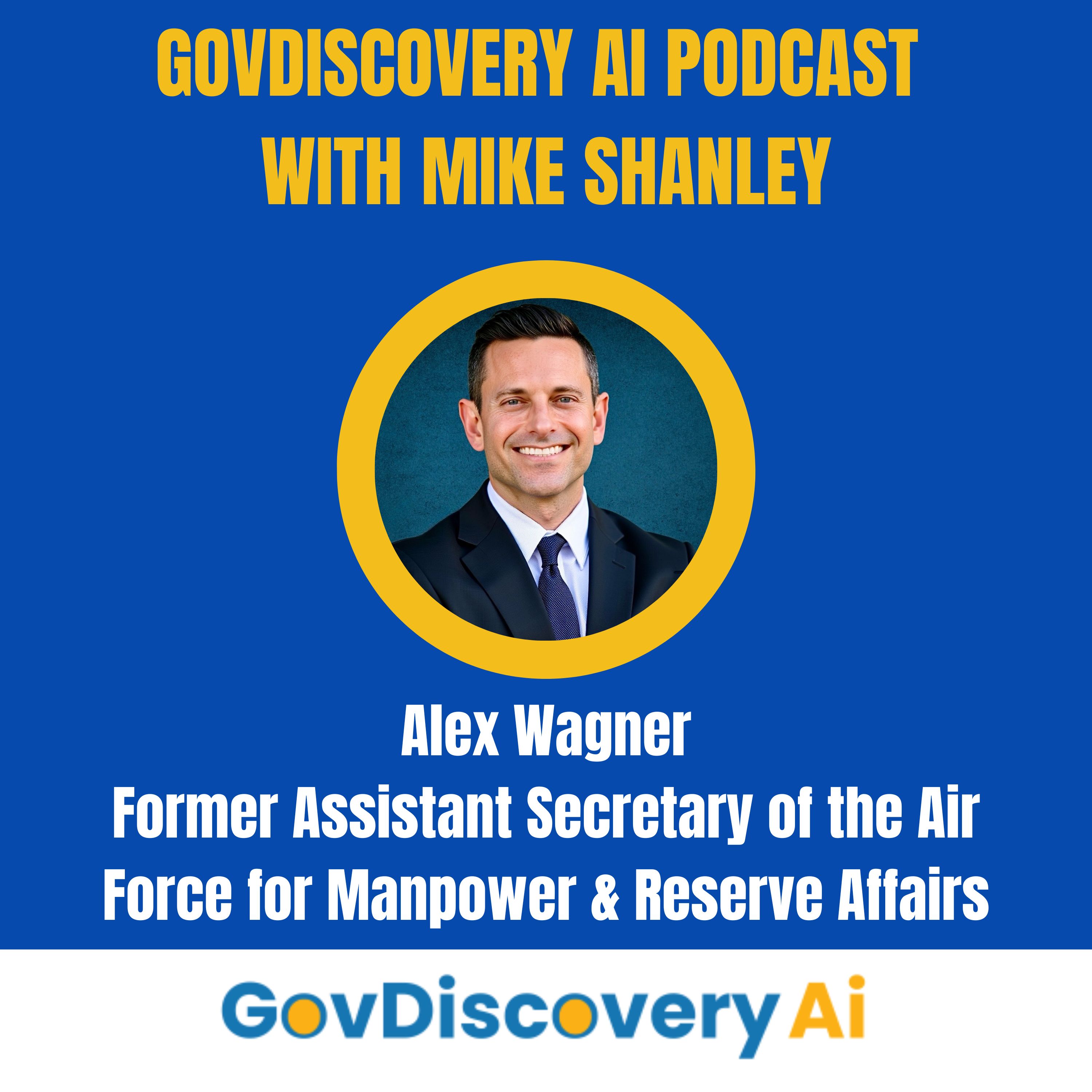
GovDiscovery AI Podcast with Mike Shanley
Ep. 58 Future of National Security Workforce
00:35:04
Alex Wagner, the former Assistant Secretary of the Air Force for Manpower & Reserve Affairs, joins Mike Shanley to discuss the Future of the National Security Workforce and how it’s being shaped by rapidly evolving trends. The conversation...
Loading summary
Transcript29 lines
- [00:00]
A
Welcome to the govdiscovery AI Podcast with Mike Shanley, your source for actionable insight into government markets and foreign policy. Gov Discovery AI leverages a decade of experience winning federal funding to deliver intel to sales proposal and capture teams working in defense and civilian markets. Now here's your host, Mike Shanley.
- [00:20]
B
Hello and welcome to the Gov Discovery AI podcast. Our guest today is Alex Wagner, former Assistant Secretary of of the Air Force for Manpower and Reserve Affairs. Alex, thanks a lot for being on the podcast today.
- [00:34]
C
Mike, it's an honor and I'm so pleased to join you. We're gonna have a lot of interesting things to talk about, I hope.
- [00:39]
B
Yeah, I just hope we have enough time. So let's get right into it. Let's start by setting the context. Alex, what was your role at Air Force?
- [00:46]
C
So I was the Assistant Secretary, which is a Senate confirmed job, which effectively was the Chief people officer of the U.S. air Force and the United States Space Force. Like the Department of the Navy, the Department of the Air force is a two service military department and as of 2020, the Space Force is the newest military service, but it also falls within the Department of the Air Force. Effectively what being the chief people officer was is anything that touches or impacts the 700,000 airmen, guardians and Department of Air Force civilians I was ultimately responsible for. That includes recruiting, retention, talent management. It also includes quality of life things like childcare like spouse employment, like housing and healthcare, but everything from the entire Air National Guard to the entire Air Force Reserves, as well as oversight of the US Air Force Academy, which is the Air Force and the Space Forces Service Academy, as well as 130 some odd ROTC detachments all over the country, Air University, so the entire education enterprise, all of the childcare facilities and ultimately every officer discipline package came across my desk. So I've seen a lot of really interesting things about human nature and I was responsible not only to the Secretary of the Air Force but also to Congress on all of those people facing issues.
- [02:21]
B
Well, one of those main policy issues was dei. At the start of this administration, end of January after the inauguration, you had an article in the Washington Post where you talked about DEI paraphrasing the your first sentence of that as instead of focusing on the wars in Gaza, Ukraine, deterring China or building on the budget, one of the priorities coming in is, I'll quote here, rooting out DEI and wokeness that they, the Trump administration believe are destroying the military. You note they won't have much to do. Diversity, equity and inclusion initiatives are a tiny sliver of what the Defense Department does. Could you talk a little bit more about that? And we're now six months on. How have you seen that played out over the last six months?
- [03:09]
C
Well, it's clear that this is still the singular focus of the Secretary of Defense. He's built his entire public image, his brand, around rooting out, quote, unquote, dei. And that's not unexpected when his entire resume for qualification for this job is being a Fox News TV host, complaining and elevating instances of quote, unquote dei. Or. What I saw in the department was that dei, whatever that actually means, represented an insignificant part of the department's attention, certainly a minor part of the senior leadership's attention. And actually, if you break it out, we need diversity because the American people are diverse. And so in order to recruit people, we need to be in neighborhoods, in communities that. That have been underrepresented because the American people should be able to see a military that looks like themselves. Second, any workplace, whether it's in a private company or in government, should be intentional about fostering an inclusive environment. You want inclusive environments where people feel comfortable bringing their full self to work, talking about their weekends with their colleagues. Why? It's because it gets you better outcomes. When people feel confident that they can engage in a conversation and they're respected for who they are, they're more likely to engage in that conversation and bring their perspectives to whether it's the boardroom or the battlefield. Finally, equity. I'm pretty sure that none of the people who talk about D.E.I have any idea what equity means. But there are two programs that DOD runs that I would call stereotypical equity programs. And both of those programs have a ton of. Of bipartisan political support. The first is the service academy. Prep schools. These are one year before you enter a service academy, typically for those who need a little extra physical or a little extra academic training. And those folks, whether they're athletes or former enlisted, spend a year at the prep school and then, believe it or not, do better at the academy because they've already developed that leadership skills, already understand military culture, and they end up being in positions where they're leading their peers at the academy who might not have gone to the prep school. That's a, by definition, equity program. The other program is a new one started in the Biden administration that has gotten rave reviews from bipartisan members on Capitol Hill. And that's the army and the Navy's Future Soldier, Future Sailor prep courses, similar to the prep schools at the service academies. If you don't Meet the physical requirements or the academic requirements to assess into military service and then go to basic training. They will put you through a several week, several month course so you can be able to do those push ups, get that run done, and in two miles or a mile and a half and meet the scores required on the ASVAB or otherwise to succeed. Now these, both of these programs are not giving you an academy degree once you complete it. And it's not getting you through basic training, it's just giving people the opportunity to compete. And by giving them that opportunity, they actually do better.
- [06:45]
B
And so a bit of a softball follow up. I'm curious how you'll frame the answer, Alex, is why is that important for national security? Why does that lead to the strongest department of Defense, the strongest military that, that we can put out there?
- [06:59]
C
Well, it's two, two parts. One, we are a team of teams. And the reason why the American military is so strong and so successful is because we empower people at every rank, at every level to bring their best ideas to be a part of the solution. It's not the North Korean military, it's, it's not the Russian military where junior members believe that they're just cannon fodder for the overall goals. Our military has different perspectives from different parts of the country. Cohesive teams that help at every echelon make us stronger and better. And those teams are diverse because our country necessarily is diverse. These initiatives, actually many of them were scaled back during the Biden administration to make sure that the programs focused on diversity were ones that had real impact. Now listen, the American military is something like 2.5 million folks in uniform, active guard and reserve. And so very often we have compliance required trainings. Those trainings are everything from sexual assault prevention, sexual harassment prevention, to how to do your time card appropriately, to how to prepare your family for a PCs move at scale. And every company in America knows this. You can't have individual sit down sessions with every employee. And I'm like the rest of you, these trainings are often annoying and they take up time and they're click through. And I'm sure there were some congressionally mandated diversity trainings. Now I'm confident those aren't as effective as they could be. But to malign an entire institution because of some annoying training seems to me to be foolhardy. The challenge is this is the qualification. This is the focus of the Secretary of Defense. We are supporting Ukraine, we are preparing for great power competition with China. We've got still conflicts in the Middle east. That we're supporting our allies and partners on to make sure the terrorists stay there and not on our shores. And so given that this focus of the Secretary is so singular on rooting out quote unquote dei, on expelling transgender service members, ripping apart those units, destroying not only morale but also readiness, it frightens me, frankly. And any CEO and any chro knows when the CEO is down a rabbit hole on a pet issue, he or she can't focus on the broader things that are important to the entire institution.
- [09:33]
B
Following from there, Alex, what are the most significant changes you've seen enacted the last six months, whether on the executive order side, the presidential action side, or at dod?
- [09:45]
C
Well, I mean, certainly I think I could agree in the current leadership of the Department would agree that the President's and the White House's focus on DEI has turned offices and special programs that were focused on readiness, that were focused on building industrial capacity, they're focused on educating the next generation of, and my department airmen and guardians focused on a witch hunt for non existent DEI programs. That's unfortunate. The other major change that's happened is the gutting of the Department of Defense's civilian workforce. And that comes from generally a lack of understanding of, of what civilians in the Department of Defense do. What they often do are things that we don't want uniform military doing. We don't want uniformed military as childcare providers, as teachers in DoD schools, running our lodging hotel enterprise. We want people in the Pentagon working with experience over years on some of these complex budget programs, on, on ensuring our, our base installations are secure, overseeing important programs that will outlast a two or three year military officer rotation, and by creating this deferred retirement program, by killing the PMF program which was the President's Management Fellowship, the primary way that young people were able to come with master's degrees and work on some of the nation's biggest challenges. By gutting the intern programs and shifting this tooth to tail, forcing military members to take up the slack in these, in these civilian jobs that require longevity, the civilian jobs that require expertise, the civilian jobs that require seeing issues evolve over the years. I think it's really set the department back today and the effects will be longstanding and, and it'll result not only in a reduction of expertise, not only a reduction of responsiveness to Congress, who effectively is the DOD's board of directors, but I think it'll hurt the quality of service and the quality of life of America's men and women in uniform.
- [12:09]
B
So Doge obviously was A large part of that. I don't think anyone would argue that government is perfectly efficient. There's significant inefficiencies. And I think there was some hope that Doge could have, could have or maybe has addressed those. What, what are some hopes for what Doge could have been and what was your view of what it ended up being specifically for, for DoD or we can just focus on Air Force, if, if you'd want to focus there.
- [12:33]
C
Gosh, Mike, when I was in the job, I would have loved, loved to have a separate staffed unit come in and help me solve some of my technology problems, bringing in Silicon Valley talent to some of the technology things that the government is still struggling to acquire, and then to put into action. When I was the Army Secretary's Chief of Staff in the Obama administration, we created an army digital service expressly to handle some of these issues and to combine our HR processes. I mean, if you think about, in the human resources world, very often you have a payment system and you bring people in and then you pay them and, and these things are separate. But in DoD military performance and rank and benefits all are integrated into a pay and performance system. And so it's much more complicated than the private sector. And for the better part of the last decade, we've been trying to acquire a system that could integrate all of these aspects. And the Air Force, it's called afips. The challenge was we had a hundred plus different personnel systems, all that use different types of data. I would have loved to brought in Doge and said, how can we glean the data out of these hundred plus systems, integrate it and then help create a uniform system not only so we could manage pay and performance better, but to give transparency to those who are in the system, to know who, when they'll be paid, to understand, you know, what that, what, what that move to this new area impacts on their housing allowance, on their, perhaps cola, their, their cost of living adjustments and the like, which is very complicated, particularly when you're moving, you know, hundreds of thousands of people every single year, not only across the country, but across the world, into different places where pay is, is very different and often into different ranks. Of course, they didn't focus on that at all. Their first thing that they did was trying to incentivize the department's civilian corps to leave voluntarily. Then they created an environment where it was so miserable that they would want to leave involuntarily by asking them every week to put the top three things that they were working on and, and why they mattered into an email. I mean, this is our nation's security and they're treating these experienced civilians as kindergartners. And by the way, you saw the Department recently lifted this requirement. Nothing came of it except driving out competent professionals. And by the way, how are those. Is the work going away? Is the mission going away? Absolutely not. Guess how those positions are being filled right now with military members in the Guard and Reserve who are being called in on special, what they call man days. And as a result of that, they're being paid more than they would be in their Guard or Reserve positions. And for those positions you can't fill with a military member, they're going to increasingly be reaching out to contractors, which everybody knows is more expensive than qualified civilians. So it's shown that the Doge folks were not really about efficiency, but were focused on government that they didn't understand, that they didn't have the experience to understand, and that they bought into an opinion of what government did from the, the media ecosystem instead of actually understanding how complicated it is when your board of directors is not interested in profit, is very often not interested in efficiency, but is interested in information. And that's what Congress wants. Congress wants to know and have oversight of what DoD does. And the bureaucracy that exists is a result of that oversight. Hundreds of reports every single year. I had to sign out or forward for the Secretary of the Air Force to sign out about things that were going on because Congress needs that oversight. Budget issues, Congress briefings, Congress slide decks. The inefficiencies in government is not because of the bureaucrats. It's the bureaucrats who are trying to fight the bureaucracy every day.
- [16:59]
B
Interesting. So recruitment and talent management. Alex, within that context, how, and we talked about in our prep, that Space Force would be an interesting example. How can those in Dodge effectively run those talent management, talent attraction, recruitment activities?
- [17:18]
C
Well, it's very different, military and civilian. One of the principal ways we get our civilian hires is, as I mentioned, through the Presidential Management Fellowship, which was this prestigious fellowship that once you complete a Master's degree, you could be placed into a high performing, impactful role in government across agencies. And the Department of Defense took a ton of advantage of this. We also created, while I was in the administration, something called the Defense Civilian Training Corps. This is a brand new program that's been, that's been rolled out only at four universities, but effectively we are looking to bring in young, smart talent in science and engineering. And if you join the DCTC program, you can get your final two years of college Paid for. You get a paid summer internship between your junior and senior year, and you get a guaranteed job once you graduate. And your only commitment is two years working at that guaranteed job. To me, that sounds like a pretty good idea. If I were the current administration, I'd find a way to scale it from the currently four schools that it's at. But bigger picture, as you read the news, you will have seen the reports of a military recruiting crisis, I would say, and characterize it as a military recruiting challenge that was brought on as a result of three things. First and foremost, the COVID 19 pandemic prevented recruiters from getting into high schools and forming meaningful relationships with high school students to help them talk about what military service actually means. Covid also created an environment where people were home a lot more, and as a result, they weren't at shopping malls and other places where military recruiters often try to engage high school students. The other thing was, post Covid, the strong economic comeback resulted in two things. Historically low unemployment and historically high wage growth, which made private sector jobs much more attractive. And when the private sector is hiring, it's a harder challenge for the military to attract folks. Finally, and I'd say the most important and enduring issue that led to this military recruitment challenge across all the services, by the way, is this lack of familiarity with the military. When I was in high school, 40% of Americans had a parent that served principally as a result of the conscripted force that ended with the dawn of the all volunteer force after the Vietnam war. With this 52 year now all volunteer force, we have fewer people that have a parent or a friend or a relative that serves. We have, with brac, fewer military communities. And so folks in the military are increasingly isolated from the civilians that they defend. In my case, I had never even met anyone in the military until after college, after law school, after a significant work experience. And it wasn't like I was living in the middle of nowhere. I was in major US cities. So this lack of familiarity has led to a lack of understanding of what service is, what you can do in the military. And so we put in place a number of interventions that worked. By the end of 2024, nearly all the services had its recruitment back on track. I can tell you, in the air Force enlisted corps, we had completed our entire fiscal year, 24 goals, an entire quarter early. And we even expanded our goal mid year. And I think those policy changes, whether it was, you know, giving additional waivers for small tattoos on the hand or on the side of the neck, whether it's making sure that our fitness requirements were uniform across the various DoD services and not exceptionally high for some reason in the Air Force. Whether it's, you know, mimicking the Army's policy, as states now allow increased legality of THC and marijuana to mirror the Army's policy that if you test positive when you're trying to assess one time, the Air Force would prevent you from joining forever. Whereas in the army, they'd say, if you maintain this GPA or test scores and have no other challenges, come back in six months, and if you. If you're clean, you can come in again. So we reviewed all of our policies and ditched those that didn't make sense in 2024 and 2023 to make sure that we were in line with where the American people were today rather than a vestige of a bygone era. And it worked. And I think what you see is a continuation of that recruiting success into 2025. And so I'd say, if you ask me what, what the Trump administration is doing right, it's keeping all of those policy changes intact that helped make not only the Air Force's enlisted recruiting, but the army and the Navy's enlisted recruiting back on track.
- [22:29]
B
What would be some of the other recommendations you would share with the current Trump 2 administration, specifically to those that are working in the role that you had under the last administration?
- [22:40]
C
Well, there's a lot of talk of a quote, unquote, warrior ethos. And I had been using that term. The Secretary of the Air Force, the Chief of Staff of the Air Force, and the Chief of Staff, the Chief of Space Operations used that term consistently during the Biden administration while I was there. What I want the new team to understand is the great thing about America's military is while they're all warriors and they're all heroes, you can do any job in the military, and there are certain jobs you can only do in the military. So you can be a lawyer or a paralegal. You can be a healthcare professional, a doctor or a nurse. You can be a contracting official. You can work on rocket engineering or acquisition programs. You could do administrative, you can do hr. All of those things exist today in the US Air Force. It's not only the people flying the planes and the people maintaining the planes, and the Space Force, as, as I hope you and your audience knows, guardians are not going into space unless they're part of NASA's astronaut program. Their job is to be here on Earth to understand and to protect the critical nature of the Satellites that enable our modern way of life, but also the military's modern way of war. And so as we created this new service, the Space Force, we had to look at how do we attract the right type of talent for jobs that are not expeditionary, not in jungles or in deserts, but principally behind computer terminals, like we're talking through right now. And by the way, when those Space Force Guardians are deployed, they're often deployed in the same place that they work on a normal basis. And so their status changes, but they're not deployed to different parts of the globe, although a few might be. The general rule is they're deployed behind the same terminal they were when they were in a different status.
- [24:41]
B
So what would be the. So what you'd share with our audience, those in industry supporting DoD, you had mentioned briefly before about with the Rifts, that the, or the, the, the, the voluntary leaving of DoD that there's likely an increased need for contractors. If you were advising one of these small or medium sized contractors working with DoD, what's the so what for them?
- [25:05]
C
From the business angle, the number one thing I'd say is there is a ton of talent on the marketplace right now and snatch it up as quickly as you can. That's the first thing. The second thing is to look for new opportunities. Right now there is a scrutiny over DoD contracts, particularly for HR functions, transformational functions. Many of those contracts are being scrutinized. But I think as military members are being brought in on temporary bases to fill those civilian roles, the department's going to quickly realize that the lack of expertise that they have because they're just warm bodies and the lack of longevity plus the expense will be outweighed by bringing in a contractor that has the experience and that you could bring in with that longevity. And so right now, while this is an uncertain period, I think you will see a lot of RFPs in the future for contractors filling requirement jobs that Congress has asked the DoD to do, whether it's in the acquisition space, whether it's in the policy space that I principally operated in, or the like. The other thing that I think is not super well known is that we have a totally new talent management system in the Space Force that will help bring industry expertise in and military expertise out, and as opposed to the one way ratchet that it used to be, traditionally with all the services where you serve active duty and then once you're done, you can go into the Guard or Reserve and you can work in industry and bring that active duty expertise. That way the Space Force has a new talent management system that's been authorized by Congress where it doesn't have a guard and it doesn't have a reserve part time force but instead within the same component, the space force has a full time and a part time role. And within that single active component you can be in a full time status. But maybe if your son is playing football and you want to be there during his senior year for the games, you can take a year and go into a part time role. Ideally you would then be able to work in industry and leverage some of that expertise and then after that year go back to be a full time guardian. Whether or not maybe you have a sick parent, right. And you want to take a couple years off, you can be in a part time role, have an industry job which is hopefully less intense than, than a military role and then, and then come back after that sick parent. And so hopefully, and ideally industry and companies will be looking for those guardians to take advantage of those times that they're in part time positions because they'll have that current expertise and then once they get back and this is so critical because I used to work at a trade association that represented America's aerospace and defense companies, the Aerospace Industries association have people who understand industry coming back into government and that I think will hopefully be a model if it proves successful for the other services over time to mimic quick follow up.
- [28:26]
B
So we analyze public market signals to identify DoD buyer intent, customer intent, what their needs are six months in, what do you think some of those needs are that they, that Trump to the politicals have not yet realized they're going to have. So then the, so what for industry is prep for these potential needs to be realized internally over the coming months and years. Are there any that come to mind that you think okay, six months in that wouldn't it be coming out? But that's going to become a pain point in the near future.
- [28:55]
C
I mean I think, and this is not a virtue of my previous position, but I read the news. If you can transform any of your proposals into supporting Golden Dome, I think that will be attractive. My personal perspective is that the, the, the wonderful folks who are working in the Pentagon are trying to meet the administration's intent. The technology isn't there, the mission is infeasible and so they will be looking to industry for off the wall ideas so they can say that they're doing something. And so transforming anything to support Golden Dome will be an arrow in the quiver of the acquisition professionals and the leadership to say to the white House, look how we're trying to meet your intent.
- [29:47]
B
Alex, do you have a couple more minutes? There's two more questions I wanted to get into. So industry when you were in government. So again, former Assistant Secretary of the Air Force, what was the most effective way for industry to engage with you? Was it finding you speaking at a conference? Coming up to you getting a business card? Was it sharing a white paper? Was it what, what. What's your advice for how can industry efficiently and effectively support DoD's missions through that direct engagement?
- [30:16]
C
So I'm biased, but I will tell you that because especially when you're a political appointee, the ethics rules are so restrictive again when you follow them. And I'm not confident that the current team is as rigorous as certainly my team was. But working with and through trade associations are an unbelievably impactful way to access senior DoD decision makers. The advantage is that you don't have to show any bias or favoritism towards one company or another. And, you know, having your lawyers in that meeting, having, you know, the acquisition professionals in that meeting. I remember being the Army Secretary's Chief of Staff, it was very challenging to organize a meeting with an industry CEO because we didn't want to project favoritism on a particular contract. And so leveraging resources like my former organization, aia, ndia, the Professional Services Council and others, they can convene interested companies. Those convenings actually can protect decision makers from the appearance of impropriety or favoritism with industry. But other than that, you know, rather than a cold email to a principal who. My first thing would be to forward it to the lawyers and. And then forward it to my staff and say, am I allowed to meet with this person? Should I meet with this person? Is this a good idea? Finding ways to engage on common issues rather than particular programs outside of the service acquisition authority lanes, I think would be. Would be productive. Within the service acquisition authority lanes, they are very experienced on how to have those types of conversations. But other than the SAEs, other than the Undersecretary for Research and Engineering or for Acquisition and sustainment, engaging senior DoD leaders, I think through trade associations is particularly effective.
- [32:28]
B
Thank you, Alex, I want to congratulate you on what's next for you on being named a Fellow at the University of Chicago. The program has past fellows. There have included Senator Tester from Montana, former Secretary Pete Buttigieg of Department of Transportation. That's very exciting. Could you talk a little bit about what you'll be covering this fall at the University of Chicago.
- [32:51]
C
Yeah, so Chicago has this incredible Institute of Politics where they bring in fellows from all different places, from the Hill, from government, from advocacy associations. And my seminar this semester in the fall is on politicization of the military. And as I'm looking out my window right now into Washington D.C. and having the National Guard deployed on the streets to do essentially nothing, but the people who pass them are not used to seeing that, to having a TV host run the Pentagon whose focus is on non existent threats rather than the real threats. I think that there couldn't be a better time to talk about how the American people understand the military, how the military understands the people that they protect, and how to find a way forward that's more effective to give the American people a real view into what their military does, and particularly with students, what the military does and what the military doesn't do. So it's not a tool that can be applied to any problem. And more importantly, from my old perspective, talk about who serves and why they serve and the impact that service can have. So the impression is not solely from pop culture or TV commercials. I'm really looking forward to doing this.
- [34:09]
B
Alex Will, congratulations again. All the best of luck this fall in Chicago and I have about twice the amount of content we got through to get into, so I'd love to have you back on the show down the road. Again, thank you for sharing your insight with our audience.
- [34:23]
C
Sounds like a plan. Mike, thanks again. Really appreciate you having me on.
- [34:27]
B
Thank you.
- [34:27]
A
Alex, thank you for tuning in to the govdiscovery AI podcast with Mike Shanley. Govdiscovery AI leverages our team's decade of experience winning federal funding to deliver federal growth intel to sales proposal and capture teams working in defense and civilian markets. Each market intel report is delivered by federal growth experts leveraging our proprietary deep data discovery process. If you enjoyed today's show, be sure to subscribe wherever you get your podcasts and connect with Gov Discovery AI and Mike Shanley on LinkedIn or learn more at govdiscoveryai.com.