← GovDiscovery AI Podcast with Mike Shanley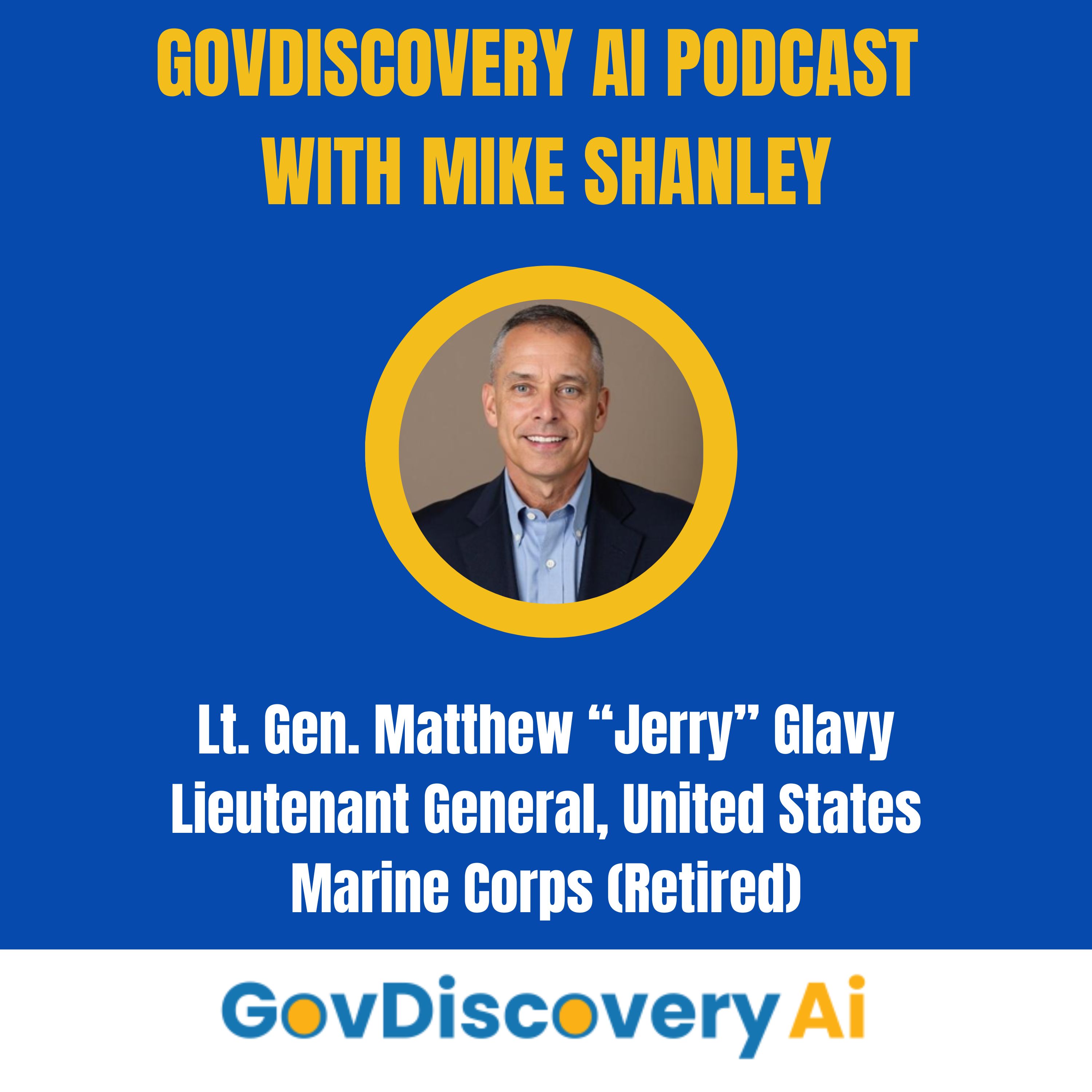
GovDiscovery AI Podcast with Mike Shanley
Ep. 60 Lt. Gen. Matthew "Jerry" Glavy (Ret.)
00:50:50
In this episode of the GovDiscovery AI podcast, Lieutenant General Matthew Jerry Glavy shares insights from his 39-year career in the U.S. Marine Corps, discussing the evolving landscape of the Department of Defense (DOD) and the importance of...
Loading summary
Transcript36 lines
- [00:00]
A
Welcome to the govdiscovery AI Podcast with Mike Shanley, your source for actionable insight into government markets and foreign policy. Gov Discovery AI leverages a decade of experience winning federal funding to deliver intel to sales proposal and capture teams working in defense and civilian markets. Now here's your host, Mike Shanley.
- [00:20]
B
Hello and welcome to the govdiscovery AI Podcast. I'm your host, Mike Shanley. Excited to have our guest today. Lieutenant General Matthew Jerry Glavy, retired general from the United States Marine Corps. He had a 39 year career in the armed services spanning air, sea, cyberspace and space operations. From the commanding officer for HMX1 commanding the President's Helicopter Squadron to leading the U.S. marine Corps Forces Cyberspace and Space Commands, General Glavy offers a strategic insider's perspective on defense priorities and what it means for industry. We'll get into all of that. General Glavy, thank you for taking some time to join us on the Gov Discovery AI podcast today.
- [01:05]
C
Thanks Mike. It's great being here.
- [01:08]
B
Let's get right into it. You had nearly a four decade career in the armed services. Could you share a bit about your insights, what you've seen, what you've learned over that period.
- [01:20]
C
Wow. I know we only have 30 minutes, but my career is probably this is.
- [01:24]
B
The start of a Ken Burns documentary question, right?
- [01:29]
C
But mine is probably unlike other other folks because I have had a pretty wide and varied career which has been fantastic for me and an incredible journey. I'll tell you. It kind of all starts at the Naval Academy. I don't want to go back that far and I'm not going to tell too many stories, Mike, but the very first deployment I went on as a midshipman after my plebe year, freshman year was on the battleship New Jersey BB62. I got to an incredible chance of a lifetime as it was recommissioned and sortied out to the fleet. I got to be on that very first sortie, what started out to be a four month deployment but turned into a full year. Now this is a battleship that, you know, we, we took it to mothballs for a while, obviously World War II and then various wars and conflicts the US fights and then it goes into mothballs and we bring it back during the Reagan era buildup and I got to be on that ship. Amazing ship that it was probably the very best mechanical shipbuilding, electrical engineering one could possibly imagine. 24 inches of reinforced steel, you know, 16 inch guns, 5 inch 50s. It was an amazing, amazing piece of gear and I got to be part of something that as a young, young midshipman, very impressionable. That, that I, that, that certainly wowed me. My general quarter station on that ship was in the number two turret. And I remember this so vividly because what was the, the portion of the, of the turret I was on was where the, the armor piercing incendiary rounds were stored. And 2,700 pounds they weighed. And that's where they got the Volkswagen thing where they fired a Volkswagen. Cause those rounds were that heavy and everything was done in a very mechanical way. Levers and elevators and everything was people in the middle of it. The manning of that ship was very impressive. They had to bring folks back to bring the ship back. Anyway, I tell you this story. Cause that's where it all starts for me in this wonder of World War II. And as a Marine as I grew up, I remember that time very well because as a Marine you certainly learn about the challenges, the things that work, things that didn't work. And for me, understanding this Navy Marine Corps team. So the battleship New Jersey and the whole Iowa class is built out of, I'll say failure may be a strong word, but our inability to execute naval gunfire in an effective way. Battle of Tarawa was a tough day for the Marine Corps and the Navy certainly in the whole Pacific island hopping campaign was not, not for the faint of heart. But on that day, unfortunately the Navy goes, and I better be careful with all my facts, but the facts as we know them written down a document for us is they go oh for 2000 against 8, 8 inch sites that the Japanese had on Tarawa that were the main targets we had to get rid of oh for 2000. So it didn't go well. And again, you know, it is what it is. But we are a learning organization. And the battleship New Jersey was going to make sure or the Iowa class writ large. My experience was make sure that ain't happen again. So I, I go out on this ship and one of the neat things I get to experience is, is, is recalibrating the guns, requalifying every gun on that ship. And it was loaded with guns besides the 16 inch guns. And I will tell you over 2000 and my memory may not serve me exactly correct here, but we get done in less than a day in qualifying all those guns to the precision required to support maneuver elements ashore or the war at sea. I tell you this because we are a learning growing organization. And that experience for me and it really impressed upon me that we have to be a learning organization every time we do something Especially when it doesn't go well. And perhaps even if it does, how are we going to get better? So these four decades, I've been in this learning mode again, most of my adult life as a very average helicopter pilot, primarily flying CH46s. I deploy a lot with that US Navy that I love so well, especially from my days at the Naval Academy. But then I, you know, I. Things kind of turn in various directions. You had mentioned HMX1 and flying the President of the United States, certainly in honor of a lifetime and something I'll never forget. Where zero defect was, of course, the plan of the day. But then having the opportunity as a brand new general officer, instead of going south on I95 from the Pentagon, I go north on I95 up to Fort Meade, Maryland, changed my life. Understanding what those critical aspects of defense for our country are, both from a National Security Agency standpoint and a US Cybercom standpoint, really enriched me as a, as, as a Marine, as a, as a member of the Joint Force, and back to this learning environment, always trying to get better. It had a profound impact on me. And then kind of at the tail end of that, our 38th Commandant, General Berger, says, hey, skirt. My call sign, not important, but says, hey, skirt. I need you to stand up U.S. space forces for, for the Marine Corps on behalf of U.S. space Command, our component C for Space Command. And so that obviously brought me into another domain. And again, this idea of learning and being the dumbest guy in the room again takes hold and I'm in a pretty steep climb, fully understanding, immersed myself in it, like you would expect any good Marine would do. But, but again, always in this learning state, and I'll call it this state of humility. Right, because the only way you're going to learn is you have to be humble. So I think in those four decades, what got me through is this humility, this quest for learning, trying to get better, understanding what Fleet Average is and what it's going to take to be successful in these various environments. So very grateful to the Marine Corps and grateful to this nation for the opportunity of the past for decades.
- [08:12]
B
So thank you for that context, General. Now you're retired, where do you see the, the industry, the needs of, of DOD today?
- [08:23]
C
Yeah, well, I will tell you, the advantage I had during that four decades is, is change was a part of it. I mentioned a few of those changes, but the speed of change now is, it's jaw dropping. Just, you know, I've been out less than a year and understanding where dod, Department of Defense has come. Even the Marine Corps and the Department of the Navy have come to where we're today is, wow. I used to say when I was up At Fort Meade, U.S. cyber Command, every 90 days, reevaluate your assumptions. Every 90 days. Because they could be wrong. I'll tell you, that's. 90 days is old school. I mean, you probably got to look every nine days, you got to look at how fast things are happening to really fully uncover, understand how the change is going to impact you. You know, I was a big fan of Colonel John Boyd, the creator of the OODA Loop. He had a big impact on the Marine Corps. Our whole Marine Corps War fighting. Publication one, which is titled War Fighting, was really based on a lot of Boyd's work and this idea of uncertainty and how important it is to be able to operate in an uncertain environment. The human is incredibly important to decision making, to deciphering what is happening. Everybody thinks that Boyd was a bit of a counter technologist. I would tell you it was the exact opposite. Boyd wanted the human to immerse him or herself in that technology and to be a master of it. So they could drive change, they could drive opportunity, and they could viciously exploit it and seek it. But I think we find ourselves in this very tight, what I would say, observe, oriented, decide and act environment, not only for the adversary, but certainly, I think, for technology.
- [10:19]
B
So we'll keep coming back to industry and how the defense industrial base and how they can best support the department's priorities. So let's start here with the Marine Corps. What should industry know about the current. The situation where we find ourselves today, where the Marine Corps is at, and how they can best be positioned to support their needs and deliver on their missions.
- [10:46]
C
Yeah. So our 38th Commandant, when he took the commandant seat, basically started a project called Force Design 2030. Today, it's kind of referred to just Force Design. And it was a significant transformation of the Marine Corps. And the one thing the Marine Corps does fairly well, especially during times of change, is we write, we try to document our thoughts as best as we can. And the 37th Commandant, General Kneller, did the same. Right. He had Force 2025 was his mantra. So they built on each other. But. But the bottom line is we wrote a lot, and. And the Navy does to some extent as well. But I think the Marine Corps really tries to do this. So I would always. And. And certainly in my days in the seat and having these engagements in the industry, you know, I, you know, have you read Force Design 2030? Do you understand what the commandant is trying to do here? Have you, have you read exhibition Advanced Based Operations? Had you read our concepts on the stand in force? You know, these things are very important to fully understand, like where the Marine Corps is going. So I always say, you know, just, just like myself, do your, you know, you got to do your homework. You got to understand how we're going to find fight in the first island chain, how important the South China Sea is, you know, to the national security. But the Marine Corps, you know, not sorry, but very focused there by direction, by back to back national defense strategies and national military strategies that we were tasked to understand that the People's Republic of China was a pacing threat. And we had to make sure that we were part of the formula for success for the department right to, you know, preferably lead to a deterrence model, but ultimately ready to fight and shoulder, shoulder with our partners in that region, our allies in that region to make sure we can do that. But with industry is understanding now how the Marine Corps wanted to go about doing this, which again, well documented. One of the publications we also published as Marine Corps Doctrinal Publication 8 titled Information. I had the honor of, of working that with General Berger, our 38th Commandant, and he had a big pen. He very much interacted with it, but trying to understand for our Marines how important information is going to be and especially how it's going to be in the areas that we're going to operate. So we write down a lot. So my, my recommendation to industry is, is to kind of, you know, prepare anytime you engage in Corps, understand these concepts of how we're going to operate, austere environments, expeditionary in nature, relatively small teams that can mass as required in disparate areas. You know, that the jungles of the South China Sea are unforgiving environments. But understanding all that and then coming to the table with opportunities I think.
- [13:45]
B
Makes a lot of sense given that context. Is the profile the Marines are looking for for their recruitment is that and skill set, is that still the same? Is the importance just the ability to learn and adapt, whether it's to a, a new ship design or it's to AI now doing your analysis rather than you collecting the dust research, is it still that same skill set and profile?
- [14:11]
C
That's a great question, Mike, and I'm going to kind of step back and maybe give you more of an answer than you want, but I think it's important to kind of clarify this. You know, I have this idea that the character of war versus the nature of War, very important. You know, the nature of war is enduring, you know, the violent clash of wills, you know, the continuation of politics and policy by other means. All the writers of warfare that we, we base much of what we do today talked about this significantly. But this nature, right, this taking my will, imposing it on others, you know, that that's not going to go away. That's the nature of warfare. And you know, and it's violence of actions, right? There's a discipline, there's grit, there's being able to operate in those, you know, very challenging conditions that go along with the nature of war versus the character of war. And the character of war is basically is how we are going to do it. The nature kind of gets at the why and the character is the how and the how changes. Technology has an incredible impact. Tactics and policies and national security strategies have big impacts, but the character of war changes. And, and if, you know, you know, guys like Boyd, if you don't understand that, if you don't understand how combined arms made the German army of World War II so powerful, it wasn't the radio or, or the motorized capabilities of both armor and tanks and other things as well as the airplane, right? But it was all of them used in a way never used before, that the human put together and made that character changed based on the technology. And sometimes we get stuck with new capabilities using old school tactics, right? And we don't bring to bear this combined arms like construct again, dark side of the force as an illustration. But I think we could even look at what happened in Iraq and Syria. What happened with the development of isis basically used the information war fighting function to take over two countries. And we can have an argument about that and the degree that that is a full and accurate statement, but at the end of the day, certainly impose their will on both Syria and Iraq in ways that probably unimaginable. And it wasn't the butchery of Zarqawi of the initial Operation Iraqi Freedom where he was kind of, you know, God help us, again, dark side of the force, doing heinous things to people. This was much more choreographed, right? This is their ability to use hotspots and to use Android phones and to use basic graphics to get a message out that, let's face it, basically scared everybody. They certainly had their heinous moments, they certainly had atrocities, but it wasn't, you know, what the prior generation had done. It took us a while to truly understand the follows on social media. You know, again, didn't understand that. But, but the idea that that social media was going to be this information domain, asymmetric advantage was something we weren't ready for. Where their, their likes and follows go from tens and hundreds to thousands, tens of thousands, hundreds of thousands before our very eyes. And we can do so little about it. So anyway, the characters constantly changing. So the young men and women that join our force, I'll tell you, the Marine Corps ethos basically wants to prepare those young and men and women for, for the most heinous day, right? The worst possible day of their life. We want to train them to such a level that they have the skills, they have what they need to be successful, even when the circumstances don't look to be in their favor. There's a certain quality called grit that is critical to this that we want to instill in our young men and women. And so that means that this idea of discipline, mental and physical toughness, very much a part of our 13 weeks of making a Marine and very much part of how we commission our officers and the training they get at the basic school for six months puts us in this, this common environment that we all understand. You know what it means, every Marine rifleman. So tance, you know, how we make Marines. So we have some, these cultural issues that we cling to very tightly and they're very important to the Marine Corps. But we say, hey, the Marine Corps is here to make Marines and fight and win our nation's battles. Like that kind of gets to this nature of war that's enduring, right? We now the character of war is going to change and how we make sure those Marines who are galvanized in this, you know, and what it's going to take, you know, the honor, courage, commitment to be successful in the most heinous conditions, how do they thrive when we give them all the capabilities they need to have? And a lot of that's going to be based on technology, which will have a direct impact on the character of war.
- [19:44]
B
So going back to learning, then the ISIS example you mentioned, social media. See, there's two sides of it. There's one, the maybe lack of full understanding of how that can be used as the, the recruitment tool, as that propaganda tool. There's also the other side, if I'm remembering correctly. I think they posted some pictures that included their GPS coordinates of, of some of their operations. So there's vulnerabilities from the adversary as well. There's what have you seen the Pentagon learning from that example? And then later on I want to get to Ukraine too. And whether or not those lessons that have been learned are still applicable today.
- [20:21]
C
Yeah, we like to say in the Marine Corps, probably in the Joint Force, that tracers go both ways, right? The ability to understand where your rounds are impacting. So we used to fly around Iraq, we used to not put tracers in our weapons. We flew primarily at night prisoners. Certainly a lesson learned, but that facilitated our ability to not be, you know, to not stick out in a dark sky per se. But, but, but with that said, you know, it was also more challenging to hit the target when, when, when you're not fully seeing your impacts. So I think social media and the ability to use the digital environment, the information domain as we call it, is something that we got to master. So in the Marine Corps, we wrote MCDP 8, Marine Corps Doctrinal Publication 8. Three things we were really looking at from information as a domain we wanted to win, have technical superiority, technical overmatch. We wanted our stuff to be better than their stuff, right? Think software, think the things that are going to go into making our capabilities better than yours. I think the F35 is a great example of that. The F35, as much as it is an incredible platform and can deliver incredible kinetic capabilities, at the end of the day, it's a, it's a server in the sky. You know, the ability to fuse and correlate information is critical to fighting that fight. As cool as everything else may be, it's the brains of that capability. You know, the F34 have 35 fights, you know, and it'll never see its wingman, right. It's totally different way, it's a totally different character on how we fight that. So we have to understand how we are going to fully exploit that. And so we want technical overmatch, we want to win the prevailing narrative in the information domain. And then we want to create this thing called resiliency. And I think that gets after some of what you're asking is this idea of resiliency. How, how do we take a punch? You know, it's not a zero defect. For all the advantages that you get right from having the, you know, the technical superiority, having this advantage in the information domain, there's going to be things, you know, there's going to be some vulnerabilities here which we learn all the time. The ability of software, the ability of coding, the ability of the ones and zeros, as great as they are, and how much advantage we can gain still provide opportunity for the adversary, a vulnerability. So we're gonna have to fight through that. And I like to say that, you know, software, and I'll just kind of leave it generic as software. You know, I was a wing commander, 2nd Marine Aircraft Wing. So I had 14,000 Marines and sailors, about 500 airplanes on any given day, about 1,000 wheeled vehicles, and I had, you know, roughly speaking, about a billion dollars to get the, the ring, the wing ready to fight and win. And that goes for all the petroleums, oils, lubricants, all the things that take to make people and, and airplanes ready for a fight. Well, I would tell you, like, software should be part of that. And, and if we have software updates that are 6 months, 12 months, whatever they may be, and I'm not being critical per se, they really need to be six days, right. Maybe six hours. Right. The ability to push code around to make our capabilities that much better, provide that much of advantage, I think is significant. Something that we learn in a morning flight, right. That the adversary, maybe we can do something, tweak something to the airplane to make it more effective. Right now those are very hard things to do. So don't get me wrong, but in the future, I think this idea of software and I throw that in the big information war fighting function, but the ability to turn that into something that, just like bullets, just like petroleum oil and lubricants, just like expendables that we need to fix airplanes or fix vehicles. Right. Software coding needs to be similar to make us more capable.
- [24:40]
B
So what are some of the other challenges you're seeing? And one that comes to mind is you're first story we started off the show with, on shipbuilding. That's obviously a priority of the Pentagon right now. What are some of the other challenges that you see the DOD in the Pentagon facing?
- [24:57]
C
So challenges, I'll say opportunities, I'll say moments of learning. I'll probably try to, you know. So we're trying to tackle the UAS challenge, right? Opportunity. We're trying to both figure out how we're going to counter it, but also how are we going to exploit it. And sometimes I want this to come out the right way, please. Sometimes our culture, things that we find so near and dear to our heart and soul and our identity could have an impact on how fast we can change to this character of war that we've been talking about as a historical example, because I love history, you know, the knight in shining armor took three centuries to say, hey man, you know, almost they went extinct because, you know, the low cost asymmetric advantage of the long bowmen, right. Outpaced the armor capability. The heavy, the Horses, the cost, the noble, the nobleman aspect. And though the knight represented everything that was good about society and had codes of honor. Right. Things that we would so very much we, that we want. And we kind of use that a little bit, by the way. Right. In some cases it gets in the way of the ability to adapt to the character and the changing nature of, excuse me, the character of war and how fast it changes. And, and again, it's a, it's, it's a, it's. So we, you know, make Marines 13 weeks of the most intense training, probably pound for pounds I would say, anywhere in the world. Same thing with, with our officers in the six months at TBS and, and all the commissioning programs. Right. All that is like, goes into making sure that these young men and women are prepared for whatever throws their way. But on the same note, do, do, do things get in the way that prevent us from seeing, like how does a small UAS change the value proposition of a squad of Marines? Locate, close with and destroy through fire and maneuver is the mission statement of a Marine rifle squad. Like, that's really important. Every Marine knows that. Right. How does that fit? If I give that squad, that platoon, all the small UAS capability they have, will they know how to fight with it? And there's learning involved in that and there's this certain sense that maybe all the aspects of locate closeth and destroy through fire maneuver will change just a little bit the character of those things from what we know. And the other aspect of that I think is critical is we want to be good at what we do. Right. I think, you know, everybody, you know, and how do you become good at what you do? By doing it over and over. Someone wrote a best selling book on this. If you do something 10,000 times, you're gonna be good at it. Well, a lot of how the military operates and aviation was a classic case. Let's be good at it. Like, so we're gonna do this way, this way. We used to say in the world of aviation that change is the mother of all risk because, you know, change just, just, you know, what we are focused on, how we're going to do it, what we prepared to do now takes on a new environment. Of course, aviation can be very unforgiving. We've hurt a lot of people and broke a lot of things because of it. So, so we got to kind of be careful how, how we look at these, you know, these clashes and understand where the opportunities rise and still have a strong culture of what we do, but really have. And I'LL go back to humility, this humbleness about us that we got to be in this continuous state of learning and then have the imagination. And this is really the hard part, the imagination to really understand what's possible going forward, especially with some of these new capabilities.
- [28:47]
B
On that note of learning, innovation is obviously a crucial piece of that. Let's talk about innovation at the Department of Defense. Mentioned AI new technologies. How do they get integrated into the legacy and in some cases terms obsolete technologies that are still part of the. The critical workflows, the critical tools that the Marines and the warfighters across DOD rely on.
- [29:15]
C
Yeah, it's going to be challenging. You know, again, we want to be good at what we do. There are certain practices and procedures, especially in big bureaucracies that you want to be faster than everybody else on. But that doesn't necessarily mean you're innovative or imaginative or have breakthroughs. I would say we're going to one the recent memo just of this past week of the J. Sid's process going away and in its place they have another process which should be more beneficial to the war fighter focus more on combatant commands, more on how we do things in a shorter term, near term requirement. So Jason's was around. I got into the Pentagon, my first tours 99 and, and that's where you know, J. Sids was becoming a thing and we thought that was a breakthrough. But really Jason's was about big, big programs and Jason's was about, you know, kind of shipbuilding and airplane building and things that are cross service lines that everybody needs to know about. Really everybody got to have a vote in so to speak, but obviously wasn't supporting the timeliness that acquisition needs to have. So I think changing these policies and procedures. We used to say better is the enemy of good enough. I think we got to be careful trying to search for the perfect model. But the closer we can get to what the services organized training equip and the vision that they have for the future to what the combatant commander needs in the next three to five years, we got to bring those things closer to together and cost is going to be important. You know, we got to be very careful here and we got to understand, you know, some affordability model. I mean it's just a good logistician will. Will want to know that what is, you know, the resources it's going to take to, to execute what we decide is going to be the future through procurement and acquisition. But it, there's got to be a degree of affordability because in Any fight of the future, there's going to be scale. There's going to have the ability to understand what it looks not only in 90 days, but 190 days, 390 days. I mean, we don't know. And understanding that's going to be so, so important.
- [31:47]
B
I want to come back to that, but I've been looking forward to asking you about being the commanding officer for HMX1. Most of us will never be on Marine One, and even less we'll ever pilot Marine One. Can you talk a bit about what that experience was like, what you learned from that? And as I understand, it was for both President Bush 43 as well as President Obama.
- [32:11]
C
Yeah, thanks. I got there towards the end of the President Bush and then I really took the helm, took command for President Obama. It was wonderful, man. It was a kind of a, it was a zero defect environment. You talk about culture, you talk about repetition, you talk about doing things the same way, understanding all the expectations about what everybody in that command was going to do. Because you can't have a bad day, you can't have someone daydreaming, you can't have someone not up to the standard that's set by having that incredible role. It was fantastic. Phenomenal. Marines and civilians and sailors were part of that organization. I used to say too much is given, much is expected. It's a biblical reference of sorts. I don't think there's any one line that gives it exactly that. But the bottom line is the Marine Corps really took good care of us and made sure that that organization had what we needed. And it was my responsibility really as the commander working for both the Director of the White House Military Office and the Deputy Commandant for Aviation in making sure that we were prepared, we were mission capable and ready to do our job, you know, 24 hours a day, literally and figuratively. So it was absolutely fantastic. A lot of great places you get to go. Wherever the President Travels, there's a HMX1 helicopter with him and they're there to support him. And it was the chance of a lifetime and one I'm very, very grateful for.
- [33:55]
B
Great. Let's go back to the combatant commands then. What are the. An industry as well, what are the best ways for industry to learn what those needs are? And as you mentioned, looking forward years into the future because they need to be upgrading, investing in their own systems and their own capabilities so they can serve those future needs. And I'm interested both on that human to human connection, those conversations as well as the documents the research, the desk, the preparation that they can do before they have those conversations with the combatant commands.
- [34:31]
C
Yeah. I tell you, the combatant commander is critical to this. He's the war fighter. He's the one tasked by the President to execute those war plans. So goes without saying, have an understanding of what they're doing. I'll use this analogy here. Since I've been retired, obviously I'm not working on classified systems. You know, and growing up as a Marine, all the operational time I had, I would say 80%. It may not be quite 80, but just for a number's sake. 80% of what I used was of some classified nature, confidential, secret, and then later on top secret stuff. So about 80% and that 20% are, you know, facts and known knowns and things you get from handbooks and other things. I think today, I think that number is probably reversed. And I'm not. And it's not. Of course it's not. But I will tell you, the world of public available information, commercially available information, you know, you can hop on and I do almost every morning, hey, what's going on in Ukraine today? You can't get that out of your system, right? You wake up and the commander's got what's going on and you kind of dive in. But. But the amount of information up there, not only the EO ir, the electrical, optical and the infrared capabilities, the things the norm, so to speak. But now there's synthetic aperture radars, there is RF spectrum maps. There's a lot of information out there. And it's incredible what that you know. Yeah, the ability to understand that and use that. And so I tell you this because I can understand. I better be careful. I don't know all of everything that's going on, but you get a pretty good idea what the hell's going on out there. I'll just say that. And understand that from an industry side and some industry partners have access to the classified information, so they should use that to enrich everything else to understand. But just like we're trying to mass data to gain an outcome, right? The magical use of artificial intelligence and through the learning of. Of machine learning. Right. They got to do the same. And I think there's some models that are starting to come forward where perhaps the department. And I'm going to say this out loud, and mostly I'm looking in the mirror as I say this, Mike doesn't know exactly what they want, right? Doesn't know exactly what they want. Just limitations of career, limitations of experience where the power of data. The power of massing that data, especially from an industry standard could provide insight that perhaps the user operator doesn't. So it's a two way street. One, the requirements holders, the budgeting aspect of this has to understand that, afford the opportunity of that to happen and then industry partners maybe shows up, hey, I know you guys are asking but, but here's perhaps a better way to do this and you know, we get, you know, I've seen tizzies on this too. So my model isn't perfect but I think we gotta be careful. So right now when I do budget stuff again when I was in the seat, I'm making decisions for something that's gonna happen two years from now. I mean just think about how fast P. Leo hit us, right? So if I'm making decisions to buy big parabolic antenna like capabilities, you know, all good, all good, right. When in fact we have these portable capabilities that can pop up, you know, come and go and really are almost consumables. Right? It is what it is. And yeah, it's going to change your, you know, but, but you didn't know, right? Or the risk level or you know, back to the requirement said this and so we got to meet that. And though the character wars change, I don't care requirement was written. So there's going to have to be some give and take is all I'm getting at. And there's going to be some gnashing of teeth here, let me tell you. And it's not going to be easy. Everything I'm saying really gets into, into the heart especially when we're, you know, we want to be good stewards of taxpayer money and that's so important as, as well. So I think industry has to go look at the problem set as well. I think their research, their ability to mask that data, just like the department needs to do to understand possible outcomes based on that. As you look into predictability maps, it has to be part of the whole big procurement process as well. And I think there needs to be a storefront, I think not new about that term by the way, but as CO comms and even the services that support the cocoms go out and do missions, they may not be prepared for exactly the mission they're going to use. Right. And they may need to go to this storefront. It could be anything from software coding to more consumable like capabilities. Think small UAs Heck, think group one, two and three. You know, there's probably some, you know, but thinking through this, the thing, you know, we're not going to get the F35 in the storefront, but maybe there's software update that can be part of that. You get my point. So there is ways to look at this, right, that I think has to change on how we do it. And then maybe some of our funding, you know, I go back to this operations and maintenance funding that we get, you know, broken down. You get procurement, you get our research, development, test and evaluation funds. All the. So if we can put a little more in that O and M, the operations and maintenance bucket, you give commanders some more leeway to operate in a storefront to fully understand that, hey, I'm deploying and employing a force in this environment. I need X, Y or Z. I don't have that. Can I go get that? And everything that goes along with it as well. It's back to the software development, back to upgrades and other things that happen, you know, maybe within hours and days, perhaps weeks, but not, not years. Don't we, we can't have that. So that doesn't fit every model. You know, what we're doing. You asked about shipbuilding and I didn't give you a great answer because it's probably not in my lane per se, but building ships is pretty tough right now. We've had a lot of delays and great people in the Navy, I work shoulder to shoulder them. I love them dearly. I got two kids in the Navy, you know, so I'm all in on the United States Navy being, you know, the world's best Navy, and they are. But building ships, you know, is something we probably got away from a little bit. And that trade craft, that skill is something we gotta look at. But there are things that'll fit neatly in this idea and then there's things that don't. But I think industry should have a say in this. I think they should provide products. Hey, Marine Corps, you need to operate in the first island chain. You need to operate in austere environments. You need incredible C2 with ubiquitous transport, commoditized hardware and software. And then you need absence and software that affect the mission that you're doing. Time now, well, here is a minimal viable product that provides you that, you know, and it costs, you know, God help us not. Not what an F35 costs and not, you know, not picking up on F35s. But you get, you get my point. So anyway, something I feel strongly about is how does industry get more involved and how do they fully understand, maybe in a parallel path, right? And they, they bisect, dissect into what DoD's doing. But maybe there's a better way. We, we did see pleo coming. We didn't, you know, we didn't check we were buying stuff that, you know, that perhaps didn't and then, you know. So just a few thoughts there probably can spend a whole nother session on a topic like that.
- [42:17]
B
No, thank you. And that's actually exactly what we've seen in the market. Your original note earlier on the public market signals and what the demand signals within there, and that's exactly what we've been focusing on is how can we deliver that analysis to the industrial base so they can better understand what those needs are. In some cases that may be their contacts in the military haven't even recognized yet. I'm interested if you have a story on industry while you were in DoD leadership. Is this, does something stand out as the most effective way that you've had industry engage with you or do you see someone in industry that's doing this right because you want to have that balance of industry's engagement with DoD without taking up all your time. That one needs to be a very efficient conversation and exchange of information. It needs to happen, but it can't be a long, drawn out conversation. Does any story come to mind or example of that? Yeah, that's where it really worked. Where industry understood the COCOM's needs and was able to deliver.
- [43:22]
C
Yeah, I got a pretty good example. One of my heroes, Lieutenant General Vince Stewart. Vince was the director of dia. He was commander of MAR for Marine Corps Forces Cyberspace Command. He was the deputy commander at Cyber Command when I, when I came back as, as a, as a component commander Vince Stewart, since his past, just, but just an incredible person. Just a great story. Yeah. Football player, armor officer turned intel officer, turned director of dia, turned deputy commander of Cyber Command. Just, just phenomenal. So Vince comes into my office and he says, he says skirt, it's my call sign. He says, I'll give you all the TSSCI information, all of it. Now he's an intel officer, director of dia. I'll take all the open source and I will kick your ass every time. Vince Stewart came in and he was representing, he was retired at the time and through his cooling off he was representing Vannevar Labs and they were this hot up and coming company really looking for how they are going to maximize over.
- [44:35]
B
Not to interrupt. Yeah. So Vannevar Labs, they've been on the podcast also. Just question what year around was this? Because obviously with technology that's irrelevant context point.
- [44:43]
C
Okay, so this would be 2021, 2022, probably 2022, something like that. And yeah, 2022, probably a year after I'm in the seat. And so Vince, again, just, just. And so I said, and. And this is where, of course, we were. We. We hugged our. Our shipper and ts. I mean, we just, we loved that. And he was just a different model that, hey, man, you got to open your eyes like this. There is so much information out there. Again, some of the good. Some are not so good. But understanding all that and having a predictable, repeatable way to use it in an impactful way was really the story he was trying to tell me. And. And sure enough, we, you know, we were able to do that. And, you know, and Vince was. Vince, and he was a character larger than life. So he really impressed. And then. And then the company obviously delivered, and to this day, they're delivered. So that's a. That's a good example. There's probably others and there's some great companies. So please, I'm. That's just. Just one example, but there are others out there that have really done some amazing stuff as well.
- [45:52]
B
So what would be, as we get closer, wrapping up here, what's the so what that you want to leave with industry?
- [45:58]
C
Yeah, the so what is we. We were in a state of urgency. You know, dod, probably for the foreseeable future, will be challenging to operate with, especially as it's going through all this change. I think perseverance matters, really matters. A little bit of grit goes along with it, too, because not every meeting is going to be a good meeting. Your product may not be as beautiful as you think it is. Back to being a learning, humble environment. But there has to be. If you want to be successful, there has to be persistence. And I think you need to take the extra step. You know, you're saying you want this, but I bet you this may be more capable or more suitable for what you are trying to do. So I think industry needs to keep thinking, needs to keep patient with the department as it goes through these changes. I think they need to be in the Marine Corps, we like to say that maneuver warfare is really about vicious opportunism. And, you know, in war fighting, those words mean something. And I would say as well, when it comes to making sure we equip our young men and women the best capabilities we possibly can, that industry needs to be vicious opportunists as well to get that best product forward as best they can and have a degree of persistence and humility as they go through that, but it's going to be challenging. I think the other side of this challenge is incredibly bright. But just like everything, bureaucracies take a little bit of time and there'll be some fits and starts and, you know, some things that don't go well. I think we got to keep our chin up and just keep, you know, that grit comes into play there and keep going and take a punch or two and get back up and keep going some more.
- [47:48]
B
All right. Well, could you talk a little bit about what you're doing now, about a year or so into, well, being retired from the Marine Corps?
- [47:57]
C
Yeah. A couple things. One, near and dear to my heart. I'm working for a nonprofit 501C3 called AI Ready Veteran. And just like the name sounds, you know, as our incredibly young men and women transition out of the service, right, what's Next? And the DoD, the department as well as Veterans affairs done a good job. You know, lots of information, as I like to say, 3000 psi to the face, right. There's so much information. Again, if we could take all of that and put it into a GPT like model, you know, how to do a resume, how to do a cover letter, how to do an interview, how to take your resume and fine tune it to a position description that you want, find position descriptions that you need. What is an elevator pitch, what is LinkedIn, what are the VA benefits that are owed you, how do you get sponsor? So this AI Ready Veteran platform really gets after that, which is basically the transition assistance program broken down into GPTs as well. I'm also doing some work with Decode, a consulting firm, really trying to hack the bureaucracy, as they like to say, but really trying to help DOD with really the conversation that we just had there, doing the, the nuts and bolts of how, how to take full advantage of, of what's in place right to the advantage of the war fighter and in this case, really focused on the warfighter, you know, the combatant command and, and the components thereof. So I think Decode's done a, done a great job and spent a little time with them. And I have some various other ones as well, near and dear to my heart. But, but those are, are probably two just for the sake of, of this discussion.
- [49:45]
B
Well, we'll put those links in the show notes and for AI ready veteran, that's aireadyveteran.org that'll also be in the show notes if you want to connect there and learn how you can engage and support their work. General Glavy, I've really enjoyed the conversation today. Thank you for taking some time to be on the podcast. Would love to have you back on the show down the road.
- [50:05]
C
Hey, thanks Mike. And thanks again for having this 61 year old fleet average Marine part of your show.
- [50:13]
B
Thank you very much. Have a great day.
- [50:14]
A
Thank you for tuning in to the GovDiscovery AI podcast with Mike Shanley. Gov Discovery AI leverages our team's decade of experience winning federal funding to deliver federal growth intel to sales, proposal and capture teams working in defense and civilian markets. Each market intel report is delivered by federal growth experts leveraging our proprietary deep data discovery process. If you enjoyed today's show, be sure to subscribe wherever you get your podcasts and connect with Gov Discovery AI and Mike Shanley on LinkedIn or learn more at govdiscoveryai.
- [50:49]
C
Com.