← GovDiscovery AI Podcast with Mike Shanley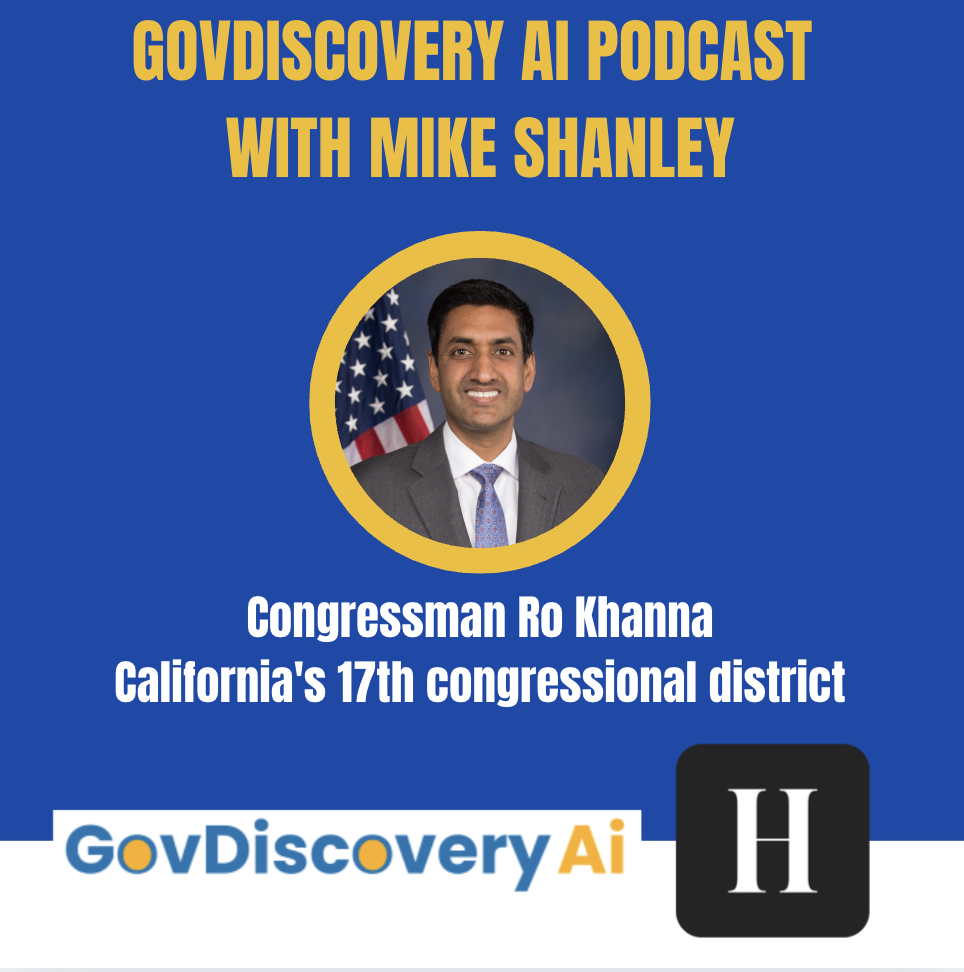
GovDiscovery AI Podcast with Mike Shanley
Ep. 62 Highland Institute - Interview with Representative Ro Khanna
01:01:55
In this inaugural episode from the Highland Institute for the Advancement of Humanity, co-hosted with GovDiscovery AI, hosts Kubs Lalchandani and Mike Shanley are joined by Congressman Ro Khanna (CA-17) for a powerful conversation on the future of...
Loading summary
Transcript93 lines
- [00:01]
A
I want to welcome our audience to the inaugural episode of our podcast put on by the Highland Institute for the Advancement of Humanity. The Highland Institute is a Boulder based think tank where elite knowledge becomes common knowledge. My name is Cubs Lal Chandani and I will be your host today. And we're very lucky as this episode is co hosted by gov Discovery AI podcast host hosted by Michael Shanley. And they have a lot of discussion of where the trends in funding occur for both foreign and domestic policy markets. And today with us is Ro Khanna, Congressman from the 17th congressional district in California encompassing Silicon Valley. And just to keep the congressman honest, we have three subject matter experts who are gonna pose some questions to the congressman on a little bit later in the show. Welcome to the podcast, Congressman.
- [01:03]
B
Thank you, Cubs. I'm honored that I'm your first guest. I'll. I'll try to set the bar appropriately.
- [01:10]
A
We're starting very strong now. Did you get to Boulder okay? And just so you know, you're in good company because a lot of your fellow Californians make their way to Colorado. We see it all the time.
- [01:20]
B
Well, I love California, but it's. Colorado is a beautiful state. So I've come here and it's just a place with a great outdoors, horseback riding, whitewater rafting, skiing, but also a lot of culture and a lot of innovation, a lot of technology innovation, a lot of venture capital. We were just talking that you're getting the Sundance Festival to Boulder. So a lot of art. It's a great place and you've got a great representative. I have to say this not just because Joe Negus is one of my closest friends in Congress, but no one is more innovative, more thoughtful about the future of our country or the future of our party. He has lived the American dream, son of immigrants, and I think the world of him.
- [02:05]
A
I can tell you universally for us here in Boulder, we love our congressman and Joe Nick Hughes, he does wonderful, wonderful things. Before we get going with some question and answers, I want to give you an opportunity to introduce yourself. For those who don't know, Ro Khanna, Congressman from California. Who are you?
- [02:21]
B
Well, I'm a son of immigrants. My grandfather spent four years in jail as part of Gandhi's independence movement in the 1930s and 1940s. My parents came here in the 1960s. At the time, John F. Kennedy said, go to the moon and we were the place to be America. We were humming, we were moving, we were filled with the confidence. And I was born in Philadelphia in 1976, our bicentenary. I grew up in Bucks County, Pennsylvania, a place that was largely 99% white. But I had teachers who believed in me, Little League coaches who believed in me even though I couldn't hit for anything. And just a place I had. My local essays often would be published in the Bucks County Courier Times. And I grew up believing that you could do anything in America. That this was a place where someone, if they had passion and wanted to work hard, could do anything. And then I had a long circuitous journey with failures and successes. But at the age of 40, after working in the Obama administration, this country elected me to represent Silicon Valley. $14 trillion of market value. More wealth has been created in this zip code, arguably than any place in in history. Five companies of over a trillion dollars in a 50 mile radius. Google, Apple, Tesla, Nvidia and Broadcom. And a lot of my work has been called economic patriotism. How do we bring modern wealth generation, modern jobs to every community, to every family? How do we tackle the economic inequality that is tearing this country apart and make our top mission the economic independence and success of every family and community in the country?
- [04:10]
A
You know, I've heard you say that term new economic patriotism, and we're going to come to that. But I wanted to start with the hardest question that I think I could pose to you. Eagles 49ers.
- [04:21]
B
Well, I am a 49ers fan. The Levi Levi's Stadium is in my, in my district. We've off off to a little tough start with all the injuries, but we've got a good team. But I still root for the Phillies because I grew up going to the vet a lot as a kid and so Phillies are great this year and so I'll go catch a Phillies game every summer. But clearly a 49ers fan.
- [04:47]
A
I think that explains why he's such a good politician. So let's jump into it. I think we have to start with the moment of the day is what are the levers that are driving this shutdown and how and when is it going to end?
- [05:01]
B
The shutdown is first of all a Trump creation because they have the votes. All these people who say the Democrats have no power, we don't hear the Democrats. You can't say the Democrats are invisible and then say the Democrats are obstructing government. The reality is the Republicans have the White House, the Republicans have the Senate and the Republicans have the House. They could pass any budget they want. They can get rid of the filibuster. I've been calling for getting rid of the filibuster for years. And they have gotten rid of the filibuster when it comes to approving Trump's appointments to the, to the administration. So they have the votes. Now they want Democratic votes because they want some cover for the budget. Well, we're saying, okay, if you want Democratic votes, you cannot have people's health care premiums double by the end of the year. And that's what would happen if they cut the tax credits for anyone who gets health care on the exchanges. 24 million Americans would lose health care or see their health care premiums double. And our ask has been very simple. Make sure if you want Democratic votes, that you actually extend these tax credits, you don't cut them, and that you agree that what Congress passes, you will agree, abide by. Because Trump is basically saying, I don't have to listen to Congress. So, well, what does it matter then if you vote for a budget if Trump's going to disregard it? That is really the crux of the debate.
- [06:23]
A
So game it out for me. How does this come to an end?
- [06:27]
B
I believe they're going to extend the credits because I don't think that they believe we should be doubling Americans health care costs. It wouldn't be good politics for them into the midterm elections. And they're going to see that. And so my belief is that they will concede and we will get these credits extended. But, you know, with Trump, it's impossible to game anything out with certainty, but that would be my guess.
- [06:54]
A
That's incredible. So you mentioned that they could get rid of the filibuster. Why are they not doing that?
- [07:01]
B
That's institutional inertia. I had called for getting rid of the filibuster when President Biden was president. We would have gotten a living wage passed. We didn't get a increase in the living wage because of the filibuster. The minimum wage is still stuck at $7.25 because of a couple senators. We couldn't get the Voting Rights act passed. JOHN Lewis VOTING RIGHTS ACT because of these senators. We could not get a lot of the President's agenda on childcare passed because of a couple senators. And the reality is that this filibuster was never originally in the Constitution. It's been adopted. It was adopted in large part to slow down the progress of, of civil rights legislation in the 1940s, 1950s, 1960s used to kill advancements in civil rights legislation. It's a vestige of Jim Crow and it should not be there.
- [07:51]
A
Wow, that is a unique answer for Sure. I have not heard that. Watching the news and watching the coverage of the shutdown. Let's move on to your economic view for the future. You talk about the new economic patriotism. What is it that, what does it look like if it was implemented in 20 years from now in America? And I think if you could answer this aspect of the question is who loses in that vision? I feel like there's always lose losers when something changes that drastically in economics. Who loses in that vision?
- [08:24]
B
Well, the billionaires will have to pay more tax and people who are very wealthy will have to pay more tax. So I suppose they would be the losers in a, in a short term sense, but in a long term sense we would have a much more cohesive, vibrant country. The reality is we've gone from 53rd in income inequality in the world to 128th. China is in the 70s and you've had wealth pile up in districts like mine, more wealth than ever before. And we're going to have more wealth created in the next 20 years than ever before with the AI revolution. You've had places like Johnstown, Pennsylvania, western Pennsylvania that made more steel than Japan and Germany combined in World War II, totally hollowed out Warren, Ohio, hollowed out Milwaukee, hollowed out deindustrialized communities for the past 40 years. No one cared about them. They were abandoned, industry left. And we have created a country with extraordinary regional inequality and extraordinary economic inequality amongst the billionaires and working families. So economic patriotism says that we cannot be a nation half prosperous and half in decline, that we need to rebuild modern industry. But it's not going to be the factories of the 1950s or 1960s. These are going to be modern factories and steel and ships and semiconductors that use AI, that use technology. But it's not just going to be advanced manufacturing. We're also going to have trade schools because a thousand new trade schools across America because plumbers and electricians, those jobs aren't going to be replaced by robots. We're going to have AI Academy so people can understand how to take an AI and have an agent that helps their small business expand, helps do digital marketing, helps with economic job creation. We're going to invest in health care because that's a large growth of jobs and education. We're going to have a Marshall Plan, not for Europe, a Marshall Plan for America. And we're going to have a White House Economic Development Council where the economic success of every community and every family is the morning, afternoon, evening priority of the United States. That and partnering with local Leaders. So I would hope we would have a Kennedy esque again sense in America where we're building things across the country, where we're creating economic value, where there's a sense of hope in the American dream again. So just for those of you who.
- [10:46]
A
Have not heard the term economic patriotism in a nutshell, how would you describe it in a couple sentences?
- [10:53]
B
It's about making sure that the vitality of every part of our country is contributing right now. I say it's about tackling the economic divides that are tearing this country apart and having a mission to unleash the potential of every community and every American to build things and contribute things. The opposite of economic patriotism is a globalization that has led to, to the kind of divides we see, which is it enriched and created value for a small group of people, people who have succeeded, but it has hollowed out a lot of the working class, the middle class, and left people behind. Now, Trump came in and David Brooks said he asks all the right questions and has all the wrong answers. So he identified a problem that there's globalization run amok. Met factories offshore, met people losing jobs. But the reality is he's got 19th century solutions. I mean, I suppose if he was president at the times of James Polk, we would have had not just the Mexican American War, we would have had the Canada American War. But no one thinks that the answer to building modern wealth is to go conquer Canada or Greenland. And no one thinks the answer to building modern wealth is to tariff everything, including coffee, which we don't produce here. The answer to building modern wealth is to invest in communities in terms of their technology, in terms of their education, in terms of the modern factories, in terms of modern industry and modern services, and to actually focus on economic development. I think the Democratic Party should be the party that says we have a 21st century vision for economic success, to tackle the places that have been hollowed out.
- [12:43]
A
I appreciate you saying that because I wanted to jump into kind of an angle that you mentioned. You referenced that Trump had some good ideas, he wanted to move in the right direction, but his execution was poor. You are one of the lone congressmen or politicians in general, who I think takes a lot of pride in reaching across the aisle, finding common ground, and implementing solutions that could actually bring an end to the problems our country faces. This morning in the New York times, I think 70% of America said the divide we have cannot be overcome. What do you think?
- [13:19]
B
Of course it can be overcome. I believe that deep in my bones, because of my upbringing in Bucks County, Pennsylvania, where we now have a Republican member of Congress, and I work with him, Brian Fitzpatrick. But I believe, deep down, this is a country that's a decent country, that is a kind country. I used to say that money in politics is our biggest challenge. Now I believe extremism and hate is our biggest challenge. But the way to overcome it is by having leaders who are going to offer an alternative, aspirational, hopeful vision, not engage in just tit for tat. You know, they. They insult us, we put up a tweet insulting them. You know, if that's the politics, then of course we're going to be further divided. The Democrats need to say, yes, we're going to oppose Trump's lawlessness with every procedural tool. But. But we're not going to match rhetorical fire with fire, because all that's left with rhetorical fire when you match it with fire is ashes. As my colleague Emmanuel Cleaver says, what we need is an alternate vision, one that reminds this country that we are big as Americans, big in spirit. The type of spirit that FDR tapped into, that John F. Kennedy tapped into, that Ronald Reagan tapped into, that Barack Obama tapped into. One president has divided us in appeal to fear. And so many people in my party think that that's the model why he's going to be one of the most failed presidents. Why don't we look at presidents who inspired us, who moved us, And I think if we have that kind of vision with a new national purpose, we're going to want to put this ugly episode of Trumpism behind us and bring us together. I argue around economic patriotism, the unleashing of the potential of Americans. 70% of Americans think the American dream is dead. We need to provide a modern vision of how we're going to restore that dream. And in the modern economy.
- [15:03]
A
You talk about bringing manufacturing back onshore. Isn't that just a way of saying Americans are going to pay more for the goods that they want because our expenses here in this country cannot compete with the labor costs in other countries? So isn't the move towards a services economy where we build and execute services in this country and then buy our goods from places abroad where we. We can get them far cheaper?
- [15:31]
B
Well, we need to have both manufacturing and services. I just was in China, first bipartisan delegation to China since 2019, and we met with Premier Li Qiang. We met with their foreign minister, Wang Yi. We met with He Lafang, who's doing the. Their finance minister, basically doing the economic negotiations. China has 20% youth unemployment. The reason they have 20% youth unemployment is they have over indexed for just export manufacturing and totally under indexed for the services industry. So they have all these college graduates in STEM who don't want to work on a factory floor. They want to make the next dating app and China isn't doing that. And so they have a problem where they don't have manufacturing. We made the opposite mistake where we hollowed out all of our manufacturing, where we don't make masks in this country. We didn't make baby formula in this country. People saw that in Covid. How is it that we have our cars lying vacant on lots of. Because we don't have semiconductors to put in them. So a nation needs to have critical industries. That doesn't mean we need to build all our toys and all the coffee here. That's why Trump's policy is silly economically, because he wants autarky. He wants us to make everything that's not possible. But could we make advanced steel? Could we make certain critical components and critical industry? Absolutely. With AI and robotics, actually the production cost has gone down and modern technology is increasing in productivity can make manufacturing more competitive. And that re industrialization also is good for the environment because it has a low carbon footprint. But it is folly to think that that reindustrialization is going to be sufficient to create all the jobs. Manufacturing unemployment, I mean employment may go from 9 to 11% of GDP, which is good, which it was going in the right direction with Biden. He had created 800,000 new manufacturing jobs. By the way, Trump, we've lost 40,000 manufacturing jobs. But the point is those manufacturing jobs are going to be high paying and then they'll spend money in the community and that'll lead to more service jobs, that'll lead to more restaurants, to more dry cleaners, to roller masseuses, to more entertainment, to a vibrant downtown. And we at the same time need to be investing in the health care jobs that will be growing, in the technology jobs that will be growing, in the trades jobs that will be growing. So it can't be obsessed just with manufacturing. It has to be advanced manufacturing as a component of the economic diversification that is needed for a 21st century economy. This should be the central contrast with Donald Trump. Instead of just calling him names, which we've been doing for 10 years unsuccessfully, we should say we have a more inspiring and pragmatic economic vision for what this country needs and what communities need going forward.
- [18:24]
A
You know you mentioned our future is in technology and all that can be produced through that. I gotta ask you, I'm a crypto lawyer and so I gotta kind of go back a little bit and get your idea of how you viewed the crypto industry under the Biden administration. Administration. Is the world of Gary Gensler's legislation by enforcement gone? And is one of the prices we paid for that kind of the distance from the folks in your district who are trying to innovate with a new technology who got quite frankly, pushed back by the administration? And then conversely, how does that, you know, juxtapose against the fact that the biggest grift this White House has executed is using crypto and all of its tools and abilities to, you know, raise funds?
- [19:21]
B
Well, I'm a progressive who believes in entrepreneurship, innovation and technology. You need wealth generation innovation to be able to have a society. And then you need the progressive aspect to make sure everyone has the health care, child care, education, housing, to be able to succeed. So I'm not one of these progressives who says we don't want entrepreneurship or innovation. And that's why I was for crypto. I said try to understand blockchain and crypto. All it's saying is that we want to be able to decentralize the finance, that we want to be able to have self executing transactions. And if it's possible to now send money to Africa through crypto exchange, why isn't that a good thing? By the way, a lot of the other parts of the world trade on blockchain because they don't have access to the dollar. And we as an America should want to lead in making sure that our institutions are participating in that and that the dollar is reflected based on stablecoin. So, so we want to be participating in the democratization of the economy. We want to be open to a technology that could lower transaction costs, maybe lower the credit card fees that you pay when you buy a cup of coffee, lower the fees of closing a house sale or closing sales. And why being against crypto is like being against the iPhone. It's just a technology now. It needs to be properly regulated. It needs to. We may need to make sure that you, as an elected official, you shouldn't be able to have meme coins. So pass legislation saying as an elected official you shouldn't be able to have meme coins. You need to make sure that if you're introducing a stable coin that there's capital requirements, that it's matched one to one with a dollar. So you don't have algorithmic stablecoins that aren't matched with the dollar. But all of that means you need thoughtful legislation. And unfortunately, there were elements of my own party that were hostile to technology and innovation. And the reason they were hostile is they sold as well. They said it's unfair and it is unfair. It is unfair that there's $14 trillion in my district and there are other communities where the American dream is totally dead. But the solution to that is not to be anti technology. It is to have the appropriate taxation on on wealth. And it is to make sure that we are creating economic opportunity in communities that have been left out.
- [21:57]
A
Along those exact same lines, should members of Congress be barred from trading stocks?
- [22:02]
B
Absolutely. I have led on that. I've led on that. I've led on banning members of Congress from taking PAC money. I've led on term limits. I've led on members of Congress not being able to engage in the kind of super PAC fundraising they have. We need a political reform agenda. And by the way, it should apply to the Supreme Court. We need term limits for Supreme Court justices.
- [22:30]
A
You have been in the House when Democrats controlled the House, the Senate and the White House. Why didn't it get done then?
- [22:37]
B
It's a very hard lift to have political reform. And I've been co sponsor of the Trust act, which would have been members from trading stock. I founded the no Pact Caucus that would be bar members of Congress from having PAC money. I'm one of 10 members of Congress that doesn't take PAC money, doesn't take lobbyist money. I founded and supported the effort to get other members not to do that. I've called for term limits for Supreme Court justices 18 years. But these are hard things. And I've said that members of Congress shouldn't become lobbyists. We should ban that. I think that a political reform agenda against the rot in Washington is one of the things that the country wants. But we need a turnover. We need a new generation in Congress who's going to fight for these things.
- [23:30]
A
Okay, I want to turn abroad. I think you've given us some great insight into how you think of the domestic policy of the country. Looking abroad, I want to turn first to. To the conflict in Gaza. You were one of the first people to come out and say that there should be a ceasefire when others wouldn't. What was the tipping point for you?
- [23:50]
B
It was a few months in. Obviously October 7th was a horrific terrorist attack. And I initially said that Israel has a right to defend itself and a right to get the Hamas perpetrators. And I saw for a couple months that they were fighting. But then Two and a half months into it, the bombing became indiscriminate. President Biden had a deal where the hostages initially were released, the initial round. And I said, okay, that shows diplomacy can work at this point. We need a ceasefire. That was three months into the conflict. It's been now nearly two years. And you've had 60,000 killed in Gaza. Anytime you give that number, people say, well, some of them were combatants. Let's stipulate 20,000 of them were combatants. You still have 40,000 killed, many of them women and children. You have life expectancy, according to the United nations in Gaza. It's gone from 75 years to 40 years. You have famine there. And it is just horrific what is going on. And so I have said that we need to end the war. We shouldn't be giving Israel military sales right now which are being used to kill civilians until the war ends. And we need a two state solution. And I led my own members of Congress to say it's time for the United States to follow France, to follow England, to follow Canada, to follow every other permanent Security Council member and recognize a Palestinian state, a Palestinian state free of Hamas, demilitarized, that recognizes Israel as a Jewish democratic homeland. That is the only way forward in that region. We need a new generation to help bring peace in the Middle East.
- [25:29]
A
I think it's a good moment to bring Mike Shanley and to kind of follow up on this discussion. Mike, did you have a question for the Congressman?
- [25:35]
C
Yeah.
- [25:35]
A
Thanks.
- [25:36]
C
Congressman.
- [25:36]
B
Hi, Mike. Hi.
- [25:37]
C
Good to see you. Thank you for being here today. So, on the Theo Vaughan podcast, you guys talked about how the world wants America to be the good people with the America first policies. We've seen the elimination of usaid, the cuts to the State Department, and a pullback from multilateral partners like the UN and NATO. Roh, what foreign policy tools do you think America should invest in? Not just to promote American interests abroad, but also to make sure Americans here at home feel the benefit of that global engagement?
- [26:08]
B
That's a great question. We build goodwill by engaging in the world. Right now, we're letting China do that through the Belt and Road Initiative. We should be part of partnering with Africa, for example, in the economic development, helping them partner to build technology, to build innovation, to build venture capital, to be part of AI so that they see that the partnership with America is helping their people. And that's in our interest because it's helping us build allies. I mean, we're not going to be the biggest country in the world. So what has been America's secret that we're the moral leader of the world. We're engaged in building allies. We need to be a more honest broker in the Middle east for peace and just peace. Because right now, China is getting a lot of the global south saying, look, America is a pariah on that issue. We need to recognize and stand up for women's rights and for primary education, children's education, and take on global poverty. Those are the things. Not just because it's who we are as a people, people that believe in the intrinsic worth of every human being, but because America being a moral leader in the world helps us build the alliances to make sure we remain the world's superpower and don't cede that leadership to China or another country.
- [27:32]
A
Great.
- [27:33]
C
Thank you. And then how do you feel? How can we make Americans here at home? Or how can they feel the benefit? Or what should that benefit look like if that policy is successful?
- [27:42]
B
Well, first of all, the benefit is just a sense of commitment to our ideals. Not everything. Everything Trump does is transactional. But Americans aren't just transactional. I was reading yesterday about a guy who was going and mowing the lawns of every Gold Star family because he wants to do something for families that have lost someone in combat. There's people who die for this country. They don't die for transactions. They die for the principle of freedom. There are people who have built this country on principles. And so part of what America's engagement in the world is that we believe in human rights. We are the nation of freedom. We are a nation that wants to see justice around the world, and that's who we are as a people beyond our material benefits. But the benefits to America from a material perspective is, is if we have more alliances, we're going to be less likely to get into war. And that's going to hurt the American economy. It's going to be a drain on our resources. And if we have more alliances, there'll be more people willing to buy our products. That's going to help America's economy and make us the lead market in the world.
- [28:53]
D
Congressman Rocona, thank you so much for being with us here this morning. My name is Maria Brink. I'm a leadership consultant and an author of the Leadership we need to. I saved you a copy.
- [29:04]
B
Thank you.
- [29:05]
D
I would like to ask you, with the gap between the human power and our human wisdom growing every day, what is your biggest fear for the future of this country? And how do we stay clear with the clouds ahead?
- [29:28]
B
Well, it's a beautiful question. How we can make sure human wisdom, human empathy, human values are shaping technology because our human power has increased dramatically and will with AI and machines and the capacity to build things. If we don't have human centric decision making, the risk is that that technology will be used to divide us with algorithms that cause hate, that it can be used to take away people's freedom and if it's used to incarcerate people, take away their finances, if it's used in banking decisions, take away their life, if it's used in medical decisions without human wisdom, or take away their life in military decisions. And, and that's why I believe that human beings need to be in charge and we need legislation saying in AI systems we need a human decision making and that in schooling, yes, I want people to learn AI, but I want them to learn the humanities, to be reading literature and reading philosophy and poetry and understanding what constitutes a good human life and making sure that we remember that and learn from that so that we are applying that to the. To technology.
- [30:55]
A
Let me ask you a question. It's one thing to say to implement those kinds of controls in this country, but how do we police the world to make sure that that's not happening abroad where AI is given full discretion?
- [31:09]
B
Well, that's why American leadership matters and another reason why we need to have these partnerships and alliances with countries around the world so we can have an international treaty. And it's one of the things we need to deal with China. That's why we can't just wish China away. I mean, my Republican colleague said, don't visit China. For six years, we haven't been able to go to China. We led this groundbreaking trip. I said, china's not disappearing. You know, we're not going to just vanish China. We've got to engage in just like we've had other international treaties on the Paris Accords, on climate or on nuclear arms with the national non. The Non Proliferation Treaty. We need a AI treaty, an AI convention that. That helps create standards so that the vast majority of the world has standards for the type of AI use that you will have. And even if you have open source, anyone can get AI, it still requires a lot of compute power. And that compute power can be regulated by nation states.
- [32:06]
A
As you reference broader international relations. I wanted to take the opportunity to bring Doug Gardner into the conversation. Doug, can you say who you are and then kind of continue the discussion of where we are with our relations abroad?
- [32:21]
E
Congressman Khanna, like my colleagues, I want to say welcome, and I also want to say thank you for your service.
- [32:27]
B
Thank you.
- [32:27]
E
It's not easy to be a congressman, and I've really enjoyed hearing your thoughts and ideas, not only about the United States, but the world. I have worked for the United nations for 30 years and was the UN Resident Coordinator in Ukraine, living in Kiev for four years, 2000 to 2004. I'm also serving now as the Director of the Highland Institute. Just a quick word on the UN we as a country have had high aspirations. These have been very much embodied in the United nations as well, the UN Charter, the Universal Declaration of Human Rights. And the US has been a leader of the free world, not because of military and economic might, but because of principles of democracy, support for human rights, interest in climate change, in the environment. I wanted to share those thoughts on UN and then drill them down into a country that I served in, Ukraine. When Vladimir Putin invaded Ukraine, he was breaking one of the fundamental points of international law. Crossing the sovereign borders of another country, killing people in hospitals. He's now an indicted war criminal. I'd like your thoughts, Congressman, in terms of, after all of these negotiations going here and going there, how might this conflict best be solved? And is there a timeline on it? Because this country has done everything humanly imaginable. They have shown resilience. They've shown will. But they're tired and they're traumatized, and it's time for the war to end. And I'm just wondering, Congressman, if you could share with us your ideas both on the value of the United nations and how that can then lead into ending the war in Ukraine.
- [34:15]
B
Well, thank you for that question, and I appreciate your service in Ukraine. I appreciate the flag lapel with the U.S. ukraine alliance. And you started with the right principle. But Putin committed a war crime, both in how he's prosecuting the war, but in invading another sovereign nation. And if we don't stand up to Putin, then we're basically telling China, go invade Taiwan. Then we're basically telling other powerful countries, you can do whatever you want in taking land. We have to stand for the principle that a sovereign nation's territorial integrity needs to be respected. You could go back in history and talk about times where any country, big power, has invaded other countries. But the whole point post World War II of the United nations and the international order was we said, those that led to world wars, we're never going to allow that again. And that is why I have been an unapologetic supporter of aid to Ukraine and Ukraine standing up for its own territorial sovereignty. At the same Time. I've said that there needs to be dialogue that the United States and the UN Lead between Vladimir Putin and Zelenskyy, because ultimately, you can't just have a war with no end. You need diplomacy, you need statesmanship. And that needs to be a just peace. It needs to be Putin withdrawing from the territories that he had and us having some guarantee to Ukraine for their security so that they are assured that Russia, with a sense of loss of its place, is not going to continue to try to take more and more of Ukrainian territory or to reconstitute the Soviet Union with Eastern Europe. And ultimately, we need the Ukrainians to be in charge of saying what type of peace they are prepared to live with. But the United States should both be providing that kind of support and in facilitating diplomacy at the same time. The problem with the Trump administration has been you've had J.D. vance lecturing Zelensky in a very embarrassing way in the Oval Office, undermining the Ukrainian resolve and fight. And you've had Trump standing with Putin, which I have no problem with, that he's meeting him, but not willing to say, putin, you were wrong in invading Ukraine, and that's the start of the war. So we need honesty as the basis of diplomacy.
- [36:53]
A
How does this come to a resolution?
- [36:55]
B
Well, it comes to a resolution through painstaking diplomacy where we continue to stand with Ukraine, Europe continues to stand with Ukraine. Putin, who's lost hundreds of thousands of soldiers, realizes that this is not in his nation's interest, that we work with China and India and the world to put pressure to start to isolate Putin. This is another reason we have to engage with India and China and can't just be blanket in our tariffs and in our antagonizing everyone, because we're actually allowing Putin to reemerge with Xi Jinping and Modi. We need to isolate Putin, have a coalition of the world stand with Ukraine, and then bring our diplomatic pressure to end the war. You know, President Bush Sr. Actually did that in the Gulf War, in the First World Gulf War, where he had all of the nations coalesce in a multilateral coalition. That's what made it successful. And this is the limitation of America first. When it's America alone, we're not going to be able to bear the diplomatic pressure that is required to bring the war to an end.
- [38:02]
A
Mike, let me get your thoughts on this.
- [38:03]
C
Yeah, thank you, Congressman, as a former Peace Corps volunteer in Ukraine, thank you very much for your support as well. On behalf of all the Ukrainians I know, thank you very much for That I have a question on the defense of Ukraine and broader America's defense strategy. You're obviously the congressman and the representative for Silicon Valley. What role do you want to see? Well, we've seen an increased interest among the tech firms in investing in the defense market participating there. On our podcast, we had on scale AI that had the talked about their $13 billion investment from Meta. What do you hope to see is the role of the tech companies and the innovation in America's defense strategy?
- [38:43]
B
Well, I'm the ranking member for Emerging Technology and Innovation on the House Armed Services Committee. I've served on the Armed Services Committee for nine years. And we need to have a modernized Defense Department. In any conflict, for example, in the Pacific, you're not just going to need aircraft carriers or submarines. You're going to need attritable drones that can do things on scale. We're seeing that in the Ukraine war, the use of drones, the use of advanced technology, and AI, the use of autonomous ships. We need to make sure that the United States is leading in adopting AI, adopting drone technology, adopting attritable and autonomous vehicles and machinery that are going to win the 21st century battlefield. And I have been a leading champion of making it easier for the Department of Defense to procure the new technologies so that it's not all going into legacy industries. I had an Amendment that said 15% of the defense Department spending should be for emergency for emerging technologies and new technologies. And I have pushed for the Armed Services Committee to do hearings, which we did in Silicon Valley, to start to be exposed to all of the work of the emerging tech companies which are needed to modernize our military.
- [40:12]
A
You mentioned technologies and the push to innovate. One of the questions that kind of brings to my mind is, you know, it used to be perceived. Whether it's true or not, I don't know. But it used to be perceived that the mainstream media was liberal. I think we can, you know, very concretely say that is no longer the case. You look at talk show radio host, you look at cable, and you look at new media like TikTok now all kind of in the hands of the more conservative members of the parties. How did that happen? And is there a way to get to a balanced diet of media information?
- [40:55]
B
Well, I think the conservatives felt that the networks were biased towards the left. I always thought a lot of them called it down the middle, like Peter Jennings and Tom Brauka and Dan Rather, who I grew up with, but they thought that the mainstream media was tilted to the left. And so they had a huge investment in cable news and talk show radio, in digital organizing, and the Democrats and the left were a bit complacent. We did not make those kind of investments. Maybe we didn't feel as aggrieved by the mainstream media and so we are now playing catch up. But there are now a lot of new podcasters emerging on the left and influencers emerging on the left. Midaya's Touch Brian Tyler Cohen Jack who's this Columbia student who's doing it. I'm excited about some of the new voices that are emerging and we need to build that infrastructure on our side. Then we need to make sure that we have regulations on these social media companies for algorithmic transparency, for not putting their finger on the scale in viewpoint suppression of speech.
- [42:07]
A
Is there an appetite for that? I feel like now that the more conservative members of the of Congress have this kind of influence and with the soon to be right owned TikTok here in the US is that even possible? I feel like once you have the power, it's pretty hard to get them to give it up.
- [42:29]
B
I think it's an uphill challenge, but I think what we need is capital investment and alternative media in the United States and then we need antitrust enforcement to say you can't just have monopolies in these areas. I mean, it was a big mistake in my view, to have Facebook combined with WhatsApp and Instagram and you just have this one dominant player. It would be a big mistake if TikTok becomes a dominant player like X, where it's only one platform with network effects that are skewed algorithmically. At the very least, we need disclosure of those algorithms so people know whether there's bias and and can challenge it. But this is a place where we need both antitrust laws, we need data privacy laws, and we need laws about disclosing what these algorithms are for the public.
- [43:15]
A
You know, I think what you say sounds very logical. It's hard to kind of take it and believe this is a possibility. When you see TikTok. Basically, you know, the new owners will be dictated by the administration. There is a golden share in American Steel. The US owns 10% of intel, which then makes investments or investments are made in them and it feels like somebody is rigging the economy. So my question to you is, is what you're saying the legislative controls and limitations even possible in this atmosphere?
- [43:51]
B
Well, this administration has been lawless, so we definitely need to push back against them in all dimensions. I mean, they attack speech. The good news is that when we pushed back. Jimmy Kimmel was reinstated and Sinclair and Nexdar folded. So it shows that when you have popular uprising, you can push back against the administration's overreach. We've seen that also with massed ICE agents. When communities have spoken up, they have been able to push back against the overreach of ice. So there are two different questions. One is an administration that is lawless and how do we push back against them? The other is how do we construct the rules for social media in a way that respects speech but allows for multiple platforms? So you don't want the government coming in and saying, well, here's what TikTok can show and not show, because you don't want the government dictating the algorithms, but you do want multiple platforms. So you don't just have TikTok and X, you have more options coming up. That's an antitrust question. You need to protect people's data. So TikTok isn't taking all your data and then generating hate and targeting people with the algorithms. You want to have algorithmic transparency. And we need those types of rules that bring some order to social media and also protection for our kids, like Online safety. Kids Online Safety act, which I've sponsored, which so many other countries have, and we don't.
- [45:19]
A
You know, you reference these acts that you would like to pursue. So I kind of want some inside baseball, you know, can you bring us inside the halls of Congress and tell us what is your relationship like with members of the opposing party? Is there a kind of camaraderie? Or is it what appears to us on the outside is just a dysfunctional group of people who cannot agree, cannot compromise and cannot, as a result, get anything done. Is your view different as somebody inside it?
- [45:52]
B
Well, it depends with who, but I've been one of the people who've had some success working across the aisle, most famously recently on the Epstein files. I've worked with Thomas Massie. There was a picture of Marjorie Taylor Greene giving me a hug on the front page of one of the D.C. newspapers.
- [46:09]
A
Was that good for your fundraising?
- [46:11]
B
Well, I don't know about that, but everywhere it was a human issue. And these young girls were raped at the age of 14. And we were hearing their testimony, and everyone was very emotional. But I've had, you know, we've gotten four Republicans on this discharge petition, and when Adelina Grijova from Arizona sworn in, we're going to have 218 signatures forcing a vote, forcing the Republican Congress probably to pass a bill to release the Files in opposition to Donald Trump. The first time anyone has led an effort for a Republican Congress to pass something against Donald Trump in either his first or second term. And then I'm working with Don Bacon to repeal the coffee tariff. I don't know if you. I drink coffee every morning. 99% of coffee is grown outside the United States, and yet we have a 50% tariff on it. Coffee has gone up 26 cents for one pot of coffee. 26%. I don't understand why we're taxing coffee. And so there are areas where you can find common ground.
- [47:08]
A
Well, if they would just let Bolsonaro out, I think that would fix it. Right. But I guess.
- [47:13]
B
Well, it's also Vietnam and Indonesia and Nicaragua.
- [47:16]
A
Can we interpret these two instances as canaries in the coal mine of Republicans finally pushing back against the administration, or this is just a blip in the. In the broader scheme of things?
- [47:30]
B
I think it's. There are cracks emerging. Cracks on. On transparency, with Trump having now become part of the very swamp he ran against. Cracks on the tariffs, which have slowed down the economy. Private sector jobs, we're losing. Now for the first time, people are sensing that the soybean farmers aren't being able to sell abroad. The farmers are being hurt. Prices are going up. Jobs are being lost on tariffs. There's some opposition on free speech. You had Ted Cruz speak out against what Brendan Carr did, but these are cracks. There's not yet a movement rejecting him. But the cracks matter. You know, they matter because Trump won not just with a MAGA base. He won independence. And if there are enough cracks, that will shift the independence towards us. I think Mikey Sherrill's race in New Jersey for Governor, Abigail Spanberger's race in Virginia will be good harbingers for how much work we need to do to continue to bring the independents to our side.
- [48:26]
A
I want to turn to your future. You know, you have become a very prominent member of the Democratic Party. You know, I think your opinion on policy issues is becoming incredibly influential. So I'm going to ask you a question, but hold your answer, because I want Maria to kind of talk and weigh in on values of leadership so that you can kind of take that into account when you give me your answer.
- [48:54]
B
All right.
- [48:55]
A
Do you have aspirations for higher office? And if not, why not? And if so, how do you convince Americans to follow your lead? Maria? Yeah.
- [49:09]
D
I would like to ask you what specific values do you feel a leader needs to honor to advance humanity?
- [49:22]
B
All the deep questions.
- [49:23]
A
I know it's tough, tough Room, not Beauvond.
- [49:27]
B
But it's tough, I think at this moment. First is courage. The courage to take viewpoints that your own party may disagree with, that big moneyed interests may disagree with, that you may pay a political price with. Because if you don't have courage, you're never going to be able to change the system and you're never going to be able to convince people you're going to be willing to take on the status quo. People often say we want strength in our leaders, but strength is not just chest thumping. Nelson Mandela had strength, Dr. King had strengthened. Gandhi, a petite individual had strength. Strength comes from a strength of convictions. There have been times in my life where I haven't lived up to courage, but the places where I've shown most courage is when I was a 27 year old young man and I ran against a 20 term incumbent member of Congress because I was opposed to the war in Iraq and opposed to the Patriot act in my own party. And I lost badly. But I was standing up for my principles. I did that in trying to stop the Yemen war and led with Bernie Sanders the first war powers resolution to stop it. I did that in speaking out very early on about not funding Netanyahu's war in Gaza when I saw the civilians that were being killed despite a lot of powerful groups coming after me. I did that in the Epstein files knowing that speaking out about that would get me the hate online hate of a lot of right wing folks. I'm being attacked these days by Laura Loomer and others because of my advocacy on peace in Gaza and the Epstein files. So I and I've done that in departing from my own party and places on free speech and places on crypto. So I think that conviction and courage is the most important. The second I think at this time is humility. We need to understand that the country is divided, that just because someone voted for Donald Trump does not make them a bad person, does not make them intrinsically racist or sexist or homophobic or xenophobic. That people are desperate for folks who are going to treat our fellow citizens with respect, who are going to listen, who are going to listen to why they have a sense of loss, a sense of anger and listen with a genuine empathy and understanding and trying to find common ground. One can hold one's convictions with courage while still having a humility of treating our fellow citizens with respect.
- [52:10]
A
Now the tough question, where does your career go from here?
- [52:14]
B
Well, it depends. I would like to have a bigger and bigger voice in the party and in the country, because I believe I have the right vision of economic patriotism and the right values of how we're going to stitch this country back together. You know, we can either keep going down a sense of loss and division, or we can try to reverse things. It seems to me the history of the world is a sense of loss. Because I was in China, they talk about the loss of the century of humiliation. India talks about the loss of colonialism. Russia talks about the loss of the Soviet empire. The Muslim world still talks about the loss of the Ottoman Empire and the loss of identity. The United States is grappling with a sense of loss, of a time where we were the only world superpower, in a sense, that the American dream is done and Europe is at a sense a loss of its grandeur. All of this loss can turn into a politics of grievance and anger, or we can offer a better way forward, a sense that we don't just turn loss into a sense of anger and grievance, but that we build something to restore pride in our world, in a modern world, that we can build economic vitality, that we can build together the first cohesive multiracial democracy in the history of the world. That that would be a civilizational achievement for America to lead a more just world than the 19th century, to move humanity forward. I believe that the values I'm talking about, the policies I'm talking about, can lead to that. Whether it's me in the quarterback role or in a different role, that's to be seen. And a lot of that depends on timing and circumstance. But the ideas I'm putting forward, I think, are the right ideas for the nation and for the world.
- [54:06]
A
So I want to kind of bring this back to earth a little bit. You are a leader in the Democratic Party. Let's just imagine it's just the opposition party for now. You know, there's a party driving this country's future right now, and you're a member of the opposition party. You know, if you were in charge of the party and all the steps it took that it can take to, you know, make it a bigger tent party, execute a messaging strategy that can cut through the muck, and actually start doing things to improve the lives of our fellow Americans, how would you do it?
- [54:44]
B
From the position we're in now, or.
- [54:46]
A
If we had power right now and you're in charge of the party?
- [54:49]
B
Well, right now I would focus far more on what our vision is going to be to improve the American dream for folks. How are we going to get people housing at an affordable rate? How are we going to make sure they go into debt for education? How do we make sure they don't have to go into debt for health care? How do we lower food prices because of tariffs? And then more broadly, how do we start to bring economic vitality, economic opportunity into every community so people have the access to high paying jobs and economic security? And what is our vision for that? And how do we make sure that we can get some group of Republicans that break off the to support that, to support building new modern steel plants in Pennsylvania or to support $10 a day childcare or to support taxing billionaires? I've never understood that. I have more billionaires in my district than anyone and I'm saying tax them. I don't understand how it's a hard vote for anyone else. But how do we build an agenda to tackle the economic inequality, to restore the American dream for folks to give this country a new national purpose? And that is based not on grievance and anger and division, but that is based on a belief that the 21st century is going to be better than the 20th century, that it's not going to be mired in that kind of division and loss, but it's going to build something affirmatively better for the nation and the world.
- [56:11]
A
Let me turn to Maria.
- [56:13]
D
Yeah. Speaking of making this world a better place, something we haven't addressed today and I would like to ask you about is climate change and transition to renewable energy. Obviously, President addressed the UN and called it a con job. We know or estimate right now that the transition to renewable energy is going to be a global economy, about $23 trillion by 2030. How is the United States of America going to stay relevant in the global economy and transition to renewable energy?
- [56:48]
B
Considering where we're at, it's a great question. Well, first of all, anyone who has lived in my state and seen the horrific wildfires knows that climate change is not a con job. Anyone who's seen the awful flooding that we've seen in the Midwest, the storms that we've seen and hurricanes and tornadoes in the Southeast, these are the impacts of climate change. It's the impact of hotter temperatures and drier conditions that are causing the cataclysmic events that are costing earth lives, costing us money. So we are already seeing the impact. It's not just a theoretical impact of something we'll have to deal with 10 years from now. We're seeing other countries take the lead. China has taken the lead on electric vehicles. And I was just there and saw Xiaomi's electric factory where they're making phones and electric cars. They've got tons of these factories that are innovating. Our own companies. Ford Motor Company CEOs going there to try to understand how we can be competitive. And what are we doing? We're taking away the electric vehicle tax credits. We're making Mary Barra actually backtrack on her commitment of transition to electric vehicles. We're taking away the solar tax credits that we passed, putting us further behind China when it comes to solar. We're basically handing solar electric vehicles and the battery technology to China, as opposed to saying we want to be leading the economy. It would be as if we were in a oil economy. And I said, you know what? The United States shouldn't develop oil. Let's just have the Middle east to all of it. And we did that for a while, and we suffered enormous consequences. Now, the United States is a great country capable of catching up, but every day, Trump is putting us at a bigger and bigger disadvantage in building the type of energy and the type of products that the world is going to want as a future. And this is really hurting America's economic preeminence.
- [58:51]
A
You know, we're going to wrap up here in a second, but I wanted to give you an opportunity to share a message that you would like to get across to the American people, the people of Boulder, the people of Colorado, the people of the United States, and the people of the world. What message would you like to share?
- [59:07]
B
Well, one. Thank you for being engaged. A lot of people say, I just am so disheartened. I'm so depressed with what's going on, I'm going to disengage. And so if they've listened this far, they're obviously very engaged in the world. And this is the time that people need activism the most, is the times when it's hard. You don't need political engagement when it's easy as much you need it when things are difficult. This is the time to double down on being involved. It does make a difference. We see it in the small things, like Jimmy Kimmel being reinstated. We see it in bigger things, like stopping the worst violations of human rights, of deportation. We see it in the Democrats now, thanks to the activism, having more spine and being willing to stand up to Donald Trump. But I believe that when you look at the history of this country, progress has never been easy. In some cases, it's required a brutal civil war, 600,000 dead. In other cases, it's required people being beaten and jailed in Jim Crow. But the country has an enormous capacity for self correction, for overcoming our more parochial sentiments, and for becoming a broader and more inclusive democracy. When I often say America is making progress in spite of ourselves, some people say are so disheartened that Kamala Harris, an African American Indian American woman, lost the presidency. And I was too. But then I thought, wow, she got 48% in Pennsylvania. And when I was growing up in the 1980s, even though I had a wonderful childhood, if you had told me that an African American woman, an Indian American woman would get 48% and be the Democratic nominee, I would have thought you were crazy. We have a new generation that is coming in this country. It is a place where we have people from across the world. We're trying to do something no nation has ever done. Of course it's going to be difficult, but I believe if we engage, we will build a cohesive, multiracial democracy and make our mark on history.
- [61:12]
A
Profound words from the congressman. I want to thank you for taking the time to come to Boulder. We very much appreciate it. We very much appreciate all that you do for the country and, and your service. I want to thank Mike Shanley, Marie Brink, and Doug Gardner, as well as our crew, Dustin Cena, Stephanie Artem, and will. Thank you for doing this. You know, the Highland Institute for the Advancement of Humanity is built on the idea that we can foster and catalyze ideas that deepens awareness and results in concrete, actionable, positive outcomes. And that's what we're trying to do here. Thank you for taking the time. This has been episode one and we will be back. Thank you.
- [61:52]
B
Thank you.
- [61:53]
A
Thank you, sir.
- [61:54]
B
Appreciate it.
- [61:54]
A
Appreciate it.