← GovDiscovery AI Podcast with Mike Shanley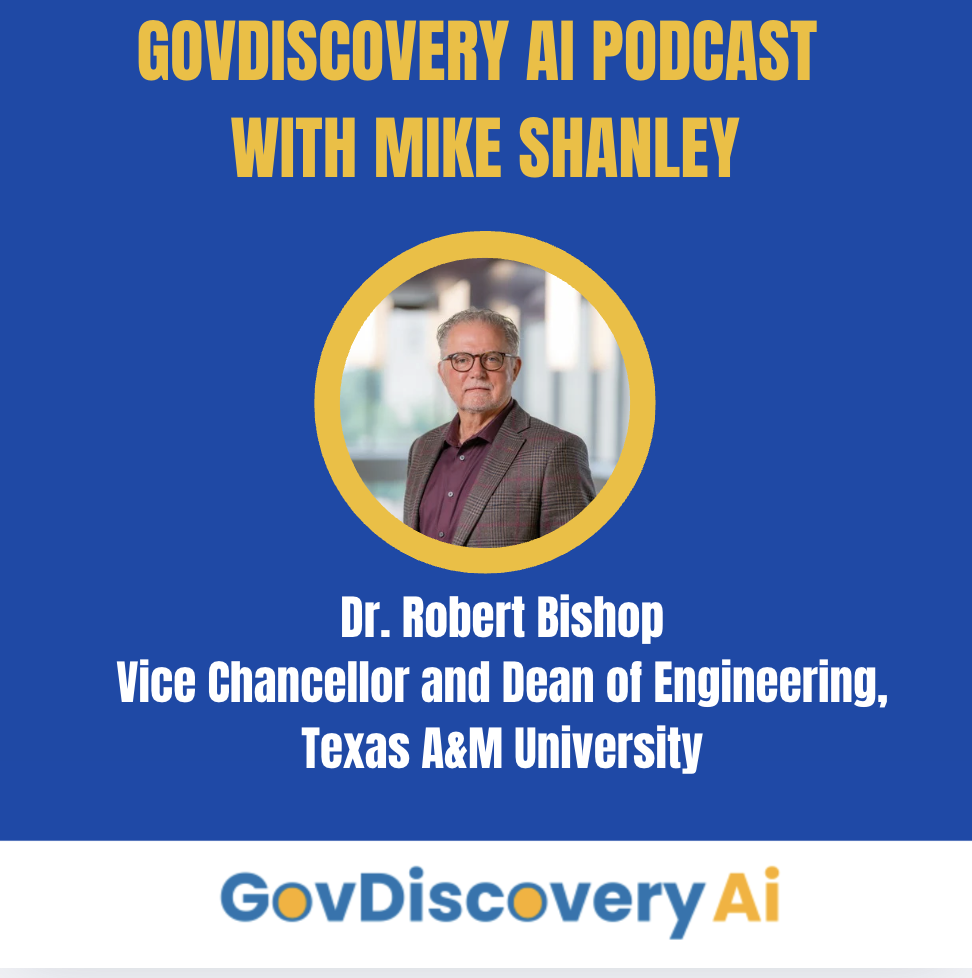
GovDiscovery AI Podcast with Mike Shanley
Ep. 63 The Role of Academia in National Security
00:36:09
In this episode of the GovDiscovery AI Podcast, Mike Shanley sits down with Dr. Robert Bishop, Vice Chancellor and Dean of Engineering at Texas A&M University, to discuss how universities can accelerate innovation for the Department of War. They...
Loading summary
Transcript47 lines
- [00:00]
A
Welcome to the govdiscovery AI Podcast with Mike Shanley, your source for actionable insight into government markets and foreign policy. Gov Discovery AI leverages a decade of experience winning federal funding to deliver intel to sales proposal and capture teams working in defense and civilian markets. Now, here's your host, Mike Shanley.
- [00:20]
B
Welcome to the GovDiscovery AI podcast. Our guest today is Dr. Robert Bishop, Vice Chancellor and Dean of Engineering at Texas A and M University. We're going to talk about the role of academia in the Department of Defense market, as well as ways that they can contribute to innovation R and D and support the department's priorities. With that, Bobby, great to have you on the podcast. Thanks for joining us today.
- [00:50]
C
Thank you for having me. Looking forward to our talk.
- [00:52]
B
Well, let's get right into it. In our prep sessions, we talked about the new model for academia and DoD R&D. Could you start by laying the, maybe the context for our conversation today and talk a little bit about that model?
- [01:08]
C
So a new model is really required to move forward, in my opinion, because here's why. First of all, in this new model, we cannot forget the impact of basic research because that really is what's going to differentiate us and keep us superior in the technology arena. So that said, we need to be able to be more nimble, more agile. So here's the challenge. The challenge is that there's two ways that our projects slow down. One is with the government because they're slow, and two is with academia because we're slow. So how can we think about moving the acquisition process ahead faster? And in order to do that, you need a new model. The models that we have currently through the university systems are just slow and cumbersome and for good reason. Okay. However, we need to think about how can we create a more contract focused model rather than grants. How can we look at the federal acquisition regulations associated with commercial rather than with academic? And here's how you do it. You create a 501C3 inside the university. It's a nonprofit. It reports to the president or chancellor. It's still a university entity, which means that the customers, which would be the, you know, folks in the Department of War or others in industry, have access to the wide range of intellectual firepower at the university. Okay, not just engineering, but sciences and so forth. But we have to be able to deliver on time and on budget. And that's something that, you know, typically we haven't been that good at. We need to sign those contracts much faster. So, yes, I think that the standard ways of doing things should remain. But we need new. I believe strongly that we need some new thinking. And this is the idea that I'm projecting and proposing and working on here.
- [03:15]
B
Yeah, that's interesting. People think innovation, R and D, new models and think a new, a new technology, a new approach. But this is really on the contracting side, on the administrative side. How do you make it just. And I've been on that side back when I worked at a large national security contractor on working with universities and really wanting to get them on, say a consortium at the capture phase, but just struggling with the timeline of, hey, this has to get done on Friday, but, but maybe someone's out. So I've experienced that from the contracting side of it. Let's get into then maybe starting on the university perspective. Bobby. So for other universities listening to this that want to engage more with the Department of War in the US Defense market, what are some things they should think about? What are some steps they should consider taking to better position themselves as a partner for the Department of War?
- [04:09]
C
I believe very strongly that they need to create an entity within the university that, that continues to give the folks, the customers, access to the, like I said, to the intellectual firepower of the university. But it needs to be much more business focused. And, you know, we're very good right now at connecting our researchers with, let's say, the Dow system folks, you know, the project managers. But we need to get much closer to the users of the technology. We need to get down to the front line. We need to get to the war fighters themselves. And typically that's not done in the construct that we have today. But with this notion that I'm talking about, which is here, we're calling it the Inspire Alliance. We use the word alliance because we admit that as big as Texas A and M is and as broad as our research is, we simply can't do everything. However, what we can do is close the gap in the time it takes for a need and a product or a service. And we can do that by bringing in other universities into the alliance and flow down all the requirements beforehand so that when somebody at, you know, you name it, Army, Navy, Special Operations, whatever comes and says I need quickly this result or I need this product, we can all we have already flowed all the, you know, requirements down. We don't have to worry about publications because we can restrict those because we're a 501C3. And so I think universities need to think about that as now it's a change. Okay, Mike. So, you know, most Universities, as much as I love academia, we are slow to change because when we change, there is a sense of loss, perceived and real, and we have to manage that sense of loss. But I always feel like, you know, you're going to access opportunities that you would not access otherwise. And by the way, everything I said to connect to the D O W also helps us connect to industry. Right. You know, how many times has industry come to academia and said I want to sign an NDA and by the time we sign it, they're gone, they've lost interest. We need to address those issues. So the technical issues are important, but the administrative and acquisition issues are just as important.
- [06:40]
B
So you talk about engaging directly with the user, the war fighter in the department. Two part question then, as a former military school, do you think A and M is uniquely positioned to do that? And, and then I see that as really two step process for a university that does not have the deep connections with the departments, both connecting to that warfighter, then making sure you have someone in your team to speak their language and really understand how to have that conversation to inform if it's product development or whatever the activity is that the university's gonna take on. Could you share a bit more your thoughts on that?
- [07:16]
C
Texas A and M is not uniquely positioned, but we are well positioned. Okay, so other universities, there are quite a few universities that have strong connections to, you know, to defending our country and those that don't, I would say it's not a major challenge. I mean there are retired colonels, there are retired generals. There's all kinds of opportunities out there to bring folks into the fold who knows how to deal with that, especially the acquisition folks. The war fighter is critically important to know what their needs are, but it's also very important to understand the acquisition process, which is not readily, it's opaque in many cases. I wouldn't say we're unique. I say having our military history certainly helps us. Having the corps of cadets is a major positive for us and for me. But it's not, doesn't make us unique, it just makes us well positioned.
- [08:24]
B
One thing that may make you unique is talking is having a SCIF on campus. Could you talk a little bit about that? And maybe the, as a university might think through maybe how unique that is, that you all have that and what that would take as a university thinks the cost benefit of making that investment on their campus.
- [08:46]
C
So some of the projects that we're working on. Right, like take for example hypersonics, I mean that's not wide open all right. There are aspects of that that are classified. There are aspects of that that are cui. Not classified, but nevertheless protected. So this is what the beauty of something like the Inspire alliance is, is that we're formed to do that kind of work. We can. We don't have to only do that kind of work. In fact, most of our work will not be classified. But having a facility on the campus or near the campus is critically important because you need to have conversations. You need to understand what's going on behind the wire so that you can guide your research in the right direction. So, you know, I will also say this. You don't build a SCIF and hope they come. This is not the field of dreams. You need to have a sponsor. You need to have a reason for that facility, and then you can move forward with it. So I do not recommend building a SCIF and hoping that people will show up. You need to have that reason first. And I believe that capability does help put you forward in a way that other universities that don't have them won't be able to do.
- [10:02]
B
Let's talk now about the role of the federal funding. What role do you see, or would you like to see that playing? Both on the. Sure, there's direct funding for R D at a university, but there can also be preparedness funding for enhancing the resilience of the American industrial base. What would you like to see for defense spending in terms of overhead preparedness for universities, direct funding and R and D, where do you think it is most effectively spent or divvied up?
- [10:40]
C
Two areas. The first area has to do with facilities. So the facilities that we're talking about, you know, are quite expensive and many industry folks cannot afford them. Okay. So take our hypersonic wind tunnels, for example. Some of the best in the world. Making those accessible to industry, I think, is something that. That is very important for us to be able to do. I think that federal funding and state funding for that purpose is very valuable. It helps us have these. Create these shared facilities. The second thing is workforce development. Okay. So that's one of the areas that we do quite well in academia, not only with our students, but also with those who have left school, graduated, and are in industry and need to enhance their knowledge with, you know, with various ways to. To look at, you know, electronic badges or all the different types of workshops. So that's an area that I believe is really important for the feds to help us out with, because at the end of the day, right, all these facilities, all this technology there have to be engineers and technicians and business folks and everybody on board. And so we need their help in order to do that.
- [11:59]
B
Let's get into the specifics of hypersonics and glide vehicles that you all are doing at Texas A and M. Could you talk in a little bit more detail about that?
- [12:10]
C
There's three aspects of the problem. The way I see it now, I'm not talking about Golden Dome. We can talk about that in a moment. But just. So the first is the experimental part. You need the hypersonic tunnels. And we have a large award from the state to build two large hypersonic tunnels. They're in construction now. These are tunnels big enough to basically stand in. These aren't the small hypersonic tunnels. Right. State of the art. We also have accomplished at least one hypersonic flight test, and we have another one that we have funding for. So from the flight test to the experiment. But here's what's been missing. That's the computational firepower in between those two areas. So we need to be able to build digital twins of both the vehicles, the physics, the hypersonic tunnels. And using data from the flight experiments, you know, to enhance those models, we need to be able to have the capability to do the computations so that we can run, let's say, 10,000 runs in. In, you know, in simulation and then use those results to help guide the experiments. So we are creating a system, an early system, $55 million system, to purchase a whole bunch of GPUs, and we're going to put the computational capability, at least the start of it, to connect the tunnels through the flight experiments. So once that has happened, now you're talking about being a real resource, okay, to the. To the Department of War, to industry, to other universities, because we will have the capability to, you know, to analyze, test, and fly.
- [13:57]
B
Do you see that experimental development as one of the areas where universities are uniquely positioned in the market to lead on those activities?
- [14:08]
C
Yes, I think so. I mean, certainly the national labs can do that, too. And they do. They do do that. But I think in terms of bringing in researchers and postdocs and workforce development and students and faculty and folks from industry and have them all work together, I think universities are well positioned to do that, as opposed to, you know, a company that might be a little bit more careful with their intellectual property and their technology transfer and things, which I understand why they're like that, but we don't have those same swim lanes. So I think. I think, yes, I think universities are. But again, it's very expensive okay, so you know, it's not every university just can't build a hypersonic tunnel or two tunnels or three or four like we.
- [14:53]
B
Have Want to get into more of that. But you mentioned intellectual property. That's obviously a huge issue on in the acquisition world in the market. Going back to the Inspire alliance, the 501C3 you have set up at an. Is that. Is there a difference to how you can do R and D that say a traditional for profit contractor contracting with the Department of War would just have more restrictions maybe. Is that a place that universities could move faster than some of the private sector contractors?
- [15:25]
C
Yes, but we don't. We have work to do there. Academia at least in my experience has not figured it out yet to the level that I believe that they really need to. Some universities have, but most of us have not. But in theory, that's exactly why we need to have a 501. That's exactly why we need to be able to have publication restrictions. That's exactly why we need to be able to control access to our facilities so that we can do the things that you just mentioned. So my hope and my dream is that at some point we become an incubator for ideas from industry and from others and not feel compelled to own all the intellectual property.
- [16:14]
B
Now let's talk to industry and let's think both the large primes as well as the subcontractors say they're listening. They want you. The wind tunnel sounds interesting to some activity they have. They want to engage with you. How does that process work? Do you have to first find that government funding opportunity to bring it to you and does that differ? Say you're a small business versus if you're one of the large primes.
- [16:38]
C
So we are in practice going to be fine tuned for the small businesses, to be honest with you. That's kind of why we're here. We in terms of our interaction with industry. Okay. Because these startups are really a place where interesting work gets done that maybe fits a little tighter with our academic thinking. Okay. As opposed to building devices for deployment in the thousands and tens of thousands. That's not what we do well. But the beautiful thing about the concept that I've proposed, which is the 501C3 concept or something like that, is that it's just a contract. You just sign a contract with the industry, you can get federal funding and that would help. You can get matching funds and that would help. The 501 can join up with SBIRS and STTRS. In fact, we can lead them because we're the FAR regulations allow us to do that. But, but our goal is absolutely not to compete with industry, small or big. Our objective is to be on their team and to help them achieve their dreams for their company. Because I believe that that's what's missing right now. You got the basic research going on in industry, I mean in academia you got the real world work that's going on in these big companies and some of these smaller companies. But the connective tissue is what we are providing or going to provide.
- [18:16]
B
So in Texas, I'm thinking, especially in Austin, there is a very large startup focus on in the defense market. Are you those startups, once they get funding, we'll say Series A. Are they thinking universities? That's something way down the road that we can think about. That's not something at our early stage. Or, or do they have a recognition of the value that in partnership, collaboration with a university can deliver early on in their, in their startup journey?
- [18:48]
C
Yeah, some do. And some are still a little skeptical. Some of them are still of the mindset that well, we're too slow, we want to own everything, you know, so we have work to do. But I have quite a few of these companies that you're mentioning that are, that we're talking to and trying to, you know, make connections to, through MOUs, through statements of work and all the different NDAs, all the different ways to do that. So it's, it's about a, it's about a bridge of trust. We're still building that bridge right now with industry. I think we have that bridge with, with, with the dow. I think that they, they believe that we can do this. They know we can. They've got examples. Look, this is not something that's so unique that it's never been done before. The 501C3 is fairly unique, but we have university affiliated research centers, we got FFRDCs, we have national labs. We do have other ways that academia does work in the defense world. It's my sense though that this is the way that it needs to move, which is much more business focused. It doesn't have a tight swim lane. So if I'm a, if I'm a university affiliated research center and my fund in my funding agency is, you know, some dod, sorry, DOW effort, you know, I can't really get out of my swim lane, but with, with this, my concept, there is no swim lane. Okay? We're here to help. And I know that sounds, I know what that sounds like, but it's true.
- [20:26]
B
Well, let's get into some specific, more specific applications. Obviously, Golden Dome is one of the largest procurement we're talking about in the market. What role do you see universities playing in that? As industry puts together their consortiums, how should they think about Texas A and M as a potential partner? What you can contribute to a team?
- [20:46]
C
Well, in the hypersonics arena, I think it's pretty clear that we can contribute the access to tunnels, to experiments, and even to flight tests. Because like I said, we have had one flight test, we have another one funded by the federal government, and we have two more proposals in. So we can provide a teaming arrangement in that area that I think it'd be very beneficial. But other areas, for example, certainly in the area of tracking sensors, targeting areas, in the area of guides, navigation and control, those type of projects, we have lots of expertise in that area. The industry does also. Okay, so that would be much more of a what can we bring to the table? But I believe we can certainly in the arena of data protection, cybersecurity, those types of AI, you know, how can we utilize AI to enhance their design or to enhance their operations or to enhance their decision making? I think A and M and other universities are well positioned to do work like that. The key though is, is that we would be a team member. There's no way, in my opinion, that a university can, can, can design and build and, and, and operate.
- [22:12]
B
Golden, you mentioned AI. I think people think AI initially think about generative AI. So chat, GPT perplexity. What role do you see that playing? Is it more in the guidance systems or to the extent you can get into it in Texas A and M's work on the engineering side?
- [22:31]
C
So when I think about the whole general area, it's AI, it's cybersecurity, it's all the things that you hear about. But what I think we bring to the table is the foundation, which is data. How do you manage it, how do you create it, how do you make it available, all that on which you can layer the AI algorithms, or you can layer the neural networks, or you can layer the guidance and whatnot. But somewhere in there you have to talk about data, data science, data engineering. You have to talk about ethics, you have to talk about various aspects that are the foundation. So I think of it as, as a foundation, and then it rises up depending on the application. Okay, so. So AI is, is very important in the overall design of these things. I mean, think about optimization, you know, think about coding. But again, I don't think that that would be our main contribution. I think our main contribution would be in that lower level, building the foundation upon which the systems can be built in a really, you know, optimal way, rather than just saying, oh, let's do AI, you know, for this application. And then, oh, but this application, I got to do another. I got to build another system for that. You know, I think that there's commonality that we need to take advantage of and that academia, I think, is set to do that because that's kind of how we think.
- [24:09]
B
Let's move on to the robotics work with thinking, moving on to space force. Could you talk a little bit about the robotics work that you all are doing?
- [24:20]
C
So space robotics is a very big deal, right? We have, obviously, robot arms on the International Space Station. We want to consider putting these robot arms on satellites, allow the vehicles to have the capability to pick things up, look at things, move things and so forth. We have one of the world's most renowned space robotics researchers here, Rob Ambrose, who came to us from NASA. And we have, I mean, we have an amazing array of robots. We have a robot that's actually a ball, okay? It can roll around on the sand, it can roll in the water, it can roll, you know, in locations that you typically wouldn't think about having a robot. And that's an example of how academia, because, you know, that's an example of how we think and what we can prototype and then, you know, what might be the applications of that. And now that we're building the Space Institute down at NASA Johnson Space center, you know, $200 million facility is going to have a Lunarscape and a Marscape. Each of those is big enough to set a football field on, like our stadium football field. So you can imagine now being able to test rovers, various robotics, you know, not maybe necessarily robot arms, but maybe, maybe even that. Because there are ways that we can look at reduced gravity systems. The gravity is not reduced, but it feels like it is to the robot arm. So you start to see that there's all these components that start to play a role in our work in academia. And then I think you can also see how industry could then step in, or the Dow could step in and say, that's a great idea. We love it. We're going to take it from here and implement it.
- [26:26]
B
Let's get into some of the other areas that are very interesting, nuclear and quantum. Could you talk a little bit about what you're. What you're seeing in those areas?
- [26:36]
C
Well, the small reactors, I think, is probably one of the Most exciting, you know, advances that we've, that I've seen. So we, we are certainly interested in that. At Texas A and M, we have a Rellis campus, which is about 10 miles from here. And at the present time there's plans for four companies to put these four modular reactors out there. We also have one of the top ranked nuclear engineering departments in the country. And as part of that, we have a reactor, Trigger. Reactor. I'm the level one operator of that reactor. It can produce electricity for research, it can produce radioisotopes for research. We bring our students in there and they learn how to operate a reactor. We have a small reactor trigger, I mean, AGN reactor that we're working on now to get it back into service for education. So again, top nuclear engineering, one of the top nuclear engineering departments. We have reactors and we have the strong interest to grow that now. In terms of quantum, we have very strong researchers in quantum, I would say in the, in, in the, in the science realm as well as the engineering realm. But quantum is, is an area that we are very interested in moving forward in. But it's, it, it's, it's, it's not one that I can tell you we lead yet.
- [28:09]
B
Do you see universities, though, likely being part of leading America's quantum development, specific for the national security applications?
- [28:19]
C
Yeah, no, I absolutely, I absolutely do. Because there's so much in the interface between physics and mathematics and engineering that leads me to believe that a university is an optimal place to do that kind of work. Because that's where we live. Right. We live in the space between. Right. We're not a company that just does A or B. We're a university that does all these things. Most of the time we do all of them really pretty good. Sometimes we don't, and we have to build that capability up, which we can. But I think Quantum most assuredly is an area that we need to be a strong player in and is an area that I believe the state of Texas is very interested in participating in.
- [29:09]
B
What would your message or thoughts be to the Pentagon or the Department of War on how they can best engage with you? We'll say universities generally or what are some of those things? Maybe it's, I don't know, biases that come into those conversations or what are the ways that they can, whether it's on the acquisition policy side, if it's just on the one, on one conversation, on the contracting side, can most effectively, we'll say, extract the most value for national security purposes from their engagements with universities.
- [29:41]
C
The Main area that I believe needs to be strengthened is that. Bridget. Trust. Okay, so you know, can academia actually deliver? And the history is yes, but never on time or on budget. And so that's why I believe strongly that where we need to go is this new way of thinking about some parts of our research, not all. I mean, again, nih, nsf, you know, NASA, those are, those are well oiled machines. And we don't want to disrupt that in any way. But I do think we want to add a component which is contracts focused on. Contracts focused on speed. And by speed, I mean speed of delivery and speed of acquisition and on time and on budget. Those are things that, that, that build that bridge of trust we need to build. And so what in order to do that, we need to be at their bases, on their posts in the Pentagon, in the halls of Congress, explaining who we are and we need them to come see us. We need them to come and look at who we are and what we do and how we do it. And then I think over time we'll build a bridge of trust. But the only way to speed the acquisition process for them to perform what I'd call a large scale idiq or BPA or something like that, that says, okay, you have up to, you know, $500 million over five years. Up to, okay, we, we layer all of the requirements, we set it all up, we get it all going so that when they come and say we need, you know, I don't know, a blood warmer for our war fighters downrange in a week, we've got somebody on it. Okay, so that's the speed of acquisition, but that requires trust. So we've got to have a defense contracting auditing agency, you know, approved accounting system. We got to have time cards, we have to have all the things that, that we don't typically have, but we have to have that to build that, that, that bridge of trust. And that's the main thing. Other than that, you know, we will deliver. And it's not just Texas A and M too, by the way. I think that there are many universities out there that are ready and willing to do this.
- [32:11]
B
So again, I'm hearing it's more just not the work you're doing, it's more the how you're doing it. The administrative side, the management side, just making that look more like a traditional government contractor.
- [32:22]
C
That's right. Except, except that the connections to the university are there. So for example, in our world, we definitely want to connect to the Bush school of government. They're right Here on the campus. They're in D.C. they have experts that we need, especially like you mentioned, nuclear. They have nuclear safety experts there. So we can bring that to the table. And we need to bring that to the table in order to create this environment in which we are delivering the processes and the solutions. So I will say this, and it may sound a little corny, but I'll say it because this is why we believe we are here for the war fighters downrange. We are here for the war fighters and their families in Garrison and, and we are here for the veterans. That's what we're doing. And all the things that I've talked about are to enhance those three, those three areas that I believe are key to national security.
- [33:34]
B
Great way to end it there. Two last questions. One is so what summarizing this conversation, what is that? So what that you want to lead with both of the department as well as industry.
- [33:47]
C
Let's reimagine how we do research in academia with the Dow and with industry. Let's give it a try. Okay? Let's not abandon, but let's think differently. That's the message. And then the other part of the message is, you know, we're here because we're patriots, because we believe in our country and what we do and all these other things are we do those things to enhance our ability to defend our country. Those are the two things that I feel very strongly about.
- [34:25]
B
Well then how can our audience connect with you both? Industry that wants to partner with you, say on Golden Dome and or students or mid career professionals that want to enroll or join some of Texas A and M's programs.
- [34:41]
C
Sure. Well, I'm certainly available and I have a big team. But if you go to the website, you'll see the email. It's a, it's a email that VCDEngineering TAMU EDU. If you just send something there, it gets distributed properly or you can contact me directly. I mean this is a big thing for us. We're definitely very interested in learning from industry what their needs are and from the government. And we're also very interested in partnering.
- [35:10]
B
Well, Bobby, thanks for taking some time to share the work you all and your team are doing at Texas A and M. Thank you for that and look forward to staying in touch as your work continues to evolve. It's a very interesting model and we'll keep checking in on how that's developing.
- [35:29]
C
Okay, great. Thank you. Appreciate it.
- [35:31]
B
Have a great day.
- [35:32]
C
You too.
- [35:33]
A
Thank you for tuning in to the govdiscovery. AI Podcast with Mike Shanley Gov Discovery AI leverages our team's decade of experience winning federal funding to deliver federal growth intel to sales, proposal and capture teams working in defense and civilian markets. Each market intel report is delivered by federal growth experts leveraging our proprietary deep data discovery process. If you enjoyed today's show, be sure to subscribe wherever you get your podcasts and connect with GovDiscovery AI and Mike Shanley on LinkedIn or learn more at govdiscoveryai.
- [36:07]
C
Com.