← GovDiscovery AI Podcast with Mike Shanley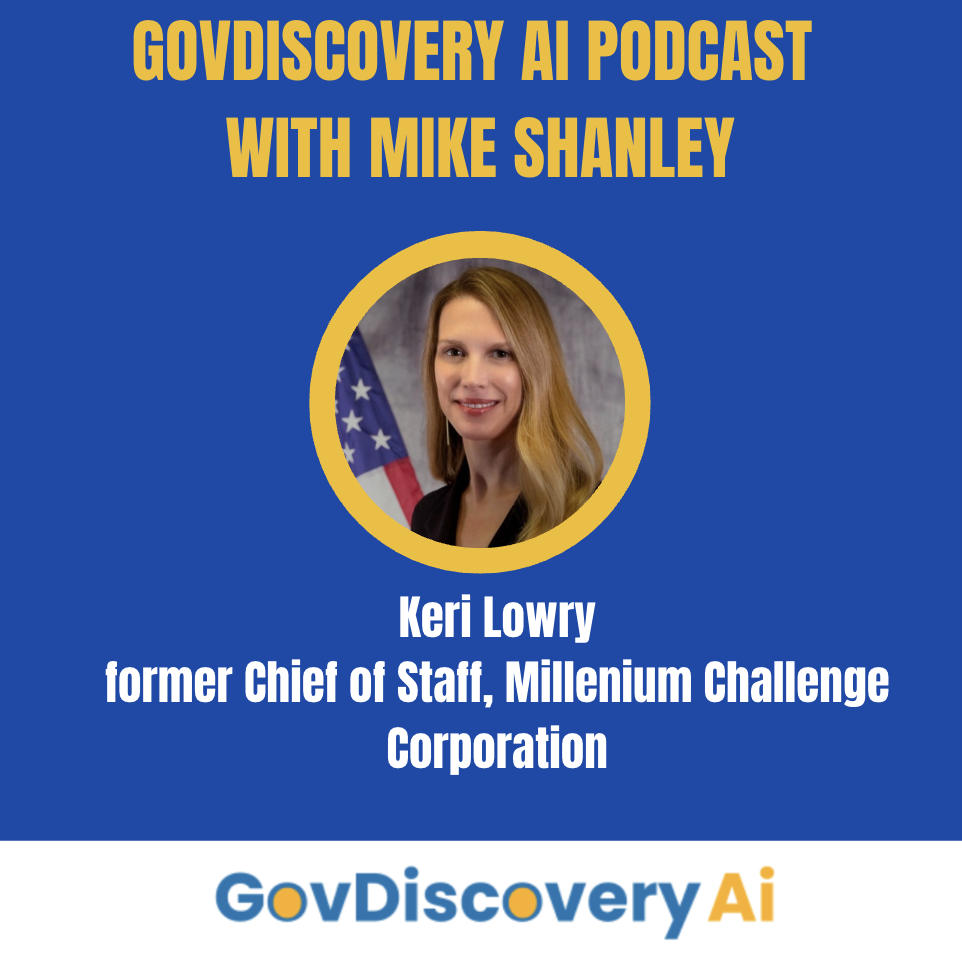
GovDiscovery AI Podcast with Mike Shanley
Ep. 64 Foreign Assistance Business Opportunities in FY26
00:29:35
In this episode, Mike Shanley sits down with Keri Lowry, former Chief of Staff at the Millennium Challenge Corporation (MCC) and board member at the Society for International Development–US. Keri shares insider insights on MCC’s expanding role...
Loading summary
Transcript41 lines
- [00:00]
A
Welcome to the govdiscovery AI Podcast with Mike Shanley, your source for actionable insight into government markets and foreign policy. Gov Discovery AI leverages a decade of experience winning federal funding to deliver intel to sales proposal and capture teams working in defense and civilian markets. Now here's your host, Mike Shanley.
- [00:20]
B
Welcome to the govdiscovery AI Podcast. My guest today is Carrie Lowry, former chief of staff of mcc, the Millennium Challenge Corporation, and fellow board member at the Society for International Development, US Carrie, been excited to have you on the show for a while. Thanks for taking some time to share your expertise with our audience today.
- [00:42]
A
Great, Mike. I'm honored to be on and excited to have this conversation with you and the community.
- [00:48]
B
Thank you, Carrie. Let's start talking MCC. September 10th, MCC signed a new compact, $400 million plus with Ivory Coast. I think that and a little bit of activity in the procurement pipeline has got people interested about MCC and the role it's going to play or might play under this administration. So let's get started. Bigger picture. Some people know of MCC but might not know exactly even what they do. Could you start by sharing a little bit of the historical context on the agency and then talking about them to kind of set the stage for the conversation today, of course, that we'll get into what's next and how can we win contracts and funding from them.
- [01:29]
A
Great. So as many on the call may know, the Millennium Challenge Corporation was created 21 years ago by President Bush and it was created specifically to do transformative investments in countries that govern themselves well and battle corruption. I can go into a little bit more of kind of the criteria and how the agency works with different countries, but it's a tool that I think is primed and ready for this administration to really unleash. And I think there's some early signs, as you mentioned, of where the administration is going and happy to share more as we continue our conversation.
- [02:10]
B
Yeah, let's start with that. What are a couple of those higher level things on why you think it might be well aligned with the foreign policy priorities of the current administration?
- [02:20]
A
Great question. Back in 2018, MCC was given regional compact authority to develop programs with neighboring countries to help economic development across the different countries. But then in addition to help with trade and prosperity of those nations, it's a tool that the agency has started to use. But now that there are a few regional compacts underneath the agency's belt, including Cote d' Ivoire that just got signed in September in Benin, that entered into force in July, it's Really now the time where I think we can start, we will start to see some of the fruits of that authority and some potential business opportunities for the Agency to take that forward. In addition, last December, the Congress gave MCC expanded eligibility authority of new places that the agency can work because of just the nature of development and adds 33 countries to places that MCC can work starting this calendar year. So the board, as some may know, met for the first time during this administration on August 21. Deputy Secretary Landau chaired the board meeting, which is normal. Usually the Deputy Secretary will chair the board meetings through most of the quarters and then sometimes the Secretary will chair the December board meeting. But in that meeting they, they did two things which I think preview where the agency is going. One, they approved the Country Candidate Report, which basically is needed for the agency to make selections of new countries at its traditional December board meeting. And then secondly, it also released another report that talks about kind of how the Agency does its selection and eligibility criteria, which is very similar to previous reports that the board has approved in the past. So it's showing that how the agency has done its work, how it is selecting new countries and programs is continuing as it has previously. But now you have these additional things at this administration's toolkit that they can then utilize and thanks Kerry.
- [04:43]
B
We'll get into that a little bit more. But a lot of our audience are going to be familiar with State Department, formerly USAID activities. Dfc, could you talk a little bit about maybe where MCC fits into that box of foreign policy tools and how the procurement process is different for mcc?
- [05:05]
A
Two great questions, Mike. So when MCC was created, it has a board that makes decisions obviously in partnership with the CEO. Board is composed of eight seats, four public sector and four private sector. For the public sector side, you have the Department of State, which is the board chair. You have the Department of Treasury, which is the vice chair. And then you have the US Trade representative is another public sector seat, as well as the US Agency for International Development, tbd, obviously that four seat, how it might be encumbered. And then the White House approved by Congress then determines who those four private sector board members are. And they have to go through confirmation nomination processes. It takes a bit of time. Right now the agency has one private sector board member. So hopefully here, maybe in the near future this administration may, you know, put a CEO name forward and. Or some of those private sector board members.
- [06:08]
B
Yeah, please.
- [06:10]
A
No, so you had asked a second question and now I'm.
- [06:13]
B
Yeah, well, so. Yeah, yeah. And then with State dfc, how do you think that, you know, with USAID being absorbed into the State Department, do you anticipate a you noted the country selection criteria is more or less unchanged, maybe entirely unchanged. Do you anticipate any other, have you seen any other early market signals from the administration or McCann to suggest an evolution and adaptation of their role under the Trump 2 administration?
- [06:43]
A
Thus far it appears that the State Department and this administration are supportive of the current way of the agency, which is great as it's been working the past 21 years. The fact that those three, four public sector entities are so intimately involved with the agency's work, I don't foresee a change that would occur. Again, each administration can approach it as they choose, but it's pretty well structured in how the Congress set up the agency.
- [07:14]
B
Now you've obviously participated in several of these MCC board meetings, especially while you were chief of staff of MCC under CEO Alice Albright. Could you talk a little bit about what happens in those? Obviously it's interesting to hear what goes on behind closed doors, but especially for our listeners in industry that want to be bidding on MCC activities, what should they know about how decisions are made at the board level and the importance of those that will then flow down into their pipelines and business development strategies?
- [07:47]
A
Great question, Mike. So the board process at MCC is, I have to say, very proud element of the agency. For those still at the agency and those that have previously been at the agency, it is a well oiled machine that we take extremely seriously. So there are quarterly board meetings that traditionally you would discuss how programs are being developed, how programs are being implemented, are there issues, are there opportunities, are there things that have changed over time since a country was added to the program list as well as where is the agency going in the future? As I mentioned, a couple of those new authorities for MCC came out of board discussions that then the agency took forward in consultation with the board. There are what is called the bria, the plus ones, and then the actual board members itself is a process that kind of works each quarter behind the scenes to make sure that the board is fully briefed and fully prepared to have discussion and make decisions at those board meetings. So it's pretty structured, it's pretty formal. I participated obviously as chief of staff in a handful of board meetings. I also was part of MCC's board when I was at the National Security Council because the NSC and OMB have two seats at the table, but they are non voting seats at the table. And what was really exciting about that was trying to peek under the hood, not even being at the agency of how it does its decision making, how it does its selecting, how it prioritizes the sectors that it works in. And it's just a lot of fun to see people do this so well and so just so regarded. One of the funnier stories, I will say when I was at the National Security Council and this is the time when Secretary Kerry was Sec. State, we had colleagues that would come forward and they would brief on the programs that the board was making decisions on. So at this time it was one of our Latin America programs. And the country director came up, he was briefing on, you know, where the program is, what we think we're going to do, and then the board would either approve or disapprove if you know the way forward. And it is, some may know on this call, Secretary Kerry would at times bring his dog to the department and his dog was actually underneath the table licking our country Director's feet as he was trying to present on the program.
- [10:28]
B
Trying to focus on that. That's when you think about prepping for all the various scenarios. Kerry, we may be missing that with our clients, but we have not yet needed to advise anyone to prep for that on their in person meetings.
- [10:40]
A
Yeah, my colleague did a phenomenal job, but it was, it was, we laughed about it afterwards.
- [10:47]
B
Yeah, yeah, very interesting. Continuing with that then with the board meeting on the technical side and the implementation side, do you anticipate any change? It sounds like there was the large expansion, as we know about in December, of the countries that MCC is going to be focused on. Was there any, do you any reason not to anticipate? That'll be the list going forward. And then have you seen any changes to the technical priorities or the types of activities that MCC anticipates funding?
- [11:23]
A
Great question. So at the August board meeting, the board at the time reviewed what was the foreign assistance review results for the agency. And obviously that encompassed all programs that were currently existing. But then the board also made decisions to select two new countries at that August board meeting, which is a bit abnormal, but a positive sign as well. Fiji was selected to develop a compact and Tonga was selected to develop a threshold program. So that is a positive sign of where the administration wants the agency's work to be focused. But with respect to the existing programs, any changes that the agency makes with an existing program has to go through a pretty robust congressional notification process with the Office of Management and Budget as well as obviously with the different communities on the Hill. Those CNS are still on the hill. As of last week, some were meant to go through their kind of 15 day business process timeline. But with the government shutting down, that is now up in the air. So I'm hopeful that the agency will be able to share with everyone where programs will continue, where programs have been adjusted and then what programs will not continue going forward. I would guess that once the government reopens, hopefully within a few weeks after that, we may learn from MCC what will be continuing. But Mike, to answer one other quick question that we talked about, December is traditionally the board meeting where the agency will pick new programs and new countries to work with. So the fact that this administration selected two new programs in August, put out those reports that I mentioned from the board meeting about the eligibility, the country candidate pool sends a strong indication that they will be selecting new countries this coming December.
- [13:24]
B
And what are you seeing on the budget wise? I'd say a rough number is always somewhere in that $1 billion a year range has been the MCC budget. Have you seen any signals about a potential the range that that might land in for FY26? Obviously knowing the entire government budget is also in flux. You know, if we're naming more countries, is the funding getting diluted more? Are there, is there more biddable opportunities with that? Is that more operations? If you could talk a little bit about what you're seeing, knowing what we know today for the 26 MCC budget.
- [14:01]
A
So so far again obviously where Congress needs to figure out where they want to go with the 26 budget. But indications from both chambers were to keep the agency's programmatic and administrative budgets about the same as they've been previously, which is a great sign. If that is where it ends up at the end of the day with that then means that you will have obviously funds to support the programs that will continue and then have hopefully funds to work with new countries in the future. When I was there, we actively worked to get what we call our unobligated balances down so that every dollar was already committed before a country was even selected. So the unobligated uncommitted money at the agency really doesn't exist anymore. And so every dollar is going towards decisions the agency will either has made or will be making in the very near term. Does that help answer what does that.
- [15:03]
B
Yeah. What does that mean for bidding? It means there's less or more for organizations to bid on.
- [15:09]
A
It means it's the same. To be honest, it was more how the agency worked with Congress and OMB was the money would come for programs usually a Little bit after a program was decided. And now because we've been able to spend on the unobligated balances, that then means that the agency potentially could be selecting programs for a budget that is going to have to ask for in the future, which is a little risky. But you know, it's something that this administration has probably already started to talk about and they, and obviously the agency will figure out how to handle that. One thing I will mention and getting to the opportunities for those on the call, one thing that's unique about MCC and I think this administration really likes, based on the America first health policy that they global health policy they recently put out, is that they MCC works with partner countries obviously hand in hand to develop the programs. And then those countries actually have to give either funds assistance, you name it, to have more skin in the game and really have that country ownership of whatever the program is that MCC and the country are doing together. So Benin, for example, the program that EIA draft in July, Benin actually put in more money than MCC did by $2 million to basically double the investment of what MCC is working on in Benin, which is phenomenal. And every program or every country that MCC selects the agency and the country figure out, you know, what is that country's contribution to get to the opportunities. So MCC does business two ways. One, there's the business of headquarters, which is you would call kind of the MCC business. And that on average puts out about 70 million opportunities. $70 million of opportunities per year. Sometimes it's via BPA, an IDIQ, a sole source. And MCC put out its forecast, I think it was late last year and they anticipating updating it once the results come out of, you know, all the CNS being cleared and being able to talk about the August board results. So that is something I would say keep an eye out for potentially coming.
- [17:33]
B
Maybe is that typically more project design, program evaluation type of activities for that 70 million ish from McCHQ.
- [17:42]
A
So it's traditionally headquarters operational support, it's due diligence funding. So kind of as you're developing those programs, what are those due diligence efforts you need to do? Monitoring, evaluation, economic analyses. If there are special assessments that are needed, it's that bucket of work. Then as many in this call may know, once a program quote enters into force, we're obviously working with what is called the Millennium Challenge account entity in country that is stood up when the program is selected. The bulk of that type of work as the program begins to implement, switches over to the country level, more robustly and that's where the MCA procurements really start to come into play. And those are on average about 500 million a year. And they are done at the country level. So if you go to MCC's Doing Business page, you'll see where you can look for opportunities to work with MCC headquarters. And Those are on SAM.gov, grants.gov, etc. And then they're also where MCC will post all of the MCA procurements as well. And the agency forecasts both of Those things, usually six to 12 months in advance so that all of you on the call can prepare for those opportunities and really think about what you want to propose in whatever bid or contract that you may be going after.
- [19:13]
B
And we're tracking all of those too. Kerry, Just to note, for anyone Interested on the aidconnect.gov discovery AI platform, just message us if you're interested in following those MCC opportunities. Can you talk a bit about that bidding process then for the MCAs? Obviously half billion sounds more interesting than 70 million a year. Both are big numbers. What does that process look like for again, someone that has not worked with mca, mcc, but has that capabilities in the international development space? What does that bidding process look like? What's the US Government's involvement? What's the host country government's involvement in that process? And, and is that then more similar to say, I don't know, a UN or World bank type of procurement process where there, where there is involvement from the host country government?
- [20:00]
A
Great question, Mike. So when MCC helps establish with the country Millennium Challenge Account entity, that is a wholly independent entity that has oversight from mcc. So the funds come from the US treasury, obviously via mcc. But that actual MCA is responsible for all of the procurement, all the financial management, all of the contracting, and then all of the technical oversight work all comes at that MCA level. So the host or the partner government, excuse me, works with MCC to set up that entity. We jointly decide who the CEO of the MCA is and then obviously they then start to populate what that entity populate the rules across that entity. Some countries that group is about 20 to 30 people, others it can get close to 100 or more, depending on the size of the investment. So you know, in some of the countries where you have a compact that's $500 million, sometimes a bit more, that's where you're going to get into that bigger, bigger entity size versus if you have more of a smaller compact or potentially a threshold program, those are usually of smaller dollar value.
- [21:17]
B
Is it usually a single Procurement, or is that 500 billion or 500 million, we'll say broken up into multiple procurements that the organizations can bid on?
- [21:29]
A
Usually it's both. So where the agency has been focused, and I believe it's going to continue this way, is once the agency starts working with a country, there's an assessment that's done, it's called the Binding Economic Constraints Assessment, to determine if MCC invests in X, Y space. How is that really going to unlock the economic potential of that country? Part of that includes what MCC calls condition precedents that a country needs to do either in a policy change way, a regulatory change way, doing business different way, so that when MCC's full investment comes in, that enabling environment has already been created, and then you're really working to boost the economic growth of that country and the people of that country. So usually the agency will focus on one to two sectors, depending what comes out of that assessment. And then there's always management and oversight work that the MCA needs assistance with. Sometimes there's monitoring and evaluation work that needs to be included, due diligence as well. So sometimes those are put out as one big procurement, sometimes they're put out as different procurements. So it really does depend on the type of program that MCC and the country decide to do together.
- [22:55]
B
It sounded like there's a lot of opportunities here. What are the ways that industry can most effectively engage? I don't know if you have any examples from when you were chief of staff of some very successful, productive ways that they can engage, whether it's during the board prep period that you talked about or otherwise other industry days. Yeah, what, what would your advice be to an organization that's hearing this and said this might be a good fit for us? What are the next steps? How can we get engaged with MCC to be positioned for this FY26 funding?
- [23:28]
A
Excellent question. So MCC definitely does industry days. I strongly recommend subscribing or signing up for all the newsletters that the agency offers. And there is a Doing Business with Us page on the website that you can subscribe to that will notify when new forecasts are put out, when new funding opportunities are there, when industry days are scheduled, and then if you have worked with the agency before, there are contracts officers in each of the countries that know how to connect back into the agency as well. So if you're working in Nepal, for example, is one country that has recently put out a procurement notice, as well as Kosovo in Mongolia. If you don't know who to contact at the agency, ask those MCAs and they know how to get back in touch with MCC and help you make connections. But we traditionally, you know, individuals names and contact information are provided. I just, I don't know where the agency is going as they come out of the shutdown, how that is going to be handled. So I think it's an area to definitely keep an eye on going forward.
- [24:40]
B
So let's talk about that going forward. We've touched on this a little bit, but what are you anticipating? What are you seeing? What kind of early market signals are you seeing from MCC on that direction of what the it sounds like the December board meeting will probably determine a lot. But what are you seeing for business opportunities with mcc really for FY26? As we say that it's probably going to be similar for 27 and 28 with, with the, with the current administration. So yeah. What are you seeing for those business opportunities going forward?
- [25:12]
A
That is a great question. So obviously with the foreign assistance review, there are some programmatic changes that will be forthcoming. Some of those may be, you know, stopping certain things, some of those may be enhancing certain things. What I would, what I would say is you have two programs. One, the Cote d' Ivoire signing is one, keep an eye on that if you're interested in working in Cote d'. Ivoire. Two, since Benin entered into force, there will be some procurement opportunities coming out of that here very shortly. And then as countries I think potentially restart programs, there may be some different procurement needs that the country needs because a business wasn't able to wait until October, November to continue a program that was paused in January. So it could be that the MCAS need to re put out procurements. And that's happened before for not just shutdown reasons, but a variety of reasons. And then I would say the new countries that MCC selected, they are probably didn't have a ton of time before the shutdown, but they are starting the development of those programs. There's two more opportunities to work with MCC on Fiji and Tonga. And then those programs that the agency may select at the December board meeting is also another opportunity for business again. So I'd say it's starting to come out, but I would encourage your audience, really keep an eye on the agency over the next three to six months where I do think a lot more business opportunities will come forward.
- [26:52]
B
And we really think that now is the time to be building those relationships, to be well positioned to implement those opportunities. So Kerry, as we wrap up today, there's never enough time here but for this episode at least what's the so what that you'd like to leave industry regarding MCC and working with the agency?
- [27:13]
A
Thanks, Mike. So it's a fabulous place that has fabulous people and I think anyone that's interested in the agency, I'm happy to provide any advice and counsel that I can. But please just reach out to colleagues at the agency when they open back up. They are always happy to talk to industry. They're always happy to learn about new capabilities, new offerings, new solutions. And one thing that we really pride ourselves on is how how to work better every time that we do something with a country. That learning component is very much embedded in how the agency works. Then on a slightly different note, Mike, with the America First Global Health Strategy being released, there are a lot of elements in there that really look a lot like how MCC works. From the time limited investment to wanting to do bilateral agreements compacts with the country to the countries. Now the administration now wanting countries to contribute on the global health side. Again, it's different, pepfar is different, et cetera. But I do think there's some really core elements of what MCC does that this administration really likes and you're now starting to see pieces of it come out from the department.
- [28:34]
B
Who knows, maybe there'll be even a bigger role going forward. So Kerry, that's all the time we have. Also be sure to check out our previous podcast with former CEO of mcc, Alice Albright, that Carrie was instrumental in setting up. So thank you very much for making that happen. Kerry, thank you for being on the show as a guest. Always great talking with you.
- [28:53]
A
You too.
- [28:53]
B
Thank you for sharing your insight today.
- [28:55]
A
Thank you everyone. Thanks Mike.
- [28:57]
B
Bye.
- [28:59]
A
Thank you for tuning in to the Gov Discovery AI podcast with Mike Shanley. Gov Discovery AI leverages our team's decade of experience winning federal funding to deliver federal growth intel to sales proposal and capture teams working in defense and civilian markets. Each Market intel report is delivered by federal growth experts leveraging our proprietary deep data discovery process. If you enjoyed today's show, be sure to subscribe wherever you get your podcasts and connect with Govdiscovery AI and Mike Shanley on LinkedIn or learn more at govdiscoveryai.com.