← GovDiscovery AI Podcast with Mike Shanley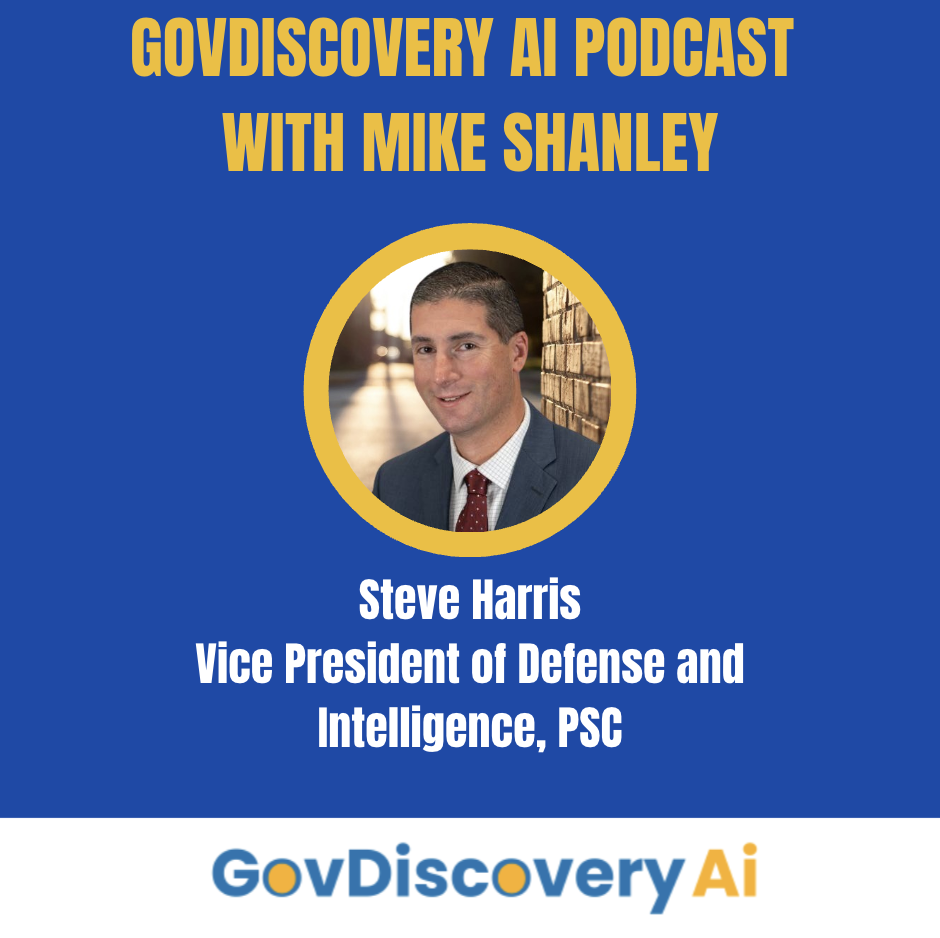
GovDiscovery AI Podcast with Mike Shanley
Ep. 65 PSC Defense Conference Preview with Steve Harris
00:27:10
In this episode, host Mike Shanley sits down with Steve Harris, Vice President for Defense and Intelligence at the Professional Services Council (PSC). Drawing on his decades of experience in government, including at the Defense Security Cooperation...
Loading summary
Transcript40 lines
- [00:00]
A
Welcome to the Gov Discovery AI Podcast with Mike Shanley delivering actionable expert insight and AI enhanced business intelligence for Defense and State Department markets. Here's your host, Mike Shanley.
- [00:13]
B
Hi and welcome to the Gov Discovery AI Podcast. I'm your host, Mike Shanley. Our guest today is Steve Harris, VP for Defense and Intelligence at the Professional Services Council, often known as psc. Steve has a long background in government, including as Deputy for Policy at the Defense Security Cooperation Agency in the Office of the Secretary of Defense, where he developed and implemented international policy for foreign military sales and security cooperation programs. He also held contracting acquisition roles at the Naval Air Systems Command and the Navy International Programs Office. Steve, thanks for taking some time to join us on the show to Talk about P. P.S.C. your work and we're going to get into the defense conference on October 3rd.
- [00:59]
C
Mike, thanks so much for having me. Really do appreciate it.
- [01:03]
B
Yeah, thanks Steve. So let's get started talking about I'm interested in the perspective of PSC and associations from the government side. As I shared during the prep here, there's another association I'm on the board of and at one point we were talking about I wonder what government thinks about us and what our role is. And then someone else said I don't know if they do think about us that much. So I'd be very interested in having had that long career in government. What was it like? What did you learn about associations when you joined psc?
- [01:32]
C
Mike, appreciate the question and again, I think it does vary depending where you are. So I will tell you, when I was in the Department of Defense, I did have more interaction with trade associations as opposed to my time that I spent over at dhs. But I think you hit the key thing, key takeaway I would take, which is never assume we'll probably come back to that at some point as well. And, you know, make sure that you're able to get out there and tell folks what they're doing. I know when I had the opportunity to learn about what trade associations did from a colleague and the public private partnership piece of it, that's what attracted me honestly to the job that I have here at psc and very lucky to have that as well. But it's that opportunity to make those matches to allow for, you know, private sector to partner with federal agencies and the right officials to be able to ultimately deliver the, the, the mission and the services and solutions that we seek.
- [02:32]
B
So for the government employees listening here, what would your thoughts or suggestions be for them that maybe think they don't have Time for it's not worth it. It's not a high enough priority to attend some of these events. We'll get into our speakers at the event. But, but even just to. For what I love to do is connect with the government officials that aren't speaking and are just, you know, attending and in the hallways at events like the defense conference next week.
- [02:54]
C
Well, I think, you know, appreciate the question first but you know, I think trade associations offer something that really does help government officials, which is trade officials. Trade associations have the ability to reach out and touch lots of members of the private sector. So you know, I'll talk about PSC for a moment here. PSC is the leading trade association and the voice of government contract industry. We represent over 400 member companies ranging all the way from startups to, you know, multinational organizations and we do everything in terms of supporting federal agencies through mission focused services and solutions. So again, part of the attraction of talking to the trade association is you don't have to go and hear the various voices. Often you get to hear the collective voice that is unified into one place. Albeit most of the trade associations I know for myself work with other trade associations. So it's not like one trade association is not talking to others. So in the defense space I do take the opportunity. We have a biweekly exchange amongst the other defense associations.
- [04:09]
B
Yeah, and so gov Discovery AI we are a longtime member of PSC and have found great value for the connections to government, insight into what's going on in policy, but really also the networking with the other members too. And I'd say you guys do a really good job of understanding what each member is interested in and you know, with a reasonable amount of effort making the connections or helping to guide them on, you know, who might be best for them to connect with on the industry, industry side and government.
- [04:42]
C
And I think that's another important role that you know, from both the companies that are listening that are not a part of a trade association or from the government folks. Again, what trade associations are able to do both in the legislative and regulatory issues in terms of, you know, pulling together, you know, key issues regarding whether it's acquisition, business, technology, we're able to get that voice out and you know, be able to again put the right people talking to one another. And sometimes that means we're in the room and other times that means we make the introductions and allow for the companies to then develop their relationships as well, which is a critical part of that advocacy that we do here at psc.
- [05:21]
B
So kind of reframing one of the questions. But after a couple of decades in government, when you did join psc, what was something that surprised you about PSC or how the Associate association does work?
- [05:33]
C
And one, I appreciate you helping age me on camera here, Mike. But joking aside, I think just how well in particular PSC does at advocating for its member companies, both with the executive branch and with the legislative branch. Again, there are times when companies want to have their name and there's other times when they want to be anonymous. And that's time where, you know, PSC is able to chime in, whether that's, you know, working with the Hill on issues that may be pending, for example, in the National Defense Authorization act or the NDAA or as you know, regulations, and we're making comments on them and sharing them with different federal agencies. You know, that level of advocacy that is continuously going on I thought was incredible. The other piece that I thought was phenomenal was the market intelligence piece. Just the overall understanding of what's going on in the markets. And obviously I'm focused a little more on the defense and intelligence side, but across both defense and intelligence and civilian as well, very, very surprised to see the level of market intelligence and accuracy that was out there as well.
- [06:49]
B
So right before we get into the conference, I want to talk high level on that. The members interested in the defense market, what are some of those priorities or topics that they're interested in getting that insight during this year.
- [07:04]
C
So I well, one, I guess I will use that as an opportunity to plug another one of our opportunities coming up, which is our Vision Conference, which will be December 1st through the 3rd. And again, there is no better place to get market intelligence than the Vision Conference. So highly encourage folks to take a look at that. Check that out. I know you'll put the links on here as well. In terms of where to get additional information about that, I do think what I know from the defense and intel side, everybody wants to know what the priorities are going to be and so that investments can be made up front. The other focus, of course, is increasing that capacity of the defense industrial base. And then on everyone's mind is acquisition reform and what's already occurring through both executive order and policy changes being made by the Department of War or the Department, as I'll call it from here on out, or what is proposed in legislation either through the Forged act or Speed Act.
- [08:03]
B
And I'll just note that too on for the member side. So I'm on the planning committee for the Defense conference next Thursday. That's been a great experience working with you, Steve and Andrea and the team and, but also working with the other members also for that vision forecast December 1st to 3rd. I'm on the Defense, the Defense services and the Defense AI and cyber. So that's been a great experience. Another great way to get involved with psc, get some really great access to the other members and some firsthand insight into what's going on in the government. So our reports will be coming out in that December conference. So a couple of different ways to get involved as a, as a member.
- [08:44]
C
Absolutely. Mike, thank you for participating into the rest of the Defense Planning Committee. Thank you so much for quickly adopting me when I came on board and helped me helping us get through this process at psc. And to your point about the vision reports, I will say one of the first things that I read when I came into this was all of the presentations that came out of last year's Vision Conference just to get an idea of where the market was, albeit back then, so that I could get a good understanding of where, where it was and where we are now.
- [09:12]
B
How, how accurate were they? Steve, when you took a look at them, you obviously had the firsthand knowledge. How did you read it and what was your reaction?
- [09:19]
C
I, I again it is amazing. You know the number, I think it's close to 400 plus volunteers that help out across both the defense and civilian space to contribute to that, both government and on the private sector side. And you know, the accuracy, it's, it is amazingly close. I mean it is, it is really good and great critical information. Again just, I think that's a key part of it. I think also just being a part of the conference, obviously the networking that comes out of it as you get to know and that's again another, as you mentioned, another opportunity to volunteer as well and be able to be a part of the presentations. And then obviously the networking that occurs during both the development of the presentations but obviously the, the conference as well.
- [10:05]
B
Well, let's get into the conference. So you'll be spearheading the seventh annual PSC Defense Conference along with. You've been leading it along with Andrea and Tamika and some of the other colleagues that PSC. I'm surprised it's taken us this long. It's now October 23rd. There is a government shutdown. We haven't mentioned that in the first 10 minutes. I thought that would have come up earlier from my end. But given that it is a unique environment to plan one of these events on one side it makes it Even more important than ever to connect, to share the insight, to get a sense of what's going on, but also add some unique challenges to it. So talk a little bit about the conference next Thursday.
- [10:48]
C
Absolutely. Thank you. Yeah, appreciate that. You know, it is a great opportunity October 30th, whether in person at the Westin Gateway in Arlington, Virginia, or virtually you can participate 12 to 6 Eastern time, just to give out the logistics there on it. But a great opportunity, obviously, focusing on what the what issues are most important to to everyone. So I kind of teed these up a little bit earlier. You know, acquisition reform that's on everyone's mind. And again, where where we're going with that and what we're starting to see and what we will see, you know, pending legislation, the capacity or increasing the capacity of the defense industrial base. You know, big issue in terms of whether it was, you know, H R1 that went through in terms of additional funds coming in through appropriations. Obviously, we're waiting on the rest of the FY26 appropriations with the current funding lapse. But again, understanding the priorities of where we're going to put, you know, investments against, particularly in that in that defense space, you see what's carved out there. You know, the and the National Defense Authorization act, as I mentioned, you know, previously in terms of acquisition reform, you know, we have both the Senate FORGED act as well as the House's SPEED act, merging those together in, you know, what will come out of conference in terms of what will probably be one of the most considerable forms of acquisition reform that many of us have seen in due time. Lots of good efforts have been done on acquisition reform, but this is in some ways very much an overhaul and then again from an IT modernization aspect and other aspects that tie into that where we're going. So we're very lucky. We've teed up right now. We've got three representatives teed up to speak for us. We've got Representative Whitman out of Virginia again going to come in, talk defense industrial base and, you know, the SPEED act and other things along those lines. We've got, you know, following him speaking, we're going to tee up our first panel that's really going to look at what's that partnership in the defense enterprise, how does Congress, industry and the executive branch all work together? And we've got some professional staff that are going to be a part of that discussion. Then beyond that, we will then go to have a discussion with Representative Walkacha out of Virginia as well, where again, we're going to take some time, talk about what is the current scenario, what's going on in terms of again back to industrial based capacity, IT modernization and what we're going through right now with the effects or impacts of the funding lapse. And then we'll have a Q A with him as well. And then we'll move into a discussion where we're going to get into sort, sort of a little more of the details in terms of acquisition and looking at commercial, commercial solutions, if you would. So get some acquisition experts to talk about where the trends are going there. Then we'll have our third panel, which I'm really excited about as well in terms of aligning energy demand and investment for, if you would, the future defense industrial base. And here what we're going to talk about a lot is, you know, AI. Obviously it comes up in just about every conference at this point, but not just, not necessarily AI, but the energy demands that come from it and how we're going to be able to match those both at a local level in the field. Again, looking at it from that, you know, that Department of War lens. And then finally we'll have the opportunity to have closing remarks there from the Honorable Michael Kadonazi, who is the Assistant Secretary for War for Industrial Based Policy. So really looking forward to what he will have to say. Recently confirmed and excited. I know he's very excited about his new position and challenging the private sector. So I'm really looking forward to his remarks as well.
- [14:50]
B
That's. Yeah, thanks for talking us through that. I find, Steve, that can be really helpful for someone that hasn't been to a PSC event, definitely not the defense one, to hear what are going to be the topics to really understand, you know, what, what that value of attending would be and where they could fit in. So, yeah, you're obviously at the heart of all the conversations. What's going on? What's one thing that you're interested? I always, you know, one thing before the conference. What do I want to learn? What's a question I have coming in? What's. What's one of one or two of your questions that you have going in that you're hoping to get some clarity or insight on?
- [15:22]
C
Mike, I have so many questions and that, you know, I think that's, that's what lets us all be lifetime learners. So it's an important thing I do, you know, again, I'm very interested particularly in acquisition reform and you know, the impacts that we'll have. Again, PSC represents over 400 members, like I said, Both small through large. So I'm very interested in, you know, what that's going to hold for a lot of our members and shaping that in the right direction as well. I do think, you know, it's going to be interesting to hear with some of the more recent announcements by the army and USA regarding energy. And I, I do think, you know, again, I think, I think we're going to learn a lot from that. You know, Representative Franklin will be on that panel and looking forward at what, what he will have to say from his perspective and what he's seeing as well. So I think that's going to be very, very interesting. And then I think just, you know, the industrial base, we, we, we talk about it a lot, we talk about industrial based supply chain. I do think it will be very, very interesting to see what insights all the speakers have to say and then from my perspective in terms of, you know, the Defense and Intelligence Council that, you know, I run, where we can make, you know, actions out of that so we can take, you know, make things actionable coming out of that and what we can do to help, you know, look at, look at potential solutions for that challenge that's being that looms out there.
- [16:52]
B
So how does this, you know, there's other defense conferences there. How do you see this differentiator fits into, you know, I was at ausa obviously who tens of thousands of people there. I was at desi in the UK I think they said there's 45,000 people there. There's something to be said of being how many people can we get into one building? But you can't really network with 45,000 people. What I like about the PSC, I'm kind of answering the question ahead of time here, but is that we're talking hundreds, probably a couple hundred people in the room. And there is, the speakers are there for the most part and I think almost most of them 90% plus in person. There's team and their staff are there. Even if you don't have a chance to connect with a member, you can connect with their team. So I find that the high level speakers, but in that smaller environment rather than here's the secretary speaking to 40,000 people, here's a senior decision maker speaking to one or 200, 300 people in a room. How do you feel about where it fits into the defense conference context?
- [17:52]
C
Remind me to record with you again, Mike, since you asked the question and answer and did a great job.
- [17:57]
B
Why am I even here if I'm just gonna answer the questions all Right.
- [18:00]
C
So I do think what you brought up is what differentiates it is you're talking hundreds versus thousands, you're talking tables, you're talking networking beforehand at lunch, you're talking networking breaks in between as well as a networking reception at the end. It is local for most of the folks that work at the department and the Hill. So as you mentioned, folks are able to stay. We do see a good number of, you know, government folks participating in addition to, you know, our member companies and non member companies that come. And again we just try to tee up those opportunities to have those conversations and quite frankly we're able to actually ask, you know, our speakers questions. So we do preserve time to know in each of our sessions for lack of a better term to allow for questions to be asked.
- [18:54]
B
One thing I also look at for conferences is who are the sponsors, who's attending. I think that could give me a good indication of what are the topics, who's going to be in the room, all that. Steve, could you talk. Obviously this is a nice shout out to the sponsors, but I think it's really useful to assessing is this worth my time to show up at Weston and Arlington next Thursday? Who are the, who are the sponsors for this?
- [19:15]
C
So our title sponsor is the Golden Key Group and then our premier sponsors are a Mentum, caci, dlh, HII and Leidos. And then we have several other sponsors and I'll make sure we put the link into the podcast as well where you can see all the sponsors. But we are very blessed by all the sponsors that we have in terms of, you know, whether it's, you know, a lot of them are participating in the planning committee or just again making sure that we can host this event and set it up in a way that to the previous question, make it so that it is very much worth members and non members, you know, private sector companies, time to be able to come have that interaction. And we hear the same feedback from the government reps as well in terms of being able to, you know, hear things smaller group having those interactions. So my thanks again to all the sponsors.
- [20:08]
B
Yeah, thanks Steve. And I'd say that to the small businesses out there, the partners, the ones outside of D.C. that can be a great value we see from our clients is attending these events to I'm sure hear from the government and connect with them. But maybe you're a subcontractor and you're really looking to connect with the big contractors, the primes. This can be generic LinkedIn emails or messages and getting you the response you want, I find that in person can be a really good time to make that connection and build that relationship with those primes. Again, especially for those groups that are small businesses or maybe doing more subbing in the market.
- [20:44]
C
I think, you know, that is one of the things that we hear collectively when we do surveys from our members. You know, what we hear about our partnership opportunities, networking opportunities, lessons sharing lessons learned and then even mentoring opportunities as well. So again, that is I think one of the prime features of PSC conferences, including the Defence conference.
- [21:08]
B
Well, let's talk. I touched on this a little bit how we're involved but Steve, so obviously you don't have to be a member to attend. You can just sign up to get to know PSC show up next, next Thursday. But talk about some of the other ways that new organizations, not members could attend and really the value we're thinking roi, it's still, it's an investment of resources and time. So what, what are the different ways to get engaged and what are the things that the members could get out of that?
- [21:37]
C
Absolutely. Well, we'll start with the basics. You can go to defense.pscouncil.org to go up and register and like Mike said, whether you're a member or non member, you can attend and you can attend both in person or virtual. So both options are available there. So again, opportunities for folks to be able to participate and you know, again, if you're a PSC member, you're a little more aware of the services and again sort of the conferences and the opportunities that are out there. I do think it is an opportunity for you to learn more about obviously the PSC and what all we have to offer in terms of what we can do for members in terms of advocacy. But I also do think again, you know that that opportunity to hear the latest and greatest from the policymakers that are in fact shaping the policy that is going to impact all of us inside of this industrial base.
- [22:36]
B
What's your advice for those attending especially given your we won't say how your government experience. Steve, I know it's out already, but maybe someone joined halfway through. What are the effect we always want to share with clients? How is government thinking? How can you most effectively. Obviously they want to partner with you, but they can't respond to a thousand emails coming in every day about meet with me about this or this or this. At a conference you have that unique opportunity to talk face to face. I don't know if you have a story from your time in government, but could you Share like some insight on what's an efficient way, an effective way for industry to engage with government at an event.
- [23:13]
C
Honestly, I think it's the same advice whether you're industry or government. I do think, you know, it is important to think ahead of time. If you only have 30 seconds, what is it that you want to say? So, you know, is it a question? You know, my case, I'm a little more altruistic. I'm going to ask a question. It's going to be a little bit more beneficial to all if it's in, you know, one of our, you know, conference sessions. But if it's in a, you know, more intimate engagement or in the networking sessions, what is it? That short and concise, what is the ask? How do you want it to be remembered? Again, just what's going to make you sort of stand out, you know, at least from a government perspective in terms of someone saying, let me, oh yeah, I remember Mike said that idea. He did give me his information. Let me circle back. I do think, you know, knowing what you hope to get out of that engagement, thinking about that in advance again, even whether it's the government engaging private sector because they're, everybody's just as busy, you know, or vice versa. I do think, having taken the time ahead, you know, ahead of, ahead of it, the engagement and actually thinking about what is it that you want to, you know, leave? What is that message that you want to resonate?
- [24:28]
B
I'd add this to get interested in your thoughts, to say you're a sub looking to connect with one of these primes, having a sense of like what, you know, not just hey, big prime, we want to work together. Can we have coffee after this? What are the opportunities? Do you know what contracts they have coming up for rebid? Do you see pre solicitations or early demand signals in the pipeline? So having some specific opportunity to connect with the other one is with some of the very high level speakers with PSC does get a lot of high level people. Say a member of Congress, probably going up to them and expecting them to reply to your email and meeting with you next week might not be the most realistic one. What I like to do is want to see the high level person connect with them, say hello, introduce yourself and then figure out who's the best person on their team to follow up with. Making sure you get that contact. If it's the comms person or the, you know, the LA or LC for what, you know, whatever the specific topic is that you're interested in.
- [25:15]
C
Absolutely and again, you know, being able to have that exchange and then quite frankly being able to leverage someone like a trade association like PSC to help you with that follow up as well.
- [25:27]
B
Right. Well, we'll all be there on next Thursday. Hope to see everyone there. Steve, any, any parting thoughts or that, that you want to, that you want to leave us with?
- [25:37]
C
You know, Mike, again, thank you so much for hosting me. I just think it's a wonderful opportunity next Thursday with the defense conference. If you're, if you've been to previous ones, I'm sure you can attest to the value that comes out of it. If you haven't had that opportunity, hopefully we've given you some insight on why you should attend either in person or virtually. I think there's a lot to be taken away from that. And if you have additional questions about psc, lots of information available on our website or feel free to reach out.
- [26:07]
B
To me and you can connect with Steve, Steve Harris at LinkedIn. Connect with me, Mike Shanley at LinkedIn with that. Steve, thank you to you, to Tamika, Andrea, Jim, the whole team at psc, the important work that you guys do, especially during, at this time, you know, during the shutdown. So thank you for that and yeah, looking forward to a, a strong event next Thursday.
- [26:33]
C
Thank you again, Mike.
- [26:34]
A
Thank you for tuning in to the Gov Discovery AI podcast with Mike Shanley. Gov Discovery AI leverages our team's decade of experience winning federal funding to deliver federal growth intel to sales, proposal and capture teams working in defense and civilian markets. Each market intel report is delivered by federal growth experts leveraging our proprietary deep data discovery process. If you enjoyed today's show, be sure to subscribe wherever you get your podcasts and connect with Gov Discovery AI and Mike Shanley on LinkedIn or learn more at govdiscoveryai.com.