← GovDiscovery AI Podcast with Mike Shanley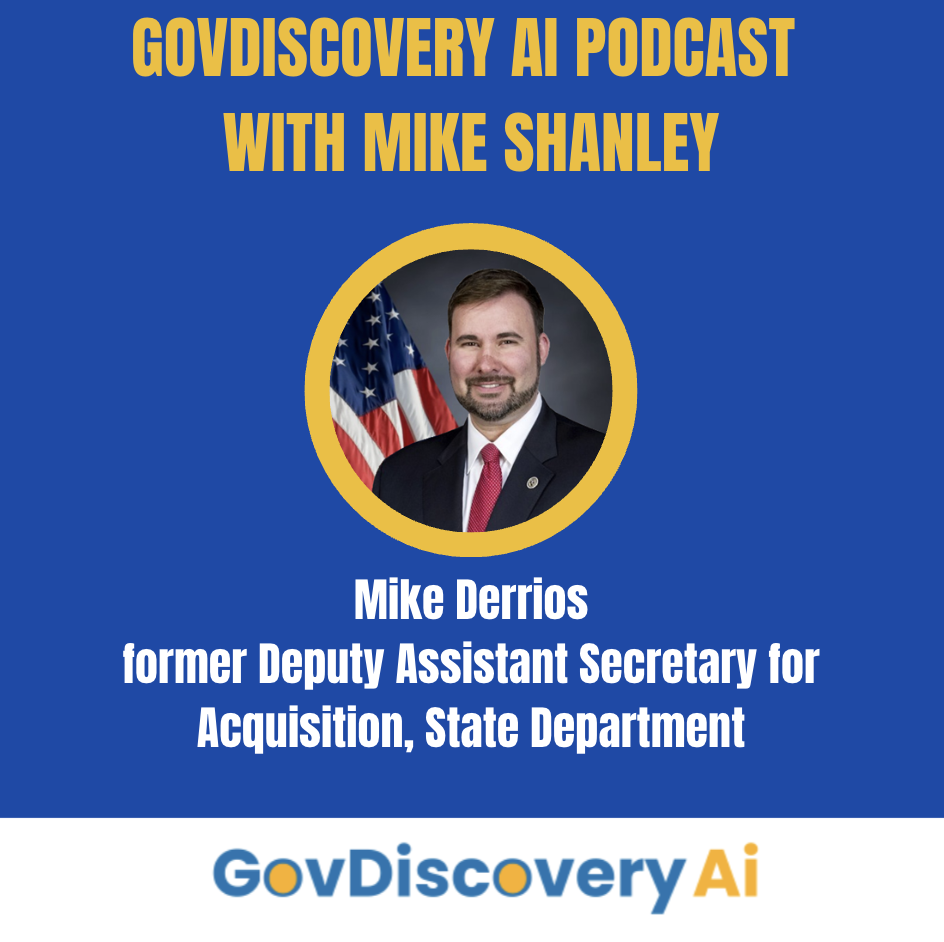
Loading summary
Transcript46 lines
- [00:00]
A
Welcome to the GovDiscovery AI podcast with Mike Shanley delivering actionable expert insight and AI enhanced business intelligence for defense and State Department markets. Here's your host, Mike Shanley.
- [00:14]
B
Welcome to the Gov Discovery AI podcast. I'm your host, Mike Shanley. Today our guest is Mike Darios, former Deputy Assistant Secretary for Acquisition and Senior Procurement officer at the U.S. department of State. Definitely an anticipated episode. Mike has five years of experience with the State Department and a long experience with the federal government before then. We'll get into all that. Mike recently left within the last month the State Department so very interested to get his perspective on the state of the State Department market. Mike, thanks a lot for being on the podcast today.
- [00:52]
C
Well, thanks for having me.
- [00:54]
B
Well, Mike, let's get right into it. What is the state of the State Department market?
- [00:58]
C
So I, you know, I think it's going to be a good conversation. Let me, let me preface by saying that obviously none of my remarks because I'm no longer with the department, none of my remarks are, you know, an indication of any policy coming from State Department. This is me as a private citizen just offering perspective as somebody that was there for a while. So I, Mike, I think you, you've seen a real confluence of activity that has happened in 2025 that is, is going to shape the State Department market for frankly years to come. And there's a couple of drivers around it. We can get into all these. But the biggest one I think is frankly the movement of the USAID work. About 15% of mission set coming from that agency into the department. That's a huge driver. Right on the heels of that, a couple months ago, a lot of folks probably saw the America First Global health strategy come out. I'm sure there's a questions about, you know, that what does that mean? Happy to get into some of that as well. I think that's going to be something that is absolutely going to be a big driver for, for State's market. And then there's there's some more inward facing things. You know, the department is going through a major reorg right now trying to get that all sorted out and I think that that's going to have a lot of ramifications for both international work and domestic facing work. There's, and this isn't just germane to, to state, but obviously there's the, the basket of executive orders that came out that are impacting every government agency right now. Contract consolidation, you know, the drive for commercialization, cost efficiencies. So I think that that's absolutely going to play into how State does its contracting, you know, going forward. And then I think, you know, the last thing, the last big driver I see that's, that's going to move the needle in terms of, you know, where State's going with, with the business of government is it's the organization itself. The, the procurement and grant making function at State is going through its own reorganization as well. And I think that there's, there's a lot, you know, wrapped up into that. So to me, those are the big drivers and I'm happy to, you know, delve into any of those, you know, as you like.
- [03:06]
B
Great. And I think one thing that'll be interesting to kind of keep as the context too, Mike, will be what do we anticipate? What could change for this administration? Something like an executive order can be quickly reversed where congressional action can't be quickly reversed. So I think that'll be interesting to, just to keep in the context of our conversation. But let's get right into usaid. What is the state of the USAID market?
- [03:32]
C
Yeah. So, you know, a lot of folks are probably tracking that. You know, over the summer, Secretary Rubio moved about 15% of USAID's mission into state Department. And in conjunction with that reorg that I was talking about, you, you've got a lot of activity that happened in preparation for that. So State had to really gear up to figure out, all right, so how, how is this going to happen? So you had a lot of internal restructuring that needed to, to go into place. And, and then there's the 85% of the work that's not coming into the department. USAID is basically set up like a, a legacy organization, if you will, and they're going to exist for some period of time into the future to essentially close out that 85% of contracts and grants. If I had to tell you how long that's going to be, I mean, I'm sure that there are political pressures to get that to happen super fast. Terminations don't happen super fast or closeouts rather, the settlements are going to take, I think, a while. So that's what's happening. On the USAID side. There is still an organization that exists that's basically working to close out all of those activities that are not transitioning over to State Department. And the work that did transfer over is largely in global health and food, frankly. Those are the two prime mission areas that continued on. So when you think about that as the backdrop, right, with now State trying to get its arms around how to deliver that part of the mission. There's a couple things that come into play and I think I liken a lot of it to just a new business model, frankly, as I understood it, as I was working with my USA colleagues, as we were going through this transition, a lot of the work, frankly happened overseas in terms of the business solutioning behind the agreements themselves and then the execution. A lot of that rested with overseas. I think you're going to see State Department employee, especially with the strategy that's come out, you're going to see them employ a new model, meaning a lot of the business solutioning, the governance in terms of how the money is going to be spent, the accountability for the money being spent is going to be at headquarters with the field executing. So a slight shift in terms of how I think you're going to see the two departments manage Foreign aid especially. But that's, that's, that's a big, that's a big driver. And then the, the strategy itself, the, the new America First Global Health strategy itself, I think that is a sea change, frankly. You're going to see a lot of impact, I think to the NGO community because what this is is basically now shifting the relationship to the country, you know, the, the other governments. It is, it is going to be less about State Department. I'm not going to, I'm this, I'm not going to say that there's no contracting and grant making that's going to happen with NGOs. That's not what I'm saying. I do think you're going to see less of that because the bilateral agreements are now going to be basically setting up the relationship with the other government and making the other government much more accountable for self reliance, I guess is the way to say it. And NGOs will be working with some of those governments, you know, even in some cases more than they are with the State Department. So I think you're going to see a shift in relationships there. There's other things I could talk about too in terms of what I think is going to happen in terms of cost drivers.
- [07:05]
B
Yeah, so a couple things on that. One is it sounds almost more like the Millennium Challenge Corporation, the MCC procurement model where the partner government, the host country government is much more involved in the procurement, if not leading the procurement process. So interesting to get your take on that. Is that going to be more like the MCC model? How would State MCC work together? The other thought, Mike, is that we're tracking closely sent U.S. department of Defense, Department of War central commands Work especially for humanitarian assistance. And they've set up this humanitarian assistance hub for Gaza, shared some open source intel from them on the organizations they've already identified that are participating in at least the planning or I don't know if it's an industry day type of event. Would you anticipate or see any signals that the military will start playing a larger role in some of these humanitarian assistant ones? So two very, I guess different questions there. MCC model is that what we're talking about? And then does the Role of the U.S. department of Defense Department of War change now?
- [08:09]
C
Yeah, I think it's, it's probably my perspective. It's probably easier to say that I think we are talking about an MCC like model. Harder for me to say what, what do do's role is going to be going forward. Yeah, I think that it's absolutely going to be more of a, a business investment relationship, if you will, between governments. I think that's what you're going to see in the new strategy. State Department, you know, brokering, you know, a relationship, a partnership with the, the host nation and then the host nation having to do some of its own contracting and maybe grant making. You may see, you may see some American NGOs seeing competition with, you know, NGOs that are cropping up in some of the countries. Right. I think they're NGOs are going to have to. American NGOs are going to figure out how to partner and employ local actors a little bit more than they have in the past because I think there's going to be a push for some of that. There's also I think going to be some big cost drivers, you know, for, for the American companies that are doing the work. Nicaras, for example, I think that the, the indirect cost rates and how that gets sorted out is going to be very different now that State is sending its money to the other government rather than contracting and grant making with, you know, organizations doing cooperative agreements, you know, with organizations stateside. It's just, it's just that shift in relationship is, is going to play out in a variety of different ways. But yeah, I, I think that it's, it's definitely much more like probably an MCC model in terms of, and I'm going to have a hard time moving away from Department of Defense. I'll try to say Department of War, but you know, in terms of what their role is and will they take more of a proactive approach in this space, I think that's, that's still left to be decided. My gut Says that's probably not where they want to be and they would prefer for State and other organizations to be in that space. And obviously they have equities there, but I don't know that they want to be in the driver's seat there. That's just.
- [10:13]
B
That'S. We had former chief of staff of the US Army, General Casey on the podcast and basically said the same thing. Humanitarian assistance is critical to what, what the US Defense's national security needs are. The military is not trained for that and they do not want to be doing that. So, yeah, we're interested to see how that will play out then. I guess a direct question then is where, when do you, when is the next usaid rfp, USAID in quotation marks our type esque RFP coming out? My understanding is this 15% is now internal. At Department of State, the priority is identifying, you know, who's leading it, who are the CEOs, what's, what's the internal structure and reorg look like for managing these programs. And then a step after that would be starting to work on what are the next procurements, what are the rebates, all of that. But what can you say about when the next, again in quotation marks, USA type of rfp, armor, RFA or procurement document might come out from State?
- [11:17]
C
Yeah, well, you know, the first thing I would offer there is we got to get out of the shutdown. You know, I mean, nothing, nothing is happening right now. As we know. It's a skeleton crew everywhere. So you're just not seeing frankly many or any RFPs coming out of State Department likely at this point. I think once the lapse is over and folks are back supporting, you know, business as usual, I think you will see frankly a deluge of activity coming out, you know, and I guess this kind of gets me into, you know, the driver around the reorg itself. So State is still trying to solidify the reorg. I think that's fair to say so on paper for the most part. Everyone knows how it is supposed to sort. I think that there's still a lot of HR work and system coding and you know, things like that that still have to happen. But there's, there's also probably some, some business process work that's happening. A huge entity that, that's going to be, you know, frankly, you know, driving much of this is going to be a new undersecretary, you know, organization for Humanitarian Assistance and Foreign Aid. You're gonna, you're gonna see that be the, the hub for governance and for, you know, that accountability that I was talking about and really driving that, the business aspect of these, these bilateral agreements, I think. And so that's, that's absolutely coming into focus, but I think there's still, it's, it's, it's so new. I mean the transition happened officially in July and you know, and then we had, you know, a couple of months to close out the fiscal year. So I, I think everybody is still trying them. Obviously we went into a shutdown. So I think when folks come back, they're going to be very focused on trying to solidify that organization and figure it out, you know, what those, what those baton passes are between headquarters and the field. Exactly how is it going to work? I think there's still a lot of program shaping that needs to happen for that, but I think the RFPs are still, you're still going to see activity. I mean we were still letting RFPs, you know, near the end of the fiscal year, you'll still see business coming out. I just think that, you know, they're, they're still sorting out some of the, the process work and the policy stuff, you know, in terms of how procurement fits into it. So when USAID was announced as kind of standing down and we knew that we were going to be taking this work in, we, I sat on a committee with, gosh, probably close to 100 people, frankly, you know, that we're all kind of focused in different areas. You know, some, some folks were going to own the work coming in. Others like myself were on a mission support function. And we tried, we tried to really plan this out as much as possible. It's, it, I mean, we had a very short deadline to do it on. But I think folks, you know, really, really did some yeoman's work and put a lot of good, you know, infrastructure in place to make the transition happen. But again, it's still so very new on my side. I was able to get 40 folks from USAID, they're on a two year, you know, appointment back at State Department. And so they, they did get extra capacity to support the, the influx of mission. So I think that was a great thing. And, and frankly, getting the folks from USAID that understood the, the work and have been doing it for years, I think that that was, you know, a good advantage for, for State. So I, I think you've got smart people that know the world of work and, and are, they were, they were helping, you know, our contracting officers and grants officers to kind of understand it better as the work was coming in. So I think it's going to come together. It's just. It's been less than six months.
- [15:01]
B
Is there a role for industry? So let's talk to the businesses, the NGOs that supported USAID, support state departments work. Is there a role for them to provide input at this point and or support now? Or is State right now internally sorting out the strategy in reorg and that time for industry input might be a little bit down the road?
- [15:24]
C
I think it's the latter. Yeah. I think that they're still trying to get the house in order. I think there's absolutely an interest in talking to industry. You have to talk to the industrial base that understands the world of work as well. And USAID was fantastic at that. They had a very healthy communication apparatus and frankly, it's something that I was always jealous of on the state side. Like we need to be doing more of what they do in terms of the outreach, the communication with industry. And some of those folks were able to come over that were doing that work. So I, you know, I think that there is absolutely an interest in talking to industry. Hard for me to tell you when they're going to open that aperture, but absolutely they're going to need to talk to the experts in the field that have been doing it.
- [16:09]
B
And under Trump won the first term. They launched the new usa, launched the new Partnerships initiative which actually was supported by Rubio, who at the time was a senator. So it'd be interesting to see how that plays. But that was definitely a push to expand the industrial base, expand the partner base and yeah, bring more efficiency there on the. Okay, so then given that as partners monitor the market, engage with it, look to support the. The priorities maybe going into next year. You mentioned food security. You mentioned the global health strategy, the America First Global Health strategy. Also the bureau is titled has humanitarian aid, humanitarian assistance in the title. Any other indications on what other priorities will it be fairly focused on? That other things USA has done in the past actually comes to mind for me is trade and investment, economic development. I was managed way back when a trade and investment program with in Azerbaijan where Azerbaijan's government actually contributed funding to it. Now the procurement was run by usg, by usaid, but the host country government gave money to it. Yeah. Any indications on other technical sectors or priorities that might be. That might.
- [17:19]
C
Yeah, I'm not going to, I'm not going to say that there are focus areas there. I mean the ones that were front center for me just because there was so much activity in them was. Was food and health, the vaccines and all that were. I'm certain that some of those, you know, those other areas are going to be things that are, that are looked at. You know, I can't tell you how much of a focus I really do think it's, it's, it's food and health, you know, it's food and health. Really. Yeah. And it just, it's, it's going to be, I can't stress enough how I think the, the new model is going to be something that everyone is going to have to get their arms around. Industry, how State interacts with the, you know, the host nations is going to be just very different going forward. But yeah, I wouldn't be surprised if there are other focus areas.
- [18:05]
B
So procurement mechanism, GSA schedules, GSA obviously has been a priority. Any indication on the types of procurement mechanisms? Everything is a free open RFP or RFA or everything under 90 IQ or let's move to GSA. What have you seen or what can you share about the direction of actually the vehicles that might be used or even, even OTAs?
- [18:28]
C
Yeah, so, yeah, a couple thoughts there and I'll, I'll talk, you know, a little bit about, you know, the, the international stuff and the USAID mission, but then I'll kind of, I think, bring it back to, you know, in general just, you know, the way that things are shaping up in terms of doing business with the government. So I think that you are, are going to see the department be a little more judicious in terms of the type of vehicle that they use. A lot of focus on, okay, is this a grant or is this a contract? And really honing in on, you know, the definitions of those instruments and wanting to make sure that if something is a true fit for a grant, then it's a grant. If it's a true fit for a contract, it's a contract. So I think you're going to see that. You mentioned OTAs. We were trying to get OTA authority, you know, for, for the entire five years that I was there at State, we weren't able to get it. USA does have some OTA authority. It's, it's limited. But the thing is the new SPI will, will have the opportunity to flex some of those policies. Essentially before I left the delegation of procurement authority down to me gave us the ability to use the same policies and the same, you know, instruments that USAID had on the State side to execute that body of work. Right. So I think you will start seeing State possibly leverage some things that it hasn't in the past, like potentially OTAs. I do think that cooperative agreements are not going to go anywhere. They're still going to be used. But I think there's also going to be a very hard look at when, when a cooperative agreement is the right fit and when it's not as well. And that kind of just leads me into, you know, where things are at in general with, you know, selecting, you know, a contracting mechanism. You mentioned gsa. Yeah, we, we were just, along with everybody else, we were trying to put a proposal together to begin working with GSA through the OneGov initiative and had identified, you know, basket of contracts, percentage of contracts that fit the, the definition of goods, you know, commercial or domestic. Common goods and services, I think is the language. And you know, state is a little bit of an anomaly because of the international mission. And the argument that we were making, frankly, is that even if it's bought domestically at headquarters, if it's supporting the international mission, it's international. And I think for the most part GSA agrees with that. So we might be. And I got to stop saying we. I'm no longer there. But the department might be one of the rare exceptions in terms of, you know, large percentages of contracts going over to gsa. Work is going to go over and it should because that freeze stayed up to focus on the more strategic mission, you know, contracts and sending over, you know, recurring services, software, that kind of stuff, you know, to GSA makes good sense. But I think that you will over time see less IDIQs at all the agencies because of this, because of the centralization.
- [21:31]
B
Interesting. And what about. So it sounds like potentially more contracts rather than grants and cooperative agreements. What about small businesses? Where are you. Where's the conversation with small business utilization prioritization and then also the different certifications within that small business conversation.
- [21:52]
C
The small Business act is still there and it's something that every federal agency has to focus on. I expect the goaling will be robust just like it has in the past for every agency. I think that the thing there is some of the changes that have come with the, the rfo, the revolutionary far overhaul I think that we can expect because, you know, there's latitude now to do things that just frankly wasn't there, you know, in the past. How competition works with the eight program, I think is going to be something of interest. You know, so small businesses are, my personal opinion, they are the economic engine of the country. I mean, every federal agency needs to continue to support the small business mission. I think that the Goaling might not be as, you know, high in the future, just to be honest with you. And I think that the way that small, disadvantaged businesses are looked at is going to be a little different, you know, because of some of the changes that are kind of like with the 8 program, for example. But yeah, I don't think you will see State Department move away from the small business mission whatsoever. You know, I think how the, how the consolidation works with gsa, I think the, how the commercialization, the drive for more, you know, commercial products, how some of that work, you know, plays out. And then there's also things too, I think that are just impacting the federal market in general. Cmmc. I mean, that, that is prime time for dod. And I think you're starting to see civilian agencies pay attention and start to incorporate, you know, some things into language in the contracts, expecting that there will be a push potentially on, on the civilian side as well. All these things are cost drivers, right? All these things are cost drivers. They affect how small businesses are going to have to think about how they market. Should they, should they start, you know, looking more at the GSA schedules than they were previously. If some of the big agency gwacs are going to go away again. I think a lot of this is still fuzzy right now. I don't know that it's, it's, it's 100% in focus yet. But yeah, I think small businesses are going to have a lot of things to try to contend with as they think about how to do business with State and every agency going forward.
- [24:04]
B
So you mentioned the revolutionary fire overhaul. From your perspective as senior procurement exec. What have you seen that's been most, I don't know, the most significant, most significant changes that, that have come through there in terms of what's actually going to affect how the procurement process works.
- [24:24]
C
Yeah, you know, it's, I had a thought, but I guess I'll preface it by saying, you know, so much of it is, is brand new. I mean, you know, OMB OFFPP did all of that tremendous work to get, you know, I'm shocked frankly, that, that they got it done in such a short period of time. They did all of their work to, to do the deviations and then the, the departments had to in kind you know, do their, their deviations. As I was leaving, we were, we were almost in lockstep, you know, with, with everything that had come out. They were, they were cranking out, you know, the deviations themselves. But just because you've got now, you know, the new language out there. Right. That doesn't mean that people have necessarily had a lot of time to play with it. Right. This fiscal year was a bit of an anomaly in the sense that, you know, you were building the car as you were, you know, driving it in terms of policy. I think this fiscal year will be the one where we'll really start to see, you know, how agencies are going to react to it. I'm going to be paying very close attention to the rulemaking. I think industry will be very vocal, as they, as they should be. And I guess this is the example I was going to give you. One thing that I know, I've heard is that industry is trying to figure out the aspect of. It looks like now there will be the opportunity to have BPAs under IDIQ, trying to understand what does that mean? What is that? You know, and that's just one example. I mean, I think you're going to see hopefully a very robust public comment period that informs, you know, the rulemaking and frankly, makes the regulation, you know, better. But, yeah, I'm excited about it. I think that if you ask, if you ask any procurement professional that's been doing this for a long time, a lot of them will say they're probably a little skittish about change. Right. Because we just, if you haven't had the opportunity to get flexible and play in that gray space, it can be a little jarring. But I think a lot of folks will tell you, yeah, we've been waiting to see something come out where we had, you know, greater, greater latitude. So, yeah, I'm excited to see what happens.
- [26:21]
B
Yeah, I don't think I've heard anyone say the fire in eight hours were perfect. They should never change. So, yeah, I'm also tracking that closely, how this, what real change comes out of this. Obviously, usaid, State Department, a lot of international activities, primarily what we're talking about. Let's get into the new regional bureaus, what we know about those. But I wanted to start first with geographic focus. It does seem like there has been a shift to focusing on the Western Hemisphere, Latin America and the Caribbean. What have you seen in terms of. We talked about technical areas now, where. What is that geographic focus going to.
- [27:00]
C
I think you nailed it from a policy perspective. That's what I'm seeing as well, in terms of where the focuses are. You know, it's interesting. So another driver, I think, for how state's market is going to shape up is, is the fact that, you know, Global Acquisition is now Global Acquisition. So what, I mean, by that is, about a year and a half ago, I changed the name of the organization from Office of the Procurement Executive, which was, you know, basically made it seem like it was about me. I was like, well, that's, that's no good. You know, the real value proposition in this, in this, this service, this mission support service that it services, a global, a global mission set. So we kind of rebranded, you know, around this moniker of global acquisitions. And then this year it became a bureau. And so why that matters is, you know, for a long time, frankly, you know, acquisition was kind of buried in the organization and it's such a critical mission support function that it needed to kind of be at the table. Your procurement function. And when I say procurement, you know, I am also talking about the grant making function as well because it's all, you know, kind of together. You know, you got a lot of data that, that, that function, you know, can, can offer in terms of enterprise thinking. Right. So getting it aligned with your, your cfo, your CIO and others, you know, that, that are at that table, I think is going to be important going forward. But getting to your, your, your point about the regionalization and how I, I see that playing out in terms, I think so GA is what we will be called it for short. I think GA is now going to have to live up to that new brand identity. Right. So you've got two communities in State Department and you can now firmly say that this is the case also and maybe even amplify because of the USAID work that's come in. Right? Because that work is, my math is, don't quote me on the math, but you're going to see an uptick somewhere, I think of 3 to 4 billion, maybe higher in terms of annual spend just because of the USAID work. State in the last five years has been somewhere on average around, you know, somewhere in the neighborhood of ten and a half billion. Some, some years it's been higher as, as high as 12 billion. One year when I was there, I, you know, I, this year it was, it was, it was a little bit closer to, to just 10. It was like nine, nine and some change. But I think with the USAID work, you're going to see an uptick in terms of annual spend and because of what we just described in terms of how that work is going to be, you know, managed and how critical it is, I think you're going to see GA need to really think about servicing these two communities, you know, differently, but also the same. Right. When I say two communities the headquarters workforce and the overseas workforce. So usaid for example, had fully warranted contracting officers in the field. The contracting officers on the state side are GSOs that have limited warrants, 250k or whatever the new threshold will be. So that's a different, that's a different scenario. Right. And how the procurement, you know, is done is also very, very different. How it's planned for, you know, overseas versus domestic. The needs of that workforce are just very different in terms of training. You know, what they need in terms of training is different than your headquarters. So I think you're going to, you're going to see GA need to really focus on that going forward. And then the last thing I'll offer there is I didn't get this done. Unfortunately. It's one of the things I was really hoping to see accomplished. But along those lines, what I was just describing, we saw that need already, I mean, years ago. I just think it's exacerbated because of the fact that the USAID mission has come in. But we were really thinking about how to push the headquarters expertise out into the field in regional models. So State has always had a regional procurement center in Germany. It's a good model, but they get overwhelmed because it's just one center trying to accommodate the entirety of State departments regional activity. And when I say regional activity, I mean overflow capacity. Right? Overflow in terms of transactional support and then also just offering close to real time policy support. So we were, we were hoping to try to replicate that model in each region, but probably a much smaller footprint. And then also, you know, getting creative in terms of how we employed that model in the regions. Meaning some of it could, you know, be in person, maybe some of it could be virtual, you know, but, but still, you know, you're still accommodating of the time zone, if you will. So those were some of the things that we were trying to get done in terms of regionalization and how to, how to best focus the, or best support the procurement and grants actions that are going to be driven by the policy emphasis. Again, I can't, I'm not going to speak to that. You know, those are, those are things that were, you know, I wasn't affiliated with in terms of determining where State was going to be putting more of its emphasis. I do think you nailed it in terms of the countries or the regions that you we mentioned. But you know, I'm hoping that, that GA will be able to continue some of that work to think about how to support the regions better Because I think they're going to need it.
- [32:19]
B
I think some of. So Frankfurt, you mentioned the Germany Regional Mission, rdma, the Bangkok Southeast Asia Regional Mission. There are some models out there interested in your take on, say, RDMA that a lot of people are familiar with. How might it be similar to that? And then procure procurement decision making, the awards, the reviews, the tech committees, Is it clear yet is that going to be done in D.C. in the regional bureaus, staff there and. Or will it be the tech committee sitting in Bangkok, in Frankfurt making the award decisions?
- [32:49]
C
Yeah. So, yeah, in terms of just, you know, coming back to like the programs themselves and less about the procurement side of it, I do think you're going to see when I, when I was talking earlier about the business shaping, that's kind of what I mean. I think you're going to see the tech panels being done at a headquarters and, you know, possibly the COs coming out of headquarters as well. They may go in a different direction. They may want to warrant people, you know, and put them at higher levels and put them out there overseas. I didn't see that shaping up on my way out. But it's not to say that that's not something that's on the table though. But in terms of the decision making about who's getting the contracts and the grants and how that whole and the structure of those, I do think that headquarters is going to be driving.
- [33:29]
B
One thing that was an issue with USAID was just the limited amount of CEO is relative to the dollar amount of awards you're talking about. State, potentially 30, 50%, very rough back of the envelope, but a significant increase to the dollar amount understanding would be there's less cos even than there were 12 months ago. And then this increased demand. No rocket science in identifying that there could be a potential issue there. But have you seen, I don't know, potential solutioning there? I mean, one solution always just less bigger contracts and then have the primes, you know, manage the grant under contract or whatever. But have you seen any signals, any indication in terms of, you know, what the results of that situation?
- [34:13]
C
Yeah, you know, again, I don't want to speak for where the new leadership may, may take it and what's being thought about. So all I can tell you is kind of where I left it and when the, when the big reorg for State Department was announced, you know, earlier this, and obviously we knew that there were going to be reps, there was a focus on trying to reduce workforce size. We were not spared in that. So you Know, I would say though it was how we were asked to accommodate it I think was probably the best way that we could have done it. Right. What I mean by that is we have vacancies on the books. Every contracting shop does, because no contracting shop is, is flush with, with people. There just are not enough 1102s have not been enough 11 2s for decades, frankly, to, to accommodate the spin. But we had some significant vacancies and those were frozen. So we were just, we were told we, we wouldn't be able to backfill those that stung. It did sting, you know, not to be able to, to backfill because I mean, in some cases, you know, those were, those were managerial positions that really, and I'm hoping that maybe that that part will change and that there, there will be some opportunity to backfill for managers. But yeah, they, they lost double digits in terms of, you know, how many, how many folks they couldn't continue to fill. Now, you know, juxtapose that though, with the fact that we were given the opportunity to bring in, you know, 40 folks from, from USAID, I would say a bit of a wash. The challenge is that the, the USAID positions are temporary. So they're, they're really two year positions. And I don't know where, where the department will want to go with, with that. I mean, my hope is that frankly they, they will convert them and give the organization the opportunity to, to keep them. Because I do worry about capacity. You know, I was able to get the organization plussed up by about 20% in the five years that I was there. And, and that was just frankly bringing it up to standard. I think we were at Standard, you know, that still wasn't doing it there. There are some big departments that have less spend than the State Department and much healthier workforces than State had. So I was trying to get, you know, the department to invest more in the acquisition workforce. We'll see how it plays out. I, I, I, I do have, you know, concerns about capacity, you know, along those lines. I mean, I, I think one of the things that the department should, you know, really focus on is really lean in on the category management and strategic sourcing, you know, piece of things. That's where the administration is going. It's where they're at. I mean, with all the executive orders that we've seen and a lot of the work that we did over the last five years ironically has set GA up to be successful. So I'm hoping that, you know, the new leadership will kind of Latch onto that and put that in place. Because, you know, aggregating your demand, if you will, and looking at combining requirements, consolidating requirements, rather, before you go to market, before you go to gsa, for example, and say, hey, this one's going to be yours. But let me, let me hand you a deal that's this big instead of this big, right? That would really benefit the budgets in the program offices and it would really benefit the contracting staff, whether it's at the State Department side or a gsa, when you can reduce the number of transactions for the same type of requirement. So we were, we were moving in that direction. We had crafted a category management service delivery model. You know, physically, the organization was going to be structured that way around the categories of spend, where you really get the benefit there is in IT and professional services, mostly because a lot of the other world of work at State is very unique around diplomatic security work and the overseas facilities. And so those were not going to really be, you know, as effective by category management. But the other two were. And that's where I think you could see a lot of reduction in transactions that would offset the concern about the capacity being there.
- [38:17]
B
So we touched on industry engagement a few times. What might that look like? Again, you mentioned they're getting the house in order, sorting out what it's going to look like internally. Right. Now, obviously the people that work with USAID were used to the business forecast that was updated regularly, the reverse industry day, some of the. These overseas business conferences. What. Yeah. What would you anticipate? Maybe not in the next couple weeks, more likely later into FY26 next year.
- [38:45]
C
Yeah.
- [38:45]
B
What, what, what might industry engagement look like? And again, the purpose of all this is for organizations that want to align their approach, their mission with the State Department priorities. Things like what you just shared in the. What's going on internally in the acquisition team. Team. This is all important to know as you engage with State Department and plan out your strategy over the next year. So, yeah, what are the signals you have seen in terms of what they might want to do on industry engagement?
- [39:12]
C
I think that again, there's going to be a need to talk to industry. I think we had tried to build out our own acquisition forecast at State Department and budget. You know, constraints kicked in, you know, just a variety of challenges associated with that. I don't think that you're going to see State roll out its own forecast, unfortunately. I think that what you'll see is then probably latch onto GSAs. But I think a lot of agencies are just going to do that.
- [39:47]
B
And feed their upcoming opportunities, anticipated release dates, things like that into, into GSAs. Is that what you're.
- [39:54]
C
Yeah, I think that's where industry can, can likely expect to go to, to see state departments forecast is, is, is the GSA system. However, you know what, before I left I, you know, I'd given some approval for folks to start developing some internal tools. We'll say that would feed that better and that would also create a platform for the department to still do some of those things you were talking about, like the reverse industry days, the quarterly. We were doing quarterly outreach sessions where we, we had all of our division directors on the line and they just, they'd run through their, their top, you know, top 10 top 15 contracts again, kind of by, by category, if you will. We were doing that, you know, all of fiscal year 24. The 25 was again a bit of an anomaly. We were mostly focused on just adjusting to, to changes coming from the executive orders and then the reorg and the new structuring. I hope to see that. I think those quarterly sessions were valuable for industry and, and I think that there's more mission to talk about now, of course, with the USAID work. So I think, I mean, and that's a, that's, that's not a heavy lift. I think that that's easily done. But yeah, there was definitely a team of folks that were interested within GA and creating internal tools that would help to aggregate the information better. Right. So if we're gonna, if we're gonna feed this stuff into the GSA system, fine. But how can we leverage our data so that we can still talk to industry right outside of what you see in the system? And I think that there's an interest in that. I think it's still just the movement of GA to a bureau is literally brand new. I mean that was happening on my way out the door. So that I think probably still needs a little bit of time to settle. And then once they, once they sort out like what their acquisition priorities are going to be going forward forward. I'd be highly surprised if industry communication wasn't in so great.
- [41:49]
B
Given all that. What's the so what for industry, for established partners, for new partners, for the local partners, the international partners, as they think about their State Department engagement strategy. And let's focus maybe not that, that 15% of the ongoing contracts, that's a little bit different, but more even those organizations or anyone else that wants to bid on and win future contracts in global health and food security Humanitarian aid from the State Department. What would some recommendations be for them at this point?
- [42:22]
C
Yeah, I think the biggest one is sharpen your pencils. You know, there, there is just, there is going to be a sincere desire for cost efficiency. And I think that companies can expect to see acquisition strategies that are put out there that kind of, kind of force them in that going in that direction. And I think that putting your best foot forward to not just deliver the mission outcomes but do it in a cost efficient manner is going to be something that is going to win the day for companies. So if that means that large organizations that kind of previously had a particular model, they knew what they could do in terms of their indirects, they knew how to spread their costs, I think it's a new day and I think that a lot of companies are going to have to revisit their, their, their pools. Oh, that's, that's probably the number one for me. I just think cash is king right now. And I think you're going to see, especially with an agency like State Department, I don't think that, I think a lot of the surveying agencies are going to see reduced budgets. There's just going to be a lot of focus obviously on DHS and Department of War right now. And an agency like State Department is going to have to be, you know, even more of a penny pincher, you know, than they were before. And I think that's going to translate out into how they go about doing the contracts. And I think you're going to see much more oversight focus on the grants as well. I can't overstate that enough. I think, you know, a lot of people have perceptions that grants are just kind of, you know, open ended vehicles. I'll tell you that the grants officers on the state side were, I mean, fiscal hawks just like the contracting officers were. They were pretty, pretty good on the oversight and I think that that's going to be something that's going to play into the grant making as well.
- [44:17]
B
Question on the cost efficiency, have you seen any signals or indication on the how is it just bottom line number we don't care if your CEO makes X and you get this, whatever the total amount is or are there any specific line items that, that are best to look at to make sure they're not, they're not too high or is it, you know, like you said, making sure it's all local staff, local partners? Yeah. Have you seen any indications on, or have recommendations on the how to keep those costs efficient?
- [44:47]
C
I think the indirect rates are going to be one of the biggest things that the companies are going to have to focus on those Nicras. I think, especially with the way these, I think the way the bilateral agreements are going to play out and the money now going to the government, I think that that is going to create an environment where how companies were managing the indirects is going to be very different. And I don't know that that, that Nicara buffer, if you will, will be there to the extent that it was previously. But I think you're also going to see the department focus on, you know, rates like, no kidding, so can these rates come down? And I think there's going to be a focus on escalation. You know, how much escalation do we realistically expect to see now? The challenge is it's probably a little easier to predict some of that domestically, a lot harder to predict overseas, because you've got a lot of environmental factors that play into things that are not as predictable in terms of how local labor law works overseas and just how much you can forecast out what you're able to do on escalation and so forth. So. But I think there's going to be an interest in seeing companies get smart in those areas and put forward some innovative solutions.
- [46:01]
B
Well, yeah, going back a bit to what you're talking about with the forecasts and tools, that's definitely something we've seen. So the main new product we've done is our Aid Connect platform. We've updated. So it's focused on State Department as mcc, DFC and Department of War on there. But the main thing is identifying opportunities earlier on in the pipeline based on these demand signals we're seeing from State, which can be more limited in some areas to help the clients align their solutioning with what we anticipate the needs being in parallel with that, building the relationships. But Mike, you now have your own consultancy. Could you talk a little bit about what you're doing, the services you're offering? And what I'm very interested in is, you know, it's only been a few weeks, so I imagine you just have ongoing client sales conversations, maybe haven't closed a ton of deals quite yet. That'd be shocking if you have in a couple weeks. And I'd say congratulations. But I'm curious, what are the types of activities people are saying they, they want your support with?
- [47:04]
C
Yeah, so it's, it's a, you know, strategic advisory consultancy. So I focused on helping, you know, government contractors in a variety of capacities. Yeah, a lot of, a lot of small businesses are Interested in talking about how to bolster their, their capture support. Getting, getting BD advice on, on the things that I'm able to talk about. A lot of folks are approaching me about, you know, Department of Homeland Security because I was there for 18 years. So a lot, a lot of companies interested in understanding my perspective about that market. But yeah, it's, you know, it's, it's coaching, it's advisory support. It's, you know, if there's an opportunity to help with proposal development, you know, it's those types of services looking at the Shipley gates and figuring out how to get a little more strategic about it. You know, as companies are going through those, those processes in terms of their pursuits. Yeah, I won't, I won't take up too much time, but I've also played around with an AI tool that kind of brings more of an evaluator's lens into and earlier, you know, into capture pursuits. So looking forward to talking to some companies about that. Yeah, it's, it's been, it's been busy. I'm busier than I thought. Talking to some big companies, talking to some small companies in general. I guess I would just say, you know, I, I'm interested in seeing successful government contractors because that translates to successful government missions and, and that's, that's what I care about, Mike.
- [48:28]
B
And that's was been our mission from the start is make government more efficient and it's helping the partners to align their strategy, align their approaches to find out what is a fit, how to pursue those and earlier on identify what's not a fit for that so that their overhead resources are most efficiently used. Mike, how, how can our listeners get in touch with you? How can they learn more about your services?
- [48:49]
C
Yeah, so I darios.com there's the website and info info areas.com is the email. But yeah, just go to darius.com and you'll, you'll see a contact page there and reach out. Love to chat with you.
- [49:03]
B
That's D E R r I o s.com Mike. Plenty more to get into. I think that's where we got to leave it for this episode. But really do appreciate you coming on the podcast, sharing your insight. I think that what's so valuable is just learning what is going on. Where is the State Department at internally so that our network, our clients on the industry side can best position their strategies and approaches as they look over the next couple years. So this has been really insightful. I've learned a lot from you today. So thank you again. For being on the the podcast and sharing your insight.
- [49:38]
C
I appreciate the opportunity. It's a fantastic mission and I'm excited to see that, you know, folks are excited about it. So thanks for the opportunity.
- [49:46]
B
Great. Well, and I'm sure we'll be inviting you to be back on sometime next year for for an update on things, Mike. So take care.
- [49:54]
C
Bye.
- [49:54]
A
Thank you for tuning in to the Gov Discovery AI podcast with Mike Shanley. GovDiscovery AI leverages our team's decade of experience winning federal funding to deliver federal growth intel to sales, proposal and capture teams working in defense and civilian markets. Each market intel report is delivered by federal growth experts leveraging our proprietary deep data discovery process. If you enjoyed today's show, be sure to subscribe wherever you get your podcasts and connect with Govdiscovery AI and Mike Shanley on LinkedIn or learn more at govdiscoveryai.com.