← GovDiscovery AI Podcast with Mike Shanley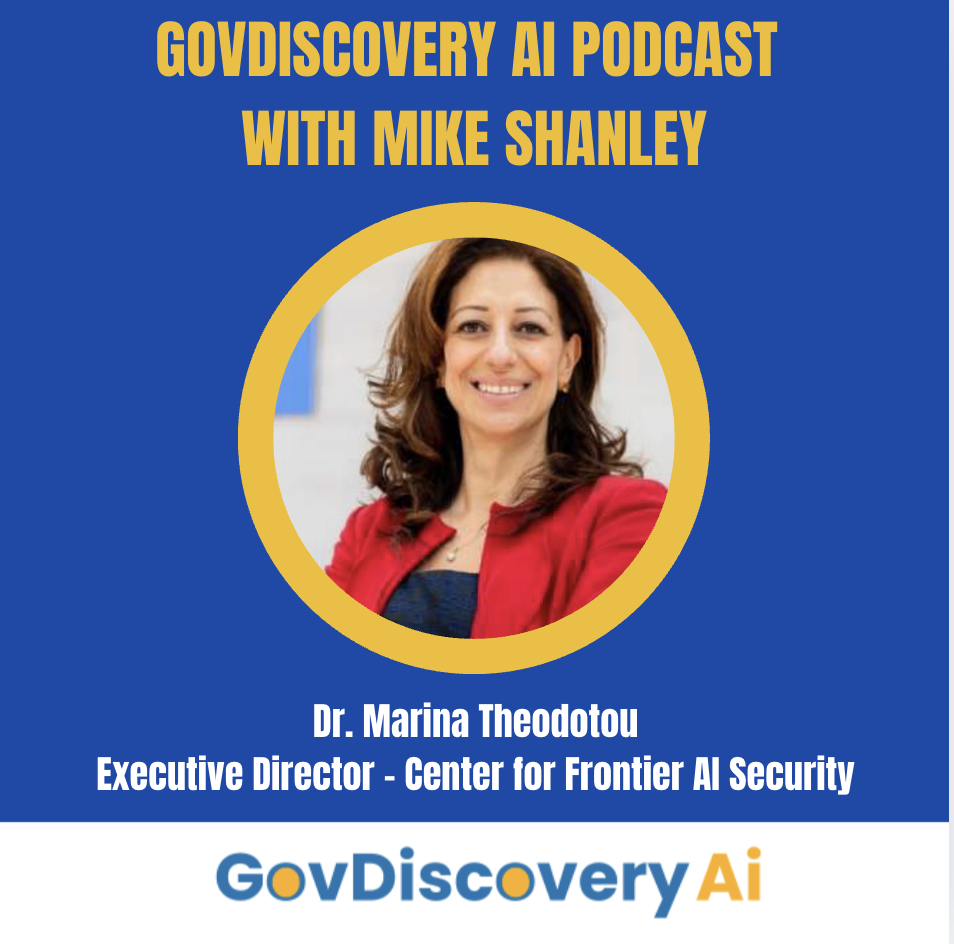
GovDiscovery AI Podcast with Mike Shanley
Ep. 68 AI and National Security with Dr. Marina Theodotou
00:25:11
Loading summary
Transcript27 lines
- [00:00]
A
Welcome to the GovDiscovery AI podcast with Mike Shanley delivering actionable expert insight and AI enhanced business intelligence for Defense and State Department markets. Here's your host, Mike Shanley.
- [00:13]
B
Hello and welcome to the Gov Discovery AI Podcast. I'm Mike Shanley, your host. Our guest today is Dr. Marina Theodotu. She is the Executive Director of the new center for for Frontier AI Security. Marina brings more than eight years experience at Department of Defense, including in the Defense Acquisition University as Executive Director of the Defense Innovation Board at the Pentagon where they published six studies on innovation in unmanned systems with an impressive 150 practical recommendations of which 40% were adopted. She's also co led an assessment of the AI race between US and China and led a team at DoD that advise joint Chiefs and co comms on innovation and AI. Marina, thank you very much for being on the podcast with us today.
- [01:05]
C
Mike, thank you so much. It's a pleasure to be here.
- [01:07]
B
Well, let's get right into it. This week, Jensen Huang, the CEO of Nvidia, said China is going to win the AI race. Marina, what was your reaction to that?
- [01:19]
C
Yeah, I was like many of us watching the news and this, the statement coming from the CEO of Nvidia is pretty, is pretty strong and foretelling. And so what is it that we can do? So the first, my first reaction was what can we do differently to prevent that from happening? I'm going to quote Mark Andreessen who mentioned a few months ago that what we really want is the world to run on a US and allied AI stack. And that's exactly where the center for Frontier AI Security is positioning itself. And that's where we want to contribute and, and make a difference.
- [01:59]
B
Well, we'll get into how we can do that. Let's take a step back though and check in on what is the current state of AI governance in national security.
- [02:09]
C
So there's a lot of great, great work going on. As we all know, AI is moving very fast every day and our frontier models are doing amazing things. And by frontier models, we're referring to the cutting edge, powerful AI systems that are operating at the limits of current capabilities. And the six large frontier models have been developed by Amazon, OpenAI, Anthropic, Google, Microsoft and Meta. And so they're doing amazing things. They're growing every day. And every day we hear more capabilities and more incredible opportunities to harness AI. At the same time, there are a number of initiatives to strengthen AI governance. And the two elements that are critical here or the three elements that are critical here are safety, reliability and alignment of the models. And so several states, including California, have passed legislation to secure frontier AI models and make sure that they are aligning and really focusing on their own governance. And this is great. And of course several other think tanks are developing and publishing really strong policy research. We've had the last two versions of the National Defense Authorization act that have been passed by equally the House and the Senate. They're both focusing on AI security especially the version passed by the Senate a few weeks ago has at least four sections that are focusing on national security, security and AI in particular. And so there's a lot of great work happening and a lot of policy and research being developed. What we are not seeing is implementation of that great research and operationalizing that research within national security. There are efforts, but what we would like to do is bring together government, industry and academia and think tanks and venture capital to work together to actually co develop and deploy a standards framework to put into operation this great research. So RAND has a great research, CSET is doing some great work. MIT is also doing great work. And I just came across a paper today, there's a small research shop in the UK called Apollo Research and they had a great paper titled Assurance of Frontier AI Built for National Security. So there is a lot of great work happening in this space on the research side, but not a lot happening on the application side.
- [05:15]
B
And so in your Intro mentioned that 40% adoption rate of those 150 recommendations, that's really what it sounds like is the role you all are going to play. Let's do high level for a second here. How were you successful? Was it in how you wrote the recommendations? Was it in how you engaged the stakeholders before identifying those recommendations? How do you get recommendations to go from a think tank policy document that sits on a website as a PDF to actually being implemented by the Department?
- [05:49]
C
That's a great question. And I would like to credit the team, the Defense Innovation Board itself chaired by Mr. Bloomberg and the board members whose gravitas actually was so critical in formulating those recommendations. And then the effort that our team within my staff team within the Defense Innovation Board that engaged all more than thousand stakeholders across the DoD, DoW and industry and academia and think tanks to come together early and often. So the key is early and often engage the stakeholders early and often and make sure that the recommendations are practical and actionable. So in my experience over the last 30 years of working in several industries including defense, banking and finance, management consulting, learning, development, this has been a key, tried and tested practice, engage stakeholders early and often and make the recommendations practical and actionable. Because when we were very specific in the way we worded the recommendations, it was easier for the stakeholders to take them on and adopt them. If the recommendation is too broad, then nobody owns it. You have to really be specific and engage the stakeholders and make them and encourage them to own those recommendations. So in the end, when the study is published, then the adoption is much easier.
- [07:46]
B
So what are the challenges to winning the AI race? One thing you'll commonly hear in these conversations is actually on the energy side and is just pure compute power numbers. What's your perspective of that? How do you frame those challenges? And then we could get into how we address them from there.
- [08:05]
C
Yeah, absolutely. So we launched CFAs on October 1, so we are a few weeks old and we actually brought together leaders from the frontier models and we can talk about that a little bit later. But in that conversation, the key, one of the key risks and challenges was obviously compute power and energy. And we know that compute power requires data centers, and data centers require copious amounts of energy that are increasing at an increasing rate because the more powerful the chips, the more energy needed. And there is also the other side, a complementing element, which is water. So you need water to be able to cool off all the heating that is generated. And so what we've seen is that China is actually finding new ways to increase energy and cooling of their data centers. So I think there is a great focus on compute power and building powerful data centers. I was reading this morning an announcement by Andy Jassy of Amazon announcing the new data center that has been built in collaboration with Anthropic. So we're seeing a lot of these collaborations across many of these large organizations, large companies, and that's great. I think together we're stronger. And so we have to tackle all of these challenges, from infrastructure to compute power to security. And we at the center for Frontier AI Security want to focus on securing AI and operationalizing AI. So we're not going to to focus too much on those areas. The infrastructure, although they are critical. However, we want to leverage the work that is being done and make sure it is incorporated into, into our efforts. I hope that makes sense.
- [10:28]
B
So take us inside. Yeah, no, no, thank you. And first of all, that's impressive within the first couple weeks of launching and getting all those big names in a virtual room together to the extent you can. Could you take us inside there? I'd be interested in. Obviously you're an expert in the field. So what was something that came up during that meeting and you know, no need to be any more specific than you're able to. That surprised you? Did someone say anything that surprised you or not say something that surprised you or. Yeah, yeah.
- [10:55]
C
Thank you so much.
- [10:56]
B
Anything you can share along those lines.
- [10:57]
C
Organizational change and, and so that's where my expertise is and I am very passionate in solving problems at the intersection of defense, organizational change and AI. And so we are this inflection point right now. And it was wonderful to be able to bring into the virtual room 44 leaders, including leaders from Nvidia and OpenAI and Google and Amazon and many others from now industry, former government and academia and think tanks and NVCs to talk about AI security. So it was an amazing conversation and a lot of great insights. What was great about that meeting was the validation of our mission. So the center for Frontier AI Security came together and what we're focusing on is we want to, as I mentioned, operationalize AI. And what does that really mean? It means that we want to make sure that our frontier models are secure, that they are reliable and aligned to our national security goals. And so currently there is no framework of standards that enables the Dow and other agencies to ascertain the safety, reliability and alignment. There are, there are recommendations and lists of requirements. However, there isn't a formal standard. Now the Department of Commerce has done a great job with nist. They created the risk framework that has been operational for probably, I want to say three or four years now, about five years. However, that is not national security specific. And so how do we build from there to create a framework that is national security specific so that both industry organizations large and small, and the federal government, dow, dhs, the intelligence community are all operating and under the same standards. And so when we compared the six frontier models security plans that they've published against each other, we found several areas of alignment, but also five key areas where there are significant gaps. And I'll highlight three. One is lack of interoperability across the the frontier model safety plans, differing definitions of risk. Now that may sound basic, but it's actually very critical if you're in a contested environment and our operators are using frontier model, they're using data from frontier models to make decisions. So what happens to our decision advantage in a contested environment if basic things like definitions of risk are not similar, are not the same across different models and our operators are having to use different models to make those decisions on the spot? So these are the kinds of questions we're asking and our participants hands down validated our mission that yes, we do need a framework. How can we help? And so, so that was very exciting.
- [15:03]
B
A couple things I want. Thank you. Let's. I want to get into. So a lot of what we're talking about is gen AI, large LLMs and I want to get into those vulnerabilities, but also going into now autonomous vehicles, autonomous systems. And a lot of the conferences I've been speaking at, attending, participating in recently have been focused on underwater maritime plan based autonomous systems. I mean I think the clear vulnerability is if someone gets into the AI adversary and creates a system that goes rogue. What are, is that too sci fi? What do you see as the main challenges or vulnerabilities to the deployment of those autonomous systems in contested settings?
- [15:56]
C
And yeah, thank you for highlighting that. So I'm going to go back to a TED talk that the CEO of UNDERIL did recently. And in that TED talk he explains why and how AI is so interrelated to unmanned systems and how the combination of those two capabilities are critical to winning the next fight because we don't have the numbers in people compared to our adversaries. So the only way we can win the fight is if we can align and deploy our best AI with our best unmanned systems in scale and speed. So I'm not an expert in AI or unmanned systems, but my expertise is in asking new questions of old problems and also bringing the right people together to answer and tackle these tough problems. So it's an imperative that all of our mans systems, some of the unmanned systems don't have to operate with AI. They can just as we see in Ukraine, they are sent out with a payload, they do their job and they either come back or self destruct. And so our biggest challenge, one of our biggest challenges is how do we ensure that there is interoperability across the different AI capabilities and unmanned systems so that they all talk to each other, there is congruency so that in the end the user, the operator that is relying on these capabilities is making the right decisions, has decision advantage, operational efficiencies that drive lethality.
- [18:15]
B
And I think there'd probably be two points there that would be interesting is both the interoperability within the US Defense Forces and then interoperability with allied forces as well. I want to get into. During our prep we talked a bit about the 20 and you mentioned earlier the 2026 NDAA. Could you talk in more detail about let's follow the money, what, where, where we can anticipate the funding going for AI spend under the Dow budget?
- [18:46]
C
Yeah, well, the NDAA 2026, the House and the Senate have approved their versions, but I don't think we have a final NDAA for 2026. We have indications of where some of the funding will go. Definitely AI security is prevalent, but I think it will be premature to comment because we will have to see the final approved version.
- [19:19]
B
Okay. Yeah. And then for what you all are working on, we got into your goals, but what would success look like over the next year?
- [19:29]
C
Absolutely. So we are activities to reconvene the experts that we brought together on October 1st and those will include identifying use cases and scenarios that are relevant to operators. So we're going to start with the user first. So the operator is the user first. So what is it that they need to have and how do we work backwards to create a framework of standards that supports what the operators need? So that's a key element. Another element is identifying or down selecting key risks to provide a framework for those scenarios. So the MIT AI risk team has done and continues to do a great work of identifying risks around AI and they have identified over 1600 risks. One of our challenges and opportunities will be how can we leverage that great work and down select the most critical risks that are foundational for operators and work around those so that we can create a minimum viable product the first year of operation, a minimum viable standards framework that everyone from government, industry primarily and academia can get behind so that we can start testing and ideally in year two, deploy that standards framework down the line. The goal is to be the think and do tank. That's how we would like to be recognized. There are great, as I mentioned earlier, great work is being done, but we want to close the gap between policy and implementation and how can we best do that? So lots of great things in store. We are working diligently and hopefully we'll have some announcements to make before the end of the year that will solidify some of these initiatives and efforts and we'll be able to publish the plans going forward so that we can engage experts from industry, AI, small AI shops, big AI shops, academia that focuses on AI. There are a number of schools and universities that have done tremendous work on AI security and also think tanks and venture capital. We want to make sure that venture capital is also involved because they have a different perspective of the market, they're following the money. And so I started my career in banking financial services, so I have that finance background. And so I think it's important to have the VCs in the room as well. And of course the federal government and state and local government if they would like to join us.
- [23:04]
B
Well, let's get into that. How can our listeners both follow the updates as well as organizations that want to partner with with you, Marina? How can they contact you?
- [23:15]
C
Thank you Mike. So please follow us on LinkedIn. We have a page CFAS center for Frontier AI. We'd love to have you follow us there. That's where you're going to get the updates. And also on our website www.cfas.online. that's our website and there's a form there. So if you want to contact us and get in touch, please fill out the form. We will collect those and get back to you and make sure that you are on our distribution list and so you will be first to know all the next steps and the next exciting things that we have in store for securing AR Frontier AI.
- [24:02]
B
Thank you very much Marina. We'll be looking forward to some future updates, hopefully soon from you all and to following the progress. Thank you for you and the team for the important and critical work that you all do. And thank you for being on the podcast today to share your insight and update with us and our listeners.
- [24:22]
C
Absolutely Mike. Thank you so much to you and your team for the invitation. Looking forward to seeing how we can all work together to move this needle forward. Thank you.
- [24:32]
B
Thank you very much.
- [24:35]
A
Thank you for tuning in to the Gov Discovery AI podcast with Mike Shanley. GovDiscovery AI leverages our team's decade of experience winning federal funding to deliver federal growth intel to sales proposal and capture teams working in defense and civilian markets. Each market intel report is delivered by federal growth experts leveraging our proprietary deep data discovery process. If you if you enjoyed today's show, be sure to subscribe wherever you get your podcasts and connect with Gov Discovery AI and Mike Shanley on LinkedIn or learn more at govdiscoveryai.com.