← GovDiscovery AI Podcast with Mike Shanley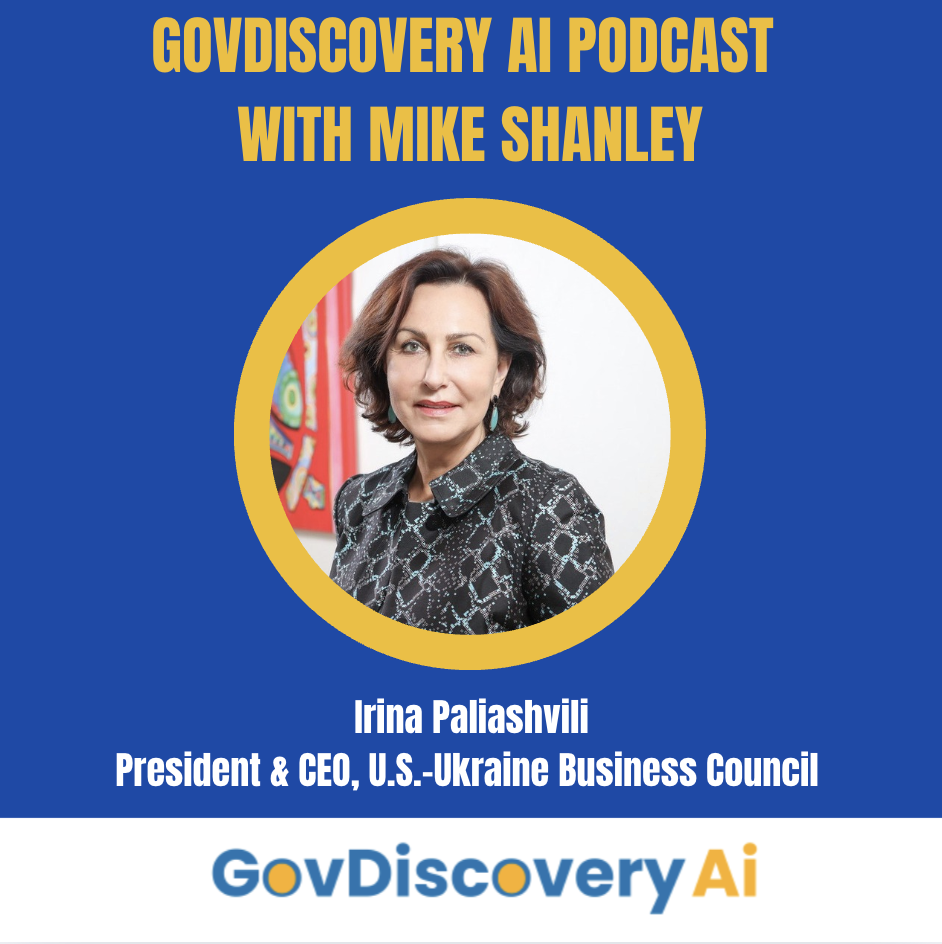
GovDiscovery AI Podcast with Mike Shanley
Ep. 69 Ukraine Defense & Rebuild: Opportunities, Challenges & Trends for Industry
00:27:49
Loading summary
Transcript31 lines
- [00:00]
A
Welcome to the GovDiscovery AI podcast with Mike Shanley delivering actionable expert insight and AI enhanced business intelligence for Defense and State Department markets. Here's your host, Mike Shanley.
- [00:13]
B
Welcome to the Gov Discovery AI Podcast. I'm your host, Mike Shanley. Our guest today is Irina Pagliashvili, President and CEO of the U.S. ukraine Business Council. Irina, thank you very much for being on the show with us today. And thank you joining us very late from Warsaw.
- [00:30]
C
It's not that late, Mike. It's 5pm here in Warsaw. I'm here for the Rebuild Ukraine Conference and for several side events that U.S. uBC is doing and I'm very grateful for this opportunity to be on your podcast. Thank you.
- [00:46]
B
Thank you. Well, looking forward to getting insight from you on the Ukraine market. Opportunities and challenges there. But let's start out with U.S. uBC again. The U.S. ukraine Business Council. Can you talk a bit about what you all all do and what makes you unique in this space?
- [01:03]
C
U.S. ukraine Business Council is a business and trade association. We were incorporated in the United states. It's an US private sector business association and we were incorporated 30 years ago. So this year is actually our 30th anniversary in October. So we are already moving towards 31st year of our existence. It's an organization that is the largest Ukraine focused association in the world that is headquartered outside of Ukraine. Our members are predominantly leading US Companies, but also we have several prominent Ukrainian companies, European, Canadian companies that are looking at doing business either in the United States or with the US partners. As of today, USBC has nearly 240 members representing all key sectors of economy. But obviously because Ukraine is now fighting the war, the defense sector is one of the fastest growing sectors in our membership as well as after the announcement of US Ukraine Economic Partnership and creation of the US Ukraine Reconstruction Fund. We have more members in energy, mineral sector and one of the other growing segments is IT sector, but we have all the traditional sectors. Of course, one of our legacy traditional sectors is agro because Ukraine is a global agro powerhouse. So all the major US Agro companies are members. So it's a great combination of different segments of membership, but definitely the current situation dictates which segments are developing faster.
- [02:49]
B
Thank you, Irina. And one thing I've been impressed by and noted since we met in Bucharest a few months ago at the NATO European Defense Conference is the Council's connections to Ukraine's government to current key decision makers. Let's focus on the defense market. Could you talk a little bit about your partnerships, your relationships in Ukraine in the defense market.
- [03:11]
C
As a business council, we are based in both capitals. Our main office headquarters are in Washington D.C. and we have a team working in Ukraine. Our very important mission is to be constantly engaged with governments on both sides of the Atlantic. In both capitals, we are engaged with US Government, we are engaged with Ukrainian government. We work very closely with both embassies, Ukraine Embassy in Washington and US Embassy in Kyiv. We work directly with several ministries in Ukraine that are interested in working with our members. So there is a lot of this business to government B2G going on. But we also do very active B2B engagement. And this, this just goes on constantly, permanently inside the Council. The council is strictly membership based. So everything we do, we do only for our members. And I think it's important that within this association there is a secure trusted platform for B2B engagement and B2G engagement both in the United States and in Ukraine. And one of our key strategic new, I would say directions is European level engagement. Just because how you can see in Ukraine an active participation of EU companies, companies coming from European Union space. And they want to work with us private sector. So we want them to work together and we want to introduce them to each other. So this is our important new direction, European level engagement as well.
- [04:49]
B
So what we often hear about is the long list of companies of organizations that want to test their solutions in Ukraine, that want to be part of Ukraine's defense, that want to do the battlefield testing and get the certification to demonstrate the effectiveness of, of their solutions. Could you talk a little bit about what that for some listeners that might not even be familiar with that process at all, what the current state is of that for an organization with no connections, definitely talk about, you know, how, how joining your council would be valuable there. But someone that has a solution that wants to test it to, to prove its effectiveness and support Ukraine's defense. Where would they even start?
- [05:29]
C
Depends which branch of defense industry accompanies. At USUBC we basically have in our defense segment, we have every branch of defense industry represented. We have OEM primes, we have defense infrastructure, we have defense tech, logistics services, drones, of course UAVs. And it really depends which subsector the companies. So they have different interests, different priorities. But of course for most of them, very important capability is testing. And in Ukraine this is Ukrainian government is trying to do it at the more centralized level. So if you have heard about cluster called Brave 1, one of their key spheres of activity is assist with the testing, combat conditions. And there is a lot of it going on through them. So we would introduce our members to Brave One and we do a lot of events with Brave One. We are in direct touch with their leadership. Just had a conference call a couple of days ago and what they are looking at Brave One, they are looking at more and more US Companies coming to Ukraine to utilize this opportunity for testing. So of course we are informing our members of this potential. But Brave One is looking at a much broader engagement with international companies and we will be supporting them in their plans to do events outside of Ukraine, in the United States as well as in Ukraine. But because of the war conditions, not all US Companies may travel to Ukraine. There are all kinds of internal corporate restrictions. So that's why Brave One will be doing events in Poland, in the United States and we will be supporting them in that.
- [07:26]
B
So that's an interesting point. And every time I'm talking with either our connections in Ukraine or other officials, the first thing they say is if you want to support Ukraine, come to Ukraine, be in Ukraine, be on the ground. Irina would do you think that's a necessary. So let's say there's an organization again, they're at the assessment stage. They're not ready to fly to Poland and get on a train to Kyiv quite yet. Should they expect that that would have to be part of their operations at some point? Or is it possible to find partners through, you know, US U B C for example and run the full testing and market entry process that way you can do both.
- [08:04]
C
Our members do both. Like we have members who travel regularly to Ukraine. We are talking about specifically defense sector right now. Yes, we have members who are opening representative offices in Ukraine. We have members who are preparing co production in Ukraine and we have members who don't travel because of internal restrictions of other reasons. That's why such entities as Brave Ones decided also to go outside of Ukraine to capture this segment of international companies that are not ready to travel to Ukraine but still can offer interesting business solutions, technology, joint co production. Some Ukrainian companies are looking at co production outside of Ukraine for this. The US Partner doesn't need to travel to Ukraine. They need to explain to the Ukrainian companies what they can offer know in the United States or in Denmark or in Germany. So it really depends what kind of business needs are there. And there is many ways to achieve those business needs. And organization like ours, we are not making deals but we are providing a platform for exclusive networking events, information that otherwise, you know, our members would not find out contacts. And we work very closely with several Other we call them best friend associations. Also in the defense sector, for example ISOA where we met with you, International Stability Operations Association. We work with bands, business executives for national security here in D.C. our new partner and very active, you know, partnership we are developing with them is association for Uncrewed Vehicle Systems International, AU VSI and these are drones and robotics. And I was 400 members just at.
- [09:56]
B
Their annual con, their annual defense conference last week. It was a two day event they hosted in D.C. definitely Ukraine was top of mind of just, just about every conversation there.
- [10:07]
C
Right. So you know, there is a lot of synergy between what we are doing and what they are doing. So we are, we have a pretty robust program that we want to pursue with them. Joint events, visits, etc. We are partnering on some events with the Institute for the Study of War, which is an extreme important analytical center. So I think these connections outside of our association with other associations are as important as government engagement or business to business because a lot of it's by extension our members benefit from what other associations are offering and their members benefit from what we can offer.
- [10:49]
B
Are you able to share any case studies of some of your members and how they have found success in supporting Ukraine's defense?
- [10:56]
C
Definitely, we have seen a of success and it's very rewarding to see a company joining us with basically no knowledge, no understanding. Just wanted to explore potential in Ukraine. And next year they're already opening an office in Ukraine. They're already creating a joint venture with a Ukrainian partner. It's really depending on your plan. It's really important to join the community and then to take active advantage of those benefits that the community is offering. One of your questions before was whether it helps to travel to Ukraine. It helps a lot. We as a business association, we cannot encourage or discourage our members from traveling. They have their own insurance policies, they have their own requirements. Again, Ukraine is a country at war. So this is a big responsibility, you know, to send your executives to, to the country which is at war. But what we have observed that those members who travel frequently or have domestic local presence in Ukraine, they're usually more successful and or their success comes much faster.
- [12:14]
B
And one kind of a nuanced question, should everyone's office be in Kyiv or is there a value to having an office elsewhere in Dnipro, in Lviv, in Odessa?
- [12:23]
C
It really depends. Traditionally everyone wants to be in Kyiv, but I think that now there is a lot of development in the regions and different regions are offering different opportunities, different capabilities for defense companies. Probably it's More important to be close to the front lines, especially if there is a capability testing. But then of course, the security risk grows the closer you are to the frontline. There is of course, you know, security risk everywhere in Ukraine, but the closer you are to the front line, the more the security risk is. But I can give example of one of our very prominent members. It's Ukrainian Freedom Fund. They're based in Kyiv, but they travel a lot to the front lines all the time. So you can be based in Kyiv, but go back and forth. Or one our other member, American University, the main campus is in Kyiv, but then they have, they just opened a campus in Nico. So there is a lot of opportunities outside of Kyiv as well.
- [13:32]
B
So let's get into the current state of Ukraine, the Ukraine market. More than 20 years ago, I was a Peace Corps volunteer in Kharkivska Oblast. And that was obviously a formative time for me getting to know Ukraine, the language. I was stationed close to the, the border. Every time I go back, I'd always been surprised by how much has changed. And what I'm hearing is it's not even just every couple of years, but even months that, that the situation, the needs are changing. Could you talk a little bit about both what the current market, the current state, the current needs look like, and then also how do your members, maybe that's the main role you all play, get that ongoing intelligence and market intelligence, business intelligence, to make sure their solutions are aligned with the evolving and what's now a very mature market.
- [14:25]
C
It's. It's hard to call this market mature. I would say that it's extremely dynamic market, slightly chaotic, because you know, the situation and the front line is changing all the time. Something that was important and needed two years ago, today these priorities are changing. So one of the keys to success, to be very dynamic and to understand these very fast changing priorities and to adjust very quickly. Unfortunately, we have seen a lot of corporate bureaucracy. So companies are coming to Ukraine with certain business plan, then the situation changes, the demands change, but the corporate inertia still is dragging on. So then those who can adjust very quickly, those who can understand the ever changing demands, they get much better success than those who are still, you know, sticking to their business plan, which was good two years ago, but it's not good anymore. So very quick reaction and also being very well informed. And it's not only being a member of association like ours, it's talking to various Ukrainian companies. I would say that few years ago there was nobody to talk to because Most of the defense industry, defense industrial base in Ukraine was monopolized by state owned giant Ukraabaron promotion. And we are talking and this was a highly regulated industry of course, and remains highly regulated industry. But it was sort of a post Soviet environment where you have a state owned monopolist and then, you know, it was very hard to do business with them. Mukrabaron Prom changed a lot. They reformed. They have very dynamic leadership. They have a supervisory board with independent directors. So today doing business with Ukraboronprom is still not easy because it's a giant company, but it's a completely different story than several years ago. So those companies that came in like seven years ago, for example, not do business, they shouldn't have this inertia in mind. They should understand that today everything changed so they should go back and try to do business again. So industry is demonopolized. There are many private OEMs in Ukraine right now, especially in the defense tech. It's completely demonopolized. There are numerous startups, most of them private. So there is a private market in the defense sector, very active, dynamic private market. The key challenges are funding scaling, accelerating IP transfer. And we see our company is facing those challenges and you can call them roadblocks or challenges, but there are ways to overcome those challenges. As long as there is a product, whether it's, you know, hard manufacturing or technology that is important at this moment, there is a way of overcoming those challenges. We also see a lot of wishful thinking, like somebody is coming to Ukraine saying we have this great product, let's say drone, of certain kind of drone, and we think that this drone will be so crucial at the battlefield. And then we had a meeting with one of the state agencies that was in charge of procurement of drones and they said, we test this drone and it's just not working. So the company takes it back, makes some improvement, they bring it back and it's not working again in the combat conditions. So I think the company should be very realistic about what they're trying to promote and test their products in Ukraine in the combat conditions and improve. Because the Ukrainian made drones, they are being improved constantly. They drag them back and forth between the front lines and the labs and it all takes weeks, not months, not years. So the same speed is required from western companies, from American companies.
- [18:44]
B
Could you talk, thank you for that. Could you talk more directly about the procurement process in Ukraine's defense sector? Both, maybe touch on, both directly selling to Ukraine as well as through its, its allies.
- [18:57]
C
There is of Course, you know, several models, there are fundings that are coming from NATO, from Danish models. So Ramstein, I'm not fluent in this. ISOA was very good in Wiesbaden in April, where they brought key NATO procurement officers that did excellent presentations with all the information available. So I would address this question to experts in terms of Ukrainian defense procurement. We issue quarterly newsletter and this newsletter is prepared by our member Ukraine Freedom Fund. And it gives like the most updated information on the procurement reform, on changes. And the latest newsletter came probably two weeks ago. So what I am seeing there, first of all, hugely increased role of military units in procurement. The Ministry of Defense now is listening to the units. There is a formal procedure where the units give direct requests to the DoD chain defense platform. This is the digitalized. It's like Amazon. They call it Amazon of Defense. So this is the main direction of the defense procurement in Ukraine, that the brigades, the military units basically tell the Ministry of Defense what they want. That's a big change because even a couple of years ago we were seeing the civil servants at the Ministry of Defense like basically telling the front what they need. Now it's a complete opposite change, which is excellent because our members now understand not what in general is needed, but what is needed at the front lines. And a lot of testing is going on. So it's a much faster system. And this reform brought the delivery time from months or years to basically weeks. In the newsletter we gave some examples of fast deliveries and some of them by Ukrainian drone manufacturers. The delivery time sometimes is like eight days, which is really extremely, extremely fast. So I would encourage our members in the defense sector to understand what the military units are asking for, talk to military units, and for this there are platforms, there are meetings. Brave One is also a great platform to coordinate those, but not anymore. Just think that if I spoke to someone at the Ministry of Defense, that's it. They know what they want.
- [21:38]
B
And Irina, that. Oh, sorry.
- [21:44]
C
The same with Brave One, by the way. And Brave One is a separate. They have their own separate marketplace and they're in parallel with the Ministry of defense, the DoD chain defense, but they're coordinating now. So that's also good news because there is a coordination going on.
- [22:00]
B
And that's exactly our approach with supporting clients with the market entry for defense testing is maintaining the connections not just at the senior levels within the Ministry of Defense, but at the battlefield level to understand what are those actual the current needs. As we wrap up, I do have one more question that we'll get into how our audience can join your, your business council? Can we, Are there other, any other roadblocks or misperceptions? You talk about both the internal bureaucracy of the organization, the company coming to Ukraine, the dynamic environment there. Corruption is something that comes up in anyone that's done business in Ukraine 10, 20, 30 years ago. Could you touch on that or any other misperceptions about doing business in Ukraine?
- [22:44]
C
Of course. You know, when you have such a dynamic market, there are a lot of misunderstandings there. Some of the companies come to Ukraine with a very sort of predetermined mindset and when they understand how quickly they have to react, how dynamic and sometimes as I said, chaotic the market is, that's discouraging for them. They just get lost. You know, they are used to a much more structured market. So the mindset needs to be prepared and needs to be flexible and needs to respond to the demands of the market very quickly. I also am a lawyer, a life long career in law in private practice. But also I'm observing that when US companies go into any other market, start with hiring lawyers, with understanding the legal environment when they come to Ukraine, they don't expect that this is necessary. And it is necessary because coming into foreign market anywhere and especially in Ukraine, which is a country at war, and it's a pretty developed legal system, it's a pretty mature bureaucratic system, regulatory system, especially in the defense sector, IP protection. So it's really important to talk to lawyers, to talk to financial advisors to understand the tax situation instead of just coming in with a product and expecting that, you know, you can do business without really understanding where you are and what you are doing. So our advice, we have a pretty good segment of law firms in US UBC which is mostly Ukrainian, you know, very reputable law firms. So when our members are coming in, we just give them the list, go, go talk to all of them or choose which one you want. But don't assume that you come to Ukrainian market and you can do whatever you want. It's not a wild east anymore. It's a pretty structured legal system. So that's the advice that we are usually giving to our members.
- [24:56]
B
With that, how can our listeners learn more about USUBC and become members and attend maybe talk about a couple of upcoming events that you have with US government, with some of the other government, with Ukrainian officials too.
- [25:09]
C
The way to join us UBC is to go on our website, usubc.org There is a separate membership page where there is all the information about joining USUBC and the annual dues. So it's a pretty exhaustive information. The process includes Know your Customer working group which our executive committee created. So every applicant fills out the application form online and then this application goes to our Know youw Customer working group. Usually it's a very robust process. So within several days we have a conclusion. I cannot say that we accept 100% of applicants. I would say every out of 10, maybe one or two are not invited to join the membership for various reasons. It's important to understand that it's not automatic. The membership is not automatic because as I said, we are a trusted platform. We want our members to trust us and also to trust each other. And our membership grows pretty fast in different sectors, not just defense. So we are becoming a larger organization but we are trying to keep personalized approach and that's, that's I think part of our advantage and DNA and another advantage is that we are in both capitals in both sides of the Atlantic.
- [26:33]
B
Very and I would imagine another values too is in addition to the government connections, also the networking say the growing defense tech startups, the the subs that want to connect with the primes with the OEMs. It's probably a great opportunity to do that. Well Irina, thank you for joining us today. That's Irina Pagliashvili, President and CEO of the U.S. ukraine Business Council. Thank you to you and your team for the important work that you do and definitely go check out their website membership opportunities and put some of their events on your calendar.
- [27:07]
C
Thank you Mike, thank you for having me.
- [27:09]
B
Thank you for being on the show. And Slavu Krajini, thank you for tuning.
- [27:14]
A
In to the govdiscovery AI podcast with Mike Shanley. Govdiscovery AI leverages our team's decade of experience winning federal funding to deliver federal federal growth intel to sales proposal and capture teams working in defense and civilian markets. Each market intel report is delivered by federal growth experts leveraging our proprietary deep data discovery process. If you enjoyed today's show, be sure to subscribe wherever you get your podcasts and connect with Govdiscovery AI and Mike Shanley on LinkedIn or learn more at govdiscoveryai.com.