← GovDiscovery AI Podcast with Mike Shanley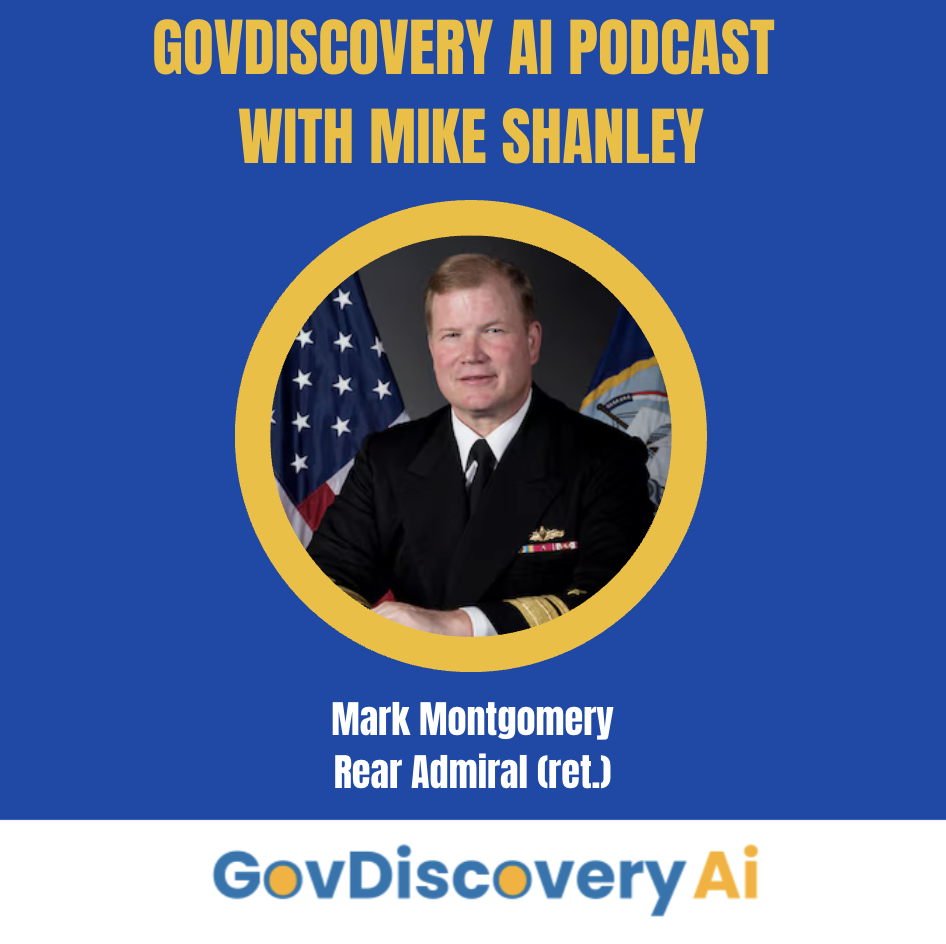
GovDiscovery AI Podcast with Mike Shanley
Ep. 70 Taiwan and the Pacific: Demand Signals for Industry
00:40:30
Loading summary
Transcript36 lines
- [00:00]
A
Welcome to the GovDiscovery AI podcast with Mike Shanley delivering actionable expert insight and AI enhanced business intelligence for defense and State Department markets. Here's your host, Mike Shanley.
- [00:14]
B
Welcome to the govdiscovery AI Podcast. I'm your host, Mike Shanley. Excited today to have our guest retired Admiral Mark Montgomery, currently senior Fellow at the foundation for Defense of Democracies. I saw Mark speak recently at the AUVSI Defense Conference and was very much looking forward to having him on the podcast after that. Very informative and interesting panel. So Admiral Montgomery, thank you very much for being on the show today.
- [00:41]
C
Hey Mike, thank you for having me. I'm looking forward to this discussion.
- [00:44]
B
Let's get right into it. We're talking about demand signals in the Pacific. What is the operational context for winning or, sorry, the operational concept for winning in the Pacific from your view.
- [00:56]
C
Thanks. This is a complex question and it changes over time and certainly it's different now than it was seven or eight years ago when I was writing the Operational Warp. But I think broadly, and I don't want to be glib when I say it's kind of an east coast, west coast thing and not Tupac and Biggie, but you know, the idea of the west coast of Taiwan is you have one kind of fight for the west coast of Taiwan that crossed the Taiwan Straits into China and you have another sort of fight east of Taiwan. And so first I'll talk about the west coast one. It's the one that you hear Sam Paparo, the excellent commander of US Indo Pacific commander, a Navy admiral, when he talks about hellscape, what he's talking about is that fight that's going to happen in the straits. And you know, that will be and again, I should preface this with I hope this combat never happens. Now I've got a son in the Navy in Japan. I don't want this to happen. But if it happens, this is how I envision it. That west of Taiwan is this counter intervention fight where Taiwan pours UAVs, unmanned surface vessels, unmanned underwater vessels, mines cruise missiles, low cost cruise missiles, anti armor weapons all across the strait to destroy hundreds if not a thousand plus Chinese ships that go from true amphibious ships which they'll have some of a few of through larger roro roll on row off ferries to smaller ferries to fishing vessels, the merchant, you know, the military militia vessels, bring in over, you know, tens of thousands of PLA forces plus their equipment as well as literally a thousand helicopters trying to bring over troops and they have to be shot engaged either with UAVs or drones or shoulder launched MANPAD missiles. Right, like Stinger type missiles. So that's a hellscape. There's thousands, he's right, there's thousands of weapons in there. And yet, and what you have to do is build so many of so many different varieties that when Xi looks across the strait he goes, you know, that is not a fight my forces want. Okay, that's east of Taiwan, west of Taiwan, something completely different. And that looks a little bit like Russia, Ukraine, but at sea. And by the way, should they get a lodgment, that is forces ashore across the Taiwan Straits, you'll have the same kind of counter intervention with anti armor artillery manpads again between the Taiwan army and the pla they've lodged ashore. Okay, west of Taiwan, something completely different. Excuse me, east of Taiwan, east of Taiwan is completely different. That's they float out their navy, their submarines, their, their, they're large surface combatants, basically destroyers and air running combat air patrol over there. And they will very quickly have air control over Taiwan. Day two, day three they'll have wiped out the Taiwan F16s who I hope will have done a lot of damage to the PLA air force as they do that, but maybe not. And then the, then the Chinese have pushed out 4, 600 miles east of Taiwan. Now we're going to have a fight there to roll them back so that US air power can get over Taiwan. That's our theory of victory. Air power in place over Taiwan within I would say five to nine days of problem start. Otherwise those forces that have the lodgment plus air power will have wiped out the Taiwan army. So we've got to get back over the. Okay, that war looks like Israel trying to take out Iran. A very different war than Ukraine, Russia. That's the war we've been building. That's a war that requires attack submarines with Mark 48 ADCAPS 5s with long range, you know, anti ship weapons, air to air weapons, B1s, hopefully eventually B52s with long range anti ship cruise missiles called LRASM. Long range anti ship cruise missiles with JASSM ERS which are long range ground strike against certain targets in China kind of thing. Destroyers with SM6s, SM2s, SM3s, these are all standard missiles that are fired, literally standard missile SM decks, you know that are fired against this. And that's kind of a high end fight. So you've got this like, it's like back alley scrape going on west of Taiwan and kind of like the high end war we've always visualized east of Taiwan. This is hard. I mean by the way, I don't mind this because we're a military that can do, we can walk and chew gum. We can do two things like this. We can think like this, we can procure like this, we can can fight like this. I have total confidence in our commanders in a deconstructed environment to fight and win in this scenario. But we've got a, an increasingly capable adversary we're going against. So there's a lot of things we do. So to me that's the operational concept is to win both those wars. But you got to win, you got to slow down the cross strait invasion, limit the number that get ashore and then fight that lodgment and then you gotta roll back the forces east so that you can get US air power over the island. And that's all gotta happen in some, I would say five to nine days. I could be proven wrong on that and I do that all through unclassified war gaming, not classified war gaming. And I think classified introduces a few extra things but to me it doesn't terrifically change the outcome.
- [06:11]
B
We had retired general US Marine Corps General Glavy on here talking about how much open source intel there is out there and how much the generals and leadership is likely using, using that too. Just to that point are, is our military, are we preparing on track to be prepared? Is our readiness at the point now is this something that we need to get to? Is there a changing course to be ready for these two different types of, of combat?
- [06:39]
C
So you know, this is what we call the most dangerous scenario. And this is actually what we exercise tabletop dude, the military, the Department of Defense and drive its requirements this most dangerous scenario. So we're working towards it. Look, we're not where we want to be. I mean we'd like to have better munitions. Thank God Russia you invaded Ukraine. I say that sarcastically, but we were the same terrible condition. You saw that artillery and jazz. The artillery and all the other ground based weapon munitions were in. So were our Pacific weapons. We weren't spending money on them either, but we filled up the Pacific weapons coffers. They're not where they need to be but they're much higher than they were three or four years ago thanks to the lesson we learned with Russia and Ukraine. So we're in a better position. The good news is, you know, we used to Davidson said oh, China might cross our ability, their ability to take Taiwan might cross our ability to defend it in 2027. You know, there's a comma after that it says, except we all get a vote. We voted after Ukraine with better procurement. Taiwan has increased its defense spending to 3.3% from under 2%. Japan's doubled its defense spending, and they already spent their money really wisely. Australia's increased its defense spending, so we've been better. And then the Chinese had a post Covid glitch. So, you know, I think that the chance of them passing us before 2030 is unlikely. That doesn't mean they don't try it. But I'm just saying a logical assessment, quantitative assessment, would say we're in pretty good shape. We're not where we want to be, but we are in good enough a shape that the Chinese should be deterred from doing it if they believe the US Will defend Taiwan.
- [08:19]
B
What role would you potentially see cyber playing in that type of attack or an invasion?
- [08:26]
C
Well, look, I. And so this is important. It'll. It'll be important in the most dangerous scenario to have a key role enabling attacks on critical infrastructure. Look, the biggest role will be in the, in the US Homeland. The president talks a lot about defending the homeland. And to his credit, President Trump's credit, every president since 911 has said defending the homeland is number one. President Trump's actually put resources against it. Like it or not, the border is more secure. He has talked about Golden Dome and putting money against that missile defense problem. That's not a guarantee for success, but it starts with resources, and he's done it. The third thing, though, cyber. And that's where China's camping out, attacking our critical infrastructure. That's where they're attacking our homeland. And this isn't espionage alone. This is operational preparation of the battlefield. That's what Volt Typhoon, which is the name for an attack done by a Chinese Advanced Persistent Threat team that we call Volt Typhoon, has done. And that's where they put. They surveil our systems, find weaknesses, penetrate them, and either put a future access in the ability to get back in the system, cyberwise, or maybe even malicious malware in some cases. And thousands of US pieces of infrastructure across our military mobility, our rail, aviation, ports. That's how we move stuff from bases to places overseas. Our electrical power grid that powers all that, our financial services that give us our economic productivity, that operational preparation of battlefield was a big deal and kind of shrugged off by Americans in a way that they wouldn't have if this was a thousand knapsacks with Semtex. In it, strapped to the same infrastructure, we'd just about lost our mind. But back on this, you think about it. Military mobility is a key capability in the United States. We have to be able to get just say a tank from Fort Hood, Fort Cavazos in Texas to Korea. We'll say, well, the tank goes on a. On a rail car that's made for tanks on the base. But on the base there's two. Two power systems, two comm systems, two water systems. So Noah's ark of critical infrastructure, all good to go. Then the train leaves the base, gets on like rural Rare collective number 52, you know, run by Uncle Rufus. And Uncle Rufus thinks his job for this 40 km of rail is to keep it clear, like dead steer. You know, I'm worried about the Chinese getting into the network that runs along that 50km and does the switching and everything, you know, and you know, from my context, it was great on the base. China's not attacking the base. They're going to attack Uncle Rufus's section. And trains won't move. In case the Chinese were confused, we labeled our 20,000 miles of strategic rail network, our 69 strategic airfields, our 17 strategic sea lift port. We said this is what matters to us, to move weapons and so have AT and the Chinese have had at We've got to get at that. So you asked me to cyber play? Yes, it plays a role. We need all these systems to work, and these are not. This stuff is not owned and operated by dod. It's owned and operated by private sector. And it's overseen by either the Coast Guard for the maritime FAA and TSA for aviation, and then surprisingly TSA for rail as well. So the people who kind of grope you at the airport are also responsible for your rail cybersecurity? Not something on my bingo card 10 years ago, but that's where we are now. So, you know, we gotta work with those agencies to get our to help Uncle Rufus take cybersecurity as seriously as he needs to.
- [11:46]
B
So how do we do that if he's not getting defense contracts? You know this CMMC compliance wouldn't be a requirement. But how do we do that? How do we secure those. The more the soft targets, the non military targets in that scenario.
- [12:01]
C
So the way you do this is you got to have an assessment standard. Look, we cannot regulate. I used to think we could possibly regulate this. Top down. Americans are okay with regulating three things with ease. Number one, nuclear power. They would prefer nothing go really wrong in their backyard. Number two, flight safety. They're pretty cool on staying in the air. And number three, their money in the banks, they'd like to not lose it. So after that the desire for all those Mark. Yeah. After that it drops off markedly. Right. So you're gonna have to have bottom up solution. So what you have to do is offer through TSA like to all the Uncle Rufus and we know who they are. Hey, here's the standard you're supposed to be at. Here's a way to assess yourself. We'll help you. That costs government money because Uncle Rufus has no money. Not only does he not know what's wrong, he doesn't know how to fix it and he doesn't have two wood nickels. And I'll spread this beyond rail to water K through 12, you know, school districts, you know, rural health care. I mean it's everywhere. And then so you do. Here's a standard, here's how you assess to it. Here's our help in getting the assessment. And once you have your assessment, you generate a list of gaps. Here's a fund, a grant fund to incentivize your fixing it. And it might be a mix of money. Now look, if you're a Fortune 50 company, you don't say I'd like some incentive money. Get out of here. But if your Uncle Rufus head of the line baby, you know, and then we'll help you fix it. And if you're on a strategic rail network, it has should have its own grant fund that says I care about all rail networks. I care about your rail network the most. Same with the strategic airfields. And again Atlanta Hartsfield's probably a strategic airfield. But you and I pay five or seven dollars every time we fly through that damn airport. And they got money. But Columbus Airport, now that's a weird looking airport with like 40, 50 gates at it and only five or six being used. So my spider sense says that's a strategic airlift airport. And it probably needs some cybersecurity support. That one I would support with, with money from a grant program. That's how I would do it. And you can get a. This is a lot of rural, a lot of 50 state blue, red, purple. This should be able to get through. The problem is it cuts across two or three congressional committees. And that can be worse than partisanship, jurisdictional bias, parochialism kicks partisanship in the butt right as the thing that most holds up legislation. So we got to figure out how to get through that. We've got to get some legislators like the guy I worked for, John McCain, who could just cut across that BS. But there's not a lot of John.
- [14:30]
B
McCain's running around going back to the Taiwan scenario and the active combat scenario there. What would I want to get into the demand signals for industry and really the so what for what should they be doing? But they obviously can't get ahead of the recognized demand signals from indopacom or from the Pentagon directly. Share some thoughts on your perspective of that. What are those demand signals? What should industry be doing right now? And then is there, is there really the funding there, do you think? There's the recognition from the leadership of what those, what those.
- [15:04]
C
So the good news is that when I look at the east coast, west coast thing, the one we were funding was the high end kind of expensive weapons which are still going to be. There's not a low cost F35. Right. There's not a low cost Virginia class or LA modernized air LA class submarine. They're just, they're, they're fixed cost and you know, Mark 48s, raise me fist. But that stuff that's east of Taiwan is a different, excuse me, west of Taiwan in the Taiwan Straits is a different cat. That stuff could be low cost munitions in there. I know we're buying them some harpoons. Those are kind of high cost. But there's other stuff and we got to really figure out how to drive the cost down. And the good news is this is what Secretary Hegseth was talking about last week when he was talking about modernization of the defense industrial base. We really got to get at how do you modernize. How do you get at low cost rapidly prototyped and delivered forces. I was in Ukraine recently and I watched them come out with a counter drone weapon. And the guy showed it to me and I said, that's pretty cool. He goes, just cat off the line this morning. First one, I was like, oh, that's very cool. And he goes, I'm going to test it. I said, well, where are you going to what range you test on? He goes, range? I'm driving out west or sorry, east of Kiev and I'm going to shoot down an actual Shaheed. And he did one for one, you know, and on the first one, no, I don't know that they're one for one still. But I mean, you know, that's not how we do testing of weapons in the US Military these days. You know, you produce that thing off the line and they're like, we'll see you in 30 months. You know, that, that stuff's got to stop. And that's what I believe that's what Hexo's talking about. The first is having a more agile. I think we're still going to have to work that hard. Stuff that's expensive. It takes time. You got to test. If you, if you can spend hundreds of billions of dollars on F5 over thousand, you know, procured planes between us and allies and stuff, you better damn test it right and get it right. I get it, I'm not a fool. But some of these munitions that we're talking about for the low cost munitions, we got a bit of crank on the system and you know we can do it. You know, people crap all over our defense industrial base. But I'll tell you right now, we asked for something called an extended range attack munition for Ukraine and late 2022 said look, we need something that can go low cost, some good distance, 400, 600 kilometers, low cost being maybe 250 to $500,000 launchable from just about any plane. In Mig 29, Sukaloid 27 in the end an F16 as well. That's a pretty, that's a pretty flexible weapon I'm told. Sixteen companies bid on it in January of 2023. And in 2025 we'd selected and delivered from two different companies the first couple weapons. I think it'd be very end of 2025, but eventually we'd probably be up to about 100amonth. Who knows somewhere in there and deliver several thousand weapons. Now it's made by two companies I had not known before. I heard about Coaspire and I think 5th gen tech. But there's a bunch of companies like this and there's a bunch of new primes like Anduril producing kick ass weapons. There's old prime doing kick ass weapons. Boeing has a powered JDAM that's pretty cheap and does some of this mission. So I'm excited, I'm excited that you know we gonna, I think our defense of drone base can take care of that west of Taiwan scenario and we're going to contribute to it. And look, we're slow on drones. I get it. We're slow on the undersea unmanned surface vessels and even the which could be cheaper. We'll get there though. I know we'll get there. We'll get there with cruisers and here's the deal on the offensive side Mike, I'm seeing the cost drive down because offensive weapon, you know, it's got the weapon body, fuel, explosives and a seeker head up front. Fuel and explosives are kind of A fixed cost, but not a lot. The weapons body used to cost us a lot. Well, that's getting additive manufactured now, for lack of a better word. I mean, I think kind of like 3D with a bunch of aluminum chips in there or something. But, you know, boom, out it comes. You got the explosives, you got the fuel. And the seeker head does not need to be like, you know, doesn't have to have a PhD from Cal Berkeley in it. Right. You know what I mean? And so we're driving the cost down on the offensive side pretty fast. And that's what I saw with those ERAM Systems Defense. If someone wants to make a Baker breakthrough in the defense industrial base, a defensive weapon is safe. They body, you know, a little bit of explosive, but in a weird kind of warhead potentially. That has to be pretty freaking smart. Fuel, that's the same. And then secret head that says, hey, and this secret head, this does need a PhD from Cal Berkeley because the target's going Mach 5, you're going Mach 4, and you're trying to adjust. And you know, that takes a PhD. How do we drive down that cost? How do we get the front end down enough? One of the ways is you demand less from it. You say, hey, instead of being a 0.96 likelihood of success, maybe a 0.8 by two of you. And 2.8 is a 0.96. If you do the reverse math on that, that's important because that 0.8 to 0.96 might be 90% of the cost of the weapon or 80% of the cost of the weapons. So we're going to drive the weapon down 80% and then buy two of them. Well, then for 40%, I got what I used to get. Anduril's driven down the cost from what I can see, you know, a little less than those kind of real small co aspire kind of ones. But they're still driving the cost down with a slightly more rigorous testing program. So I think, I think we're getting there. There's companies like that out there. I'm not selling any of these. I don't own any stock in any of the companies we just mentioned. But I'm just saying I see us getting there. We're going to get there faster with offensive weapons and slower with the defensive weapons. But if a dip company wants to kick butt and make money getting that defensive interceptor down, you know, the replacement for the amraam or the AIM 9X in our air defense systems, because that's killing like replacement for Patriot I love Patriot. What a great weapon. And that's what I want. If a hyper, you know, if a, if a high end cruise missile, you know, ballistic, short range ballistic missiles fired at me. But I don't need it for drones and I don't need it for lumbering cruise missiles. For that I'd like something that's not 3 million a copy on the effector. I'd like something more like a hundred thousand a copy or 200,000 a copy at most. So.
- [21:01]
B
Well, yeah, for Taiwan. What do you see as we're talking about this scenario here? What do you see as the scenario we're talking about? What's the likelihood of this? What do you see as the most likely scenario? And then my assumption is we're talking about the most dangerous scenario here.
- [21:16]
C
Well, you're sp. So first, the most dangerous is the one we just talked about. Not likely, I hope, as mentioned, my son over there, I'm hoping really not likely, but not likely. The most likely scenario is one that's going on right now. It's a cyber enabled economic warfare campaign. That's where China uses diplomatic, economic, administrative, which is like lawfare kind of tools mixed with military feints like missile closure areas and cyber attacks and influence operations to try to pressure Taiwan to break their societal resilience. And it's through all the sectors of the economy, but really three big ones, financial, communications and energy. And to me the absolute critical vulnerability is a cyber enabled economic warfare campaign against Taiwan's energy supply. Because Mike, I'll tell you, people don't get this. Well, they understand Taiwan's an island. It imports 100% of its electrical power, right. Of the fuel for its power grid, it's basically 50% LNG, 35% coal, about 5% oil and about 10% renewables. I took the nuclear power offline over the last few years. So that 50% LNG comes in 350 ships a year, so about one a day. They've got weeks of stowage. So if I'm China and I can cut off through any of those diplomatic, economic, administrative, military fate kind of moves, if I can cut off about 15 to 20 LNG ships from coming. But you know, missile closure, Jean Kaohsiung, that'll put four or five sitting on the outside, you know, embargoes, quarantines, pressure on Qatar, hey, how about we're 10 times the customer they are, how about slowing them down? You know, tricks like that. LNG goes, they go out and they lose 50% of their grid. And when they go to 50% of their grid. That's a tough choice for the leaders of Taiwan. They gotta decide do I power my electrical, my homes and in hospitals and schools and in military, or do I do industrial manufacturing? SMC, UMC. You know, in the 2,000 companies that support them, you know, they're going to pick number one and they're like little crisis is going to become a global maelstrom for the economy. You know when, when a couple weeks later we stopped getting chips. And the TSMC ones are interesting. That's, that's the phone and the E gaming and stuff like that. TSMC and UNC, UMC combined are also the legacy champs. That's your F150s, your whirlpools, you know, everything you know. So it's a big deal. And at most likely campaigns going on right now. Now it's at rheostat setting 2. Xi could bring it to 3, 4, 5. He's trying to find out where's a spot where I can boil them up. Yeah, yeah.
- [23:58]
B
And Admiral, I'm thinking of Russia invaded Crimea a decade, almost eight years before they had the 2022 full scale invasion. That there can almost be a straight. Do you see a strategy from the Chinese of figuring out how much of this rather than a day one full scale invasion, hatcheting it up to the point that they can maximize their engagement while without creating, I don't know, the, the catalyst for full American intervention.
- [24:26]
C
That's 100%. The goal is to, is to get Taiwan to bend the knee before the United States or our friends Japan and Australia respond and Japan and Australia aren't responding until we respond. So it's really just us. If you can just keep it. So the US is going. Yeah, I think they're okay. I think they're okay. Okay. They're not okay. Whoops. So this is a problem, right? We have got to do education, we got to do preparation that says, look, look, look. No, no, no, no. We got to be routinely doing maritime convoy escorts of LNG in peacetime as training alone, unilaterally, and then bilaterally with our Taiwan partners and maybe multilaterally with Japan and Australia. And then do that and just get used to it. Set up a maritime information sharing area that says this is what the Chinese are up to, transit zones. You know, if the US Navy's escorting an LNG ship into Taiwan, I don't think the Chinese are going to go ahead. That breaks the chain on this thing and they back off. I mean then they got to go to the full scale invasion, which I don't think they're ready to do. So we can break this chain, but it takes operations in the maritime. There's some things we can do in energy. They can buy more backup. You know, they can, they can try to get more. We can get this thing going in Alaska with our lng, so they're getting it from us. There's things we can do in cyber, working together, so we can do things across all these lines of effort. But you got to do some ahead of time and then some in Suthu in the crisis. And I just don't think if you don't do the ones ahead of time, you're not going to be able to do the ones in crisis. So you got to practice ahead of time. You got to be ready to go. Plus it deters China. If they see you doing the ones ahead of time, they're like, yeah, all right, not today, not this year. And that's what we need to do. I mean, I guess xi might leave 150 years. He and Putin were having a kind of Dr. Evil discussion about that about a month ago, you know, on a hot mic, you know, talking about living to 150 years by doing like organ transplant. I don't know from whom, but assuming Xi's around five or seven more years. This is not an endless game we have to play. I think it's time limit and also.
- [26:25]
B
Also our readiness will affect their, their calculus whenever that transition would happen. Let's shift a little bit. Another topic here. Is shipbuilding obviously a clear priority of, of the US Navy. Admiral, what's the current situation, current status of our shipbuilding capabilities and readiness?
- [26:43]
C
You know, it's, I don't want to say it's lethargic because that's not fair, people working hard. But it's stuck. It's stuck. We're stuck around 290 ships. We're stuck at our current production levels, about half of the Chinese Navy's warship production level in terms of quantity of ships, different in terms of tonnage. But, you know, I just don't think with the current 4 or 5, you know, 5 mil kind of yards producing destroyers, submarines, amphibious ships and aircraft carriers that we're going to ever kind of get out of this, you know, whole swatha classes of logistics and support ships are being ignored as they age out that are critical to war fighting. You know, ammunition ships, replenishment ships, hydrographic ships, command ships, hospital ships, fleet tugs. You need all these things, we're just not getting them. And so I'M from the school that says we gotta do a kind of a dramatic change. You know, if the president wants to do a, quote, Golden Fleet, you know, he's going to have to really change things. And I think there's some trail markers out there. I think, you know, I think we first we got to have an honest discussion with the current shipyards that, look, you can't treat your backlog as a reason to take dividends and buybacks. You need to treat your backlog as something you could take a loan against to do modernization. Now, we as a government should help. The Navy should take some of the money from the reconciliation or one big beautiful bill and apply it to yard modernization with the current existing yards. But I'd go a step farther after that and I'd say, look, we're going to slow down the rate of production. Some of these ones with big backlogs like Southern Virginia class and, you know, people's heart stop with that Arleigh Burke amphib ship, take the money from, you know, cutting back from two to one on a couple of those ship classes and take those tens of billions and then build new yards. And what I mean by that is partner with an existing commercial yard. Then go get, and this is the key, a Korean or Japanese or even European firm to partner with you in that yard where we put in money, they put in money. We agree to buy one or two ships or three ships in Korea or Japan. These are support ships, not warships. And then they train our crew, our shipyard team over there, and then they come back here and build the next five, six or seven of that class. And we can drive down the cost of support ships. Right now, a support ship in the US is about a dollar for every 30 cents of what it is in Japan or Korea. That's for Korea. That is for Korea. Some of its cost of per union cost. I get that. But a lot of it's the processes going on in the yards and the modernized plant of the Korean yards. We've got to learn from them, do that here. And so I'd like to do that. And then we'd have seven, eight yards going. Then we could break the 300, you know, the magical 300 number, and have without like faking the number of ships, you know, where we change what's a ship and what's on a ship, but really build ships so that we, we're tracking towards 350 or 380 and we have the fleet we need to impose our will around. We don't have to be as big as a Chinese fleet. We just have to be big enough that when you add in our qualitative advantage because we build the best submarine in the world, we build the best three submarines in the world. The Seawolf, the Virginia and the modified la, we built the best destroyers in the world. The Arleigh Burke, we built the best aircraft carrier the world. The Ford, we built the best amphibious ships in the world. Our yards kick ass in quality, but the quantity's not there. And to get to that, I think we need to bring some more yards online.
- [29:59]
B
I'd like to shift to your work in Ukraine. Let's start with, start with an assessment. Then I want to get into what are we learning from the Ukrainian MoD, from the Ukrainian Armed Forces as we prepare prepare more for that scenario west of Taiwan that you were talking talking about. Could you start by sharing a bit of the work you are doing in Ukraine and then your assessment of the current situation there?
- [30:22]
C
So I'm in Ukraine pretty routinely with a team that does a mix of training. Some of it's kind of boring, but really weird training, like where we train the Ministry of Defense and the General Staff on how to de Sovietize, kind of your MOD infrastructure, like how you do recruiting, education, military justice stuff, they got to get fixed if they're ever going to be in a true Euro Atlantic integration environment like NATO or something else, and just get the Soviet stuff out of there. But most of it's with units that are being trained in mission command, how to command and integrate forces the way the United States does. And we're really good at that. Our Army's fantastic and the training's done by Army Marine Corps retired officers who do a lot of this training for them and help them. But as part of that, I get to see the environment there. And I'll tell you right now, they're not going to lose. CRANE I don't know how they win. I don't know how they recoup Crimea, but I know they're not going to lose. I know that the societal resilience in Ukraine is strong. Their army is wise. They're iterating slightly faster than the Russians. They're building what they need slightly faster than the Russians. And with the assistance from continued assistance of our Defense International base, whether it's paid for by us or more likely paid for by Europe under what's called the PURL initiative, B U R L Initiative, we they can win. I mean, again, they will not lose. And to me, not losing is a victory. When you're Fighting a country you know, 20 times your size geographically, 10 times your size population wise, 7 times your size GDP wise, this is a big deal. And, and the Ukrainians deserve a lot of credit for that. There is a largest slightly ahead in that innovation fight and they've got to stay there.
- [32:08]
B
Well, first of all, on behalf of me and all my friends in Ukraine, I was in Peace Corps there 20 plus years ago in the Kharkivsko oblast near the Donbass, thank you very much for that critical work. What is it that we can learn? The US Armed forces, the allies from, from, from the Ukrainians and how they've responded to this, this invasion.
- [32:29]
C
Look, we're learning things there. Not as much as we could. Right. We have some people there, we get briefs on it. But you know, for a $60 billion military investment, which is what we've done there, and the Europeans have their own 65 or $70 billion investment now, neither one of us has near enough people in country learning lessons. That's something that I find unusual. And I've never seen an, I know there have been one or two visits, but I've never seen an active duty US General or admiral in there you really want to have learn. So anyway, we're losing opportunity. Having said that, I think through, you know, secondhand, not through briefings and lessons learned, we're getting some. Look, the most important thing is the pace of change on the battlefront. Now look, this is not the war we're going to be in. This is a no air power war. So it's a little different than us but for that west of Taiwan, there's a lot of hellscape going on there. And, and the, and the deal is the speed, the iterative speed, understanding the. I added this EW technique. You countered with this. I added with this. You countered with that. Seeing a lot in electronic warfare, you see a lot of it in drone operations, you see a lot of it in energetics, you know, and how these are doing. So I see a lot of growth. Ukraine's got some great product. Look, I don't think it's red free, which is to say it's not China equipment free yet, but we can work with them over time and we can learn a lot from their defense industrial base. You almost have to remind yourself that Ukraine was like the breadbasket of the Soviet defense industrial base in the Wayback machine. Dnepro is like an old school Soviet industrial town and it still is. And it's cranking out weapons and engine flight engines and things like that. So they, they're still, they've got a lot of capability and capacity that would be useful to us. We could joint venture, joint venture firms either in Europe or in the United States. We need to get on that. Look, we're the defense and bishop base of choice. And one thing I want to say, the Europeans kind of slightly drive me crazy when they say we're going to replace the U.S. and Defense Industrial base and just do it ourselves. I want to say our defense industrial base was a $2 trillion investment by shareholders in those companies and by the US government over 20 years. You're not replacing that defense industrial base with $190 billion a euro money. I don't know the euro to dollar conversion, but I'm pretty sure 190 billion euros is a lot closer to $200 billion, not 2 trillion. So get your butt out of here. The U.S. defense Industrial Base is still going to dominate delivery to western democracies. So I do think we, our dib should be doing exactly what they're doing, which is partnering with cooperative European partners like Rheinmantel in Germany and BAE in the UK Other places like that. I think the French are, I would say gently less cooperative and they deserve. What's going to happen to them if they keep this stuff up? Because we have the defense industrial base, we have the meat, you know, they're going to need to work with us to get this right.
- [35:22]
B
What would a, the, what would be an ideal scenario that you would see for that? Cooperation under NATO or other alliances between the European military powers and the U.S. north America, including Canada.
- [35:36]
C
There is one great area to cooperate together. It's going to be missile defense. Look, I, I appreciate the President announcing and putting his some shoulder into golden dome. I'm not sure if that will be eventually successful in the United States. A lot of decisions have to go into that, a lot of understanding of how long it will really take to get a space based system with a, with an underlayer of some, you know, terrestrial systems. It can't be all one or the other, it's gotta be both. But we can work. Look, the Russians have demonstrated that cruise ballistic and hypersonic missiles is a calling card for the end. Drones or calling cards for them. The Europeans are. What's amazing me is after two and a half years of war they were still kind of like are we sure? And then the last three months of, of penetrations have reminded them that yes, this is coming to you. And so I think we can work with them because remember that low cost interceptor I Mean that may have to be produced outside the United States, I'm not sure. But we have the great radars, the command and control systems, good launchers we can work together. Dirigibles are an answer to this. Aerostats going up. And we can experiment with all this stuff in Europe as they build their integrated air missile defensive sensors, shooters and the command and control system to bring it all together. There's passive. The Europeans are really starting to get into something that Ukraine has championed. Acoustic sensors detect drones and low flying cruise missiles. That's part of it. Does it detect everything? Oh heck no. But you integrate it together with land based radar aerostats with radars in them. You know, inefficiently you can have aircraft with radars, these acoustic sensors, electronic warfare systems. But together you paint this system and then you have a lot of effectors to get at it. To me, this is a great opportunity for the US and Europe to work together, partner together to build the eastern flank. Not just a drone wall, but a integrated air and missile defense system.
- [37:31]
B
On that note, have you seen the Netflix movie House of Dynamite?
- [37:34]
C
No, I haven't.
- [37:35]
B
Okay, all right, I'm going to, I've.
- [37:37]
C
Been, I've been restraining myself because I have like PTSD from GBI in North Korea, from my time at Indo Paycom. But I'm eventually going to go see him.
- [37:46]
B
We're interested to get your reaction on that. So then, as we wrap up, Admiral, what is the so what that you want to leave with the defense industrial base? We got a couple minutes. Let's say the American and the allied defense industrial bases. What's the so what? What can they take back to their teams Monday morning? To, to, to. Given in the context of this conversation.
- [38:08]
C
Look, to me the biggest so what is figuring out how to drive down the cost of intercept. You know, we gotta get those low cost defensive weapon systems, whether they're air launched, ground launched, ship launched, I don't care whether they're going after drones, ballistic missiles, cruisers, hypersonic, and clearly those are different costs. Low cost. In a ballistic missile intercept, when you say an SM3 block 2 is $30 million, low cost might be 3 million, but in drone defense, 3 million is not low cost. Right. So I mean you got to drive this across a spectrum of weapon systems. You have to drive down the cost. I want low cost attack as well. But I think that's coming. I think there's way too many like defense industrial primes, new primes, startups like galloping for that. You know, the I think they're I think they're but the so what to me is driving down that Great.
- [39:01]
B
Well thank you. How can our listeners, how can they follow your work, read some of your publications? How can they connect with you and the team at foundation for Defense of Democracies?
- [39:11]
C
So we're@fdd.org foxtrot delta delta.org and then and we have a a missile defense program there in Russia, China and then Cyber and a few others centers so you can see us there. And then I'm on twitter@mark CMOTGO.
- [39:28]
B
Great. Well, Admiral Montgomery, thank you for being on the podcast today, for sharing your very valuable, very insightful comments and and context. Thank you especially for your continued support of Ukraine's defense and the critical work that you do there. It was a pleasure having you on the show and look forward to continuing the conversation, hopefully having you back on the show next year.
- [39:50]
C
Thank you very much, Mike. Excited to be here and glad I had the opportunity to talk with you.
- [39:54]
A
Thank you for tuning in to the Gov Discovery AI podcast with Mike Shanley. Gov Discovery AI leverages our team's decade of experience winning federal funding to deliver federal growth intel to sales proposal and capture teams working in defense and civilian markets. Each market intel report is delivered by federal growth experts leveraging our proprietary deep data discovery process. If you enjoyed today's show, be sure to subscribe wherever you get your podcasts and connect with Govdiscovery AI and Mike Shanley on LinkedIn or learn more at govdiscoveryai.com.