← GovDiscovery AI Podcast with Mike Shanley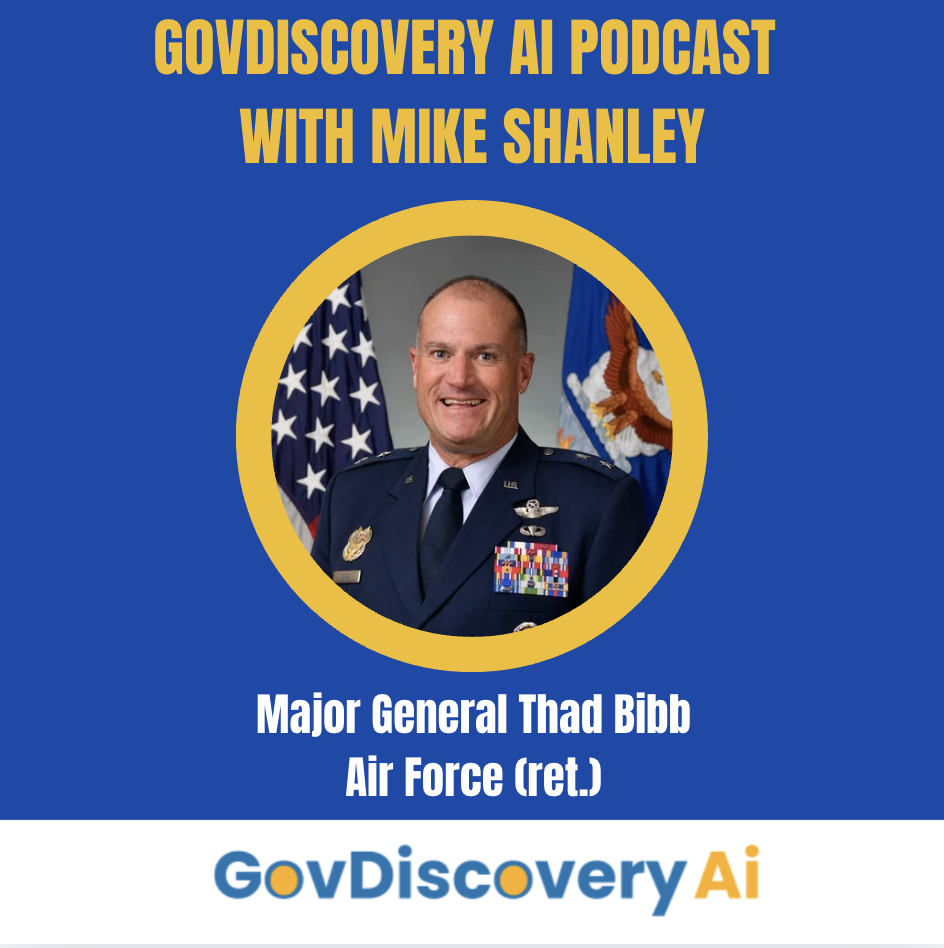
Loading summary
Transcript39 lines
- [00:00]
A
Welcome to the GovDiscovery AI podcast with Mike Shanley delivering actionable expert insight and AI enhanced business intelligence for defense and State Department markets. Here's your host, Mike Shanley.
- [00:14]
B
Welcome to the Gov Discovery AI podcast. I'm your host, Mike Shanley. Our guest today is General Thad Bibb. General Bibb is a retired Air Force general and currently the Vice President of Business development for Defense at Radia. General Bibb, thank you very much for being on the podcast today.
- [00:33]
C
No, thanks for letting me be here, Mike. I've watched some of your podcasts and they're fantastic. So thanks for letting me be a part. It's an honor.
- [00:39]
B
Excellent. Well, let's get right into it. Let's start with Radia. Can you share those who aren't as familiar with Radia's background, what it is where you all fit into the defense market?
- [00:50]
C
Yeah, some of you may not have heard of Radia. We just came out of stealth mode about a year ago. So we're so we now have a side on our building and some things like that that we didn't have before. So. But about eight years ago, three of the biggest wind turbine manufacturers came to Radia and said if we could figure out a way to get the largest blades onshore, we could basically increase our return on investment two to three times. We could create energy in more places. The energy that we create would be cheaper. In today's environment with AI and data centers and blockchain and all the high electricity requirements, we just can't get enough right. So, so this is, you know, the timing's perfect. You know, in addition to oil and everything else and coal and all the other non green sources, it was just a great, great opportunity to multiply that market. When I was, I grew up in Oklahoma so I thought our wind blades were big there, 70 meter blades. What I didn't realize is those offshore blades like in the North Sea are 105 meters. And so without the ability to, to get those onshore, you can't get them around corners, you can't get them under underpasses, you can't get them through tunnels. And so windru take the 105 meter blade and deliver it to a dirt strip that's 2,000 meters long that's built at the wind farm and create the wind farms that way. And so very excited about that market. And then the last year as I retired from the United States Air Force, my new boss Mark Lundstrom came to me and said, Thad, is there a defense use for this? And For Mike Minahan and Chris Medea from Germany and others that are helping out the company, you know, they're like, yes, absolutely, there's never enough airlift and this would be a great capability.
- [02:26]
B
So during our prep, we talked a little bit about the design of it and designing for volume versus weight. Could you talk a little bit about that and the importance of that, that consideration during the design process?
- [02:38]
C
Yeah, so this was a complete game changer, you know, for us, you know, for, for me about 33 years in the Air Force. And we always studied, you know, weight, mass, and, and how much you need to move. So for a Taiwan China scenario for the United States, how many million 10 miles would you need to move? For a scenario like that or for Putin invades NATO countries, how many million ton miles would you need? But what we didn't look at was how much volume do you need? And my whole career I had two missions that we maxed out the weight before we hit the volume. We always would cube out before we would mass out and then we would add as much gas as we could to go as far as we could. Right. But the real limitation usually was just that cubicle amount. For the Windrunner, it carries about nine times the volume of a 747 Foxtrot, you know, so much, much larger than the antonov or the C5 or the C17. And so it, it allows you to do things like carry six helicopters with the blades on and the turbines on, where a C17 could carry one. It allows you to carry space vehicles like the Vulcan rocket that can't go on any other aircraft, including that alb. Right. So it can only go by ship today. So that's a eight and a half our eight and a half day trip from Alabama to get to Florida or a 23 and a half day trip to go through the Panama Canal. And with Windrider, we'll be able to do that in one day to each of those locations. So anyway, very powerful and we give you lots of examples, but the volume is really the game changer.
- [04:08]
B
Yeah, and let's get into those examples in a bit. What does that say about the requirements of modern warfare, modern readiness for defense ministries, for the Defense Department? Was it more just there wasn't the capability, so there was no need, or has there been something that's changed in modern defense preparedness that requires this additional, this focus on the volume?
- [04:30]
C
No, I, I, you know, anybody that knows logistics or knows the military knows that there's logistics is the, the cornerstone of any operation. And for the outsized cargo. We just never have enough strategic airlift for, you know, Army, Navy, Air Force, Marine, Space Force, our coalition partners. And so part of my job as 18th Air Force commander, where we had all 12 wings with the airlift, all the strategic and tactical airlift as well as the tankers for the Air Force, you know, part of my job was figuring that out as you know, who gets what. And you know, previously as the Tanker Airlift Control center commander, I had to tell nations no all the time, hey, sorry, it's going to be another 30 days. You have to wait in South Africa. You know what I mean? We've got troops on the ground in Afghanistan or other places that we need to support. So that requirement, that need has always been there. And now, you know, for the US we have about 220 C17s. The C5s were down to 52 down from 100. The C5s that we do have, that mission capable rate is 46%. So it's a coin flip to whether you're going to be able to, you know, take off any given day. That need, you know, 46% is where we are today. So now you look ahead 10 years or 20 years and we don't really have a replacement that's ready to go. The Windrunner is ready in 2030 and so that's a big argument, you know, in our favor that they'll have something flying in 2030 and hopefully we will get the next generation airlift and other design requirements from Air Mobility Command and from the United States and other nations. But it'll be the before any of those are developed at best. Right. So we saw with the KC46, it just takes a long time.
- [06:07]
B
So you talked about how you started with the commercial application, now a dual use company. Obviously you 30 years in the Air Force, you have a pretty clear idea of what the demand signals are and what the needs are. But you never really validate it. So you actually get those sales conversations going to those contracts signed. What has been the general response either from the US side or from the allied side to your hypothesis that there is a strong demand for the increased logistics volume?
- [06:32]
C
Well, we really view ourselves as a Neoprime. So you know, familiar with the, if you're familiar with that term. So the Primes, you know, the Boeings, the Lockheed's, the big guys that have done this for years and then the Neoprimes, you know, like Palantir and Anduril, that haven't waited on a requirement. Right. The Palantirs and Andurils have said hey, we see a need out there, we're going to go out there, we're going to use private funding, we're going to use the funding from others and we'll come up with a product that's so good that the United States and our allies will have no choice but to say, yeah, this is, this is a great idea, we need to do it. And so there's no formal requirement for 108 meter airplane that will land on 2000 meter strips. But what we see is that demand is out there. So, you know, if you build it, they'll come. That's where we're, you know, as we will start manufacturing next year. This is, it's an exciting, it's an exciting place to be. We've seen great response from our potential customers in all areas, whether that's been in the wind energy market. We just signed four agreements in the wind energy market. But in the defense side, you know, we've been all over the world visiting nations that are very excited about this and we've taken time to listen to them and listen to what, what their needs are. And they, you know, see this as a valid and different countries see it different ways with the United States, you know, they see it right now as part of their civil reserve airlift fleet, essentially. And so we've got to create a cooperative research and development agreement with US Transcom, with the United States military, where we're looking at about 20 different areas to say, hey, is this a good fit? Does this work? And we're looking at things like, you know, cargo that will only fit on a C5 today won't fit on a C17. There's 48 items and we discovered that 47 or 48 will fit on Windrunner and can be delivered worldwide. The one that we can't do is a Crane that the C5s never move. So I think we did pretty good. So 47 out of 48, but there's another 19 areas we're looking at. You know, one of those is MOG maximum on ground. So, you know, we look at Ramstein, you know, how many windrunners would fit at a airbase like Ramstein in Germany? You know, you could on an open ramp you can fit 10. So, you know, it shows that, you know, without having to change the, change any of the infrastructure, you don't have to take it out any light poles, any stop signs, you know, you could fit 10 today if you had an open ramp. So those kind of questions to give senior leaders in the United States confidence that this is a tool that would.
- [08:58]
B
Be valid for, for those companies, startups, defense tech startups new to the space. One of the critical pieces, really the core of business development, of sales, of growth for defense partners are those conversations. Understanding the customer's needs, what are their demand signals and understanding who the customer is. So I'd like to get into that a little bit, talking towards those two new entrants to the market, really some guidance and advice for them. So maybe we'll start broadly, obviously without getting the details of who you're talking to or what, or what countries or anything. How do those conversations go? Do you go right to the Ministry of Defense? You're probably not getting a meeting with them right off the bat. Do you go to the battlefield level? Do you go to the commander? Do you just go to your best contact at the defense. Could you maybe start by framing a little bit of how to think about approaching those customer, those listening conversations?
- [09:52]
C
Yeah, my boss, Mark Lundstrom, you know, he's a, you know, a serial entrepreneur, he started several companies and a Rhodes Scholar and MIT aerospace engineer. 20 patents and he's real big on shots on goals. Right. So really we'll take a meeting at any level and there's some advantages and disadvantages of each of those. Right. And so we've gone straight in. The first meeting we had was with the chief of defense at the highest ranking military general in that nation. That was a great opportunity. You know, we've had others where we started at the, you know, lieutenant colonel and colonel level and you know, built the momentum that way. And that's been a highly successful for us too. But the biggest thing I think is to go in and listen. And you know, we were talking a little bit earlier that you know, the tendency is to go in if you only get 15 minutes with a senior leader or 30 minutes or 45 minutes or an hour and then, you know, you're so excited about your, we're so excited about our product that, you know, you want to fill the whole hour with the capabilities and show what it could do. And I think what we've, you know, by taking a step back and listening and Chris Padilla has really helped us in Europe with eatc, which is the command and control for all of the airlift, you know, in or most airlift in Europe and MCCE which does all the, you know, similar for the ships and the airlift, you know, and going into them to start to say, okay, what do you need? What gaps do you have? You know, you could do this. You know, I don't Want to get into any sensitive information, but you know, kind of laying out, you know, it's not classified, but you know, what, where could Windrunner fit? And then how could we develop that, you know, for the colonels and for the one stars? You know, part of my approach is to ask how, you know, as I prepare this for your chief of Defense or for your Minister of defense, how do I better tell your story? Can you give us specifics? What airfields would it be best to show, you know, in particular that winter. Winter.
- [11:42]
B
And is that conversation different for the U.S. department of War compared to selling to NATO or, or Aukus Allied ministries of Defense?
- [11:53]
C
I think it's, it's different for every country you talk to. Right. So I think that for the US they see it as part of the civil reserve airlift fleet. And having that capability could be a real bonus in a number of ways. I think when I talk to nations, nations in Europe, they really see the need for it. But it's hard to go alone, right? Montenegro is probably not going to buy 10 windrunners, right? So they see the coalition work that's been done before with Solis, the strategic airlift interim solution, where they buy about 2000 hours of Antonov time a year together as a consortium or the heavy Airlift Wing, the strategic airlift capability that we have in Hungary with three C17s that are shared with eight nations. So each of those are examples of how do we get together and build a coalition to do this. Other nations, their priorities. For some, it's moving aviation assets. One runner can move four F16s at a time. No other aircraft could carry F16s. You know, we could carry four Ospreys at a time. The Osprey right now has to ship by boat, right? And so when you go into those countries and whether it's aviation access or whether it's space assets or whether it's the dual use capability and what they might could do with wind or with hydro projects. It's very powerful. And even talking to the pilot level, I was at the Paris Air Show, I was talking to a Singapore air force and he's like, oh my gosh. He said, can we get this this fall? Because we tried to get a C17, we couldn't. We tried to get the Antonov, we couldn't. We had to hand fly our helicopters to pitch black in Australia. It took, you know, it took nine days for six helicopters. We had to make six stops. You broke it. So, you know, somebody broke at every stop. It was just, it was completely painful, right?
- [13:35]
B
That would have Been to be on.
- [13:36]
C
Yeah, if we could have the Windrunner, we could do this and you know, four, four Windrunner, four Chinooks at a time and it could have been there in a couple days. So anyway, it's, I think and listening is an important aspect.
- [13:47]
B
Now. You were on the other side of this for 30 plus years at the Air Force. What was, let's start with that. What were those conversations like when you were the one sharing the, the demand signals and industry was trying to engage with you?
- [14:02]
C
Now, I think it's, I just think our acquisition system, there's a lot of challenges that it takes so long and I had actually had a Guinness at one of our nations, one of the national capitals in Europe last week with a very insightful 06 is like, you know, Thad, I think we need, you know, we need the Neoprimes, but we need the primes too. Right? So we, we need, we need both. Right. You look at the lessons of the Ukraine, we can't just run to, you know, making everything quick and fast and not having any, you know, big projects on the horizon. You know, listening to the, with formal requirements, it's both. And so I think, you know, I saw that firsthand, you know, as we brought on the KC46, you know, and other, you know, new weapon systems, you know, into the, into the military. Just the challenges of, even with the best industrial partners, just how challenging that is and how difficult it can be sometimes I think the advantage, some of the things we've taken with the Windrunner is, you know, no new technology. Right. So we're using all existing technology to solve a problem that's out there, but it's not a capability that exists today. Right. So, you know, the composites that we're using, the engines that we're using, the flight control system that we're using, the landing gear system, you know, is all based on current things that are certified. And so we've bought down a lot of risk in that way. You know, by, you know, if, if you need the new technology, then by, you know, for sure you get it. But if you don't need new tech technology, but you can bring it together and you know, have it work together in a new way.
- [15:29]
B
What was, what kind of prep did you like to see industry do for, for our end? So what we do is identifying those early demand signals in open source intelligence to inform those types of conversations General, so that our clients are ideally going in sharing with a colonel. Hey, your boss said we, you need this. Here's our solutioning for this from the air Force side as a sitting general, what did you appreciate or what were the most valuable things that industry could bring? Was it being a thought partner? Was it coming in with a list of here's three key solutions. I saw you gave this speech at an industry. Here's how we can help you. How is industry best able to prepare for those meetings for you?
- [16:08]
C
Yeah, no, I mean our industrial partners are the best in the world. It's just the speed of the process is slow on both ends. Right. So I think all the things you mentioned there are helpful. But one of the things I think for us is thinking outside the box. The tendency when you're in government is to as you build the AOA and the requirements process is to try to hang everything on there. Right. So for the ngal, I can only imagine that you know that AOA will be worked in the next two years and as the as that AoA has worked, you know, everybody will want to make it stealth. They'll want to make it, you know, to land on short fields, they'll want it to make it to carry outsized cargo. They'll want it to be airy fueler, they'll want it to be airy fueling capable. I mean you can on and on and on, right. If I imagine I, you know, I haven't seen and they haven't even started this process yet. Right. But it's a one or two year process of doing, you know, the AOA and the requirements and then in the end you get something with like everything hung on the Christmas tree. And so I think, you know, my lesson learned is, you know, you could take small bites the elephant. And so one of the things the wind rider does is for the endgall. You know, it allows you to take that outsized requirement and say, hey, you know, if we have Windrider either in our commercial fleet or in the military fleet, then they can fill that gap. And now ngal, now we can make a next generation airlifter. We can make it the very combat focused, incredible platform that can, that can do a lot. It can't maybe not do the huge outsized mission that's nine times as big as a 747. But now you can focus and really make it tactically capable aircraft and enable industry to really do something special there and not try.
- [17:52]
B
So when you did leave to join industry, was there anything that surprised you? That, oh, I thought I knew how industry works. We've been engaging with their defense industrial base for 30 plus years. Was there anything surprising when you were on the industry side supporting DoD, DoW directly.
- [18:11]
C
Yeah. And I think my biggest lessons learned are going from 33 years and the Air Force, incredible team, but also bureaucracy to a very agile company that's more of a startup mindset and being able to pivot on a dime, to be able to hire the best people, to be able to, to hire the best people and just let them go, let them run. And so to watch my new boss, Mark Lundstrom, how he does that, how he handles that, how he approaches decisions and he thinks so much bigger than I ever think. When I first got hired, he said, thad, I think we need some help with the uk. How about Sir William Fox, used to be Minister of Defense. And I was like, that would be great to have the former Minister of Defense on our team. Right. As an advisor, et cetera. And so you look at our advisor team and they're all at that level, really experts in their field. And so to, you know, get mentored by them and to go again, Mark will, you know, swing for the fences and some things I wouldn't even think to ask or to go to. Like what, what are we expecting him out of this meeting? I think we can go big here. He keeps telling me I'm shooting at an on an empty goal because we don't really have any, you know, there's nothing else in this outside space, you know, 2030 to 2045.
- [19:27]
B
Yeah. And then just about every conversation I would have with government with the defense officials is going to the expectation is the innovation that what you just described, whether it's AI or logistics capabilities will come from industry. Let's go back to your point of radio being a neoprime, like Palantir, like Anduril. What are the challenges and opportunities? I know you joined more recent, you know, as part of the transition. So I'm sure some of this investment maybe took place before you joined. But what do you see as those challenges, opportunities. Obviously people look at Palantir, Anderil and think, great, let's invest in that. And. But what if you get it wrong? That's a pretty big upfront investment without a contract supporting the overhead or your R and D side of things. So what are your thoughts on those? Yeah, the challenges and opportunities of someone that does want to follow your lead, lead of radio and become another neoprime.
- [20:22]
C
No, I think, yeah, the advantages are obvious. The challenges, you know, I would say one, we're blessed to have a phenomenal group of investors that are behind us. Right. That, you know, that really Believe in the program, they believe in the project, they believe in the people. And that gives you a lot of flexibility and a lot of confidence when you're moving out, when you know that you've got the entire team, from investors to the nations that are on board that are supporting us in a big way, to the manufacturing partners that we have. We've got about a dozen manufacturing partners that we've announced and pretty big ones like Leonardo huge, you know, the biggest Italy and others. As you look at our website, you can see what can be done. So that helps a lot. I think there is some pressure. Like I said, you want to get it right. I think the challenge is you're going maybe where no team's gone before. And so for us, yes, ots prototype, OTS and the other outside the box thinking for the fars has been done in software now for quite a while. And you know, the drone technology and counter drones, but nobody's really done that with airlift. Right. How do we leverage those tools? I saw that you had, you know, Roper on the other day was very insightful and, you know, and using those tools and how they might be different, but how do you do? And so right now we're thinking through that. Right? So, yeah, we're using private investment. Yes, we're using investment from some other nations that have ponied up in a big way. And so we're, we're grateful for that. But also, you know, for the US how do we spend just a little bit of money instead of the billions and billions and billions of dollars that would be required for a major acquisition project? The US can spend basically very small amounts, relatively, and have a great product and great capability in the2030s.
- [22:09]
B
So you mentioned your very impressive list of advisors. Let's go back to those new entrants. The defense companies in Silicon Valley, in Austin, in Colorado, in the D.C. area that want to get into the defense market. Should they all go out and find a retired general, a former Minister of Defense, former pentate, senior Pentagon official, Is that what's needed first? Is it identifying the demand signal first? Where would you suggest those firms start? Start framing that conversation.
- [22:41]
C
I think he could do both at the same time. What I've seen with Mark as he's hired the key advisors, is he's found advisors that really believe in the product, really believe in the company, really believe in the mission of what we're doing. And so when you have that, you know, then it gives you a lot more flexibility. Right, because maybe if folks work for you, Know, a lesser fee or for equity or for, you know, those kind of things. But even if you're having to pay, you know, full price and out the nose, right person that is really passionate about your product. And so that when they're in those conversations, you know, that, that, that shows. I was in a conversation, another embassy conversation. I was getting some back brief from one of our U.S. embassies overseas. They're like, it's so different when you company like Radiant comes in the energy level that sets across from us at the table compared to some of the other companies that come in because you can just really tell that you believe this is the right thing for the US it's the right thing for allies. And that really comes across. And so I think when you're looking at those advisors maybe not just going for the greatest name or the hood ornament to put on your new company, right. But somebody that's really a good fit for you and where you're going and then as things change and you figure out like for us that hey, with this defense thing, the wind energy is going to be our main business business, you know, over the next, you know, 50 years. But if we can help defense and help help our allies and help help defend our country, then this is a great opportunity. And so, you know, Mark, you know, pivoted a little bit. You know he hired Mike Minihan, he fired, hired Chris Padilla from Germany, you know, hired, hired me. And so those, you know, I think being will to flex and then sometimes you have to let advisors go too as you've changed directions like hey, we're not going this direction, we're going that way then. And that, that's, that's I think a hard, you know, conversation to have. But it's just reality to live within your budget. Right.
- [24:28]
B
I think it's an important point there is, is not just find that fanciest title you can or the, or the highest profile person, but making sure they're actually going to be a valuable piece of your sales and sharing and believe in the story of the company. A couple more questions then. I know we got limited time today General. Let's, let's get into the BD side of it. So obviously you have impressive Rolodex you great list of advisors. What are the other tool pieces of research intel that you need to have that successful business development operation?
- [25:02]
C
Yeah and I, I think that's a really valuable conversation to have as you're growing. Right. As soon as you're getting to that next level, what team members do you bring on? And in what role? And for us, like in what country do you bring them in? You know what I mean is that. So we recently brought in Achille Ferraro from, from Italy, from Rome. So her office in Rome is growing and. But Aquila brings decades of defense, BD and large industrial selling ships and other other things. Right. So it's not Windrunner expertise and not military expertise, but his dealing with large scale business development, you know, really helps us, you know, having Giuseppe Gordo, who used to be the CEO of the company that preceded Leonardo, you know, as our CEO for. I'm sorry, Radia Italy has been very helpful because, you know, just. And what they're able to do is ask the key questions. You know, for me, I've got the military experience, but not a lot of BD experience. And so I'm learning, you know, again, passionate about the product but you know, to have some structure, you know, into our process. Right. And so to know that we're asking the right questions, that we're bringing the right teammates on at the right time to build that out. And you know, who's going to, if you only have so many dollars to spend or so many people you can hire, who's that going to be? Is that another three advisors or is that somebody that's actually, that's grinding away.
- [26:24]
B
Over the next year? Then what are those demand signals or other data points that you're going to be looking for to see where Radia will best fit into the growing U.S. defense and allied defense markets?
- [26:38]
C
Yeah, so I think for us it's, you know, the data we're looking for is to fill out our order book is the main goal. Right. Because you want to show that to your investors and show that to the nations that are, that are along, along with us and to show that it's going to be profitable. And so, you know, we recently, you know, we're constantly reworking our business plan to make sure that it's up to date that we could show, you know, show both investors and countries that are on board with us, you know, the profitability of this as well as the usefulness, you know, you know, the usefulness case for me is easy, right, because you just show, you show the force multiplier to, you know, 12 Apaches on a Windrunner compared to two on a C17. And you can see very quickly how it could be a game changer for your nation, you carrying that equipment, you know, but also showing the backbone that you've got the business plan. You know, constantly revising that based on things that are happening in the market. It's going to be, it's just going to be successful. Ours are showing good. So it's, it's a great, that's a great part of the story.
- [27:39]
B
So as we wrap up here, what's the, so what that you'd like to leave with the defense industrial base and the Defense Department ministries and department.
- [27:49]
C
No, I think, I think the. So what is, you know, we've got to move faster than we've moved, you know, over the last 30 years in the department of War, you know, for on the defense side. You know, we have to be willing to take, take a little risk. I think we have to think outside the box. I think it's important to have, you know, those traditional requirements based processes and acquisition structure. But I think you also need things like radiation that can fill those gaps that we see from 2030 to 2045. As I brief people at all levels, usually the people at the highest level get it pretty quickly and they're like, no, no, no, we need to, you know, we need to do this. And sometimes as I brief people at the middle levels, they're like, no, no, no, we need to fall back into the, like, no, let's, you're right, there is a gap there. Let's go back to the requirements process and let's try to shoot for something in 2045. So when I was in Warsaw two weeks ago and you know, the Russian drones were flying over, there were lots of the fighters. My boss was at Copenhagen three weeks ago and the Russian drones were flying over Copenhagen. So I think in the NATO countries, seeing, you know, what's happening in Ukraine and seeing the threat that's on the doorstep has helped, you know, motivate that need for speed. You know, in the U.S. i think there are definitely people that get it, but I think there's still some frozen middle that we need to work through.
- [29:04]
B
Yeah, I was on a panel in Bucharest a couple months ago as well. It's a procurement panel with NATO in and US official. It was a week or so after that. Romania first. Romania, Poland. Drone incursion just made that conversation much more, much more relevant and much more important. Well, General, thank you for being on the show. For those of our listeners who want to help fill up that order book, what's the best way to learn more about Radia and contact you and your team?
- [29:36]
C
Yeah, please go to radia.com, go take a look at our website, get some more details and you can reach out to us through there, but we'd love to. I hear from people all over the world that are excited about this. It's neat to be a part of building the world's largest airplane. So yeah, but go. We've got some great pictures there of artist renditions of what we're going to look like and would love for you to take a look. So thanks for doing that.
- [29:58]
B
Radio.com Excellent. That was General Bibb, retired Air Force General and Vice President of Business Development for Defense at Radia General. Thank you for being on the show. Look forward to checking in next year to see how things are going in 2026.
- [30:13]
C
That'd be great. Thanks, Mike.
- [30:14]
B
Thank you.
- [30:15]
A
Thank you for tuning in to the GovDiscovery AI podcast with Mike Shanley. Gov Discovery AI leverages our team's decade of experience winning federal funding to deliver federal growth intel to sales proposal and capture teams working in defense and civilian markets. Each market intel report is delivered by federal growth experts leveraging our proprietary deep data discovery process. If you enjoyed today's show, be sure to subscribe wherever you get your podcasts and connect with Gov Discovery AI and Mike Shanley on LinkedIn or learn more at govdiscoveryai.com.