Loading summary
Transcript93 lines
- [00:00]
Steve Rinella
When you're in the back country, don't forget your own backcountry. Keep it pristine and confidently clean by bringing along wet Extra Large Dude Wipes. Just like your truck gets muddy out in the wild soaking your butt, you never clean your vehicle with dry paper towels, so why would you clean your butt with dry toilet paper? Wetter cleans better, so ditch the itch and switch from TP to Wet Extra Large Dude Wipes Dude Wipes it is the best clean. Pants down. They're available at Amazon. That's where I usually order mine from, but you can get them at Walmart nationwide. Fantastic product. Proud to be doing ads for these boys. At Dude Wipes, you're juggling gear, weather.
- [00:39]
Dan Flores
And maybe your kid's first hunt. Let the Dometic CFX5 handle camp. It keeps food cold, drinks chilled and any ice for meat frozen solid without you having to lift a finger. No ice runs, no cleanup. Just one less thing to worry about so you can focus on the good stuff. Teaching, laughing and making memories that'll stick. Head to dometic.com to check it out and learn more about Dometic Electric Coolers.
- [01:05]
Unknown
Are you still quoting 30 year old movies? Have you said cool beans in the past 90 days? Do you think Discover isn't widely accepted? If this sounds like you, you're stuck in the past. Discover is accepted at 99% of places that take credit cards nationwide, and every time you make a purchase with your card, you automatically earn cash back. Welcome to the now it pays to Discover. Learn more@discover.com credit card Based on the February 2024 Nielsen report.
- [01:35]
Native America existed.
- [01:37]
For 10,000 years in a West marked.
- [01:39]
By many prior extinctions, but somehow found.
- [01:42]
It possible to preserve almost all the.
- [01:45]
Biological richness of the continent until the arrival of Europeans.
- [01:50]
I'm Dan Flores, and this is the.
- [01:52]
American west, brought to you by Velvet Buck. Still in barrel Velvet Buck arrives this.
- [01:58]
Summer, just in time for the season.
- [02:00]
That calls us home.
- [02:02]
A portion of every bottle supports backcountry hunters and anglers to protect public lands, waters and wildlife.
- [02:09]
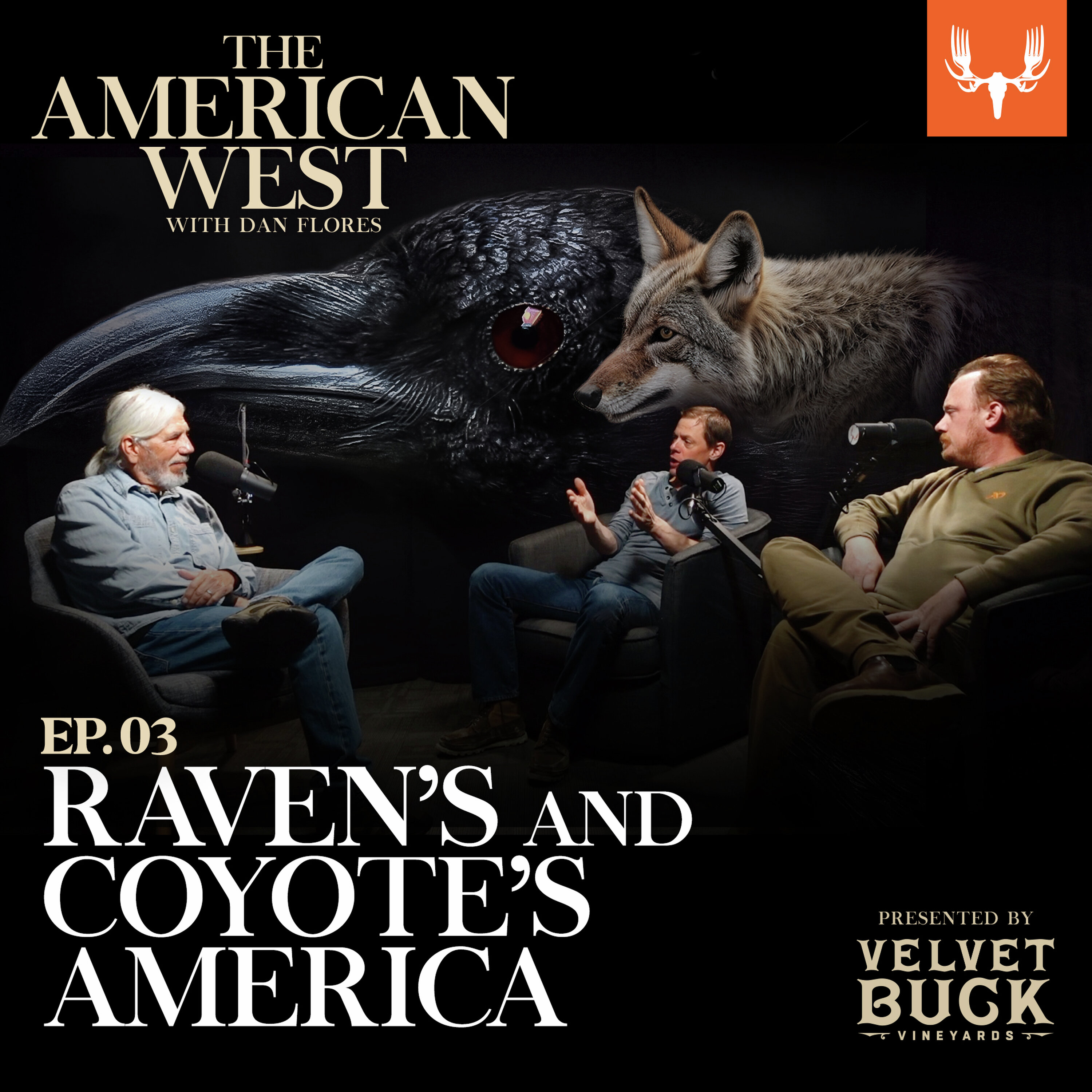
Enjoy responsibly ravens and coyotes America I.
- [02:33]
Am walking the edge of a sharp, rimmed cliff in Outback Montana before sunrise, moving through a twilight of grays and blacks and outlines, large, graceful birds. Sandhill cranes are fluting their strange Pleistocene cries in the pastel sky overhead, but I'm focused on the lines of the topography in front of me, especially the way the mesa I'm walking narrows up ahead. Seeing that, my walking pace quick this is a historic piece of ground starting some 2,000 years in the past and continuing down to 200 years ago, it was the scene of frenzied, albeit sporadic, human activity. Like most historic places, there is something maddeningly mute about the spot now. It's why we often stand and gawk numbly in such places, unable to connect to the events we're supposed to marvel over. But this morning I'm not going to be stymied by lack of imagination. I'm here with a purpose, my intent to experience at least some part of what a buffalo jump drive was all about. It was fully dark when I arrived here an hour earlier, parked my car at an interpretive sign, finished a cup of coffee, then slowly worked through the boulders to the top of this mesa while I walked eastward to the luxuriant grassland of a high meadow. The sky had gradually lightened. Now turning back towards the car and the cliff I'd climbed in the dark, I'm becoming caught up in what I tell myself are echoes of the place. Pointing myself down the narrowing mesa towards the far rim rock, I start to jog. I'm running a track that men and other animals have run many times in the past, but in contrast to my lope beneath the fluting cranes. Then there would have been the pounding thunder of sharp black hooves cutting through the grass and the alarmed grunting of animals, their huge forms wrapped in billowing clouds of dust that must have made for a ghostly stampede. Now I hear only my footfalls and my breathing. But in the real thing, the air would have been rent by the exultant shouts of the drivers, the urging on runners wearing the skins of wolves and red coated bison calves leading the herd to its destiny, their costuming a ruse to fool buffalo cows into thinking that wolves were selecting out defenseless young ones. Listening to the rhythm of my feet, I wonder if the herd's noise wouldn't have been so overwhelming. It would have morphed into silence and adding a surreal quality to the ghostliness. The whole affair would have commenced days earlier with a religious ceremony and careful maneuvering of a bison herd in that high meadow into position for a stampede. Then, if all went well, and it went well enough times in the past to accumulate a bone layer five feet deep at the base of the cliff I'd climbed. The runners who led the herd to the cliff edge would escape if they could, by darting aside at the last moment, dodging the relentless brown river of animals hurtling into space in a dream of wild, frozen action. Where I've begun my run is a half mile back from the cliff, and soon enough I cross to descending benches and realize I am on the point of no return in this bison jump. Get the animals here and have them running, and the downhill pitch steepens so quickly there would be no way for the herd leaders either to stop or turn aside. I'm running harder now, pulled faster by the angling slope, and I register that out in the valley, dawn color has arrived. Chrome yellow light cast by the rising sun is lighting the white cliffs on the far side of the river, a scene of great beauty, one last soothing sight of earth, perhaps, as the lip of the plunge is scarcely 120ft away now. Beyond that is windmilling motion and the silence of 40ft of free space. Then the jarring stop amongst the boulders. I slide to a stop a few feet from the cliff edge and stand panning for a few minutes, looking down on the slope below. By modern standards, the scene would not have been pretty. In 1797 the British trader Peter Fiddler described such a concluding set. The young men kill the crippled animals with arrows, bayonets tied upon the end of a pole and etc. The hatchet is frequently used, and it is shocking to see the poor animals thus pent up without any way of escaping. However, pod like their behavior as classic herd animals, all these bison were individuals, of course, and that is the way they died. Slanting sunlight throwing morning shadows hundreds of feet long across the Madison Valley of Montana lights my face over the mountains. I see a jet glinting silver, a mobile diamond slicing through the blue it its motion fetching me back to my climb down to the car, back to my commitments. But before I start, I stand for a moment thinking of the bison that died among the boulders below. Humans drove buffalo off cliffs in America for 12,000 years, and despite knowing something about it, I find it a shock to be in this space where it happened, this close to how it worked. I visited Head Smashed End jump in Alberta and absorbed archaeologist friends accounts of Bonfire Shelter. Jump in the gray limestone canyons of the Pecos river in Texas, hearing at the visitor center in Canada that Indians carefully utilized every part of the animals. Yet knowing that in Texas the cliff at Bonfire Shelter is scorched hundreds of feet high from the spontaneous combustion of an enormous mangled heap of unutilized bison, native hunters drove off the rim above those two sites beg a big question. Putting aside whatever fantasies of the past we have, what kind of relationship did humans and animals fashion over the hundred centuries of native America that followed the Pleistocene? And if it was different, more ecologically benign or balanced than what came before and what came after. Then why Clovisia the Beautiful ended with the demise of elephants and the majority of America's big animals. People were here, but most of the original animals were not. The haunting stories of losses must have lasted because having so many charismatic creatures disappear seems to have shifted human behavior. The 10,000 years that followed wasn't entirely extinction free. But thousands of years later, arriving Old Worlders described the wild New World that greeted them as a paradise of animals. The image of America as an animal eaten out of prehistory has shaped the country's sense of itself ever since. But was that actually the reality of Native America? When 19th century ethnographers began to assemble a linguistic map of Native America, the conclusion anyone would draw is that over 10,000 years there had been a tremendous movement of peoples around the continent. Athabascan speakers lived in interior Alaska and also way down in the southwest. There were pools of Algonquin speakers in New England, in the Ohio Valley, and in the foothills of the Rocky Mountains. All this was in contrast to Australia, for example, where aboriginal populations have stayed in place for 50,000 years. The American story implies significant experimentation with different locales and ways of life. Some of those human migrations may have been related to the reshuffling of American nature that took place place in the echoes of the Pleistocene extinctions. The biology of the continent was reinventing itself. The vegetation was changing. Without ground sloths to disperse their seeds, the range of Joshua trees now began to contract. And without mammoths to curb them, honey mesquite began to spread. There were so many missing animals that a remarkable number of ecological niches either were vacant, but are newly filling. The ecological rebirth was most dramatic in the western half of America. The loss of mammoths, giant bison, horses, camels, ground sloths, dire wolves, short faced bears, scavenging birds and a range of cat predators opened niches at every level. In cases like wolves and bears, the there were ready replacement species. With dire wolves now extinct, gray wolves and ancient American wolves emerged as the primary canid predators. But with 70% of America's grazers gone, niches for replacements were wide open. With almost no competition, a new smaller bison supplanted horses, mammoths and its huge bison ancestors. Within a few centuries, this new dwarf bison grew into a biomass of animals that had almost no analog anywhere else on Earth. Biologists now believe modern bison are a classic example of anthropogenic selection. Their size and rapid reproduction shaped by human predation. Seals, sea otters and Sea lions accepted, along with the one pronghorn species that survived to browse the forbs that camels once ate. Most of the large animals west of the Mississippi were Asian immigrants. In some parts of the planet, the warmer climate that marked the end of the Ice ages allowed hard pressed humans to try out some new things. But since humans had extensively settled America only 13,000 years ago, when rather than 45,000, North America didn't yet call for an agricultural revolution the way the old world did, America's human cultures segued to a stage where animals were still of primary importance, but plants were taking on a more significant role. Archaic is the term anthropologists and archaeologists have long used for humans living this way, by which they mean people existing as hunter gatherers. So while the old world experimented with agriculture and domestication in North America, the hunting gathering lifestyle continued over vast spans of time and diverse geographies all the way into modern history. Clearly, we ancient hunters of animals surrendered.
- [14:24]
Our oldest life way with reluctance.
- [14:31]
America wasn't just in the throes of biological recreation. Around 8,500 years ago, there was another potent change. The warming cycle that ended the last ice age didn't relent. And America's climate swung into a hot dry phase that stayed in place for a mind blowing 3700 years. This was the depths of the last interglacial, the long slide out of the frozen Wisconsin Ice Age. Now the Earth's rotational wobble had the Northern hemisphere slightly closer to the sun. And for almost 40 centuries, some parts of America cooked. The altithermal, as it's called, came close to turning large parts of the continent into a true desert and a vacant one. Many species of animals left for wetter settings. So did many human groups. Like other animals shifting eastward and westward out of the interior west. The country where Clovis and Folsom people thrived nearly emptied of humans during the altithermal. But once the altithermal subsided, generations of hunter gatherer peoples returned to occupy the same landscapes for centuries. That kind of close familiarity gave them bodies of handed down ecological insights about how to live in particular places. The feedbacks they read from place based living enable humans to come up with a striking epiphany. One allowing them to live well without using up their world. The breakthrough, a key to success in native America sprang from the realization that there was no longer a wild new world empty of other people out there. Clovis like expansion across a virtually uninhabited continent was over. Humans now had to learn to deliberately, carefully manage their Own numbers to avoid overshooting local resources. When times turned bad. In a variable world, Good times inevitably give way to bad times. That was an ancient lesson. Basing your numbers on the good times could set you up for disaster. How did these ancient Americans manage to pull off Controlling their populations so they could live well on local resources? Birth spacing was one common strategy. Breastfeeding suppresses ovulation During a mother's fertile years, Preventing a rapid success succession of pregnancies. Child mortality was high among ancient humans anyway, but most hunter gatherers practiced forms of abortion to control their populations. And the evidence is that as an ecological strategy, it worked well. But for the women who carried babies to term or close to it, infanticide in particular, was a psychological burden. Ultimately, many hunter gatherers sought to escape it. But the larger equation was relentless. The hunting, gathering economy was still the predators economy, and predators of whatever kind were always few compared to prey. Hunting and gathering required space to roam habitats for birds and mammals. Living the good life meant you could not overburden the world with people. There was one possibility to increase human numbers, but. But it meant giving up much of humanity's ancient life and investing in an entirely new economy. Around 5,000 years ago, an agricultural revolution Similar to the one that swept the old world Began to spread into north America. From the south. The selection and domestication of wild plants emerged where human populations were densest and animal populations lowest, Namely crowded mesoamerica. Unknown traders and travelers first carried ideas about domestication northward about 4,000 years ago, and later, the actual seed stocks of Mexican agriculture. So over the ensuing millennia, Crop fields and farming towns Began to dot native America from the south to southern new england, Then along the river valleys of the midwest, and even in scattered locations in the desert southwest. Once the agricultural transformation took root, Populations began to grow and sometimes centralized governing bodies, usually religious ones, Organized towns into regional empires we know as Cahokia, Spiro mounds, Hohokam, and the chacoan empire, which I talked about about in our first podcast. All of these were very late experiments in the last thousand years of native America. But in vast regions of America, agriculture never replaced hunting and gathering. So wedded were native people to the hunt that even as agricultural towns emerged, Many of the farmers continued to hunt, at least seasonally. Some returned exclusively to hunting when circumstances allowed. What sort of human existence could be better?
- [19:59]
Steve Rinella
When you're in the back country, don't forget your own back country. Keep it pristine and confidently clean by bringing along wet, extra large dude wipes. I'm. I'm Glad to be doing dude wipe ads because I buy dude wipes anyways. I've been a long time dude wipe. I'm a dude wipe dude all the time. Just like your truck gets muddy out in the wild soaking your butt. You never clean your vehicle with dry paper towels. So why would you clean your butt with dry toilet paper? Wetter cleans better. So ditch the itch and switch from TP to wet extra large dude wipes. Love them. Like going on a ten day moose hunt. I just bring a pack along. Not only that, so they're extra large. Okay. If you're a little baby, you get little baby wipes. If you're a man, you get extra large dude wipes. And when you're out in nature, it's going to inevitably call. So make sure you bring along wet dude wipes and three adventure sizes like day hike single wipes, 18 pack weekend wipers, or you know, for long trips you got a 48 count pack. And it's not just that. Like when you're out camping, just sleeping in a sleeping bag, let's say you're gone for 10 days, whatever. I use them just to clean up at night. Like, you know, scrub the old pit, scrub your arms if it's all dusty. Just kind of get your neck and everything cleaned up. I love having them with me. Dude wipes. It is the best.
- [21:12]
Clean.
- [21:12]
Pants down. They're available at Amazon. That's where I usually order mine from. Is that Amazon? But you get them at Walmart nationwide. Fantastic product. Proud to be doing ads for these boys at dude wipes.
- [21:25]
Hey, it's Steve Rinelli here and I'm going to tell you about fishing boy booker.com the world's largest online marketplace for fishing trips. Now this is cool because I travel around a lot sometimes with my family. We're always looking for cool fishing opportunities when we're going to new spots. We'll check this out. FishingBooker.com is as easy to use as your favorite lure in a stocked pond. Fishing Booker connects you with top rated guides who know where the fish are biting. So if you're planning a trip, you take all the hassle out of it. No guesswork, no stress. Just show up and fish.
- [21:59]
Do they have verified reviews?
- [22:01]
Yes. Easy booking? Yes. Loyalty discounts? Yes. They've got those too. And it doesn't matter what kind of fishing you're into. Trophy bass in Texas, salmon in Alaska, tarpon on the flats in Florida. Fishing booker works in, get this, over 100 countries. Whether you're a seasoned angler or just getting your feet wet, this is the way to go. So stop scrolling through random fishing forums and start catching memories with fishingbooker.com your next big catch is waiting for you. That's fishingbooker.com fishing trips made easy when.
- [22:39]
Dan Flores
You'Re out on a hot, early season hunt, the Dometic CFX5 keeps your food cold at camp. No ice needed, no mess to worry about. And if you're packing ice to keep your harvest Fresh, the Dometic CFX5 holds it frozen solid until you need it. Just plug it in and get on with the hunt. Quiet, efficient and engineered to perform so you can focus on the real work, not the cooler. Perfect for deer camp or backcountry. Whatever kind of hunt you're on, you'll wonder how you did it without one. Head to dometic.com to check it out and and learn more about Dometic Electric Coolers.
- [23:17]
Unknown
All the evidence indicates that America's native people lived immersed in art, stories and observations designed around the grand theme of understanding themselves in a sometimes impenetrable world. A fundamental way to probe those kinds of understandings is through stories of gods. The oldest named characters in North American history, in fact, are the deities who created the continent and its life and set in motion human life with all of its victories and tragedies. Stories of these deities make up the continent's oldest literature. With few exceptions, ancient American gods were animals, although the stories describe some as anthropomorphic animals. In Western America, for example, the deity who acquired the universal epithet coyote stood upright on its legs and brandished human hands, but had the fur, sharp nose, erect ears, and the tail of a coyote. The deities who made it into modern English as Coyote, Raven, Spider, Man, Skeleton Man, Master Rabbit, all shared a background basic human nature with their followers. Our vices, our lusts and our jealousies, our selfishness and our narcissism resided in America's ancient gods, there to witness, and there for good reason. More about this in a later episode. But the deities not only explained to listeners why North America was the kind of world it was, they taught lessons, often uncomfortable or funny ones, about human behavior and motives. They were gods, creators, also thieves, liars and lechers, classic professors of human nature. Coyote, who emerges from the stories as a kind of whirlwind biophysical force with an enormous appetite for pleasure and sensuality, was one of the most widely known gods out of ancient America, an avatar for human in the world. And we'll devote much of an episode to him and his stories. Like Raven, he Is the on the scene conductor of a master plan set in motion by an aloof first cause. This more knowable, approachable God was common in Native America. And if there are mysteries in the world you've wondered about, let Raven's adventures explain them. Raven was yet another merged animal human deity who told the Tlingits, I was born before this world was known. Uttering his monosyllabic gah, Raven proceeds to shape each animal in a slightly different way and to name them whale, seal, eagle, bear, caribou, beaver, salmon, sea otter, land otter, wolf. The birds he paints in bright colors because he wants them to be pretty. There is one worrisome thread that runs through Raven and Coyote stories, though. In early times, the Inuit explained, Raven becomes concerned that humans are becoming too numerous. Human villages are growing too large, and subsequently their residents are killing too many animals. The Inuit first man, agrees and tells Raven, if the people do not stop killing so many animals, they will kill everything you've made. In Coyote's case, as both the Yanas of California and the Navajos of the Southwest told the story, humans have to die, because if they do not, human overpopulation will result in the destruction of all the animals and even of Earth itself. In the early 1930s, a historian of religion named Joseph Epps Brown became fascinated by native religions. He interviewed traditional Lakota elders, including the legendary Black Elk, and ultimately set down the ideas that made up part of hunter gatherer knowledge about America's animals. Brown's informants perceived the essential nature of animal species as much through dreams and visions as through native science. Bears ruled the underground as bison did the surface and eagles the air. Certain animals illustrated particular traits useful to the human animal. Members of a wolf clan sought to invoke the wolf's cooperative skills in hunting and killing. If a young man on a vision quest heard a bull elk bugle for cows in the crisp air of autumn, he might then regard the elk as a totem whose potent sexuality he could internalize. These elders also recalled a connection involving energy flow between creatures. These were connections neither 18th century Linnaean science or 21st century Genetics science would ever think to link together. What the Lakotas called umi or yum was whirlwind power, the unrestrained residue of the energy of the four winds. They remembered whirlwind power as much sought, in part because possessing it made one difficult to attack in battle. But only a small number of special animals spiders, also moths, dragonflies, and bears. Elk and bison possessed the whirlwind secret. As for bison Seasonal winds coming from the north or south seemed part of their mystery, bringing them or taking them away. A south wind might produce herds that blanketed the landscape from horizon to horizon, but they could entirely disappear, which led to a widespread belief in Native American that bison had their origins underground. And sometimes they returned there, as had been true of our first hunting ancestors in Africa, true of the Neanderthals, true of the Clovis people. Native ceremonial lives centered on an ancient human desire to control nature. But they did so primarily as part of a religious philosophy, not a scientific one. Managing animals based on population, modeling, carrying capacity of landscapes, or selective sustainable harvests, as modern ecologists and biologists do, would have been incomprehensible because Native cause effect explanations for why things happened relied on completely different premises. The religions through which Native people understood animals were, however, social superb at apprehending the kinship between animals and humans. Crucial in Native America was knowledge about how to influence animals in a realm usually defined as supernatural, an essential part of religion. A friend from my years in Montana, Professor Rosalind Lapeer, has done the best insider account so far of the invisible reality that was central to to this 10,000 year old world. Rosalind's own Blackfeet people possess what she calls a powerful worldview that suggests the Blackfeet desire to manipulate animals and nature is a deep seated human impulse available through the assistance of supernatural allies. The degree of power one possessed to call on those allies determine how much you could make happen. Human beings could become vectors of power from these supernatural realms if a sacred being sought them out, or through a vision quest or other effort to find a sympathetic animal ally, or even by purchasing power from someone who already had it. Another intriguing look at Native religious traditions with respect to animals comes from the work of an anthropologist who lived with the Athabaskan speaking Koyukon peoples of Alaska. The Koyukons preserve an ideology with powerful echoes of how life in the 10 millennia span of Native America must have worked. Keen observational naturalists with a highly refined knowledge of animal behavior. The Koyukons trace their link with animals back to what they called distant time when animals were human and spoke human languages. The deity animal was ever watching raven. Raven rarely missed anything and was always alert to violations of taboos about how to treat animals and respect them. Many raven stories were about the bad luck that befell people who transgressed against the animal world. Animals were critical to a major life force, luck that could make or break a person's life. Luck was an award from ever watching Raven as a result of correct behavior towards animals, and the most correct behavior of all was treating them as kin. 10,000 years ago, the entire human population of planet Earth numbered only about 4 million across all the Americas. Humans then likely made up only a quarter of of that number. North America probably had barely 500,000 people then, fewer than a single large city. In our time, agriculture changed that. But because big parts of the continent were unsuited to farming, and because farming was a new development, America wasn't entirely remade by agriculture the way Europe or Asia were. By 500 years ago, the best guess is that America, north of Mexico had grown its population to just under 4 million people. 4 million people spread across a landscape that in the 21st century supports 400 million, seems explanation enough for why humans and wild animals coexisted well for so long in Native America. That might be an argument that for hunting and gathering and subsistence farming economies, 4 million people was just about the carrying capacity of of the American landscape. The effects accumulated though, across the final 1500 years of native America before Old Worlders arrived, a cumulative total of 150 to 200 million people lived out their lives north of Mexico. America was no howling wilderness. It was a long inhabited lived in world human. Humans are biological after all, and no species gets a free ride in nature. In some American archaeological sites, animal remains show a significant decline over time. The massive Emeryville Mound site on the shore of San Francisco Bay portrays a steady decline in the bones of sturgeon, salmon, deer, elk and pronghorns, demonstrating a drawdown of local wild wildlife as human populations grew in Native California, Elk remains in many continental archaeological sites are so scarce that some scientists suggest that elk numbers must have been suppressed and the almost certain cause was human hunting. There was also at least one human caused wildlife extinction in Native America. As humans spread around the world, flightless birds were always particularly vulnerable. And the Pacific coasts of California and Oregon, along with the Channel Islands, held one, a flightless sea duck and the genus Chindites. In the past decade, researchers dating the remains of these goose sized ducks from six coastal sites concluded that humans began killing them 10,000 years ago, just as the Pleistocene gave way to Native America. Wiping them out was hardly the three century blitzkriegs that took out mammoths or later passenger pigeons or bison. But by 2400 years ago, people had hunted Pacific flightless sea ducks to extinction. Judging from the stories people preserved of their cultural heroes. The most common environmental overreach, though, was what the Inuit ran raven story feared over hunting brought on by growing Human numbers coyotes in ravens. America existed for 75 times longer than the United States has so far. So it shouldn't be a surprise that a history reaching beyond human memory would provoke a religious awe from its human inhabitants. Native America's cultural heroes taught that the key to the animal human relationship was kinship. Animals were people. They had families and societies, opinions and cultural memories. Like people, they also possessed something essential to them, a breath or a spirit that survived death. Respect came from honoring that humans and animals were kin and acknowledging that we and they could move between one another's cultures because we sprang from the same source. This became the key when, because of some human hubris that violated the arrangement, the animals retaliated by withdrawing from human's presence, pleading with bison, elk, deer to return and rebalance the world. Thus became a focus of some of the grand ceremonies native peoples developed in North America. When Old Worlders arrived in America 500 years ago, Central and South America held more than 50 million people. But in what is now the United States and Canada, hunting and gathering culture still prevailed across vast stretches. And here the human population had not not yet reached 5 million. Even with human numbers seemingly so slight, 500 generations of humans had physically transformed North America to the native peoples. The continent was occupied, settled, its birds and reptiles and mammals all intimately known and considered kin. Even with fewer than 5 million inhabitants, parts of America had held large enough numbers of people that wild animals weren't always abundant. But save one, all the species that had survived the Pleistocene extinctions still existed. Beavers continued to engineer a watery landscape. Shorebirds and ducks filled the skies, and bears, wolves and other predators still played their crucial roles in American ecologies, even with thousands of years of human harvest. And bison and passenger pigeons were still among the most numerous species on Earth. But the change that was coming was on a scale no one could possibly fathom. Since the Ice Age ebbed and northern seas flooded Beringia, America's animals and humans had lived in near total isolation from the rest of Earth. No one on either side of the Atlantic had any inkling the Earth other existed or that such biological isolation sat ready to deliver one of the most profound tragedies in history. When the planet's human population finally rejoined after parting thousands of generations earlier, the America of Clovis and Folsom and Chaco, of bison and passenger pigeons confronted a staggering transformation. Raven and coyote would never be able to turn things back to the way they had been.
- [39:58]
Steve Rinella
When you're in the back country, don't forget your own back country. Keep it Pristine and confidently clean by bringing along wet extra large dude wipes. I'm. I'm glad to be doing dude wipe ads because I buy dude wipes. Anyways. I've been a long time dude wipe. I'm a dude wipe dude all the time. Just like your truck gets muddy out in the wild soaking your butt. You never clean your vehicle with dry paper towels. So why would you clean your butt with dry toilet paper? Wetter cleans better. So ditch the itch and switch from TP to wet extra large dude wipes. Love them. Like going on a ten day moose hunt. I just bring a pack along. Not only that, so they're extra large. Okay. If you're a little baby, you get little baby wipes. If you're a man, you get extra large dude wipes. And when you're out in nature, it's going to inevitably call. So make sure you bring along wet dude wipes and three adventure sizes like day hike single wipes, 18 pack weekend wipers, or you know, for long trips you got a 48 count pack. And it's not just that. Like when you're out camping, just sleeping in a sleeping bag, let's say you're gone for 10 days, whatever. I use them just to clean up at night. Like, you know, scrub the old pit, scrub your arms if it's all dusty. Just kind of get your neck and everything cleaned up. I love having them with me. Dude wipes. It is the best clean pants down. They're available at Amazon. That's where I usually order mine from Z on Amazon. But you get them at Walmart nationwide. Fantastic product. Proud to be doing ads for these boys at Dude Wipes.
- [41:23]
Hey, it's Steve Rinelli here and I'm going to tell you about fishingbooker.com the world's largest online marketplace for fishing trips. Now this is cool because I travel around a lot sometimes with my family. We're always looking for cool fishing opportunities when we're going to new spots. Well, check this out. FishingBooker.com is as easy to use as your favorite lure in a stocked pond. Fishing booker connects you with top rated guides who know where the fish are biting. So if you're planning a trip, you.
- [41:53]
Take all the hassle out of it.
- [41:55]
No guesswork, no stress. Just show up and fish. Do they have verified reviews? Yes. Easy booking? Yes. Loyalty discounts? Yes. They've got those too. And it doesn't matter what kind of fishing you're into. Trophy bass in Texas, salmon in Alaska, tarpon on the flats in Florida Fishing Booker works in, get this, over 100 countries. Whether you're a seasoned angler or just getting your feet wet, this is the way to go. So stop scrolling through random fishing forums and start catching memories with fishingbooker.com your next big catch is waiting for you. That's Fishing Booker. Fishing trips made Easy when you're out.
- [42:38]
Dan Flores
On a hot, early season hunt, the Dometic CFX5 keeps your food cold at camp. No ice needed, no mess to worry about. And if you're packing ice to keep your harvest Fresh, the Dometic CFX5 holds it frozen solid until you need it. Just plug it in and get on with the hunt. Quiet, efficient and engineered to perform so you can focus on the real work, not the cooler. Perfect for deer camp or back country. Whatever kind of hunt you're on, you'll wonder how you did it without one. Head to dometic.com to check it out and learn more about Dedic electric coolers.
- [43:15]
Unknown
Dan last time we talked about, you know, in the 1970s, there being this very popular conception of Native people as being inherently environmentalist. And I think in a lot of ways we've sort of moved past that. And I think from a historical perspective, we recognize that not all human actions on the landscape prior to European contact were environmentally sustainable. But then in this lecture, you describe a long swath of time that does appear to be relatively stable or sustainable. And I wonder, not necessarily asking if it was sustainable, but more sort of how you begin to untangle the contradictions there.
- [44:12]
Well, I had to look for some explanations for what appeared to be a fairly obvious premise, which is that when people from the old world arrive 500 years ago, they find a North American continent that seems to be ecologically healthy with, you know, a pretty wide diversity of animals and birds and fishes. And, I mean, we know that to some extent that description was based on a kind of an ecological release of animals and birds and other species that came about as a result of the suppression of Indian population through this sort of, you know, inadvertent introduction of Old World disease. And so the Indian population drops from nearly 5 million, which is what it was, we think, at about the time of contact, down to about 900,000 in what is now the United States and Canada as a result of those disease epidemics. And so a lot of the descriptions we get of kind of what a marvelous Eden of nature, North America was kind of based on that, on this rapid ecological release. But on the other hand, when you sort of try to survey the range of species that were present, we think were present, say 10,000 years ago. And the ones that were still present 500 years ago, there's not really a substantial difference in the range now. There would have been. There's no question there's evidence here and there that there were reductions in numbers of particular species. But as we talked last time, I mean, when I was doing the research on, on this particular chapter, which is out of Wild New World, I can only find evidence of one entire and complete extinction during that 10,000 year period, which of course is very different from the Pleistocene that preceded it. And it's very different from the 500 years since then. So I was tasked with trying to figure out, so why, how did this happen? How is it possible to do this? And I came up with two or three explanations, really, that, that I relied on and I think have some explanatory power. And one of them has to do with the fact that North America is colonized by people at a far later date than much of the rest of the world.
- [46:53]
And in a lot of the rest.
- [46:54]
Of the world, like in Eurasia, for example, the human population reaches a point where it becomes pretty difficult to live as hunters and gatherers because the numbers of huntable creatures are gradually being reduced. And so at the end of the Pleistocene, that sort of stimulates what we call the Neolithic revolution in the Old World, the agricultural revolution, where you start relying a lot on growing crops. People start living in towns rather than hunting across the landscape, and they start domesticating a lot of the animals that they had hunted. So hogs and sheep and goats and cattle and horses and all get domesticated. But because North America was settled a lot later, although agriculture does get a start in North America about four or five thousand years ago, it never reaches the kind of epic level that it does in the Old World. So that a lot of America is still inhabited by, populated by hunter gatherer groups. I mean, there's agriculture certainly in the south and as far north as southern New England. There's, of course, a big agricultural region in the Southwest based on irrigated crops and Mexican cultivars. But a lot of, say, the Great Plains, the Rocky Mountains, the Pacific Northwest, California, which has a very dense population of native people, they never become agricultural. And so what that ultimately translates to is that the population of North America, as far as we can tell, never grows beyond about 5 million people. And that relatively low population obviously doesn't put as much stress on wildlife populations as a larger population would. Then I also came to the conclusion that by not having Domesticated animals and native people, I mean, they had, obviously dogs and a lot of groups, domesticated wild turkeys, especially in the Southwest, because they were kind of starving for protein. And turkeys, as domesticated birds, provided a possibility for that. But it's kind of a.
- [49:14]
Strategy of.
- [49:15]
Living that allows a lot of ecological functions to continue. So there's no need to make war on predators. For example, you don't have to go after wolves and coyotes and lions and bears because you don't have domesticated herd animals to protect the way Old Worlders did. So that provides a kind of an ecological continuity, I think, that. That Europeans find. Then the last thing that I. I dealt with was this distinction. And it really becomes a distinction after Europeans arrive in how native people and native religions viewed their relationship with other animals. They continued to think of themselves. And I think this is a very old human idea. I think it goes back beyond Neanderthals, maybe far back in our history, where we considered ourselves to be kin, to coming to come from the same sources, same origins as other creatures. And so that kinship idea, sort of with the idea that other creatures were. They had families, they were. They were just like us. In fact, you could even. Some people could even go back and forth from being bears to people. And that sort of blessed belief system about animals as being kin is strikingly different from the one that Europeans bring to bear, because they arrive with the idea that humans are completely exceptional, we are above everything else, and all the other creatures on Earth were placed here by a deity for us to use. And so we stand in one spot and everything else stands in a lower position. And that distinction, I think, probably has some role to play in. And trying to explain this, but as I said, you have to operate from the premise that here's the evidence, when Europeans arrive, the place looks pretty damned healthy. It looks like it's got the pretty full complement for the previous 10,000 years of all the animals and birds and fishes that were there 10,000 years before.
- [51:26]
You just strayed into a question I had. You kind of inadvertently walked into a question I had, which was, I know that in North America there were dozens, probably hundreds of religions of some sort.
- [51:42]
Right.
- [51:42]
Belief systems.
- [51:43]
Yeah.
- [51:46]
Around a theme of animism.
- [51:49]
Right.
- [51:50]
If you go to Western Europe.
- [51:56]
Steve Rinella
Do you.
- [51:57]
Unknown
You kind of said that you think this, but if you expand on it, if you go to Western Europe, back to some point, I don't know when, was it that religions mirrored that there as well, or was it a totally different belief system that made this sort of Primed them for, like, the Abrahamic religions, meaning like Islam, Judaism, Christianity. I mean, did they go from animism and thinking that they were related to bears and that mountains had a spirit and a personality into, like, monotheism? Or do you think that the. That the path was more gradual and they just developed a sort of different worldview that made Christianity eventually appealing?
- [52:43]
Yeah, well, I think it's more gradual, and there is a progression from that. And there's no doubt that not long ago in Western Europe, 1500 years maybe, certainly for areas like, say, Scotland, Ireland, outback regions of Germany and France, people are still, you know, the Druids are still considered to be. They're not only non Christian, but they're considered to be nature worshipers.
- [53:16]
Oh, okay.
- [53:16]
And so, I mean.
- [53:18]
And that's 1500 years ago.
- [53:20]
Yeah, that's still evident, you know, at a time when Christianity is attempting to convert all these outback pockets of Europe. But even by that point, 1500 years ago, say the Vikings, for example, some of those Viking groups share this idea that they are related still to deities that are found in mountains and to various animals. But there's been a progression already, and you can see it from this kind of animistic religious tradition in the Greeks, because the Greeks began about 2,500 years ago, sort of steadily moving from the idea of polytheistic animal or animal deities and deities that are found in landscapes to human gods.
- [54:17]
But they don't have a single one. They will have.
- [54:21]
They will have Demeter, for example, who becomes the goddess of the crops. And they'll have Poseidon and they'll have Artemis, who is the. The goddess of the wild creatures. And so but Artemis and Poseidon and Demeter are all in human form. So there's been a progression from the idea that you have a creature like, say, coyote, who is a Paleolithic deity in North America who can stand on his. On his hind legs and may have.
- [54:53]
Opposable thumbs, but he also has coyote snout, erect ears, he has coyote tail. So coyote is sort of in the.
- [55:02]
Process of doing the same thing in North America, sort of becoming human. So the Greeks do that so that their deities ultimately become human like deities. And then ultimately, of course, in Judeo Christianity, the idea is there is a single.
- [55:17]
They narrow it way down.
- [55:18]
They narrow it down to a single deity who lives in the sky.
- [55:21]
Sky rather than in a mountain or.
- [55:23]
In a population of animals.
- [55:24]
Yeah.
- [55:29]
I think when I was looking at this episode, it's an episode about a long period of time from the Pleistocene extinctions up until first contact, essentially. And it treats it almost as a whole. And I think that has a lot of explanatory power, but also there's moments in it where you can drill down and say, like Cahokia, you know, there are these stories of these rise and fall of civilization, which on its own is sort of this epic historical tale. Right. Even if we don't have all the details. But I kind of wonder how you think about that, the big picture compared to the small picture and sort of what you gain by looking at the big picture and what you lose without zeroing in on these, like, sort of epic human stories.
- [56:28]
Yeah, well, I mean, that's obviously a great question. And what I will say is that the episode here that we're talking about is highly distilled version of a chapter in one of my books, which is about four or five times longer than what we presented here in the podcast. And even that comes from a book that was in its entirety 400 pages long. And I realized that I could have easily written a 2000 page book book while I was working on this. And so it, it becomes, you know, sort of a matter of all right, in terms of the book and the chapter particularly, and to a certain extent the podcast as well. How many people are interested in reading a 2000 page book? You know, so I've got to make the book 400 pages. And how many people are interested in listening to a three and a half hour podcast? I've got to make the podcast. It's got to be only 35 or 40 minutes or something, or an hour or whatever we're doing.
- [57:37]
So, yeah, it's very humane that you keep your audience in mind.
- [57:40]
Well, I mean, yeah, I mean, I started out as a writer for magazines and I had editors who drill that into me when I was in my early 20s that you had to think about the audience. And so I've always kind of, as a result of that, I think I've never kind of gotten over the notion of. I got to think about, you know, the readers, and I can't lay, you know, an enormous kind of thing on top, especially today, where people, you know, are not committed to the idea necessarily of, of reading.
- [58:10]
Oh, yeah, no, I didn't. And I didn't mean that to be a question of like, why didn't you do this? Or why, why'd you leave this out? But it's more like that story is comprehensible read at a certain level.
- [58:23]
Yeah, right.
- [58:24]
And then. And you gain a lot from the Big, broad, sweeping history.
- [58:29]
But.
- [58:31]
Yeah, there's also all of this drama that sort of lies beneath the surface of that.
- [58:36]
Yeah, there. I mean, that's exactly right. And there are. So the truth is, you know, with a story like that, I mean, that's an attempt to cover 10,000 years in sort of one quick sweep. And I mean, it does give, I think, some narrative power.
- [58:56]
Yeah.
- [58:57]
To it doing it that way. But I would hope that for a lot of people who are fascinated, for example, by whatever one says about Cahokia or Chaco, that they would dig deeper because, yeah, the stories are phenomenal and they are far richer than one can tell. In an attempt to kind of do a broad coverage.
- [59:24]
I got one last one for you with your book Wild New World, where you do you tell the story of wildlife in America and you start with the Chicxulub impact or like the destruction of the dinosaurs, which happened just off the coast of our. Kind of the coast of our current day country. And then you track all the way through to the present and then you kind of dabble in the future for a minute. Like, I'm not gonna go read one of those for every continent right now, but I'm dying to read that for South America. Like, there's the language barrier, but does that kind of work exist? Like, does what you do. Are you aware of your, like a South American counterpart, an Asian counterpart, an African counterpart, who are, who are saying, like who are doing that type of work in those places?
- [60:25]
Or is there something particular about the North American story that makes it possible. Possible in North America to do it?
- [60:33]
Yeah. Does that book exist about South America?
- [60:37]
I am not aware of a book like that existing for South America. I mean, I think probably Australia may come the closest to having work like that. But I do think North America lends itself, and probably South America would too. But the Americas lend themselves to a particularly powerful kind of story in this form because they're the last parts. Except for some of the islands out in the oceans, they're the last parts of the earth that humans find and come to. And so by the time we find the Americas, I mean, we're. We're pretty much who we are now. But we had also been living 45,000 generations as hunters. And so we're really, really good at that. And the other thing, of course, that I think makes it a powerful story is that it's fairly evident. At least I think it's evident. I argue that in Wild New World that one of the things that propels our migration around the world is that we're doing something that, you know, all.
- [61:52]
Of us today still do.
- [61:53]
We all love getting out to a spot where, man, okay, there's not a single other car at the trailhead. I'm looking over this valley.
- [62:01]
I do not see a single other campfire where we're the only ones.
- [62:05]
My buddies and I are the only ones that are going to be backpacking into this mountain valley this weekend.
- [62:10]
And what I think people were doing.
- [62:12]
As they moved out of Africa, into the Middle east, into Europe, into Asia, is they were propelled constantly by looking for places that other humans hadn't been because that implied to them that the resources were going to be just rich.
- [62:31]
And available, the animals were going to.
- [62:34]
Be innocent of humans as hunters. I mean, and it propelled us around the world. And it's probably one of the reasons, you know, without us really being conscious of it, we still tend to be fascinated with exploration and with going to the moon, going to Mars, going to, you know, Titan, Saturn's moons, or Europa, one of Jupiter's moons. I mean, we're still fascinated by this idea of going into new places. And as I said, you know, I certainly experience this all the time. And I know, I'm pretty sure probably you guys do as well. This is something we always feel good about is, man, I'm the. I'm looking out over this country and I don't see evidence of anybody else in it.
- [63:21]
Yeah.
- [63:21]
Well, Dan, thanks, man. I look forward to jumping in to the next episode.
- [63:24]
Thanks, Stephen Randall.
- [63:26]
Appreciate it.
- [63:43]
Steve Rinella
Hey, Steve Renell here and let me tell you guys about fishingbooker.com. this is an awesome service for when you're traveling to new spots and you want to get into some good fishing. Fishing booker is the world's largest marketplace for fishing trips. Connect with top rated guides who know where the fish are biting. No guesswork, no stress. You show up, you fish. Verified reviews check, easy booking, double check. And Fishing Booker works in over 100 countries, so stop scrolling and start fishing. Head to fishingbooker.com it's fishing trips made easy.
- [64:18]
You ever feel that deep pull to.
- [64:20]
The land to know it, to build something that lasts, that itch for your own wild country? Well, it ain't just a daydream in 2025, it matters more than ever.
- [64:29]
Whether you're a lifelong hunter or just.
- [64:31]
Starting out, dreaming of land to explore, to leave something real, or there is a trailhead where you can start. It's called land.com the biggest online network for rural property. Find the right agent and explore everything from timber tracks to ranches. Get the tools you need to buy that dream generational property. Stop dreaming about it and head to land.com it's your place to find your.
- [64:54]
Open space when you're in the back country. Don't forget your own back country. Keep it pristine and confidently clean by bringing along Wet Extra Large Dude Wipes. Just like your truck gets muddy out in the wild, soaking your butt. You never clean your vehicle with dry paper towels, so why would you clean your butt with dry toilet paper? Wetter cleans better, so ditch the itch and switch from TP to Wet Extra Large Dude Wipes. Dude Wipes it is the best clean. Pants down. They're available at Amazon. That's where I usually order mine from, but you can get them at Walmart nationwide. Fantastic product. Proud to be doing ads for these boys at Dude Wipes.