← The Audacity to Podcast® - tips and how to start and grow profit in podcasting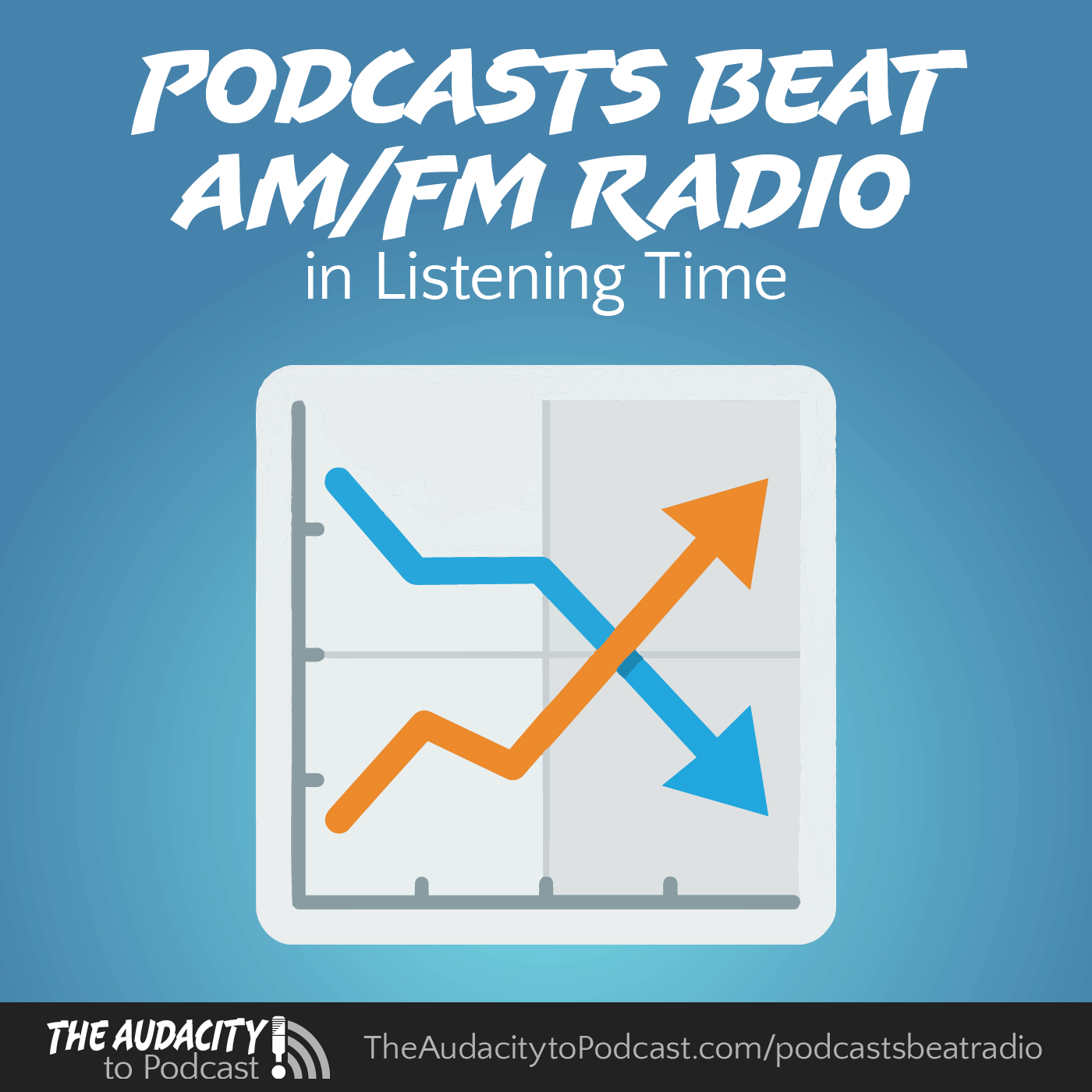
The Audacity to Podcast® - tips and how to start and grow profit in podcasting
422. Podcasts Beat AM/FM Talk Radio in Listening Time!
00:29:23
Loading summary
Transcript1 lines
- [00:01]
A
It finally happened. Podcasts are consumed more than AM FM talk radio. Let's get excited. Thank you for joining me for the Audacity to Podcast. I'm Daniel J. Lewis. And it does take audacity to podcast. It takes that courage, the guts, the power to believe that you can share a message to impact people anywhere in the world, sometimes literally from your closet or your basement, because, after all, that's where the sound is often the best for us recording. And I named my show the Audacity to Podcast because that's really what it is and what it takes to podcast, believing that you can impact people even though you don't have a massive budget, you don't have a huge radio tower, you don't have a huge production team behind you. Us independent podcasters are podcasting from our homes and yes, literally our closets or our basements, because that's what we can do. And yet some of us are impacting the world more than the radio broadcasters are because of that audacity that you have. And so this news is, I think, far more exciting than world's best cup of coffee. Edison research revealed that as of the fourth quarter, 2025, Americans spent more time listening to podcasts than spoken content on AM FM radio. Now, this isn't the number of Americans or the number of shows that they're listening to. This is the more important metric, the most important currency that we have as humans. Time. All of us have 24 hours a day. How we invest that time can make a huge difference to our futures. And for many people, it does. You look at people who achieve a lot of. Yes, there are certain personality factors, but the biggest factor is how they choose to invest their time. And it's exciting to see that more Americans are now choosing to invest their time listening to podcasts than spoken content on AM FM radio. I have the link to this study. It's part of the Share of Ear study from Edison Research, and it's a great study. I really love Share of Ear. Not just the name, which is brilliant, but also what they share in it. So many great insights that can apply and we can learn things from as podcasters and seeing how people spend their time with their ears. But lest you think this is only because of the whole thing about YouTube and podcasts, and let's just clear this up right now. YouTube is not a podcasting platform. Nothing on YouTube is a podcast. I know that's a strong opinion, but I'm planting my flag on that. But that aside, I don't think that's factored into this because they were specifically asking about what people are listening to. Not what they're watching, but listening. And they're either listening to podcasts or listening to AM FM radio. And in this study, it's shown a steady decline of AM FM radio talk content from 2015 to 2025, dropping from 75% in 2015 to now 39% in 2025, whereas podcasts, on the other hand, were at a mere 10% in 2015. That's 10 years after Apple launched support for podcasts in iTunes. 4, 9. And podcasts had been around then for more than a decade, and they were only at 10% of the time people were listening. Now, for me, by that time, my time spent listening to spoken word content, podcasts were 95%, 100%. Probably every now and then I would listen to an audiobook, but for me, I stopped listening to the radio in 2005, and I have not intentionally listened to the radio ever since then because of podcasts. So I know I'm on the the extreme side of that, and maybe you are too. So podcasts were 10% in 2015. Now, as of fourth quarter 2025, they're 40% of the time spent listening, whereas AM FM talk radio is at 30, 39%. And what I also find interesting is while the decline of radio has been rather steady from 75% now 39% over these 10 years, the growth of podcasting has not been a steady growth. At times it looked kind of stagnant, like from 2018 to 2019, same 16%, but then there was a spike from 2019 to 2020. Then you might think there was a spike from 2020 to 2021 because of COVID lockdowns and all of that stuff. But no, there was actually a decrease in time spent listening to podcasts from 2020 to 2021, but then from 2021 to 2023, it went from 20% to 37%, almost a straight line across all three of those years. And now here at 2025, as of the latest from the study, it's at 40% of time. So this is interesting that it's had its ups and downs while radio has been on a steady decline. It's interesting to me, it's not too interesting to the AM FM radio people, but it's exciting now that people are choosing to spend more time listening to podcasts, and especially since podcast consumption is time shifted and you have other abilities over how you consume a podcast, like being able to listen faster, called pod speeding so you can listen at 1.5x or faster than that. I often listen that. Please don't think I'm crazy for this 2.5x with the silence reduction feature in it, so that sometimes makes it seem even faster. But it's possible to consume a lot more content listening to podcasts than listening to AM FM radio, especially when you factor in things like how much advertising there is on AM FM radio versus in podcasts. The percentage in an hour for AM FM radio advertising is higher than average percentage for podcasts. And many of the podcasts I listen to have a very low percentage of advertising or even no ads at all. Or if they do have ads, I don't really mind them that much because they're much more relevant because they're more related to the podcast or the audience of the podcast. And so it's exciting to see more time spent with podcasts. Just a one for one. An actual minute of time, not minutes of content. I I guess that the minutes of content is much higher than this because of the pod speeders like me. But I do have some structured thoughts to share with you on this. And definitely look at the chapters, get the notes for this episode and get that link to the study so you can read the article. It's a very short article from Edison Research, but they also have much more detail from the share of ear in their studies and things that they share. It's always exciting when they come out with this information. So get those links in the notes or the chapters. A simple tap or swipe away and you can probably see this chart in the chapter images as well. But here are some thoughts I want to share with you. First, this is the sad thing for the AM FM radio people. AMNFM radio is dying. I recently attended and spoke at the National Religious Broadcasters Convention or nrb. Every year they have an advocate who comes and speaks on their efforts to keep FM and especially AM radio in cars and accessible to all Americans. But think about this. When is the last time you actually wanted the AM FM radio in your car? Well, we'll dig into that a little more in detail. But I might have made some enemies when in a much smaller setting it was the Digital Media Committee meeting and they invited some people to participate and watch the meeting, even though they weren't members of the committee itself. But they opened it up for anyone to share some thoughts on more content that should be covered in future NRB conventions. And and someone had just spoken on their efforts and advocacy for saving FM and AM radio in cars And I had this internal dialogue or debate really that I was thinking, should I say this? No, maybe I shouldn't. Maybe I should. No, maybe I shouldn't. Ultimately, I decided I have to say this and maybe I made some enemies. And I even joked about that. I said you might hate me for this, you might even say that I should be kicked out for saying this. But I think it's great that you're fighting to keep AM FM radio, keep that fight up. But ultimately it's a losing battle because ultimately it will die. And so we need to not just think about that transition to digital, but make that transition and make it a full time kind of transition where digital becomes the primary focus. And I see that AM FM radio is dying in four specific ways. Availability, content, desire and audience. First, the availability of it. Well, yeah, it's being removed from cars. Did you know that AM radio actually causes some interference in many electric vehicles? And there might be a day where FM radio causes interference too. Or maybe causes interference with 6G phones or any kind of data connection that's built into the car that might be coming too. The availability is also diminishing in the kinds of devices we buy. When is the last time that you bought a device that could get an AM or FM radio signal? I haven't bought one in more than 25 years. Gosh, that makes me feel so old. I am not old, by the way. I am still young, still have lots of energy in me. But the only reason I even have a device in my home with AM FM radio on it is because it's my original stereo I got as a teenager for listening to my music collection back then on CDs and it had an AM FM radio on it. That wasn't exactly an appeal to me, except for back then I listened to Adventures in Odyssey which came over the radio. But the only reason I have that radio still today is because the speakers that were attached to it are better than my TV speakers and better than a sound bar that I can afford for my tv. So I use that old radio, that old stereo system as the speakers for my tv. That's the only reason I still have a working radio in my home, is because of that. Do you even have any radios? When is the last time you turned on a radio? The availability of AM FM radio is dying also. The content is dying. You look at what's broadcast on terrestrial radio stations and even some of the satellite stations, it's pretty much the same handful of topics across all of the radio stations. Sports, politics, news, finances, Relationships, religion, maybe if you're lucky, you might get some tech somewhere in there. And late night you sometimes get the wild card topics. But you're not going to really find niche content. And the content on the radio is kind of dying itself. It's increasingly being pushed out by advertising people because they have to cover their bills for broadcasting this content, especially with fewer people listening. That means they have to cover their expenses in other ways and other stuff is just pushing it out. So you can't really find niche content on the radio. The desire then for AM FM radio content is dying, and that's why you're seeing that decrease from 75% in 2015 to 39% in 2025. There's just not the desire for AM FM radio. I encountered this many years ago as well, where I just thought, why do I want to listen to what someone else decides they want me to listen to? I don't want to listen to that. I want to listen to my music, I want to listen to my subjects. I want to listen what I want to listen to and when I want to listen to it. Not waiting until the ideal broadcast time where I have to be there to catch the station at just this particular time. And then, oh, there are all of the ads and the traffic report and the weather and the news on the tens and fives. And however they work that out. No, not that kind of thing. But I desired more, and I think other people are also desiring more than they can get from AM FM radio. And that desire then for AM FM radio is dying too. And that's what the data is just showing. People desire it less. They don't want to spend as much time with AM FM radio. They are now, on average, spending more time by intentional choice listening to podcasts. That's the other interesting thing, the intentional choice aspect of this. A lot of people will kind of accidentally listen to radio or kind of default to certain radio stuff, and it might just be they turn on the radio, see what's on, and this kind of seems interesting. What is the show is this about? Whereas on a podcast you are picking what you want to listen to either by the podcast that you're following or even the specific episodes that you're choosing to listen to at certain times. Like there are many times that I want to listen to podcasts about podcasting right now, or I want to listen to news podcasts or comedy podcasts or religious podcasts, and I'm choosing what I want to listen to. You don't get that kind of choice With AM FM radio, in fact, they remove the choice from you a lot of times, where sometimes it seems like at a particular time on the radio, no matter what station you turn to, you're hearing pretty much the same content. The desire is dying. And fourth thing is, unfortunately, the audience is literally dying. The average age of a podcast consumer is lower than the average age of a radio consumer. AM FM radio consumers are old. There's no delicate way to put it. They are old and they are dying. That's unfortunate. Every life is precious and worth celebrating, but the audience is literally dying. And the new audiences coming along are choosing to consume their content in different ways because they have a desire to consume it differently. They have a desire for different content, and the availability is different for them. So I know that the AM FM radio people are not happy about this. But the exciting thing, though, is that there's so much more opportunity for them in podcasting, because the AM FM radio side is expensive and it has all of these restraints on it that podcasting does not have. You can talk about whatever you want in podcasting. Your episodes can be as long or as short as you want, as frequent as you want. And there are certain rules that you don't have to follow in podcasts that you do have to follow on broadcast radio and broadcast television. And there are all kinds of other things that you don't have those limitations in podcasting, but you do have so much more freedom and so much more ability and all of that at much lower costs. Think about how many successful podcasts are out there, probably podcasting, recording their episodes literally from their closet with a $50 microphone. Maybe you're one of those podcasters and you're able to get great sound quality that often rivals what they have on AM FM radio. But you are in your closet, huddled between clothes, holding a $50 microphone in your hand, sweating because it's getting hot in there. But you're getting great audio. And what's even more important, you're making a bigger impact. You're building deeper relationships with people. And it's because of that that my next point here, podcasts are thriving. I find it interesting that this shift, and it's not a completely inverse or mirrored direction when you see the steady decline of radio, AM FM talk radio specifically. But the increase of podcast consumption has not been as steady as the decrease of radio. In fact, it's not been even the same inverse amount. But it's interesting that people didn't just leave radio for streaming radio, where that's just the same Kind of experience, but consumed in a different way and maybe with more choices. Like, I remember the early days before podcasts came out back in 2001, listening to Live365 and someone had a streaming radio station, so to speak, of just soundtrack music. And it was someone who picked soundtrack music. Now, I really liked their taste and they picked a lot of songs that I really liked and led me to all kinds of other music that I liked. But that was streaming radio, and that never really picked up. And it certainly hasn't picked up as much as podcasts have picked up. So it's not like people just chose a different way of getting the same experience. They're choosing to spend their time with a completely different experience. And I think because of those same four reasons, availability, content, desire, and audience. Like you look at the availability of podcasts, more and more apps and platforms are adding a podcast section or a podcast feature inside of the app, inside of the experience, to the point now that many of these newer cars with digital dash systems and all of this stuff have a podcast feature built right into the car. You don't even have to pair your phone with it. Sometimes they even just get their own Internet connection for the car. And you can consume a podcast directly in the car, directly from the Internet, without having to connect it to anything else. It's right there. TVs have podcast apps on them. It seems like there isn't a device anymore that doesn't have a podcast feature on it. The availability of podcasts, and I know that there is some debate in some of these places, like is it actually a podcast that they're offering? Like, you look at YouTube and how they now have this podcast section, which YouTube is not a podcasting platform. Nothing on YouTube is a podcast. But that aside, still, they are calling it podcasts and they're labeling this as this is available on our platform. So the availability of podcasts is thriving and the content is thriving too. It's been thriving since the beginning of podcasts. This is what attracted me to podcasts in the beginning. When iTunes 4.9 released in 2005, I was driving 90 minutes each way to my full time job at that time. And I was burning out on other audio content. I'd listened to all of my music over and over and over again and I burned out on that. And I didn't really have the money to add to my music collection. I had listened to every audiobook I could find that was interesting from the public library. And talk radio was just burning out my brain cells. And frying every last brain cell I had. It felt like because of the advertising, the sports talk, the weather, the traffic, the news, all of this stuff I did not want to hear, plus all of the heavy advertising. And that was back in 05 and the few years before then. Now the advertising is so much more. And the content was that same handful of content. But I wanted more. I wanted content that I wanted. I wanted to listen to what I wanted to listen to when I wanted to listen to it. But that wasn't available on radio, but it was available in podcasts. And that's what made me fall in love with podcasts. And I said this to the National Religious Broadcasters Digital Media Committee meeting. I admitted that here I am. I still consider myself young, but I have not turned on a radio since 05. Why? Because of podcasts. I fell in love instantly with the content of podcasts, where I could find a podcast about any topic. And this was in 05. And now there are so many more podcasts about so many more different topics, too, hosted by so many more different personalities. But I love that even back then and so much more today, the content is thriving. You can find a podcast about anything, or if there isn't a podcast about the subject that you are most passionate about, you can be the one to start the podcast about that. And you can connect with an audience who has been dying for that content. The content is thriving in podcasting, and because of that, the desire for podcasts are increasing, too. I made this joke at the hall of Fame ceremony when I was inducted a couple of years ago. And I know I still need to share that speech with you because I'd love to share that experience with you. But I had my parents there, and they got to see me inducted into the Podcast hall of Fame. And I made this joke, and this is a true story. I admitted in front of them, in front of the whole audience, I admitted that I was using my parents as a social experiment to see when they would have an interest in podcasts and when they would listen to podcasts unprovoked by me. So I never tried to educate them on what a podcast is or why they should listen or how to listen or anything like that. As my little social experiment, I just sat back and waited to see when would they discover podcasts, when would they, more importantly, desire podcasts. And when I saw them actually desiring podcasts, telling me about podcasts that they were listening to, that's when I knew that podcasting was mainstream. I'll share more details about why that was so funny in my speech when I share that speech later. But this is what people are finding is also as they discover, wow, there's content about this subject that I am so passionate about. What other passions might there be podcasts about? People get hooked with it. I think this is a big reason why people love POD Speeding, too. Listening to the content faster because they discover so much more content they want to listen to as well. And I recently had to do some culling with my podcast app because I was just following too many shows. So much good content out there that I want to listen to. And sometimes I feel guilty for not listening to certain content that people tell me is so good. And I know it's so good, but I just don't have enough time. Even as fast as I listen to content up to three times speed, depending on how the silence reduction works. Yeah, you can call me insane if you want, but I can consume audio content fairly quickly, and I just have so much I want to consume. Such a desire to consume all this good content. And other people are like that too. They get excited about their. What they're listening to and about the topics that are out there because of the content and because of the availability. So the desire is thriving and the audience then is thriving too. Because today, I think podcasting has enabled more entrepreneurs than any other media in the past. In the 80s, 90s, early 2000s, maybe even before the 80s, there was this thing called programs I've heard about. I think I've read about them in history books and museums, but it would be where someone would sell some kind of training program on cassette tapes or a VHS or. Or maybe even CDs. And these were experts teaching certain lessons that then they would sell on these distribution methods that people would listen to these and study these and learn from these things. And they would sometimes sell these things for hundreds or even thousands of dollars for audio programs. Now you can get that same level of expertise and information, maybe even more for free from a podcast. And because of that, audiences are thriving. Look at the story of John Lee Dumas with entrepreneurs on fire. And even just his origin story, that he wanted content that would inspire him and he would get to learn from other entrepreneurs. And he felt like that content wasn't out there, and he decided he wanted to present that content, so that helped him to thrive. And then the kind of content that he's been sharing has been able to pull out from his audience, has helped many other entrepreneurs to thrive and encourage them to launch their own endeavors, too. And all of the great knowledge that's out there about business, finances, relationships, faith, and so much more is helping people thrive in all of these different areas. So podcasts are thriving in availability, content, desire, and audience. So here's the takeaway for you. Can you tell I'm excited about all of this? And I hope you're excited, too, because this is the takeaway. Embrace a niche. Yes, there are hundreds of thousands of podcasts out there. Actually, there are millions of podcasts, but they're not all publishing anymore. The numbers, you can go over to podcastindustryinsights.com to see the numbers that I collect over there of how many podcasts have actually published an episode in the last week. And it's a much smaller number than you might think. So the competition is not all that big, but don't let that bog your mind down. Instead, embrace a niche. And this is the magic word in podcasting, your niche or for the British people, niche. But I'm an American, so I pronounce it niche. The niche that you can have in podcasting is, yes, it could be your content. And a lot of people tend to think about that, that I need to have a niche content. My podcast needs to be a podcast for busy moms that are thinking about what to cook for dinner tonight. And that is what my podcast is about. The what's for dinner tonight podcast for busy moms with toddlers who are boys. And yeah, you can really narrow your niche down like that. Yes, you could. But that doesn't have to be the only kind of niche. You might be really passionate about movies or about certain books or something like that. And that's not completely a niche, but the niche could be you, your perspective, your experience, your approach to the subject. I remember back when I was podcasting about the TV show once upon a time, there were several other podcasts about the TV show as well. I think ours was the only one to survive all of the seasons of the show and podcast from the beginning to the very end. And ours was the most popular unofficial podcast about the show. And our niche was we went really in depth with the theorization and the Easter eggs that we discovered and all of this other stuff. Another podcast that I thought of, I remember talking to the podcaster and he was a little bit discouraged about, there are all of these other podcasts about once upon a time. And I'm not sure quite where we fit, but I pointed it out to him. You have a niche here in your approach to this niche topic. Your approach is kind of Making fun of the show you love, laughing about the show, laughing along with things. You and your co hosts have a lot of fun. So I suggested some taglines to him, and I think he used one of them was something like laughing our way to happy ever after or something like that. But that was their niche. Even though they were talking about a niche subject, a specific TV show, they further niched down from their perspective, their approach. So if you're doing a podcast about food, about travel, about movies, those might not be niche subjects in and of themselves, but your approach can be the niche. And that approach, that niche, whether it's the subject that's the niche or your approach that's the niche, that is what attracts an audience and connects with some people deeper than other things. That's why some people will listen to one movie review podcast over another one. It's not because of the movies they choose. It might not be a niche. They might all be talking about the same Marvel movies, but their approach to how they're talking about those movies is what separates them from others. And that is the same for you. So embrace a niche, whether that is your subject or your approach to the subject. Figure out what makes your show unique. That's what you should try to amplify then, because that's why your audience is coming to you. And that's why people will eventually say about your podcast, oh, you gotta listen to this podcast because. And fill in that blank. And that blank is your niche. Oh, you gotta listen to this podcast because it's the only podcast I've heard that gives me this. You gotta listen to this because it's the only podcast I found where they really get me. And I feel like they are asking the exact same questions I would ask of these entrepreneurs, these celebrities, these whatever it is that they're talking about or how they're presenting the information. You can be the niche. So embrace a niche. And so that then you and your podcast can thrive too. So please check out the share of Ear Study. I've got the link in the notes for this episode and in the chapters. And if you value the Audacity to Podcast, would you consider giving some value back? Put a number on it. Whatever you feel the Audacity to Podcast is worth to you and the information and inspiration you get from this, go to the audacitytopodcast.com give back to figure out what it's worth to you and give back whatever value you feel it's worth. That's at theaudacity2podcast.com giveback and now that I've given you some of the no, no. Now that I've given you a lot of the guts, I hope and taught you some of the tools, it's time for you to go start and grow your own podcast for passion and profit so that you can get a little bit more of that share of ear time from others and help others invest their time into your podcast. I'm Daniel J. Lewis from audacity2podcast.com and creator of Podgagement and Pod Chapters. Thanks for listening.