← The Audacity to Podcast® - tips and how to start and grow profit in podcasting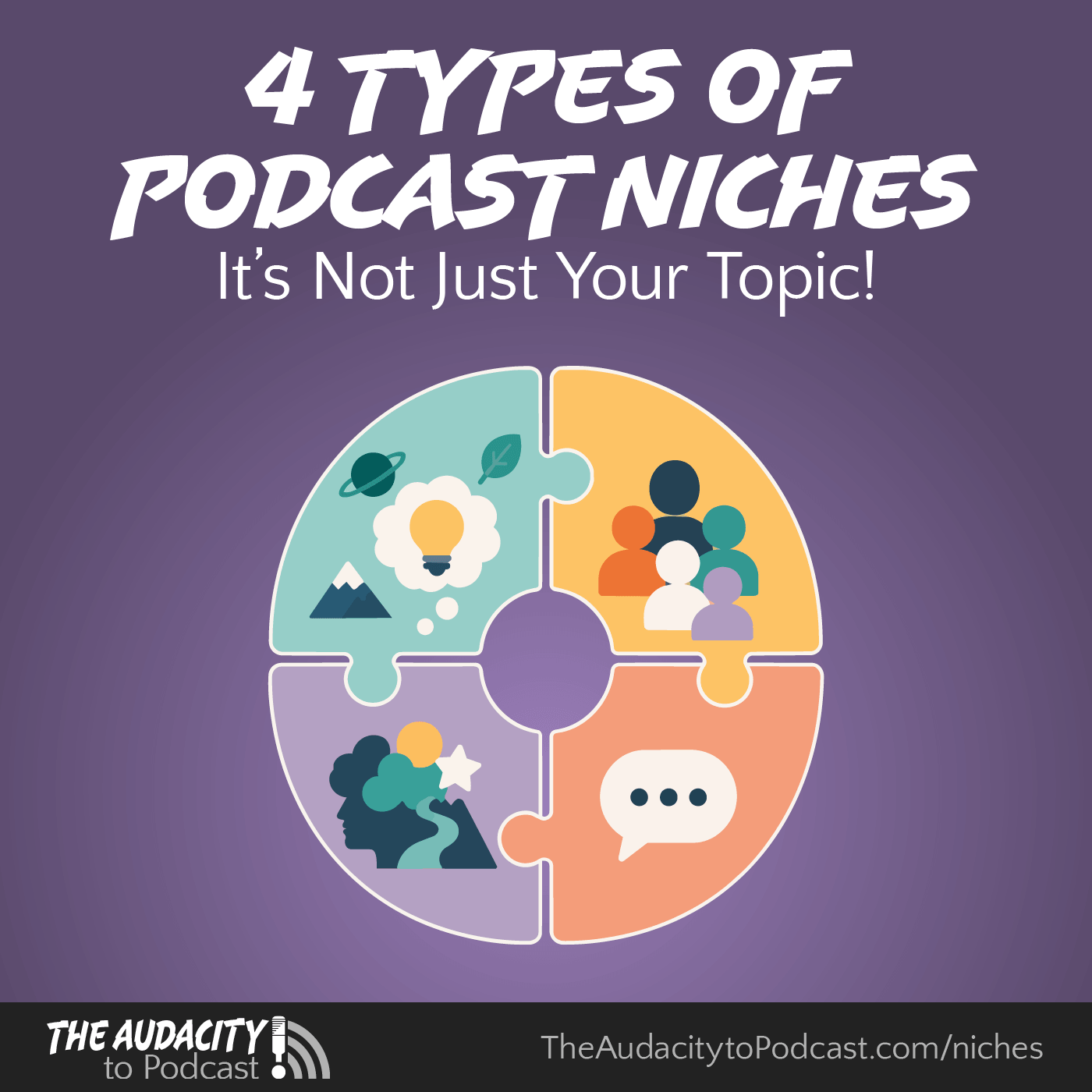
The Audacity to Podcast® - tips and how to start and grow profit in podcasting
433. Four Types of Podcast Niches—It's Not Just Your Topic!
Loading summary
Transcript1 lines
- [00:00]
A
You've probably heard the podcasting advice that you must choose a niche or even niche down. But your topic is not the only potential podcast niche you could have. In fact, here are four types of podcast niches. Thank you for joining me. For the Audacity to Podcast, I'm Daniel J. Lewis. In podcasting, we've got many buzzwords like passion and content and audience and avatar, which is sometimes a misused term. But the other term then that so many people talk about is niche. Oh, you need to pick a niche. You need to niche down, make sure you're in a not populated niche, make sure you have a niche audience, a niche podcast, niche this, niche that here, niche there. Niche everywhere. Snitch, snitch. It feels like we're talking about snitches, and snitches get stitches. But let's focus on the niche. Because in podcasting, yes, a niche is important, but there are multiple ways that you could have a niche for your podcast. And it doesn't have to be only one way. It could be multiple ways. And some people will think that niching down means limiting yourself or restraining the potential that your podcast could have. And in some ways, yes, it is potentially limiting your audience, but. But in other ways, picking the right niche and approaching even just the concept of a niche can actually be more freeing to you. If you'd like to follow along in the notes for this episode, they are a simple tap or swipe away. Look at the Chapters powered by podchapters.com or go to the audacitytopodcast.com niches first. What is a niche podcast or a podcast niche in America? The correct way to say it is niche, like the riches are in the niches, but in British English it is niche. And you could try and remember that by niches have no leashes. Which is true, as you're going to find out. Many people think of a niche as having a leash and restraining them. But riches are potentially in the niches. But I'm an American, so you're going to hear me pronounce it niche. Consistent with American English, of course. And if you look at the Merriam Webster dictionary, it provides multiple definitions for the word niche. Two of them stand out as being relevant in the case of podcasting and content. Here, 2A says a place, employment status or activity for which a person or thing is best fitted. And 2D says a specialized market. And that's from Merriam Webster's Dictionary. I've got the link to that in the notes. If you're interested yes, that is a niche. So a specialized market or an activity for which a person or thing is best fitted. I think in podcasting we can redefine this as something more relevant to what we're doing. So we could say that a podcast niche is content and experience specialized to best fit a particular audience. That's my definition for a podcast niche. And there are multiple facets of this and multiple types for this. Note that in this definition that I'm suggesting, it is not saying it has to be a particular topic or one of these other types of niches. It is content and experience specialized to best fit a particular audience. So if you were to niche down, then you would be narrowing that content or narrowing that experience or further specializing or. Or making it a better fit or making it for a smaller audience. So you're just focusing it in on that core definition that I suggest for a podcast niche content and experience specialized to best fit a particular audience. So what are those podcast niche types? Number one topic. This is the one that we all know that people often talk about. Oh, you need to have a niche topic that you talk about with your podcast. So. So that your podcast can be known for this particular thing. That's not necessarily bad advice. It is good for your podcast to be known for something, and sometimes that's the topic. This very podcast is an example of this. I talk about podcasting. That is my niche for the topic of my podcast. And that is a sentence that we're going to build on as we go. Fill in the blank. I talk about blank. That's your topic or topics for your podcast. If you have a lot of topics that you talk about or you can't think of a particular topic to put in there, then the topic is not your niche. That's not necessarily a bad thing. There are plenty of highly successful podcasts that are not known for having a niche topic. One example of this very popular podcast is the Joe Rogan experience. He does not cover one single topic or even a collection of topics. He's all over the place for what he talks about and who he talks to. But we can't say unless we had a parallel universe to do split testing. We can't say that he is successful because he doesn't have a niche topic. We also can't say the other way that he would be more successful if he had a niche topic. We just don't know. What we can see is he is successful and he doesn't have a niche topic. So you don't have to try to be Joe Rogan or any other top podcaster who does not have a niche. Just talking about whatever you feel like talking about is not going to make you famous. But having a good niche could still make you famous. And the niche doesn't have to be your topic. But if it can be a topic so you can tell people I talk about and fill in the blank, that is your niche topic. Like when I had a TV show fan podcast about the TV show once upon a time, I can tell people I talk about the TV show once upon a time. That was a niche topic. We weren't talking about all the other TV shows that were out there. We weren't talking about movies unless the movie was relevant to the TV show. And there were a few times that that came up. But our niche topic was the TV show here on the Audacity to podcast. My niche topic is podcasting. There are many other podcasts out there with niche topics, but also many podcasts that you can't really nail them down to a single topic or even a collection of related topics. They might be all over the place, but they could still have a niche because topic is just one kind of podcast. Niche number two audience. Think of it like this. As we build onto that example sentence, I talk about topic here for audience. Who is the audience you're going for? You might have a cake baking podcast. Okay, that is a niche topic, but how then do you differentiate your podcast from other cake baking podcasts? Is your podcast for people, people with dietary considerations? Is your podcast for people trying to start a cake baking business? On the side? Is your podcast for people who bake cakes as a hobby, your audience that you are targeting your podcast for, that you are designing and specializing your podcast to reach that audience. That could be your niche, even though you might be talking about the same subjects as other people, or maybe not even having a clearly defined list of topics that you talk about. You just talk about anything in particular, but you do it for a particular audience. There is definitely a place for that. Like in the last episode I mentioned the podcast from Erica Mandy, the newsworthy that doesn't have a niche topic because frankly, she doesn't know what the next episode's topic is going to be until she starts preparing the episode. Because it's all based on what actually happened in the world. It's a news show. It doesn't have a niche topic at all, but it does have a bit of a niche audience, and that is people who want balanced news and want it short and daily. And there's a little Bit of that that blends into the next niche that I'll get into in a moment. But your audience could be the niche, maybe not the topic. So you could be all over the place talking, though, for this specific audience, however you define that audience. So fill in those blanks. I talk about topic here for audience here. Number three, approach your niche could be the way that you approach the subject that you're talking about. So you might not be able to say, I talk about a particular topic. You might not be able to say it's for this particular audience or this demographic of people. Instead, it might be how you approach that subject. An example of this is my Once Upon a Time podcast, where we talked about the TV show, but so were other podcasters who had podcasts about the same TV show. We were multiple podcasters podcasting about the same niche, and our audiences were very similar. It was people who loved the TV show and were watching it. And then we started to niche down a little bit more because our podcast was very in depth. So our audience was people who wanted to go in depth into the show and explore some of the Easter eggs. But what really started to set us apart was our approach. And a lot of things fall under this umbrella of the approach to the topic and how you approach that audience. Like for us, in our TV show, Fran Podcast, we. We went really in depth. We'd watched the TV show Lost, which had a big influence on the TV show Once Upon a Time, and there were lots of Lost Easter eggs inside of the Once Upon a Time show. And it was created by some of the same people who worked on Lost as well. And there seemed to be some crossover things here and there as well. And that was fun and we could bring that kind of insight into it. And we had other approaches that we took. Like we wanted our podcast to be a clean podcast with absolutely no profanity, even though there was profanity in the tv. We wanted our podcast to be family friendly and have no profanity and make it so that any family could listen to the show and not be offended by some profanity or obscenity or adult talk or something like that inside of our podcast. That was part of our niche approach to this. Our perspective on the show, the way that we did our schedule, was another aspect of our approach to the show. Like, we would do two episodes of the podcast for every one episode of the TV show. We would do an episode right after we watched the TV show episode when it aired on Sunday nights. We would record an initial reactions where we would often get stuff wrong and we just shared our initial thoughts. And sometimes it was just like, what just happened? And other times it would be like, ugh, this episode was dud. This didn't seem like there's all that much to talk about. Those would be our initial reactions. And then later in the week, about halfway between the TV show episodes, we would do a full discussion where we had time then to rewatch the episode, maybe even rewatching it multiple times. We had time to get feedback from our audience. That was another aspect of our approach, was how we incorporated our audience feedback into the podcast. And then we would dig into things more. We would do some research, we would get some screenshots and sound clips from the show and use those in our podcast episode as we would then have our full discussion. So our schedule was part of our approach. It could be the way that you talk about things, like continuing this example of the once upon a time TV show. There were other podcasts talking about the same TV show, but they had different approaches. One of the podcasts, I love their approach that for every episode of the TV show, they would simply bring five things that they wanted to talk about. That was great. That made their episode shorter, that made it really easy to follow. And you would always know, I'm going to get five things from each host of this podcast. There were other TV show fan podcasts as well that maybe did something short. They just took one idea from it, one concept to pull out. There are podcasts about TV shows that all that they do is just incorporate the fan feedback about the show and really focus on what do the fans think about the show. These are all parts of the approach to the show. And there's so much that fits under this umbrella of approach. It is really about how you want to make the show, how you are making your show that talks about the same thing that others talk about and maybe tries to reach the same audience as others are trying to reach. But how are you making your podcast different? That's your approach niche, and it can be what sets your podcast apart from others, because some audiences will like your approach better than others. And some audiences will listen to both you and others because they see the value in what you say and how you say it versus what other people say and how they say it. This plays out in so many different ways and applications of this. How you approach the topic. What is it that you want your audience to get from your podcast? That's your approach niche. So our sentence now is, I talk about topic for audience by fill in with an active verb approach, like by digging deep into the theories and Easter eggs, or by sharing quick snippets and thoughts based on listener feedback. Or by giving you just what you need to be able to have those conversations around the water cooler. See, these are different active verbs that you can use to explain your approach to the podcast. So even if you're talking about the same topic and for the same audience, your approach could be your niche and what sets you apart from the other podcasts doing very similar things, but not the same approach. And number four is voice. Let's take our sentence again. I talk about topic for audience by active verb approach from my unique and your voice. And your voice here is not just your literal voice, although that is certainly part of it, but it's everything that makes you you and gives you a voice in the space. I remember when I first started the Audacity to podcast, or even before I started it, when I was thinking about starting it, I felt like I had something to say in the space of podcasting that wasn't being said, even though I felt the space was saturated by the two other podcasts about podcasting that I was listening to at that point. And then when I discovered that there was a third one at that point too, I thought, oh, I'm just in this saturated space here that I'm podcast number four on this. Turns out there were several other podcasts about podcasting. I just didn't know about them back then. But I've since built great friendships with many of these people who talk about podcasting, and some of them are some of my closest friends to this day. But what set me apart is my voice, my perspective that I wanted to share from my experience, my thought process. And I'm not trying to make this all a me, me, me, my, my, my, now, now, now kind of thing and make it all narcissistic. But you do have a unique voice. You have unique experience, unique perspective, unique thoughts and feelings because you are a unique person just like everybody else. But it is true, you are unique. So don't feel like you need to hide your uniqueness in your podcast. Let it come out. That uniqueness could be your niche. What makes you your unique uniquely you might be exactly why people want to listen to your podcast. I've got a couple of people who listen to the Audacity to podcast hi David. And one of them in particular, his name is David, every now and then tells me, hey, I was listening to your podcast and it sounds pretty cool what you're talking about. David is not a podcaster. He's not really interested in starting a podcast. But he listens to my podcast because he knows me and because he just enjoys listening to what I'm passionate about. I've heard this same kind of story for many other podcasters, people who say, I don't really care what you talk about. I just love to hear your perspective on things. And sometimes this is why people will listen to celebrity podcasts, because the celebrity has a unique voice and they share that perspective, that voice on a whole wide variety of subjects. And so people aren't coming for the subjects. They're coming for the voice because they appreciate that celebrity. And I think that the celebrities who get into podcasting and fail at podcasting, and there have been plenty of them over the years, decades, at this point, I think they fail because they neglect their unique voice. They might be just trying to leverage their celebrity status, thinking, oh, if I start a podcast because I'm a celebrity, everybody's going to listen to me. When it turns out that they're not talking about anything unique, they're not really making it for a unique audience. They're not approaching it with a unique perspective. And while they could very easily leverage their unique voice, their perspective, their experience, their personal background, their worldview with what they're talking about, they're not. And then it's no wonder that people won't listen or watch because they might think, oh, this is great. I'd love to hear the podcast by this celebrity. Fill in the blank of whatever celebrity you have in your mind. And then they discover, oh, this is kind of boring. They're not talking about anything I'm interested in. It's not really for a specific audience. They're not approaching this in a unique way. They're not really bringing a unique voice to this. Here's a great example, though, of this Office Ladies podcast. And they are talking about the show the Office, which has been off the air for a long time. And it's for fans of the Office. So so far, not unique among other podcasts about the Office. And even they take an approach that is somewhat similar to other podcasts about the same TV show, where they are breaking it down scene by scene, talking about things. But their unique voice comes into this because they were actresses on the TV show, so they can approach things from a unique perspective from that experience with the show. And because they were actresses on the show, they can share their own unique experiences. And their personalities are really fun, and they let their personalities come out in the podcasts, they have fun with each other. They have fun with the show, they make fun of each other. It's an entertaining show because they're unique and they leverage that uniqueness. So if you are looking at your podcast and thinking it's not a niche topic, that's okay. It doesn't have to be the topic that's the niche. It doesn't have to be the audience that's the niche. It doesn't have to be the approach that's the niche. It might simply be you, your voice that is the niche. What makes you uniquely you. Leverage that in your podcast. Let that come out in your podcast. Like here with the Audacity to Podcast. Part of my voice in the Audacity podcast is the audacity part. The guts, the boldness, the courage, the audacity to podcast. And that's what I felt when I first started the podcast and when I first started listening to podcasts, I really felt like, wow, this is amazing that these people can be sharing a message with the world, just recording into their computers, or having conversations through Skype. At that time when Skype was a thing. Now it's dead if you haven't heard. And that's when I realized I could do this same kind of thing. And I feel like I have something to add to the podcasting space. I feel like I have a unique voice, too. And also I felt like I had a unique approach to talking about podcasting because of my background in public speaking and the way that I approach information. And I'm very analytical about things. I test things, I weigh things back and forth. I give you comparisons. I, a lot of times let you make the choice between options. Although I do highly recommend certain things here and there. That's my approach. I've seen other podcasters who say, this is the way to do it. Follow this. Step one, step two, step three, steps four. These are the decisions. These are the things you need to use. These are the tools you should get. This is how you can do your podcast while they leave certain room for your own discretion. I'm not like that because I just think about all these caveats. That's why I never say there is one best podcast hosting provider, because it depends on your needs. And that's why I recommend several different ones depending on what you need. There isn't one best podcast microphone. There are several I recommend the most often, but it really depends on your needs and on your budget. Same thing with websites and podcasting tools and all this stuff. Even my own tools like Podgagement and Pod Chapters, which are tools I made for you as a podcaster and I'd love for you to use them. I know that not everyone needs them. Like podgagement, for example, if you don't care about engaging with your audience and you don't care about where your podcast ranks in the up to 34,000 global charts in Apple Podcasts and Spotify, you don't care where you show up in search results, then podgagement is obviously not for you because it's what that does. And Pod Chapters, for example, if you really do not want to make chapters for your podcast, and you are fine with with the other podcast apps and services out there making the chapters and transcripts for you in their platform, and the chapters being potentially different in different apps because they're using their own chapters that they create for your podcast instead of the ones you provide. If you're okay with that and you don't want to make your own chapters as the standard that all of the other apps will use, then podchapters isn't for you. But I'd love for you to try these things anyway. Podengagement.com and podchapters.com, these are niche products for niche podcasters. And as a podcaster, yes, you should have a niche, but your niche could be your topic, it could be your audience, it could be your approach, and it could be your voice. So that full sentence, Think about it like this. I talk about fill in the blank with your topic or topics for fill in the blank with your audience by fill in the blank with an active verb approach. From my unique Fill in the blank with your voice or your perspective or your identity. For example, here with the Audacity to Podcast, I talk about podcasting for mostly independent podcasters by digging deep and providing thorough options and ideas that they can apply both in technology and concepts. From my unique perspective of a public speaker coming from a technical production background and loving the podcasting industry, See, I did that. I filled in the blanks. That is my niche. And that's what sets apart the audacity to podcast from other podcasts about podcasting. Other great podcasts about podcasting, like Dave Jackson, my really good friend who does School of Podcasting. He does things on his show that I would not do on my show. And that's not to criticize them. That's not to say they're bad or my show's better than his or his show is better than mine or anything like that. It's different. He has a different approach. He has a different voice for his podcast. We're both talking about podcasting. We both are trying to reach an audience of podcasters and I'd say we're both primarily targeting independent podcasters. But our approaches start to diverge and certainly our voices are very different. That can be the same for you too. So pick your niche or your niches or if you're British, your niches, your topic, your audience, your approach and your voice. Please share this episode out with other podcasters if you think it would be valuable to them. You can go to the website@theaudacitytopodcast.com or tap on the share button that you see inside of your podcast app. Now that I've given you some of the guts and taught you some of the tools to make your own niche, it's time for you to go start and grow your own podcast for passion and profit. I'm Daniel J. Lewis from the audacitytopodcast.com thanks for listening. Sam.