← The Audacity to Podcast® - tips and how to start and grow profit in podcasting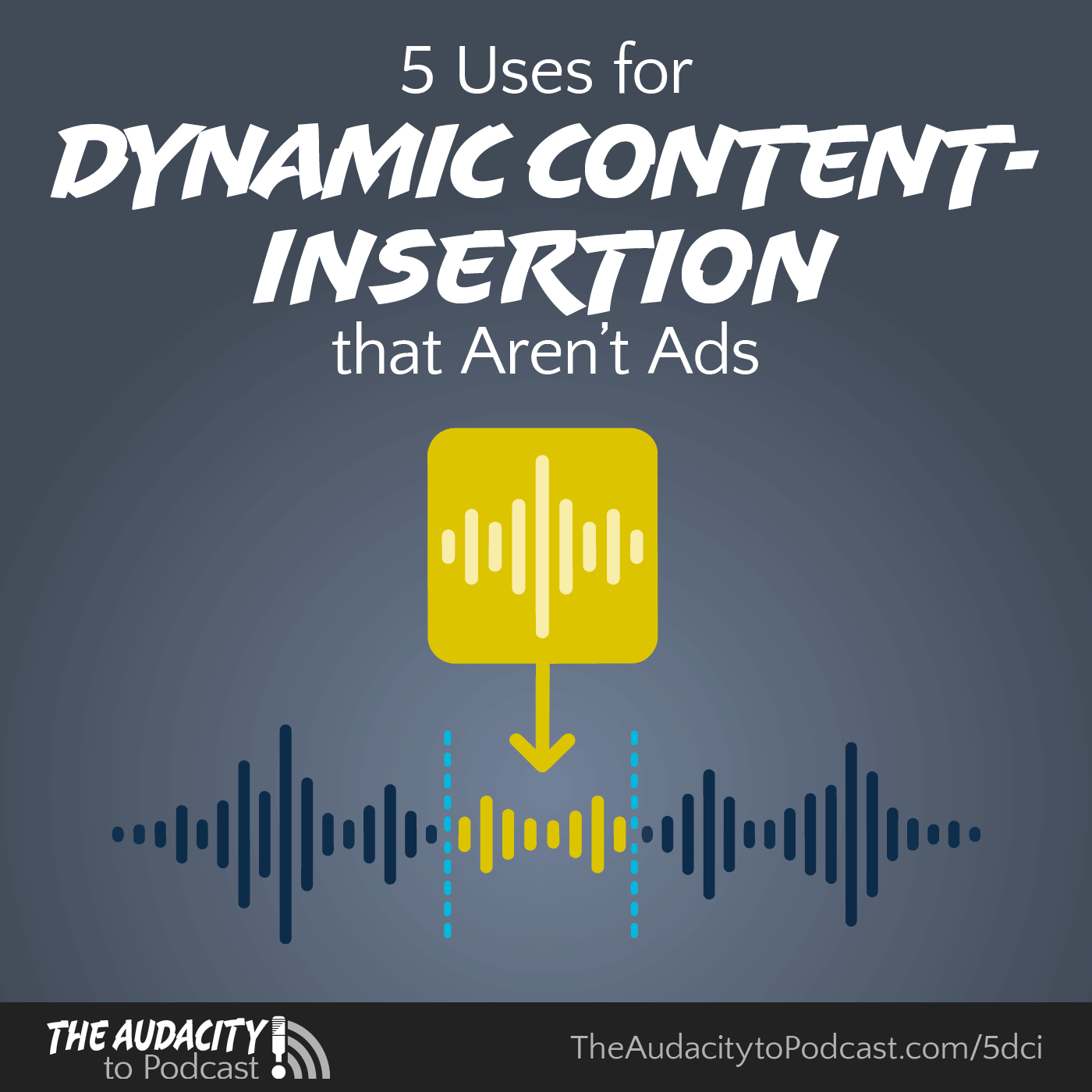
The Audacity to Podcast® - tips and how to start and grow profit in podcasting
442. Five Uses for Dynamic Content-Insertion that Aren't Ads
00:23:25
Loading summary
Transcript1 lines
- [00:01]
A
Five ways to use dynamic content insertion that aren't for ads. Thank you for joining me for the Audacity to podcast, I'm Daniel J. Lewis. Dynamic content insertion, or what many people call dynamic ad insertion, can be used for a lot more than ads. And that's why I prefer the term dynamic content insertion. So what is this really doing? It is where content can be inserted dynamically. Ooh. Okay. What this really means is imagine that you have, let's say, a 30 minute audio episode. And when people download or stream that episode and they get to a particular point, your system that's managing that episode, media can dynamically insert content. And that content could be whatever you want it to be. Let's take the classic example of dynamic ad insertion. And this week it is an ad for product A, and the next week it's an ad for product B. So anyone who downloads it after the dynamic system changes it, or sometimes these systems change things on the fly. They'll get that different version of that ad when they listen to the episode. Once an episode has actually been completely downloaded, DCI dynamic content insertion, that is, cannot change any of the contents within the episode. But this is about when people download it or stream it and how the system managing that dynamic content insertion or dynamic ad insertion works on the backend. And this can be really powerful. And it's why I highly recommend using the term dynamic content insertion, because it's not only for ads. A lot of people say DAI for dynamic ad insertion, but it can be so much more than ads. As a little aside, just because an ad is inserted dynamically doesn't mean it is a programmatic ad. Programmatic ads are where an ad is selected automatically for your podcast based on something about the audience or based on something about your show. And that's served like that programmatically. You could prerecord an ad but still insert that dynamically into your content. So just because it's dynamic doesn't mean it's programmatic. But programmatic usually is dynamically inserted. But it's not only about ads. There are so many other things that you can do as even an independent podcaster with dynamic content insertion. There are even some companies out there that will put together entire episodes using dynamic content insertion. You don't have to go that crazy with it. But here are five ways that you can use dynamic content insertion in can it not be for sponsors with their ad spots in your podcast? If you want to follow along in the notes for this episode, they are a simple tap or swipe away look at the chapters powered of course by podchapters.com or go to the audacitytopodcast.com 5dci number one upcoming events this is the thing that I think is the most powerful for Dynamic Content insertion, or DCI as I might refer to it frequently. With dci, you could insert a promotion for any kind of upcoming event and then change that promotion based on when your schedule changes, or even remove that promotion when the event has passed, or replace it with something talking about the event that has already passed and what people can do now. So think of it like this. You have something coming up in two months. So not only for your episodes between now and then, but. But with dynamic content Insertion, you could dynamically insert the promotion of that upcoming event in your entire back catalog of episodes so that anyone listening to an older episode or downloading an older episode after you have already activated the dynamic content insertion for them would get that dynamically inserted promotion for your upcoming event. And then once that event passes, you maybe promote the next event after that. So you switch your DCI system to then promote the upcoming event. So then anyone who downloads any of your back catalog of episodes or future episodes after you've made that switch, now hear the promotion for the next upcoming event. That's the really cool thing that you can do with dynamic content insertion is being able to have more control without having to go back and edit, edit all of those episodes. You could prerecord your special announcement for the upcoming event or maybe multiple announcements and cue that up with your system so that then that's what goes out in all of your episodes. And when you turn it off, that gets removed from all of those episodes for new people listening to those episodes. It's really powerful to do this, especially for upcoming events. And an event doesn't have to be something like live and in person. It could be an upcoming live stream. It could be something special that you're doing. Maybe it's a Ask me anything or an open Q and A or a special episode that you have coming up. Anything that is upcoming could be used and promoted inside of Dynamic Content Insertion Number two Products, services and cross promotions. This could be affiliate links. It could be your recommendations for gear. It could be whatever you imagine. Something where you are not being paid specifically to talk about the thing, like a sponsor, an advertiser would have, but it's something that you want to promote. You could use dynamic content insertion for this so that anytime you want to promote that particular product, you use your DCI system to Use that prerecorded ad so that then if you ever change how you want to promote that product or service, or you want to change the product or service that you're recommending, then you could change that in all of your back catalog of episodes and automatically change that for your future episodes. Here's a practical example for me as a podcaster. I could have some dynamic content insertion promoting my own product, Podgagement. I could say, go to podgagement.com to supercharge your audience interactivity. And then maybe later on I think, you know, audience interactivity, that's a lot of syllables. Maybe I want to do a different call to action for that. Or maybe I'm running a short term promotion like an extended free trial or some kind of sale. So then I could rerecord my ad, switch that out in the dynamic content insertion system, and that new promotion then goes out to anyone listening to those episodes for the first time, or redownloading them or streaming them. This could also be for affiliate products. Again, using myself as a podcaster, maybe I have a section of my episode near the end of my episodes where I just list all of the gear I'm currently using for my podcast and I say, this podcast episode was recorded on this, this, this, this, and this, and that is a dynamically inserted piece of content. I might want that content to stick for all of those past episodes. So I might not want to change the old episodes, but I might want to change the new episodes. So instead of recording that into the episode or manually editing it into the episode, I could use DCI to do that instead. And also, if there's something I realized, oh, I forgot to mention the whatever that I'm using, then I could add that into my little audio promotion and then fix that for all of the things that that actually applies to, not to the much older episodes. There were many episodes in the past where I was using a hi LPR40 microphone. It wouldn't make sense for me to insert dynamically into those older episodes to say I podcast with an RE320 because those old episodes weren't using the RE320 yet. That's what I use right now. So for all the episodes I have now using the RE320, I could insert something like that and maybe update it at some point when I realize, oh, I forgot to mention this other thing that I always use with my podcast or something that I want to include with that. You can also use this for cross promotions with other podcasts, whether those are your own Podcasts or someone else's, where you could then decide that, like, if you're running a network like I used to do, that you could promote a particular other podcast in the network for an entire month and then you switch the DCI system so then it promotes a different podcast for the next month. Or maybe you are including cross promotions for other podcasts on your own podcasts. So, so that could be something that you've got an agreement with other podcasters that for this month we're going to promote each other. Maybe you even sell those promotions in your podcast or any other kinds of ads that you yourself sell. Whether that is with something that you're promoting, podcasts or products or services or anything like that. You can do that kind of thing with more power and control by using dynamic content insertion number three, Time sensitive announcements. This could be things like asking for feedback before an upcoming episode. I love the way that Dave Jackson does this with School of Podcasting, where he has usually a question of the month and he inserts that promotion and that announcement for the upcoming question of the Month dynamically into his episodes, so that whenever you listen to an episode, if you haven't downloaded it yet, you're going to get the latest version of of his announcement for what the upcoming question of the month is. So you will hear what that question of the month is supposed to be regardless of when you download that episode later on. And the regardless does have a little caveat to that. That is, if you've already downloaded the episode, then you're going to hear whatever was inserted at the time of download or at the time of streaming the episode, but it is still dynamically inserted. And so for Dave, that gives him great flexibility to be able to easily change all the past episodes. So if you started listening to School of Podcasting today and listened to an episode from a year ago, you would still hear the announcement for whatever the actual next question of the month is, because he's been using dynamic content insertion to include those time sensitive announcements. Time sensitive announcements could be for those kinds of events, like I mentioned earlier, it could be for live streams, it could be. It could be for an upcoming episode that you're asking people, hey, I'm preparing an episode about this, kind of like Dave Jackson does with the question of the month. And you ask your audience to send you feedback or answer that question, or maybe ask their questions for this special upcoming episode. And then when you've already done that episode, then you can remove all of those announcements because they don't apply anymore. You could also use this for hiatus information. Like we are currently on a hiatus, so you're not going to see any new episodes from us until such and such date. Then when you return, you remove all of those past announcements. And that's very easy because you don't have to go back and edit the episodes. You just deactivate that dynamic content insertion campaign, or whatever it's called inside of your system. There are so many other things that you could do with this that are time sensitive announcements and number four, audience calls to action. Think of anything you want your audience to do, even if it is something that is not time sensitive, it's not an upcoming event. Think of things like asking for feedback or supporting your podcast financially, or giving your podcast a rating and review, which by the way, I'd love to see more ratings and reviews for the Audacity to podcast. I haven't asked for a while, but if you go to lovethepodcast.com audacity you can leave me a rating and review over there. And I'd love to read that out in the podcast at some point. But that could be an example right there of a call to action. That could be something you prerecord but insert dynamically and that could be inserted in all of your episodes or maybe you space it out. So the first episode of the month you ask for ratings and reviews. The second episode of the month you ask for financial support. The third episode you ask for something else, and so on. So you could build a strategy around it. Then if I ever decide that I want to change how that call to action works, I could edit that inside of the campaign and then update all of those past episodes. So maybe it's the same basic call to action. Leave a rating in review, support the podcast financially, send us feedback, whatever it is. But I ask for it differently and it's something that I've decided this is a better way to do it, or I'm changing the particular channel, I'm asking people to use any other kind of call to action. Think about your feedback. Maybe for a long time you want people to send you voicemails and. And at some point you realize people don't really want their voice on my podcast for some reason. So instead of asking for voicemails, I'll ask them to text the show instead. So you get a special texting number. You could insert that dynamically into your episodes and then at some point maybe you change what that number is so then you can go back and change that in your past episodes because you've inserted those calls to action dynamically. So you change it once. It changes all your past episodes instead of having to go back and re edit those episodes. And this is something where in the past I've talked about this quite frequently and I say this a lot online. Any kind of call to action should not have anyone's branding except for your own. So instead of sending people to patreon.com myawesomepodcast you send them to myawesomepodcast.com support or whatever you want that URL to be. That way, if you someday change and use something other than Patreon, all your past calls to action are not broken. But if you have mentioned Patreon by name, you could, with some tools, go back and dynamically replace all of those places. Or maybe your ad right now that you are dynamically inserting does mention Patreon and you realize, yeah, I probably shouldn't say Patreon. I want to make this more generic but branded to my show instead of to Patreon. So then you change your call to action. You change that in all of the places where that appears just by switching it in the dynamic content insertion engine. And then even if you're using the same Patreon page, but you're changing how you give that call to action, it's now more accurate and it's better maybe based on your experience and what you find converts your audience better. So audience calls to action are fantastic for dynamic content insertion. And number five, advanced targeting and experiments. This really depends on the tools that you use for dynamic content insertion, because some of these tools can get extremely granular. A great example that I heard of this many, many years ago, when dynamic content insertion was not really used much for content other than ads. I really like the way that Conan o' Brien did this for his show. He had something where it was kind of like the Willy Wonka golden ticket thing. Maybe he even called it the golden ticket. But it was where one person or maybe a handful of people would get a dynamically inserted quote ad, unquote. It was really just content, but it was dynamically inserted for just a handful of people that would personally invite them to a special recording. With Conan, it was a way to do a random sweepstakes for his audience. And that was a really cool idea and it worked. And I think that's what spun off his little sideshow that he did for a while called Conan o' Brien Needs a Fan, where he would talk with the fans, because I think he had so much fun with Those random sweepstakes sort of things where someone got to be on the show with them, he decided to do that more regularly. That's an awesome use of that. And it targeted just a handful of people. I don't know exactly what their criteria was when they set up that system to how they would pick those few people, but that kind of thing is possible. You could also do more advanced targeting, like certain regions, like if you travel frequently or maybe even infrequently, but you just so happen to be traveling and you want to host a meetup in a particular area. Some of the dynamic content insertion tools will allow you to target a geographic area. So for example, I live near Cincinnati, but maybe I was going to be near Dallas and I wanted to host a special meetup or a special event in Dallas and just to invite people within a reasonable drivable distance from Dallas. So in my DCI tool, I could go in and specify, I want this promotion to go out to only people in the Dallas Fort Worth area and within a certain radius outside of that, and then only the people who through the system show up as downloading or streaming the episode within that radius would then receive that extra dynamically inserted content. You could also target it to devices. Maybe you have a podcast about technology and mobile devices and you specifically want to target people on Android devices with certain content. And Maybe people on iOS devices get different content or don't get that content at all. It could be an app you're talking about or promoting, or it could be whatever kind of content that you might imagine. So then you could say, send this content only to people using Android devices, and send this other content to only people using iOS devices, and then people using anything else wouldn't get that content. That kind of targeting is possible with dynamic content insertion. And maybe the wheels in your head are turning since you started listening to some of these ideas of ways that you could use this for some cool stuff. You could also do some experiments with this. Again, this depends on what your dynamic content insertion engine allows you to do. But some of the experiments you could do, like split testing, or some people call it a B testing, where you could send out two different versions of a call to action for whatever that is, whether it's sending you feedback, supporting you financially, maybe even for ad spots. But you send out two different versions and you have the calls to action slightly differently, like a different promo code or a different URL or a different call to action, something that you would then be able to systematically measure in some dashboard. And so you could see how one version is performing compared to the other version or multiple versions. That kind of experimentation is possible through dynamic content insertion. Just keep in mind that is affecting the content, not the text or the metadata around the content. Now, how you actually do this? The best way to go about getting into dynamic content insertion is to use your podcast hosting provider. Some podcasting hosting providers do this only for ads, some have limited features. So far I think the best places for dynamic content insertion in your podcast are these two hosting providers and one of them you very rarely hear me recommend, but they're very good with this. So the first one is Captivate. Captivate has this cool system called Amy that allows you to very easily dynamically insert content. And in fact you can go back to older episodes and you can choose your insertion points or even paint over current points. Like if you had an old ad or a promotion or anything like that, you could select that like as if you're editing it, but then mark that as a section for dynamic content. And then the system can dynamically insert whatever you want into that. So Captivate is really good for that. If you want to sign up with my affiliate link and I do earn a commission from that. But I've recommended Captivate for years. I used to be on the advisory board as well. It's at theaudacitytopodcast.com captivate. The other system is Redcircle. Redcircle has been really good at dynamic content insertion, even getting down to some of the targeting and experiments for many years. And if you want to sign up for them, go over to the audacitytopodcast.com redcircle and honestly I don't know if I have an affiliate link with them or if that's an affiliate relationship. I might earn earn a commission. I really do not know at this point, but that will be a link that will redirect you to their site. And it's possible I might earn a commission if you purchase through that link. I just don't know right now because I don't remember if I have an affiliate relationship with them or not because I recommend things I truly believe in regardless of earnings. So if the publishing tool and podcast hosting provider you currently use does not already offer dynamic content insertion, but you feel like this is something that would be really important to you and your podcast, then consider trying out these other providers, Captivate, my number one recommendation or red Circle. And I've got those links in the notes for this episode and I would love to hear from you some of your ideas. Or some of the ways that you might be using or want to use dynamic content insertion. You can contact me through podcastfeedback.com audacity or comment on the notes for this episode on the website@theaudacitytopodcast.com 5dci DCI stands for Dynamic Content Insertion. Here's my challenge, though, to you. Whenever you hear anyone talking about DAI dynamic ad insertion, think instead content. And that content could be whatever you want. It could be these five things I mentioned, or could be potentially anything else you could imagine. And I would love to hear from you how you currently use this technology or would like to use this technology, or just your general ideas or questions about podcasting in general that I can address in a future episode. Go to podcastfeedback.com audacity and that podcast feedback page allows you to either write your message or record a voicemail for me. And that's powered by Podgagement.com where you can track your ratings and reviews, your global rankings, track your podcast search rankings. You can collect feedback, written and audio feedback. You can discover networking opportunities and Much more@podengagement.com Sign up for a free trial. I would love to have you using it. I built it for you. I'm a podcaster, obviously, because you're listening to me podcasting right now and I've made it for other podcasters. That's over at podgagement. Now that I've given you some of the guts and taught you some of the tools, it's time for you to go start and grow your own podcast for passion and profit. I'm Daniel J. Lewis from the audacitytopodcast.com thanks for listening.