← The Audio Long Read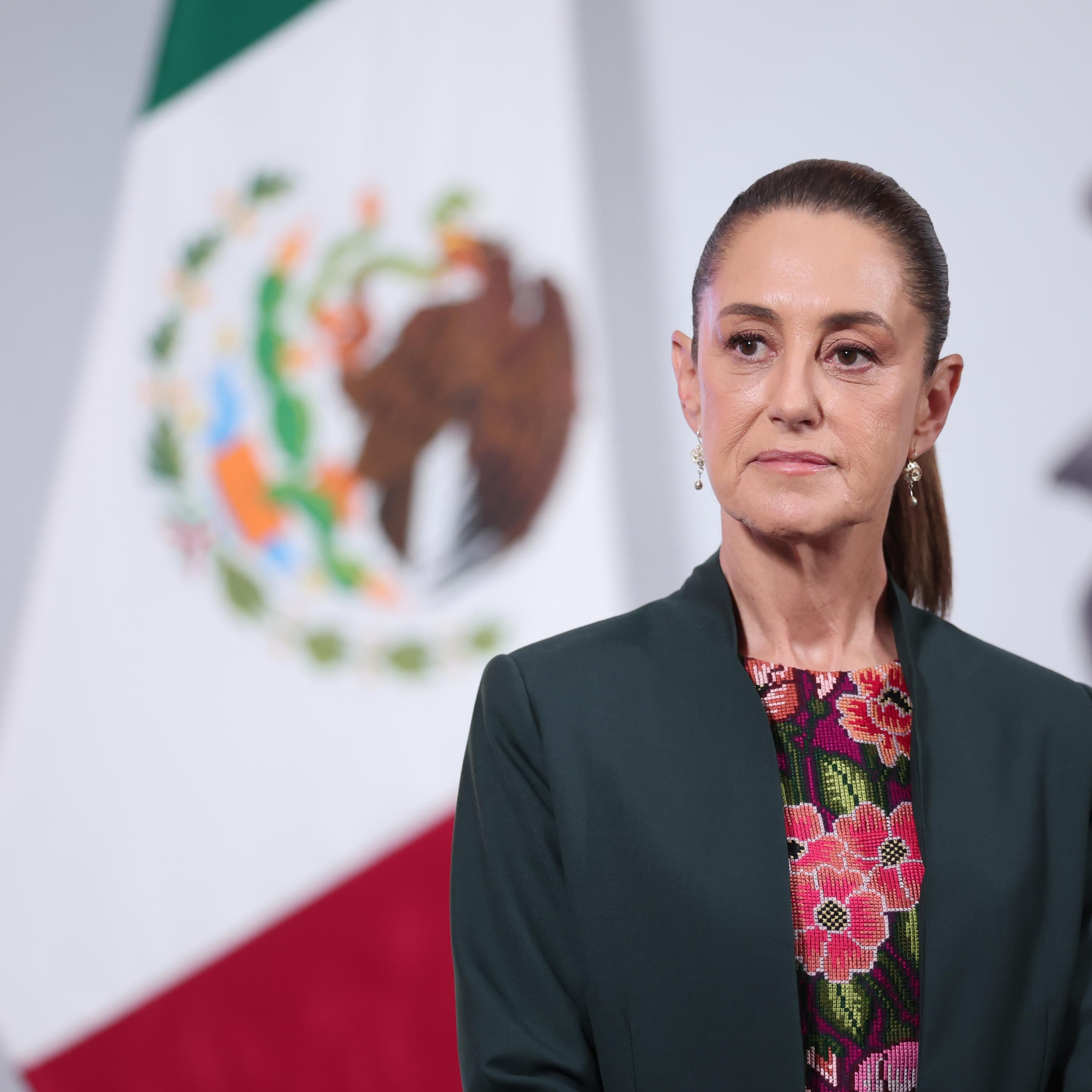
The Audio Long Read
How did Mexico’s president become the world’s most popular leftwing leader?
00:52:45
Claudia Sheinbaum started as an activist. Now she is Mexico’s president. Has she stayed true to her ideals? By Rachel Nolan. Read by Gemma Acosta
Loading summary
Transcript23 lines
- [00:00]
Narrator/Guardian Host
This is the Guardian.
- [00:09]
Wayfair Advertiser
You want to get your backyard summer ready, but you don't want to break the bank. Wayfair gets it. Planning on dining al fresco or relaxing poolside? Wayfair has everything you need to prep your space. Shop now and save up to 70% off during Wayfair's 4th of July clearance. Score huge deals on outdoor furniture, area rugs and more. We're talking thousands of products for every style and budget, plus surprise flash deals. July 6th. Don't wait. Shop Wayfair's 4th of July clearance now through July 6th at Wayfair.com Wayfair Every style, every home.
- [00:39]
Boost Mobile Advertiser
He's dribbling the ball with everything on the line. He's driving down the pitch. He's facing price hikes and cuts past him. Carrier contracts, tries to block him. Oh, he leaves him in the dust. He's at the edge of the box. He cuts past the nonstop group chat, trash talk. He clears on goal. He shoots no unlimited data for $25 a month forever. Visit your local Boost mobile store today to get unlimited data with a price that never changes. Boost mob after 30gb, customers may experience lower speeds. Customers will pay $25 a month as long as they remain active on the Boost $25 Unlimited plan.
- [01:16]
Claire Longrigg / Jane Coston / Max Rushton (Guardian and Crooked Media Hosts)
Hello, I'm Claire Longrigg, Deputy Editor of the Guardian Long Read. The summer issue of the Long Read magazine is out now, showcasing some of the Guardian's finest long form journalism. In this beautifully illustrated new edition of
- [01:30]
Narrator/Guardian Host
the magazine, you'll find stories about the
- [01:33]
Claire Longrigg / Jane Coston / Max Rushton (Guardian and Crooked Media Hosts)
UK's strangest pubchain, how AI is taking over the classroom, the Christian cult that hid in plain sight, and many more. Pick up a copy today from theguardian.com thelongreadsummer or from selected WHSMITH travel stores. Welcome to the Guardian Long Read, showcasing the best long form journalism covering culture, politics and new thinking. For the text version of this and all our longreads, go to theguardian.com longread.
- [02:12]
Narrator/Guardian Host
How did Mexico's President become the world's most popular left wing Leader? By Rachel Nolan Read by Gemma Acosta. The President's dressmaker works at home down a narrow road in a working class neighborhood on the southernmost edge of Mexico City. There is no sign, just the house number marked in chalk on a rusted metal door. In the brightly lit pink walled room at the back of her modest house, Olivia Trujillo sits at her sewing machine, piecing together the president's seat signature suits and dresses. Trujillo sews everything here, accompanied only by her family three dogs and one green parrot. Once finished, an assistant spirits away the items by motorcycle straight to the national palace, where the president lives. Claudia Scheinbaum's clothing, tailored from modest fabrics produced in Mexico and featuring indigenous motifs, is one of the many ways that her administration communicates its slogan for the good of all. First the poor. The dressmaker has just one problem with the president. People who wear made to measure clothes normally sit for the tailor twice first to have their measurements taken, then a second time for final adjustments. Not once has she done a fitting for me. Never, says Trujillo. An exacting and neatly turned out woman in her 60s, she knows the president is busy. Still, she objects. Any normal woman does a fitting for important clothes, like their wedding dress. Trujillo designed and sewed both the president's wedding dress for her recent remarriage to an old college flame, reconnected through Facebook, no fitting and the bell sleeve dress for her 2024 inauguration as president of Mexico. Landslide victory. No fitting for the inauguration. The dress was pearl colored, with tiny embroidered flowers on the skirt and the top section left plain. To show off the presidential sash, Trujillo made two identical versions in case someone threw tomatoes or something. There are bad people out there. Sheinbaum first heard about Trujillo through word of mouth when she was still mayor of Mexico City more than a decade ago. Back then, she did at least consent to have her measurements taken in person. On first meeting, Trujillo was charmed by the politician's cordial manner, her trim figure and her good bearing, a relic of her childhood ballet training. Trujillo tells me that of course she voted for Sheinbaum in 2024. Most people of her social class appreciated that Scheinbaum's party, Morena, emphasized welfare spending and provided more generous pensions. Earlier this year, Sheinbaum decreed universal healthcare for all 133 million citizens, rolling out free care regardless of job or insurance status. Because morena is so widely supported among Mexico's poorer and indigenous citizens, opponents sometimes refer to it as morenaco, a term freighted with class and racial disdain. Naco is derogatory slang for someone who is low class or tacky. While the Mexican elite have traditionally favored expensive foreign designers, Sheinbaum, who is from a middle class background, prefers to incorporate Mexican handicrafts, more traditionally worn by the working class. When Sheinbaum was named on The New York Times 67 Most Stylish People of 2025 list, alongside Bad Bunny and Jennifer Lawrence, she thanked indigenous artisans, calling them the pride of the nation in her austere and elegant designs. With her signature slicked back ponytail, she appears dainty, even incongruous alongside the generals who were such an important part of her government. Having noted the president's tiny size, Trujillo says she now does fittings on her own granddaughter, Maria Cristina, who is 11. Trujillo showed me a photo of the preteen, serious expression, arms extended, wearing one of the president's jackets. Everything fits, only the sleeves are a little long. On her seeing me out of her house, Trujillo pointed out the blue sweater with lace worn by her most elderly dog, also an Olivia Trujillo original design, she says, laughing uproariously. President Claudia Sheinbaum is one of the most popular democratically elected leaders in the world. Her approval rating hovers about 70% or above, and she stands out against the wave of conservative and far right leaders elected throughout the Americas in recent years. For many leftists around the world, she is an inspiration. Zoran Mamdani has signaled his admiration for Sheinbaum on many occasions, saying she has shown what can be won when you're willing to fight. She has drawn praise for her management of the country's most difficult and important relationship that, with its northern neighbor deftly running down the clock during tariff negotiations with Donald Trump last year, was a demonstration of her signature attitude, which she calls cabeza Fria cool headedness under pressure. It helps also that she is a climate scientist with a PhD in energy engineering. Sheinbaum is still an academic at heart. Someone who works with her told me to look up the YouTube video of a presentation she gave in June 2025 trying to convince the US that fentanyl trafficking from Mexico was going down. That's what it is like to be in meetings with her, he said. The presentation was all charts, detailed sourcing and minutiae. Sheinbaum is universally agreed to be a detail obsessed micromanager. She goes to bed early and is up at 4am texting everyone from her senior advisors to lowly functionaries working in obscure departments. Sheinbaum was both a preordained president, given her status as protege of the previous president, Andres Manuel Lopez Obrador, and a surprising one, as many have noted, she is a female leader of a very macho country. Marta Lamas, the country's most prominent feminist of her generation, explained this to me as men suspending their machismo to vote with their pocketbooks. Certainly her election has not suddenly transformed gender relations across the country. Last year, a video of the president being groped on the street by an apparently drunk man caused international outrage. Lamas has known Sheinbaum for years and describes herself as a fan, but she emphasized that the president emerged from the left but not from the feminist movement. Rather than explicitly focusing on policies that target women, Sheinbaum tends to think in terms of broad social provisions, such as universal health care in home elder care and early education centres. Still, she is aware of the symbolic victory her election represents in 2023. When an interviewer asked Sheinbaum why she wanted to be president, her first answer was being the first woman president would be historic in our country. Her second answer to continue the policies of Andres Manuel Lopez Obrador. On a personal level, Scheinbaum could hardly be more different to her predecessor. Where Amlo, as he is known, was flamboyant, she is subdued. Where he was impulsive, she is cautious. Where he was a politician to the bone, she is a former professor. Amlo emerged from the state of Tabasco, emphasizing the central role of poor and indigenous people, what people sometimes call Mexico profundo or deep Mexico in opposition to the Westernized elite. Sheinbaum is from a family that, though far from wealthy, formed part of the cultural elite of the capital. In the 2024 election, Sheinbaum trounced her opponent by 32 percentage points. A lot of the columnists say it, that I don't have a personality, she told the press after the election, laughing wryly. That President Andres Manuel Lopez Obrador tells me what to do, that when I get to the presidency he's going to be calling me on the phone every day. She went on to joke about him writing her undergraduate physics thesis for her, or telling her what to do during her doctorate or when she was mayor of Mexico City. Indeed, when she was first elected, there was plenty of openly sexist commentary that Amlo would be pulling the strings. Some members of the opposition called Sheinbaum prese elvienta, combining the words for president and made. According to those inside Morena, Amlo has not been picking up the phone to bother his, though a common debate among the chattering class in Mexico is whether the continued dominance of his loyalists mean that Sheinbaum holds little power. When we spoke earlier this year, the writer Juan Viloro urged me to check out a video from Sheinbaum's inauguration in which a group of Marena heavy hitters rush away from the new president to pose for a photograph with AMLO's son, Andy Lopez Beltran, the party's operations manager. But in late May, Lopez Beltran resigned, leaving Sheinbaum in a stronger position. It is a change that one Mexican historian described to me as part of the process of cutting the umbilical cord in the ruling party. There is clearly a split between technocrats, Scheinbaum's people, and the true believers who call themselves los burros, the Pure Ones, AMLO's people. But it is also true that Sheinbaum has so internalized AMLO's politics that interventions from him are unnecessary. Usually an authorized biography will have just one person on the COVID but Scheinbaum's has two. She is pictured waving with Amlo beside her, holding her other hand high in the air. Each of us has their own personal style, but we have been fighting in the same movement for the last 23 years, Scheinbaum has reflected. As I often say, what do you all want that I say first? The rich. One of the most telling differences between the president and her predecessor is the journey they each took to arrive at the same destination. Amlo rose to prominence through party politics, first through the Institutional Revolutionary Party, which dominated the country through one party rule from the Mexican Revolution until the first truly open election elections in 2000. In other words, he came up through the state. Sheinbaum came up as an activist against the state and even as president. She continues to highlight this part of her story. For some on the left, this has made some of her positions on issues such as the militarization of Mexican society and the crisis of forced disappearances all the more surprising, even shocking. The granddaughter of Bulgarian and Lithuanian Jews who fled Europe for Latin America, Sheinbaum was raised without religious practice but with a strong sense of political duty. Her father, Carlos, stashed his copies of Karl Marx in secret nooks around the house in case it was searched by intelligence agents. In my house, politics was discussed at breakfast, lunch, and dinner, she told her authorized biographer, Arturo Cano. Mexican politics at the time was a deadening procession of state bureaucrats, nicknamed dinosaurs from the one party government. Sheinbaum often describes herself as a child of 68, shorthand for the student movements that characterized that year, not just in the US And Europe, but in Mexico, too. Although Mexico never descended into a military dictatorship like many of its neighbors to the south, the state engaged in some of the same techniques during the Cold War, such as forcibly disappearing those it considered political subversives. In this period's most infamous episode, the 1968 Tlatelolco massacre, military snipers fired on a student protest in the Capitol. As many as 300 people died in Tlatelolco Square, and more than a Thousand were dragged off to jail as political prisoners. Scheinbaum's mother took six year old Claudia to visit one such prisoner, a family friend, in the notorious Lecumberi prison, nicknamed the Black palace for its rats and torture sessions. She has called this family friend, student organizer Raul Alvarez Garin, her political mentor. The fate of those disappeared by the state was the heart of Sheinbaum's early activism. In a documentary made by Morena's supporters, Sheinbaum recalled that the first night she spent away from home at the age of 15 was to join a group of mothers looking for their children who had been disappeared for political reasons by the state. They were led by Rosario Ibarra de Piedra, whose son belonged to a communist group and had been taken to an undisclosed location. Ibarra de Piedra went on to found the first National association of the Mothers of the Disappeared in 1977. A year later, the teenage Sheinbaum was forcibly evicted by the Mexican police from an encampment set up in support of the mothers. While studying physics at the country's leading university, the National Autonomous University of Mexico, unam, Sheinbaum continued her activism, protesting against privatization and austerity. The student movement was dominated by men, but Sheinbaum became a quietly persuasive member. In a TV interview from this time, Sheinbaum, almost unrecognizable with her short, curly hair, defended free public education. This is a line she has followed to the present day, often declaring that education is a right, not a commodity. It was through student politics that Sheinbaum met her first husband, Carlos Imas. In 1988, when she was 26, Sheinbaum gave birth to their daughter, Mariana. The family, including her older stepson Rodrigo, accompanied her to the University of California, Berkeley, where she completed her doctorate. She has three butterflies tattooed on her shoulder, representing herself and the two children. Sheinbaum could have stayed in the US to teach, but she returned home to join the faculty at the public university where she had studied academics. Hardly rake in the cash there. And in the documentary, she recalls this period as a squeeze, taking on extra work to make ends meet, living in their modest house on the outskirts of the capital. And above all, the anguish of trying to pick the kids up from school on time. This permanent anxiety. There was traffic very often. I was late. She smiles a smile that is more like a grimace. Well, that's how the lives of women proceed. Sheinbaum first Met AMLO in 1999, during strategy sessions held at her house with her then husband, Carlos Imas, who was involved in leftist politics and supported AMLO's run for mayor of Mexico City. After his election in 2000, AMLO called Sheinbaum into a meeting in Sanborns, the classic Mexican spot for power breakfasts, and asked her if she could clear up the city's notorious pollution if he made her Secretary of the Environment in his cabinet. She said yes, and she largely managed to deliver. As president, Sheinbaum has disappointed environmentalists by pursuing energy sovereignty, largely through the state owned oil company Pemex rather than renewables. When AMLO announced his first presidential bid in 2005, he made Sheinbaum his spokesperson. After he lost the 2006 election by half a percentage point, Sheinbaum was appointed head of an investigation to explain how in fact, he had won. She proved herself a loyal aide de camp, leading a team of mathematicians to cook up a series of formulas that convinced few but the most devoted AMLO supporters. These true believers shut down traffic on one of the main arteries of Mexico City, la Reforma, for 48 days to demand a recount. The demand went nowhere, and when his rival Felipe Calderon was duly sworn into office, AMLO faithful staged a parallel inauguration for public stage presidential sash, crowd of 100,000 people. Sheinbaum appeared on stage, and the sash was conferred on AMLO by Rosario Ibarra de Piedra, the activist who had founded the association of the Mothers of the disappeared in 1977. Eventually, AMLO gave up the pretense of being president and went home. But through his campaigning, he had established a strong base, especially in the impoverished agrarian south of the country among its majority indigenous population, which later grew into a fervent following. Sheinbaum was at his side as he went knocking door to door throughout the country in 2011 to spread news of his new political party, the National Regeneration Movement, Movimiento Regeneracion Nacional, or MORENA for short. In 2015, Sheinbaum ran for and won her first political office as mayor of Tlalpan, the southernmost borough of Mexico City, where her dressmaker lives. In 2018, Scheinbaum was elected mayor of Mexico City and Amlo was elected president of the residential Republic. In Mexico, presidents can only serve one six year term. So despite the fervent devotion AMLO inspired, a few years later he was forced to throw his weight behind a successor. In 2022, graffiti of Shinebound's silhouette, ponytail and all along with the hashtag Sclaudia or simply It's Claudia, began appearing all over the country, the slogan capturing the inevitability of victory for his chosen replacement. Thanks for listening to the Guardian Long read. The story continues right after this.
- [23:10]
Claire Longrigg / Jane Coston / Max Rushton (Guardian and Crooked Media Hosts)
The World cup is back, and because
- [23:11]
Boost Mobile Advertiser
we have no off switch, Football Weekly is going daily. If you want a podcast with more footballing heritage than a Brazil number 10, more talent than a French starting 11, and more predictable than an England penalty shootout, look no further. We'll have 33 daily episodes covering not just the goals and the glory, but the politics and the problems of this year's tournament. Can England end 60 years of hurt? Join me, Max Rushton, our expert panel, and Barry every day of the tournament. World Cup Daily Listen wherever you get
- [23:35]
Claire Longrigg / Jane Coston / Max Rushton (Guardian and Crooked Media Hosts)
your podcasts or watch the full episodes on YouTube.
- [23:43]
Wayfair Advertiser
You want to get your backyard summer ready, but you don't want to break the bank. Wayfair gets it. Planning on dining al fresco or relaxing poolside, Wayfair has everything you need to prep your space. Shop now and save up to 70% off during Wayfair's 4th of July clearance score. Huge deals on outdoor furniture, area rugs and more. We're talking thousands of products for every style and budget, plus surprise flash deals. July 6th.
- [24:06]
Narrator/Guardian Host
Don't wait.
- [24:06]
Wayfair Advertiser
Shop Wayfair's 4th of July clearance now through July 6th at Wayfair.com Wayfair Every style, every home.
- [24:13]
Boost Mobile Advertiser
He's dribbling the ball with everything on the line. He's driving down the pitch. He's facing price hikes and cuts past him. Carrier contracts, tries to block him. Oh, he leaves him in the dust. He's at the edge of the box. He cuts past the nonstop group chat, trash talk. He clears on goal. He shoots. Go unlimited data for $25 a month forever. Visit your local Boost Mobile store today to get unlimited data with a price that never changes. Boost mobile after 30gb, customers may experience lower speeds. Customers will pay $25 a month as long as they remain active on the Boost $25 unlimited plan.
- [24:44]
Claire Longrigg / Jane Coston / Max Rushton (Guardian and Crooked Media Hosts)
Former politics reporter Jane Coston is now hosting Crooked Media's daily news podcast what a Day, five days a week. With stories constantly flooding your for you page, it's hard to separate what matters from all the noise. That's why every weekday, Jane and the Whataday team scour the biggest headlines and bring you the stories that matter most to your life, all in just 20 minutes. Listen to what a Day wherever you get your podcast or subscribe to what a Day on YouTube for the video version.
- [25:24]
Narrator/Guardian Host
Welcome back to the Guardian Long read. The two biggest challenges Sheinbaum faces as president are tightly linked. The first is tackling what is usually but somewhat misleadingly called the War on Drugs. The second is handling Mexico's relationship with its overbearing neighbor to the north, Le Toco. Trump is how Marta Lamass puts it. Sheinbaum was stuck with Trump. In January, Trump warned on fox news that U.S. forces would soon be sent into Mexico. We are going to start now hitting land with regard to the cartels. The cartels are running Mexico. It's very, very sad to watch and see what's happened to that country. Trump has since been distracted by Greenland, then Cuba, then Iran. The following month, in what some viewed as an attempt to placate Trump or preempt US Action, Sheinbaum ordered a raid to capture the country's most wanted cartel leader, Nemesio O Seguera Cervantes, known by his alias, El Mencho. He was killed in the operation, and El Mencho's outfit, the Cartel de Jalisco Nueva Generacion, responded with force, setting trucks on fire and mounting blockades in 20 of Mexico's 31 states. In the ensuing gunfights, more than 70 people were killed, including about 25 members of the Mexican National Guard. In the wake of El Mencho's death, rumors on Mexican social media played on anxieties about the US Role in the operation. One of the unfounded bits of news circulating was that a US Agent had personally strangled El Mencho to death. The reality seems to be that the operation was carried out by Mexicans, but with the help of U.S. intelligence. Still, the false rumors captured a central ambiguity in the war on drugs. Is the US Waging it or is Mexico? This is an extremely sensitive question in a country for which the word sovereignty soberania has nearly incalculable resonance. After losing more than half of its territory to the US in the 19th century, Mexico has been invaded by its northern neighbor many times, including as recently as 1914. The Trump administration has designated several Mexican cartels foreign terrorist organizations, opening the door to possible US Military strikes. Yet Sheinbaum has repeatedly stated that Mexico won't allow unilateral actions on its territory. What is never negotiable is the sovereignty of our country, she has said. But two months after El Mencho's killing, the question of sovereignty was once again on the table when two CIA officers were found dead in a car crash following a raid on a drug lab in Chihuahua. Sheinbaum claimed they were not authorized to operate in Mexico. Either she was backing away from an operation she had authorized or. Or she was unaware that U S. Forces were operating on Mexican territory. Neither possibility is flattering. Let us hope this is an exceptional case, Sheinbaum said, and that a situation like this never happens again. Then in May, CNN reported that the CIA was responsible for a car explosion that killed a mid level member of the Sinaloa cartel just outside Mexico City. If true, this went far beyond the usual coordination between Mexican forces and U S agencies. The CNN report, based on multiple sources, kicked up a firestorm in Mexico. A CIA spokesperson called it false and salacious. Sheinbaum called it a lie. According to cnn, the CIA planned the mission owing to concerns that the cartels have effectively infiltrated some of the Mexican government. This has been a cross party problem, especially at the local and state level, and Morena is no exception. In late April, the U.S. department of justice accused the Morena governor of Sinaloa, Ruben Rochamoya, of actively conspiring with the Sinaloa cartel. Sheinbaum said she would require irrefutable evidence to act. My position on these events is as truth, justice and the defense of sovereignty, she said. Meanwhile, Rochamoya, after denying the accusations, has gone into hiding. These are just the latest episodes in a long running conflict that is often misunderstood, especially from abroad. The drug war began in 2006 when President Felipe Calderon sent the army into a direct confrontation with the cartels. The US was happy to fan the flames because of the perceived success in Washington of Plan Colombia, a multi billion dollar initiative launched by the Clinton administration to combat drug production and trafficking in that country. Then, under George W. Bush's administration, the US tried the same formula again, sending money and equipment to the Mexican army and training them to go after narcos. Whatever the merits of the Plan Colombia, fiercely disputed by many Colombians, Plan Mexico proved disastrous. By the end of Calderon's six year term, an estimated 60,000 people had been killed. Fourteen years later, hundreds of thousands are dead and there is no end in sight. This violence is often seen as an inter cartel affair with civilians caught in the middle. The reality is much murkier. Narcos are certainly killing people, but so are their ostensible antagonists, the Mexican police and military. Who exactly is being killed and why is often unclear. Among the reasons for this uncertainty is that many politicians are in the pay of narcos and the cartels are deeply embedded in the Mexican security forces. When a local police officer kills a young man, is it in his capacity as a police officer fighting against the cartels? Or is it in his capacity as someone paid by the cartels? It's usually impossible to know. An additional layer of complexity is that the drug war provides Cover for violence that is unconnected to drugs. Inconvenient people, political rivals, activists, indigenous peoples who resist mining on their lands can all be safely killed, so long as it is part of the drug war. Narco traffickers regularly kill and disappear young men and young women, often after sexual attacks. According to reports by groups like Human Rights Watch and Amnesty International, members of the Mexican security forces do so too. For all perpetrators, impunity is the norm. In this sense, the drug war resembles the Cold War in Latin America, which involved US approved killing of communists and leftists at massive scale, but was also the occasion for a lot of score settling and bitter local conflicts. Author Cristina Rivera Garza, in her book Grieving, calls the misnamed war on drugs actually the war against the Mexican people. Sheinbaum is a statistics person, and the statistics surrounding this epidemic of violence are very, very bad. Between 2018 and 2020, an average of one person in Mexico was killed every 15 minutes. Things have improved slightly, but the homicide levels and the fact that more than 1 million people are internally displaced are more typical of a country actively at war than one that is not. Alongside the horrifying death toll, there is the crisis of forcible disappearances. Mexico is a large country with states whose levels of violence vary widely. But in some regions, and to many grief stricken citizens searching for family members who have been disappeared, it is a mass, clandestine grave. Credible reports place the number of missing people at about 130,000. One would think that a leftist political project would address this head on. In his 2018 presidential campaign, AMLO promised to strengthen the state's search for the disappeared. In particular, he stressed the plight of the families of the missing students of Ayochinapa. That name is recognized in Mexico and beyond as emblematic. The facts are particular. The disappearances are not. To the best of our knowledge, this is what happened. On 26 September 2014, uniformed local police officers, along with other assailants, attacked six buses in the city of Iguala. Five of the buses had been commandeered by students from a rural teacher school in Ayochinapa, part of a yearly tradition in which the activist students reroute the buses to Mexico City to commemorate the anniversary of the 1968 Tral Deloco massacre. There is no consensus over why the buses were attacked, or whether the other attackers were federal police, army, cartel members, or some mix of these groups. A leading theory is that state forces may have been attempting to protect heroin stashed on one of the buses. The heroin was allegedly destined for sale up north in Chicago, the remains of three students have been found, but the whereabouts of the other 43 are unknown. The role of the Mexican army in the events is contested, but according to a group of independent experts convened by the Inter American Commission on Human Rights, the army had real time knowledge. As the disappearances unfolded, the army was allegedly monitoring the students movements and military intelligence intercepted communications between the cartel and local police during the attack. Investigators and human rights groups claim that at the very least, the army sat back and left the students to their fate. Some make a graver allegation. As yet, without evidence that the army directly handed over the students to cartel members, it is impossible to know the truth because the Secretariat of National Defense, Sedena, which denies knowledge of or participation in the events, has repeatedly refused to hand over 800 files of information they hold that were requested by the internationally appointed Truth Commission. After making promises to the Ayotinapa families, Amlo is widely seen to have betrayed them, shielding the army from having to release information in the case. Likewise, under Scheinbaum, there has been little progress for the families. Why would Amlo do this? And why would Sheinbaum follow his lead? One straightforward explanation is that their success depends on keeping the army on side. Given the pride in national sovereignty and the extreme internal insecurity Mexico faces, the army is vital for any president. And under Amlo and Sheinbaum, it has become even more central to the way the state operates. As President, Amlo adopted a new approach to reduce drug related violence. He reduced military operations against the cartels and increased social programs that aimed to draw young people away from criminal activity. At the same time, to the surprise of many, he increased the role of the armed forces in civilian life. Amlo deployed them for everything from routine street policing to manning highway checkpoints to building roads and constructing a new airport. Scheinbaum doubled down on this approach, integrating the National Guard, a security force formed in 2019, directly into Sedena in 2025. Among their many tasks, members of the National Guard now apprehend foreign migrants attempting to cross through Mexico into the US A significant but unknown proportion of the disappeared are migrants, often from Central America. Morena's militarization of the country has been roundly criticized by international organizations. The UN Human Rights Office in Mexico opposed the integration of the National Guard into the military, fearing increased surveillance powers and lack of oversight. Marcel A. Turati, a prominent Mexican journalist, argues that the wider presence of the army has actually increased violence. A team of investigative journalists she leads, Quinto Elemento Lab has extensively documented instances where state forces, rather than simply common criminals, have carried out disappearances. Turathi's team have also shed light on a more common occurrence cases where security forces with knowledge of mass graves have declined to investigate or even relocated human remains to avoid negative publicity for a particular town or region. On a sunny day in late February, I met Maria Luis Aguilar Rodriguez, director of Centro Prod, a human rights organization that works with families of the disappeared, in her office in downtown Mexico City. It sits above a tortilla shop and smelled of toasting corn. While we spoke, Aguilar told me that the Ayochinapa families continued to meet regularly with Sheinbaum, who always emphasizes her lineage as an activist. Whereas conversations with Amlo came to involve a great deal of friction because he was so focused on defending the military military tooth and nail. Early conversations with Sheinbaum were more encouraging. In a characteristic move, she spoke of revitalizing investigations with new technologies and new scientific evidence. In 2025, the Mexican government created a unified identity platform to try to identify people who had disappeared. But the reality is that for the families caught in this tragedy, little has actually changed. Many have criticized the identity platform for creating a large biometric database without resolving the underlying issues. Aguilar observed that the investigations have been slow walked once again. Political timelines once again took precedence over the timelines of the victims or, in other words, the urgency they feel about locating their loved ones. Morena's lack of progress on disappearances has not dented its popularity for many voters. Rather than focusing on an intractable problem, it makes more sense to pay attention to the truck painted with Morena colors that drives into your remote town to install solar panels for free or to make use of the 1900 pesos every two months, which used to go only to high achieving students that Morena has expanded to every public school student to help them buy school supplies. All parties have failed to address narco violence. Only one party funds your child's new school uniform. The president has not given a single sit down interview since taking office. Instead, journalists are all cordially invited to the Magnanera, a daily press briefing created by AMLO and continued by Sheinbaum, which is broadcast on television and online and widely watched across the country. The Magnanera is a more staid affair with Sheinbaum than with Amlo, who used the opportunity to attack his critics as cretins and massive crooks and to harass journalists. Sheinbaum expresses her displeasure in more subtle ways. When Sheinbaum is in Mexico City, the Magnanera is held at the National Palace, a massive complex originally built using stones from the palace of Aztec emperor Moctezuma ii. A stapled printout specifies the rules for journalists. Questions must wait until the president has finished her daily presentation. Usually a PowerPoint, the professional pedantry dies hard. Journalists are allowed one initial question and two follow ups. On the day that I attended in March, a Mexican colleague who broke the rules was hissed at by some of the roughly 150 journalists in the room. At 7:30am sharp, with little fanfare, the president appeared from behind a stage, clad in a sober black suit with blue frontispiece, not Trujillo's design. The dressmaker later texted me, mine look better. At the end of the conference there will be a surprise, sheinbaum said during her introductory remarks, pointing to the television cameras and smiling. Stay tuned because you will all like it. Sheinbaum is petite but projects a quiet power in person. The topic of the day was public health, and Sheinbaum, one cabinet member and five other high ranking officials gave long and, frankly, extremely boring presentations, relaying the details of successful organ transplants throughout the country in minute detail. After the presentation, the president turned to the audience, whether because of curiosity about a new face or because her press person had told her there was a foreign journalist working on a long profile. Sheinbaum called on La compagnera que Vienna de fuerate, she said, a friendly, lefty way of calling on the comrade from abroad. I asked about the disappeared, about what plans the government had to support their families, and about a new government report on the subject that would soon be published. I also mentioned the importance that this issue has had for her personally, going back to the 1970s. Scheinbaum looked mildly displeased. First things first, she said. The disappearances of the 1970s and 1980s were very different from those that we are seeing now. In that era, they were political disappearances perpetrated by the Mexican state against people who were social activists. As an example, she noted the case of Rosario Ibarra de Piedra. By contrast, today, she said, we are facing a situation involving missing persons linked to criminal groups, primarily organized crime. But there are other cases that could be crimes of passion, though they are fewer. The major issue is organized crime. To hear these words from Sheinbaum was a shock. The crimes of passion argument about disappearances goes right back to the Argentine Dirty war of the 1970s and 1980s, when military officials infamously suggested to mothers searching for their children that maybe their children hadn't been disappeared at all. Maybe they had simply grown sick of their families and run off to have an affair or even become sex workers. Scheinbaum did at least acknowledge that today's disappearances remain a painful situation in our country. I was allowed to ask a follow up question according to family members. The link between past and present disappearances is impunity, I said, and the participation of security forces. Given that, what are the chances of the state investigating itself? Sheinbaum looked even less pleased. Every possibility, she answered, though she insisted that state participation in disappearances was minimal. She acknowledged some cases of low level malfeasance, but once again emphasized that this was nothing like in the past where there had been an instruction from the federal level to disappear the opposition. The president's tone was even her eye contact, even at many feet away from the dais, intense. She often responds to questions with a clipped we will look into that and moves on. On this occasion she gave longer answers, speaking slowly, pausing for effect. As my last question, I asked about the much criticized militarization. What conditions would be necessary to have less participation by the army in the life of the country? It's legal. That's the first point, was her immediate answer. This is true, but the logic is circular. It is legal because Morena passed laws making it legal for the military to participate in more arenas. More substantively, Scheinbaum offered a robust defense of Morena's policies based on her belief that the Mexican army is special. It is unique in the world. The Mexican army doesn't come from the elites, she said. To explain, she offered a brief lecture on Mexican history, noting that the army in its modern form was created in 1913 to oppose a coup backed by the US ambassador against the first leader of the Mexican Revolution. So the Mexican army is of the people in its essence, she said, getting a nice little dig in against gringo imperialism. On the way to making her point, she has been consistent on this nationalist refrain over the years. This idea of militarization that is promoted is not so. It is simply not so. It would mean that the military makes decisions instead of civilians. Thanks to the vote of the Mexican people. I am the commander in chief and I am the one who makes the decisions. The clip of the exchange did the rounds on Mexican social media, where some people applauded Sheinbaum's command of history and others criticized her answers as insufficient. Others were unhappy with the questions. People who are fake left like this reporter, pissed me off, said one. They give the appearance of being liberals when in reality they are helping the fascists. Another suggested that the Guardian had been infiltrated by the CIA. The press conference that day indeed concluded with a little surprise, which, it turned out, was the appearance of the FIFA World cup trophy. 100 days before the start of the contest, Bebeto, the former Brazilian national team star, removed the gold trophy from behind the glass casing and presented it to Sheinbaum. Hold it up, hold it up. Some reporters called, and Sheinbaum lifted it awkwardly for the cameras. On the 26th of every month, the families of the disappeared stage a protest all along La Reformation, the main avenue of the Capitol. These are the inheritors of the very protests Sheinbaum used to attend as a teenager. In February, I joined the marchers at the angel of Independence, a victory column at one end of the avenue that has been the starting point for parades and protests since it was built in 1910. This is where Amlo and his supporters, including Sheinbaum, first shut down traffic in 2006 to demand a recount. At first I thought I'd found the wrong march. I had been told it would be a small affair. But this was well attended and noisy and shut down one whole side of the avenue. Holding up their megaphones, organizers on pickup trucks led chants for hundreds of people who rolled out banners with the faces of their missing loved ones. La Reforma cuts through a busy business district, and some on the sidewalk stopped to watch, while others hurried by, buried in their mobile phones. Traffic was open on the opposite side of the avenue, and a religious procession rolled by with trucks decorated with flapping threads of paper, flowers and images of the Virgin of Guadalupe. The drivers leaned on their horns in support of the protesters. Ayochi is alive and the struggle continues. Shouted a man with a megaphone, leading a delegation of the current students of the rural school of Ayochi Napa. The students responded with a deafening cry, somewhere between a growl and a howl, the sound both sad and unsettling. They were dressed in matching school jerseys, track pants and huaraches, leather sandals so widely worn in the countryside that they are a symbol of the poor in Mexico, different governments just talk and talk. The students yelled back their agreement. Now Claudia Sheinbaum covers up the past. The protesters shouted for information, for justice, to finally know what had happened to the disappeared, we call on Claudia as mother of a family. Those who know her told me that Claudia has changed relatively little despite her rise to power. In a video two years ago, her husband, Jesus Maria Tariba, noted that he met her in university, and she is the same to this day. In her interview for the documentary created by Morena supporters, Sheinbaum contemplated her own story. One does not come to power for power's sake. This is not a personal matter, she said. One has to to know how to continue being una Persona cencia, meaning in Spanish, a simple, humble or even poor person. Above all, a normal person. Governing is making decisions, she added. You must make the decision and then endure the pressures that may be generated by that decision. Thanks again for listening to the Guardian. Longread that was how did Mexico's president become the world's most popular left wing leader? By Rachel Nolan, read by Jamara Acosta and produced by Nicola Alexandru. The executive producer was Ellie Beery.
- [55:09]
Claire Longrigg / Jane Coston / Max Rushton (Guardian and Crooked Media Hosts)
For more Guardian long reads in text and a selection in audio, go to theguardian.com longread.
- [55:25]
Narrator/Guardian Host
This is the Guardian.
- [55:35]
Boost Mobile Advertiser
He's dribbling the ball with everything on the line. He's driving down the pitch. He's facing price hikes and cuts past him. Carrier contracts, tries to block him. Oh, he leaves him in the dust. He's at the edge of the box. He cuts past the non stop group chat trash talk. He clears on goal. He shoots no unlimited data for $25 a month forever. Visit your local Boost Mobile store today to get unlimited data with a price that never changes. Boost mobile after 30gb, customers may experience lower speeds. Customers will pay $25 a month as long as they remain active on the Boost $25 Unlimited plan.
- [56:06]
Wayfair Advertiser
You want to get your backyard summer ready, but you don't want to break the bank. Wayfair gets it. Planning on dining al fresco or relaxing poolside? Wayfair has everything you need to prep your space. Shop now and save up to 70% off during Wayfair's 4th of July clearance. Score huge deals on outdoor furniture, area rugs and more.
- [56:23]
Narrator/Guardian Host
More.
- [56:23]
Wayfair Advertiser
We're talking thousands of products for every style and budget, plus surprise flash deals. July 6th don't wait. Shop Wayfair's 4th of July clearance now through July 6th at Wayfair.com Wayfair Every
- [56:35]
Claire Longrigg / Jane Coston / Max Rushton (Guardian and Crooked Media Hosts)
style, every Home Former politics reporter Jane Coston is now hosting Crooked Media's daily news podcast what a Day. Five days a week. With stories constantly flooding your for your page, it's hard to separate what matters from all the noise. That's why every weekday, Jane and the Whataday team scour the biggest headlines and bring you the stories that matter most to your life, all in just 20 minutes. Listen to what a Day. Wherever you get your podcast or subscribe to whataday on YouTube for the video version.